31 Travel Hacks for Making Flights, Hotels, and Packing Easier
The hacks that actually make travel easier are spread across every part of the trip — and knowing just a handful of the right ones for flights, hotels, and packing can completely change how the whole experience feels from start to finish. The traveler who breezes through the airport, checks into a quiet room on a high floor, and pulls exactly the right item from exactly the right pocket did not get there by accident. They picked up specific habits at specific points across the trip and used them consistently enough that they stopped feeling like habits and started feeling like just how travel works.
These thirty-one hacks cover all three of the stages where small improvements compound the fastest — the flight, the hotel, and the bag. None of them are complicated. All of them are the kind of thing that is obvious once someone mentions it and quietly transformative once it becomes a habit. If any part of traveling still feels harder than it should, this is the article that closes the gap.
Free Download: Our Travel Packing Checklist
Before the next trip starts, our free Travel Packing Checklist confirms every bag is right, every document is in place, and every pre-departure step is done — so the flight, the hotel, and the whole trip start from the best possible position.
Get the Free ChecklistFlight Hacks: From the Night Before to the Landing Gate
The flight experience is shaped almost entirely by decisions made before arriving at the airport. The traveler who checks in online the night before, wears slip-ons, puts the liquids bag in the outer pocket, and knows the gate before buying coffee has removed the friction points that make airport days feel exhausting. These hacks cover every stage of the flight — the evening before, the security lane, the gate, the aircraft, and the arrival — and each one pays back in time, energy, or calm on every trip that uses it.
1. Check in online the night before every flight and screenshot the boarding pass immediately
Online check-in opens twenty-four hours before most departures. Completing it the evening before produces the boarding pass in the camera roll before the departure morning begins, removes the check-in desk from the travel day entirely, and secures the preferred available seat before the morning crowd claims what remains. Screenshot the boarding pass immediately after check-in and confirm it opens on airplane mode. The screenshot that appears in one tap at the security ID check, the gate, and the jetway is always faster and more reliable than the app that needs to load under time pressure at the worst possible moment.
2. Pack the liquids bag and laptop in the carry-on’s outermost pocket the night before
These are the two items that must come out of the bag at standard security, and their position in the bag determines whether the security interaction takes forty-five seconds or four minutes. The liquids bag in the outermost front pocket removes in one motion and returns to the same pocket after the checkpoint. The laptop in its dedicated outer sleeve does the same. Pack both there the night before and leave them there for the full travel day. The security interaction that moves smoothly was organized the previous evening.
3. Wear slip-on shoes and put metal items in the bag before joining the security queue
Slip-ons come off in three seconds and go back on in three seconds at standard security. Lace-ups require kneeling, unlacing, and re-lacing — sixty seconds the queue behind the traveler would prefer they had managed differently. The belt, the watch, and anything else that will trigger the scanner belong in the carry-on’s outer pocket before the queue is joined, not at the bin where the time cost is shared. Both preparations take thirty seconds at the queue’s entry and are paid back at every security checkpoint that follows.
4. Enroll in TSA PreCheck or Global Entry if you fly more than twice a year
The PreCheck lane removes shoes, laptops, and liquids from every domestic security interaction entirely. The application takes under an hour. The processing takes a few weeks. The cost is eighty-five dollars for five years. Two trips a year is the break-even on time saved. Global Entry adds the automated customs kiosk for international returns. Both programs provide the PreCheck designation on the boarding pass and convert the airport’s most consistently stressful stage into a sixty-second walk-through. No single investment in travel ease pays back across more trips with less ongoing effort.
5. Go straight to the gate after clearing security — before food, coffee, or anything else
The gate confirmed before anything else after security is the gate whose distance, status, and departure time are known before any terminal time is committed. The gate change caught at the departures board on the way to the gate is caught with time to respond. The gate change discovered after thirty minutes of terminal exploration is discovered under pressure. Walk to the gate first. Confirm the flight on the display. Note the return distance to every terminal feature needed for the wait. Then use the terminal time with the knowledge of what the departure buffer actually is.
6. Keep a complete change of clothes in the carry-on in case the checked bag takes a detour
The checked bag delayed by twenty-four hours is an inconvenience for the traveler whose carry-on contains a change of clothes and a crisis for the one whose does not. One complete outfit — including underwear and socks — rolled into the carry-on beside the travel documents means the first morning at the destination is unaffected by wherever the checked bag currently is. Most trips never use this outfit because the checked bag arrives as expected. The trip where a bag is delayed uses it before breakfast and the morning is exactly what it was supposed to be.
7. Choose a forward cabin seat when the itinerary includes a tight connection
Deplaning order runs front to back, and the difference between row four and row thirty-two on a narrow-body aircraft at a busy connecting airport can be ten to fifteen minutes when the plane is full and the connection is tight. Select the forward seat at booking when the itinerary includes a connection under ninety minutes. The seat upgrade cost, when it exists, is almost always less than the cost of the missed connection it prevents. Book forward. Deplane early. The connection is made walking rather than running.
8. Drink water consistently throughout every flight and skip alcohol on anything over four hours
The cabin’s humidity runs between ten and twenty percent — drier than most deserts — and dehydration accumulates across a long flight faster than the suppressed thirst response reveals. Eight ounces of water per hour, accepted at every service pass and requested between them, replaces what the cabin takes. Alcohol at altitude dehydrates faster than it does on the ground, disrupts the sleep quality the flight allows, and produces the landing-day fatigue whose source the dehydrated traveler cannot always identify. Skip it on anything long. Drink the water. The landing feels like the difference.
“The travelers who make it all look easy are almost never luckier than everyone else — they just picked up the right habits early enough that none of it feels hard anymore.”
Plan Our Escape
Let us plan the trip so the flights, the hotels, and every stage in between are handled before the first bag is packed. Tell us where you want to go.
Plan Our EscapeHotel Hacks: Getting More From Every Room You Stay In
The hotel experience is shaped more than most travelers realize by decisions made at booking and check-in rather than by the room itself. The room at the end of the corridor on a high floor, away from the elevator, facing away from the street, in the accommodation whose amenities were checked before anything was packed — this is not a lucky room. It is a requested room. Most hotels accommodate specific room requests when they are made early and politely. These hacks cover the requests worth making, the habits worth building, and the small operational details that make every hotel stay noticeably better.
9. Request a high floor room away from the elevator when you book — not when you arrive
The high floor room away from the elevator is quieter, better ventilated, less affected by the lobby’s ambient noise and the corridor traffic of arriving and departing guests, and — at most properties — significantly more comfortable to sleep in than the equivalent room on the second floor adjacent to the lift. This room is available to anyone who requests it. The request made at booking — in the reservation notes, by phone, or by email — is the request with the most lead time for the hotel to honor. The request made at check-in is accommodated when the room is available and politely declined when it is not. Make the request early. It costs nothing and pays back in sleep quality across every night of the stay.
10. Bring a compact power strip for hotel rooms with limited outlets
The hotel room with two wall outlets shared between the bed area and the bathroom is the room that greets the modern traveler with two phones, a laptop, a tablet, charging earbuds, and a portable speaker. A compact travel power strip — three or four outlets plus USB ports, under one hundred grams — multiplies the room’s charging capacity from the first evening without requiring a negotiation about which device charges overnight and which waits until morning. Keep it in the carry-on’s outer pocket. It earns its space on every trip that uses it and costs nothing to the trips that have adequate outlets.
11. Unpack into drawers and the wardrobe for stays of two nights or more
The bag used as a daily wardrobe degrades progressively as items are removed and imperfectly returned — organized at check-in and collapsed into a general disorder by day two. For any stay of two nights or more, ten minutes unpacking the packing cubes into the room’s drawers and hanging structured items in the wardrobe maintains the organization without requiring any active management across the stay. The daily routine accesses a drawer rather than a compressed bag. The departure repack takes five minutes because everything is in organized drawers rather than distributed through a bag that has been opened and closed daily.
12. Keep one designated spot for all valuables at every accommodation — the same spot every time
The passport, the travel wallet, the room key, the spare cash — all in one designated spot at every accommodation, always the same spot: the bedside table drawer, the safe, a specific interior pocket of the main bag. The valuable that is always in its position is found without searching at every checkout, every departure, and every moment it is needed under time pressure. The valuable without a designated spot is the one searched for with the most urgency at the worst possible moment. Choose the spot. Use it at every accommodation. Never make an exception.
13. Do a five-minute room tidy before leaving the accommodation each morning
The room maintained by a daily five-minute tidy — charger back in its pocket, clothes back in their drawer, surfaces cleared — stays organized throughout the stay without any single dedicated reorganization session. The checkout that follows a maintained room is a five-minute confirmation sweep rather than a fifteen-minute sort from days of accumulated drift. The tidy before leaving each morning is also the pre-checkout sweep’s daily advance notice: the item out of place noticed today is found today, before the taxi, rather than after it.
14. Check in online or via the hotel app whenever the option is available
Mobile check-in through the hotel app — available at an increasing number of properties — sends the room assignment to the phone before arrival, allows the room upgrade request to be made digitally, and in some cases produces the digital room key that bypasses the front desk entirely. The traveler who walks directly from the taxi to the elevator with the room already assigned and the digital key already on the phone has recovered the fifteen-minute check-in desk wait for something more useful. Confirm mobile check-in availability when the booking is made. Use it when it is offered.
15. Request extra pillows and towels at check-in rather than during the stay
The request made at check-in is honored in the room setup before the first night. The request made at nine in the evening after the housekeeping shift has ended is honored when a staff member can be located, which is sometimes promptly and sometimes not. The extra pillow, the additional towel, the foam mattress topper for a softer bed — all of these are standard requests that most hotels accommodate readily when they are made at check-in with enough lead time for the room to be prepared before it is occupied. Ask at check-in. Ask everything at once. The room is ready before it is needed.
16. Do a systematic room sweep before every checkout — every surface, every outlet
The outlet by the bed where the phone charged overnight. The bathroom counter where the toiletry kit was last used. The safe whose contents were accessed the previous evening. The desk where the laptop was open. The wardrobe hooks. The floor under the bed. Three minutes, every surface confirmed clear, before picking up the bags. The items found by this sweep come home. The items not found by it do not. Three minutes at checkout cost nothing. The recovery process for the item found by housekeeping after departure costs time, effort, and sometimes the item itself.
DND Resources
Our travel resources page has trusted tools and official sources for hotel bookings, destination planning, and every practical stage of the trip.
DND ResourcesPacking Hacks: The Bag That Is Always Right Before It Closes
The best packing hacks are the ones that remove the decisions that produce overpacking, disorganization, and forgotten items — and replace them with a structure that makes the right outcome automatic rather than effortful. These hacks cover the full packing arc from the first selection to the post-trip reset, and every one of them is the kind of thing that improves every subsequent trip the moment it becomes a habit.
17. Use packing cubes with one permanent category per cube
Packing cubes without category assignments are containers. Packing cubes with permanent category assignments are a system. The tops cube is always tops. The bottoms cube is always bottoms. The assignment never changes between trips. After three or four trips the category is automatic — the cube opened is the cube with the right contents because the system has made it predictable. The organized bag is not the one packed most carefully on this trip. It is the one whose organization was decided once and maintained consistently across every trip since.
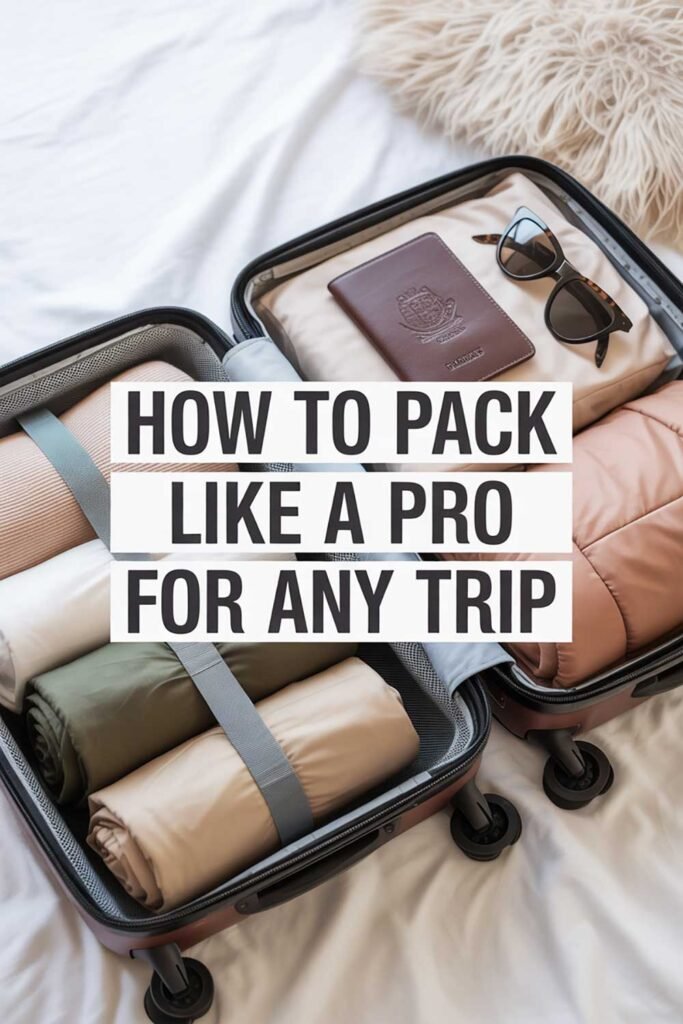
18. Roll soft clothing and stand the rolls upright in the cube like books on a shelf
Rolled soft clothing stood upright in the packing cube — visible from above rather than stacked flat — produces two benefits simultaneously: every item is retrievable with one reach without disturbing anything else, and the cube holds roughly three times the clothing it holds with flat-folded items at the same compression. Roll every soft item. Stand every roll upright. Open the cube to a clear top-down view of every item in it. The morning routine at the accommodation becomes a scan and a reach rather than a rummage.
19. Lay every outfit flat on the bed and confirm it as a complete look before packing any part of it
Top, bottom, shoes, layer, accessories — confirmed together as a working combination before any component goes in the bag. The outfit that works on the bed works at the destination. The outfit assumed to work in the mind occasionally produces the gap discovered in the hotel mirror on the second evening. Lay them out. Confirm every combination. Pack only the confirmed pieces. The items removed by this process are the items that would have traveled the full trip without being worn.
20. Pack by occasion type, not by day count
The trip whose packing is calculated by multiplying outfits per day by the number of days produces a bag whose size is determined by trip length rather than trip content. The trip whose packing is built around distinct confirmed occasions — casual days, one elevated evening, one active day — produces a bag whose size is determined by what the trip actually contains. Count the distinct occasions in the confirmed itinerary. Pack for those. Re-wearing the casual day outfit on Monday, Wednesday, and Friday is not a sacrifice. It is accurate packing for a trip whose casual days require one outfit, not three.
21. Do the final edit and remove three items after packing — before the bag closes
The fully packed bag almost always has three more items than the trip requires — items that made it through every editing pass on the strength of individual plausibility but whose honest final review identifies them as backup maybes dressed as confirmed necessities. Open the packed bag one more time. Remove three items without negotiating with the anxiety that packed them. They will not be missed. They would have come home untouched and confirmed at final checkout as the items that were correctly identified one pass too late. Remove them before the bag closes. The closet is right there and the trip does not need them.
22. Weigh the bag at home before leaving and know the strictest limit on the itinerary
The sixty-second bathroom scale weigh-in before departure is the habit whose entire value is in its timing. At home, the edit is free and the closet is available. At the check-in counter, the edit costs money and happens under the observation of a queue. Check every carrier’s specific limit for every leg of the journey before packing and pack within the most restrictive one. Know the number before the departure morning. The bag weighed at home never produces a surprise at the counter.
23. Keep a pre-packed toiletry kit that is restocked immediately after every trip
The toiletry kit assembled from the bathroom cabinet before each trip takes twenty minutes and forgets something every third departure. The permanent kit — travel-size versions of every daily-use toiletry, always in the bag, restocked the evening of returning home — removes toiletry packing from the pre-trip task list entirely. When the next trip is announced, the kit is already done. The only question is whether the specific destination requires anything additional. That is a one-minute addition rather than a twenty-minute assembly that still somehow misses the specific item.
24. Tuck socks, chargers, and small items into every gap before closing the bag
The packing cubes and the shoes in their bags do not fill the bag’s full three-dimensional volume — there are corners, curves, and side tapers whose contents are determined by what was deliberately placed there or by nothing at all. Rolled socks in the shoe cavities, charging cables in the corner between cubes, the travel adapter in the heel space of the shoe — these placements recover meaningful capacity from the bag’s interior at zero additional weight cost since the items were going in the bag anyway. Fill the gaps. Every cubic centimeter of a carry-on is worth using purposefully.
25. Check accommodation amenities before packing what they already provide
Most hotels provide a hair dryer. Most resorts provide beach towels. Many vacation rentals provide high chairs, cots, and basic toiletries. Two minutes reviewing the accommodation’s listed amenities before packing removes every item the destination already supplies at no cost. The hair dryer alone — if the accommodation provides one and the packed version stays home — removes a meaningful share of the toiletry kit’s weight on any trip where it would otherwise have traveled. Check first. Pack only what the accommodation does not have.
How Kit Stopped Finding Travel Harder Than It Needed to Be
Kit had been traveling for work and pleasure for years and had a specific description of his own travel experience that he gave when people asked: “I’m fine at it, I just find it harder than it looks like it should be.” The flights were manageable. The hotels were generally fine. The packing was always slightly wrong in one or two ways he could not fully diagnose. The whole thing worked, just with more friction than the travelers around him seemed to experience.
The changes happened across three consecutive trips, each one addressing one of the three areas. The first trip introduced the boarding pass screenshot and the liquids bag in the outer pocket. Two things. The security interaction at the first airport with the new setup took fifty-three seconds from bin to belt collection. The previous version had averaged somewhere around three minutes depending on how deeply the laptop was buried. The time saved was modest. The feeling was disproportionately different.
The second trip introduced the hotel room request — high floor, away from the elevator — made at booking rather than at check-in. The room was on the eighth floor at the end of a corridor. Kit slept through the night on the first evening for the first time in four hotel stays. The third trip introduced the packing cubes with permanent category assignments and the final three-item edit. The bag weighed two kilograms less than the same trip the previous year and came home with zero untouched items for the first time he could remember. None of the changes were dramatic. Each one addressed a specific friction point that the previous version of his travel had simply accepted as unavoidable. These thirty-one hacks are the complete version of what Kit built across those three trips. The description he gives now is different: “I actually enjoy it.”
The Habits That Make Every Part of the Trip Easier Over Time
The hacks that change travel the most permanently are not the ones applied once on a single trip. They are the ones that become habits — built into the pre-departure evening, the security lane, the hotel check-in, and the post-trip reset until they stop requiring active thought and start being simply how travel works. These final hacks are the maintenance layer: the practices that keep the flight hacks, the hotel hacks, and the packing hacks running smoothly on every trip after the first one that established them.
26. Notify the bank before every international trip at least twenty-four hours before departure
The card frozen at the first international ATM is the most common and most entirely preventable international travel financial problem. The bank’s fraud detection system flags unfamiliar foreign transactions as suspicious when no travel notification is on file. Five minutes online or by phone — destination countries, travel dates, confirmation that both primary and backup cards are covered — converts the card from a frozen liability at the worst possible moment into a confirmed working tool at every payment terminal and ATM across the trip. Five minutes. Twenty-four hours before departure. Every international trip.
27. Keep the travel wallet organized with assigned slots that never change
The passport in one slot, the boarding pass in one slot, the backup card in one slot, the local currency in one slot — all permanently assigned, never shuffled. The travel wallet opened at any checkpoint produces the right document in one reach because the system knows where it is even when time pressure makes thinking harder. Organize the wallet once. Keep the assignments permanently. The checkpoint that produces the right document in two seconds was organized months ago.
28. Set two alarms for every early departure and confirm both before sleeping
The single alarm that fails is the entire alarm system failing. Two alarms at staggered intervals — or on two separate devices — convert the alarm from a single point of failure into a confirmed safety net. The early departure whose alarms were both set the evening before is the early departure that begins at the planned time. The early departure that relied on the one alarm whose sound setting was accidentally too low is the story that begins with a missed flight.
29. Do a home walkthrough thirty minutes before leaving on every departure day
The charger still in the outlet. The passport on the kitchen counter from the breakfast passport check that was not put back. The medication in the bathroom cabinet rather than the travel wallet. All of these are found by the walkthrough thirty minutes before departure, while the closet is accessible and the solution is available. The specific feeling of leaving the house confident that nothing was forgotten is the direct product of this walkthrough — not luck, not a naturally organized mind, but a three-minute systematic pass through every room before the door closes.
30. Reset the bag within twenty-four hours of returning home
The bag reset the evening of returning home is the habit that makes the next trip’s preparation a twenty-minute confirmation rather than a two-hour rebuild. Laundry out and to the wash. Cubes emptied and returned to position. Toiletry kit restocked. Charger back in the outer pocket. Travel wallet reviewed. Bag closed in its ready state. Fifteen minutes. Done. The next trip announced next week starts from a bag that is already organized rather than from the aftermath of the last one.
31. Update the permanent packing list and the hotel request preferences after every trip
The item that was wished for and not there. The item that came home untouched. The hotel room request that produced the best night’s sleep of the trip and should be made at every booking going forward. These details are most actionable in the twenty-four hours after returning, before the specific feedback fades into the general memory of a good trip. Update the list. Note the room request that worked. Apply both to the next trip’s preparation. The traveler whose system improves after every trip is the traveler whose travel keeps getting easier — not because the airports get better or the hotels get quieter, but because the habits get more accurate every time they are used.
Book A Trip
Book the next trip with a travel agent who handles the flights, the hotels, and every booking in between — so the only thing left is using these hacks to make the experience as smooth as possible.
Book A TripPicture This
The boarding pass was in the camera roll before the departure morning started. The liquids bag was in the outer pocket and the laptop was in its sleeve. The slip-ons came off at security in three seconds and went back on in three. The gate was confirmed before the coffee. The carry-on held a complete change of clothes and every medication in the personal item. The flight had water at every service pass and no alcohol because it was over four hours and the landing mattered.
The hotel room request — high floor, away from the elevator, facing away from the street — was made at booking six weeks before arrival. The room was on the ninth floor at the end of the corridor. The power strip was in the outer pocket and every device charged overnight without any negotiation about which one waited. The packing cubes went into the drawers within ten minutes of check-in. The checkout sweep found the charger in the outlet and the sunscreen on the bathroom shelf. The repack took six minutes.
At home the same evening, the bag was reset, the list was updated with two changes, and the hotel room request was noted permanently. The next trip, announced ten days later, took twenty minutes to prepare. That is thirty-one hacks working as a single system across every part of the trip. That is travel that looks easy because it was built that way — habit by habit, trip by trip, until none of it felt hard anymore.
Before the Next Trip: Grab the Free Packing Checklist
Our free Travel Packing Checklist covers every packing category, every pre-departure confirmation, and every final check that makes the bag right before it closes — the foundation of the packing system these hacks describe. Download it and use it before the next trip.
Get the Free ChecklistExplore Our Top Picks for a Better Trip
After years of flights, hotels, and packed bags across destinations around the world, these are the booking platforms and travel services we personally rely on — tested, trusted, and recommended because they have made our own trips consistently better.
See Our Top PicksTravel Printables at Premier Print Works
Visit Premier Print Works for packing checklists, trip planners, hotel stay guides, and travel organization printables that make every flight easier, every hotel stay better organized, and every bag lighter than the one before it.
Visit Premier Print WorksBecome An Agent
Love helping travelers make every flight, every hotel, and every packed bag work better? See how to turn that into a home-based travel business.
Become An AgentDisclaimer
The information shared in this article is provided by Don and Diana’s Travels for general informational, educational, and inspirational purposes only. It reflects our personal experiences, opinions, and the experiences of travelers we have worked with. It is not professional travel, legal, medical, or financial advice.
Airline check-in policies, baggage allowances, security procedures, and TSA PreCheck and Global Entry program details vary by carrier, airport, and country and are subject to change without notice. Always confirm current requirements with your specific airline and the relevant authorities before traveling. Hotel amenities, room request policies, and mobile check-in availability vary by property. Always confirm directly with the accommodation. We are not responsible for any fees, outcomes, or experiences arising from reliance on information in this article.
This article may contain affiliate and partner links that pay us a commission at no extra cost to you. Our recommendations are based on real use and genuine belief in the products and services we share. Stories on this site combine real experiences from Don, Diana, clients, and travelers we have worked with. Details may be adjusted for privacy and narrative clarity. All content is the copyrighted property of Don and Diana’s Travels. You may not copy or republish our content without prior written permission. By reading this article you acknowledge that you have read and agree to this disclaimer.