25 Packing Tips for Travelers Who Want to Pack Smarter
Packing smarter is not about packing less for the sake of it. It is about arriving at every destination with exactly what the trip requires — no more, no less — in a bag that is organized enough to be navigated quickly, light enough to move freely, and built from habits reliable enough that the same result is produced on every trip without starting from scratch each time. The difference between the traveler who packs well consistently and the one who packs well occasionally is almost always a system rather than a talent.
These twenty-five tips build that system from the ground up. They cover how to decide what to pack before the bag opens, how to pack it once the decisions are made, and how to maintain the system across trips so it keeps improving rather than resetting. Whether the next trip is three days or three weeks, these are the habits that make the bag right before it closes.
Free Download: Our Travel Packing Checklist
The smarter packing system starts with a reliable checklist. Ours covers every category, every pre-departure confirmation, and every final check that makes the difference between a bag that was packed well and a bag that was packed right. Download it free and use it before the next trip.
Get the Free ChecklistSmarter Decisions Before the Bag Opens
The most impactful packing improvements happen before a single item is selected. The framework used to decide what goes in the bag determines the bag’s weight, its utility, and how much of its contents actually gets used at the destination. These tips replace the anxiety-driven coverage approach — “what might I need?” — with a confirmation-based approach — “what will I actually use?” — and the bag that results is consistently lighter, more functional, and more accurate to the trip’s real requirements.
1. Build a permanent packing list and update it after every trip
The packing list built from memory before each trip rediscovers the same items every time, occasionally forgets the one it missed before, and reflects what seemed reasonable rather than what the previous trip confirmed was necessary. A permanent list — built once, updated after every trip with honest feedback about what was used and what was not — is the starting point that makes every subsequent pack faster and more accurate. The item wished for at the destination gets added. The item that came home untouched for the third time gets removed. After five or six trips the list is a near-perfect reflection of what the traveler actually needs rather than what they imagine they might.
2. Start packing two days before departure — not the evening before
The packing session two days before departure has the calm required for honest editing, the time to notice the over-duplicate, and — crucially — the twenty-four-hour gap that produces the subconscious realization of the forgotten item while the closet is still accessible. The packing session the evening before departure has none of these advantages. It happens under time pressure and departure anxiety, and every “maybe I should bring this” becomes a yes rather than a considered decision. Start two days early. Use the gap. Close the bag with the confidence of a decision made without urgency.
3. Read the confirmed itinerary before selecting a single item
The itinerary is the accurate version of the trip. The imagination is the expanded version. Packing from the itinerary — the specific confirmed activities, occasions, and environments — produces the bag built for the trip that was booked. Packing from the imagination produces the bag built for the most eventful possible version of the trip, which almost never materializes. Open the itinerary before opening the wardrobe. Every item selected from a confirmed itinerary context earns its space. Every item selected from an imagined context is a candidate for the final edit.
4. Choose the bag before selecting any item — and choose the smallest one the trip can fit
The large suitcase selected before a single item is chosen is the permission slip for every item the trip might need. The carry-on or compact duffel selected first is the constraint that does the editing work that the packing list sometimes cannot finish. The bag is not the container for what was going to be packed anyway. It is the limit that makes the right packing decision automatic. Choose the smallest bag that can genuinely serve the trip’s confirmed requirements. Let the bag’s finite volume be the system’s most reliable filter.
5. Lay every intended item out on the bed before packing anything
The physical pile on the bed is the honest version of the packing intention — and it is almost always larger than expected. Items that seemed like reasonable individual additions in the mental packing list look different as part of the physical reality of everything going in the bag at once. The over-duplicate, the single-partner piece, and the backup maybe whose scenario has never materialized across the last four trips are all identifiable in the pile before they occupy space in the bag. Review the pile honestly before packing anything. The items removed from the pile at this stage cost nothing to remove. The same items removed at the destination checkout are the regret that traveled the full trip first.
“Packing smarter is not a talent. It is a set of questions asked in the right order, with honest answers, before the bag closes.”
Smarter Clothing Selection
Clothing accounts for the majority of overpacking in the majority of bags, and the clothing selection system is the single highest-leverage area for packing improvement. The travelers who consistently arrive at destinations with the right clothes in the lightest possible bag are not more disciplined than anyone else. They use a specific method that makes the right outcome automatic rather than effortful. These tips build that method.
6. Build every travel wardrobe around two or three base colors
Two or three colors whose every combination works — navy, white, and tan; black, cream, and olive — produce a wardrobe where every top pairs with every bottom, every layer works across every outfit, and every accessory complements everything in the bag. The coherent palette multiplies the outfit combinations from the items packed rather than fixing them at one per piece. Choose the palette before selecting any specific item. Every piece selected from within it earns its weight through the combinations it enables. Every piece outside it reduces the wardrobe’s flexibility even as it adds to its volume.
7. Pack by occasion type, not by day count
A ten-day trip with three distinct occasion types — casual exploration, one elevated dinner, one active day — requires three outfits, not ten. The same casual outfit worn on multiple days is not a compromise. It is accurate packing for a trip whose casual days genuinely require one outfit regardless of how many there are. Count the confirmed distinct occasions in the itinerary. Pack for those. The day count is not the packing unit. The occasion type is.
8. Lay every outfit flat and confirm it as a complete look before packing any part of it
Top, bottom, shoes, layer, accessories — confirmed together as a working combination before any component goes in the bag. This process reveals the top whose shade does not work with the trousers it was paired with in the mind, the dress that requires the shoes already identified as the third pair beyond the limit, and the blazer whose only confirmed partner was removed from the pile earlier in the edit. The outfit confirmed on the bed works at the destination. The outfit assumed in the mind produces the gap discovered in the hotel mirror on the second evening.
9. Apply the two-partner rule to every item before it stays in the bag
Every item going in the bag must pair with at least two other items already confirmed to be going in the bag. One partner earns one wear. Two partners earn two wears from the same space and weight. The item with no confirmed second partner is the item to reconsider before the bag closes. The item with three partners is the item that justified its space three times across the trip. Run this check for every clothing item before the final edit. The items that fail it are the ones to remove. The items that pass it are the ones doing the work the bag needs them to do.
10. Grant yourself explicit permission to re-wear before you start packing
The mental permission to re-wear is not given by default. The default assumption — for most people, in most packing sessions — is that a fresh outfit per day is the minimum. It is not. The jeans worn on days two, four, and six represent three fewer items in the bag with zero impact on the trip’s experience. The social accounting that drives the fresh-outfit-per-day calculation assumes an audience tracking the rotation that does not exist. Grant the permission before selecting the first item. It removes the baseline assumption that has been adding unnecessary weight to every bag that has ever been packed without it.
11. Pack one versatile piece that works across at least three distinct occasions
The linen shirt dress that works over a swimsuit at the beach, as a casual lunch outfit with sandals, and as an evening look with the right accessories. The tailored blazer that works as a layer over a casual outfit, as business-appropriate outerwear, and as an elevated piece for the one dinner that warrants it. One genuinely versatile piece replaces what its absence would require as three separate items. Identify this piece in the wardrobe before selecting anything else. Everything else is built around it and in conversation with it. The bag built around one genuinely versatile piece is always smaller than the bag that was not.
Plan Our Escape
A confirmed itinerary is the smarter packer’s most useful tool. Let us plan the trip so every packing decision has a specific occasion to answer to.
Plan Our EscapeSmarter Physical Packing
Once the right items are selected, the physical packing techniques determine how much space they take, how accessible they are throughout the trip, and how organized the bag stays from the first morning to the last checkout. These tips are the structural decisions that turn a good selection into a well-packed bag.
12. Use packing cubes with one permanent category assigned to each
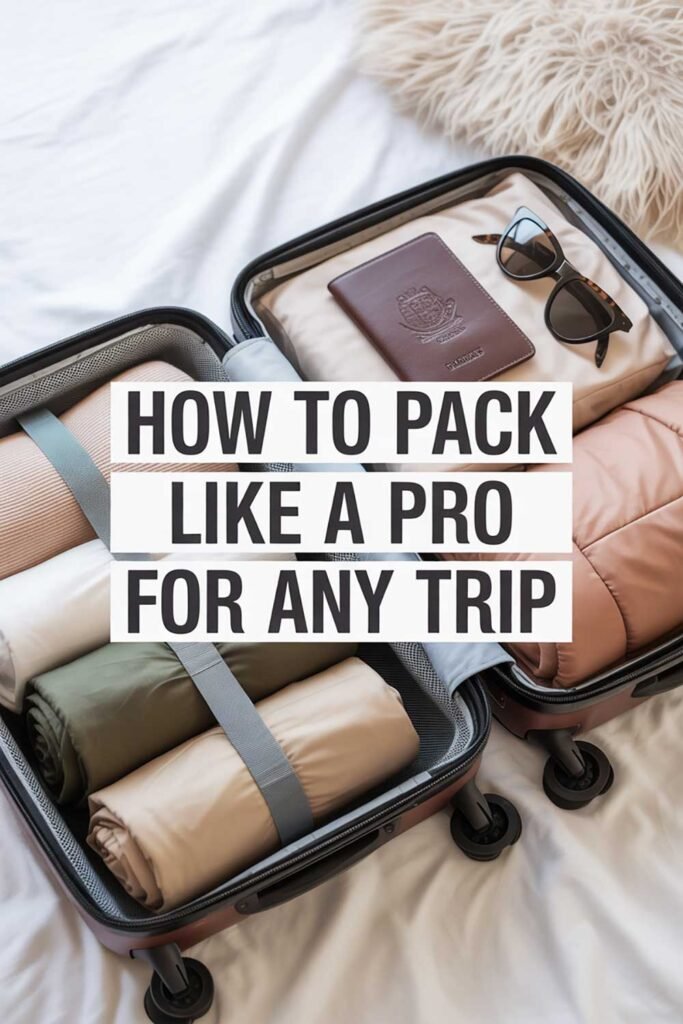
Packing cubes without category assignments are containers. Packing cubes with permanent category assignments — tops always in the blue cube, bottoms always in the grey cube, underwear always in the small red cube — are a system whose predictability is the organizing principle of the bag. The system does not change between trips. The specific items in each cube change. The cube opened to find a top is always the same cube. After three or four trips the assignment is automatic and the label is a confirmation rather than a direction. The organized bag that stays organized throughout the trip was organized by a system, not by effort applied daily.
13. Roll soft clothing and stand the rolls upright in the cube
Rolled soft clothing stood upright in the packing cube — visible from above like books on a shelf — produces two results simultaneously: the cube holds roughly three times the clothing it holds with flat-folded items at the same compression, and every item is retrievable with one reach without disturbing anything else. Roll every soft item. Stand every roll upright. Open the cube to a clear top-down view of every item in it. The morning routine becomes a scan and a reach rather than a rummage through a compressed stack whose bottom layer requires unpacking the top to access.
14. Pack the heaviest items at the wheel end for a balanced, easy-rolling bag
Heavy items at the top of a rolling bag produce a bag that tips, strains, and handles poorly through every terminal and hotel corridor. The same items — shoes, the toiletry kit, electronics — packed at the wheel end produce a bag that rolls upright, balances naturally on the handle, and maneuvers through every surface with the physical ease that the correctly weighted bag provides and the incorrectly weighted one never does regardless of its quality. Pack heavy first at the base near the wheels. Build everything lighter above it. The bag that handles well was organized from the bottom up.
15. Fill every gap, corner, and curve before closing the bag
The packing cubes and the shoes do not fill the bag’s full three-dimensional volume. There are corners at the frame, curves at the base, and side tapers between cubes whose contents are determined by what was deliberately placed there or by nothing. Rolled socks in the shoe cavities, the charging cable coiled in the corner between cubes, the travel adapter in the heel space of the shoe — these placements recover meaningful capacity from the bag’s interior at zero additional weight cost since the items were going in anyway. Fill the gaps deliberately. Every cubic centimeter of a carry-on was paid for in baggage allowance and weight limit. Use it purposefully.
16. Keep the lid pocket or top exterior pocket reserved for arrival-day essentials
The lid pocket is the most accessible position in the bag at every arrival and should hold the items needed first: the phone charger, the sleep clothes for the arrival night, the toiletry kit for the first morning, the accommodation booking reference. Packed deliberately with the arrival in mind — last in, first out — the lid pocket converts the first five minutes at the accommodation from a full-bag excavation into a single-layer retrieval. The bag that produces what is needed immediately is the bag whose lid pocket was organized for the arrival rather than used as a catch-all for items without another designated position.
17. Photograph the packed bag before closing it
The photograph before departure is the visual inventory for any lost bag claim and the post-trip comparison that produces the packing list’s most useful updates. The photograph taken with the bag open and organized — every cube visible, every position confirmed — is the record of what went in. The honest count of what came home untouched at the final checkout is the record of what did not need to. The gap between the two produces the specific, actionable packing list updates that improve the next trip rather than the same approximate adjustments made from a faded general memory months later.
How Paz Finally Built a Packing System That Worked Every Time
Paz had been what she called a “hit or miss” packer — some trips felt right from the first morning and some felt like an ongoing negotiation with a bag that had been packed for a different trip. The misses were not disasters. The clothes were there. The toiletries were there. But something was always slightly off: an outfit combination that had seemed obvious at home that did not work in the hotel mirror, a third pair of shoes that occupied a third of the bag’s volume and was worn once, a toiletry kit whose contents were distributed across two different pouches whose specific separation she could never fully remember the logic of.
The change came from doing two things in a different order. She had always selected clothing first and checked the itinerary afterward to see if what she had chosen worked. She reversed it. The itinerary first, the wardrobe second. The confirmed itinerary for a ten-day trip — four casual city days, three beach days, two active days, one elevated dinner — required four distinct outfits, not ten. Everything selected from that context had a confirmed purpose. Everything that did not have a confirmed purpose in those nine occasion slots was a candidate for removal before the first item went in the bag.
The second change was the partner check, applied honestly for the first time. The embroidered blouse that had been in the bag on the last four trips — always packed, never paired with more than one other item, always returned home folded exactly as it was packed — did not pass the two-partner check and was removed from the bag for the first time. The bag weighed less. The trip had the same wardrobe range. The blouse was still at home where it had always been most useful. These twenty-five tips are the system built from the order those two changes established. The packing session that used to take ninety minutes of negotiation now takes thirty of confirmation.
Smarter Toiletries and Supporting Categories
For many travelers, the clothing selection is reasonably managed and the excess lives in the supporting categories — the toiletry bag whose bottles are filled to capacity rather than trip-length, the shoe collection that grew by one pair too many, the full-size backup products whose travel-size versions were already packed. These tips address the categories whose weight and volume contribution is often larger than expected and whose solutions are often simpler than the problem suggests.
18. Fill toiletry bottles to trip-length amounts — not to the bottle’s capacity
A sixty-milliliter travel bottle filled to capacity for a five-day trip carries forty milliliters of unnecessary weight. Filled to twenty-five milliliters — the accurate daily-use amount for five days — it carries exactly what the trip requires. Fill every bottle to the trip-length amount before every departure. The toiletry kit whose bottles are all filled accurately is lighter than the alternative by a meaningful total and requires no calculation at the destination about whether enough of anything remains for the last two days.
19. Swap liquid shampoo and conditioner for solid bars on trips where bag weight matters
Solid shampoo and conditioner bars are not subject to the liquids rule, do not occupy quart-bag space, weigh less than the travel bottles they replace, and function equivalently for most hair types in most water conditions. The switch recovers most of the quart bag’s limited volume for the liquids with no solid equivalent and removes the heaviest items in the typical toiletry kit from the weight calculation. Try the switch before a trip where bag weight is a constraint. The quart bag recovered is available for what genuinely needs it.
20. Check accommodation amenities before packing what they provide
Two minutes checking the accommodation’s listed amenities before packing removes every item the destination already provides. The hair dryer, the shampoo, the body wash, the iron — most hotels and many vacation rentals supply these at no cost to the guest. For the traveler whose bag weight is consistently close to the airline’s limit, the accommodation items removed from the kit are frequently the margin between a bag within limits and a bag that requires reorganization at the check-in counter. Check first. Pack only what the accommodation does not have.
21. Limit shoes to two pairs and choose both for comfort and style
Shoes are the heaviest, least compressible, most space-inefficient category in any bag. Two pairs — one worn on travel day, one in the bag — is the number that keeps the bag manageable for most trips. Both pairs should be chosen so that comfort and style coexist in the same shoe: comfortable enough for a full day of walking, styled enough for the evening. The third pair requires a specific confirmed occasion that the first two genuinely cannot cover before its weight and volume earn a place in the bag. Most trips do not produce that occasion.
22. Leave a deliberate gap for what you buy at the destination
Pack to approximately seventy-five percent of the bag’s capacity on the outbound journey. The remaining twenty-five percent is not empty space — it is the return margin that accommodates the purchase at the destination market, the product found locally that was better and cheaper than the home-city version, the small find that becomes the trip’s most remembered item. The bag packed to absolute capacity on the outbound has no answer for any of these. The bag packed with a deliberate gap arrives home with the find already inside it and the zip closed without difficulty.
DND Resources
Our travel resources page has trusted tools and official sources for destination planning, airline policies, and every practical stage of the trip.
DND ResourcesSmarter Habits After the Trip
The packing system that improves trip after trip is maintained by what happens in the twenty-four hours after returning home, not by effort applied at each new departure. The post-trip reset and the honest feedback applied to the permanent list are the two habits that convert a single smart pack into a consistently smart packing system. These tips are the maintenance layer that makes the whole system compound over time.
23. Count the untouched items at checkout and remove them from the permanent list
The items packed and never opened across a trip are the items whose presence on the packing list is wrong. Count them specifically at every checkout — not “over-packed clothes” but “the grey cardigan,” “the third pair of shoes,” “the full-size backup moisturizer.” Remove them from the permanent list before leaving the accommodation. The list updated from the honest feedback of the items sitting untouched at checkout is the list that produces a lighter bag on the next trip without requiring the same editing effort to arrive at the same conclusion a second time.
24. Reset the bag and restock the toiletry kit within twenty-four hours of returning
The laundry out and to the wash. The cubes emptied and returned to their positions. The toiletry kit restocked with whatever ran low. The charger back in its outer pocket. The bag closed in its ready state. Fifteen minutes. Done. The bag reset the same evening of returning home is the bag ready for the trip announced the following week without a preparation session that has to rebuild what the last trip dismantled. The traveler whose bag is always reset is the traveler whose next trip starts from the right place — which is the place where the system already exists rather than the place where it has to be rebuilt.
25. Trust the system over the anxiety — the bag is right when the system says it is
The packing anxiety that suggests one more item is needed does not disappear after the first smart-pack trip. It is present at the next departure and the one after, suggesting that the system is insufficient and the coverage approach is safer. Trust the system over the anxiety every time. The anxiety is not information about what the trip requires. It is the habitual response to the uncertainty of travel — present before every departure regardless of how well the bag was packed. The system is the answer to the question the anxiety is asking. The bag confirmed by the system is the bag that is right. Close it. The trip is ready.
Book A Trip
Book the next trip with a confirmed itinerary — the smarter packer’s most useful starting point. Our travel agents plan the whole thing so every packing decision has a specific occasion to answer to.
Book A TripPicture This
The itinerary was open before the wardrobe was. The confirmed occasions — four casual days, two active days, one elevated dinner — produced a clothing selection of six items rather than the fourteen that the ten-day trip length would have suggested. Every outfit confirmed flat on the bed. Every item confirmed with at least two partners. Re-wearing explicitly permitted and applied across the casual days. The bag chosen before the first item was selected — a carry-on — closed on the first attempt with room to spare.
At the destination, everything in the bag had a reason to be there. The morning routine was a top-down scan and one reach. The mid-trip repack at the hotel on day four was a five-minute confirmation rather than a full sort. The checkout untouched item count was one — the grey cardigan packed for the cool evening that never arrived — noted and removed from the permanent list before the taxi. The bag reset happened the evening of returning home. The next trip’s packing session, announced ten days later, took twenty-five minutes.
That is twenty-five tips working as a system. That is packing smarter — not once, but every time, because the system that produces it is built to improve rather than repeat.
Before the Next Trip: Grab the Free Packing Checklist
Our free Travel Packing Checklist is the permanent starting point that replaces the rebuilding-from-scratch packing session with a confirmed system. Every category, every pre-departure step, every final check. Download it and use it before the next trip.
Get the Free ChecklistExplore Our Top Picks for a Better Trip
After years of smarter packing and travel together, these are the booking platforms and travel services we personally rely on — tested, trusted, and recommended because they have consistently made our own trips better.
See Our Top PicksTravel Printables at Premier Print Works
Visit Premier Print Works for packing checklists, outfit planners, capsule wardrobe builders, and travel organization printables that make every packing session faster, lighter, and more accurate than the one before it.
Visit Premier Print WorksBecome An Agent
Love helping travelers pack smarter and experience better trips? See how to turn that passion into a home-based travel business.
Become An AgentDisclaimer
The information shared in this article is provided by Don and Diana’s Travels for general informational, educational, and inspirational purposes only. It reflects our personal experiences, opinions, and the experiences of travelers we have worked with. It is not professional travel, legal, or financial advice.
Airline baggage allowances, carry-on restrictions, weight limits, and liquids rules vary by carrier and are subject to change without notice. Always confirm current requirements with your specific airline before traveling. Accommodation amenities vary by property. We are not responsible for any fees or outcomes arising from reliance on packing or travel information in this article.
This article may contain affiliate and partner links that pay us a commission at no extra cost to you. Our recommendations are based on real use and genuine belief in the products and services we share. Stories on this site combine real experiences from Don, Diana, clients, and travelers we have worked with. Details may be adjusted for privacy and narrative clarity. All content is the copyrighted property of Don and Diana’s Travels. You may not copy or republish our content without prior written permission. By reading this article you acknowledge that you have read and agree to this disclaimer.