27 Vacation Packing Tips Every Overpacker Needs to Read
Overpacking is not a character flaw. It is a system problem. The traveler who arrives home from a ten-day trip with half the bag untouched did not pack that way because they lack discipline or self-awareness. They packed that way because nobody ever gave them a method that replaced the anxiety-driven “what if I need this” decision-making with something more reliable. Every extra item in an overpacker’s bag got there the same way: it felt reasonable at the time and unnecessary at the destination.
These twenty-seven tips are the system that replaces the anxiety with a structure. Not rules that make packing feel restrictive, but habits that make packing feel finished — the specific satisfaction of a bag that closes on the first attempt, weighs what it was supposed to weigh, and contains exactly what the trip required. Nothing more. Nothing less. If you have ever stood at a baggage carousel watching a suitcase that you packed and immediately regretted, these tips are for you.
Free Download: Our Travel Packing Checklist
The packing checklist is the overpacker’s single most useful tool — a permanent, trusted starting point that replaces the open-ended “what should I bring?” session with a confirmed list of what the trip actually needs. Download ours free and use it before the next trip.
Get the Free ChecklistUnderstanding Why You Overpack — And What to Do Instead
Before any packing technique can work consistently, the overpacker needs to understand the specific mechanics of how an overpacked bag happens. It almost never happens because too many items were deliberately chosen. It happens because the decision framework used at packing time is optimized for coverage rather than accuracy — for answering “what might I need?” rather than “what will I actually use?” Changing the framework changes the outcome before a single item is selected.
1. Identify your specific overpacking trigger
Most overpackers have one consistent trigger that accounts for the majority of the excess: the clothing overpacker who brings an outfit for every possible social scenario, the toiletry overpacker whose full-size products add two kilograms to every bag, the shoe overpacker whose footwear collection requires its own bag. Identifying the specific category that drives the overpacking is the first step toward addressing it precisely rather than applying general restraint across everything equally. Look at what came home untouched on the last three trips. The category that keeps appearing is the trigger.
2. Replace “what might I need?” with “what will I actually use?”
The question “what might I need?” has no correct answer because it includes every possible scenario the destination could produce — including the ones that will not materialize. The question “what will I actually use?” has a much smaller, more accurate answer because it is anchored to the confirmed itinerary rather than the imagined one. Before any item goes in the bag, ask the second question. If the honest answer involves any version of “probably not” or “just in case,” the item stays home unless a specific confirmed occasion requires it.
3. Lay everything out before packing and look at the pile honestly
The physical pile on the bed is the honest version of the packing intention — and it is almost always larger than expected. Items that seemed like reasonable individual additions to the mental packing list look different as part of the physical reality of what is going in the bag. The over-duplicate, the item with no outfit partner, and the just-in-case item whose scenario is genuinely hypothetical are all identifiable in the pile before they occupy space in the bag. The pile reviewed before packing produces the bag that closes without sitting on it. The pile skipped produces the opposite.
4. Start packing two days before departure — not the night before
The packing session the night before departure happens under time pressure, departure anxiety, and the specific mental state that converts every “maybe I should bring this” into a yes. The packing session two days before departure happens with the calm that allows honest editing, the time to notice the over-duplicate, and the twenty-four hours to discover the item that was forgotten and add it without drama. The best packing edit happens in the hours after the initial pack, when distance from the first session makes the unnecessary items visible. That distance only exists if the first session happened early enough to allow it.
5. Choose the bag before you start packing — and choose the smallest one that can serve the trip
The large suitcase pulled out before a single item is selected is the permission slip for everything the trip might need. The carry-on or compact duffel selected first is the constraint that does the editing work the packing list sometimes cannot. The bag is not the container for what was going to be packed anyway. It is the limit that makes the packing decision for you. Choose the smallest bag the trip can genuinely fit and let the bag’s finite volume be the system’s most reliable filter.
“The overpacker’s bag is not full of bad decisions. It is full of good decisions made with the wrong question. Change the question and the bag changes with it.”
The Clothing System That Ends Overpacking
Clothing is the category responsible for the majority of overpacking in the majority of bags. It is also the category whose excess is most addressable with a specific, repeatable system. The travelers who consistently pack light and look good doing it are not the ones with a special talent for restraint — they are the ones who built a clothing selection method that does the editing automatically rather than relying on willpower at packing time.
6. Build every travel wardrobe around two or three base colors
Two or three colors whose every combination works — navy, white, and tan; black, cream, and olive — produce a wardrobe where every top pairs with every bottom, every layer works across every outfit, and every accessory complements everything in the bag. This coherent palette multiplies the outfit combinations from the items packed rather than fixing them at one per piece. Ten items in a coordinated palette produce more distinct looks than fifteen items in uncoordinated colors, at two-thirds of the weight. Choose the palette before selecting any specific item. Every selection from within it earns its space through the combinations it enables.
7. Pack by occasion type, not by day count
Packing one outfit per calendar day is the calculation that produces the bag whose size is determined by trip length rather than trip content. A ten-day trip with three distinct occasion types — casual exploration, one elevated dinner, one active day — requires three outfits, not ten. The same outfit worn on Monday, Wednesday, and Friday for casual days is not a sacrifice. It is accurate packing for what the trip actually contains. Count the distinct occasions in the confirmed itinerary. Pack for those. Let the days fall where they may.
8. Lay every outfit flat on the bed and confirm it as a complete look before it earns a place in the bag
Top, bottom, shoes, layer, accessories: confirmed together as a working combination before any component is packed. This process reveals the top whose shade does not work with the trousers it was intended for, the dress that requires the shoes already identified as the third pair beyond the limit, and the blazer whose only confirmed partner has already been removed from the pile for having no outfit matches of its own. The outfits confirmed on the bed arrive at the destination. The outfits assumed in the mind arrive with gaps that appear in the hotel mirror on the second evening.
9. Every piece must work with at least two other pieces in the bag — remove anything with only one partner
A piece with one partner earns its weight once. A piece with three partners earns it three times. The single-partner piece is the clearest indicator of an item that does not belong in this specific bag. Before the bag closes, run the partner check for every item. The ankle boot that works with the jeans, the midi skirt, and the tailored trousers earns its space every day of the trip. The embroidered blouse that works only with the specific olive trousers it was bought to match is the item that will be carried for every day and worn for one. Remove it. The wardrobe that remains after the partner check is genuinely working.
10. Plan to re-wear — and give yourself explicit permission before you pack
The social accounting that produces a fresh outfit for every day of the trip assumes an audience tracking the daily rotation that does not exist. Nobody at the café on Thursday was at the same café on Monday noting which trousers were worn. The jeans re-worn on days three, five, and seven represent three fewer items in the bag and a meaningfully lighter travel day across every transit. Grant the permission before packing. It removes the last barrier between the overpacker and the lighter bag — not a technique, not a system, but a decision made in advance that the packing session does not have to revisit.
11. Apply the “three times rule” to every item before it earns a place in the bag
If an item cannot be worn at least three times during the trip in three distinct contexts or outfit combinations, it does not earn its space in the bag. A white linen shirt worn on the beach in the morning, as a casual lunch layer, and with tailored trousers for the evening earns three wears in three contexts. A sequined evening top worn once for one confirmed occasion does not earn three wears unless the trip holds three confirmed occasions that require it. Apply the rule honestly. The items that pass it are the ones that justify their weight across the trip’s duration.
Plan Our Escape
The trip planned with a confirmed itinerary is the trip that gets packed accurately. Let us build the itinerary so every packing decision has a specific occasion to answer to.
Plan Our EscapeThe Practical Packing Techniques That Cut the Bulk
Once the clothing selection system is in place, the physical packing techniques are what convert the right items into the smallest possible bag. These are not clever tricks — they are structural decisions about where things go and how they are placed that recover meaningful space and weight from a bag that already contains only what the trip needs.
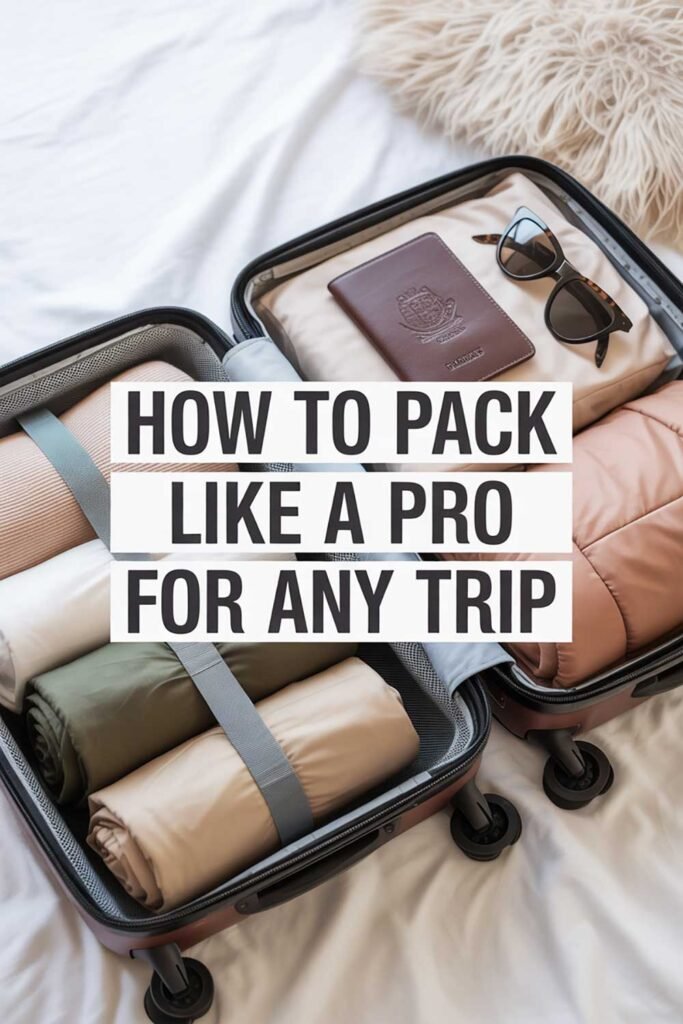
12. Roll soft items into tight cylinders and stand them upright in packing cubes
A rolled t-shirt occupies roughly one-third of the space of the same shirt folded flat. Stood upright in the packing cube rather than stacked flat, it is also visible from above without disturbing anything else in the cube — every item retrievable with one reach rather than a rummage through a compressed stack. Roll every soft item. Lay structured garments flat in a dry cleaning bag at the top layer. The rolled bag holds more, stays organized longer, and requires no compression assistance to close.
13. Use packing cubes with assigned categories and stick to the assignments every trip
Packing cubes without category assignments are organizational containers. Packing cubes with permanent category assignments are an organizational system. The tops cube is always tops. The bottoms cube is always bottoms. The assignment does not change between trips. After three or four trips the cube is opened without reading the label because the category memory is already established. The consistency of the assignment is the habit that produces the organized bag that stays organized throughout the trip rather than requiring periodic intervention to maintain its structure.
14. Wear the heaviest and bulkiest items on the travel day
Every item worn on the body on travel day is an item not contributing to the bag’s weight or volume. The heaviest shoes, the thickest jacket, and any bulky accessories worn through the airport cost nothing to the bag’s weight while covering the travel day’s outfit requirement. This habit is the most consistently effective single space and weight recovery available to any packer at any trip length. Wear the heavy. Pack the light. The bag that boards within its limits often achieves that margin here.
15. Tuck socks and small items inside shoes before they go in the bag
Every shoe in the bag occupies space regardless of whether its interior is used. Rolling socks into cylinders and tucking them inside the shoe — alongside a small adapter, a folded belt, or a compact accessories pouch — converts dead interior volume into functional storage. The space recovered by consistently filling shoes before placing them in the bag is recovered at zero additional weight cost since the tucked items were going in the bag anyway. Every shoe packed without socks inside it is space that was paid for and contributed nothing.
16. Limit shoes to two pairs and wear the heavier pair on travel day
Shoes are the heaviest, least compressible, most space-inefficient category in any bag. Two pairs — one worn on travel day, one in the bag — is the limit that keeps the bag manageable for most trips. The two pairs chosen should cover every confirmed occasion without a third: the daily walking shoe comfortable enough for a full day and styled enough for the evening, and one alternative for any occasion the first cannot cover. Every additional pair requires a specific confirmed occasion that the first two cannot serve before its weight and space earn a place in the bag.
17. Do a final edit after packing and remove three items before closing the bag
The fully packed bag almost always has three more items than the trip requires — items that made it through every editing pass on the strength of individual plausibility but that the final honest review identifies as the backup maybe dressed as a confirmed necessity. Open the packed bag one more time and remove three items without negotiating with the anxiety that packed them. They will not be missed. They would have traveled the full trip, arrived home untouched, and confirmed at final checkout as the items that were correctly identified one editing pass too late. Remove them before the bag closes. The closet is right there.
18. Weigh the bag at home before leaving — and know the strictest limit on the itinerary
The bathroom scale weigh-in — step on holding the bag, subtract personal weight, compare to the airline’s limit — is the sixty-second habit whose entire value is in its timing. At home, the closet is available and the edit is free. At the check-in counter, the edit is expensive, public, and time-pressured. Check every carrier’s limit on every leg of the journey before packing and pack within the most restrictive one. The bag weighed at home never produces a surprise at the counter.
DND Resources
Our travel resources page has trusted tools and official sources for every stage of trip planning — including airline baggage policies and destination-specific preparation.
DND ResourcesToiletries, Shoes, and the Categories That Add Weight Fast
For many overpackers, the clothing system is already reasonably managed — it is the supporting categories that account for the excess. The toiletry bag whose bottles are filled to capacity rather than trip-length. The shoes packed three deep for a five-day trip. The full-size backup of every product already packed in travel size. These categories have specific, simple solutions whose combined effect on bag weight is often larger than any single clothing decision.
19. Fill toiletry bottles to trip-length amounts — not to the bottle’s capacity
A toiletry bottle filled to its sixty-milliliter capacity for a five-day trip carries forty milliliters of unnecessary weight. A bottle filled to twenty-five milliliters — the accurate daily-use amount multiplied by five days — carries exactly what the trip requires. Fill every reusable bottle to the trip-length amount before every departure. The toiletry bag whose bottles are all filled accurately is lighter than the alternative by a meaningful percentage of the kit’s total weight, multiplied across six or eight bottles.
20. Swap liquid shampoo and conditioner for solid bars
Solid shampoo and conditioner bars are not liquids, do not occupy quart-bag space, weigh less than the travel bottles they replace, and work equivalently for most hair types. The switch recovers two-thirds of the quart bag’s limited volume for the liquids with no solid alternative and removes the heaviest items in the typical toiletry kit from the liquids calculation entirely. Make the switch before the next trip. The quart bag recovered is available for what genuinely needs it.
21. Check accommodation amenities before packing what they provide
The hair dryer, the shampoo, the conditioner, the body wash, the iron — most hotels and many vacation rentals provide these items. Two minutes checking the accommodation’s listed amenities before packing removes every item the destination supplies at no cost. For the overpacker whose toiletry excess is the main driver of bag weight, the accommodation items removed from the kit are frequently the margin between a bag within the airline’s limit and a bag that requires a checked bag fee.
22. Never pack a full-size backup of anything already packed in travel size
The full-size backup packed alongside the travel-size primary is the toiletry category’s version of the backup maybe — carried for the full trip against the possibility that the travel size runs out, which it almost never does when the fill amount was calculated correctly. Pack the travel-size version filled to the trip-length amount. Leave the full-size backup at home. If the calculation turns out to be insufficient, the destination has pharmacies. The destination’s pharmacy is always cheaper than the overweight bag fee for the backup that traveled unused.
23. The destination has stores — almost everything genuinely forgotten can be replaced locally
The just-in-case item packed against the possibility of forgetting the primary is available at a pharmacy, a supermarket, or a convenience store within walking distance of most accommodations at most destinations. The over-the-counter medication, the sunscreen in a slightly different brand, the specific product that ran out faster than expected — none of these require being packed from home in backup quantities. Pack the essentials, the irreplaceables, and the items whose specific local availability at the destination is genuinely uncertain. Leave the coverage items for the destination’s shops. They are there.
How Rue Went from Two Checked Bags to One Carry-On
Rue had packed two checked bags for every trip longer than four days for as long as she had been traveling. Not because she needed two bags — the post-trip audit always confirmed that roughly a third of what she packed came home untouched — but because the packing session had always been organized around coverage rather than accuracy, and coverage for ten days felt like it required two bags. The system produced the bags. The system needed to change.
The first change was the question. She had always packed by asking what she might need. She started packing by asking what she would actually use, anchored to the specific confirmed itinerary rather than the imagined version of the trip. The difference was immediate: three items removed in the first session from the question change alone, including the formal blazer for the “nice dinner” that did not appear on the confirmed itinerary anywhere.
The second change was the partner check. Every item confirmed against at least two others in the bag before it was allowed to stay. The embroidered top with one matching bottom was the first casualty. The specific shoes that worked with only the formal blazer that had already been removed were the second. The third change was the final edit — three items removed after the bag was packed, without negotiation, before it was closed. The three items removed in the final edit were invariably the ones she had felt uncertain about during the initial pack and had talked herself into anyway.
The first trip with the new system produced one carry-on. It felt wrong at the airport — the specific anxiety of traveling lighter than felt safe. It felt right at the destination, where everything in the bag had a reason to be there and everything needed was found in one reach. She has not checked a bag since. These twenty-seven tips are the system that produced that carry-on. The question changed first. Everything else followed.
The Habits That Keep You Packing Light Trip After Trip
The overpacker who packs light once has beaten the anxiety for one trip. The overpacker who packs light consistently has built the habits that replace the anxiety permanently. The difference is in what happens after the trip ends — the feedback applied, the list updated, the system maintained. These habits are what convert a single successful light pack into a permanent way of packing.
24. Count the untouched items at every checkout and update the list before leaving
The items packed and never opened across a trip are the items whose presence on the packing list is wrong. Count them at every checkout. Note them specifically — not “over-packed clothes” but “the grey cardigan,” “the third pair of shoes,” “the full-size backup moisturizer.” Remove them from the permanent packing list before leaving the accommodation. The list updated from the honest feedback of the items sitting untouched at checkout is the list that produces a lighter bag on the next trip without requiring the same editing effort to arrive at the same conclusion.
25. Photograph the packed bag before every departure and compare it to the checkout inventory
The photograph of the packed bag before departure is the visual record of what went in. The checkout inventory of what came home untouched is the feedback. The gap between the two photographs is the packing list’s most actionable improvement data: the items in the departure photograph that are in the untouched pile at checkout are the items to remove before the next trip. This comparison takes five minutes and produces the packing improvement that would otherwise require several trips of trial-and-error to accumulate.
26. Reset the bag and update the list within twenty-four hours of returning home
The bag reset on the evening of returning home — laundry out, cubes emptied and replaced, toiletry kit restocked, list updated — is the investment that makes every subsequent pack faster and more accurate. The list update happens while the feedback is most specific: the item wished for, the item over-packed, the accommodation amenity that made something unnecessary. Applied immediately, this feedback improves the next trip’s pack. Deferred until the next trip’s preparation, it is largely forgotten. Reset within twenty-four hours. Update the list. The next trip’s overpacking problem was just solved today.
27. Trust the system over the anxiety — every time, without exception
The chronic overpacker’s packing anxiety does not disappear after one light-pack trip. It is present at the next departure, and the one after that, suggesting that the extra items are needed and the system is insufficient. Trust the system over the anxiety every time. The anxiety is not information about what the trip requires. It is the habitual response to the uncertainty of travel, and it predates the system that now exists specifically to address it. The system is the answer to the question the anxiety is asking. Trust it. Close the bag. The trip is ready for exactly what was packed for it — which is exactly what the trip needs.
Book A Trip
Book the next trip with a confirmed itinerary — the overpacker’s most effective packing tool. Our travel agents plan the trip so every packing decision has a specific occasion to answer to.
Book A TripPicture This
The itinerary was confirmed before the bag was opened. The question asked of every item was what it would actually be used for, not what it might conceivably be needed for. The pile on the bed was edited before a single item went in. The two base colors produced eight distinct outfit combinations from five clothing items. Every piece confirmed with at least two partners. Re-wearing explicitly permitted before the first item was chosen. The three-times rule applied. The final edit removed three items that had been uncertain from the start.
The bag closed on the first attempt. The bathroom scale confirmed it within the airline’s limit. At the destination, everything in the bag had a reason to be there. The morning routine was a top-down scan followed by one reach. The travel day was the lightest it had been in years. At checkout, the untouched item count was zero — the first time that had happened. The list was updated on the return flight. The next trip’s packing session took twenty-five minutes.
That is twenty-seven tips working as a system. That is the bag that closed the first time. That is the trip that was packed for accuracy rather than anxiety — and the departure from a way of packing that had been wrong for a long time and is now, finally, right.
Before the Next Trip: Grab the Free Packing Checklist
Our free Travel Packing Checklist is the permanent starting point that replaces the anxiety-driven packing session with a confirmed system. Every category, every pre-departure step, every final check built in. Download it and use it before the next trip.
Get the Free ChecklistExplore Our Top Picks for a Better Trip
After years of travel together, these are the booking platforms and travel services we personally rely on — tested, trusted, and recommended because they have consistently made our own trips smoother, lighter, and more memorable.
See Our Top PicksTravel Printables at Premier Print Works
Visit Premier Print Works for packing checklists, capsule wardrobe planners, outfit builders, and travel organization printables that make every packing session faster, lighter, and more accurate than the one before it.
Visit Premier Print WorksBecome An Agent
Love helping travelers pack smarter and travel lighter? See how to turn your passion for travel into a home-based travel business.
Become An AgentDisclaimer
The information shared in this article is provided by Don and Diana’s Travels for general informational, educational, and inspirational purposes only. It reflects our personal experiences, opinions, and the experiences of travelers we have worked with. It is not professional travel, legal, or financial advice.
Airline baggage allowances, weight limits, carry-on restrictions, and related policies vary by carrier and are subject to change without notice. Always confirm current requirements with your specific airline before traveling. We are not responsible for any fees or outcomes arising from reliance on baggage information in this article.
This article may contain affiliate and partner links that pay us a commission at no extra cost to you. Our recommendations are based on real use and genuine belief in the products and services we share. Stories on this site combine real experiences from Don, Diana, clients, and travelers we have worked with. Details may be adjusted for privacy and narrative clarity. All content is the copyrighted property of Don and Diana’s Travels. You may not copy or republish our content without prior written permission. By reading this article you acknowledge that you have read and agree to this disclaimer.