Packing Light Tips for Women Who Love Options
Packing light does not mean giving up options — it means building a wardrobe where every single piece works with everything else so ten items feel like twenty outfits. She packed ten pieces and wore a different outfit every day of the trip — and checked no bags. This article builds the system that makes that possible without sacrificing a single look.
Grab Our Travel Packing Checklist
Our free packing checklist is organized by category rather than by outfit — the structural foundation that prevents the what-if outfit packing that adds weight without adding genuine options. Print it before the next trip and use it as the framework that governs the session rather than the record of what already went in.
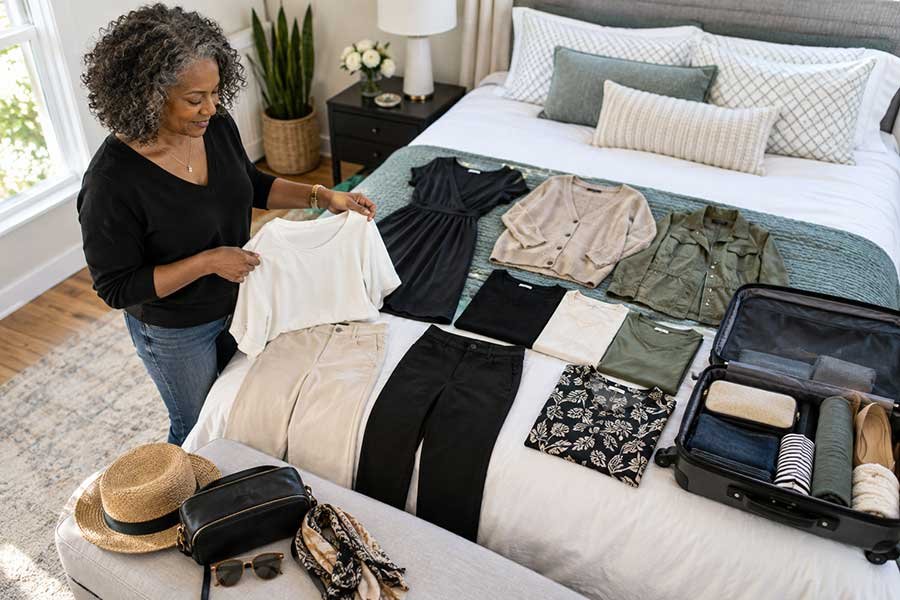
Get the Free ChecklistThe wardrobe that produces the most combinations from the fewest pieces is the wardrobe built on a shared foundation — a neutral color palette where every top works with every bottom and every layer works over every outfit because the palette’s logic was established before a single item was retrieved from the closet. The woman who packs in a shared neutral palette of navy, cream, camel, and olive does not need to mentally calculate which top pairs with which bottom before getting dressed each morning. Every top pairs with every bottom. Every bottom works with every layer. The palette does the coordination work before the items ever leave the bag.
A neutral palette is not a boring palette. Within a navy, cream, and camel range, there is significant texture variation — a ribbed merino knit cream top reads completely differently from a silk-look cream blouse. There is significant silhouette variation — a fitted navy midi dress is visually distinct from a relaxed navy linen trouser. There is significant print variation — a cream floral on navy background, a camel stripe on cream, a navy-and-white geometric print. The palette defines the color family, not the piece’s personality. The personality comes from the cut, the fabric, the texture, and the silhouette — all of which are fully available within the palette’s constraint.
The neutral palette is the system’s highest-leverage decision because it is the decision made before the packing session begins. The overpacker who arrives at the packing session with items already pulled from the closet in their home-wardrobe logic — this top goes with these jeans, this dress needs these shoes — is applying the combination test after the selection has already happened. The woman who selects the palette before opening the closet produces a collection pre-configured for maximum combination at the selection stage. She is not finding out which items pair with which items. She already knows. Everything in the palette pairs with everything else in the palette. Selection done.
She packed ten pieces and wore a different outfit every day of the trip — and checked no bags.
Packing light does not mean giving up options — it means building a wardrobe where every single piece works with everything else so ten items feel like twenty outfits.
Choose your personal neutral palette rather than the generic navy-black-white recommendation, because the palette that works is the palette you actually wear. If your home wardrobe is built on warm neutrals — camel, cream, terracotta, olive — take the warm neutral travel palette. If your home wardrobe is cool — grey, navy, white, burgundy — take the cool neutral travel palette. A travel palette that feels foreign to the traveler’s personal style produces the packing session where nothing feels right and everything gets added as a hedge. A travel palette that mirrors the colors already dominant in the home wardrobe produces the session where every item feels like an obvious choice and the bag is closed on time.
Let Us Book the Trip the Ten-Piece Wardrobe Was Built For
The trip where every outfit is right, the bag is light, and the whole thing fits in the overhead bin starts with the right destination. Tell us where you want to go and what kind of experience you are looking for. We will handle the booking. You build the ten pieces.
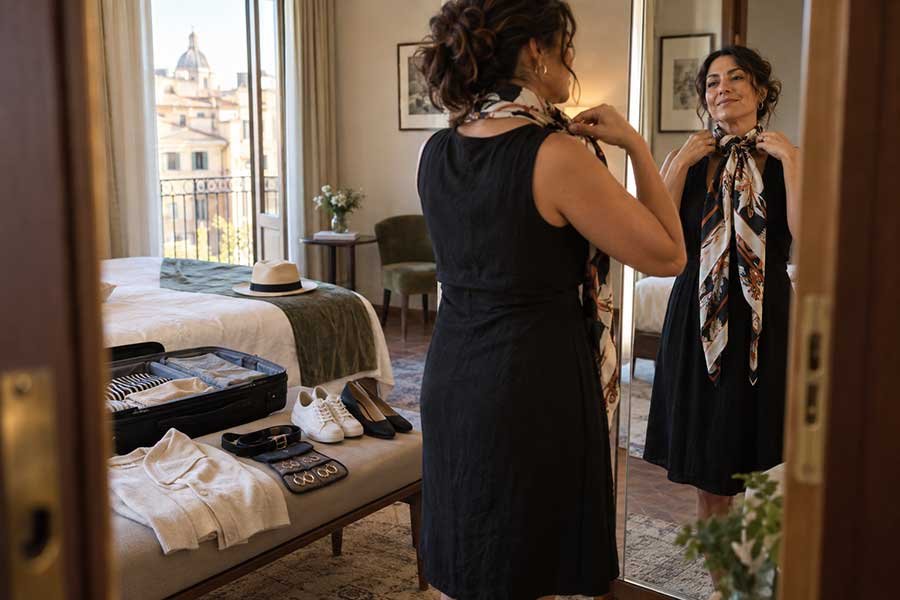
Plan Our EscapeThe woman who loves options and the woman who packs light are not in conflict if the option-producing element is an accessory rather than a clothing item. A statement silk scarf in a rich print, a bold gold necklace, a patterned belt, a signature earring — one accessory that is visually distinct enough to shift the register of any combination it is added to. The cream blouse and dark trousers is one outfit. The same cream blouse and dark trousers with the silk scarf tied at the neck reads as a completely different outfit in photographs, at the table, and in the traveler’s own experience of getting dressed. The accessory is the variation engine of the light-packing wardrobe.
The one-statement-accessory principle is the specific answer to the woman who feels that a neutral palette is too safe, too uniform, too same-looking-every-day. The neutral palette is the canvas. The statement accessory is the color, the personality, and the visual interest that makes the canvas different every time. A silk scarf in a painterly floral print carried in the palette’s accent color — a rust, a jewel green, a deep burgundy — is the item that, worn differently on each day of the trip, produces more visual variety from one item than five additional tops in five different colors would produce at ten times the weight and volume.
The statement accessory earns its place in the bag by being the single highest-combination-count item in the entire packing collection. It pairs with every outfit combination the neutral palette produces. On the first evening: draped over one shoulder. On the second morning: tied as a headband. At the afternoon gallery: knotted at the wrist. On the last evening: folded as a neck scarf over the same white blouse that was worn six days ago and reads as a completely different outfit because of the scarf’s presence. One accessory. Ten days. Ten variations. That is the options-rich light packing system at its most efficient: the item that multiplies options at zero additional clothing weight.
The statement accessory’s weight and volume should be negligible relative to its outfit-combination return. A silk scarf weighs under sixty grams and folds to the size of a smartphone. A quality pendant necklace weighs under twenty grams. A patterned belt weighs under one hundred grams and folds flat. Any accessory that produces the visual transformation this section describes at over two hundred grams is worth reconsidering in favor of a lighter format that produces the same effect. The accessory’s value is entirely in its visual impact, and visual impact has no minimum weight requirement. Choose the most visually impactful accessory in the lightest available format.
The what-if outfit exists because it was never tried on. It was imagined — a top pulled from the closet and held against a bottom on the hanger, both looking fine in the closet’s lighting and the imagination’s cooperative mood, packed on the basis of a mental outfit that was never physically worn. At the destination, the what-if outfit is tried on and produces the specific mid-trip discovery that the top’s neckline does not work with the bra packed for the trip, or the fabric combination is unwearable in the destination’s temperature, or the look that seemed elegant in the imagination looks slightly wrong on the body in the destination mirror. The what-if outfit has traveled across an ocean to not be worn.
The full try-on session before packing is the specific intervention that eliminates every what-if outfit before the bag is opened. Every combination in the intended collection is physically tried on in the actual shoes and with the actual accessories planned for the trip. The outfit that reveals its specific problem in the try-on session reveals it at home, where the problem can be solved or the item can be left home without consequence. The outfit that works in the try-on session goes in the bag with the full confidence of an outfit that has been confirmed rather than imagined.
The try-on session also produces the combination count: the actual number of complete, wearable outfits the intended collection creates. The overpacker who imagined fifteen outfits from her twenty-two items frequently discovers in the try-on that nine of those fifteen outfits are genuinely complete and wearable, four are technically possible but not actually preferred, and two are the what-if outfits that were always going to be left in the hotel room. The try-on session makes the nine the packing justification and the four and the two the items that stay home — a conclusion that the imagination without a mirror cannot reach.
Photograph every confirmed outfit during the try-on session and save the photos as a labeled set — Day 1 casual, Day 2 evening, etc. — as a packing reference. The photograph set confirms that the outfits exist physically and look as intended, serves as the packing checklist’s confirmation layer (if all eight outfits are in the photograph set, all eight items required for those outfits are in the bag), and is available at the destination if the morning’s getting-dressed energy does not produce the same inspiration the try-on session did. The photograph set converts the try-on session’s effort into a permanent resource rather than a one-time confirmation.
Find Booking Ideas and Travel Essentials on Our Favorites Page
Our favorites page has helpful booking ideas and travel essentials that we have found genuinely useful for women who want to travel lighter without sacrificing a single look. Take a look when you have a moment.
DND FavoritesThe outfit mathematics of the options-rich light packing wardrobe is the system’s most concrete and most compelling argument for the woman who doubts that ten pieces can produce genuine variety. The math is straightforward: a wardrobe of five tops and three bottoms in a shared neutral palette produces fifteen base combinations before any layering or accessory variation is applied. Add one mid-layer that works over any of the fifteen combinations and the number of distinct looks doubles. Add the statement accessory to any of those looks and the number doubles again. From five tops, three bottoms, one layer, and one accessory — ten items — the theoretical combination count is well above twenty distinct looks that are each genuinely wearable, genuinely distinct, and genuinely variable enough to wear a different one every day of a trip without the visual repetition that the overpacker feared.
In practice, not every theoretical combination is a combination the woman would choose to wear. Some tops sit better with some bottoms than others even within the shared palette. The mid-layer works best over the fitted tops and less naturally over the structured blouse. The accessory elevates some combinations more than others. The practical combination count, after personal aesthetic preference removes the technically possible but visually less successful combinations, is typically twelve to sixteen confirmed, genuinely preferred outfits from ten pieces — which is more outfit variation than most women use across ten days of travel even when they pack thirty items.
The outfit math is also the light packer’s answer to the what-if outfit’s specific anxiety: what if I get tired of the same pieces? The answer is that the same ten pieces, in twelve to sixteen genuine combinations, in the statement accessory’s range of positions and pairings, with the destination’s natural context providing the backdrop that makes each day’s photographs distinct, do not read as the same pieces repeated. They read as a considered and intentional wardrobe that was built for the trip and is being used fully. The variety the what-if packer fears losing is already present in the system. She simply never did the math before she opened the bag.
Write out the outfit combinations explicitly before the packing session — a simple list of which top pairs with which bottom, with and without the layer, with and without the accessory — and count the total. Most women who do this for the first time discover they have more confirmed outfit combinations from their intended collection than they had what-if outfits they were anxious about leaving home. The explicit list also reveals which items are doing the most combination work (the neutral bottoms that appear in every combination, the versatile top that pairs with everything) and which items are doing the least (the single-combination top that was always a what-if) and makes the light packing decision specific rather than abstract.
The system that makes ten pieces feel like twenty outfits is not a constraint on the woman who loves options. It is the framework that makes her options richer, more intentional, and more genuinely varied than the thirty-item bag ever was.
Step one: select the palette before opening the closet. Two to three neutrals that form the foundation of the travel wardrobe, chosen from the dominant colors of the home wardrobe so every selected item feels natural to wear. One accent color for the statement accessory, chosen to enliven the palette without requiring any specific clothing item to accommodate it.
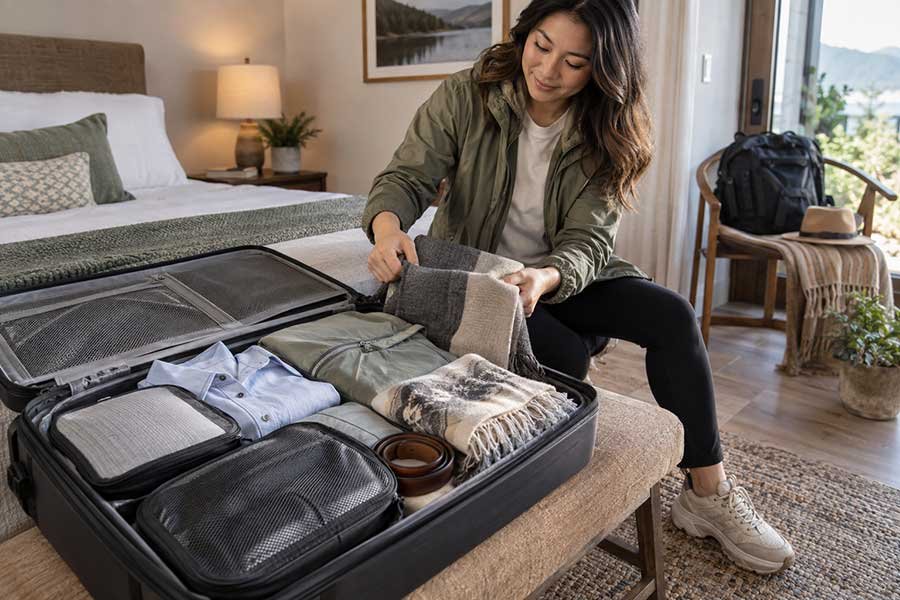
Step two: select the ten pieces. Tops: three to four, varying in formality register — at least one that elevates to an evening register and at least one that handles the casual day register. Bottoms: two to three, varying in silhouette — a trouser or tailored option, a more casual or flowing option, a dress that functions as a top-and-bottom unit for maximum combination flexibility. Layer: one — the specific mid-layer that works over every top in the collection and transforms every daytime combination into a transitioned evening look. These ten items (or fewer) are the wardrobe.
Step three: the full try-on session. Every combination tried, photographed, confirmed. What-if combinations removed. Photograph set saved.
Step four: the statement accessory and the shoes. One statement accessory that works with every confirmed combination. Two shoe pairs: one on the body on the travel day, one in the bag. The shoes complete the outfits the ten pieces began.
Step five: pack. The bag closes. The carry test passes. The trip begins with the specific confidence of a woman who knows exactly what is in the bag, knows every outfit is confirmed, and has no what-if outfits competing for space with the outfits that are actually going to be worn.
The first time this system is applied, the evening before the trip will feel like under-packing. This is the chronic overpacker’s specific relationship with a correctly packed bag: it feels inadequate because the reference point is the overpacked bag, not the actual trip’s requirements. Resist the departure-eve impulse to add items back in. After the trip, count what was worn and what was not. The correctly packed bag’s items were almost all worn. The what-if items that the departure-eve impulse wanted to add were almost never worn. That evidence is the specific reinforcement that makes the second trip’s correctly packed bag feel complete rather than incomplete before the door closes.
The Bag That Had Every Option and Produced the Same Three Outfits
Priya loved to get dressed. She loved clothes, she loved putting looks together, and she loved the feeling of having options. For every trip she took, she packed with this love fully expressed: tops for every possible mood, bottoms in every register from casual to formal, three pairs of shoes for three different contexts, and the specific items she called her just-in-case pieces — the formal dress for the dinner invitation, the warm layer for the cold night, the dressy sandal for the occasion that might arise. The bag for a ten-day trip typically contained somewhere between twenty-five and thirty-five items. She knew this was too many. She did not know how to have fewer items without having fewer options, and fewer options felt like a different kind of trip than the one she wanted to take.
After one particular ten-day trip, she counted what she had worn. She had packed thirty-one items and worn eleven. The twenty unworn items had been in the bag in every city, up every staircase, through every transit, and across every cobblestone street for ten days. Among the unworn: the formal dress brought for the dinner invitation that came as a brunch invitation instead, attended in the outfit she was already wearing. The third pair of shoes worn once, on day two, when her primary shoes were damp, and not again. Six tops that were backup options for days when the primary tops were dirty, solved by a single laundromat visit on day six that meant the primary tops were never dirty long enough for the backups to be needed. The cold-night layer used on two evenings and otherwise packed, which could have been the scarf that was also packed rather than the additional jacket it was.
She laid the twenty unworn items on the bed on the night of her return and looked at them. Then she laid the eleven worn items next to them. The eleven worn items had covered ten days, every occasion, every temperature, every photograph. They were a navy linen dress, two merino tops, one cream blouse, two pairs of trousers, one pair of dark jeans, the ankle boot worn on every day of the trip in every context, the white sneaker worn at the museum and at the market, and one large silk scarf in a rust print that had appeared in a different position in every single photograph of the trip and that, more than any other item in the bag, had made the same pieces look different every time it was worn.
She built the system from those eleven items. She identified the palette they shared: navy, cream, camel. She counted the outfit combinations they produced: fourteen confirmed, all worn at least once. She identified what the silk scarf had done: it had been the variety engine the twenty unworn items were supposed to be, at a fraction of their combined weight. On the next trip she packed eleven items in the palette, one statement scarf, two shoe pairs. She did the full try-on session the evening before departure, photographed every combination, and confirmed fifteen outfits. The bag weighed under seven kilos. It fit in the overhead bin. She wore a different outfit every day and had two combinations left over for the return journey. This article is the system she built from twenty items laid on the bed that had never been worn.
Beyond the three core system principles, these six additional approaches address the specific patterns that keep the what-if outfits in the bag even after the system is understood.
Invest in one versatile travel dress that functions as a top when belted or tucked into a trouser, as a layer worn open over a fitted top, and as a standalone dress at its intended register. A midi dress in a matte jersey or a wrap style in a neutral fabric is the single item in the travel wardrobe with the highest number of functional roles. Worn as a dress with the ankle boot for the evening dinner, worn open as a light duster over the merino t-shirt and slim trouser for the casual day, worn belted over the cropped trouser for the smart-casual afternoon. Three roles, one item, zero additional outfit items required. The versatile travel dress is the ten-piece wardrobe’s combination multiplier above and beyond the mathematics of tops-and-bottoms.
Pack fabrics that travel without wrinkling rather than items that require pressing after transit. The matte jersey, the ponte knit, the satin-back crepe, the merino jersey — these are the fabrics that emerge from the packed bag in the same condition they entered it. The linen blouse that looks beautiful in the closet and arrives at the destination with the specific creases that ten hours of bag compression produces is the item that either requires accommodation pressing at a cost in time and energy, or is worn creased in a way that its intended register does not accommodate. Pack the fabrics that forgive the journey. They produce more genuine outfit options at the destination because they are all available rather than the pressed-item version of a subset of them.
Allow the destination to add to the wardrobe rather than packing against the possibility that it will not. The market find, the local boutique discovery, the specific item that could only exist in this destination — these are the reasons the twenty percent intentional empty space at departure exists. The woman who packs to capacity and then discovers the perfect scarf at the destination market has the choice between buying it and rearranging everything in the bag, or not buying it. The woman who packed with twenty percent empty space has the choice of buying it or not buying it and then simply putting it in the bag. The destination’s additions to the wardrobe are among the trip’s best memories and among the wardrobe’s most meaningful acquisitions. Leave room for them.
When the what-if outfit anxiety strikes in the departure-eve packing session, apply the last-trip evidence test: did the same or similar what-if item get worn on the last trip? If the answer is no, the what-if item has a demonstrated record of being what-if and not what-actually. The evidence from the previous trip’s unused items list is more reliable than the departure-eve imagination about what might be needed. The departure-eve imagination is optimistic and scenario-generating. The post-trip evidence is specific and honest. When they conflict, trust the evidence.
Use one small jewelry organizer pouch in the personal item rather than packing jewelry in individual bags throughout the carry-on. A slim jewelry organizer that holds six to eight pieces — a second pair of earrings for evening variety, a delicate ring, a second necklace for days when the statement accessory is a scarf rather than jewelry — adds the option layer for accessories at under one hundred grams and the size of a passport. The jewelry organizer in the personal item converts the accessory category from one statement piece to a small curated collection that provides the variety the woman who loves options wants, at the weight and volume that the light packing system requires.
Let the shoes carry the style variation the clothing categories do not. Two shoe pairs in a neutral palette — a daytime walking shoe and an evening shoe — produce a genuinely different visual register for the same outfit. The same navy dress in the white leather sneaker reads casual-city; in the tan leather mule it reads smart-casual-evening. The shoe is the outfit’s final statement and, for the woman who loves options, the shoe is the most weight-efficient source of genuine outfit variation available. Investing in two shoe pairs that are both visually interesting rather than one interesting shoe and one functional backup produces more outfit variation per shoe-pair than the safe-and-interesting combination does at the same bag weight.
The women who consistently travel with the lightest, most stylish bags are almost universally not minimalists by nature. They are options-lovers who discovered that the options the light packing system produces are better options than the what-if options the heavy bag produced — more intentional, more confirmed, more genuinely varied through combination — and that the freedom of a light bag at the destination produces experiences that the managed-luggage alternative does not. The light bag is not a sacrifice of options. It is an upgrade of options from unconfirmed and heavy to confirmed and free. Once that distinction is experienced, the heavy bag becomes the loss and the light bag becomes the natural choice.
Book the Trip Where Every Outfit Has Somewhere Worth Wearing It
The ten-piece wardrobe is most satisfying when every combination gets its moment at a destination worth dressing for. Our travel agents plan those trips. Let us book yours.
Book A TripThe Packing Patterns That Keep the What-If Outfits in the Bag
These are the specific decisions that produce the thirty-one-item bag and the eleven worn items on the return. Each has a system-based resolution.
Selecting items from the closet before selecting the palette
Items retrieved from the closet in their home-wardrobe logic — this top goes with these jeans — arrive at the packing session already in isolated outfit pairs that fail the combination test by design. The palette selected before the closet opens produces items that are combination-capable by design. Palette first, closet second. Every time.
Packing items that were never physically tried on in combination
The outfit confirmed in the closet mirror under home lighting in thirty seconds of mental evaluation is not the outfit confirmed by a try-on session. The try-on session reveals the neckline that does not work with the packed bra, the fabric combination that the destination’s temperature makes unwearable, the silhouette that the imagination approved and the body does not. Try on everything. Photograph the combinations that work. Pack only those.
Adding multiple additional clothing items in search of variety when one statement accessory produces more
Five additional tops in five different colors produce five additional outfit options at significant bag weight and volume. One statement silk scarf produces twelve variations of the existing outfit combinations at sixty grams. The accessory is the variety engine. The additional clothing items are the weight and volume the accessory makes unnecessary.
Packing backup items for problems that the trip’s actual solutions would handle
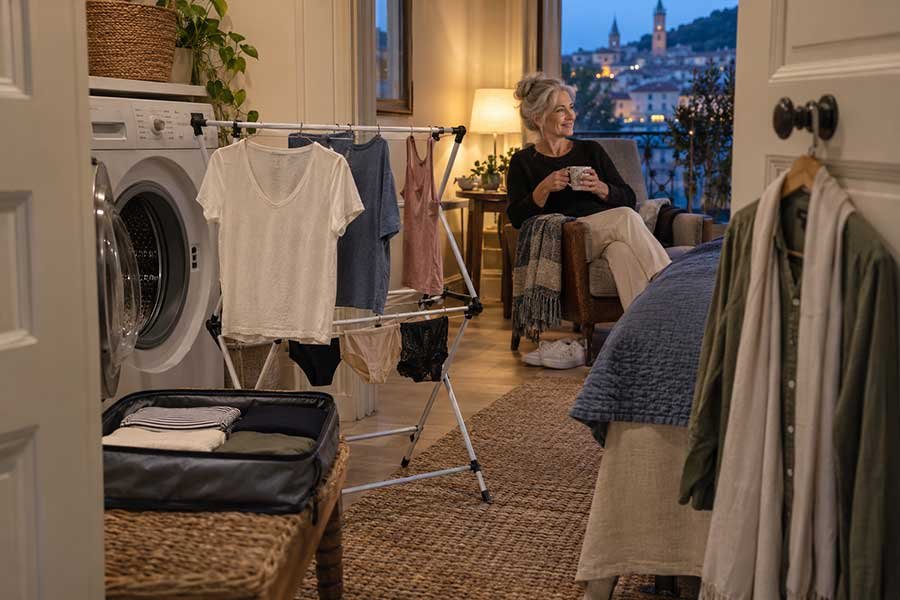
The backup top for the days when the primary tops are dirty is solved by a single mid-trip laundry session, not by six additional tops. The backup warm layer for the cold night is solved by the scarf already in the bag at a fraction of the jacket’s weight. The backup shoe for the day when the primary shoe is damp is solved by an afternoon without the specific shoe and an evening when they have dried. Most backup items are backup solutions to problems that the trip’s natural resources handle without them.
Treating the departure-eve anxiety about under-packing as accurate information
The departure-eve anxiety about having too few options is the overpacking habit’s final assertion before the correctly packed bag is zipped for the last time. It is not accurate information about the trip’s requirements. It is the habit’s discomfort with the departure from its normal operating conditions. The evidence from the previous trip’s unused items count is the accurate information. When the departure-eve feeling and the previous-trip evidence conflict, the evidence is right.
Counting potential outfits rather than confirmed, tried-on, genuinely wearable outfits
Potential outfits are combinations that might work. Confirmed outfits are combinations that were tried on, looked right on the body in the actual shoes and accessories planned for the trip, and felt like genuine choices rather than contingency positions. The overpacker’s thirty-item bag has fifteen potential outfits and nine confirmed ones. The light packer’s ten-item bag has twelve confirmed outfits and zero potential ones. Confirmed outfits get worn. Potential outfits get carried.
Love Helping Women Travel Stylishly With Less?
If becoming a home-based travel agent who helps women plan and travel with intention sounds like the right next step, see how the TravelPreneur system works. Earn commissions and build a real business from anywhere.
Become An AgentFrequently Asked Questions
These are the questions women who love options ask most often about packing lighter.
How do you pack light for a trip that includes both casual days and formal evenings?
The multi-register trip is where the neutral palette earns its highest return. Within a navy and cream palette, the same neutral trouser that is casual with the relaxed merino top becomes smart-casual with the silk blouse and elevated with the blazer or structured cardigan. The dress that is daytime with the white sneaker becomes evening with the leather mule. The register shift happens through layering, shoe selection, and accessory position rather than through additional clothing items. The key piece for the multi-register trip is the one garment that does double duty across registers — typically a well-cut blazer or a structured wrap dress — that costs the bag one item and produces the formal option without requiring a separate formal wardrobe alongside the casual one.
What if you genuinely do not know what occasions the trip will produce?
Pack for the occasions the itinerary confirms and include one elevated piece that handles the unexpected escalation. A trip with confirmed casual days and one planned dinner packs for the casual days plus one elevated option. The unexpected formal occasion that the casual wardrobe cannot accommodate is the occasion where the destination’s retail infrastructure — a local boutique, a market’s textile stall, the hotel gift shop’s silk scarf — provides the specific addition needed at the destination rather than being packed from home against a probability. The traveler who packs for every potential occasion comes home with items that were packed for occasions that did not materialize. The traveler who packs for confirmed occasions and purchases the specific addition the unexpected occasion requires comes home with a story and an item that could only have come from that destination.
How do you travel light when you genuinely love different aesthetic modes — some days minimal, some maximalist?
The aesthetic variation within a light packing wardrobe comes from the accessories and the shoes rather than from additional clothing items. A minimal aesthetic is the neutral base pieces without the statement accessory — the cream blouse and the dark trouser and the clean leather sneaker. The maximalist aesthetic is the same pieces with the statement scarf, the bold earrings, the patterned belt layered over the same neutral foundation. Both aesthetics are available from the same ten pieces because the aesthetic register is expressed through what is added to the neutral base rather than through different base pieces entirely. The base is minimal. The accessories are maximalist. The combination of the two produces the full range of aesthetic expression the options-loving woman wants at the weight of the minimal base plus the negligible weight of the accessories.
Is there a maximum number of items for a ten-day trip in carry-on only?
The carry-on item count for a ten-day trip is governed by the bag’s volume and weight limits rather than by a universal maximum number, since items vary significantly in weight and volume. The system in this article — five tops, three bottoms, one layer, one statement accessory, two shoe pairs plus the standard toiletry kit and electronics — typically produces a total clothing weight of three to four kilograms and fits comfortably in a standard carry-on with room for the toiletry kit and electronics. The specific maximum that any individual woman finds achievable in carry-on only for ten days depends on the specific items’ weights and volumes, the carry-on bag’s dimensions, and the airline’s carry-on limit for the specific booking. The combination test and the try-on session are the tools that ensure the items selected are the highest-utility items for the specific space and weight available rather than an arbitrary number that may be over or under the actual carry-on’s capacity for the specific collection.
How do you handle a trip that requires packing for significantly different climates in the same bag?
A trip that spans significantly different climates in a single bag — a warm coastal city followed by a cold mountain region, for example — is the packing scenario where the layering principle produces its highest return. The same base pieces worn across the full temperature range through the addition and removal of layers, rather than separate warm-climate and cold-climate wardrobes, is the climate-spanning approach that keeps the bag within carry-on dimensions. The warm-climate outfit is the base layer and bottom without any additional warmth. The cold-climate outfit is the same base layer and bottom with the mid-layer and the outer layer added. The same neutral palette foundation serves both climate contexts, and the layer additions for the cold component are the packable down jacket and the merino mid-layer that compress to small volumes rather than the heavy separate cold-weather wardrobe that the non-layering approach requires. One bag, both climates, the same foundation wardrobe in different layer configurations.
How do you maintain personal style when packing in a neutral palette?
Personal style within a neutral palette is expressed through exactly the same elements that express it in a full-color wardrobe: the specific cut of each piece, the fabric’s texture and drape, the proportion of the layering combination, and the accessory choices. A tailored navy blazer over a cream silk slip dress with tan mules and a rust silk scarf is a considered and personal statement entirely within a neutral palette. A relaxed olive linen trouser with a white embroidered top and a straw bag is a bohemian personal style statement entirely within a neutral palette. The palette constrains the color range. It does not constrain the cut, the texture, the silhouette, the proportion, or the accessory personality that constitutes personal style. The women who travel in neutral palettes and look most like themselves are the women who selected neutrals that genuinely reflect their color preferences and then expressed everything else about their style fully within them.
The woman who opens her bag on day seven and finds every item worn at least once did not pack less than she needed. She packed exactly what she needed — which is a different and significantly lighter thing.
Picture Day Seven of the Trip
The navy dress is on. The tan mule is on. The silk scarf is tied at the wrist. It is the fourteenth combination from the ten items and the photograph from today will look completely different from yesterday’s because the scarf moves everything. The bag has one more combination available for tomorrow that you have not worn yet. It weighs under seven kilos. It is in the corner of the room rather than open across the floor in the specific spread of the overpacker’s daily repacking. You are not managing the bag. You are wearing the wardrobe. That is what ten pieces feels like when every one of them was confirmed before it went in. That is every trip from here.
One More Thing Before the Next Packing Session
Print our free Travel Packing Checklist and use it as the category framework that governs the session — palette first, items second, try-on third. The same checklist we recommend before every trip we pack for carry-on.
Get the Free ChecklistExplore Our Top Picks for a Better Trip
Visit our favorites page for helpful booking ideas and travel essentials that we have found genuinely useful for women who want to travel lighter and look great doing it. Worth a browse when you have a moment.
See Our Top PicksTravel Prints and Printables From Our Shop
Visit Premier Print Works for packing list printables, wardrobe planners, travel journals, and wall art that makes every trip a little more beautiful and a lot more organized — from the afternoon the palette is chosen to the morning every combination is confirmed and the bag is finally, perfectly, light.
Visit Premier Print WorksDisclaimer
The information shared in this article is provided by Don and Diana’s Travels for general informational, educational, and inspirational purposes only. It reflects our personal experiences, opinions, and the experiences of travelers we have worked with. It is not professional travel, legal, or financial advice.
Airline Baggage Policies
Carry-on size and weight limits change frequently and vary by airline, fare class, and route. Always confirm current policies with the specific airline before travel. We are not responsible for any baggage fee or outcome arising from information in this article.
Affiliate and Partner Links
This article may contain affiliate links and partner links that pay us a commission. Our recommendations are based on real use and genuine belief in the products and services we share.
Third-Party Websites and Services
We may link to third-party websites for convenience. We do not control these sites and are not responsible for their content, pricing, or availability.
Health, Safety, and Personal Responsibility
Travel involves personal risk. You are solely responsible for your own health, safety, travel insurance, and travel decisions. We strongly recommend comprehensive travel insurance for every trip. Don and Diana’s Travels accepts no liability for any loss, injury, delay, or inconvenience arising from information in this article.
Composite Stories and Characters
Stories shared on this site are composites drawn from real experiences of Don, Diana, clients, and travelers we have worked with. Names and details may be changed or fictionalized to protect privacy.
No Guarantees
We do not guarantee any specific result from using the information in this article. Your results depend on your own choices, effort, and circumstances.
Copyright and Use
All content is the copyrighted property of Don and Diana’s Travels. You may not copy or republish our content without prior written permission. You are welcome to share a direct link with proper credit.
By reading this article, you acknowledge that you have read and agree to this disclaimer.