A stress-free flight starts with a carry-on packed so well you never have to stand up and rummage through the overhead bin once. The most relaxed person on any flight packed their carry-on the night before and thought of everything so the flight could think of nothing. This article is that carry-on list.

Best For
Every Traveler, Every Flight
Vibe
Calm, Confident, Ready
Read Time
11 Minutes
Walk Away With
The Complete Stress-Free Carry-On System
Free Download

Grab Our Travel Packing Checklist

Our free packing checklist includes the carry-on essentials section organized by the access-priority system this article describes — flight essentials at the top, destination items below — so every item ends up exactly where it needs to be before the aircraft door closes.

Get the Free Checklist

Load Entertainment Before You Board

The single most preventable source of in-flight frustration is the entertainment that was not ready when the flight began. The streaming app that requires connectivity the aircraft does not provide. The downloaded episode that was started but not completed before the WiFi cut out at altitude. The podcast that was in the queue but not in the phone’s offline storage. The book app that opened to a chapter already read rather than the next one. Every one of these frustrations has the same resolution: download everything before the aircraft door closes, while home WiFi is available and the download is free, fast, and reliable.

The entertainment download session the evening before departure — or at minimum during the drive to the airport while a hotspot connection is still available — should cover the full expected flight duration plus a comfortable buffer. Two to three episodes of the current series covers a short-to-medium flight and the first portion of a long-haul. One full feature film covers a medium flight independently and supplements the series episodes for the long-haul. One podcast episode or two handles the transition between actively watching content and passively listening while resting. One audiobook chapter or the current book’s offline sync handles the traveler who prefers reading to screen content. The full entertainment library for any flight takes fifteen minutes to download on home WiFi and is available in full airplane mode from the moment the aircraft leaves the gate.

Equally important: download the destination’s offline maps and any translation tools needed for the destination before boarding. The navigation that works from the aircraft door at the destination rather than requiring local connectivity to function is the navigation that begins working at the exact moment it is needed — the immigration exit, the taxi queue, the walk from the transit stop to the accommodation. These downloads are not entertainment but they are part of the complete pre-flight loading that converts the arrival from a connectivity scramble into a confident beginning.

The most relaxed person on any flight packed their carry-on the night before and thought of everything so the flight could think of nothing.

A stress-free flight starts with a carry-on packed so well you never have to stand up and rummage through the overhead bin once.

Insider Note

Check that downloaded content is genuinely available offline by putting the phone in airplane mode before leaving the house and confirming that each downloaded item plays without any connectivity attempt. Some apps download content that requires a brief license verification call on first play — which requires connectivity — before the offline play is truly available. The airplane mode test at home confirms that every downloaded item is genuinely offline-available before the aircraft door closes rather than discovering the license check requirement at 35,000 feet when no connectivity is available for the verification.

We Plan the Trip

Let Us Book the Destination That Makes Every One of These Preparations Worth It

The stress-free carry-on earns its full return when the destination at the other end is worth the preparation. Tell us where you want to go. We will handle the booking, the itinerary, and the planning. You handle the carry-on.

Plan Our Escape

Snacks Within Reach Before Takeoff

The airport food environment is expensive, often limited in quality and dietary accommodation, and unavailable once the aircraft door closes. The in-flight meal service on most carriers provides meals at the airline’s schedule rather than the traveler’s hunger, leaving the specific mid-flight hunger window — typically hours three through six of a longer flight — without any available food from the service until the next meal round. The snack kit in the carry-on’s most accessible position is the personal food supply that fills every gap in the airline’s schedule at a cost dramatically lower than the airport’s prices and at a quality that the traveler chose rather than accepted.

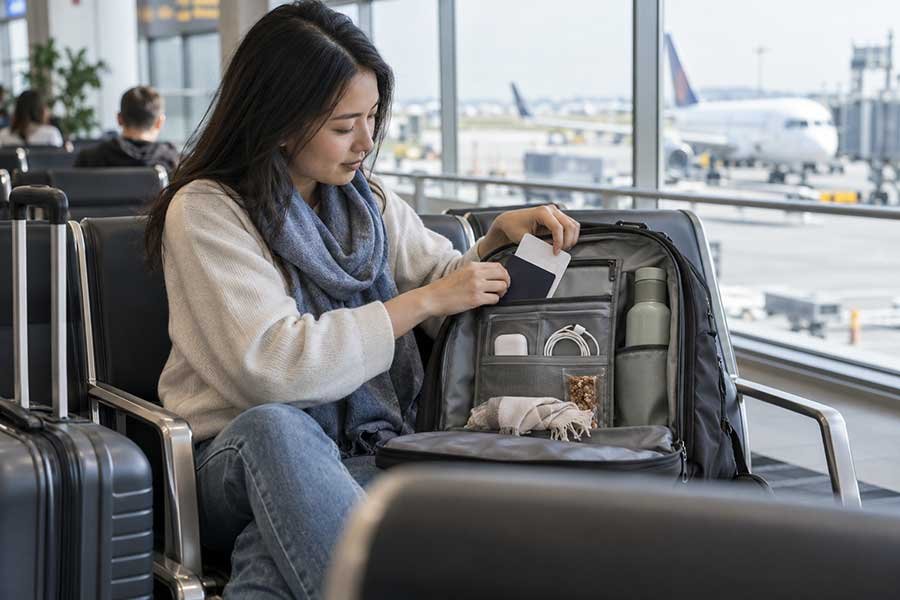
The ideal carry-on snack kit is compact, high in protein and satiety, and stored in an exterior zip pocket or the top layer of the personal item before takeoff so it requires no bag excavation to access during the flight. Mixed nuts, a protein bar, dark chocolate, a small portion of dried fruit, and a savory crackers option cover the full range of snack occasions a flight produces: the post-boarding appetite, the mid-flight hunger between services, and the final approach’s pre-landing nibble when the tray table must be stowed and the service cart is packed away. These items together weigh under three hundred grams, cost a fraction of their airport equivalents, and are available at exactly the moment they are needed without disturbing the seatmate, standing up, or opening the overhead bin.

For travelers on long international flights, the snack kit supplements the airline’s meal service rather than replacing it. The airline’s meal is the primary nutrition. The snack kit is the gap coverage that prevents the six-hour window between meal services from becoming a six-hour hunger experience. Together they produce the sustained, even nutrition across the full flight that the meal service alone cannot provide.

Insider Note

Avoid packing snacks with strong aromas in the carry-on for any flight. The aircraft cabin’s sealed, recirculated air environment amplifies food smells significantly — what would be unremarkable in an outdoor setting becomes a presence that extends across several rows of seating in the aircraft’s confined space. Mixed nuts, protein bars, dark chocolate, and dried fruit are the low-aroma, high-satiety options that provide excellent flight snacking without creating an olfactory experience for the surrounding passengers who had no say in the snack selection.

Documents in the Outermost Pocket

The passport, boarding pass, and any required entry documents are the items accessed at every official interaction from the security queue’s identity check through the boarding gate scanner through the connection’s immigration desk to the destination’s customs declaration. Each of these interactions requires immediate document access at a moment when a queue is moving or a gate agent is waiting. The documents in the carry-on’s outermost pocket — consistently, on every flight, without exception — produce a one-to-two-second retrieval at every interaction. The documents in the main compartment, in the bag that is already in the overhead bin, produce the specific overhead bin excavation that this article exists to prevent.

The documents belong in the carry-on’s outermost pocket or in a travel document wallet kept in the carry-on’s most accessible exterior position for the journey to the seat. Once seated, the document wallet moves to the seat pocket or remains in the accessible top layer of the personal item under the seat so that it is available throughout the flight without the overhead bin at any connection point. The governing principle: documents are never in the overhead bin during a flight that has a connection. The overhead bin is inaccessible during the seatbelt sign, which includes the taxi and the final descent — exactly the periods when a connection’s documents need to be confirmed and organized for the next interaction.

Include a screenshot of the boarding pass in the phone’s photo library as a backup. The screenshot opens without any app loading, connectivity requirement, or account authentication. At a boarding gate where the airline app is slow, the phone’s battery is at eleven percent, or the connectivity is poor, the boarding pass screenshot in the photo library is the boarding pass available in one tap at full screen brightness. It is the document backup that requires no additional bag item — it is already in the phone — and that provides the specific document confidence the checklist’s outermost-pocket documents also provide.

Insider Note

Email copies of all critical documents to yourself before every international departure: the passport data page, the accommodation confirmations with addresses, the travel insurance policy number and emergency line, and the flight confirmation. The email is accessible from any internet-connected device at the destination if the physical documents are lost or the carry-on is gate-checked and inaccessible. For domestic flights, the email backup is most valuable for the accommodation confirmation and the return flight details. Five minutes of emailing before every departure, accessible from any device at every moment of the trip. That is the document backup that asks almost nothing and returns significant peace of mind.

Helpful for Your Journey

Find Booking Ideas and Travel Essentials on Our Favorites Page

Our favorites page has helpful booking ideas and travel essentials that we have found genuinely useful for stress-free flying and every kind of trip. Worth a look when you have a moment.

DND Favorites

A Change of Clothes Just in Case

The change of clothes in the carry-on is the one item that handles two distinct scenarios at full effectiveness: the gate-checked carry-on scenario and the overnight flight arrival scenario. In the gate-check scenario — the flight where the overhead bin is full and the carry-on must be checked at the gate, arriving at the baggage belt at the destination rather than traveling in the cabin — the change of clothes is the specific item that makes the gate check a logistical inconvenience rather than a first-morning appearance problem. In the overnight arrival scenario, the fresh top and clean undergarments retrieved from the carry-on in the destination airport’s restroom before the taxi queue produce the arrival reset that twelve hours in recycled cabin air makes genuinely welcome.

The carry-on change of clothes is minimal: one clean top, one pair of clean underwear, one pair of clean socks. These three items roll to the volume of a large apple, weigh under two hundred grams, and sit in the carry-on’s main compartment beneath the flight essentials without occupying meaningful space. For travelers whose flight arrives at a context where first impressions matter — a business meeting, a significant reunion, a special occasion — adding a clean pair of trousers or a change dress raises the change’s register to the full outfit refresh that makes the arrival feel genuinely fresh rather than merely freshened.

Insider Note

Pack the change of clothes in a small reusable mesh or zip bag within the carry-on’s main compartment so it is identifiable at a glance without opening and searching. A mesh bag in a distinctive color or pattern means the change of clothes is retrieved in five seconds from the carry-on rather than five minutes of searching through the packing cubes and the cables and the toiletry kit for the rolled-up t-shirt that is somewhere in the main compartment. The mesh bag also holds the worn clothes after the arrival refresh, keeping them contained and separate from the clean items for the return journey’s laundry organization.

A Reusable Water Bottle Filled After Security

The aircraft cabin’s humidity environment — typically ten to twenty percent relative humidity compared to thirty to sixty percent in most indoor environments — produces continuous dehydration throughout any flight through increased moisture evaporation from the skin and respiratory system. The airline’s in-flight water service delivers water at the service schedule’s intervals, which may leave stretches of several hours without water access during the sleep segment of overnight flights and during the busiest portions of the service cycle when the cart is at the far end of the cabin. A reusable water bottle filled at the terminal’s water station or purchased at the airport gate and kept in the carry-on’s most accessible position provides water at the traveler’s timing rather than the service cart’s timing.

The reusable bottle passes through security empty — liquids over 3.4 ounces are subject to the TSA rule — and is filled at the terminal’s water station or at any water source after the security checkpoint before boarding. Most major airports have water refill stations throughout the post-security terminal. The filled bottle in the carry-on’s exterior bottle pocket provides water access throughout the boarding process, the taxi, the ascent, and any period during the flight when the service cart is not providing water. It also provides water during the connection’s transit between gates, which can be a thirty-to-sixty-minute period of walking and waiting without any convenient water access other than the airport’s food court pricing.

For long-haul flights, refilling the bottle at the galley during the movement interval — the two-hour standing and walking break that supports circulation — produces continuous water access across the full flight without any dependence on the service schedule. The proactive hydration that the personal bottle enables, rather than the reactive hydration of waiting until thirst signals dehydration that has already developed, maintains the body’s fluid balance across the flight and contributes to the arrival freshness that the change of clothes and the night-before preparation together produce.

Insider Note

Choose a water bottle that fits in the carry-on’s exterior bottle pocket and does not require two hands to open and close during the flight. A single-handed flip-cap or a push-button straw bottle produces the one-handed mid-film hydration that a screw-top bottle does not, and the one-handed access means the bottle is used more frequently and more naturally than the two-handed version that requires putting down whatever else is in the hands to open. The bottle used more frequently provides more consistent hydration. The specific bottle format is the thirty-second decision that determines whether proactive hydration is the actual flight experience or the intended one.

The Complete Stress-Free Carry-On System

The stress-free carry-on is not a bag packed to capacity with every item the flight might require. It is a bag where every item has a known location, every flight essential is accessible without the overhead bin, and the packing was completed the night before so the departure morning requires confirmation rather than assembly.

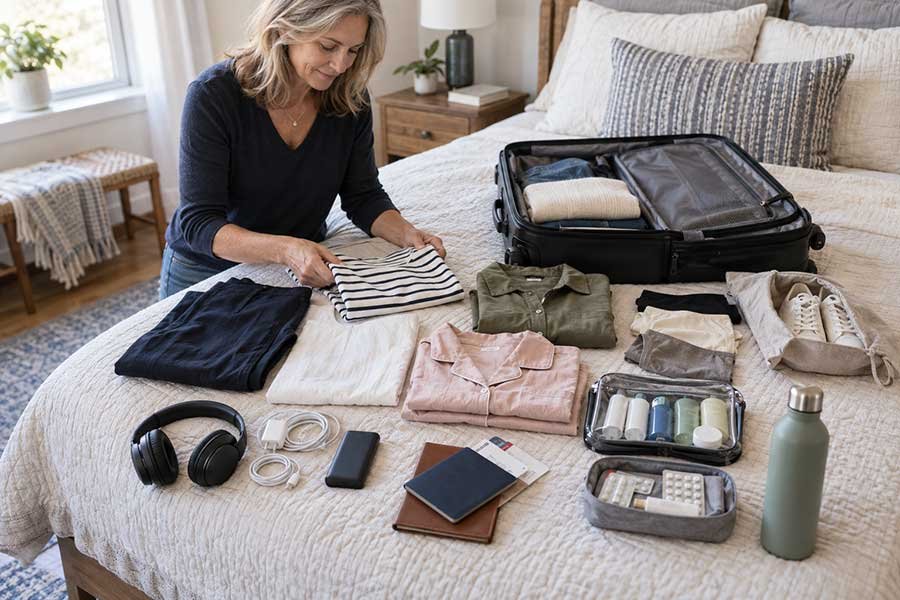
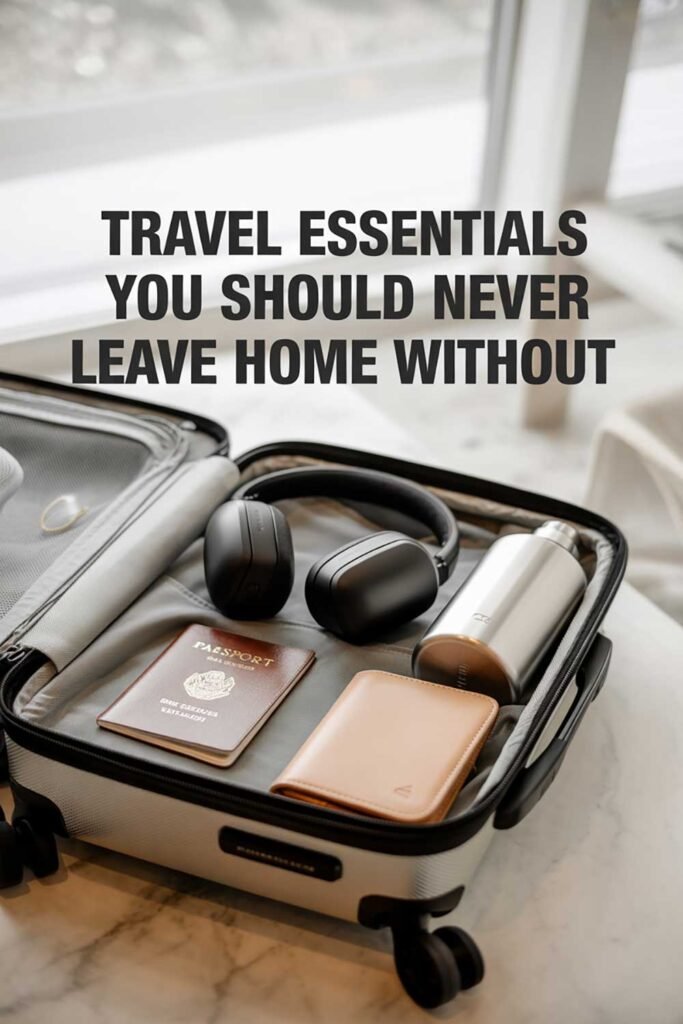
The access-priority layout: the outermost pocket holds the documents wallet with passport, boarding pass screenshot, accommodation address, and any connection documents. The exterior zip pocket holds the snack kit — mixed nuts, protein bar, a piece of dark chocolate — and the lip balm and hand cream. The exterior bottle pocket holds the reusable water bottle, empty at security and filled before boarding. The personal item’s main compartment top layer holds the noise-canceling headphones and a light warm layer for the cabin. The carry-on’s main compartment holds the packing cubes with clothing, the toiletry kit in the top accessible position, and the change of clothes in the mesh bag above the clothing cubes.

The night-before checklist — the five minutes that makes the departure morning a confirmation rather than a session: entertainment downloaded and confirmed offline-accessible. Documents photographed and emailed. Boarding pass screenshot in the photo library. Snack kit assembled. Water bottle empty in the exterior pocket. Change of clothes in the mesh bag. Noise-canceling headphones at the top of the personal item. Carry-on closed and the carry test passed. Everything is ready. The departure morning is twenty minutes of confirmation, not forty-five minutes of assembly. The flight has nothing to think about because the night before thought of everything.

Insider Note

The stress of flight day is almost entirely a time and certainty problem: not enough time to do everything needed, and not enough certainty that everything needed was done. The night-before system resolves both simultaneously. The time pressure is absorbed the night before when the flight is tomorrow rather than in three hours. The certainty is confirmed by the checklist rather than trusted to memory. The specific feeling of the stress-free flight — the gate arrival with time to sit, the boarding without rushing, the seat settled without the overhead bin — is the direct product of the night before’s twenty minutes that the departure morning without preparation never produces.

The Flight That Finally Made Us Pack the Night Before

We have taken enough flights together that we are embarrassed to say how many of them were stressful in entirely preventable ways. Not the delays and the missed connections — those happen to every traveler regardless of preparation. The self-inflicted stress: the movie that started buffering as the WiFi dropped, because neither of us had downloaded it the night before. The snack situation at hour five of a seven-hour flight when the service was done and the airport food was a memory. The boarding pass on Don’s phone that required the airline app to load at the gate while the boarding line moved around us. The change of clothes Diana wished she had packed when her bag was gate-checked and arrived at the destination two hours after she did, which happened to be the trip where the accommodation’s check-in was at 3 p.m. and there was no lobby to wait in and she was sitting in a coffee shop in the same clothes she had been in for sixteen hours.

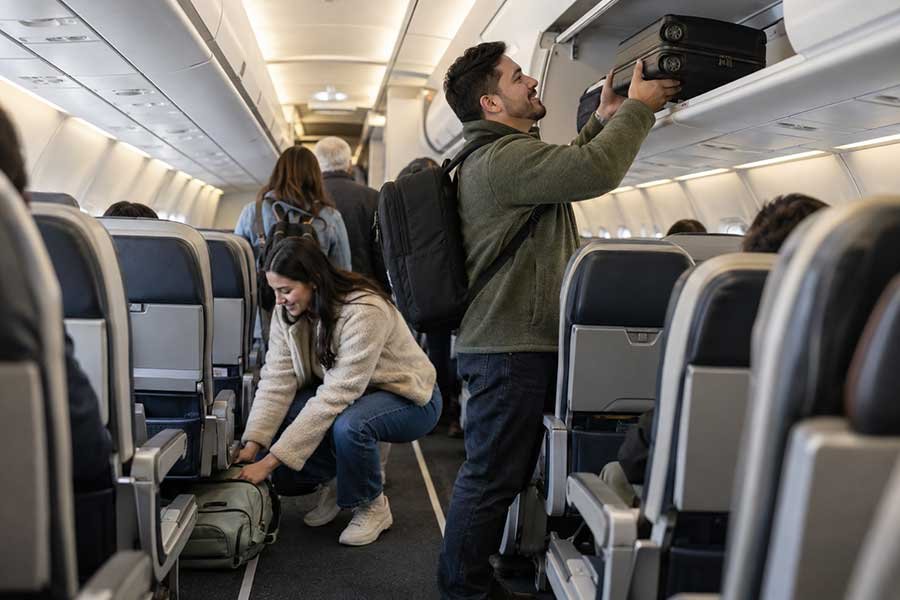
The last-straw flight was a short domestic hop that should have been the least stressful flight of the year and was not. Don had packed the carry-on the morning of departure and had put his headphones in at the bottom of the bag because they went in first. At the gate he could not find the boarding pass in the bag he had reorganized twice at security. On the aircraft, the headphones were at the bottom and the extraction required standing, opening the overhead bin, and the specific performance of retrieving one item from the bottom of a bag while the person in 11C watched with polite patience. The flight was two hours and twelve minutes. Don was standing in the aisle accessing the overhead bin twice. For a two-hour flight. It was the self-inflicted version of the flight stress that the night-before system eliminates entirely.

We built the system. The rule is now simple: carry-on packed the night before, every time, for every flight regardless of how short the flight is or how close to home the departure is. Entertainment downloaded and confirmed in airplane mode. Documents in the outermost pocket. Boarding pass screenshot in the photo library. Snack kit in the exterior zip. Water bottle empty in the exterior pocket, filled at the terminal. Headphones at the top of the personal item. Change of clothes in the mesh bag. Carry-on closed and carry test passed by 9 p.m. the evening before the flight.

The flight has not been a source of self-inflicted stress since. This article is the checklist from the system we built so you do not need the two-hour domestic flight with the twice-opened overhead bin to arrive at the same conclusion. Pack the night before. Think of everything. Let the flight think of nothing.

Six More Carry-On Hacks for Stress-Free Flying

Beyond the five core carry-on elements, these six additional approaches address the specific flight stress sources that the core list does not fully cover.

Pack a compact travel pillow in a compression sack attached to the carry-on’s exterior handle or clipped to the bag’s exterior rather than packed inside. The travel pillow inside the carry-on occupies significant volume for an item that is accessed once per flight at a specific known moment — the sleep segment’s beginning. The compression sack on the exterior handle clips off and deflates to a small package when not in use and inflates in thirty seconds when needed. The exterior position means the pillow is accessible without opening the carry-on at the seat while adding no volume to the carry-on’s interior.

Keep a spare charging cable in the carry-on’s cable organizer for the specific cable that is both the most frequently needed and the most frequently forgotten. The phone cable left in the outlet at the accommodation at 2 a.m. by the charging phone is the cable that would have been useful at the airport and at the gate and on the aircraft. A spare cable in the cable organizer is permanent — it lives there between trips and does not require packing and unpacking — and provides the fallback for the primary cable’s specific vulnerability of being attached to the wall rather than in the bag when it is most needed.

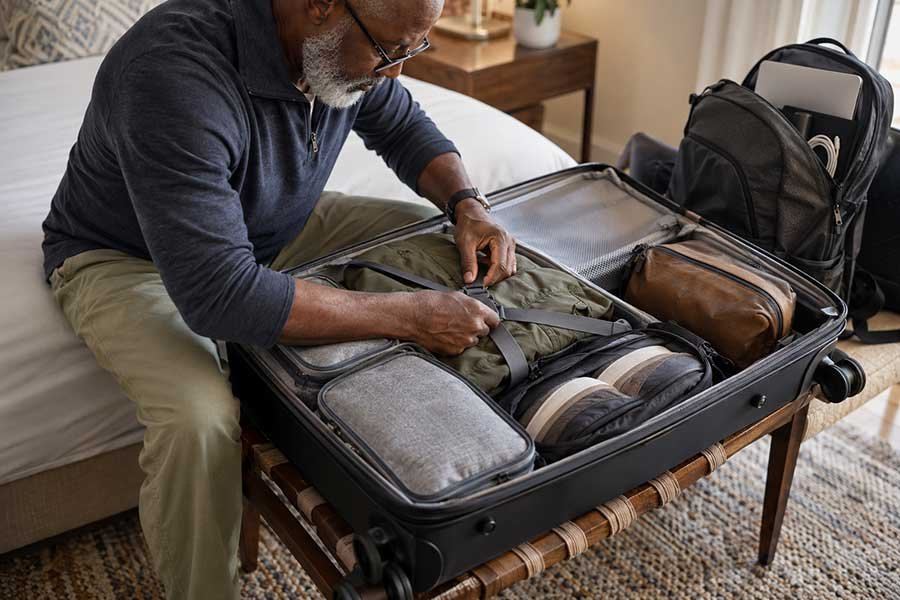
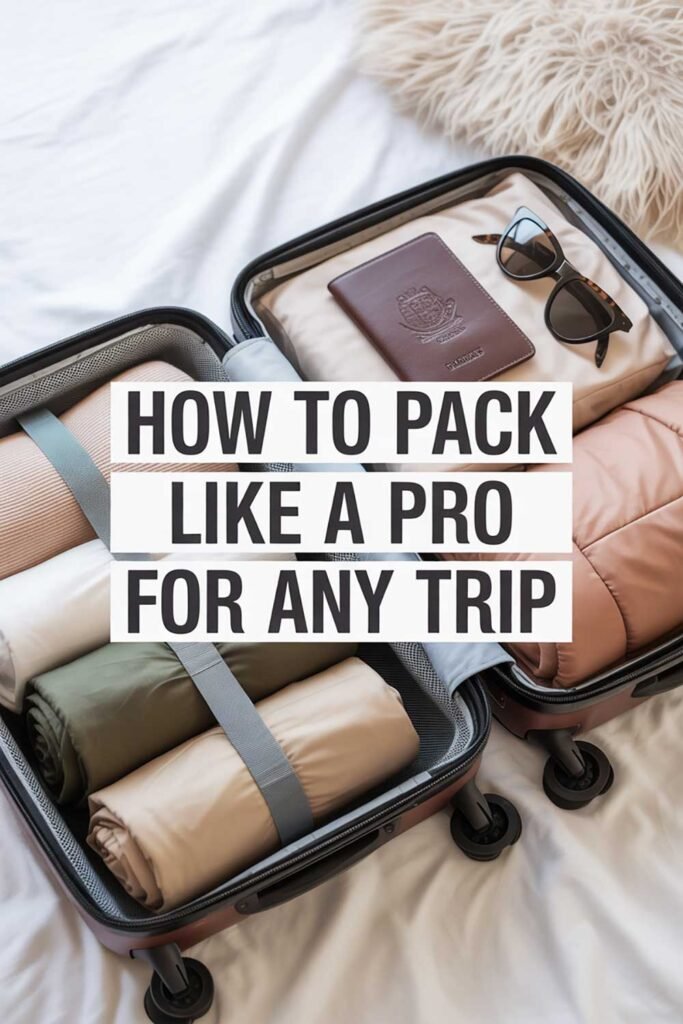
Use packing cubes in the carry-on’s main compartment so that the destination items are organized and the flight items are separately accessible without disturbing the destination organization. The carry-on without packing cubes is a single undifferentiated space where the flight’s clean change of clothes is somewhere among the destination’s three days of clothing and the toiletry kit is somewhere in the same space as the camera and the laptop cables. Packing cubes produce the specific organization where opening the carry-on reveals a structured arrangement of cubes rather than a layered accumulation of items that requires full excavation to locate any single thing.

Bring noise-canceling earbuds or headphones regardless of whether the flight has in-seat entertainment. The aircraft cabin’s ambient noise — the engine, the air systems, the surrounding passengers — is the continuous background that makes sleeping, reading, and thinking significantly harder than the same activities in a quiet environment. Noise-canceling technology reduces this background to a manageable level regardless of whether it is paired with content. The earbuds in the carry-on’s top layer, deployed before the aircraft door closes, are the single in-flight comfort upgrade with the highest return for the lowest weight and volume investment.

Pack a small, lightweight eye mask in the carry-on’s personal item section. The aircraft cabin’s lighting cycle — the brightening before meal service, the ambient lighting during the flight, the specific overhead light the passenger in 14A turns on at 2 a.m. — is not within the traveler’s control. The eye mask is. A quality eye mask in the personal item converts the cabin’s lighting environment from a sleep interruption into a managed variable that the traveler controls rather than endures. Paired with the noise-canceling earbuds, the eye mask and earbud combination produces the most complete sensory sleep environment available in an economy seat without any upgrade purchase.

Confirm the carry-on fits the specific airline’s size limit for the specific fare class before leaving the house. Not every airline uses the standard twenty-two by fourteen by nine inch carry-on allowance. Budget carriers frequently have smaller limits. Basic economy fares on legacy carriers sometimes restrict carry-on to the personal item under the seat. A packed carry-on that exceeds the specific flight’s limit produces the gate check that the change of clothes was specifically packed to manage but that the day is better spent avoiding entirely. Five minutes of checking the specific airline’s current carry-on policy for the specific booking is the five minutes that confirms the system works as planned rather than discovering the policy difference at the gate.

Insider Note

The stress-free carry-on’s most important property is not what is in it but that everything in it is in a known location confirmed the night before. The specific items this article describes are the items that produce the stress-free flight when they are present and in their positions. But the system’s fundamental value is the certainty it produces — the boarding gate confidence of knowing that every item is present, in position, and accessible without the overhead bin for the full flight. That certainty is not a product of any specific item. It is a product of packing the night before, using the checklist, and closing the bag only after every item has been physically confirmed rather than mentally assumed to be present. Pack the night before. Confirm everything. Board with confidence. The flight can think of nothing because you already thought of everything.

Book With Us

Book the Destination Worth Boarding With Complete Confidence For

The stress-free carry-on is the beginning of the trip. Our travel agents plan what comes after. Let us book the destination worth arriving at well-rested, well-fed, and with a fresh change of clothes. Let us know where you want to go.

Book A Trip

The Carry-On Mistakes That Make Flights Feel Harder

These are the self-inflicted flight stress sources. Every one is entirely preventable with the night-before system.

1

Packing the carry-on the morning of departure

The morning-of carry-on is packed under departure time pressure, which means items go in where they fit rather than where they should be, the headphones end up at the bottom, the documents are somewhere in the main compartment, and the entertainment downloads were planned for the airport WiFi rather than completed at home. The night-before carry-on is packed deliberately, with every item in its access-priority position, and the flight can begin from that organization rather than from the improvised arrangement the departure morning produced.

2

Planning to download entertainment at the airport rather than at home

Airport WiFi is slower, less reliable, and sometimes unavailable at the specific terminal or gate where the boarding begins. The entertainment download planned for the airport is the entertainment download that may or may not complete before the boarding call. The entertainment downloaded at home on home WiFi the evening before is confirmed complete, confirmed offline-accessible, and available from the moment the aircraft door closes regardless of what the airport’s connectivity situation was.

3

Keeping documents in the main compartment rather than the outermost pocket

Documents accessed from the main compartment at the security checkpoint, the boarding gate, and any connection’s immigration desk require opening the main compartment at each checkpoint interaction. Documents in the outermost pocket require a one-to-two-second retrieval at each interaction. The overhead bin cannot be accessed during any official document interaction anyway, which means the documents must be either in the outermost pocket or in a bag under the seat. Consistently, outermost pocket. Every flight, without exception.

4

Not packing a snack kit and relying entirely on the airline’s service schedule

The airline’s service schedule produces meals at the airline’s timing, with a menu determined before the flight by the catering, and with the specific options available at the specific row’s cart arrival being whatever the rows ahead of it did not take. The personal snack kit in the exterior zip produces the right food at the right moment at the traveler’s timing for the full duration of the flight regardless of the service schedule, the menu, or the row position.

5

Not having a change of clothes in the carry-on

The gate-checked carry-on without a change of clothes in the personal item or accessible bag produces the arrival in the clothes worn for the full flight duration while the carry-on makes its separate journey to the baggage belt. The change of clothes rolled into the mesh bag in the carry-on’s main compartment is a two-hundred-gram, apple-volume preparation for the scenario where the carry-on is gate-checked and the destination arrival is in a fresh outfit rather than a flight outfit. Pack it before every flight. Use it if needed. Appreciate its presence even when it is not.

6

Not filling the reusable water bottle before boarding

The in-flight dehydration that produces the specific dry-mouth, dry-eyes, and mild-headache arrival experience is primarily the product of the cabin’s ten-to-twenty-percent humidity environment across the flight’s full duration. The airline’s water service addresses this at the service’s intervals. The personal water bottle addresses it continuously. The water bottle filled at the terminal water station before boarding and kept in the carry-on’s exterior bottle pocket provides water access from boarding through every seatbelt-sign period through the service gaps through the connection’s gate-to-gate walk to the destination’s taxi queue. Fill it before boarding. It is the carry-on’s lightest and most-used item across any flight over two hours.

Turn Travel Into Income

Love Helping Travelers Board With Confidence on Every Flight?

If becoming a home-based travel agent who helps people plan and travel better from the carry-on to the itinerary sounds like the right next step, see how the TravelPreneur system works. Earn commissions and build a real business from anywhere in the world.

Become An Agent

Frequently Asked Questions

These are the questions travelers ask most often about the stress-free carry-on system.

How do you fit everything in a carry-on without checking a bag?

Fitting a complete trip in a carry-on requires three practices applied together: the five-piece neutral-palette wardrobe that produces maximum outfit combinations from minimum clothing items, the decanted-to-trip-size toiletry kit that eliminates the full-size product volume from the packing equation, and rolling the clothing rather than flat-folding it to maximize the carry-on’s volume efficiency. Clothing packed in this way for a seven-day trip with one mid-trip laundry session typically occupies forty to fifty percent of a standard carry-on, leaving the remaining space for the toiletry kit, electronics, and the flight essentials this article describes. The specific items that most often prevent a trip from fitting carry-on are multiple shoe pairs, full-size toiletry products, and more clothing than the combination test’s minimum wardrobe requires. Address all three and most trips for most travelers fit carry-on comfortably.

What is the best personal item to bring on a flight alongside the carry-on?

The best personal item for any flight is the bag that fits under the seat in front without significantly reducing foot space, has multiple exterior pockets for access-priority item placement, and has a structured enough base to remain organized when slid under the seat rather than collapsing into an unorganized pile. A structured backpack or a purpose-built under-seat bag with exterior pockets for the snack kit, document wallet, and water bottle produces the stress-free flight’s accessible in-seat storage that this article describes. The personal item’s dimensions must comply with the specific airline’s personal item limit for the specific fare class. Confirm the limit before packing, as personal item dimensions vary by airline and fare class and are enforced at boarding on many carriers.

Should you put the laptop in the carry-on or the personal item?

The laptop belongs in whichever bag has a dedicated exterior-accessible laptop sleeve for security checkpoint efficiency. If the carry-on has a dedicated back-panel or spine-sleeve laptop compartment accessible from the exterior without opening the main compartment, the laptop travels in the carry-on. If the personal item has the dedicated sleeve, the laptop travels there. The determining factor is security checkpoint accessibility: the laptop that requires opening the main compartment and removing or shifting other items adds thirty to sixty seconds to the security interaction and disturbs the packing organization that the system established. The dedicated exterior sleeve produces a five-second laptop removal and a five-second replacement after screening with no main compartment disturbance. Never pack the laptop loose in the main compartment of either bag if an exterior sleeve option is available.

What happens if your carry-on is gate-checked?

A gate-checked carry-on arrives at the destination’s baggage belt rather than in the cabin, making it inaccessible during the flight and delayed at the destination by the belt wait. The stress-free carry-on system prepares for this scenario in two ways. First, the personal item under the seat holds all flight essentials — headphones, snacks, water, documents, entertainment — so the gate-checked carry-on contains only destination items and its inaccessibility during the flight produces no flight inconvenience. Second, the change of clothes in a mesh bag within the carry-on means that the gate-check’s one most practically inconvenient outcome — arriving at the destination in the same clothes worn for the full flight — is avoided if the change of clothes is transferred to the personal item before handing the carry-on to the gate agent. Before the gate agent takes the bag, retrieve the headphones, the phone, the charger, any medication, and if possible the change of clothes. These fit in the jacket pockets and the personal item and cover the flight’s essentials regardless of where the carry-on ends up.

Is it worth buying TSA PreCheck or Global Entry for stress-free security?

For travelers who fly more than twice per year from major US airports, TSA PreCheck provides a meaningful and consistent stress reduction at the security checkpoint: shoes stay on, laptop stays in the bag, liquids stay packed, and the PreCheck lane is typically shorter and faster per person than the standard lane. The net effect is a security interaction that is consistently less disruptive to the departure morning’s pace and that removes three of the four most time-consuming security steps from the process. The enrollment cost and in-person appointment are the investment. The return is every security interaction on every qualifying flight for the five-year membership period. For travelers who take four or more international trips annually, Global Entry adds expedited US customs and immigration processing on the return in addition to the TSA PreCheck benefit — a combination that addresses the two most stressful routine travel checkpoints in a single enrollment. Both programs have fees and application processes that change; always confirm current details at the official program websites before applying.

What do you do if your flight is delayed or cancelled?

A delayed or cancelled flight is the scenario where the stress-free carry-on’s preparation produces its least-visible but most meaningful return: the downloaded entertainment that keeps playing regardless of the gate’s WiFi availability, the snack kit that covers the hunger of the extended wait without the airport food court’s pricing, the water bottle that provides hydration through the gate-to-gate walk of the rebooking process, and the documents in the outermost pocket that are immediately available when the airline agent at the rebooking desk needs to see the passport or the original boarding pass. Beyond the carry-on’s contribution, the most important responses to a flight disruption are: contact the airline through the app or the customer service number rather than the gate agent queue (typically faster), know the alternative flight options on the route before requesting a rebook, and contact travel insurance immediately for any delay or cancellation large enough to trigger coverage. The stress-free carry-on’s preparation does not prevent delays. It does prevent the carry-on from adding to the delay’s stress.

The gate was reached with time to sit. The boarding was calm. The seat settled without the overhead bin opening once. None of this was luck. It was twenty minutes the night before and a system that thought of everything so the flight could think of nothing.

Picture the Boarding Gate Tomorrow Morning

The carry-on is packed. The entertainment is downloaded and confirmed offline. The boarding pass screenshot is in the photo library. The snack kit is in the exterior zip. The water bottle is in the exterior pocket ready to be filled after security. The headphones are at the top of the personal item. The change of clothes is in the mesh bag. The documents are in the outermost pocket. The carry test passed at 9 p.m. last night. This morning was twenty minutes of confirmation, not forty-five minutes of assembly. You are at the gate. You have time to sit. The boarding call comes. You board without rushing. The seat is settled before the aircraft door closes. You will not open the overhead bin once during this flight. The flight can think of nothing because last night thought of everything. That is the system. That is every flight from here.

Free Download

One More Thing Before You Pack Tonight

Print our free Travel Packing Checklist and use the carry-on section to confirm every flight essential is in its access-priority position before the bag is closed. The same checklist we use before every flight we take together. Pack the night before. Confirm everything. Board with complete confidence.

Get the Free Checklist

Explore Our Top Picks for a Better Trip

Visit our favorites page for helpful booking ideas and travel essentials that we genuinely use and recommend for stress-free flying and every kind of trip. Worth exploring when you have a moment.

See Our Top Picks

Travel Prints and Printables From Our Shop

Visit Premier Print Works for packing list printables, flight preparation checklists, travel journals, and wall art that makes every trip a little more beautiful and a lot more organized — from the evening the carry-on is confirmed and closed to the morning the gate is reached with time to sit.

Visit Premier Print Works

Disclaimer

The information shared in this article is provided by Don and Diana’s Travels for general informational, educational, and inspirational purposes only. It reflects our personal experiences, opinions, and the experiences of travelers we have worked with. It is not professional travel, legal, financial, or medical advice.

Airline Policies

Airline carry-on size limits, personal item limits, baggage fees, security procedures, and related policies change frequently and vary by airline, fare class, route, and aircraft. Always confirm current policies with the specific airline for the specific booking before travel. We are not responsible for any baggage fee, gate check, or security outcome arising from information in this article.

TSA PreCheck and Global Entry

Program fees, eligibility, enrollment processes, and benefits change. Always confirm current details at the official program websites before applying. We are not affiliated with these programs and receive no compensation for mentioning them.

Affiliate and Partner Links

This article may contain affiliate and partner links that pay us a commission. Our recommendations are based on real use and genuine belief in the products and services we share.

Third-Party Websites

We may link to third-party sites for convenience. We are not responsible for their content, pricing, or availability.

Health, Safety, and Personal Responsibility

Travel involves personal risk. You are solely responsible for your own health, safety, travel insurance, medications, and travel decisions. We strongly recommend comprehensive travel insurance for every trip. Don and Diana’s Travels accepts no liability for any loss, injury, delay, or inconvenience arising from information in this article.

Composite Stories

Some stories on this site combine real experiences from Don, Diana, clients, and travelers we have worked with. Details may be adjusted for privacy and narrative clarity.

No Guarantees

We do not guarantee any specific result from using the information in this article. Your results depend on your own choices and circumstances.

Copyright and Use

All content is the copyrighted property of Don and Diana’s Travels. You may not copy or republish our content without prior written permission. You are welcome to share a direct link with proper credit.

By reading this article, you acknowledge that you have read and agree to this disclaimer.