Personal Item Packing Tips for Long Flights
Your personal item is your in-flight home base, and the travelers who pack it right never have to stand up and dig through the overhead bin mid-flight again. Everything you need for the journey goes in your personal item — everything else can wait overhead. This article builds the personal item system that makes the full flight available from the seat, without disrupting a single seatmate.
Grab Our Travel Packing Checklist
Our free packing checklist includes a personal item section organized by the access priority system this article describes — documents and boarding pass first, flight essentials second, comfort layer third — so the personal item is packed by importance rather than by whatever fit last. Print it before your next long haul.
Get the Free ChecklistThe personal item is asked to produce exactly three items with high frequency at the airport’s key interaction points before the aircraft door closes: the passport or ID at the security queue’s identity check, the boarding pass at the gate scanner, and the boarding pass again at the jetway scanner. Each of these interactions requires immediate access at a specific moment under the specific time pressure of a queue or a boarding line moving behind the traveler. The personal item that requires opening and searching the main compartment at each of these interactions produces a fifteen to thirty-second fumble at every checkpoint. The personal item with the passport and boarding pass in the outermost pocket produces a one to two-second retrieval at every checkpoint for every flight, every time.
The outermost pocket designation is not about where the documents fit — they fit almost anywhere in most personal items. It is about where they are always found, regardless of where they seemed to fit most conveniently when the personal item was packed the evening before. The consistent location is the specific benefit: the outermost pocket is checked first, automatically, before any other location is searched, because the documents are always there. The traveler who built the habit of always-outermost-pocket for passport and boarding pass does not spend time at the security checkpoint or the boarding gate wondering where the document is. The wondering process is the time that produces the queue backup. The certain knowledge of the location eliminates the wondering before the checkpoint interaction begins.
Include the accommodation address — written or screenshot accessible offline — and any other document needed at the destination’s arrival in the same outermost pocket or in a travel document wallet in that pocket. The taxi driver who needs the hotel address, the customs declaration that requires the passport number, and the accommodation confirmation that the check-in desk requests are all interactions that follow within minutes to hours of each other at the destination’s arrival, and having all of them in the same known pocket converts the arrival’s multi-document moment from a multi-pocket search into a single pocket access.
Everything you need for the journey goes in your personal item — everything else can wait overhead.
Your personal item is your in-flight home base, and the travelers who pack it right never have to stand up and dig through the overhead bin mid-flight again.
Screenshot the boarding pass and save it to the phone’s photo library rather than relying on the airline app to load at the gate. The boarding pass in the photo library opens in one tap without any app loading, connectivity requirement, or account sign-in, and is available at full brightness the moment the gate agent reaches for the scanner. The boarding pass that requires the airline app to load, the booking to be retrieved, and the barcode to display is the boarding pass that requires ten seconds of tap-and-wait during which the traveler is in the boarding line and the traveler behind them is also in the boarding line. One tap to the photo library, full-brightness barcode immediate. That is the boarding pass in the outermost pocket at its most frictionless.
Let Us Book the Long-Haul Trip Worth Building This System For
The personal item system earns its full return on the long-haul flight to the destination worth arriving at well-rested and organized. Tell us where you want to go. We will plan the trip. You pack the personal item.
Plan Our EscapeThe personal item’s primary function during the flight is continuous access — the ability to retrieve any item at any moment of the flight without the overhead bin interaction, without standing, and without any disturbance to the seatmate or the traveler’s own settled position. This function is most valuable for the items used most frequently during the flight: the snacks consumed between meal services, the entertainment consumed throughout, and the headphones that are the gateway to both. These items need to be accessible in thirty seconds or less from the seated position at any point in the flight, including during the seatbelt sign illumination, meal service, the seatmate’s sleep, and the period between the descent announcement and landing when all tray tables are stowed and the personal item is already pushed under the seat in front.
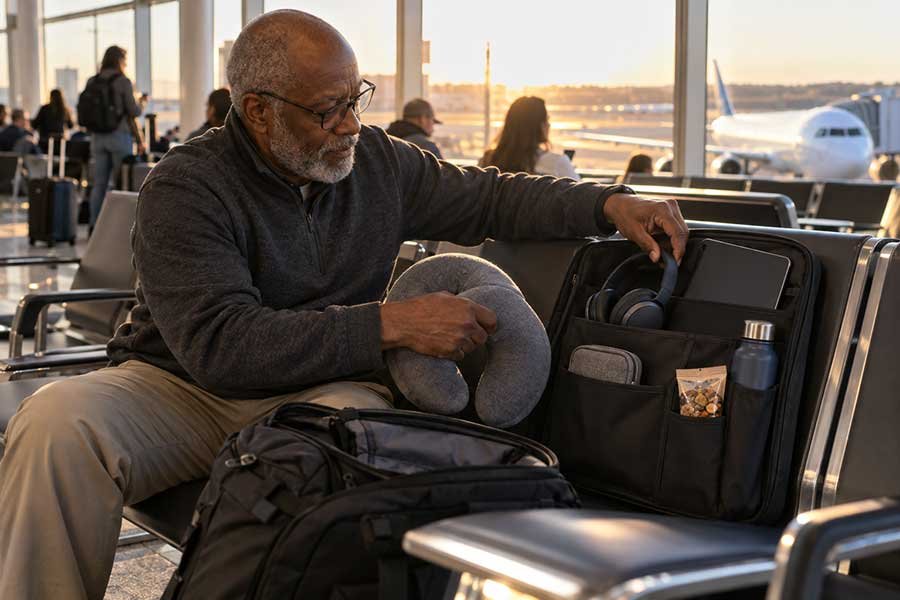
Before takeoff is the specific window when the personal item’s position and access is most freely manageable: the bag is under the seat in front, the seat is upright, the tray table is stowed, and there are no service carts in the aisle blocking movement. This is the window for organizing the personal item’s top layer to contain exactly the items needed for the first period of the flight — earphones on top, snack kit in the exterior zip — so the moment the seatbelt sign illuminates and movement is restricted, everything needed for the next two to three hours is already at the top of the bag without any rearrangement required. The traveler who organizes the personal item’s access layer before takeoff never needs to rearrange the bag during the flight.
The snack kit in the personal item’s most accessible exterior zip pocket: two to three high-protein, high-satiety options available throughout the flight without any tray table access required. A mixed nut packet, a protein bar, and a small square of dark chocolate in the exterior zip pocket are the flight’s nutritional supplement to the airline’s meal service timing, available at any moment including during the seatbelt sign and the tray-table-must-be-stowed final approach. The entertainment — downloaded films, podcasts, or a book — on the phone or tablet that stays in the personal item rather than in the carry-on overhead, accessible in fifteen seconds from the under-seat position.
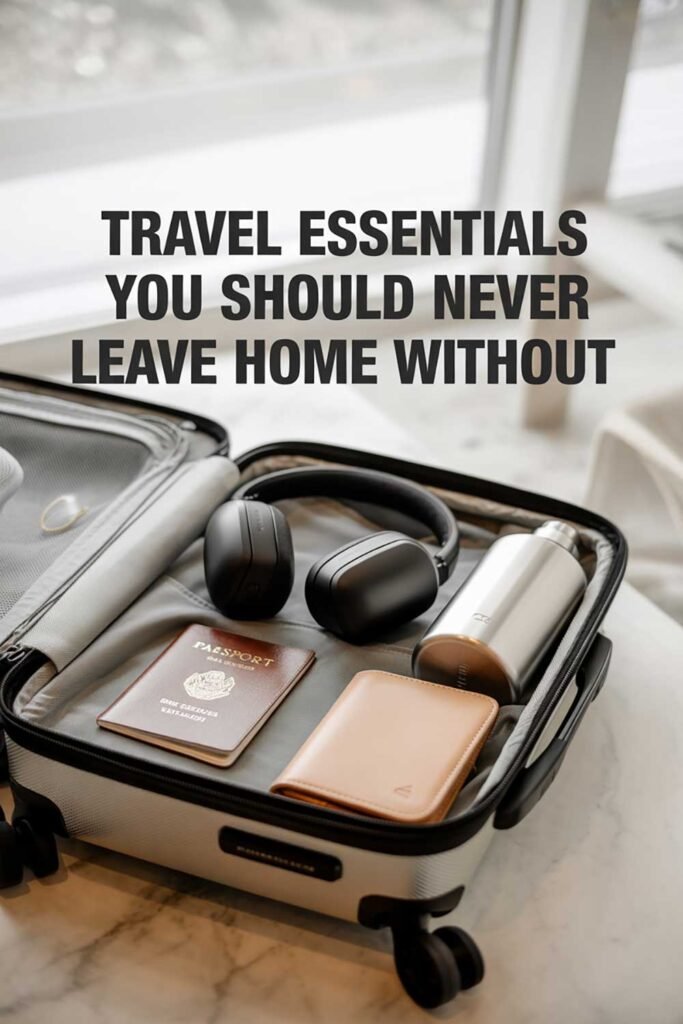
Pack the noise-canceling headphones at the absolute top of the personal item’s main compartment, not in the carry-on overhead or in the bottom of the personal item under the snacks and the change of clothes. The headphones are the single most frequently used item in the personal item over the course of a long-haul flight, and they are the item most consistently packed last (at the bottom) because they are large and awkward. Packing them last and at the top is the specific inversion that converts the boarding seat-settling from a two-minute headphone extraction from the bottom of the bag into a fifteen-second headphones-from-the-top deployment. On the ears before the aircraft door closes. That is where they belong.
A change of clothes in the personal item is the specific preparation that converts a delayed or lost checked bag from a disruption that affects the trip’s first days into an inconvenience that is resolved at the destination’s nearest shop at a time of the traveler’s choosing rather than urgently and immediately upon arrival. For the carry-on traveler, a change of clothes in the personal item serves a different but equally valuable function: it is the fresh outfit for the arrival’s first moment, the specific sensory reset that a twelve-hour flight’s recycled air, food service, and general physical compression makes genuinely welcome before the first destination activity begins.
The change of clothes for the personal item is the minimum: one clean pair of underwear, one pair of clean socks, and one clean top. For the traveler whose first destination activity is an important meeting, a reunion, or a context where arriving in a flight-fresh state matters, the addition of a pair of fresh trousers or a clean dress converts the arrival from the twelve-hour flight to the deliberate fresh start. The clean clothes in the personal item are accessible in the destination airport’s restroom before the taxi queue, converting the moment between baggage claim and the taxi from the tired end of a long journey into the rested beginning of the destination’s first impression.
The change of clothes rolls to approximately the volume of two balled socks, weighs under three hundred grams, and sits in the personal item’s main compartment between the bottom layer and the top layer without adding meaningful volume to the bag’s profile. For travelers already using the carry-on rather than a checked bag, the change of clothes in the personal item is the specific insurance that makes the gate-checked carry-on — the scenario where the overhead bin is full and the carry-on is gate-checked and inaccessible for the flight and at the destination baggage belt — a logistical inconvenience rather than an arrival appearance problem.
Include a folded face towel or a pack of facial cleansing wipes in the personal item alongside the change of clothes for the arrival restroom refresh. The cleansing wipe that removes the twelve hours of flight air’s accumulated residue from the face, applied in the destination airport’s restroom before the taxi, produces the specific arrival freshness that the change of clothes provides for the body. Together, the clean clothes and the face wipe are the two-minute arrival reset that the traveler who packed a personal item thoughtfully performs every time — and that the traveler who packed the personal item as a junk drawer of flight leftovers does not have available at the specific moment it would have been most useful.
Find Booking Ideas and Travel Essentials on Our Favorites Page
Our favorites page has helpful booking ideas and travel essentials that we have found genuinely useful for long-haul travel and flight comfort. Whether you are planning your next trip or looking for resources that make the journey itself better, it is worth a look.
DND FavoritesThe aircraft cabin’s humidity environment — typically ten to twenty percent relative humidity, compared to thirty to sixty percent in most normal indoor environments — produces the specific skin dehydration that most travelers notice as dry, tight lips and dry hands by mid-flight. These are not cosmetic inconveniences. Cracked lips are genuinely uncomfortable during the fourteen-hour overnight flight where sleep is the objective and lip discomfort is the specific interruption to sleep onset and quality that a lip balm applied before the lights dim prevents entirely. Dry, irritated hands are the tactile experience of every touchscreen interaction, every meal service contact, and every wrist movement across a flight where the cabin air is doing to the skin’s moisture barrier what it is doing to the lungs’ moisture level simultaneously.
The lip balm and hand cream in the personal item are not luxury items for beauty-conscious travelers. They are the specific comfort items that address the two most consistently noticed physical manifestations of the aircraft cabin’s dehydrating effect on the body’s skin. A lip balm weighs five grams. A travel-size hand cream weighs thirty grams. Together they represent the lowest weight-to-comfort return of any item that fits in the personal item’s exterior zip pocket alongside the snack kit. Apply both before the lights dim at the beginning of the sleep segment of the flight, again at the meal service, and again at the final approach. Three applications across a fourteen-hour flight maintain the skin’s baseline comfort throughout and contribute to the arrival freshness that the change of clothes and the cleansing wipe produce at the destination airport.
Include a travel-size facial moisturizer in the same exterior pocket. The skin’s moisture barrier is affected by the cabin environment through three mechanisms simultaneously: the low humidity increases moisture evaporation through the skin’s surface, the cabin’s temperature cycling between cool and neutral affects the skin’s blood flow and moisture retention, and the pressurized cabin air’s reduced oxygen partial pressure produces the mild skin fatigue that long-haul travelers associate with looking and feeling tired after a flight. A light facial moisturizer applied at the beginning of the sleep segment addresses the first mechanism and contributes to the arrival appearance that the clean clothes and the cleansing wipe complete. All three items — lip balm, hand cream, facial moisturizer — together weigh under forty-five grams and fit in the personal item’s exterior zip beside the snack kit.
Add a small nasal saline spray to the personal item’s skincare pocket. The nasal passages are the specific physiological location where the cabin’s low humidity most directly and most immediately affects the body. Dry nasal passages are associated with increased discomfort during the flight, slower sleep onset, and a higher likelihood of the flight’s recirculated air affecting the respiratory system. A two-gram nasal saline spray applied at the beginning of the flight and again at the mid-point maintains nasal moisture at a level that significantly improves the flight comfort experience for many long-haul travelers, particularly on overnight flights where sleep is the primary objective. The spray is available at any pharmacy for a small cost and is compliant with carry-on liquids rules at its standard small volume. It is the personal item skincare addition that is least frequently recommended and most consistently appreciated by long-haul travelers who discover it.
The complete personal item system organizes every flight-essential item into a known location within the personal item, accessible in under thirty seconds without standing, without overhead bin access, and without disturbing the seatmate at any point during the flight.
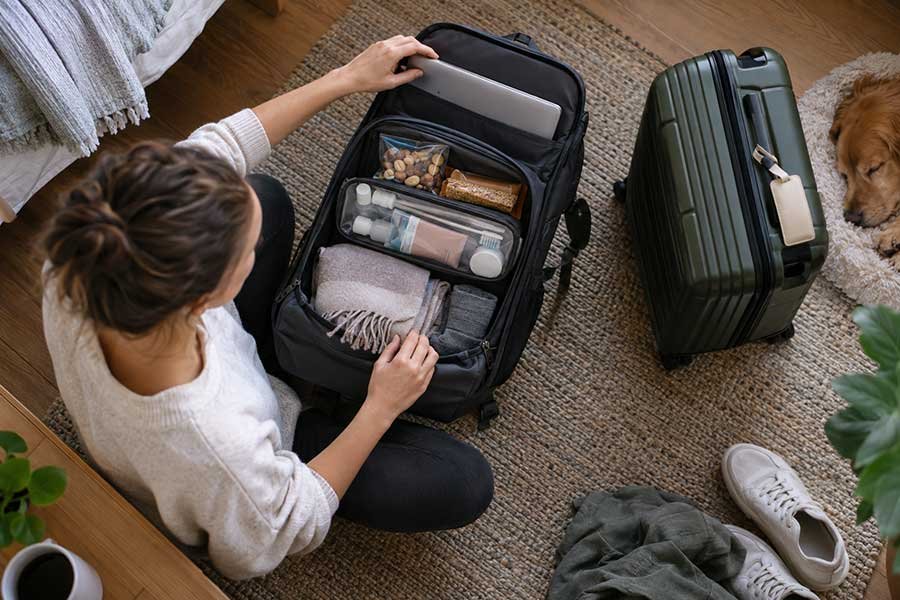
The outermost pocket: passport and boarding pass (physical or screenshot), accommodation address and any document needed within the first hour of arrival. The outer layer of the main compartment: noise-canceling headphones at the absolute top, retrieved first when seated. The middle layer: the snack kit in the most accessible exterior zip, the water bottle in the exterior bottle pocket or the main compartment’s top section, the skincare pocket with lip balm, hand cream, facial moisturizer, and nasal spray. The inner layer: the change of clothes rolled into a compact bundle, the eye mask and earplugs in a small pouch, the charger and power bank in the cable organizer’s dedicated pocket.
The laptop, if carried on the trip, belongs in the carry-on’s dedicated spine sleeve rather than the personal item’s main compartment for security checkpoint accessibility. If the personal item is the only bag for a specific trip — a short trip without the carry-on — the laptop sits in the personal item’s dedicated sleeve and is removed at the security checkpoint before the bag goes through the scanner.
The system’s governing principle is access priority: the items accessed most frequently during the flight are at the highest-accessibility position in the personal item. Documents and boarding pass at the outermost pocket. Headphones at the top of the main compartment. Snacks and skincare in the accessible exterior zip. The items accessed least frequently — the change of clothes, the eye mask pouch for the sleep segment — are in the main compartment’s inner position. Access frequency determines position. Every item is in a known location before the aircraft door closes. The flight begins from that organization and maintains it because every item returns to its known position after use.
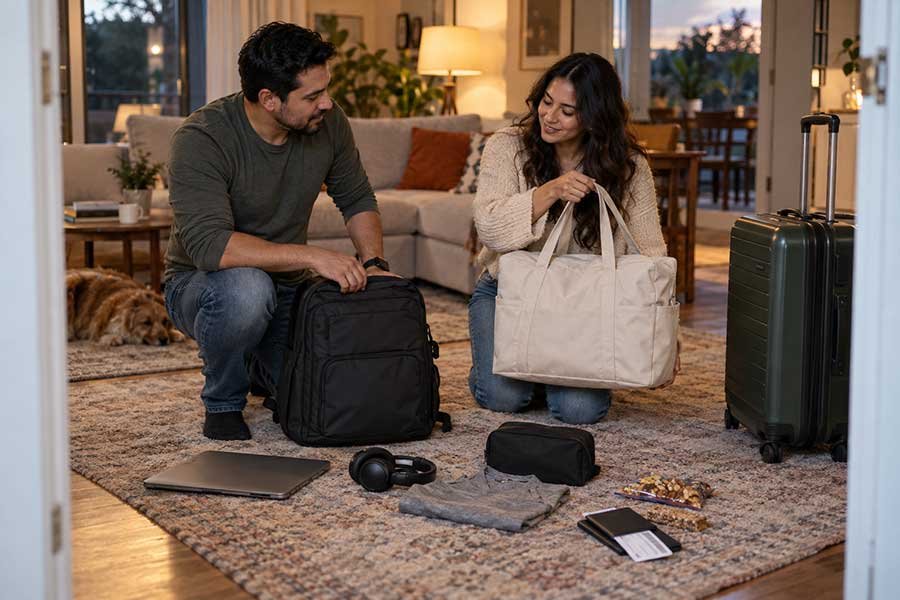
Pack the personal item the evening before departure, not the morning of. The morning-of personal item packed under departure pressure is the personal item where the headphones end up at the bottom, the boarding pass ends up somewhere in the middle, the snacks end up wherever there was room, and the change of clothes does not make it in at all because the bag was full before it was considered. The evening-before personal item is packed deliberately, in the access-priority order this article describes, with every item confirmed in its known location before the bag is set by the front door. The personal item is the bag most consistently packed last and least deliberately of all the travel bags. Making it the first bag packed rather than the last converts it from the flight’s junk drawer into the in-flight home base the journey requires.
The Bag Packed Last That Was Needed First for Eleven Hours
Aaliyah had been flying frequently enough that she thought of herself as a competent traveler. She knew the TSA system. She knew the boarding process. She knew to download the offline maps before departure. And for several years she treated the personal item as the bag that received whatever did not fit in the carry-on or whatever she grabbed in the final fifteen minutes before leaving for the airport: the laptop because it needed to be accessible, the phone charger because the carry-on was already full, the snacks in a paper bag from the kitchen counter, the passport and boarding pass somewhere in the main compartment, the headphones at the bottom because they went in first.
On an eleven-hour overnight flight, she experienced the full inventory of what the disorganized personal item costs across an extended flight. The headphones at the bottom required a complete bag excavation five minutes after boarding, producing the specific seat-standing, seatmate-disturbing, main-compartment-opening interaction at the most crowded boarding moment. The passport was needed at the transit connection in the main compartment, which required opening the bag completely in the middle of the connection’s immigration queue. The snacks were in a paper bag that had transferred to the bottom of the main compartment during the first three hours of the flight. At hour four she reached for a snack and retrieved a charging cable. At hour seven she was hungry enough to excavate for the snack bag under the headphones she had already retrieved and the passport she had already retrieved and the change of clothes she had not brought and whose absence she noticed for the first time at the destination airport after the overnight flight when she was in the arrivals hall and would very much have liked to have been a different person from the one who had just spent eleven hours in the same clothes without sleeping particularly well.
She built the system on the return flight. The boarding pass was in the outermost pocket, screenshotted in the photo library. The passport was in the outermost pocket behind the boarding pass. The headphones were at the top of the main compartment — she put them in last, specifically so they would be first. The snack kit was in the exterior zip: mixed nuts, a protein bar, dark chocolate. The lip balm and the hand cream and the small facial moisturizer were in the same exterior zip pocket. The change of clothes — one clean t-shirt, one clean pair of socks, one clean pair of underwear — was rolled in the main compartment’s inner position. The eye mask was in a small pouch on top of the change of clothes. Before the aircraft door closed she had the headphones on her ears, the snack kit at her fingertips, and the lip balm applied. She did not open the main compartment once during the eleven-hour return flight. Everything she needed was where she had put it. She arrived at the home airport, retrieved the clean t-shirt and the cleansing wipes from the personal item in the arrivals restroom, and felt like a person who had spent the night somewhere comfortable rather than someone who had spent it in a seat over the Atlantic. This article is the system she built from the outbound flight’s bag excavations and the return flight that made none of them necessary.
Beyond the four core personal item principles and the complete system, these six additional approaches address the specific in-flight scenarios that the core system does not fully prepare for.
Keep a reusable water bottle in the personal item’s dedicated bottle pocket or in the most accessible exterior section. The cabin’s ten to twenty percent humidity produces dehydration throughout the flight, the airline’s water service delivers water at intervals governed by the service schedule rather than the traveler’s hydration needs, and the personal item without a water bottle produces the specific mid-flight need for water at the moment the service cart is three rows ahead and moving away. A water bottle filled at the terminal water station after security, accessible from the personal item’s exterior at any point during the flight, converts proactive hydration from an event that depends on the service schedule into a continuous access at the traveler’s own timing. Refill it at the galley during any movement interval throughout the flight.
Include a small travel journal or a notepad in the personal item for the specific writing that long flights produce. The long-haul flight, with its extended uninterrupted hours and the specific detachment from the home environment’s obligations, is one of the few contexts in modern life where sustained thinking and writing is possible without interruption. Ideas arrive on long flights that the busyness of normal days displaces. The itinerary adjustment that the reading about the destination produced. The trip journal’s opening entry about the departure gate’s specific atmosphere. The letter that has been unwritten for months that the altitude and the isolation make possible. A small notebook in the personal item’s most accessible interior position converts the long flight from a period of passive entertainment consumption into a creative opportunity at whatever moment the passive entertainment gives way to the desire for active production.
Pack a compact travel toothbrush and travel toothpaste in the personal item’s skincare pocket for the arrival refresh and for any overnight flight where the option to brush after the meal service makes the sleep segment’s transition from eating to sleeping more comfortable. The travel toothbrush weighs fifteen grams, fits in the skincare pocket alongside the lip balm and the hand cream, and provides the specific hygiene comfort that the overnight flight’s meal service and eleven-hour interval before arrival makes genuinely welcome at the destination airport restroom.
Include a small, flat book or a downloaded ebook specifically for the flight. The in-flight entertainment system provides films and television series whose quality and selection varies by carrier and aircraft. The personal book or ebook, downloaded or physical and specific to the traveler’s current reading interest, provides the specific reading content that no airline’s library curates. A physical book in the personal item’s main compartment — slim enough to fit flat against the clothes — is the personal entertainment option that works fully in airplane mode, requires no screen brightness management for the seatmate, and provides the focused reading engagement that screen content does not always facilitate across a twelve-hour flight.
Store a small plastic bag in the personal item for the travel day’s accumulated small items: the boarding pass stubs, the receipt from the airport coffee, the small wrapper from the snack bar, the earphone cable tie that came off during headphone storage. The personal item without a designated small-item collection pouch accumulates these items in every pocket and the main compartment’s bottom during the travel day, which produces the post-flight personal item cleanup that takes longer than the flight’s small-item generation warrants. The small plastic bag in one interior pocket receives all of these items and is emptied at the accommodation as a single action rather than the pocket-by-pocket hunting that the unorganized alternative produces.
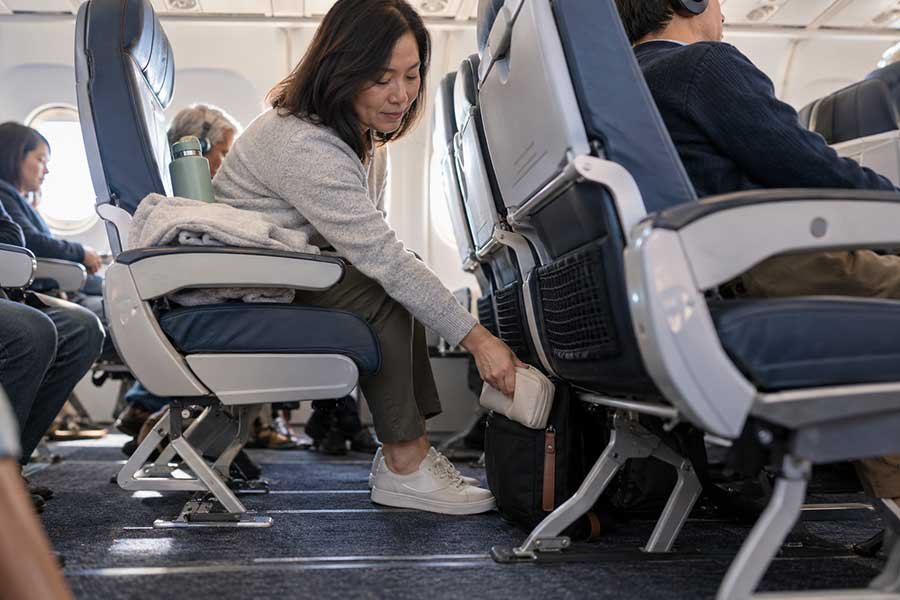
Leave the personal item under the seat in front of you for the full flight rather than stowing it overhead or in the seat pocket. The personal item under the seat is accessible at any moment during the flight from the seated position, in the dark, without standing. The personal item in the overhead bin is accessible only when standing is possible — not during the seatbelt sign, not during meal service, not during the taxi, ascent, or descent. The personal item in the seat pocket is accessible but exposed — items can fall out, the pocket’s contents are visible to the adjacent seat, and the seat pocket is not the cleaned environment that the traveler’s personal item should share for eleven hours. Under the seat in front of you, within reach at all times, every item in its known position. That is where the personal item belongs for the full flight’s duration.
After every long-haul flight, spend five minutes reorganizing the personal item at the accommodation before the next use rather than leaving it in the post-flight state for the return journey or the next departure. The post-flight personal item is always in a different state from the pre-flight personal item: the snack wrappers are in the exterior zip, the headphones are loosely coiled on top instead of in their case, the boarding pass stubs are in the document pocket with the passport, and the change of clothes that was worn at the arrival airport refresh needs to be replaced with a clean set before the next flight. The five-minute post-flight reset confirms that every item is back in its known position, the snack kit is restocked for the return journey, and the personal item is the ready and organized bag for the next use rather than the post-flight artifact of the outbound journey. The traveler who resets the personal item at the accommodation has the same organized departure experience on the return that they had on the outbound — the system works consistently because it is maintained consistently.
Book the Long-Haul Destination Worth Arriving at Organized and Rested
The personal item system earns its best return when the destination at the other end of the long-haul flight is worth arriving well. Our travel agents plan the trips worth taking the long way to reach. Let us book yours.
Book A TripCommon Personal Item Mistakes That Make Long Flights Harder
These are the personal item decisions that produce the mid-flight overhead bin excavation, the seatmate-disturbing bag search, and the arrival that feels more like survival than a beginning.
Packing the personal item as overflow from the carry-on rather than as the flight’s dedicated home base
The personal item packed as overflow from a too-full carry-on contains the carry-on’s least important items at the bag that is most accessible during the flight. The flight essentials — headphones, snacks, documents, comfort items — end up in the carry-on overhead because they were added to the carry-on before the personal item was considered. The flight is then spent accessing the overhead bin rather than the under-seat bag. Pack the personal item first, with the flight essentials, before the carry-on’s contents are determined. The personal item’s purpose is the flight. The carry-on’s purpose is the destination. Pack accordingly.
Packing the headphones at the bottom of the personal item’s main compartment
The headphones are the first item needed after boarding and the most frequently accessed item for the full flight duration. Packing them last and at the bottom produces the single most consistently avoidable in-flight inconvenience: the post-boarding headphone extraction from the bottom of the bag that stands the traveler up, opens the main compartment, and disturbs the settling-in process at the most crowded boarding moment. Pack the headphones last. They belong at the top. The thirty seconds of deliberate reversal converts the boarding’s first five minutes from a bag excavation into a seated deployment.
Keeping the passport and boarding pass in the main compartment rather than the outermost pocket
The passport and boarding pass accessed from the main compartment at the security queue, the boarding gate, and the connection’s immigration desk produce a main compartment opening at each checkpoint interaction. The outermost pocket produces a one to two-second retrieval at each interaction. The habit of always-outermost-pocket for the passport and boarding pass is established once and applies to every trip from that point forward. The main compartment stays closed at every checkpoint. Every checkpoint interaction is under five seconds.
Not including a change of clothes in the personal item for long-haul or connecting flights
The change of clothes in the personal item is the specific preparation that converts a gate-checked carry-on, a delayed checked bag, and an overnight long-haul’s arrival refresh from problems of varying severity into resolved situations. A gate-checked carry-on with the change of clothes in the personal item is an inconvenience. A gate-checked carry-on without a change of clothes in the personal item is the first destination day in yesterday’s clothes while the carry-on is retrieved from the baggage office. Three hundred grams and the volume of two balled socks. The return is potential and it is occasionally very high.
Not including lip balm and hand cream in the personal item
Lip balm and hand cream are forty grams combined and address the two most consistently noticed physical manifestations of the aircraft cabin’s dehydrating effect. The twelve-hour flight without lip balm produces cracked lips at hour eight that the flight’s remaining four hours are spent being aware of rather than sleeping through. The hand cream in the exterior zip pocket, applied at the beginning of the sleep segment, is the sensory comfort that the cabin air’s ten to twenty percent humidity is actively working to prevent. These items are not beauty products. They are the forty-gram comfort investment that maintains basic physical comfort across the full flight duration at a cost of forty grams of personal item space.
Packing the personal item the morning of departure rather than the evening before
The personal item packed the morning of departure under departure time pressure is the personal item where the headphones end up at the bottom, the boarding pass ends up somewhere undefined, and the change of clothes is the item that did not make it in because the bag was full before it was considered. The personal item packed the evening before is packed deliberately, in access-priority order, with every item confirmed in its known location before the bag is set by the door. The personal item is the bag most consistently packed last and least deliberately. Making it the first bag packed — packed the evening before with the same intentionality as the carry-on — converts it from the flight’s junk drawer into the in-flight home base this article describes.
Love Helping Travelers Experience Every Part of the Journey Comfortably?
The traveler who arrives at a destination organized, refreshed, and ready is the traveler whose journey was well-planned from the personal item to the itinerary. If becoming a home-based travel agent who helps people travel better on every flight sounds like the right next step, see how the TravelPreneur system works. Earn commissions and build a real business from anywhere.
Become An AgentFrequently Asked Questions
These are the questions travelers ask most often about packing the personal item effectively for long flights.
What size should a personal item be for long flights?
The personal item size for any specific flight is governed by the airline’s personal item size limit for that booking, which is not standardized across carriers. Most airlines allow a personal item of approximately eighteen by fourteen by eight inches or the equivalent, though some budget carriers have smaller limits and some specific fares restrict personal items more significantly. The personal item for a long-haul flight should be as large as the specific airline permits, sized to fit under the seat in front comfortably without protruding into the foot space significantly, and structured enough to maintain its organization when placed under the seat. A structured backpack or a structured under-seat bag with multiple exterior pockets provides the best personal item format for a long-haul flight: the structure maintains the internal organization, the exterior pockets provide the access-priority positions for documents and comfort items, and the backpack format allows comfortable carrying between connections and at the destination. Always confirm the specific personal item size limit for the specific airline and fare class before packing rather than assuming a standard dimension applies.
Should you put your laptop in your personal item or your carry-on?
For security checkpoint efficiency, the laptop belongs in the carry-on’s dedicated spine sleeve or exterior-accessible laptop compartment rather than the personal item’s main compartment. The carry-on’s dedicated laptop compartment is accessible from the exterior without opening the main compartment, allows the laptop to be placed in the security tray in five seconds, and maintains the carry-on’s internal organization. The personal item in the main compartment with the laptop packed inside requires the full main compartment to be opened at the security tray, disturbs the personal item’s access-priority organization, and reduces the space available for the flight essentials the personal item’s purpose requires. For the specific trip where the personal item is the only bag and no carry-on is being used — a genuinely minimal travel configuration — the personal item’s dedicated laptop sleeve, if the bag has one, is the correct laptop position. The general rule: the laptop travels with whichever bag has the dedicated security-accessible laptop sleeve.
How do you keep a personal item organized under the seat for the full flight?
The personal item stays organized under the seat when every retrieved item is returned to its known location immediately after use rather than placed wherever is convenient at the moment. The headphones retrieved from the top of the main compartment and placed on the seat or the tray table rather than returned to the top of the main compartment when not in use become the headphones that are somewhere on the tray table when the descent tray stowage announcement requires them to be in the bag. The snack wrapper from the exterior zip pocket dropped into the main compartment rather than the small plastic collection bag becomes the main compartment clutter that the arrival restroom cleanup involves. The system is maintained by the return-to-known-location habit applied to every item after use throughout the flight. Each return takes five seconds. The collective result is the personal item that is as organized at landing as it was at takeoff.
What are the best items to have easily accessible in a personal item on a long flight?
The items that benefit most from being in the personal item’s most accessible exterior pocket rather than the main compartment are the items accessed most frequently during the flight without warning — the items whose absence from immediate access produces the overhead bin dig or the full main compartment opening. In order of access frequency on a typical long-haul flight: noise-canceling headphones (first out at boarding, last in before landing), the snack kit (accessed throughout the flight independently of meal service), the water bottle (accessed as frequently as the hydration habit requires), the skincare pocket with lip balm, hand cream, and moisturizer (accessed two to three times across the flight), and the phone charger (accessed whenever the seat outlet requires it). The documents — passport and boarding pass — are accessed primarily pre-flight and at connections rather than during the flight itself, and are in the outermost pocket for those specific high-frequency checkpoint moments rather than for in-flight access. The change of clothes and the eye mask are accessed once each, at their specific moment, and live in the main compartment’s interior position because their low in-flight access frequency does not warrant the exterior pocket accessibility that the high-frequency items require.
Is it worth buying a specific personal item bag for long-haul travel?
A personal item bag purchased specifically for long-haul travel is a worthwhile investment for any traveler who takes more than two long-haul flights per year. The specific features that a purpose-built long-haul personal item bag provides and that a general bag typically does not: a dedicated document pocket in the outermost accessible position, a dedicated laptop sleeve with exterior access for security checkpoints, multiple exterior zip pockets for the access-priority items this article describes, a water bottle pocket on an exterior wall, a structured base that keeps the bag upright under the seat and prevents contents from shifting during the flight, and dimensions that are optimized for the under-seat space of economy class seats without wasting dimensions in any direction. These features collectively produce the in-flight home base that this article describes from a bag designed for exactly that purpose rather than a general bag adapted to it. The investment is amortized across every long-haul flight for the product’s useful life, which for a quality personal item is typically several years of regular use.
What do you do if your personal item is gate-checked?
A gate-checked personal item — where the gate agent determines that the aircraft’s under-seat space is insufficient for the bag — is the scenario the carry-on system is designed to prevent but that occasionally occurs on smaller regional aircraft or full flights. The response: before handing the bag to the gate agent, quickly retrieve the absolute minimum items needed for the flight from the personal item: the headphones, the phone, the charger, and any medication. These fit in the jacket pockets and the seat pocket, providing the flight essentials without the personal item. The boarding pass screenshot in the photo library is already on the phone, so the boarding pass in the outermost pocket is covered. The change of clothes and the comfort kit will be inaccessible for the flight. The gate-checked personal item is typically returned at the aircraft door at the destination rather than at baggage claim, so the delay is the boarding sequence and the jet bridge positioning rather than a baggage belt wait. The personal item system reduces the impact of this scenario from a full-flight inconvenience to a managed one because the phone with the boarding pass screenshot and the headphones retrieved before handoff cover the flight’s essential functions.
The flight where you never opened the overhead bin, never disturbed the seatmate, and had everything you needed within thirty seconds of wanting it was not an accident. It was the personal item packed the evening before in access-priority order. That is the home base that the journey requires.
Picture the Moment After the Seat Belt Sign Goes Off
The boarding pass was in the outermost pocket and cleared every checkpoint without opening the main compartment. The headphones were at the top of the personal item and are on your ears before the aircraft door closed. The snack kit is in the exterior zip. The lip balm and hand cream are in the same pocket. The change of clothes is in the inner section. The eye mask is in its pouch above it. The water bottle is in the exterior pocket. Everything is in its known location. The seat belt sign goes off. You do not stand up. You do not open the overhead bin. You reach into the exterior zip and take out a handful of mixed nuts. You put the second film on. You are home. The destination is six hours away. You are already there. That is the in-flight home base. That is every long-haul flight from here.
One More Thing Before Your Next Long-Haul Flight
Print our free Travel Packing Checklist and use the personal item section to confirm every flight essential is in its access-priority position before the bag is set by the door. Documents in the outermost pocket, headphones at the top of the main compartment, snacks and skincare in the exterior zip, change of clothes in the interior. Confirmed the evening before. Home base ready before the boarding call. The same checklist we use before every long-haul flight we take.
Get the Free ChecklistExplore Our Top Picks for a Better Trip
Visit our favorites page for helpful booking ideas and travel essentials that we have found genuinely useful for long-haul travel and in-flight comfort. Whether you are planning your next big trip or looking for things that make the journey itself more comfortable and organized, it is worth a look.
See Our Top PicksTravel Prints and Printables From Our Shop
Visit Premier Print Works for packing list printables, personal item organization guides, flight preparation checklists, travel journals, and wall art that makes every trip a little more beautiful and a lot more organized from the evening the personal item is packed by the door to the morning the outermost pocket clears every checkpoint without a pause.
Visit Premier Print WorksDisclaimer
The information shared in this article is provided by Don and Diana’s Travels for general informational, educational, and inspirational purposes only. It reflects our personal experiences, opinions, and the experiences of travelers we have worked with. It is not professional medical, health, legal, or travel advice, and it should not be relied on as such.
Airline Policies and Personal Item Dimensions
Airline personal item size limits, carry-on policies, and related baggage rules change frequently and vary by airline, fare class, route, and aircraft type. Always confirm current personal item dimensions with the specific airline for the specific booking before travel. We are not responsible for any baggage fee, gate check, or baggage-related outcome arising from information in this article.
Health and Skincare Information
The skincare and personal care information in this article, including the discussion of lip balm, hand cream, facial moisturizer, and nasal saline spray, is general educational information for typical healthy travelers and is not professional medical or dermatological advice. Individual skin responses to cabin humidity vary. If you have specific skin conditions, allergies, respiratory conditions, or other health concerns that may be relevant to the products or practices described, consult a qualified healthcare provider. We are not responsible for any skin, health, or comfort outcome arising from information in this article.
Security Checkpoint Information
TSA and airport security checkpoint procedures, personal item requirements, and liquids rules change frequently. Always confirm current requirements with the relevant security authority before travel. We are not responsible for any security outcome arising from information in this article.
Affiliate and Partner Links
This article may contain affiliate links, partner links, referral links, and links to products or services that pay us a commission. If you click a link and make a purchase or complete any qualifying action, we may earn a small commission at no extra cost to you. Our recommendations are based on real use and genuine belief in the products and services we share.
Third-Party Websites and Services
We may link to third-party websites, services, and resources for your convenience. We do not control these sites and are not responsible for their content, terms of service, pricing, availability, or any product or service they sell. Your use of any third-party site is entirely at your own risk.
Health, Safety, and Personal Responsibility
Travel involves personal risk. You are solely responsible for your own health, safety, travel insurance, medications, vaccinations, documentation, financial decisions, and choices while planning or taking any trip. We strongly recommend purchasing comprehensive travel insurance for every trip. Don and Diana’s Travels, its owners, employees, contractors, and affiliates accept no liability for any loss, injury, illness, delay, cancellation, damage, theft, or inconvenience arising from your use of the information in this article or from any travel decisions you make.
Composite Stories and Characters
Some stories, examples, and traveler experiences shared on this site are composites drawn from the real experiences of Don, Diana, clients, friends, and travelers we have worked with over the years. Names, identifying details, locations, and circumstances may be combined, changed, or fictionalized to protect privacy. Any resemblance to a specific real person beyond the composite portrayal is unintentional.
No Guarantees
We do not guarantee any specific result, outcome, savings, or experience from using the information, tips, services, or products mentioned in this article. Your results depend on many personal factors including your own choices, effort, circumstances, and external conditions outside of our control.
Copyright and Use
All content in this article is the copyrighted property of Don and Diana’s Travels unless otherwise noted. You may not copy, republish, redistribute, modify, sell, or reuse our content without our prior written permission. You are welcome to share a direct link to this article with proper credit.
By reading and using the information in this article, you acknowledge that you have read, understood, and agree to this disclaimer in full.