Travel Hacks for Road Trips With Kids
Road trips with kids run smoothest when every child has their own zone and every mile has a plan. The families who love road trips most are the ones who treated the drive as part of the destination, not an obstacle to it. This article builds the system that makes that possible — from the downloaded shows before departure to the buffer time that turns unexpected detours into the trip’s best stories.
Grab Our Travel Packing Checklist
Our free packing checklist includes a family road trip section that covers the car organization, snack kit, and each child’s entertainment needs alongside the standard packing categories. Print it before your next family road trip and use it as the complete family departure preparation guide.
Get the Free ChecklistThe family road trip’s in-car entertainment strategy lives and dies by one decision made the night before departure: whether the content the children will want for the next eight hours was downloaded to the devices before the cellular signal became a rural bar-or-two situation forty-five minutes outside of town. The streaming app that requires reliable connectivity, the audiobook that only exists in the cloud, and the podcast episode not yet pulled offline are all entertainment options that remain available in theory for the full drive and available in practice for approximately the first ninety minutes until the signal drops and the spinning loading indicator becomes the children’s primary in-car experience.
The pre-download evening session — one of the simplest and highest-return preparations the family road trip offers — covers the full expected driving duration for each child’s device plus a buffer. For a seven-hour drive, each tablet or phone receives enough downloaded content for ten hours: three to four episodes of the series currently being watched, one film as the longer-form engagement option when the episode format loses its appeal, one audiobook for the listening periods, and any games that function offline for the active-engagement breaks between passive viewing sessions. Each device’s download session takes fifteen to twenty minutes on home WiFi and produces a self-contained entertainment environment that functions at full service regardless of what the cellular infrastructure along the route provides.
The family audiobook deserves special mention as the road trip entertainment form that works for every person in the car simultaneously. A well-chosen audiobook — one that engages the children’s age range and does not bore the adults into distracted driving — is the entertainment form that the individual-device content cannot provide: a shared experience, a story that unfolds at the same pace for everyone in the car, and a naturally recurring stopping point at chapter endings that makes the stopping-for-gas moment feel like a satisfying chapter break rather than an interruption to whatever the back seat was in the middle of. Download the family audiobook to the car’s Bluetooth speaker or the front seat’s device before departure. Start it after the individual device content has run its first session and the family is ready for something together.
The families who love road trips most are the ones who treated the drive as part of the destination not an obstacle to it.
Road trips with kids run smoothest when every child has their own zone and every mile has a plan.
Create a Road Trip playlist on a streaming service the evening before departure — songs the whole family knows and enjoys — and download it offline alongside the individual content. The music playlist is the unifying entertainment option for the first thirty minutes of the drive, the departure energy-setter that makes the first miles feel like the trip has properly begun, and the fallback option for the inevitable moment when the back seat cannot agree on what to watch next and needs a neutral entertainment choice that does not require any child to accept someone else’s show preference. Downloaded before departure. Available throughout. Everyone knows the words.
Let Us Help You Book the Family Road Trip Destination Worth Driving To
A well-planned family road trip starts with a destination worth the drive. Tell us where you want to take the family and when you can travel. We will help you plan the route, identify the best stops, and book the accommodations that work for everyone in the car. You handle the snack pouches. We handle the rest.
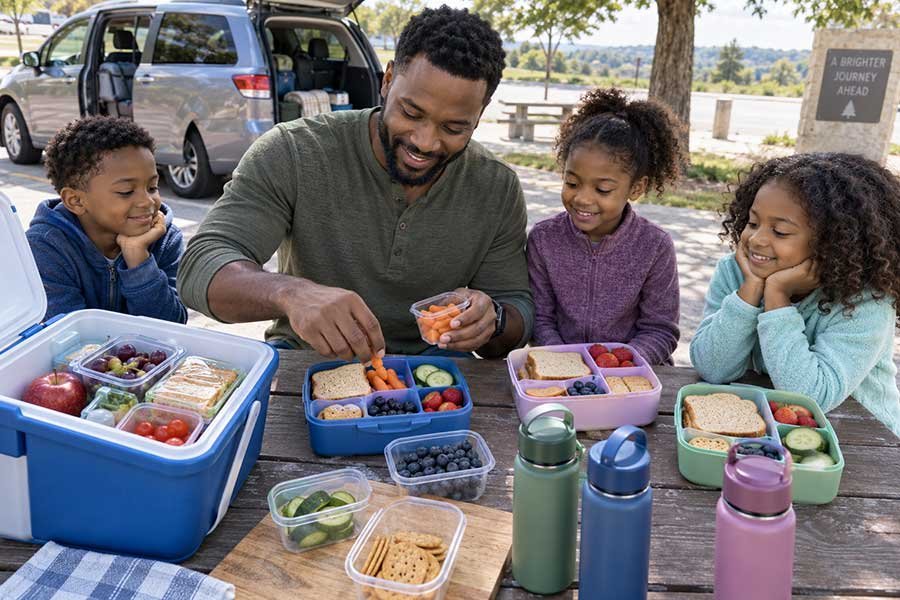
Plan Our EscapeThe communal snack bag in the family road trip car is the snack system that produces one child eating everything in the first hour of a seven-hour drive, one child unable to find their preferred item because a sibling took the last one, and a third child asking for a snack from the communal bag and receiving the honest answer that there is nothing left that any of them actually want, fifteen minutes before the gas station with the overpriced convenience store options that the communal bag was specifically intended to prevent. The individual snack pouch for each child is the snack system that gives every child sovereignty over their own food supply, eliminates the communal bag’s specific sibling-negotiated inequality, and extends the snack supply across the full driving day rather than concentrating it in the first quarter.
The individual snack pouch — a small zippered bag or a cloth pouch — contains each child’s specific preferred snacks in quantities calibrated for the full trip’s snack occasions: a mid-morning snack, a pre-lunch bridge, an afternoon snack, and the post-dinner mileage snack for long driving days. Each pouch is assembled at home the evening before with the specific items each child prefers rather than the communal compromise bag’s items that represent everyone’s second-favorite options. The older child’s pouch has the trail mix and the protein bar. The younger child’s pouch has the crackers and the squeeze apple sauce and the fruit gummies. Each pouch is the child’s snack library for the full trip, managed by the child rather than distributed by the parents, and consumed at the child’s own pace rather than at the communal bag’s first-come-first-served rate.
The individual pouch system also eliminates the specific road trip parental distraction of the front-seat snack distribution while driving — the reach back, the opened bag negotiation, the finding of the specific item from the communal collection — by making each child’s snack access self-contained and self-managed. Each child reaches into their own pouch in the back seat and retrieves their own snack. The front seat’s attention stays on the road.
Include a treat item in each individual pouch that is genuinely exciting rather than just present. The treat is the specific item in the pouch that the child has been looking forward to since the pouch was assembled — a specific candy, a specific chocolate bar, a specific fruit snack that is not part of the normal home snack routine. The treat is the pouch’s reward item that makes the pouch feel like a gift rather than a ration. It also provides the specific incentive that patient behavior in the car earns: the child who has been managing their pouch well reaches for the treat when the mood in the back seat needs a lift. One treat item per pouch. The parents choose when to tell the child it is treat time, which produces a small but genuine motivation for whatever behavior the trip has most recently required.
The road trip measured in destination arrival time is the road trip that treats every driving hour as a cost to be minimized. The road trip measured in stops worth stopping for is the road trip that treats every driving hour as movement between experiences that are part of the trip rather than time between the car and the destination. Children, whose experience of time in a moving vehicle is not the same as an adult’s experience of time in a moving vehicle, respond to the distance as an experience rather than a duration — which means that a seven-hour drive with three genuinely exciting stops is a completely different experience from a seven-hour drive with three bathroom stops at gas stations.
The exciting stop is not simply a rest stop or a fuel stop, though fuel and bathroom access are included in the stop’s logistics. The exciting stop has a specific child-appealing feature that makes the stop something to look forward to rather than a interruption to the driving: a specific roadside attraction that the children have been told about since the morning’s departure, a specific park or playground where everyone runs around for twenty minutes and the back-seat energy is reset, a specific food item at a specific local stop that is available nowhere else on the route and that the children have been told about since breakfast as the day’s exciting food moment. Each stop’s specific appeal should be communicated to the children in advance — not as a bribery but as an itinerary item, the same way the destination’s first activity is discussed with genuine excitement. The children know that in two hours there is a specific thing worth seeing. That knowledge makes the two hours manageable in a way that two hours of unannounced driving toward the gas station does not.
Research the stops in advance. Most family road trip routes between any two significant destinations pass through or near small-town attractions, natural landmarks, state parks with accessible trailheads, historic roadside sites, and regional food institutions that are worth knowing about before departure. The roadside ball of twine, the world’s largest something, the small-town diner with the specific pie, the overlook with the view that makes the children genuinely go quiet for thirty seconds: these are on the route. They require thirty minutes of research the week before departure to find and ten minutes at the right exit to experience. The stop that costs forty minutes of driving time produces the specific memory that the destination’s most planned experience may not.
Let each child over the age of five or six choose one stop from a pre-approved list prepared before departure. The ownership of the stop — this is the stop I chose, this is the place we are going because I picked it — converts the child’s relationship to the drive’s rhythm from a passive passenger to an active participant. The child who chose the stop is invested in reaching it, is engaged with the approach, and experiences the stop with the specific pride of having selected correctly. Each child gets one choice. The parents set the approved list to ensure the choices are achievable. The drive becomes a series of someone’s choice rather than an adult-determined sequence of interruptions.
Find Booking Ideas and Travel Essentials on Our Favorites Page
Our favorites page has helpful booking ideas and travel essentials that we have found genuinely useful for family road trips. Whether you are planning your next family adventure or looking for resources that make driving with kids more enjoyable, it is worth a look.
DND FavoritesChildren experience time in a moving vehicle through a fundamentally different set of physical needs and attention spans than adults do. A child who needs to use the bathroom in a car does not need to use the bathroom at the next reasonable stopping opportunity. They need to use the bathroom at the moment the need arrives, which may be nineteen minutes after the last stop that everyone confirmed was enough. A child who is hungry in a car is not hungry in a way that is manageable until the planned lunch stop in forty minutes. They are hungry in a way that is immediately relevant to the quality of the back seat’s atmosphere. A child who is done being in the car is done being in the car at a time that does not correspond to the GPS’s estimated arrival, the accommodation’s check-in window, or the parents’ planned driving schedule.
Building buffer time into the family road trip schedule is the specific acknowledgment that the driving day will not proceed at GPS pace. The practical buffer: add one hour for every four hours of GPS-estimated driving time as the family road trip’s honest duration estimate. A four-hour GPS drive is a five-to-six-hour family road trip with children. An eight-hour GPS drive is a ten-to-eleven-hour family road trip with children. The accommodation booked for a 3 p.m. arrival on a five-hour GPS drive should be the accommodation that is comfortable with a 5 p.m. arrival, not the accommodation with a strict 3 p.m. check-in that produces the final hour of driving under the specific family road trip pressure of the accommodation deadline.
The buffer time is not wasted time on the family road trip. It is the time that the children’s specific road trip schedule fills with exactly the experiences the adult schedule did not plan for: the longer stop at the roadside attraction because everyone was having too much fun to leave on schedule, the spontaneous turn onto the road with the interesting sign, the extended playground stop because the children had been in the car for three hours and the parents had been in the car for three hours and twenty minutes of running around was not optional. The buffer time absorbs the unplanned good moments as readily as it absorbs the unplanned difficult ones, and the family that arrives at the destination ninety minutes after the GPS estimated but having stopped at three things the GPS did not plan for has had a better road trip than the family that arrived on GPS time and passed everything the GPS had no knowledge of.
Communicate the buffer time philosophy to the children before departure in age-appropriate terms. Rather than a specific arrival time that becomes a countdown and a source of back-seat pressure as the hours accumulate and the estimated arrival recedes, tell the children that the trip will arrive when it arrives and that the stops along the way are part of the day’s plan. The child who is told they will arrive at 3 p.m. and it is now 4:30 p.m. has been managing a specific disappointment for ninety minutes. The child who was told the trip will get there when it gets there and there will be stops along the way is experiencing the road trip as a sequence of events with an open arrival time rather than a failure to achieve a promised schedule. The second child’s road trip experience is better in every measurable way, and the parents’ experience is better because no one in the back seat is asking why it is taking so long relative to a specific promised time.
The family road trip system that makes the drive part of the destination rather than the obstacle before it is built on four foundations: entertainment prepared before departure, food sovereignty for each child, stops worth stopping for, and a schedule that treats children’s road trip needs as legitimate rather than inconvenient.
The evening before departure: each child’s device receives the downloaded content for the full driving duration plus buffer. The family audiobook is downloaded to the front-seat device. Each individual snack pouch is assembled with the specific snacks and the treat item. The route’s exciting stops are identified, their timing is noted on the driving plan, and the children are told about at least two of them at the evening’s dinner as part of the trip’s excitement-building. The car is loaded with everything that is going in the car the night before rather than the morning of, so the departure morning is the car seats, the devices charged, and the departure — not the loading session.
The departure morning: the children know the first stop’s specific appeal and approximately when it will arrive. The individual snack pouches are within reach of each child in the back seat without any adult intervention required. The devices are charged to full and in their holders. The family audiobook is cued to Chapter One. The departure happens at the time that provides buffer for the driving day’s actual pace rather than the GPS’s theoretical pace. The car leaves and the trip has begun — not when the destination is reached, but when the driveway is cleared.
During the drive: stops happen at the planned intervals and occasionally at the unplanned ones. The snack pouches are managed by their owners. The entertainment transitions from individual devices to the family audiobook to the playlist and back without the front seat managing each transition. The buffer time absorbs whatever the drive produces. The destination arrives when it arrives, having been preceded by several things worth remembering.
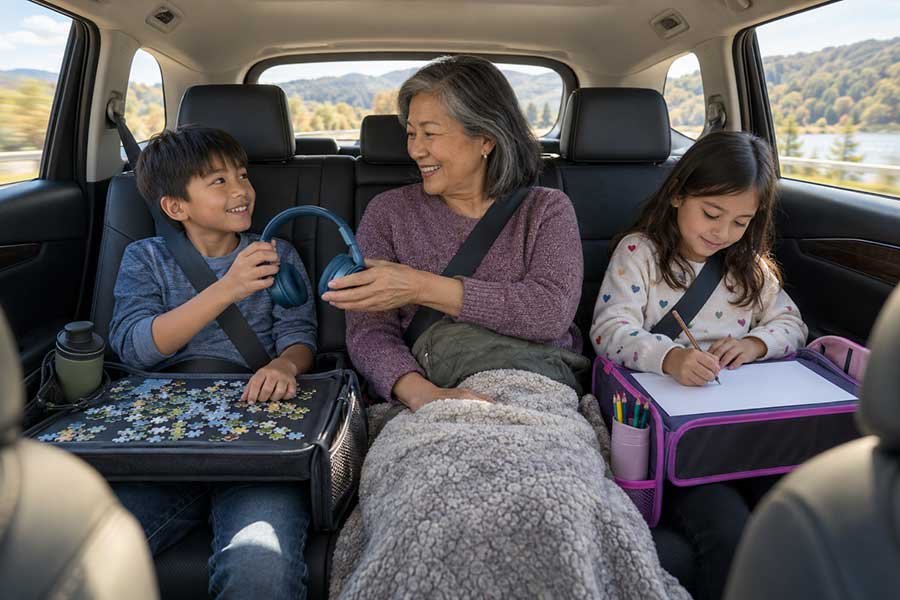
Keep a small activity kit in each child’s seat back organizer alongside the snack pouch — a small notepad, a few colored pencils, a compact travel game, and a window cling set — for the driving periods when the screen content is done or the audiobook is not holding attention. The low-tech activity kit does not replace the downloaded entertainment but supplements it for the specific back-seat energy of a child who wants to do something rather than watch something. The window clings in particular are the zero-mess, unlimited-reuse activity that produces ten to fifteen minutes of genuine quiet engagement at the window’s condensation level in a way that nothing involving paper or pencils in a moving car reliably produces.
The Eight-Hour Drive That Taught Her the Children’s Schedule Exists
Renee had planned the family road trip the way she planned everything: efficiently. The route was mapped. The departure time was calculated to arrive before the accommodation’s check-in window closed. The driving hours were divided into two segments with one fuel stop in between, timed to arrive at the fuel stop at the specific intersection that had the fast food restaurant her children preferred. The entertainment strategy was the shared family tablet with the streaming app and a good signal for most of the route according to the carrier’s coverage map.
The first indication that the children’s road trip schedule was different from her route plan came at hour one and forty minutes, when the youngest needed to stop. Not when they reached the planned fuel stop. At hour one and forty minutes. Renee stopped. She noted the time. She recalculated the arrival. The recalculation produced an arrival fifteen minutes later than planned, which felt manageable. At hour two and fifty minutes, the tablet’s streaming app began buffering because the coverage map had a gap that the map’s scale had not communicated, and the content that had been streaming smoothly since departure stopped and produced the spinning indicator. The oldest asked how long until the planned fast food stop. The answer was one hour and twenty minutes. The oldest communicated that one hour and twenty minutes was a long time. The youngest agreed, with emphasis.
The fuel and food stop happened eventually and was a significant relief for everyone in the car. It lasted longer than planned because the children needed to run around in the parking lot for eight minutes before they were able to get back in the car with any degree of cooperative energy. The recalculated arrival was now fifty minutes later than original. The second driving segment was quieter — the tablet had been taken offline before the cellular gap’s recurrence destroyed whatever content the children were watching — but quieter did not mean easy. The accommodation was reached at 5:40 p.m. for a check-in that closed at 6:00 p.m. The front desk staff confirmed they arrived just in time with twelve minutes to spare.
In the car’s parking space after check-in, Renee made the list. Download all content offline before departure. Individual snack pouches for each child. One stop with something genuinely worth stopping for somewhere in the middle of the drive. Build two hours of buffer into the next road trip’s schedule. Do not plan the accommodation check-in at the GPS arrival time. The next road trip was different. The children knew about the waterfall they were going to stop at. Their pouches were full of their specific snacks. The content was downloaded and playing from the moment the coverage map’s gap began. They arrived at 6:15 p.m. for a 7:00 p.m. check-in. The waterfall stop had been everyone’s favorite part of the day and had added forty minutes to the drive. Those forty minutes were the best forty minutes of the trip. This article is the system she built from the twelve minutes to spare.
Beyond the four core family road trip principles, these six additional approaches address the specific back-seat management, car organization, and family travel dynamics that the core system does not fully cover.
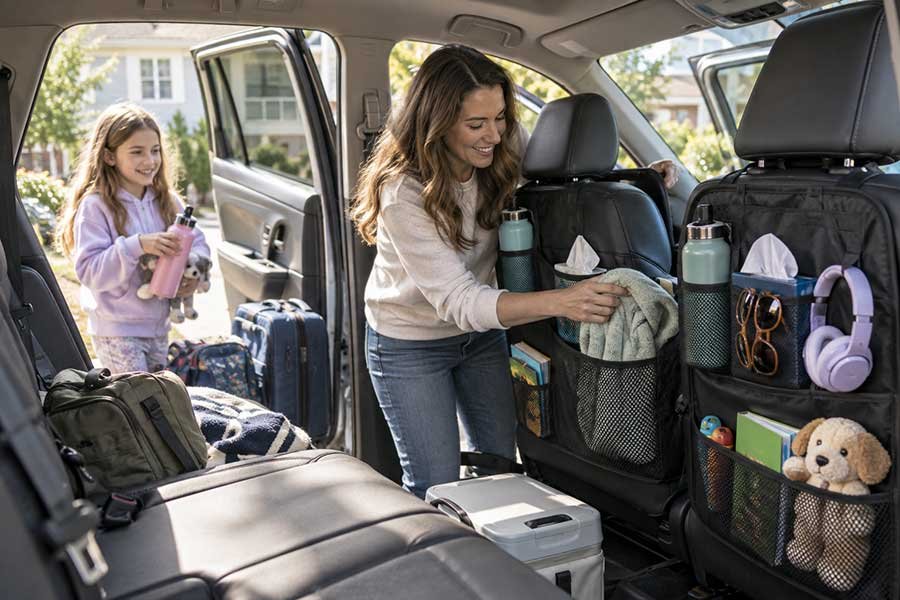
Organize the back seat before departure with each child’s zone clearly defined. Each child’s space includes the seat back organizer with the individual snack pouch, the activity kit, and the device holder at a height accessible from the seat. The zone definition is as much psychological as physical: the child who has a defined space — their snack is here, their activity kit is here, their device is here — is significantly less likely to encroach on the adjacent child’s zone than the child who has no defined space and defaults to the available space, which is whatever is not yet occupied by the adjacent child. Zone definition before departure does not prevent every back-seat boundary dispute. It reduces their frequency and their intensity by making the boundaries visible and agreed upon before the car is moving.
Plan the driving departure time around the children’s sleep schedule rather than the adults’ efficiency preference. For families with young children who still nap, the road trip that departs at nap time produces forty-five minutes to two hours of quiet, sleeping children as the first stretch of driving — which is the stretch where the adults can cover the most ground most efficiently. For families with older children, a departure before sunrise produces the same effect: the children sleep through the early morning hours, the adults cover the most miles in the quiet, and the children wake to the drive already several hours underway and the first exciting stop approaching rather than several hours of driving still ahead of them.
Pack a dedicated cleaning kit in the car’s central console or the front passenger seat’s door pocket: wet wipes, paper towels, a small bin liner, and a stain-remover pen. The spilled drink, the motion-sickness emergency, and the snack that escaped its pouch and found a seat fold are the specific cleaning events that family road trips produce with a reliability that makes the cleaning kit a necessity rather than a precaution. The cleaning kit available in five seconds from the front seat converts each of these events from a road trip disruption into a managed inconvenience that the kit resolves before the back seat’s reaction to it escalates the situation.
Use a car-specific trash system — a small hanging bin or a reusable bag attached to the back of the front headrest — rather than relying on the children to manage their own wrappers and drink cups. The back seat of the family road trip car without a specific trash destination accumulates the day’s snack wrappers, drink straw wrappers, wet wipe packaging, and empty juice boxes in every available crevice by mid-afternoon. The specific trash destination converts the back seat’s natural entropy into a managed system where the trash goes in the bin as it is generated rather than into the seat fold and under the seat and out the window if the window happens to be open at the relevant moment.
Research and note the location of rest areas, playgrounds, and interesting small stops at thirty-minute intervals along the route rather than only noting the planned stops. The buffer time the family road trip requires is most usefully absorbed by a known stop rather than a pulled-over highway shoulder. The rest area with the walking path, the small town with the historical marker worth a five-minute look, and the park visible from the highway with the parking entrance sign — knowing these exist before the drive allows the buffer’s unplanned stop to be a good stop rather than an improvised one. Google Maps saved along-the-route locations, a quick highway rest area search the evening before, and the route’s state or regional tourism website provide the specific along-route stop knowledge that converts buffer time from waiting to experience.
Give each child a specific role in the road trip’s shared experience rather than treating every child as a passenger. The navigator who has a paper map and is following the route with a marker. The spotter who is looking for the specific animal, license plate state, or roadside item on the family’s I Spy list. The historian who is reading from a short age-appropriate account of the places the route passes through. Each role is age-calibrated and each role produces genuine engagement with the drive as an experience rather than a duration. The child with a role in the road trip is not asking when the destination will arrive. They are doing the road trip’s work of their designated area, which is the specific orientation toward the drive as a thing worth doing that the families who love road trips most already have.
Start a road trip journal tradition with the children — a small notebook for each child in which the trip’s specific observations, drawings, and mementos (a ticket stub from the waterfall’s parking fee, a pressed flower from the rest area’s wildflower patch, a sticker from the gas station’s collection) accumulate into a physical record of the trip that the children keep. The road trip journal is not assigned homework for the back seat. It is an optional activity that some children take to enthusiastically and some set aside after three miles. The child who takes to it produces, by the trip’s end, the most accurate and most specific record of what the trip actually contained — which is almost always different from what the parents would have recorded from the front seat, and almost always more interesting.
Book the Family Road Trip Destination Worth Every Mile
A great family road trip destination is one that rewards every person in the car — the children’s sense of wonder and the adults’ sense of place. Our travel agents know the family-friendly destinations and the routes worth driving. Let us plan yours.
Book A TripThe Family Road Trip Mistakes That Make Long Drives Feel Longer
These are the planning decisions that the GPS’s estimated arrival time does not account for. Each has a system-based resolution in this article.
Planning entertainment around streaming rather than downloading
The streaming entertainment strategy requires the cellular coverage that rural and highway driving consistently does not provide for the full route. The downloaded content plays at full quality from the moment the driveway is cleared to the moment the parking spot is found, regardless of what happens to the signal between those two moments. Download everything. Every device. The night before. There is no good version of a family road trip where the cellular coverage decides what the back seat watches.
Using one communal snack bag instead of individual pouches
The communal snack bag is the snack system that produces sibling negotiation, uneven distribution, and a bag empty by hour three of an eight-hour drive. The individual pouch is the snack system that gives each child autonomy over their own supply, eliminates the negotiation, and extends the snack supply across the full driving day. Assemble individual pouches the evening before. Each child manages their own. The front seat manages the road.
Planning stops only for fuel and food rather than for child engagement
The fuel stop is a logistics stop. The exciting stop is a road trip stop. Children do not experience fuel stops as breaks from the car. They experience them as car experiences with a different view. The playground stop, the roadside attraction, the small-town diner with the specific local item — these are the experiences that make the drive feel shorter because they convert the driving hours from uninterrupted duration into a sequence of things worth doing. Plan them before departure. Tell the children about them. Let them look forward to them.
Booking the destination accommodation with a check-in time matching the GPS arrival estimate
The GPS arrival estimate is the arrival time if every driving minute of the full route is used for driving and no additional stops occur. The family road trip arrival time includes the extra bathroom stop at hour one and forty minutes, the extended playground stop because the children needed it, the longer time at the roadside attraction because everyone was enjoying it, and the additional snack stop that was not planned. Book the accommodation with a comfortable buffer between the GPS arrival estimate and the check-in window. The buffer absorbs the road trip’s actual pace without the specific final-hour pressure of the closing check-in deadline.
Giving children a specific arrival time that becomes a countdown
The specific promised arrival time in the family road trip becomes the countdown that the back seat manages against the actual elapsed time, producing the specific back-seat question of why it is taking so long relative to the number that was announced at departure. The approximate or open arrival time — we will get there when we get there, and there are stops along the way — removes the countdown structure from the drive and replaces it with a sequence-of-events structure that produces a fundamentally different and significantly calmer back-seat experience.
Loading the car the morning of departure rather than the night before
The family road trip departure morning is already the most logistically complex morning of any trip: the children need to be fed, dressed, and in the car with their individual pouches, their devices charged, and their excitement calibrated to the drive ahead rather than the departure’s chaos. Adding the car loading session to this morning produces the specific departure delay and departure-morning tone that begins the trip in a lower energy state than any family road trip deserves. Load the car the evening before. Every bag, every snack pouch, every device charger in the car. The departure morning is breakfast, car seats, and the road.
Love Helping Families Plan Road Trips They Will Talk About for Years?
Family travel planning is the most meaningful travel planning there is — these are the trips that become the family’s story. If becoming a home-based travel agent who helps families plan those trips sounds like the right next step, see how the TravelPreneur system works. Earn commissions and build a real business from anywhere.
Become An AgentFrequently Asked Questions
These are the questions traveling parents ask most often about family road trips.
How long is too long for a road trip with young children?
There is no universal maximum road trip duration for young children, because the factors that determine how long is manageable vary significantly by the child’s age, the family’s road trip preparation, the quality of the stops along the route, and the adults’ stress tolerance for the specific conditions the back seat produces across long drives. As a general planning framework, most families find that driving days of four to six hours — measured in actual family road trip hours including stops rather than GPS hours — are manageable for children over three years old with good preparation, regular stops, and engaging entertainment. Shorter daily driving distances with more overnight stops distribute the car time across multiple days and produce a genuinely enjoyable road trip pace for both children and adults. Driving days over eight family road trip hours are challenging for most children under ten regardless of preparation and are most successfully managed when the departure is timed for overnight driving so the children sleep through the extended hours.
What do you do when a child gets carsick?
Motion sickness in children during road trips has both preventive and responsive approaches. Preventive: a forward-facing seat for children old enough to use one (rear-facing seats increase motion sickness risk), activity choices that look out the window rather than down at a screen for children prone to motion sickness from screen use in a moving vehicle, a light pre-trip meal rather than a heavy one, and adequate ventilation in the car. For children who experience motion sickness despite preventive measures, consult a healthcare provider or pharmacist about appropriate over-the-counter remedies for the child’s specific age and weight before the road trip, since some anti-nausea medications are approved for certain age ranges and not others. Always follow the specific guidance of a qualified healthcare provider for any medication given to a child. Keep plastic bags accessible in the back seat for the specific scenario where the preventive and responsive approaches are insufficient and the car must stop.
How do you keep siblings from fighting in the back seat?
Back-seat sibling conflict during road trips is reduced most effectively by the same two approaches that reduce it in other confined spaces: physical space definition and individual engagement. The individual zone system in this article — each child’s defined space with their own snack pouch, their own device, and their own activity kit — removes the physical boundary negotiation that produces a significant proportion of back-seat conflict. Individual entertainment through individual devices removes the shared-resource competition that produces another significant proportion. When conflict occurs despite these structural measures, the most effective responses in the car context are: brief physical separation through a stop where everyone gets out and the space is reset, a change in the entertainment format that shifts the dynamic (from individual screens to the shared audiobook is often enough), and specific acknowledgment of the child who is managing the drive well rather than primary attention to the child who is not. Road trips with siblings have conflict. The preparation reduces frequency and intensity. The management responses determine how quickly the conflict resolves.
What are the best road trip games for kids that do not require any equipment?
The zero-equipment road trip games that work across the widest age range and the longest uninterrupted engagement time: the license plate game, where the family collectively tracks which US states appear on the license plates encountered during the drive; the alphabet game, where the family finds each letter of the alphabet on signs and billboards in order from A to Z; the twenty questions game in its standard form or in the road-trip-specific animal-vegetable-mineral format; the story-round-robin where each person adds one sentence to an ongoing story; and the name game where each player names a famous person and the next player must name someone whose first name begins with the last letter of the previous person’s surname. These games require nothing but participation, scale from two to any number of players, produce genuine back-seat engagement for twenty to forty minutes at a stretch, and are available at any moment on the drive without preparation, charging, or any item that can be lost or broken in the back seat.
How do you handle a road trip when the children are very different ages?
Mixed-age family road trips are the most logistically complex version because the entertainment, stop, and schedule needs of a ten-year-old and a three-year-old are genuinely different and do not overlap at every point. The approaches that work best across significant age gaps: individual device content tailored to each age group rather than shared content that satisfies neither fully; stops selected for a feature that both age groups find engaging — playgrounds work for nearly every age, nature stops with accessible trails and visible wildlife work for nearly every age, specific food stops work for nearly every age; and driving scheduling that respects the younger child’s sleep and snack needs as the binding constraints for the full family, since a three-year-old’s needs have harder natural time limits than a ten-year-old’s. The older child typically adapts well to the younger child’s schedule as long as the older child’s specific entertainment and engagement needs are genuinely met — the ten-year-old who is bored is a harder back-seat companion than the ten-year-old who is absorbed in their own content and periodically engaged by a stop that worked for them too.
How do you make the destination feel exciting after a long drive?
The destination’s first impression after a long drive is set most effectively by the specific activity or experience that begins immediately rather than after the check-in logistics are complete. If the accommodation can be accessed before the official check-in time, the bags can stay in the car and the family can begin the destination’s specific first activity — the beach, the pool, the main street’s ice cream shop — before the rooms are organized. If the check-in is required first, the specific first-destination-activity should be confirmed, exciting, and within thirty minutes of the check-in’s completion: not the room unpacking, not the grocery run for the accommodation’s kitchen, not the family meeting about tomorrow’s schedule. The first thing at the destination is the fun thing. The logistics follow. The children’s relationship to the road trip’s ending and the destination’s beginning is determined by whether they experience the arrival as the beginning of something good or as the extension of the car’s logistics in a different building.
The road trip that everyone wanted to take again started with downloaded content, individual snack pouches, a waterfall stop at hour three, and a schedule that expected to arrive when it arrived rather than when the GPS said it would. The drive was the destination. The destination was waiting at the end of it.
Picture Hour Three of Tomorrow’s Drive
Everyone’s content is playing from the download. The individual pouches are half-used and exactly where they should be. The waterfall sign is two miles ahead and the children know it is coming because you told them at breakfast. The exit is here. You turn. The waterfall is exactly as described. The children run toward it. You are ten minutes behind schedule and forty years ahead in memory. The buffer time absorbs the ten minutes. The waterfall absorbs everything else. The destination is still two hours away. The trip is already the best part of it. That is the family road trip done right. That is every drive from here.
One More Thing Before the Next Family Road Trip
Print our free Travel Packing Checklist and use the family road trip section to confirm every preparation is complete before the departure morning. Every device downloaded. Every snack pouch assembled. Every stop noted on the route. The car loaded the night before. The departure morning is breakfast and the open road. The same checklist we recommend to every family we help plan a road trip for.
Get the Free ChecklistExplore Our Top Picks for a Better Trip
Visit our favorites page for helpful booking ideas and travel essentials that we have found genuinely useful for family road trips and every kind of family adventure. Worth a browse when you have a moment.
See Our Top PicksTravel Prints and Printables From Our Shop
Visit Premier Print Works for family road trip planners, kids’ travel activity printables, packing list templates, road trip journals, and wall art that makes every family adventure a little more beautiful and a lot more organized from the evening the snack pouches are assembled to the afternoon the waterfall stop earns its place in the family’s story.
Visit Premier Print WorksDisclaimer
The information shared in this article is provided by Don and Diana’s Travels for general informational, educational, and inspirational purposes only. It reflects our personal experiences, opinions, and the experiences of travelers we have worked with. It is not professional medical, safety, legal, or parenting advice.
Child Health and Safety
This article discusses motion sickness and references medication. All health and medication decisions for children should be made in consultation with a qualified healthcare provider. We are not responsible for any health outcome arising from information in this article. Always follow current child safety guidelines for car seat use, child restraints, and road travel safety.
Road Safety
Safe driving is the first priority of any road trip. Never handle devices, distribute snacks, or engage in any activity that distracts from safe driving. Pull over safely before any in-car management task that requires the driver’s attention. We are not responsible for any road safety outcome arising from information in this article.
Affiliate and Partner Links
This article may contain affiliate and partner links that pay us a commission. Our recommendations are based on real use and genuine belief in the products and services we share.
Third-Party Websites
We may link to third-party sites for convenience. We are not responsible for their content, pricing, or availability.
Health, Safety, and Personal Responsibility
Travel involves personal risk. You are solely responsible for your own and your family’s health, safety, and travel decisions. We strongly recommend comprehensive travel insurance for every trip. Don and Diana’s Travels accepts no liability for any loss, injury, delay, or inconvenience arising from information in this article.
Composite Stories
Stories on this site combine real experiences from Don, Diana, clients, and travelers we have worked with. Details may be adjusted for privacy and narrative clarity.
No Guarantees
We do not guarantee any specific result from using the information in this article. Your results depend on your own choices, your children, and circumstances outside our control.
Copyright and Use
All content is the copyrighted property of Don and Diana’s Travels. You may not copy or republish our content without prior written permission. You are welcome to share a direct link with proper credit.
By reading this article, you acknowledge that you have read and agree to this disclaimer.