Simple Packing Tips for Your First Vacation
Your first vacation packing list does not need to be complicated. It needs to be intentional. Every great traveler started with one suitcase, one trip, and the simple decision to pack only what they actually needed. That decision is the beginning of every great travel wardrobe ever assembled. This article builds yours before the first trip rather than after it.
Grab Our Travel Packing Checklist
For your first vacation, the checklist matters most. Every category covered, every easy-to-forget item included, and the editing reminders that most first-time travelers need before they accidentally pack twice as much as they need. Print it once, use it before every trip, and never stand at the airport wondering what you forgot.
Get the Free ChecklistThe neutral color palette is the single most powerful packing decision any traveler can make and the one most first-time travelers discover after returning from a first trip full of mismatched pieces that limited their daily outfit choices despite the large amount they packed. A neutral palette means choosing clothing in two or three base colors that all coordinate naturally with each other, so every possible combination produces a coherent outfit without any planning required at the destination.
Navy, white, cream, grey, black, tan, and warm terracotta are all neutrals for packing purposes. A bag built on navy and white, for example, means every top coordinates with every bottom, every layer works over every outfit, and every accessory you already own works with everything in the bag. The traveler who packs a navy short, a white linen shirt, a striped tee, tan chinos, a navy dress, and a cream sweater arrives with a wardrobe where every item works with every other item and produces far more daily outfit combinations from fewer total pieces than the traveler who packed bold patterns and statement colors that each required specific pairings.
Two bottoms and four tops is the foundation for any trip of five to seven days. Two pairs of bottoms in neutral colors, jeans and a lighter-weight trouser or shorts depending on destination, with four tops that all coordinate with both bottoms produces eight possible outfit combinations from six pieces. Add one layer, a cardigan or a linen shirt, and that layer works over all eight combinations and produces additional variation for evenings and cooler moments. Eight complete looks from seven pieces. All of them work because the palette works. None of them require planning at the destination because the work was done at the packing stage.
The neutral palette also solves the packing for multiple occasions problem. A neutral outfit dressed down with flat shoes and a casual tote for a morning at a market is the same neutral outfit dressed up with the good sandals and a simple necklace for a casual dinner. The pieces do not change. The accessories and shoes do the work that creates the appropriate formality level for the occasion. This is the invisible benefit of the neutral palette that most first-time travelers do not anticipate until they have it: the bag that looks limited in theory produces more versatility in practice than the colorful bag full of occasion-specific pieces that limit each other.
Every great traveler started with one suitcase, one trip, and the simple decision to pack only what they actually needed.
Your first vacation packing list does not need to be complicated. It needs to be intentional. The two are not the same thing.
Before you pack a single item, choose your two base colors and one accent color. Write them on a sticky note and put it next to the open suitcase. Every item you consider packing goes past the note before it goes into the bag. Does this work with navy and white? Then it goes in. Is it a bold patterned top in colors that only work with two things in the whole bag? It stays home. The note is not a rigid rule. It is a decision filter that prevents the impulse additions that accumulate across a packing session and produce a bag that felt complete when you closed it and reveals its inconsistencies on day two of the trip.
Let Us Plan Your First Vacation
Your first vacation should be unforgettable for all the right reasons. Tell us where you want to go, your travel dates, and what kind of experience you are dreaming of. We will handle the planning, the booking, and the itinerary details while you focus on the packing list. Real travel agents, real first-trip expertise, real results.
Plan Our EscapeThe rolling technique is the simplest and most immediately impactful packing habit any first-time traveler can adopt. Rolled clothing compresses significantly more efficiently than folded clothing, produces fewer wrinkles in soft fabrics, and allows a vertical organization system where every rolled item stands upright in the bag and every item is visible at a glance without removing anything else. The traveler who rolls packs more into a given bag with fewer wrinkles and better access than the traveler who folds, using the same items and the same bag.
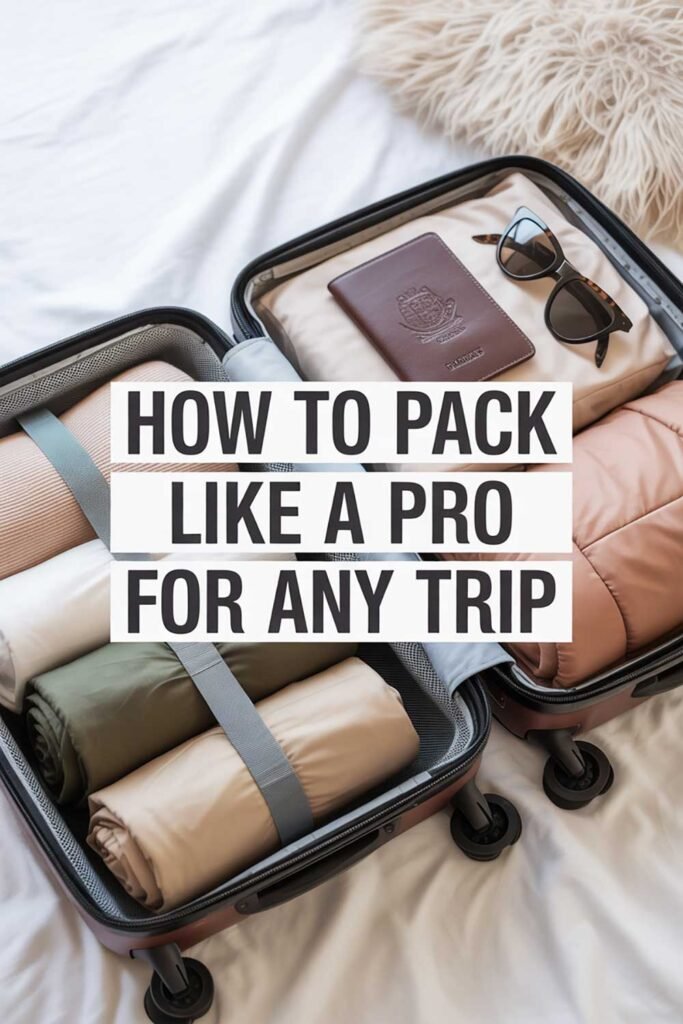
The rolling technique for each garment is simple. Lay the item flat, smooth out any wrinkles, fold in any structured elements like sleeves, and roll tightly from one end to the other. A t-shirt rolls to about the size of a tennis ball. A pair of jeans rolls to about the size of two tennis balls. A lightweight dress rolls to about the size of a water bottle. Place rolled items vertically in the suitcase rather than stacking them horizontally. Vertical placement means the suitcase floor is covered with the tops of rolled items visible from above, like a file drawer of clothing where every item can be seen and selected without disturbing the others.
Not everything benefits from rolling. Structured garments, blazers, collared shirts with stiff fabric, tailored trousers, and any piece where maintaining a specific crease or shape matters, fold flat and stack at the top of the bag rather than rolling. The roll-flat combination organizes the bag into two layers: rolled casual items filling the base efficiently and structured pieces flat at the top where they are accessible without compression. This two-technique approach gets more in the bag with less wrinkling than either technique alone manages.
Use packing cubes alongside rolling for the most organized first-vacation bag. A set of three to four packing cubes in different sizes assigns a category to each cube: tops, bottoms, undergarments and socks, and a spare for miscellaneous items. Roll items within each cube before closing it. Each cube compresses the rolled contents further while keeping them organized by category. At the destination you unpack by placing the cubes in a drawer rather than emptying the full suitcase across the room. Finding a specific item takes three seconds rather than the full-bag search that a loosely packed suitcase requires by day three of any trip.
Full-size toiletries are the most consistently overpacked category on any first vacation packing list. A full-size shampoo that will be used four times over a five-day trip. A full-size moisturizer that will be used ten times. A full-size body wash that the hotel provides anyway. These items add significant weight and take up space that the rest of the bag needs, while providing at most a fraction of their total product for a trip duration that requires almost none of it.
Travel-size toiletries solve this in both directions. Travel-size versions of your essential products, those you use daily and that are specific enough to your routine that hotel alternatives do not substitute well, provide exactly enough product for the trip in containers small enough to pass through airport security in the required quart bag without any concern about the 3.4-ounce liquid limit. A travel-size moisturizer at one ounce holds enough product for ten to fourteen days of twice-daily application. That is more than enough for most first vacations and it weighs one ounce rather than eight.
Identify what your accommodation provides before packing a single toiletry. Most hotels and many guesthouses provide shampoo, conditioner, body wash, and soap. Some provide toothpaste, razors, dental kits, and basic skincare. Research what your specific accommodation includes and remove from your toiletry bag any item they provide that you are happy using their version of. The result is a slim toiletry pouch containing only your non-negotiable personal items and nothing that was already waiting for you in the bathroom.
Solid alternatives to liquid toiletries go further than travel-size containers in reducing both the liquids bag burden and the weight of your toiletry kit. Solid shampoo bars, solid conditioner bars, solid moisturizer balms in stick form, solid sunscreen sticks, and pressed powder makeup all bypass the TSA liquids rule entirely. They do not count toward the quart bag. They take up minimal space. They weigh almost nothing. A solid shampoo bar the size of a hotel soap bar washes hair as effectively as liquid shampoo and lasts through ten to fifteen washes. For a first-time traveler building a toiletry system from scratch, choosing solid alternatives wherever they work for your routine produces the lightest and least security-complicated toiletry kit possible.
Decant the products you genuinely need into the smallest containers that hold enough product for the trip plus a small buffer. A one-ounce pot filled with your preferred moisturizer, a small squeeze bottle of face wash, and a compact container of your daily SPF covers the face care routine for a full week in three items weighing under three ounces combined. The decanting takes about five minutes before a trip and produces a toiletry kit that is lighter, more organized, and easier to replace if lost than a bag of full-size products. Buy a small set of travel decant containers before your first vacation and use them on every trip from then on rather than buying travel-size versions of products you already have at home in full size.
The Packing Gear That Changed Every Trip
The packing cube set that turned every suitcase from a chaos pile into an organized system, the decant containers that replaced the full-size toiletry bag permanently, and the slim travel wallet that keeps every document organized and immediately accessible. Real first-trip picks that became permanent habits across years of travel since.
DND FavoritesA bag packed to capacity at departure is a bag that comes home with nothing new in it. Every first vacation produces the same experience: the destination has things in it that you did not know to expect. A local market with textiles or ceramics that are unlike anything at home. A shop with a clothing style specific to the region. A food product or a locally made item that represents the place in a way a photograph cannot. A souvenir that is genuinely beautiful rather than generically tourist. These things need room. The bag closed at maximum capacity cannot provide it.
Leave 20 to 25 percent of your bag empty at departure as an intentional decision, not as evidence of underpacking. The empty space is reserved for the things the trip will give you that you could not have anticipated at home. This reservation of space is one of the most experienced-traveler habits available to a first-time traveler, and the first-time traveler who understands it at the packing stage rather than discovering the need for it at a market on day four has a meaningfully better trip-return experience than the one who stands between two beautiful things they cannot both fit in the bag that left home at capacity.
Pack a foldable lightweight tote bag in the bottom of the suitcase as a second bag option for the return. A quality foldable tote weighs one to two ounces, compresses to the size of a golf ball, and opens into a full-sized tote that handles overflow purchases on the way home. For a first vacation where souvenir discoveries are almost guaranteed, the foldable tote is the return-journey insurance that means the market find and the local textile and the beautiful small ceramic all come home together rather than requiring an impossible choice between them at a shop counter on the last day.
Weigh your packed bag at home before you leave using a portable luggage scale or a bathroom scale. For a carry-on, confirm it meets your airline’s size and weight limits for carry-on bags. For checked luggage, confirm it is under your airline’s weight limit for the first checked bag. A bag that is over weight at home is a bag that produces an overweight fee at the check-in counter unless items are removed and redistributed at the departure gate. A portable luggage scale costs $8 to $15 and eliminates every overweight-bag surprise at any airport for every trip it is used on. Buy one before the first trip and use it before every subsequent trip as a five-second pre-departure confirmation that the bag is within bounds.
A complete first vacation packing list for a five to seven-day trip covers clothing, toiletries, documents, tech, and a small first aid category without including anything that does not earn its place by being genuinely used on the trip. This list is deliberately simple. It is the foundation. Every subsequent trip refines it based on what you actually used and what came home unpacked.
Clothing for a five-to-seven-day trip in a neutral palette: two bottoms in neutral colors, four tops including one that can serve as a slightly nicer option for an evening out, one layer such as a cardigan, light sweater, or linen shirt, one pair of comfortable versatile shoes worn through transit, one pair of flip-flops or flat backup if destination requires it, underwear and socks for the trip duration plus one spare day, one set of sleep clothes, one swimsuit if the destination warrants it. Total clothing items: approximately 12 to 15 pieces. All of them used. None of them hypothetical.
Toiletries in a slim travel pouch: your face wash and moisturizer decanted to travel size, your SPF if you will be outdoors, your deodorant, your toothbrush and travel-size toothpaste, your razor if needed, any prescription medications for the trip duration, lip balm, and contact lens supplies if applicable. Total pouch weight: six to eight ounces. Everything that needs to be in the liquids quart bag fits in it easily. The hotel or accommodation provides the rest.
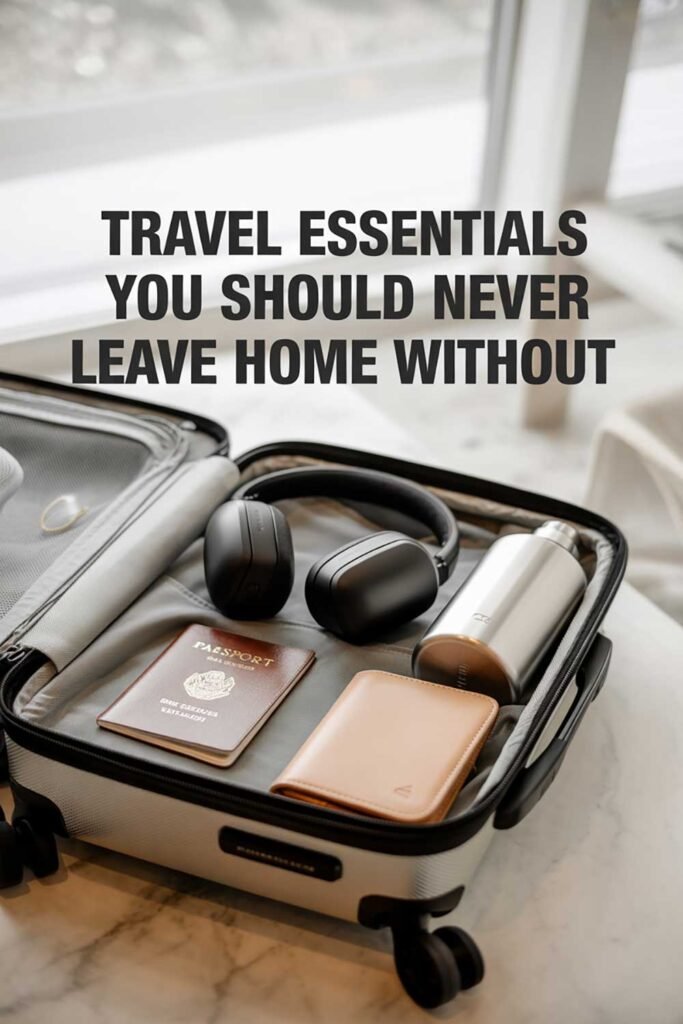
Documents and tech in the personal item: passport or ID, travel insurance card, one credit or debit card plus a backup card in a separate location, some local currency for cash-only situations, your phone charger and cable, a power bank fully charged the night before, your earbuds or headphones, and any offline downloads completed before departure. One pen in the front pocket of your travel wallet. Boarding pass saved in three locations: airline app, camera roll screenshot, and email.
Small first aid pouch in the top of the carry-on: a handful of adhesive bandages in multiple sizes, pain reliever, antacid tablets, antihistamine, and three to five blister plasters. Total weight under two ounces. Addresses the four most common travel health situations, blisters, headaches, upset stomach, and minor cuts, immediately rather than requiring a pharmacy trip in an unfamiliar city in the middle of a trip day.
After you finish packing, close the bag and leave it closed for twenty-four hours before departure. When you open it again just before leaving, remove one more item. This is the most consistent and most effective packing advice available to any traveler of any experience level, and it is particularly valuable on a first trip where the natural instinct is to add rather than remove. The item you remove on the second opening is almost always something that felt necessary during packing and reveals itself as a just-in-case after twenty-four hours of reflection. Carrying a just-in-case item to a destination and back unused is the definition of packing regret. Leaving it at home twenty-four hours before departure is the decision that prevents it.
The First Vacation That Repacked Itself
Jasmine packed her first vacation by packing everything she might possibly need for any scenario she could imagine arising over seven days. She had outfits for each day. She had backup outfits for the days the primary outfits might not feel right. She had four pairs of shoes for different occasions. She had the full-size versions of every product from her bathroom. She had the book, the journal, and the portable speaker. She had the formal outfit for the dinner she had not yet booked. She had both the blazer and the cardigan because she could not decide between them.
The bag weighed 28 kilos. The airline limit was 23. She paid the overweight fee at the check-in counter and spent the flight feeling vaguely embarrassed about it without being entirely sure why. At the destination she wore three of the seven planned outfits. She wore two of the four pairs of shoes. She used the full-size shampoo three times and came home carrying the remaining 90 percent of it. She never wore the formal outfit. The speaker stayed in the bag. The blazer and the cardigan both remained folded for the entire trip.
On the return journey she sat with her journal in the airport and wrote down everything she had worn and everything she had not. The list of what came home untouched was longer than the list of what had been used. She wrote a second list of things she wished she had packed: more underwear for the days she had not anticipated sweating through two changes. A small first aid kit for the blister on day three that she had limped through for two days. A foldable tote for the market on day five where she had to choose between two things she wanted because the bag was completely full at departure and had no room for either.
She repacked on a mental level on the flight home. By the time the plane landed she had the packing list in her head that she should have had at the beginning. Neutral palette. Rolling. Travel sizes. Empty space for discoveries. She used that list on her next trip. The bag weighed 14 kilos. She wore every item. She came home with the foldable tote full of things she found along the way and nothing wasted in the bag that carried them.
Every experienced traveler has a version of the story Jasmine tells. The first trip that was overpacked, the return flight inventory of what was worn versus what was carried, and the packing list built from that honest accounting that became the system used on every subsequent trip. The difference between a first-time traveler and an experienced one is not natural organization or natural minimalism. It is the accumulated evidence of what a trip actually requires versus what it feels like it will require when you are standing in your bedroom surrounded by your full wardrobe and trying to anticipate seven days.
The packing mindset that produces a great bag is based on one question applied to every item before it goes in: will I actually wear or use this specific item on this specific trip? Not could I theoretically use it. Not is it nice to have. Will I actually use it. The formal outfit for the unbooked dinner fails the test. The backup pair of shoes that are essentially the same as the first pair fails the test. The full-size products that take up significant space and weight for three to four uses fail the test. The blister plasters, the one nicer piece, and the foldable tote all pass it easily.
Trust the destination. First-time travelers overpack partly because of a belief that everything they might need must be brought from home because it cannot be obtained elsewhere. This is almost never true at any actual travel destination. Every city, beach town, and resort destination has pharmacies, supermarkets, clothing shops, and gear providers. Forgetting something, running out of something, or discovering you need something you did not bring almost always results in a short shopping trip that sometimes produces a better product than the one you left behind. The destination is not a remote wilderness. It is a place where people live and where the things people need are available. Pack what you are confident you will use and trust that the things you might need will be findable if you need them.
After your first vacation, before you unpack, do the post-trip inventory that Jasmine did on her return flight. Open the bag and physically separate everything you wore or used from everything you did not. Count both piles. The items in the unused pile are your personal packing blind spots. Add them to a list on your phone labeled things I always pack but never use. Check this list when packing for future trips and treat every item on it as a default removal candidate unless there is a specific confirmed reason this trip is genuinely different. The list builds slowly across several trips and eventually becomes one of the most useful packing tools you own because it is built entirely from your own travel behavior rather than anyone else’s generalized advice.
Book the First Vacation Worth Packing For
A perfectly packed bag deserves a perfectly planned first trip. Our travel agents specialize in helping first-time travelers find the right destination, the right accommodation, and the right itinerary for their first time away. The packing is yours to handle. The planning is ours. Let us build your first trip together.
Book A TripCommon First Vacation Packing Mistakes to Avoid
Most first-vacation packing regret comes from the same consistent patterns. These are the most predictable ones and what to do differently before the first bag is closed.
Packing a separate outfit for every day of the trip
Seven outfits for seven days is seven specific combinations where each piece only works with its intended partner. If anything in any combination does not work at the destination, that entire combination becomes unusable with no alternative available from the bag. Two bottoms and four tops in a neutral palette produce eight combinations from six pieces. Every piece works with every other piece. Nothing is stranded by a missing specific partner. The neutral-palette mix-and-match wardrobe produces more functional daily variety from fewer total items than the day-by-day approach, and does it at half the bag weight.
Packing full-size toiletries for a short trip
A full-size shampoo for a five-day trip is 90 percent product carried to the destination and back for the use of ten percent of its contents. Travel-size containers or decants of your personal essentials weigh a fraction of their full-size equivalents, take up a fraction of the space, and provide exactly enough product for the trip with nothing wasted in the bag. The hotel provides the rest. The first toiletry kit any first-time traveler builds should be the travel-size version, not the bathroom-shelf version transported into a smaller space.
Packing multiple pairs of shoes for a short trip
Four pairs of shoes for seven days is three pairs of shoes taking up significant bag space and weight for coverage of hypothetical occasions that a versatile primary pair and one flat backup already handles. One pair of versatile shoes worn through the airport and one packable flat backup covers every occasion a first vacation realistically produces. A pair of shoes in a bag is weight the airline may be measuring and space occupied by something that could be worn rather than packed. Wear the best pair. Pack the smallest backup. Leave the rest at home.
Packing the bag to maximum capacity with no empty space
A bag at maximum capacity on departure day is a bag that carries everything out and everything back with nothing added in between. The first vacation almost always produces the desire to bring something home that was not anticipated when packing. A market find. A local textile. A bottle of something local. A souvenir that is beautiful rather than generic. These things need room. Deliberately leaving 20 to 25 percent of the bag empty at departure and packing a foldable tote for the return is the decision that allows the trip to give you things rather than just taking you somewhere and bringing you back.
Packing without a checklist and trusting memory under departure morning pressure
A departure morning packing session assembled from memory under time pressure produces a bag that is missing something important and contains something irrelevant in its place. A checklist completed at least the day before departure converts packing from a memory exercise into a verification exercise. Every category is covered. Every commonly-forgotten item is on the list. The charger that was still in the wall is on the list. The pen that was needed for the arrival form is on the list. A checklist used consistently on every trip eventually produces the automatic habits that make the checklist feel redundant. Until those habits are fully formed, the checklist is the difference between packing well and hoping for the best.
Not doing a post-trip inventory to learn from the experience
The first vacation is the most information-rich packing experience any traveler has because the gap between what was packed and what was actually needed is widest on the first trip. Not reviewing what was worn versus what was carried home unused means carrying the same blind spots into the second trip and learning the same lessons twice. Five minutes at the end of any first vacation comparing the used pile to the unused pile produces the personal packing data that refines every subsequent trip. The list of unused items is not a judgment. It is the most useful packing resource any traveler can build and it can only come from the trip itself.
Love Helping First-Time Travelers Pack Right and Go Confidently?
If helping people plan their first trips, pack their first bags, and arrive at their first destinations feeling prepared and excited rather than overwhelmed sounds like work you were made for, becoming a home-based travel agent might be exactly the right next step. Earn commissions, get insider travel perks, and build a real business from anywhere. See how it works.
Become An AgentFrequently Asked Questions
These are the questions first-time travelers ask most often about packing for their first vacation. Real answers that address the real uncertainties of someone who has never done this before.
How many outfits do I actually need for a first vacation of five to seven days?
Two bottoms and four tops in coordinating neutral colors provide eight complete outfit combinations for a five-to-seven-day trip. With one layer, you extend that to more variation without adding more pieces. If your trip involves specific activities with specific clothing requirements, swimming, hiking, or a formal occasion, add the specific item for each confirmed activity. For everything else, the two-bottom-four-top foundation is genuinely sufficient for most five-to-seven-day trips and will not produce the repeated-outfit feeling most first-time travelers fear. The fear comes from thinking in terms of specific full outfits rather than interchangeable pieces. The neutral palette removes the repetition because every combination looks distinct from every other combination even though the individual pieces are the same ones used throughout the trip.
What if I forget something important?
Almost everything you might forget is available at the destination. Pharmacies, supermarkets, and convenience stores exist at virtually every travel destination and stock the essential personal items most travelers need. Toothbrush, toothpaste, sunscreen, pain reliever, deodorant, basic skincare, razor, and most other daily-use items can be purchased locally if forgotten. The items worth the most concern if forgotten are prescription medications, which must be brought from home, and travel documents including your passport and travel insurance information. These belong on your checklist as the first-check items confirmed before anything else is packed. Everything else is replaceable at the destination. Having to buy a travel toothbrush at a destination pharmacy is not a crisis. It is a five-minute errand that most travelers complete without meaningful disruption to the trip.
Should I use a carry-on or checked luggage for my first vacation?
For trips of five to seven days, a carry-on is almost always the better choice for a first-time traveler. Carry-on travel eliminates checked bag fees, eliminates the baggage claim wait at both ends, eliminates the possibility of lost luggage, and allows immediate departure from the aircraft to the accommodation without stops. A standard 22 by 14 by 9 inch carry-on holds a complete five-to-seven-day wardrobe when packed using the techniques in this article. If the trip involves a very formal occasion requiring a garment that does not pack well, or a specific sporting activity requiring significant gear, checked luggage may be genuinely necessary. For most first vacations involving casual or smart casual destinations without specialized gear requirements, a well-packed carry-on is sufficient and the experience of traveling without checked luggage, particularly the airport exit speed and the zero-lost-bag risk, is worth choosing for the first trip.
How do I decide what the right neutral palette is for my specific travel destination?
Choose a neutral palette based on three factors: the climate of the destination, the types of activities you have planned, and your existing wardrobe. For warm sunny destinations, cream, white, navy, and warm terracotta work beautifully and photograph well in bright light. For cooler or urban destinations, charcoal, grey, navy, and black produce a versatile palette that works across casual and slightly dressier occasions. For outdoor and activity-heavy destinations, olive, tan, and navy provide practical neutral coverage. The most important factor is that your existing wardrobe already has pieces in the chosen palette so you are packing items you know and feel confident in rather than buying a travel wardrobe from scratch. Work with what you already own that fits the palette rather than purchasing new items specifically for the trip.
How do I handle the TSA liquids rule on my first trip?
The TSA 3-1-1 rule requires all liquids, gels, aerosols, creams, and pastes in your carry-on bag to be in containers of 3.4 ounces or less, all fitting inside a single quart-sized clear zip-seal bag, one bag per passenger. The bag must be removed from your carry-on and placed in a security bin separately at the checkpoint. Prepare for this before the trip by placing your toiletry quart bag at the very top of your carry-on main compartment so it can be lifted out in one motion without unpacking anything else. Common items that fall under the rule include shampoo, conditioner, body wash, toothpaste, all face products in liquid or cream form, sunscreen, deodorant spray, and anything else that pours, pumps, or squeezes. Solid alternatives including bar shampoo, solid deodorant, and pressed powder makeup do not count toward the quart bag at all. If you are unsure whether a specific item counts as a liquid under the rule, the TSA website has a searchable database that provides a definitive answer for any product.
What should go in my personal item versus my main carry-on bag?
Your personal item, the smaller bag that goes under the seat in front of you on most aircraft, should hold everything you need access to during the flight without requiring you to open the overhead bin. Phone and charger cable. Earbuds or headphones. Power bank. Snacks. Lip balm and any in-flight moisturizer or eye drops. Sleep mask and earplugs if you use them. Any medication you take on a schedule. Your travel documents, ID, and boarding pass. Your book or tablet with offline content loaded. Your wallet. At the destination your personal item transitions to a day bag for the trip, carrying what you need for each day’s activities without opening the main suitcase. Choosing a personal item that serves both functions, small enough to fit under the seat and functional enough to carry a day’s essentials at the destination, is one of the most useful bag choices available to a first-time traveler. One less bag to manage through the full trip.
The first bag you pack is not the best bag you will ever pack. It is the one that teaches you what the best bag looks like. Let it teach you. Then pack it better the next time.
Picture Yourself Closing That First Bag
You chose two neutral base colors. Every item in the bag coordinates with every other item. Everything soft is rolled. The toiletry pouch is slim and holds travel-size versions of the things only you can bring. The hotel provides the rest. The bag is about three-quarters full. The foldable tote is in the bottom for the market on day five. You close the bag. You weigh it. It is within the limit with room to spare. You leave it for twenty-four hours. You open it and remove one more thing. You close it again. You are ready. Every great traveler started exactly here. This is your here. This is where it begins.
One More Thing Before Your First Trip
Print our free Travel Packing Checklist and use it alongside this guide for your first vacation. Every category covered, every easy-to-forget item listed, and the editing reminder that makes the bag better before it closes. The same checklist we wish we had on our first trip and have used on every one since.
Get the Free ChecklistExplore Our Top Picks for a Better Trip
From the packing cube set that made every trip organized from the first use to the slim travel decant kit that replaced the full-size toiletry bag permanently, see the first-vacation and beyond travel products we actually use and recommend. Real picks from real travel that we would give to every first-time traveler we know.
See Our Top PicksTravel Prints and Printables From Our Shop
Visit Premier Print Works for travel journals, packing planners, trip organizers, packing list printables, and wall art that makes every trip a little more beautiful and a lot more organized from the very first item packed on the very first vacation.
Visit Premier Print WorksDisclaimer
The information shared in this article is provided by Don and Diana’s Travels for general informational, educational, and inspirational purposes only. It reflects our personal experiences, opinions, and the experiences of travelers we have worked with. It is not professional travel, legal, or financial advice, and it should not be relied on as such.
Travel Information and Airline Policies
Airline carry-on size and weight restrictions, personal item policies, TSA liquids rules, baggage fees, security procedures, and related travel regulations change frequently and vary significantly between airlines, routes, and jurisdictions. Always confirm current baggage requirements, size limits, and security rules with your specific airline and the TSA before travel. The carry-on dimensions and liquids information in this article reflect general current standards and may not apply to all airlines or airports. We make no guarantee that any regulatory or policy information in this article is current, complete, or applicable to your specific travel situation.
Affiliate and Partner Links
This article may contain affiliate links, partner links, referral links, and links to products or services that pay us a commission. If you click a link and book a trip, make a purchase, sign up for a service, or complete any qualifying action, we may earn a small commission at no extra cost to you. This includes but is not limited to links to our travel booking platform, host agency, recommended products, the Premier Print Works shop, and any third-party retailers or service providers mentioned in the article. Our recommendations are based on real use and genuine belief in the products and services we share. Commissions help support the cost of running this site and producing free content for our readers.
Third-Party Websites and Services
We may link to third-party websites, services, and resources for your convenience. We do not control these sites and are not responsible for their content, terms of service, privacy practices, pricing, availability, accuracy, customer service, refund policies, or any product or service they sell. Your use of any third-party site is entirely at your own risk and subject to that site’s own terms and policies.
Health, Safety, and Personal Responsibility
Travel involves personal risk. You are solely responsible for your own health, safety, travel insurance, medications, vaccinations, documentation, financial decisions, and choices while planning or taking any trip. We strongly recommend purchasing comprehensive travel insurance for every trip. Don and Diana’s Travels, its owners, employees, contractors, and affiliates accept no liability for any loss, injury, illness, delay, cancellation, damage, theft, or inconvenience arising from your use of the information in this article or from any travel decisions you make.
Composite Stories and Characters
Some stories, examples, and traveler experiences shared on this site are composites. They are drawn from the real experiences of Don, Diana, clients, friends, and travelers we have worked with over the years. Names, identifying details, locations, and circumstances may be combined, changed, or fictionalized to protect privacy and to better illustrate a point. Any resemblance to a specific real person beyond the composite portrayal is unintentional.
No Guarantees
We do not guarantee any specific result, outcome, savings, experience, or financial return from using the information, tips, services, or products mentioned in this article. Your results depend on many personal factors, including your own choices, effort, circumstances, and external conditions outside of our control.
Copyright and Use
All content in this article, including text, images, graphics, design, and original stories, is the copyrighted property of Don and Diana’s Travels unless otherwise noted. You may not copy, republish, redistribute, modify, sell, or reuse our content in whole or in part without our prior written permission. You are welcome to share a direct link to this article with proper credit.
By reading and using the information in this article, you acknowledge that you have read, understood, and agree to this disclaimer in full.