Packing Cube Tips for Organized Travel
Packing cubes are the single most life-changing travel purchase most travelers wish they had discovered sooner. They do not just organize your suitcase. They organize your entire travel experience, from departure morning to arrival night to the repacking that happens at every stop in between. This article shows you how to use them at the level that experienced travelers have spent years figuring out on their own.
Grab Our Travel Packing Checklist
Packing cubes work best alongside a great packing checklist. Ours walks you through every category in the right order, so every cube gets filled with exactly the right items and nothing gets left behind. Print it once and use it alongside your cubes on every trip from here forward.
Get the Free ChecklistThe single most important packing cube principle is also the one most new cube users get wrong the first time. Organize by category, not by day. One cube per outfit per day sounds logical and produces a system that falls apart by day three. One cube per clothing category produces a system that works perfectly for the entire length of the trip regardless of how many days you are away.
When you organize by day, you are essentially creating seven individual packing puzzles that must each be opened, disturbed, and repacked every morning. When you need a second shirt or want to wear something differently than planned, the day system forces you to open multiple day-specific cubes to find it. The system that was supposed to create order creates its own kind of rigid inflexibility.
When you organize by category, you have one clear answer for where every type of item lives regardless of which day you are on. Tops in the tops cube. Bottoms in the bottoms cube. Underwear and socks in the underwear cube. Sleep clothes in the sleep cube. Every morning you open the one cube with the items you need. Every evening worn items go into the laundry pouch or cube. The system is self-maintaining because its logic is simple and consistent.
The specific categories that work best for most travelers are tops, bottoms, underwear and socks, sleep clothes, and one miscellaneous category for swimwear, workout gear, or specialty items specific to the trip. Five cubes covers a complete wardrobe for any trip length. Add a sixth for shared family items or specialty categories on longer trips. Keep it simple enough that the right cube is obvious without thinking about it.
Packing cubes do not just organize your suitcase. They organize your entire travel experience from departure morning to the last repacking on the journey home.
Organize by category and the cube always knows where to go. Organize by day and the whole system collapses the morning you want to wear something different.
Add a dedicated laundry cube or a mesh laundry bag to your packing cube system. Worn items go directly into the laundry cube as soon as you remove them. Clean items stay in their category cubes. At no point during the trip does anyone have to wonder whether a particular item has been worn. The laundry cube eliminates the most common mid-trip organization failure, which is the gradual mixing of worn and clean clothing that makes repacking at each stop increasingly chaotic.
Let Us Plan Your Next Adventure
A perfectly organized suitcase deserves a perfectly planned trip. Tell us where you want to go, your travel style, and your dates. We will handle all the planning while you handle the packing. Real travel agents, real destinations, real results.
Plan Our EscapeA slim packing cube, typically about one to two inches deep and sized to fit flat documents, is one of the most underused and most useful cube types in any travel kit. Most travelers know to use cubes for clothing. Far fewer have discovered how effectively a slim cube manages the flat, easily lost items that tend to migrate to every inconvenient corner of a suitcase without a dedicated home.
A slim cube for documents holds your passport photocopy, your printed booking confirmations, your travel insurance details, any printed maps or guides, a small notebook, and any flat documents specific to your trip. This is the non-critical flat document home in your checked luggage, not your actual passport and irreplaceable documents which always travel in your carry-on. Having a slim cube for document copies means you can find any printed information in seconds without searching through every pocket of your bag.
Beyond documents, slim cubes work beautifully for flat accessories. Scarves and lightweight wraps that wrinkle if bundled into a larger cube. Jewelry laid flat to prevent tangling. Belts coiled flat rather than crammed into available gaps. Flat cables and small electronics accessories that get lost in larger cubes but fit perfectly in a slim profile. Travel-size face masks and sheet masks for long-haul flights that you want accessible without opening the main clothing cubes.
A slim cube in the top layer of your suitcase, visible and accessible when you open the bag, becomes a catch-all for the flat items that would otherwise scatter. When you are repacking at checkout under time pressure, everything flat has an obvious destination and the repacking takes minutes instead of the hunting process that happens without a designated flat item home.
Use a slim cube specifically for your electronics accessories. Phone charging cable. USB adapter. Earphone case. Memory cards. Small power bank if it fits. These are the small, easily lost items that disappear into the depths of a standard cube or rattle loose in a bag pocket. A slim cube dedicated to electronics accessories means you can pull the entire cube out at the airport, during a flight, or at any accommodation without searching for individual items in multiple locations.
A compression packing cube has a dual-zipper system that lets you fill the cube normally with the first zipper, then compress the contents by zipping a second layer that reduces the cube’s depth by 30 to 50 percent. For bulky, compressible items like sweaters, fleece layers, thick jeans, and puffer jackets, this compression is the difference between fitting everything in one bag or needing a second.
The items that benefit most from compression cubes are exactly the items that cause the most suitcase space problems. A chunky knit sweater that fills an entire standard cube compresses to half the height in a compression cube. A puffer jacket that seems impossible to include with a week’s worth of clothing compresses into a manageable, defined shape that fits in one corner of the bag without displacing everything else. Two thick jeans that take up a third of a medium suitcase compress to the footprint of one.
Choose your compression cube size based on the number and bulk of items going inside rather than trying to match standard cube sizing. A large compression cube handles two to three bulky sweaters or a single puffy jacket plus a fleece. An extra-large compression cube handles the full cold-weather layer wardrobe for a winter trip. Do not overcompress. The cube should reduce its depth noticeably with the second zip but the seams should not strain. Overfilling and maxing out the compression tears the seam construction over repeated use.
One strategic note on compression cubes: they work best for items you do not need to access mid-flight. The items inside become significantly harder to remove and replace once fully compressed. Pack your compression cube with items that live in the checked bag or the hotel room rather than items you will want during the journey itself.
Use a compression cube specifically for dirty laundry on longer trips. Worn clothing takes up more volume than clean clothing because it is no longer folded neatly. A compression cube used as your laundry container keeps worn clothing compressed and contained rather than billowing out of an open laundry bag. It also reduces the smell that accumulates from worn clothing in a warm suitcase by keeping everything sealed. At the end of the trip, the compression cube of laundry goes directly from the suitcase into the washing machine as one contained unit.
The Packing Cubes We Actually Travel With
The compression cube that made winter travel finally manageable, the slim cube for documents and flat accessories we have in every bag we pack, the color-coded set that means we never confuse whose cube is whose, and the mesh laundry cube that separates clean from worn across every trip we take. Real cube picks from real trips.
DND FavoritesAn unlabeled cube is a mystery. A labeled cube is a destination. The difference between searching your entire suitcase for a specific item and going directly to the right cube every time comes down to whether every cube has a clear, immediate identifier that communicates its contents without opening it.
Color coding is the most efficient labeling system because it works visually across the suitcase without requiring any reading. Assign a consistent color to each category and keep it. Navy cube always equals bottoms. Teal cube always equals tops. Gold cube always equals underwear and socks. You learn the color-category association within two uses and from that point forward finding anything is as simple as identifying a color in the bag.
For couples and families traveling together, color coding by person within the category system is even more powerful. Each person has a dedicated color set and each cube is labeled with both the person’s color and the category. Diana’s teal tops cube and Don’s navy tops cube live in the same suitcase but are never confused. Children’s cubes in bright colors are immediately identifiable from the adult cubes. The system scales to any family size without losing clarity.
If you cannot find or afford a complete color-matched set, label cubes with iron-on tags, luggage tag attachments through the zipper pull, or a small piece of masking tape labeled with a marker. The method does not matter. What matters is that every cube communicates its contents without requiring you to open it, and that the labeling is consistent enough that it becomes automatic rather than something you have to think about.
Buy packing cubes with a mesh or semi-transparent panel on at least one side so you can see the contents without fully opening the cube. This feature reduces the number of times you open the wrong cube by mistake and makes a partial view of the contents possible without disturbing the organization. Many packing cube sets now offer this feature at the same price point as fully opaque cubes. The mesh panel combined with a clear label or color code means you can find any specific item in under five seconds regardless of which end of the suitcase the cube has migrated to during transit.
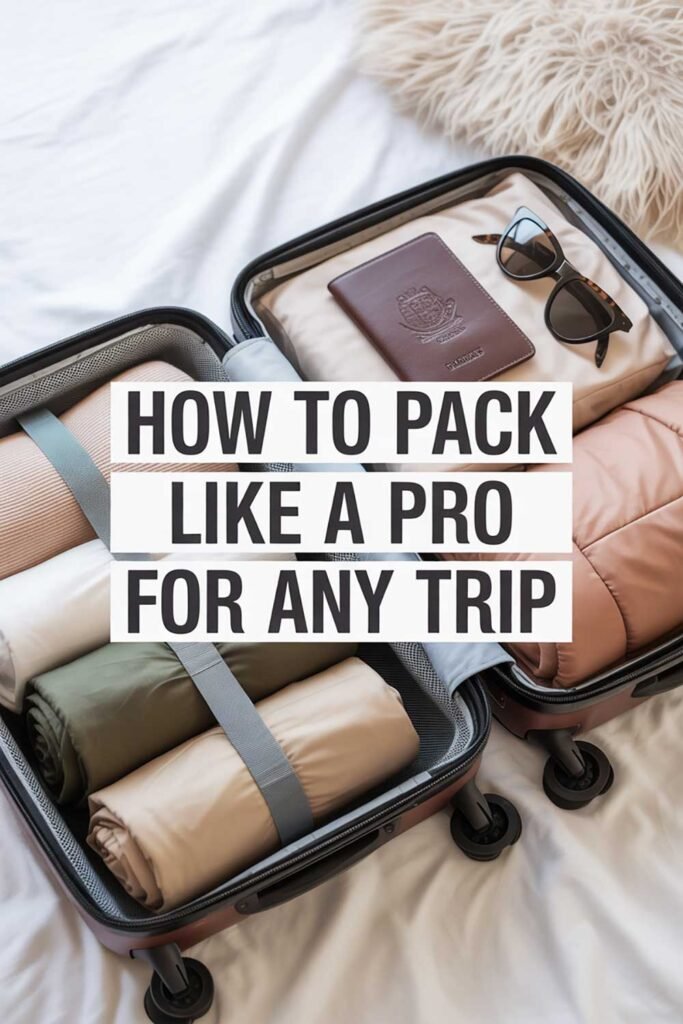
How you orient packing cubes in your suitcase matters as much as which cubes you use and what goes in them. The default instinct is to lay cubes flat like pancakes in a stack. This is the orientation that produces the least visibility, the most digging, and the most disruption when you need something from the middle of the stack. The correct orientation is upright, with cubes standing on their smallest edge like files in a filing cabinet drawer.
When cubes stand upright in a suitcase, you can see every cube label from above when you open the bag. Every category is visible simultaneously. Finding the right cube is a single glance, not a search. Removing the top cube to reach the one underneath is not required because every cube is equally accessible from the top. The system maintains its organization throughout the trip because replacing a cube is as simple as sliding it back into its upright position.
Cubes standing upright also use suitcase space more efficiently than cubes lying flat in many bag shapes. The depth of a standard suitcase fits two or three cubes upright side by side. Laid flat, the same cubes produce a stack that fills the depth but limits the width and prevents easy access. The upright orientation turns your suitcase into a visual inventory system where everything is immediately apparent rather than hidden under whatever is on top.
The one exception to upright orientation is the compression cube, which is often best laid flat at the base of the suitcase over the shoe layer because its compressed depth may not allow a stable upright position. All other cubes stand upright above the flat compression cube base. This combination gives you the stability and accessibility of the upright system alongside the space efficiency of a compressed base layer.
At your accommodation, you do not always need to unpack cubes into drawers. Pull out the cubes you need and set them on the dresser or shelf in their upright position, open and accessible like a portable dresser drawer. This is particularly useful for short stays where full unpacking and repacking is more work than it saves time. The cube on the dresser is as functional as a drawer, keeps everything in its organized category, and means repacking at checkout is closing a zipper rather than restuffing a drawer.
The Day Packing Cubes Arrived in Our Travel Life
For the first decade of traveling together, we packed without any organizational system. Everything went in the suitcase in roughly the order it occurred to us. Clothes, toiletries, shoes, chargers, and documents all competed for the same space with no logic to their arrangement. By day two of any trip, the suitcase looked like a small laundry explosion. By day five, we could not reliably find anything without removing everything else first. We joked that our packing style was archaeological, which was funny until the morning we spent twenty minutes finding Diana’s passport copy in a suitcase that contained two weeks of both our lives.
We bought our first packing cubes before a two-week international trip, mostly because a friend had mentioned them twice and we were tired of the archaeological packing. We organized them by category. Tops in one. Bottoms in another. Underwear and socks together. A compression cube for the sweaters that had previously taken half the suitcase. A slim cube for documents and flat accessories. We labeled each one with a small tag.
We opened the suitcase at our first accommodation and found everything in under two minutes. The tops cube. The bottoms cube. The slim cube with the documents. Everything was exactly where its label said it would be. We repacked the next morning in eight minutes. We repeated this at six more accommodations on that trip and the system held every single time.
We came home, looked at each other, and agreed that we had wasted ten years on the archaeological method. Packing cubes did not just organize our suitcase. They organized every trip after that one. The discovery felt genuinely significant in the way that small, practical improvements to a repeated activity feel significant. Better every time. From a $30 purchase and twenty minutes building the system.
The packing cube system extends well beyond the main suitcase into every bag you travel with, and experienced cube users often find that the biggest improvements come from applying cube organization to their carry-on and day bag rather than just the checked luggage.
A small packing cube in your carry-on for in-flight essentials keeps your most-needed items organized and immediately accessible without unpacking your entire carry-on at your seat. The in-flight cube holds your earbuds, your eye mask, your lip balm, your in-flight medication, and your phone charger. You pull out the cube when you board, set it in the seat pocket or on your tray table, and have everything you need for the flight in one small, organized container that goes back in the carry-on the moment you land.
A slim cube in the carry-on for documents keeps your boarding pass, passport, entry documents, travel insurance card, and any required paperwork in one location that you can pull out at security and border control without searching through your full carry-on. This is particularly valuable on international trips where multiple documents are required at multiple control points. The slim document cube becomes a trusted single location that you reach for automatically every time something official is requested.
For day bags and backpacks used on excursions, a small cube for daily essentials keeps sunscreen, lip balm, a small first aid kit, snacks, and phone charging cables from disappearing into the main compartment of a bag. Pulling out the day essentials cube from the main bag means everything is in one place for the day rather than scattered across multiple pockets you cannot remember which item went into.
Use a small packing cube as a toiletry cube alternative for shorter trips. Pack your travel-size toiletry bottles in a small cube rather than a dedicated toiletry bag. The cube sits in your suitcase like any other cube, stands upright, and stays organized alongside your clothing cubes. For trips where the full hanging toiletry kit is more infrastructure than you need, the toiletry cube is a lighter and more flexible alternative that integrates naturally into the rest of your cube system.
Book the Trip Your Organized Suitcase Deserves
You have the system. Now you need the destination. Our trusted booking platform lets you reserve flights, hotels, vacation rentals, and travel packages in one place, with real travel agents who match the right trip to your travel style and make sure every detail is handled before you zip that beautifully organized suitcase.
Book A TripCommon Packing Cube Mistakes to Avoid
Most packing cube frustrations come from setup mistakes that are easy to avoid once you know what they are. These are the most common ones and exactly what to do differently from the first use.
Organizing by day instead of by category
Day-based organization requires opening multiple cubes to find any single item that does not match the day plan you made at home. Category-based organization always sends you to exactly one cube for any type of item regardless of which day of the trip you are on. The day system collapses the morning you want to wear something differently than planned. The category system holds for the entire trip without any adjustment.
Laying cubes flat instead of standing them upright
Flat cubes stacked in a suitcase require removing the top cubes to see and access the ones underneath. Upright cubes visible from above are all equally accessible simultaneously with a single glance. The upright orientation turns finding any item from a multi-step digging process into a two-second scan of visible labels. This single orientation change produces the most immediate improvement of any cube tip and requires no additional equipment or cost.
No labels or color coding on cubes
Unlabeled cubes in a dark suitcase at 5 a.m. require opening each one until you find what you need. Labeled cubes communicate their contents without being opened. The labeling can be as simple as a strip of masking tape with a marker word or as deliberate as a color-coded set with iron-on tags. The method is less important than the consistency. A labeling system that you use the same way on every trip becomes automatic within two or three uses and eliminates every instance of opening the wrong cube.
Overfilling cubes until they strain to close
A cube filled to the point where the zipper strains is a cube that damages at the seams over time and defeats its own organizational purpose by being too rigid to fit into the suitcase efficiently. Cubes should close comfortably with the items inside lying flat and the zipper moving without resistance. If a cube is straining, remove one or two items and distribute them to a different cube or reassess whether everything packed is actually needed. The cube’s firmness when closed properly is what gives it the defined shape that makes upright orientation stable.
Using cubes only in the main suitcase and not in the carry-on
The carry-on is often less organized than the checked bag because it is a smaller space and travelers feel there is less need for a system. In practice, the carry-on needs organization more than the checked bag because it is opened more frequently, in more awkward environments, and under more time pressure. A small cube for in-flight essentials and a slim cube for documents in the carry-on provides the same clarity and accessibility that the full cube system provides in the main bag, in the exact situations where that clarity matters most.
Buying cheap cubes that lose their shape after one trip
Packing cubes vary significantly in quality and the difference matters over time. Cheap cubes with thin fabric and weak zippers lose their defined shape after a few uses, which compromises the upright orientation and the organized appearance that makes the system work. Quality cubes with reinforced zippers and structured fabric hold their shape trip after trip and last for years. A set of quality cubes costs $25 to $45 and is a one-time purchase. A set of cheap cubes replaced every year or two costs more in both money and frustration. Buy quality once.
Help Others Travel Better and Smarter
If sharing packing systems, recommending the right destinations, and helping travelers arrive prepared and organized sounds like the work you were made for, becoming a home-based travel agent might be exactly the right next step. Build a real business from anywhere. See how it works.
Become An AgentFrequently Asked Questions
These are the questions travelers ask most often about packing cubes. Real answers from real cube-system experience.
How many packing cubes do I actually need?
For a solo traveler on a trip of any length, four to five cubes handles a complete wardrobe comfortably. One large cube for bottoms and bulky items. One medium cube for tops. One small cube for underwear and socks. One medium cube for sleep clothes and specialty items like swimwear. One slim cube for documents and flat accessories. A compression cube is a strong addition for cold-weather travel or any trip with particularly bulky items. For couples sharing a suitcase, six to eight cubes covers both people’s wardrobes in the category-and-color system. For families, each person gets their own color set of three to four basic cubes. More cubes is not always better. Too many cubes creates its own form of fragmented organization. Start with four and add only when a genuine category gap appears.
Do packing cubes actually save space or just reorganize the same amount of space?
Packing cubes reorganize space more effectively than they create new space. The space saving comes from three things. First, rolling or folding items consistently inside a cube before packing removes the irregular voids that randomly placed items create. Second, the defined cube shape uses the rectangular geometry of suitcases more efficiently than amorphous clothing piles. Third, compression cubes actively reduce the volume of compressible items. The net effect for most travelers is a suitcase that fits more in the same space than it did without cubes, not because cubes are magical but because consistent, compact packing inside defined shapes is simply more space-efficient than throwing things in. Most travelers find they can pack slightly more or pack in a smaller bag after switching to a cube system.
What size packing cubes work best for a carry-on versus a checked bag?
For a carry-on, small and medium cubes work best. Large cubes often do not fit comfortably in a standard carry-on while also leaving room for shoes, a toiletry kit, and a laptop or tablet. A medium cube for tops, a small cube for bottoms, and a small cube for underwear and socks covers a week’s capsule wardrobe in a carry-on with room remaining for non-clothing essentials. For a checked bag, any cube size including large and extra-large is appropriate. The goal is to use the largest cube that fits your category without overfilling, because a single large cube for bottoms is easier to manage than two medium cubes for the same amount of clothing.
Are packing cubes worth buying for a short trip of two or three days?
Yes, and short trips are actually where the organizational benefit of packing cubes is most immediately obvious. A two-day trip in a small bag or a carry-on with no organizational system is a bag you have to excavate every time you need something different. A two-day trip with two or three small cubes, one for tops, one for underwear and socks, and one slim cube for documents and flat accessories, is a bag where everything is findable in seconds regardless of how rushed the packing was. Short trip travelers who adopt cubes often find that the benefit scales down just as well as it scales up and that short trips become significantly less stressful with even a minimal cube system.
How do you use packing cubes when you share a suitcase as a couple?
Assign each person a dedicated cube color and keep it consistent across every trip. The category-based system applies within each person’s color. Diana’s navy tops cube and Don’s teal tops cube both live in the suitcase. Both are in the same upright orientation. Both are immediately identifiable by color. Neither person’s cubes are confused with the other’s. When you need to find a specific item, you go to your color of the relevant category cube. The system scales to any number of travelers sharing luggage by adding a new color per person. For families, use bright, distinct colors for children’s cubes so they are immediately different from adult cubes even at a glance. The color system requires consistent purchasing of the same brand in different colors, or the use of color labels on a mixed set of cubes.
How do you maintain the packing cube system throughout a multi-week trip?
The system maintains itself when the rule is simple and followed consistently. Clean items always return to their category cube after use or after laundry. Worn items always go directly to the laundry cube or mesh bag rather than back to a clean cube or loose in the bag. At every accommodation repacking, cubes go back into the suitcase upright and in the same zone arrangement. The five minutes of consistent repacking at each stop is the maintenance cost of the system. Travelers who skip this step at one stop find it takes longer to restore the system at the next stop. The system that is maintained consistently across a two-week trip produces the same clarity on day fourteen that it produced on day one, which is the whole point.
The $30 packing cube purchase that changes every trip after it is one of the best travel investments most travelers ever make. The only regret is not finding it sooner.
Picture Your Next Packing Day
You open your suitcase and the cubes are already labeled and waiting. Tops cube. Bottoms cube. Underwear and socks cube. Compression cube for the sweater. Slim cube for documents. You fill each one in ten minutes, roll the soft items, close each zipper without straining, and stand them upright in the suitcase like files in a drawer. You close the suitcase. It zips easily. You pick it up. It feels organized in a way you cannot quite articulate but that you notice immediately. When you arrive, you open the bag and find what you need in under ten seconds. That is packing cubes. That is every trip from now on.
One More Thing Before You Pack
Print our free Travel Packing Checklist and use it alongside your new cube system on every trip. Every category covered, packed in the right cube in the right order, with nothing forgotten and nothing wasted. The same checklist we use before every single trip we take.
Get the Free ChecklistExplore Our Top Picks for a Better Trip
From the packing cube set with mesh panels and strong zippers that has been in our bags for years to the compression cube that made winter travel manageable, see the packing products and travel resources we actually use and recommend. Real picks from real trips, tested trip after trip.
See Our Top PicksTravel Prints and Printables From Our Shop
Visit Premier Print Works for travel journals, packing planners, trip organizers, wall art, and printable goodies that make every trip a little more beautiful and a lot more organized from the first cube packed to the last souvenir unpacked.
Visit Premier Print WorksDisclaimer
The information shared in this article is provided by Don and Diana’s Travels for general informational, educational, and inspirational purposes only. It reflects our personal experiences, opinions, and the experiences of travelers we have worked with. It is not professional travel, legal, or financial advice, and it should not be relied on as such.
Travel Information and Booking
Airline baggage policies, carry-on size restrictions, weight limits, baggage fees, and related travel regulations change often and vary significantly between airlines, routes, and booking classes. Always confirm current baggage policies directly with your specific airline before travel. We make no guarantee that any information in this article is accurate, complete, or up to date at the time you read it.
Affiliate and Partner Links
This article may contain affiliate links, partner links, referral links, and links to products or services that pay us a commission. If you click a link and book a trip, make a purchase, sign up for a service, or complete any qualifying action, we may earn a small commission at no extra cost to you. This includes but is not limited to links to our travel booking platform, host agency, recommended products, the Premier Print Works shop, and any third-party retailers or service providers mentioned in the article. Our recommendations are based on real use and genuine belief in the products and services we share. Commissions help support the cost of running this site and producing free content for our readers.
Third-Party Websites and Services
We may link to third-party websites, services, and resources for your convenience. We do not control these sites and are not responsible for their content, terms of service, privacy practices, pricing, availability, accuracy, customer service, refund policies, or any product or service they sell. Your use of any third-party site is entirely at your own risk and subject to that site’s own terms and policies.
Health, Safety, and Personal Responsibility
Travel involves personal risk. You are solely responsible for your own health, safety, travel insurance, medications, vaccinations, documentation, financial decisions, and choices while planning or taking any trip. We strongly recommend purchasing comprehensive travel insurance for every trip. Don and Diana’s Travels, its owners, employees, contractors, and affiliates accept no liability for any loss, injury, illness, delay, cancellation, damage, theft, baggage fee, or inconvenience arising from your use of the information in this article or from any travel decisions you make.
Composite Stories and Characters
Some stories, examples, and traveler experiences shared on this site are composites. They are drawn from the real experiences of Don, Diana, clients, friends, and travelers we have worked with over the years. Names, identifying details, locations, and circumstances may be combined, changed, or fictionalized to protect privacy and to better illustrate a point. Any resemblance to a specific real person beyond the composite portrayal is unintentional.
No Guarantees
We do not guarantee any specific result, outcome, savings, experience, or financial return from using the information, tips, services, or products mentioned in this article. Your results depend on many personal factors, including your own choices, effort, circumstances, and external conditions outside of our control.
Copyright and Use
All content in this article, including text, images, graphics, design, and original stories, is the copyrighted property of Don and Diana’s Travels unless otherwise noted. You may not copy, republish, redistribute, modify, sell, or reuse our content in whole or in part without our prior written permission. You are welcome to share a direct link to this article with proper credit.
By reading and using the information in this article, you acknowledge that you have read, understood, and agree to this disclaimer in full.