The guests who enjoy cruises most are not the lucky ones. They are the informed ones. A great cruise is ninety percent planning and ten percent saying yes to everything the ship puts in front of you. The planning happens before you board and in the first hour after you do. This article covers both windows and everything in between that turns a good cruise into an exceptional one.

Best For
All Cruise Guests
Vibe
Prepared and Relaxed
Read Time
13 Minutes
Walk Away With
The Complete Cruise System
Free Download

Grab Our Travel Packing Checklist

Cruise packing has its own specific requirements that most generic travel checklists miss entirely. What to bring for the cabin setup, what goes in the day bag for port visits, what documentation belongs in your carry-on versus your checked luggage, and the comfort items that make every sea day a genuinely relaxing one. Our free packing checklist covers every category. Print it before your next sailing.

Get the Free Checklist

Book Specialty Restaurants and Shore Excursions the Moment You Board

The first hour aboard a cruise ship is the most valuable booking window of the entire sailing. In that window, specialty restaurant reservations are fully available, popular shore excursions have not yet reached capacity, and spa appointments are bookable at first-day promotional pricing that disappears by the following morning. Every experienced cruise traveler knows this. Every first-time cruiser learns it, usually on day two when they discover that the teppanyaki table they wanted is fully booked for every evening of the cruise and the shore excursion they had been planning since booking is sold out.

Before you go to your cabin, before you explore the ship, before you find the pool and claim a chair, go to the specialty dining venue or the ship’s main booking desk and make your reservations. Most cruise lines also allow pre-cruise booking through the cruise line’s app during a booking window that opens 60 to 90 days before departure. Use the pre-cruise booking window if it exists for your sailing. For anything not booked in advance, the first hour aboard is the recovery window that allows the same access the pre-cruise booking would have provided.

Shore excursions follow the same first-hour urgency. The most popular excursions at each port sell out within the first day of sailing on most ships. The zip line at a Caribbean port. The private snorkeling trip at a Mediterranean island. The wine tasting tour at a coastal vineyard. These excursions are oversubscribed because they are genuinely excellent, and the guests who book them in the first hour aboard are the guests who have them. Research the excursion options for each port before boarding so you know exactly what you want and can book it immediately without the research that takes time you do not have in that first-hour window.

If you are traveling as a group, assign one person to handle the bookings while others handle the cabin setup. One person moving efficiently through the booking desk or the ship’s app with a pre-researched list completes the entire group’s reservations in fifteen to twenty minutes. The alternative, everyone wandering to their cabins first and regrouping to discuss options, produces a conversation that takes an hour and results in the excursions being sold out by the time the decision is made.

A great cruise is ninety percent planning and ten percent saying yes to everything the ship puts in front of you.

The guests who enjoy cruises most are not the lucky ones. They are the informed ones. The information is available to anyone before they board.

Insider Note

Download the cruise line’s app before departure and set up your account during the pre-cruise window. Most major cruise lines offer app-based booking for specialty dining, spa appointments, shore excursions, and entertainment with visible availability calendars. The app allows booking from your phone in the taxi to the port or in the embarkation queue before you even board. A guest who books while waiting to board has the same first-hour advantage as a guest aboard, without the fifteen-minute competition from hundreds of other guests who board at the same time and have the same idea.

Ready to Sail

Let Us Book the Cruise Worth Planning This Carefully

The best cruise experience starts with the right ship, the right itinerary, and the right cabin for your travel style. Tell us where you want to sail, when you want to go, and what kind of cruise experience you are looking for. We will find the sailing that matches the vision and handle the booking details while you focus on the first-hour reservation strategy. Real travel agents, real cruise expertise, real results.

Plan Our Escape

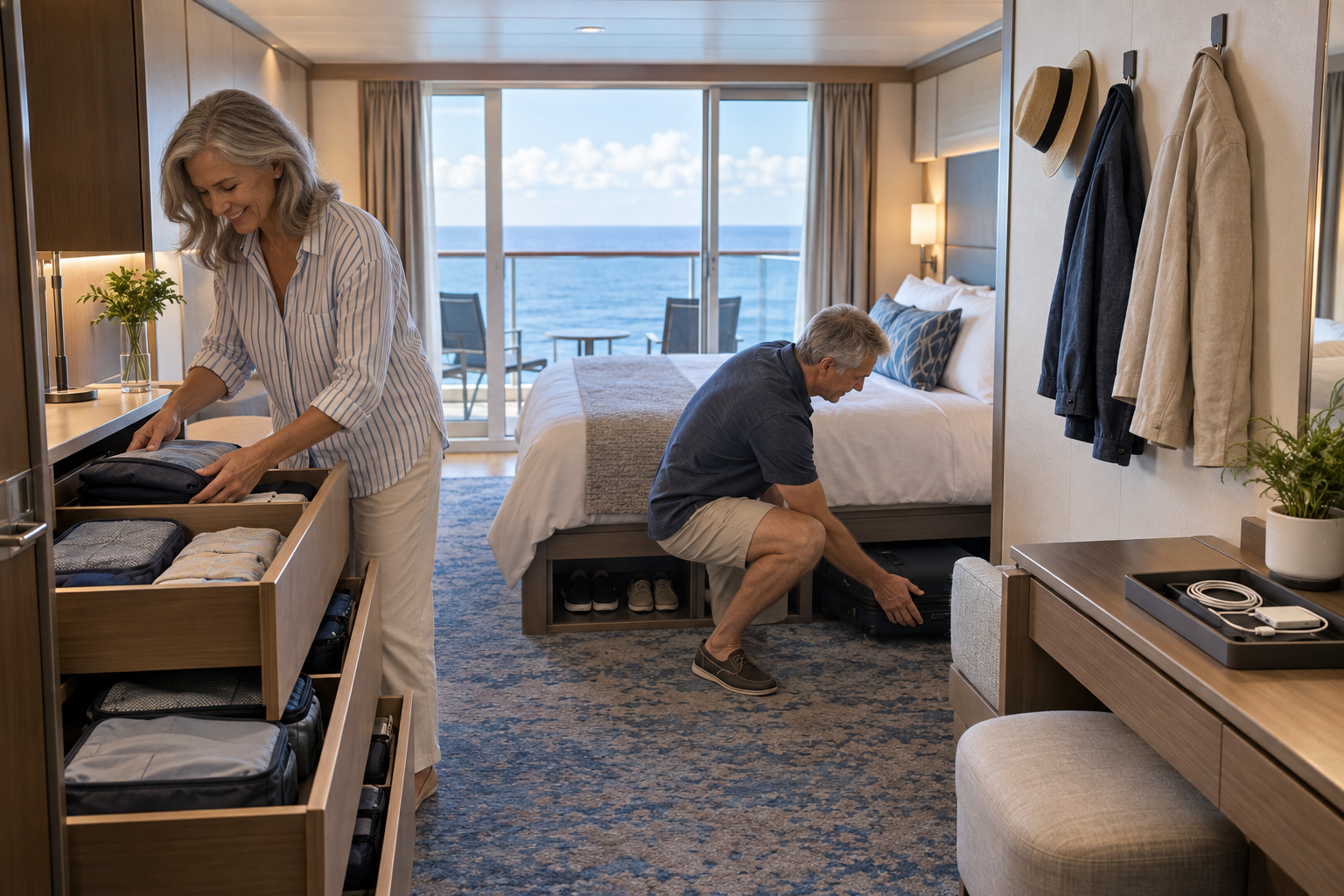
Bring a Power Strip and Magnetic Hooks for Your Cabin

Cruise ship cabins are thoughtfully designed for their size but they are designed for the ship’s standard passenger, not for the specific technology and organizational needs of the modern traveler. Most cruise cabins have two to three power outlets total, positioned at the desk area rather than at the bedside, which serves guests with one or two devices and not at all the traveler with a phone, a tablet, earbuds, a camera, a CPAP machine, and a partner with the same set of devices. A surge-protected power strip with USB ports transforms two desk outlets into the full charging station the cabin needs.

Before packing a power strip for a cruise, confirm two things. First, confirm the cruise line’s specific policy on power strips. Most major cruise lines permit power strips with surge protection but prohibit those without it, as the surge protection prevents electrical issues that could affect the ship’s systems. Policies vary and change, so verify with the specific line and ship before packing. Second, confirm the voltage standard at the outlets in your cabin. International sailings may have European voltage at some outlets requiring a converter for devices not rated for dual voltage.

Magnetic hooks are the cabin organization tool that experienced cruisers name most consistently when asked what they always bring. Cruise ship cabin walls are steel and magnetic. Magnetic hooks adhere instantly without any adhesive, damage, or installation, hold several pounds of weight reliably, and can be repositioned anywhere on the cabin wall as needed. Use them for hanging bags, scarves, hats, and jackets. Use them to hang the daily newsletter on the wall where it is readable from the bed. Use them to create a key card and lanyard station by the cabin door where every cabin guest’s card hangs at a consistent location that eliminates the morning card-hunt before every shore departure.

A small over-the-door hanging fabric organizer for the back of the cabin bathroom door is a third cabin organization item that experienced cruisers consistently recommend. Cruise ship bathrooms have limited counter and shelf space. A hanging organizer with pockets provides the toiletry storage that the cabinet shelf does not and keeps the counter clear for the morning routine rather than cluttered with every product from every cabin guest.

Insider Note

Pack a small dry-erase marker or whiteboard marker and confirm whether your cabin door has a magnetic surface before your sailing. Many cruise ship cabin doors are magnetic on the exterior. If yours is, a whiteboard marker allows you to write notes to your travel group directly on the cabin door, visible from the corridor. A message saying which excursion bus to meet at, what time the group is gathering for dinner, or simply where you are becomes a reliable group communication tool that costs the price of one marker and requires no signal.

Read the Daily Newsletter Every Night Before Bed

The ship’s daily newsletter, delivered to every cabin each evening for the following day’s programming, is the single document that transforms a cruise from a series of accidental discoveries into a deliberately curated experience. Every activity, every show, every specialty event, every limited-availability experience, and every time-sensitive deal offered aboard for the following day is listed in the daily newsletter. The guest who reads it the night before plans the next day with complete information. The guest who does not reads it at breakfast, discovers they missed the 9 a.m. priority booking for the captain’s table dinner, and spends the morning reconstructing the day from whatever remains available after the informed guests have claimed the best options.

Read the newsletter with a pen in hand and circle three things: the one entertainment event you most want to see, the one activity you want to book or show up for, and the one time-sensitive offer you want to act on. Three specific commitments from the newsletter create a focused next-day agenda. The rest of the day remains open for the spontaneous discoveries, the pool conversations, the unexpected cocktail bar you find at 4 p.m. that becomes the group’s unofficial gathering spot for the rest of the sailing. The three circled items are the structure. Everything around them is the saying yes to whatever the ship puts in front of you.

Pay particular attention to the newsletter’s early booking and sign-up sections. These are the items that require action before the next morning to secure: the cooking class with limited spots, the private ship tour that runs once per sailing, the specialty coffee tasting at 8 a.m. for the first twenty guests to sign up. These opportunities are available to every guest on the ship. The guests who get them are the ones who read the newsletter the night before rather than over breakfast when the sign-up sheets are already full.

The newsletter also provides the next day’s weather forecast, the dress code for dinner, the port arrival and departure times, the all-aboard time for port days, and any important operational announcements. Ten minutes of reading before bed eliminates every logistical surprise the next day could produce and replaces it with specific, confirmed knowledge of what is happening and when.

Insider Note

Most cruise ships now offer the daily newsletter in a digital version through the ship’s app, available earlier than the physical cabin delivery, sometimes by early evening for the following day’s programming. Set a reminder on your phone for 8 p.m. each evening to check the digital newsletter, circle your three items, and share the relevant timing information with your travel group so the entire group benefits from the one reading session rather than each person doing it independently or not doing it at all.

Our Real Favorites

The Cruise Gear That Makes Every Sailing Better

The surge-protected power strip with USB ports that solved the cabin charging problem permanently, the magnetic hooks that created an organizational system on a steel wall in thirty seconds, and the small dry-erase marker that replaced the group text thread with a cabin door message board. Real cruise gear picks from real sailings that changed how we board and how we stay organized from embarkation day to the last sea day.

DND Favorites

Always Return to the Ship at Least Thirty Minutes Before All Aboard

The all-aboard time printed in the daily newsletter and announced at every port is not the suggestion time. It is the deadline. A cruise ship will depart at its scheduled time with anyone who has not returned aboard left at the port. This is not a theoretical consequence that applies to other travelers. It is a documented and consistent reality of cruise travel that happens on sailings around the world to guests who underestimated the distance back to the ship, overestimated how quickly the port shuttle would run, or simply lost track of time at a market, a restaurant, or a beach. The ship does not wait.

Returning thirty minutes before all-aboard time provides the buffer that absorbs every port-day variable that the perfectly-timed return does not account for. The taxi that was not immediately available. The traffic on the road back to the pier. The port shuttle running on a twenty-minute interval. The security queue at the gangway that had backed up. The guest who turned an ankle on the cobblestones three hundred meters from the ship and needed five extra minutes. Any one of these scenarios, on a perfectly timed return, produces a missed ship. On a thirty-minutes-early return, any one of them produces a slightly hurried but successful reboarding.

Photograph the ship’s departure information from the daily newsletter or write the all-aboard time on your phone’s lock screen before going ashore. In the immersive experience of a port day, the all-aboard time that was clearly remembered at 9 a.m. becomes uncertain at 3 p.m. when hours of walking, eating, and exploring have filled the working memory with other information. A photograph or lock screen note provides the time without requiring recall under pressure.

Insider Note

On port days, identify the ship’s dock location in relation to the port’s exits and set a pin on your maps app before going ashore. Many cruise ports have multiple exits, long pier walks, and shuttles to the main cruise terminal that add fifteen to twenty minutes to the apparent walking time. A pin on the map showing the ship’s location allows real-time assessment of how long the return will take from wherever you are. This is particularly valuable at ports where the pier is long, the tender service between ship and shore adds a ferry wait to the return time, or where the port town extends significantly in both directions from the pier.

What to Do Before You Even Board the Ship

The most impactful cruise planning happens before embarkation day. Research the ports on your itinerary using cruise line forums, travel blogs, and recent traveler reviews to identify the one must-do experience at each stop. Build a port priority list before sailing so the shore excursion booking on day one is a confirmation of a researched decision rather than a first-time browse through the ship’s options under time pressure.

Complete the cruise line’s online check-in as early as the window opens. Online check-in, which includes uploading passport photos, emergency contact information, credit card registration, and any pre-cruise documentation, produces a boarding pass that allows you to bypass significant portions of the embarkation queue. The guest who completes online check-in thirty to sixty days before sailing boards meaningfully faster than the guest who completes it at the pier. The difference is often thirty to ninety minutes, which is the exact time available for the first-hour aboard booking strategy.

Research what is included in your fare and what incurs additional charges before boarding. Beverage packages, specialty dining packages, shore excursion credits, gratuity inclusion, and Wi-Fi access vary significantly between cruise lines, ships, and cabin categories. Understanding the financial structure before boarding eliminates on-board discoveries of unanticipated costs and allows you to make pre-cruise purchase decisions at the rates that are almost always lower than the on-board equivalent.

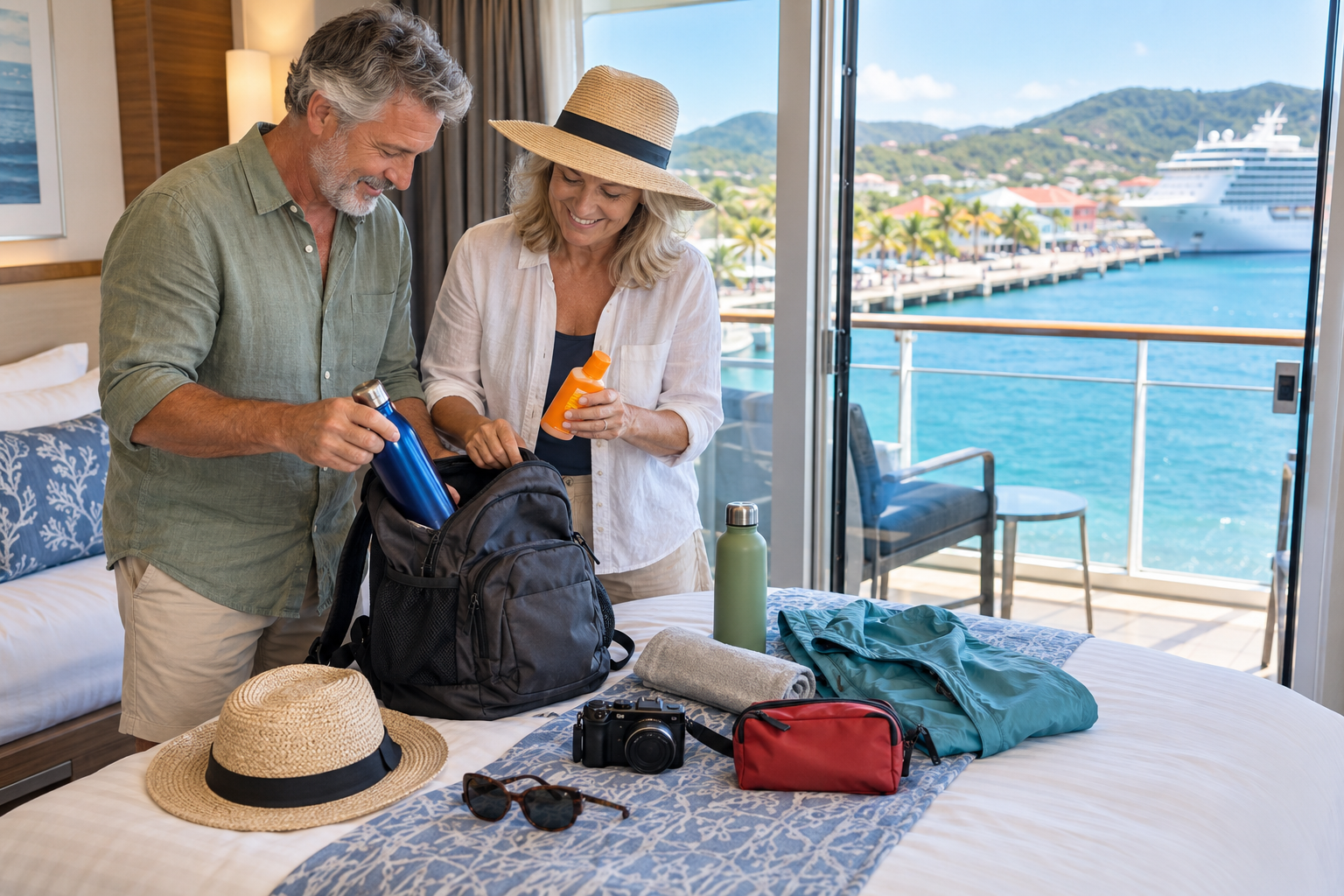
Pack a small day bag for port visits containing everything you need ashore without the weight of your main carry-on. A lightweight tote holds sunscreen, a water bottle, your ship card (never leave the ship without it), cash and a card, a small first aid kit, a light layer, your phone with an offline map of the port, and the shore excursion confirmation. The day bag should be light enough to carry for several hours of walking without fatigue.

Insider Note

Join the cruise line’s online community forum for your specific ship and sailing date before departure. Most major cruise lines have active passenger communities where guests who have sailed on the same ship share current information about specialty restaurant reviews, which shore excursion companies are currently the best independent options at each port, and what practical cabin upgrades other guests found useful. This community intelligence, assembled from guests who sailed weeks or months before yours, is more current and specific than any published guide and is available for free from any browser before you ever set foot on the pier.

The First Cruise and the Second One That Were Not Even the Same Vacation

Nadia had booked her first cruise because everyone she knew who had been on one said the same thing: you will love it. She was skeptical. She preferred travel with more spontaneity and less structure than a ship on a fixed route could offer. She boarded with low expectations and no particular plan beyond showing up and seeing what happened.

What happened was a week of consistently discovering that the good things were already gone by the time she found them. The teppanyaki restaurant was fully booked for every night of the sailing when she asked about it on day two. The best snorkeling excursion at the first port was sold out before she had finished unpacking on embarkation day. She had not read the daily newsletter on night one and missed the sign-up for the chef’s table dinner that filled within forty-five minutes of the newsletter being distributed. On day four she returned to the pier shuttle at what she thought was a comfortable margin before all-aboard and sat in traffic on the road back to the port for thirty minutes she had not accounted for, arriving at the gangway with eight minutes to spare and the crew member’s expression communicating precisely how close she had cut it.

She went home thinking the cruise format was not for her. Then someone who had sailed the same ship the following month asked if she had known about the pre-cruise booking window. She had not. Or the first-hour boarding strategy. She had not. Or the daily newsletter sign-up items. She had not read it in time. A second person asked if she had brought a power strip. She had charged her phone in the corridor outlet outside her cabin for three nights before the cabin steward quietly suggested she try the desk.

She booked a second cruise specifically to test the system. She completed online check-in thirty days before sailing. She downloaded the cruise app and pre-booked the specialty restaurant for night two and the shore excursion she had researched at each port before embarkation. She brought the surge-protected power strip and twelve magnetic hooks. She read the daily newsletter every night by 8:30 p.m. and circled three items. She returned to the ship thirty-five minutes before all-aboard at every port day without exception. She joined the ship’s online forum two weeks before sailing and arrived knowing which table at the main dining room had the best view and which sea day activity filled up fastest on this particular ship. She loved the cruise. The same cruise format, the same type of ship, transformed entirely by the difference between a guest who arrived and a guest who prepared. She is now the person other guests ask for advice at the specialty restaurant booking desk on embarkation morning.

Six More Cruise Hacks That Experienced Guests Always Use

Beyond the four core hacks and the pre-boarding preparation, these six additional strategies address the specific cruise experiences that most first-time cruisers leave to chance and that experienced guests manage deliberately.

Get to the main dining room for breakfast on sea days rather than the buffet. The main dining room breakfast is served at the same quality as dinner, by attentive servers at a properly set table, with a menu that includes cooked-to-order eggs and specialty items not available at the buffet. It takes slightly longer but produces a genuinely different sea day morning: settled, unhurried, served, and a meal rather than a crowded cafeteria experience.

Attend the first captain’s reception or welcome event of the sailing. This event, typically held on day one or two, is where the ship’s senior officers are introduced and where the social atmosphere of the sailing begins to form. First-time cruisers who attend find the cruise social atmosphere accessible from day one. Those who skip it often feel like they missed the beginning of something that continued without them.

Use the ship’s gym or sports facilities in the early morning before the sea day crowd arrives. Cruise ship gyms are well-equipped but not large, and popular sea day gym sessions between 9 a.m. and 11 a.m. can involve waiting for equipment. A 7 a.m. gym session produces the experience of having the facility almost entirely to yourself, the most dramatic ocean views from the gym windows, and the rest of the sea day genuinely free.

Explore the ship’s quiet areas on embarkation day. The forward observation deck, the aft pool area, the adult-only sundeck, and the quieter bars at the ship’s extremities are almost always deserted during the first few hours aboard when everyone is at the main pool, the buffet, or exploring the central areas. Embarkation day exploration of the quiet areas identifies the spots that will serve as private retreats across the sailing when the popular areas are crowded.

Buy a small waterproof phone case or dry bag for port days involving beaches or water-based excursions. A phone dropped in salt water during a snorkeling excursion is almost certainly damaged beyond repair, and the cost and disruption of a damaged phone for the remainder of the sailing significantly exceeds the cost of a waterproof case purchased before boarding.

Take advantage of the ship’s late-night dining options on evenings you are not at specialty restaurants. Most cruise ships offer late-night buffets, pizza service, and room service at no or minimal additional charge through the late evening. A late-night light meal before bed after a port day is the recovery that makes the following morning feel normal rather than depleted.

Insider Note

Book a ship’s organized excursion for the first port day even if you typically prefer independent exploration. The first port day is the one where the ship’s procedures, gangway etiquette, and practical logistics of reboarding are all new. A ship’s excursion on the first port day provides a structured experience of these logistics with a guide who manages the return timing. On subsequent port days, with the practical logistics understood, independent exploration becomes a confident choice rather than a leap into an unfamiliar process.

Book With Us

Book the Cruise That Rewards This Much Preparation

The right cruise depends on the itinerary, the ship size, the cruise line’s style, and the specific experience you are after. Our travel agents specialize in matching travelers with the sailing that fits them rather than the sailing that is most available. Let us find yours. You do the preparation. We handle the booking details that make the preparation worth doing.

Book A Trip

Common Cruise Mistakes to Avoid

Most first-cruise disappointments come from the same preparation gaps. These are the most consistent ones and what to do differently before the next sailing.

1

Waiting until day two or three to book specialty dining and excursions

The specialty restaurant that is fully booked for every remaining evening by 10 a.m. on embarkation day was available when the ship left port. The popular shore excursion that sold out on day one was available in the pre-cruise booking window and on the ship for approximately the first ninety minutes of the sailing. The guest who books in the first hour either aboard or through the cruise app before boarding has access to the full availability. Every hour after that is an hour during which the best options narrow. Waiting until day two to think about it is waiting until after the best things are gone.

2

Not reading the daily newsletter or reading it at breakfast when it is too late

The daily newsletter read at breakfast on the day of its programming is the newsletter whose sign-up items have already been claimed by the guests who read it the night before. The chef’s table that filled in forty-five minutes. The private bridge tour that went to the first twelve guests to sign up. The cocktail demonstration limited to twenty guests. These are available to every guest. The difference is entirely when the newsletter was read. Reading it the night before is a ten-minute investment that produces full access to the following day’s best experiences. Reading it at breakfast is reading a menu where the best items have sold out.

3

Returning to the ship without a time buffer before all-aboard

A perfectly timed return to the ship that leaves no margin for port variables is a return that one unforeseeable obstacle turns into a missed ship. Traffic, an unavailable taxi, a longer pier walk than expected, a tender wait in heavy demand, a security queue backup: any single one converts a perfectly timed return into a too-late arrival. Thirty minutes of buffer before all-aboard absorbs every one of these independently. The guest who returns thirty minutes early waits on the ship for thirty minutes. The guest who returns with no buffer and encounters one obstacle does not return at all.

4

Not bringing a surge-protected power strip

Two to three outlets in a cabin shared by two guests with combined devices totaling six to eight charging needs is a charging schedule that requires deliberate management and the consistent inconvenience of having specific devices uncharged at the specific moments they are needed for port days and evening entertainment. A surge-protected power strip converts the same two outlets into a full charging station for the entire cabin. Verify the cruise line’s specific policy on power strips before packing, as policies vary between lines.

5

Not completing online check-in before embarkation day

The embarkation queue at a cruise terminal for a large ship can involve hundreds to thousands of passengers arriving within the same boarding window. The queue for guests who completed online check-in in advance is typically a fraction of the length of the queue for guests completing it at the pier. The difference in embarkation time is often thirty to ninety minutes, which is the exact time available for the first-hour aboard booking strategy. A guest who completed online check-in boards quickly, books immediately, and has the first two hours of the sailing working for them.

6

Spending every sea day in the same popular areas without exploring the ship

A large cruise ship has significantly more to offer than the main pool deck and the central atrium. The quiet forward observation lounge with the panoramic ocean view. The aft sundeck that is empty at 7 a.m. The library with genuinely comfortable chairs and no background noise. The smaller specialty bar tucked behind the main atrium that has better cocktails and no queue. The guest who explores the ship systematically in the first two days discovers the quiet retreats that become their personal cruise spaces for the rest of the sailing. The guest who stays in the main areas has a good cruise. The guest who finds the spaces that feel like they belong to them has a great one.

Turn Travel Into Income

Love Helping Travelers Find the Right Cruise?

Matching travelers with the right ship, the right itinerary, and the right cruise line for their specific travel style is genuinely rewarding work, and the commissions on cruise bookings are among the best in the travel industry. If becoming a home-based travel agent who specializes in cruise travel sounds like the right next step, see how the TravelPreneur system works. Earn commissions, get insider cruise perks, and build a real business from anywhere.

Become An Agent

Frequently Asked Questions

These are the questions first-time and returning cruise guests ask most often. Real answers from real cruise experience across ships, itineraries, and sailing types.

Is it better to book shore excursions through the cruise line or independently?

Both options have genuine advantages and the best choice depends on the specific port and your risk tolerance for return timing. Cruise line excursions carry the guarantee that the ship waits for late-returning groups from their own organized tours, meaning a delayed bus will not result in a missed ship. They also handle all logistics including transportation, entrances, and return timing. Independent tours through reputable third-party operators typically cost 20 to 40 percent less for comparable experiences, often provide smaller group sizes and more personalized guides, and frequently offer experiences not available through the cruise line. The risk is that the ship does not wait for independently touring guests who return late, which means the all-aboard timing responsibility is entirely yours. For ports where you are confident of the return logistics and the independent operator has recent positive reviews on cruise forums, independent excursions offer excellent value. For first-time visits to complex destinations with unpredictable traffic, the cruise line’s own excursion provides the safety net that the price premium purchases.

What should you bring in a day bag for port visits?

The port day bag is a lightweight tote or small daypack containing your cruise ship card (essential for reboarding), your passport or a photo of it on your phone plus the original secured in the cabin, local currency and a travel card, sunscreen with a travel-size reapplication tube, a refillable water bottle, a light layer for air-conditioned interiors and unexpected weather changes, your phone with the offline port map downloaded the night before, your shore excursion confirmation if applicable, a small basic first aid kit including blister plasters, and snacks for any port day extending beyond a meal service. Wear comfortable walking shoes regardless of what later in the day requires. Most port days involve significantly more walking than guests anticipate, and blisters are one of the most common reasons port days become shorter than planned.

How do you handle seasickness on a cruise?

Seasickness susceptibility varies significantly between individuals, sea conditions, and ship sizes. Large modern cruise ships are stabilized for smoother motion and sail most itineraries in conditions that most passengers navigate comfortably without intervention. For guests with known susceptibility, several preventative approaches are available: over-the-counter medications taken before the motion begins rather than after symptoms start, acupressure wristbands worn on both wrists, and positioning yourself in the lower and more central portions of the ship when rough seas are expected. Fresh air and a visible horizon are consistently effective for mild symptoms. Ginger in various forms has modest evidence for reducing nausea in some individuals. Consult a healthcare professional about prescription anti-nausea options before sailing if you have experienced significant motion sickness in previous travel contexts.

What is the best cabin type and location for a first cruise?

For a first cruise, the most consistently recommended cabin choice is a balcony cabin on a middle deck toward the ship’s center. The balcony provides private outdoor space that is one of the most valued cruise amenities, particularly for sea days and for watching port arrivals and departures. The middle deck and central ship position minimizes the effect of the ship’s motion on rough days. Avoid the lowest passenger decks immediately above the engine room due to potential vibration and noise. Avoid the highest decks at the bow and stern if motion sensitivity is a concern. Cabins near the elevators provide convenient access to common areas but receive more corridor traffic noise. A mid-corridor balcony cabin on deck seven through ten toward the ship’s center is the starting recommendation most experienced cruisers give to first-timers.

How do cruise gratuities work and how much should you expect to pay?

Cruise line gratuity structures vary between lines and are updated periodically, so confirming current rates with your specific cruise line before booking is strongly recommended rather than relying on general figures that may be outdated. Most major cruise lines apply a daily automatic gratuity charged to the guest’s onboard account, typically covering the cabin steward, dining room staff, and other service crew. Some cruise lines include gratuities in the fare. Others offer a pre-paid gratuity option before sailing. The daily automatic gratuity can often be adjusted at guest services if your experience warrants it. Additional tipping in cash for exceptional service from specific staff is common and appreciated but not expected. Specialty restaurant service charges may be separate from the daily gratuity. Confirming the full gratuity structure for your specific sailing before departure allows you to budget the total cruise cost accurately rather than discovering additional expenses on the final account statement.

What documents do you need for a cruise and how should they be organized?

Document requirements for a cruise vary significantly based on the itinerary, the ports visited, your citizenship, and the citizenship of every guest in your group. For any cruise visiting foreign ports, a valid passport is the recommended document for all guests regardless of citizenship, since it is universally accepted at every port. For closed-loop cruises beginning and ending at the same US port, US citizens can technically travel with a birth certificate and government-issued photo ID, but the passport is strongly recommended since it handles medical emergencies abroad, unexpected itinerary changes, and alternative return arrangements if the guest cannot reboard the ship for any reason. Organize cruise documents in a single slim travel wallet: the cruise booking confirmation, each guest’s passport or ID, the online check-in boarding pass, travel insurance information, and any port-specific entry requirements for the specific sailing. Carry this wallet in your personal item, not your checked luggage, for the embarkation journey.

The difference between a good cruise and a great one is almost never the ship. It is almost always the guest, and specifically whether they arrived knowing what the informed guests know.

Picture the First Hour Aboard Your Next Sailing

Online check-in was completed thirty days ago. You walk through the priority boarding lane. You are aboard within twenty minutes of arriving at the terminal. Your travel companion heads to the cabin to set up the magnetic hooks and power strip. You go directly to the specialty dining venue and book the teppanyaki for night two, the steakhouse for the last evening, and the chef’s table for the formal night. You open the cruise app and book the shore excursion you researched before sailing for the first port day. You are done in eighteen minutes. Tonight you will read the daily newsletter by 8:30 p.m. and circle three things for tomorrow. On every port day you will be back at the gangway thirty minutes before all-aboard. You are the informed guest. The great cruise is already underway.

Free Download

One More Thing Before You Board

Print our free Travel Packing Checklist before your next cruise. The cruise-specific categories cover every cabin item, every port day bag essential, and the document organization that makes embarkation day smooth rather than stressful. The same checklist we recommend before every sailing we help plan.

Get the Free Checklist

Explore Our Top Picks for a Better Trip

From the surge-protected power strip that solved the cabin charging problem permanently to the magnetic hook set that created an organizational system on a steel wall in thirty seconds, see the cruise products and travel resources we actually use and recommend. Real picks from real sailings built around the system in this article.

See Our Top Picks

Travel Prints and Printables From Our Shop

Visit Premier Print Works for cruise journals, voyage planners, port day itinerary printables, shore excursion organizers, and wall art that makes every sailing a little more beautiful and a lot more organized from embarkation morning to the last sea day sunset.

Visit Premier Print Works

Disclaimer

The information shared in this article is provided by Don and Diana’s Travels for general informational, educational, and inspirational purposes only. It reflects our personal experiences, opinions, and the experiences of travelers we have worked with. It is not professional travel, legal, financial, or medical advice, and it should not be relied on as such.

Cruise Line Policies and Regulations

Cruise line policies including power strip rules, gratuity structures, pre-cruise booking windows, online check-in procedures, shore excursion booking policies, all-aboard timing enforcement, and related cruise operational matters change frequently and vary significantly between cruise lines, ships, routes, and sailings. Always confirm current policies with your specific cruise line before departure. The policies mentioned in this article reflect general practices at the time of writing and may not apply to your specific sailing. We make no guarantee that any cruise line policy information in this article is current, complete, or applicable to your specific situation. We are not affiliated with any cruise line and make no representations on their behalf.

Travel Documentation

Passport and travel document requirements for cruise travel vary by itinerary, ports of call, guest citizenship, and applicable regulations that change frequently. Always confirm current documentation requirements with your cruise line, a qualified travel agent, and official government sources for every port included in your itinerary before travel. We are not responsible for any documentation-related travel disruption arising from reliance on information in this article.

Health and Medical Information

Any information in this article about seasickness, motion sickness remedies, or general health matters during cruise travel is general educational information only and not professional medical advice. Consult a qualified healthcare professional about any health-related travel preparations, including anti-nausea medications or other travel health interventions, before your sailing.

Affiliate and Partner Links

This article may contain affiliate links, partner links, referral links, and links to products or services that pay us a commission. If you click a link and book a trip, make a purchase, sign up for a service, or complete any qualifying action, we may earn a small commission at no extra cost to you. Our recommendations are based on real use and genuine belief in the products and services we share.

Third-Party Websites and Services

We may link to third-party websites, services, and resources for your convenience. We do not control these sites and are not responsible for their content, terms of service, privacy practices, pricing, availability, or any product or service they sell. Your use of any third-party site is entirely at your own risk.

Health, Safety, and Personal Responsibility

Travel involves personal risk. You are solely responsible for your own health, safety, travel insurance, medications, vaccinations, documentation, financial decisions, and choices while planning or taking any trip, including cruise travel. We strongly recommend purchasing comprehensive travel insurance for every trip, particularly for cruise travel where port-day mishaps, missed-ship scenarios, and medical events at sea have specific financial implications. Don and Diana’s Travels, its owners, employees, contractors, and affiliates accept no liability for any loss, injury, illness, delay, cancellation, missed ship, damage, theft, or inconvenience arising from your use of the information in this article or from any travel decisions you make.

Composite Stories and Characters

Some stories, examples, and traveler experiences shared on this site are composites drawn from the real experiences of Don, Diana, clients, friends, and travelers we have worked with over the years. Names, identifying details, locations, and circumstances may be combined, changed, or fictionalized to protect privacy. Any resemblance to a specific real person beyond the composite portrayal is unintentional.

No Guarantees

We do not guarantee any specific result, outcome, savings, or experience from using the information, tips, services, or products mentioned in this article. Your results depend on many personal factors including your own choices, effort, circumstances, and external conditions outside of our control.

Copyright and Use

All content in this article is the copyrighted property of Don and Diana’s Travels unless otherwise noted. You may not copy, republish, redistribute, modify, sell, or reuse our content without our prior written permission. You are welcome to share a direct link to this article with proper credit.

By reading and using the information in this article, you acknowledge that you have read, understood, and agree to this disclaimer in full.