25 Travel Hacks for Surviving Long Layovers
The long layover — four hours, six hours, twelve hours in an airport between flights — is the part of the travel itinerary that most travelers dread and most travelers handle less well than they could. The hours spent slumped in a gate chair, stiff and understimulated, eating forgettable terminal food and watching the departures board are not the only version of the long layover. They are just the version that happens when the layover was not thought about before it arrived.
These twenty-five hacks cover every dimension of the long layover — the preparation done before arriving at the layover airport, the comfort and rest available to the traveler who knows where to find it, the productive and restorative uses of the time that most layover travelers never discover, the navigation habits that protect the connection, and the mindset shift that turns a long layover from something to survive into something that occasionally becomes the most interesting part of the itinerary. The prepared layover is not the same layover as the unprepared one.
Free Download: Our Travel Packing Checklist
Before the layover bag closes, our free Travel Packing Checklist confirms every layover essential is in the personal item and every pre-departure step is done so the layover starts from the best possible position. Download it free.
Get the Free ChecklistBefore the Layover: The Preparation That Changes What the Time Feels Like
The long layover whose character is determined entirely by what the airport happens to offer to an unprepared traveler is a fundamentally different experience from the long layover whose character was shaped by thirty minutes of research done before the departure that preceded it. These tips cover the preparation that converts the layover from an obstacle into a manageable — and occasionally enjoyable — stage of the journey.
1. Research the layover airport before the first flight departs
Every major transit airport has a specific character whose features — lounges, shower facilities, sleeping pods, restaurants worth seeking out, architectural highlights, transit hotels, walking distances between terminals — are documented on airport guides, traveler forums, and the airport’s own website. Thirty minutes of research before the departure that precedes the layover produces a specific plan for the layover hours: the lounge access confirmed, the shower facility located, the restaurant recommended by previous transiting passengers identified, the walking distance from the international terminal to the connector confirmed so the departure gate buffer is accurate. The traveler who arrives at the layover airport knowing what it offers is the traveler whose layover hours are used rather than endured.
2. Check whether a transit visa is required for the layover country
Transiting through a country does not automatically mean the traveler is exempt from that country’s entry and transit visa requirements. Some countries require a transit visa for passengers who will pass through immigration to access the international transit area — even briefly, and even without leaving the airport building. The specific requirement depends on the specific passport held and the specific country. Discovering a required transit visa at the layover airport’s immigration desk is not an administrative inconvenience — it is a potential denial of entry, a missed onward connection, and a serious disruption whose cause was a five-minute research omission. Check the layover country’s transit visa requirements for the specific passport well before departure.
3. For layovers of six or more hours in a transit-friendly city, consider leaving the airport
The major hub airports of Amsterdam, Singapore, Dubai, Tokyo, Istanbul, Hong Kong, and others are positioned in cities whose transit-accessible highlights — a specific neighborhood, a famous landmark, a local food experience — are reachable within the layover window for the traveler who has researched the logistics before arrival. The time required to clear immigration, travel to and from the highlight, and return to the airport with a comfortable buffer for re-entry security and the departure gate is calculable in advance. For a nine-hour layover at Changi, the thirty-minute train to Singapore’s Gardens by the Bay and back is a genuine enhancement of the travel day. For the traveler who planned it before departure, it is one of the trip’s memorable moments. For the traveler who decided on arrival, the timing math rarely works as hoped.
4. Pack a dedicated layover kit in the personal item before the first flight
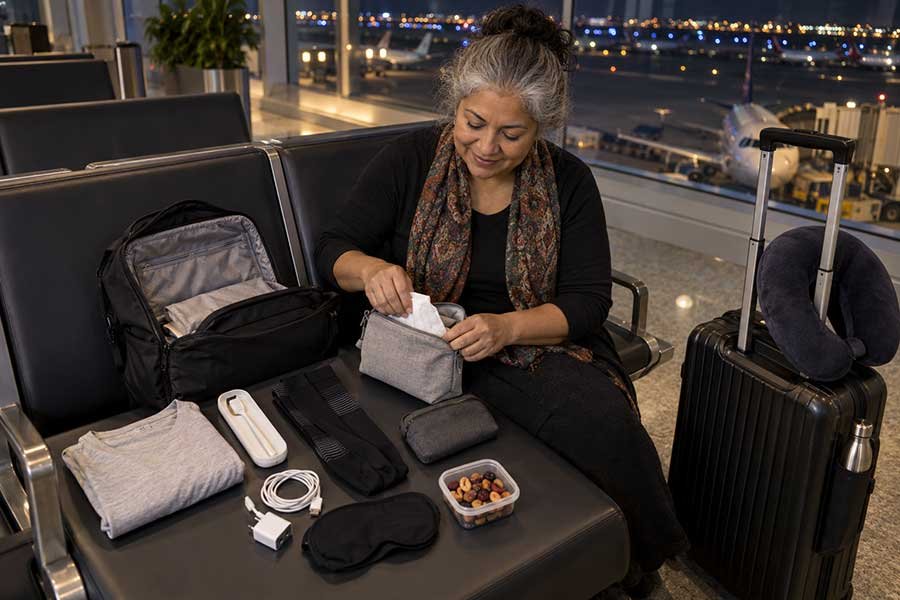
The layover kit — the sleep mask, the earplugs, the neck pillow, the travel toothbrush and toothpaste, a clean change of socks and underwear, the phone charger, the snacks for the layover, the entertainment downloaded offline — packed in the personal item before the first departure is the kit available from the moment of landing at the layover airport without opening the overhead bag. The layover that begins with the personal item already organized for it begins with a different quality of calm than the layover whose first twenty minutes are spent excavating items from the carry-on in the boarding gate’s seating area.
5. Download the layover airport’s app and the layover city’s offline map before departure
The layover airport’s dedicated app — available for most major hub airports — provides real-time gate information, interactive terminal maps, lounge locations, restaurant listings, and facility guides specific to the transit experience. Downloaded before the first departure, it is available from the moment of landing without requiring connectivity whose reliability at the layover airport is unknown until arrival. The offline map of the layover city serves the traveler who leaves the airport during a long layover — navigation from the airport train station to the specific destination and back, available at zero data cost, loaded before the connection is needed.
Book A Trip
Book the next trip with a travel agent who builds the right connections, the right layover lengths, and the right routing so the journey works as well as the destination. Let us handle the planning.
Book A TripComfort and Rest: What the Layover Airport Actually Offers
The long layover airport offers significantly more comfort infrastructure than most transiting passengers realize — because the infrastructure is not on the path between the gate and the food court where most layover travelers spend their hours. The lounge, the shower, the sleeping pod, the quiet zone, and the airport hotel are features of major hub airports that are used exclusively by the traveler who looked for them before arriving.
6. Access a lounge — more are purchasable than most travelers realize
Airport lounges are not exclusively for business class passengers and elite frequent flyers. Most major hub airports have independent lounges — Priority Pass, Plaza Premium, Aspire, and others — whose day access is purchasable directly at the door or through an app for a fee that ranges from twenty to sixty dollars depending on the airport and the lounge. For a long layover, the lounge provides: a quiet, comfortable seating environment, food and drinks included in the access fee, shower facilities at most locations, reliable high-speed WiFi, and the specific rest quality of a space designed for layover passengers rather than a gate seating area designed for boarding queues. Research the specific lounge options at the specific layover airport before arrival. The fee is frequently the best per-hour value available in the layover budget.
7. Book an airport hotel room or sleeping pod for overnight layovers
The overnight layover spent in a gate chair produces the arrival at the destination in a state of accumulated discomfort whose recovery costs the trip’s first morning. An airport hotel room — available airside at most major international hubs, bookable by the hour or for a half-day rate rather than a full night — provides a bed, a shower, and the specific restorative value of lying horizontal in a dark, quiet room for the hours available. Airport sleeping pods, where available, provide the same core benefit at a lower cost and a smaller footprint. Either option converts the overnight layover from a night of fitful chair-sitting into genuine rest whose value is felt at the next airport rather than at the accommodation whose first morning was spent recovering from not having it.
8. Locate the quiet zones and rest areas specific to the layover airport
Every major hub airport has areas whose lower traffic volume, reduced ambient noise, and specific seating configuration provide rest quality significantly better than the main terminal concourse — without the cost of the lounge or the hotel room. These areas include the quiet floors at Singapore Changi, the sleeping areas at Amsterdam Schiphol, the garden terrace areas at several Asian hub airports, and the less-traveled satellite terminals at most major hubs. Research the specific airport’s quiet areas before arrival. The airport whose quiet floor is a ten-minute walk from the main food court will not be discovered by the traveler who stays within sight of the gate. The traveler who looked it up before landing walks directly to it.
9. Use the sleep kit consistently for any rest attempted during the layover
The sleep mask that achieves genuine darkness, the earplugs that reduce the terminal’s ambient noise to a manageable level, and the neck pillow that supports the head in the position the gate chair’s geometry does not — these three items convert the layover sleep attempt from the light, interrupted doze the terminal environment produces without them into something closer to actual rest. All three together. Every layover sleep attempt. The sleep mask alone without the earplugs produces darkness without quiet. The earplugs alone without the sleep mask produce quiet without darkness. The specific combination of both produces the rest quality whose difference from each alone is significant enough to be felt at the next destination.
10. Change into clean clothes if the layover spans a sleep window
The change of socks and underwear in the personal item’s layover kit is one of the most cost-effective physical restoration investments available during a long layover. The transition from the clothes worn through the previous flight into a clean change — even without a shower — produces a physical reset whose quality improvement is disproportionate to the two minutes it requires. Combined with a face wash at the terminal bathroom sink and the brushed teeth from the travel toothbrush kit, the clean-clothes change converts the long layover’s physical condition from the accumulated state of the preceding flight into a refreshed starting point for the following one.
“The long layover is not the enemy of the trip. It is the part of the trip that rewards the traveler who brought the right things and looked up the right information before they arrived.”
Plan Our Escape
Let us plan the trip from the first booking to the final destination — the right routing, the right connections, and every detail that makes the journey as good as what is waiting at the end of it.
Plan Our EscapeMaking the Time Useful: What a Long Layover Actually Allows
The long layover’s most consistent misuse is the passive wait — seated, scrolling, increasingly uncomfortable, watching the hours pass without directing them toward anything. The same hours contain enough time for a genuine meal, a shower, several hours of offline entertainment, a meaningful amount of work, or a brief exploration of the transit city. These tips address the active uses of the layover that its passive endurance consistently displaces.
11. Use the airport shower — more hub airports offer them than most travelers know
The airport shower is one of the least-used facilities in most major hub airports relative to the number of layover passengers who would benefit from it — because most layover passengers do not know it exists until they have been using that airport for years. Most major international hub airports offer shower facilities — some in the main terminal, some exclusively in lounges whose day access includes shower use, and some in dedicated shower suites bookable by the hour. The shower available between a long-haul flight and a following connection is the physical reset that affects the rest of the journey’s quality more than almost any other single layover decision. Look up the specific airport’s shower options before arrival. Use them when the layover provides the time.
12. Load offline entertainment for the full layover duration before the first flight departs
The layover’s entertainment that depends on the layover airport’s WiFi — streaming shows, online content, social media — is entertainment whose quality varies with the WiFi quality, whose data privacy is uncertain on a public airport network, and whose availability assumes the connectivity that the layover airport may or may not provide reliably. Downloaded offline content — the specific shows, the podcast episodes, the audiobook chapters, the e-reader’s loaded books — plays from local storage at full quality regardless of any connectivity variable. Load enough content for the full layover duration plus a buffer before the first departure. The layover whose entertainment was loaded is the layover whose entertainment works.
13. Eat a proper meal rather than snacking through the layover
The long layover whose food plan is the rotating consumption of terminal snacks produces the specific combination of blood sugar instability and accumulated dissatisfaction that makes the gate chair feel worse than its physical reality justifies and the boarding of the connecting flight feel like a relief rather than a continuation. A single proper meal — one of the terminal restaurants whose specific recommendation was identified in the pre-layover research, or a lounge meal included in the access fee — provides the nutritional baseline and the satisfying reset of a real eating experience that the snack rotation never achieves. Identify the meal destination before arriving at the layover airport. Eat it as a deliberate choice rather than as a series of vending machine and grab-and-go compromises.
14. Use the time for the work or tasks that the preceding flight did not allow
The long layover is the travel day’s most available block of uninterrupted time — more than the flight, whose turbulence, service interruptions, and seatback constraints limit sustained work; more than the hotel’s first evening, whose check-in procedures and adjustment period interrupt concentration. The four-hour layover with a reliable power outlet and a lounge’s quiet environment is a genuine work window whose use converts hours that felt like a delay into hours that advanced something. The laptop work that would otherwise need the destination’s first morning can happen at the layover airport. The email that needs writing, the document that needs review, the planning for the trip’s first day — all of these have a home in the long layover that a prepared traveler uses rather than wastes.
15. Move and exercise during the layover — some airports specifically support it
The physical stiffness of a long-haul flight accumulates across the transit and compounds across the connecting flight if the layover hours are spent entirely seated. Walking the terminal’s full length, finding the specific walking routes mapped in some major hub airports, using the yoga room or fitness facility where available — these activities address the circulation restriction and the joint stiffness that the preceding flight produced and the following flight will continue to produce. Singapore Changi has a swimming pool and a gym. Amsterdam Schiphol has a specific walking route mapped with distance markers. Dallas Fort Worth has a yoga room. The airport that supports physical movement during the layover rewards the traveler who looked it up before arriving.
How Remy Stopped Dreading Long Layovers and Started Booking Them Deliberately
Remy flew six to eight times a year and had a consistent strategy for long layovers: find the gate, find a chair near the outlet, watch the hours pass with varying degrees of discomfort and decreasing phone battery. It worked in the sense that the connection was always made. It produced, consistently, the specific type of travel fatigue that came not from the flying itself but from the hours spent in between flights doing nothing useful and resting nothing effectively.
The change began with a nine-hour layover at Singapore Changi whose length felt, at the time of booking, like a significant inconvenience. The research done before the first departure — out of a specific determination to not spend nine hours in a gate chair — produced the specific knowledge that Changi had a swimming pool, a movie theatre showing free films, a rooftop garden, a sleeping area with recliners, and a lounge whose day access included a shower and two meals. The nine hours planned against this information produced a morning swim, a genuine breakfast at the lounge, two hours of work in the quiet lounge environment, a film, a shower, and a two-hour sleep on a recliner that left the subsequent flight feeling like a continuation of a rest rather than the accumulation of a second deficit on top of the first flight’s.
The layover was not the obstacle. It was the morning. The destination started from a refreshed position whose cause was the nine hours before it rather than despite them. Remy now books connections through Changi specifically for the layover. These twenty-five hacks are the system that the nine-hour research session produced. The long layover is not survived. It is used.
Become An Agent
Love helping travelers turn every stage of the journey — including the layovers — into something genuinely worthwhile? See how to turn that into a home-based travel business.
Become An AgentNavigating the Airport and Protecting the Connection
The long layover’s enjoyment and productivity depend entirely on the connection being protected — and the connection is most at risk when the enjoyment and productivity of the layover hours pushes the departure gate to the back of attention. These tips cover the navigation habits and the connection-protection practices that allow the layover hours to be used fully without the specific risk of using them too fully.
16. Confirm the departure gate before doing anything else on arrival
The departure gate for the connecting flight — found on the arrivals board at the layover airport immediately after landing — is the first piece of confirmed information the layover requires before any other layover activity begins. At a major hub airport where gate changes are common and terminal distances are significant, the gate confirmed on arrival is the gate whose position shapes everything that follows: how far the lounge is from the gate, how much time the walk back requires, whether a mid-layover return to the gate area is worth planning. Confirm the gate first. Every layover. Every airport. The gate change discovered at the end of a comfortable lounge stay with forty minutes to departure is the gate change that the arrival board check would have caught with three hours to spare.
17. Enable airline app notifications for the connecting flight immediately on landing
The gate change notification pushed to the phone arrives before the departure board at the physical gate is updated — sometimes by the full interval between the airline’s system update and the physical gate’s signage change, which at a busy hub can be fifteen to twenty minutes. Enable push notifications for the connecting flight in the airline app immediately after landing. The notification that arrives while seated in the lounge with two hours remaining produces a calm repositioning. The gate change discovered at the original gate with forty minutes remaining produces a sprint whose outcome depends on the new gate’s distance.
18. Set a boarding alarm — for the boarding time, not the departure time
The departure time is the time the aircraft leaves the gate. The boarding time is the time the gate closes for boarding — typically twenty to thirty minutes before departure on international flights and fifteen to twenty minutes on domestic connections. The alarm set for departure time produces the arrival at the gate after the boarding window has closed. The alarm set for thirty minutes before departure — or for the specific boarding time printed on the boarding pass — produces the arrival at the gate with the boarding queue still open. Set the alarm for boarding, not departure. Confirm the specific boarding time for the connecting flight from the boarding pass or the airline app. Build the walk time to the gate into the alarm’s trigger time.
19. Know the re-security requirements before leaving the sterile zone
At some international hub airports, leaving the sterile transit zone — to access a different terminal, an airside hotel, or a transit area that requires exiting the secure zone — requires passing through security again on return. The re-security pass at a busy international hub can add thirty to sixty minutes to the return to the gate area. The traveler who left the sterile zone for the transit hotel without knowing the re-security requirement and the current security queue length is the traveler whose layover buffer was consumed by the return process. Confirm whether the specific activity — the lounge, the hotel, the shower, the transit exit — requires re-security on return. Build the re-security time into the layover plan before the departure, not after the return queue length becomes the constraint.
20. Find the currency exchange and ATM for the next destination’s currency during the layover
The layover airport is frequently the last convenient opportunity to obtain a small amount of the final destination’s local currency before arrival — at a better rate and with more time than the arrival airport’s exchange kiosk provides under the pressure of a taxi queue and the first destination hours. If the final destination’s arrival requires local currency for the initial transport, meal, or activity, the layover’s unhurried hours are the window to address this. Use a city ATM if the layover is long enough and leaving the airport is possible. Use the layover airport’s ATM for a better rate than the arrival airport’s terminal kiosk. The destination’s first payment that does not require the arrival airport’s exchange rate was addressed during the hours the layover provided.
The Long Layover Mindset: What Changes When the Perspective Does
The fundamental quality of the long layover experience is shaped more by the traveler’s relationship to the time than by the airport itself. These final tips address the mindset shifts that convert the long layover from something to be survived into something to be used — and occasionally to be deliberately chosen.
21. Treat the layover as a stage of the journey rather than a pause in it
The transit city is a place. The transit airport is a place within it. The long layover is time spent in that place — unhurried, unscheduled, and available to be directed toward anything the airport and the transit window support. The traveler who approaches the layover as time between places — dead time whose value is zero — experiences it exactly that way. The traveler who approaches it as time in a place — with specific things to discover, specific facilities to use, and specific hours to direct — experiences a fundamentally different version of the same airport and the same hours. The perspective shift requires no additional preparation. It is a decision made about the same hours whose physical reality does not change.
22. Stay hydrated and move at regular intervals throughout the layover
The long layover’s physical experience is determined significantly by the hydration and movement maintained throughout it. The dry air of the preceding flight’s cabin continues to deplete hydration during the layover — a condition the sedentary gate chair wait compounds. Eight ounces of water per hour during the layover, accepted from every available fountain or purchased from every water station, and a five-minute walk every hour throughout the layover duration maintains the physical condition that the following flight will continue to challenge. The traveler who arrives at the connecting flight’s gate well-hydrated and having moved regularly through the layover boards from a significantly better physical baseline than the one who spent the layover seated and thirsty.
23. Explore what the airport specifically offers rather than defaulting to the main concourse
Some of the world’s major hub airports are genuinely interesting spaces whose specific features — Singapore Changi’s butterfly garden and orchid garden, Tokyo Haneda’s observation deck, Amsterdam Schiphol’s Rijksmuseum exhibit, Dubai International’s indoor water features and architectural spectacle — exist specifically for the transiting passenger and are experienced almost exclusively by the traveler who sought them out. These features are not on the path between the gate and the food court. They are documented in the airport’s app and on its website. The layover traveler who explores what the specific airport offers finds a different version of the layover from the one available to the traveler who stayed within sight of the boarding gate for the full duration.
24. Build a realistic buffer into every departure gate return plan
The layover plan whose gate return timing was calculated at its most optimistic — the lounge that is exactly twenty minutes from the gate on the map, the walk that takes twenty-two minutes under actual hub airport conditions with a bag, the security queue that adds fifteen minutes to the airside re-entry — produces the boarding queue arrival at the outer edge of its window. Build the realistic buffer: the actual walking time from the layover’s furthest point to the departure gate, confirmed by the airport map, plus fifteen minutes for any queue, delay, or unexpected obstacle. The traveler who built the buffer arrives at the gate with time to settle. The traveler who calculated the minimum arrives at the gate with time to board and nothing else.
25. Arrive at the destination’s first moment ready rather than depleted
The long layover’s ultimate measure is not the quality of the hours at the airport — it is the condition of the traveler at the destination’s arrival. The layover whose hours produced rest, nourishment, movement, a shower, and the clean change of clothes produces the arrival that begins the trip from a genuine starting position. The layover whose hours produced stiffness, dehydration, hunger, and accumulated fatigue produces the arrival that begins the trip from a deficit. Everything in this article exists to produce the first version. The shower, the lounge, the proper meal, the sleep kit, the movement, the confirmed gate, the boarding alarm, the hydration — each individually small, collectively the difference between the traveler who arrives at the destination ready and the one who arrives needing to recover. Prepare for the layover. Use the hours. Arrive ready.
Picture This
The layover airport was researched before the first flight departed. The lounge was confirmed accessible for purchase on arrival — shower included, breakfast included, quiet seating area available. The layover kit was in the personal item: sleep mask, earplugs, neck pillow, travel toothbrush, clean socks and underwear, snacks for the first hour, entertainment downloaded for the full duration. The transit visa requirement had been confirmed as not applicable for the specific passport through the specific country.
On arrival at the layover airport, the departure gate was confirmed on the arrivals board before the walk to the lounge began. The airline app notification was enabled for the connecting flight. The boarding alarm was set for forty minutes before departure to cover the lounge-to-gate walk time. At the lounge, the shower was used first. The clean clothes changed. The breakfast eaten properly. The work session used two hours of the six available. The sleep mask and the neck pillow produced an hour of genuine rest in the quiet seating area. The phone charged from full at the lounge outlet. The gate change notification arrived with two and a half hours to spare. The new gate was a seven-minute walk from the lounge.
The boarding of the connecting flight happened from a position of rest, nourishment, and physical comfort. The destination’s first evening was the destination’s first evening — not the recovery from a layover that was endured rather than used. That is twenty-five hacks. That is the long layover that was used rather than survived.
Before the Next Long Layover: Grab the Free Packing Checklist
Our free Travel Packing Checklist confirms every layover essential is in the personal item and every pre-departure step is done before the first flight. Download it free and use it before the next trip with a long connection.
Get the Free ChecklistExplore Our Top Picks for a Better Trip
After years of long layovers and international connections around the world, these are the booking platforms and travel services we personally rely on — tested, trusted, and recommended because they have consistently made every part of the journey better.
See Our Top PicksTravel Printables at Premier Print Works
Visit Premier Print Works for layover planning guides, packing checklists, airport navigation printables, and travel organization tools that make every long layover more comfortable and every connection more confidently protected.
Visit Premier Print WorksDisclaimer
The information shared in this article is provided by Don and Diana’s Travels for general informational, educational, and inspirational purposes only. It reflects our personal experiences, opinions, and the experiences of travelers we have worked with. It is not professional travel, legal, immigration, or health advice.
Transit visa requirements vary by passport held, destination country, and layover country and are subject to change without notice. Always confirm current transit visa requirements directly from official government sources well before departure. Airport facilities, lounge access policies, shower availability, and related amenities vary by airport and are subject to change. Always confirm current facilities directly with the specific airport. Connection times and re-security requirements vary by airport, terminal, and routing — always confirm with the airline and airport before planning activities that require leaving the sterile zone. We are not responsible for any missed connections or outcomes arising from reliance on information in this article.
This article may contain affiliate and partner links that pay us a commission at no extra cost to you. Stories on this site combine real experiences from Don, Diana, clients, and travelers we have worked with. Details may be adjusted for privacy and narrative clarity. All content is the copyrighted property of Don and Diana’s Travels. You may not copy or republish our content without prior written permission. By reading this article you acknowledge that you have read and agree to this disclaimer.