25 Travel Organization Tips for a Smoother Vacation
The most relaxed, confident travelers you have ever watched move through an airport, check into a hotel without a second of confusion, or pull exactly the right document from exactly the right pocket at exactly the right moment did not get there by accident. They built a system — a quiet, repeatable structure that removed the friction from every stage of the trip so nothing requires scrambling, searching, or starting over from a place of disorganized chaos.
Travel organization is not about being the most prepared person in the terminal. It is about making every trip easier than the one before it by building habits that compound over time. These twenty-five tips cover the full arc of a trip — from the preparation at home to the reset when you return — and every single one of them is designed to give you back the time and mental energy that disorganized travel consistently wastes. A smoother vacation almost always starts well before the departure gate.
Free Download: Our Travel Packing Checklist
The foundation of any organized trip is a reliable packing checklist. Ours covers every category, every pre-departure step, and every confirmation needed before the bag closes. Download it free and use it before every trip going forward.
Get the Free ChecklistBefore You Leave: The Organization That Happens at Home
The most impactful travel organization decisions are made days before the departure, not at the airport. The traveler who arrives at the terminal with every document confirmed, every booking screenshotted, and every bag organized before leaving home is the traveler who moves through every checkpoint with the specific calm of someone who already knows what comes next.
1. Keep a master packing list that lives permanently and gets updated after every trip
The packing list built fresh for every trip rediscovers the same items every time and occasionally misses the one it missed before. A permanent master list — built once, refined after every trip, never rebuilt from scratch — is the starting point that makes every subsequent pack faster and more accurate. Add the item you wished for after every trip. Remove the item that came home untouched three times in a row. After five or six trips the list is a near-perfect reflection of what you actually need, and the packing session becomes a confirmation rather than an exercise in memory.
2. Create a dedicated trip folder — digital or physical — before any booking is made
A single folder — a Google Drive folder, a Notes document, or a physical envelope — that holds every confirmation, every address, every booking reference, every contact number, and every piece of travel-related information for the specific trip is the organizational infrastructure that makes every trip-related question answerable in one place. The accommodation confirmation is in the folder. The tour booking reference is in the folder. The airline’s luggage policy for the specific carrier is in the folder. Nothing requires searching through emails or text message threads at the airport because everything was placed in one location when it was received.
3. Screenshot every confirmation and save it to a camera roll album labeled by trip
The email inbox is a reliable document store until connectivity fails, the battery dies, or the specific email becomes unfindable under time pressure. A dedicated camera roll album for each trip — every confirmation screenshotted and saved the moment it arrives — produces the document that opens in one second at the check-in desk, the tour meeting point, and the accommodation lobby regardless of internet connection. Create the album when the first booking is made. Add every subsequent confirmation to it. The trip’s entire document set is in one swipe-to-access location before departure day arrives.
4. Keep a pre-packed toiletry kit that is restocked immediately after every trip
The toiletry kit assembled from the bathroom cabinet before each trip is the toiletry kit that forgets the specific item every third trip and takes twenty minutes to build every time. The permanent kit — travel-size versions of every daily-use toiletry, always in the bag, restocked the evening of returning home — removes toiletry packing from the pre-trip task list entirely. When the next trip is announced, the kit is already done. It travels, it returns, it gets restocked. The only decision remaining is whether the trip’s destination requires anything additional. That is a one-minute addition rather than a twenty-minute assembly.
5. Organize every travel document in a dedicated travel wallet before leaving home
The passport, the travel insurance card, the backup payment card, the accommodation confirmation, the boarding pass, and the local currency all belong in one travel wallet whose slots are assigned permanently and never change. The passport is always in the same slot. The boarding pass is always in the same slot. The backup card is always in the same slot. The traveler who reaches into the travel wallet at any checkpoint produces the right document in one motion because the system knows where everything is even when time pressure makes thinking harder. Organize the travel wallet the night before departure. Confirm every slot is filled. Close it and leave it closed until the first checkpoint requires it.
“The organized traveler’s real advantage is not that they think harder about their trips — it is that they built a system good enough that they barely have to think about it at all.”
Packing Organization: The System Inside the Bag
The organized bag is not the most carefully packed bag. It is the bag whose organization was decided before the first item went in and maintained throughout the trip without requiring active management. The difference between the bag that stays organized across a week-long trip and the one that devolves into chaos by day two is almost always the presence or absence of a few simple structural decisions made before departure.
6. Use packing cubes and assign one permanent category to each
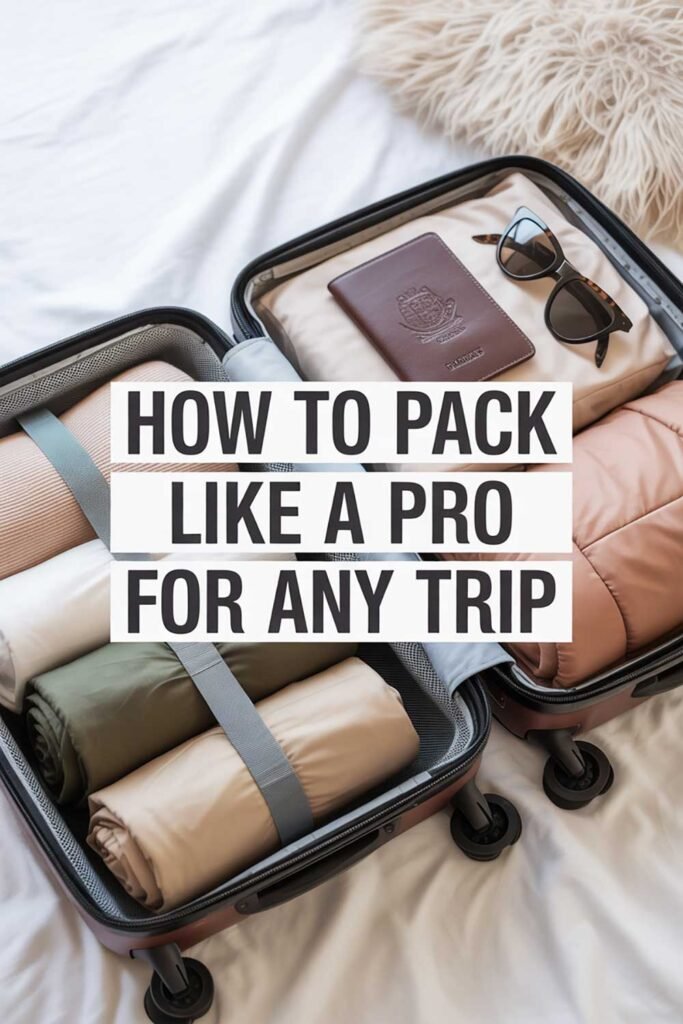
Packing cubes transform a single open compartment that gradually collapses into disorder into a system of category-specific containers whose organization is maintained automatically. One cube for tops. One for bottoms. One for underwear. One for layers. The assignment never changes between trips — the blue cube is always tops, the grey cube is always bottoms — so finding any item in the bag requires knowing the category rather than searching the contents. The cube opened is the cube with the right contents because the system said so before the bag was even unzipped.
7. Roll soft clothing and stand the rolls upright in the cube like wine bottles in a rack
Rolling soft clothing into cylinders and standing them upright in the cube rather than stacking them flat produces two benefits that the flat-fold method cannot match: every item in the cube is visible from above without moving anything, and every item is retrievable without disturbing anything else. The morning routine at the accommodation becomes a top-down scan followed by a single reach rather than a rummage through a compressed stack. Roll everything soft. Stand every roll upright. Open the cube to a clear view of every item in it.
8. Pack by occasion type, not by day count
Packing one outfit per calendar day of the trip produces a bag whose size is determined by trip length rather than trip content. Packing by occasion type — one casual exploration outfit, one elevated dinner look, one active day outfit, one travel day outfit — produces a bag whose size is determined by the number of distinct occasions the trip actually contains, which is almost always fewer than the number of days. The organized packer counts the occasions before counting the days and builds the wardrobe around the former.
9. Put a complete change of clothes and every medication in the personal item
The personal item that travels under the seat is the bag that is never gate-checked and never delayed by baggage handling. A complete change of clothes for the arrival day and every medication for the trip in the personal item means that the gate-check of the overhead bag costs nothing beyond inconvenience. The first morning at the destination is unaffected regardless of where the checked or overhead bag is. This is the single preparation that converts the gate-check from a disruption into a minor administrative event.
10. Designate the lid pocket specifically for arrival-day essentials
The lid pocket or top exterior pocket of the main bag is the most accessible position when the bag is opened at the accommodation. Pack it with the items needed first on arrival: the phone charger, the sleep clothes, the toiletry kit for the first morning. These items come out in the first five minutes. Everything else stays in the cubes until the trip’s daily routines require it. The arrival that produces what is needed immediately from the top of the bag rather than from a full-compartment excavation is the arrival that begins the trip rather than being managed through it.
Plan Our Escape
Let us plan the trip that gives every organized departure somewhere genuinely worth arriving. Tell us where you want to go and we will handle everything from there.
Plan Our EscapeDigital Organization: The Information That Travels With You
The organized trip is as much a digital organization challenge as a physical one. The traveler who arrives at the destination with offline maps loaded, every address saved, and every confirmation accessible without connectivity has removed the single most common source of arrival-day friction: the information that was known at home and is inaccessible at the destination because the phone has no signal, the battery is low, or the specific email cannot be found under pressure.
11. Download offline maps for the destination before leaving the accommodation each morning
The offline map downloaded over Wi-Fi before stepping outside works everywhere the day goes — in the narrow alley with no signal, underground, in the taxi whose driver takes an unexpected route. Download the day’s specific area before leaving each morning. The map that loads in two seconds from local storage is never the map being waited on at a street corner while the taxi meter runs. Make the download the last step before picking up the bag for the day.
12. Save every destination address to phone contacts before arrival
The accommodation address, the tour meeting point, the restaurant reservation, the airport — every address saved as a phone contact before departure produces a navigation destination that requires one name search rather than a hunt through emails, booking confirmations, or screenshots. Name each contact clearly: “Hotel Lisbon,” “Airport Transfer,” “Friday Dinner.” The navigation app opened from a contact name rather than a copied address is the navigation that takes ten seconds rather than ninety when the taxi is already waiting outside.
13. Use a single notes document as a running trip reference and journal
One running notes document — a phone note, a shared Google Doc, whatever is already used daily — serves as the trip’s operational reference: the local cash amount remaining, the restaurant name the hotel host recommended, the market opening time confirmed that morning, the thing noticed on day two and worth revisiting on day four. The same document is the two-sentence daily journal whose entries are specific enough to be recoverable months after the trip when the general memory has faded into a pleasant impression. Start the document before the trip. Add to it throughout. The trip’s best memories and most useful practical information live in the same place.
14. Keep all travel apps on a dedicated phone screen and confirm each is loaded before departure
Airline app, accommodation booking app, map app, translation app, transport app, travel insurance app — a single dedicated phone screen whose icons are all travel-related and whose apps are all confirmed open and functional before departure means every travel-day app interaction is one swipe to the right screen rather than a search through pages of unrelated icons under time pressure at the gate or the border. Organize the travel screen before the first trip that uses it. Keep it permanently.
15. Photograph the accommodation exterior and neighborhood on arrival
A quick photograph of the accommodation’s exterior, the street sign at the corner, and the nearest landmark on arrival produces the visual reference that makes returning to the accommodation from an unfamiliar direction reliable rather than approximate. The photograph of the street is the confirmation that the taxi has stopped at the right building when the address and the visual do not immediately match. It takes thirty seconds on the walk from the taxi to the front door and prevents the specific disorientation of a return journey to an accommodation whose exterior was never consciously registered on the way in.
DND Resources
Our travel resources page has trusted tools and official sources for every stage of the trip — planning, packing, arrival, and everything in between.
DND ResourcesAt the Destination: Staying Organized Through the Trip
The most organized departure in the world produces a disorganized trip if the habits that maintain the system are not applied at the destination. The bag that arrives organized and is immediately used as a drawer — opened and searched daily, items returned to approximate positions — loses its organization by day two and requires a full repack before the return journey. Destination organization is the daily maintenance that keeps the departure-day system working through the last checkout.
16. Unpack the packing cubes into drawers and the wardrobe for stays of two nights or more
The bag used as a daily wardrobe degrades progressively as items are removed and imperfectly replaced. For any stay of two nights or more, spending ten minutes unpacking the cubes into the room’s drawers and hanging structured items in the wardrobe maintains the organization without requiring any active management across the stay. The daily routine accesses a drawer rather than a bag. The departure repack takes five minutes because everything is in organized drawers rather than distributed through a bag that has been opened and imperfectly closed repeatedly. Unpack at two nights. Leave it packed for one.
17. Designate one spot for all valuables — the same spot at every accommodation
The passport, the travel wallet, the key card, the spare cash, and any other valuable that travels through the trip belong in one designated spot at every accommodation — the same spot, consistently: the bedside table drawer, the safe, the specific interior pocket of the main bag. The valuable that is always in its designated spot is the valuable that is found without searching at every checkout, every departure, and every moment it is needed under time pressure. The valuable without a designated spot is the one searched for most urgently at the worst possible moment. Choose the spot before the first trip that uses it. Use it at every accommodation after it.
18. Do a five-minute daily room tidy before leaving the accommodation each morning
The room maintained by a daily five-minute tidy — charger back in its pocket, clothes back in their cube or drawer, surfaces cleared of the previous evening’s distributions — stays organized throughout the stay without any single dedicated reorganization session. The checkout whose preparation is a five-minute confirmation of an already-tidy room is the checkout that leaves on time. The checkout whose preparation is a fifteen-minute sort-and-search from days of accumulated drift is the checkout that misses the item on the bathroom shelf and boards the taxi without it.
19. Keep a designated dirty laundry bag from the first evening at every accommodation
A lightweight mesh laundry bag placed at the base of the main bag before departure is the clean/dirty boundary that maintains the cube system’s category integrity across the trip. Every worn item goes into the laundry bag from the first evening. Every clean item stays in its cube. The bags return home with a clear separation that makes the post-trip laundry straightforward and the departure repack a clean-item confirmation rather than a smell-test of uncertain items. The laundry bag that was in the bag before the first departure is the laundry bag that never has to be thought about again — it is simply where worn items go.
20. Use the last ten minutes before leaving the accommodation each day for a quick room sweep
The item left at the accommodation is the item most difficult and expensive to recover. A ten-second check of each surface before leaving the room each day — the outlet, the bathroom counter, the bedside table, the desk — catches the item placed down during the evening and not consciously registered before the morning’s departure. This daily check is cheaper and easier than the checkout sweep because it happens when returning to the room is still possible. The item found by the daily check is found before the taxi. The item found at checkout is found with the taxi running.
How Dani’s Trips Went From Chaotic to Calm
Dani traveled several times a year and described her trips with a specific qualifier that she had never quite identified as the problem until someone pointed it out: they were good trips, but they were tiring in a way that had nothing to do with the distance traveled or the activities packed into the itinerary. The tiredness was the administrative kind — the low-grade friction of never quite knowing where the booking reference was, of repacking the bag mid-trip because it had stopped making sense, of arriving at checkpoints with the specific anxiety of someone who was not quite sure they had everything they needed.
The change did not come from a single dramatic reorganization. It came from three consecutive small ones. The first was the permanent master packing list — built after a trip where she forgot the same item for the third time and decided the list needed to be a permanent document rather than a new creation each time. The second was the camera roll album — started after spending four minutes at a hotel check-in searching through an inbox for a booking reference while the desk agent waited. The third was the travel wallet — a physical one with assigned slots, bought because she had handed over the wrong card at a foreign ATM after searching through a disorganized wallet for the right one.
None of these were dramatic. Each was a small, specific response to a specific friction point. But the accumulated effect was the trip that felt different — not shorter, not less eventful, just noticeably smoother. The check-in was the camera roll album open in one tap. The charger was in the outer pocket where it had been placed before boarding. The laundry bag had kept the bag organized so the mid-trip repack was a five-minute confirmation rather than a full sort. These twenty-five tips are the complete version of the three habits that changed Dani’s trips. The same system. The same calm. Available to anyone who builds it once.
The Return and the Reset: Finishing the Trip Right
The way a trip ends determines how the next one begins. The traveler who resets the system within twenty-four hours of returning home starts every subsequent trip from the best possible position — the bag ready, the list updated, the toiletry kit restocked, the lessons from the trip already applied. The traveler who lets the return drift starts the next trip from a dismantled system whose rebuild takes the same time as building it the first time.
21. Do a systematic room check before every checkout — every surface, every outlet
The systematic checkout sweep is the last safety net of the destination organization system and it needs to be systematic rather than cursory to do its job. The outlet by the bed where the phone charged overnight. The bathroom counter where the toiletry kit was last used. The safe whose contents were accessed the previous evening. The desk where the laptop was used. The wardrobe hooks. The floor under the bed. Three minutes, every surface confirmed clear. The items found by this sweep come home. The items not found by it do not.
22. Separate dirty clothes from clean ones consistently throughout the trip
The trip whose dirty laundry bag was used consistently from the first evening produces a checkout repack that takes five minutes: clean items from the drawers back into the cubes, worn items already collected in the laundry bag, both confirmed in their positions. The trip without a dirty laundry bag produces the checkout repack that requires sorting through the bag’s contents to identify which items are clean, which are worn, and which need to go directly to the wash. Use the laundry bag from the first evening. The checkout is only as easy as the system that preceded it.
23. Reset every bag within twenty-four hours of returning home
The bag reset the evening of returning home is the investment that makes every subsequent trip’s preparation a thirty-minute confirmation rather than a two-hour rebuild. The laundry comes out and goes to the wash. Every cube is emptied and returned to its position. The toiletry kit is restocked. The electronics pouch is confirmed complete. The travel wallet is reviewed and refreshed. The bag is closed in its organized, ready state. Fifteen minutes. Done. The next trip starts from there rather than from the aftermath of this one.
24. Update the master packing list within twenty-four hours of returning while the feedback is specific
The item wished for and not there. The item that traveled untouched. The accommodation that provided the hairdryer that was packed unnecessarily. The toiletry whose travel-size ran out on day five of a seven-day trip. All of this is most specific and most actionable in the twenty-four hours after returning, before the trip settles into a general pleasant memory and the specific details that would improve the next packing session fade. Update the list before unpacking is fully done. The list updated from honest post-trip feedback is the list that makes the next trip better than this one.
25. Trust the system — the organized trip runs itself after the first one that built it
The most organized travelers are not the ones who think harder about their trips. They are the ones who built a system good enough that the thinking is largely already done. The permanent packing list means the pack is a confirmation. The pre-stocked toiletry kit means it is already in the bag. The camera roll album means every document is one tap away. The travel wallet means every checkpoint is one reach away. The laundry bag means the checkout is five minutes. The reset means the next trip starts ready. Each of these habits takes one trip to establish and runs automatically on every trip after it. Build them once. The smoother vacation is not something that happens to some travelers and not others. It is what the system produces — consistently, reliably, and with less effort every single time it runs.
Book A Trip
Book your next vacation with a travel agent who handles the planning so your organization system has somewhere genuinely worth going to.
Book A TripPicture This
The trip folder was created the day the first booking was made. Every confirmation was screenshotted into the camera roll album before the tab was closed. The master packing list was opened, updated with the one item from the last trip, and used as the pack’s starting point. The toiletry kit was already in the bag. The travel wallet had every slot confirmed filled the evening before departure. The packing cubes were labeled and the rolls stood upright and visible from above.
At the accommodation, the cubes went into the drawers within ten minutes of check-in. The travel wallet went to the bedside table drawer — same spot as every accommodation before it. The laundry bag went to the base of the emptied main bag on the first evening. The daily morning tidy took four minutes. The checkout sweep found the phone charger in the outlet and the lip balm on the bathroom shelf and put both in the bag before the taxi arrived. The repack took six minutes. The camera roll album produced the booking reference at checkout in one tap. The return home produced a bag reset by nine in the evening. The packing list was updated with two changes before sleeping.
The next trip, announced three weeks later, started from a bag that was already organized and a list that was already accurate. The preparation took thirty minutes. That is twenty-five tips working as a system. That is the smoother vacation — not the lucky one, not the well-funded one, but the one built by the habits that made every stage of every trip easier than the one before it.
Before Your Next Trip: Grab the Free Packing Checklist
Our free Travel Packing Checklist is the foundation of the organization system these twenty-five tips describe — every category, every pre-departure confirmation, and every step that makes the bag close right and the trip start ready. Download it and use it before the next one.
Get the Free ChecklistExplore Our Top Picks for a Better Trip
After years of travel together, these are the booking platforms and services we personally rely on for every trip — tested, trusted, and recommended because they have made our own vacations smoother and more memorable than anything else we have used.
See Our Top PicksTravel Printables at Premier Print Works
Visit Premier Print Works for packing lists, trip planners, organization guides, and travel printables that make every departure more organized and every trip easier from the first bag packed to the last checkout completed.
Visit Premier Print WorksBecome An Agent
Love helping travelers build the systems and plan the trips that make every vacation smoother? See how to turn that into a home-based travel business.
Become An AgentDisclaimer
The information shared in this article is provided by Don and Diana’s Travels for general informational, educational, and inspirational purposes only. It reflects our personal experiences, opinions, and the experiences of travelers we have worked with. It is not professional travel, legal, or financial advice.
Travel conditions, airline policies, accommodation amenities, and related details vary by destination, carrier, and provider and are subject to change without notice. Always confirm current requirements and policies directly with the relevant parties before traveling. We are not responsible for any outcome arising from reliance on information in this article.
This article may contain affiliate and partner links that pay us a commission at no extra cost to you. Our recommendations are based on real use and genuine belief in the products and services we share. Stories on this site combine real experiences from Don, Diana, clients, and travelers we have worked with. Details may be adjusted for privacy and narrative clarity. All content is the copyrighted property of Don and Diana’s Travels. You may not copy or republish our content without prior written permission. By reading this article you acknowledge that you have read and agree to this disclaimer.