35 Packing Tips for Women Who Want Cute Outfits and Less Luggage
Looking good on vacation and traveling light are not opposites once you know how to build a travel wardrobe that actually works for every day of the trip without doubling the weight of the bag. Thirty-five tips for the woman who loves fashion, hates how much it weighs, and is ready to arrive at every destination looking exactly the way she planned — with half the luggage she used to carry.
Grab Our Travel Packing Checklist
Our free packing checklist is the foundation for the travel wardrobe system these thirty-five tips build — every category organized, the outfit-first structure built in, the final edit included, and the capsule framework ready to be filled with the pieces that look great, pack light, and work for every day of the trip.
Get the Free ChecklistThe most stylish travelers are almost never the ones with the biggest suitcases — they are the ones who figured out that a few great pieces worn differently every day beats a bag full of options you never end up wearing.
Looking good on vacation and traveling light are not opposites once you know how to build a travel wardrobe that actually works for every day of the trip without doubling the weight of your bag.
The Foundation: Build the Capsule Before You Open the Suitcase
Choose two or three base colors and build the entire travel wardrobe around them
The capsule color palette is the structural decision that determines how much the travel wardrobe weighs and how many complete outfits it produces. Two or three colors chosen so that every top works with every bottom, every accessory complements every outfit, and every layer works across every combination means that ten pieces produce twenty or thirty outfit possibilities rather than the ten fixed combinations that an uncoordinated selection allows. The neutral base — black, navy, camel, cream, or olive — is the foundation that everything sits against. One or two accent colors that also work together provide the variety. A white linen shirt and a black blazer and tan trousers in the same palette produce more styled looks than five items in five different colors that each have only one partner. Choose the palette before selecting any specific piece. Every piece selected from within it earns its weight through the number of outfits it enables. Every piece outside it reduces rather than expands the wardrobe’s flexibility.
Lay every intended outfit out as a complete look before it earns a spot in the suitcase
The most effective fashion packing habit available requires no extra time or money — only the discipline to lay each complete outfit flat on the bed before packing any of its components. Top, bottom, shoes, bag, layer, and any jewelry or accessory that completes the look: confirmed together as a working combination before any piece is packed. This process reveals the top whose specific shade does not work with the trousers it was intended for in the same bag, the dress that requires the specific shoes that were already identified as the second pair beyond the limit, and the blazer whose only partners have already been removed from the pile for having no outfit matches of their own. The outfits confirmed on the bed are the outfits that arrive. The outfits assumed in the mind are the ones whose gaps appear in the hotel room mirror on the second evening. Lay them out. Every single one. The extra fifteen minutes produces the travel wardrobe whose every component has a reason to be there.
Pack by occasion type rather than by day — one outfit per occasion category, not per day
Packing one outfit per day of the trip produces the bag whose size is determined by trip length regardless of how many different occasions those days actually contain. Packing by occasion type — one casual exploration outfit, one elevated dinner look, one active day outfit, one comfortable transit look — produces the bag whose size is determined by the trip’s distinct occasion types, which is almost always fewer than the trip’s days. The casual exploration outfit wears on Monday, Wednesday, and Friday — worn differently each time through the accessories. The dinner look works for the two confirmed evening occasions without requiring two separate outfits. The occasion-type approach is how the travelers who always look polished and always pack lightly achieve both simultaneously: they identified the distinct occasions rather than the distinct days and packed precisely for the former. Count the occasion types. Pack for those. Let the days fall where they may.
Make sure every piece in the bag pairs with at least two other pieces — remove anything with only one partner
A piece with one partner earns its weight once. A piece with three partners earns it three times. In the context of a travel wardrobe where every gram carried through every transit and every checkout is a deliberate choice, the single-partner piece is the clearest available indicator of an item that is not pulling its weight in the capsule. Before the suitcase closes, run this check for every piece: top, bottom, layer, shoes. The black ankle boot that works with the jeans and the midi skirt and the tailored trousers earns its space every day of the trip. The embroidered blouse that works with only the specific olive trousers it was bought to match is the piece that will stay folded in the suitcase while the olive trousers are worn with the three other tops that also work with them. Remove the single-partner pieces. The wardrobe that remains is the one where every item is genuinely working.
Build the travel wardrobe around the destination’s confirmed activities — not the imagined ones
The travel wardrobe built without reference to the confirmed itinerary is the wardrobe that packs for the imagined trip — the one with the yacht dinner, the hiking excursion, and the black-tie moment that the actual confirmed itinerary does not contain. Open the itinerary before selecting any piece: the specific activities, the confirmed restaurants, the known dress codes, the planned excursions. The wardrobe built from this reference contains pieces for what the trip is actually scheduled to be rather than what the most eventful version of it might theoretically become. The sailing holiday whose capsule was built around it produces a wardrobe of breezy layers, swimwear cover-ups, and one elevated dinner look. The cultural city break produces structured daywear and two dinner options. The beach resort produces the specific ease of a wardrobe whose every piece belongs to the vacation that was actually booked. Pack for the trip you planned. The imagined trip stays in the imagination where it belongs.
Choose fabrics that resist wrinkles naturally so everything arrives looking as polished as it packed
Fabric choice is the decision that determines whether the travel wardrobe arrives looking the way it was planned to or whether the first evening requires a steaming session before anything is wearable. Fabrics with natural wrinkle resistance — merino wool, jersey knit, ponte, travel-weight crepe, modal, and many technical fabric blends — move through transit in a packed suitcase and emerge looking presentable without intervention. Fabrics that require specific care to avoid permanent creasing — pure linen, untreated cotton, silk charmeuse, stiff poplin — pack beautifully in a flat draw but travel poorly in the compressed environment of a packed suitcase. This does not mean avoiding beautiful fabrics — linen on a beach trip is perfect and worth the morning hang — but choosing fabric with travel behavior in mind produces a wardrobe that is more consistently ready to wear on arrival. The same outfit in a wrinkle-resistant fabric and in a linen version arrives looking fundamentally different after twelve hours in a checked bag. The fabric is the choice that determines which.
Start the travel wardrobe selection two days before departure so the edit keeps improving
The travel wardrobe assembled the night before departure is assembled under the least favorable conditions for good decisions: time pressure, the closet viewed under stress, and the specific anxiety of an approaching departure that turns every considered removal into a risk. The wardrobe started two days early is assembled from the same closet but with two days of background processing available: the piece noticed as redundant in the morning after the initial assembly, the accessory remembered in the afternoon that unlocks three more outfits, the shoes reconsidered after sleeping on whether both pairs are genuinely needed. The two-day window also allows for the specific fashion packing edit that matters most — the return to the assembled wardrobe with fresh eyes and a lower emotional investment in every piece already on the pile. Try each outfit on if time allows. Photograph them if that helps. The edit gets better with distance. Give the distance. The travel wardrobe that closes the suitcase two days before departure is the one that was right before the departure morning made being right harder.
Let Us Build the Trip That Gives Every Carefully Chosen Outfit Somewhere Worth Wearing It
The travel wardrobe built for a specific destination and a confirmed itinerary is the one that works perfectly because every piece was chosen for what the trip actually is. Tell us where you want to go and we will plan the trip whose occasions, climate, and character give every piece in the capsule exactly the context it was selected for.
Plan Our EscapeClothing Strategies: Look Good Every Day Without Doubling the Bag’s Weight
Pack statement accessories instead of statement outfits — the accessories weigh almost nothing
The statement outfit — the maximalist print, the structured sequined piece, the outfit whose impact depends on its being seen once — occupies significant space and weight in the suitcase for one wearing. The statement accessory — the bold earrings, the printed silk scarf, the striking belt, the conversation-starting necklace — transforms a simple base outfit into a distinctive look for the weight of grams and the space of a small pouch. The same black dress worn with the bold earrings and the printed scarf is a different outfit than the same dress worn with the delicate studs and the crossbody. The same jeans and white shirt worn with the statement necklace and the block-heeled mule is styled differently than with the simple chain and the flat sandal. One statement accessory changes the entire read of a base outfit. A few statement accessories packed alongside versatile base pieces produce the variety and impact of a much larger wardrobe at a fraction of its weight and volume.
Limit shoes to two pairs maximum — and wear the heavier or bulkier pair on the travel day
Shoes are the heaviest, most space-inefficient, least compressible category in any suitcase, and for fashion-forward travelers they are the category most consistently over-represented in the bag. Two pairs, chosen to cover every confirmed occasion on the trip, is the limit that keeps the suitcase manageable. The pairs that cover the most ground are the ones that are both comfortable enough for a full day of walking and stylish enough for an evening out — because the two-pair limit means the daytime shoe and the evening shoe are often the same shoe, just styled differently. Wear the bulkier of the two pairs on the travel day so it never adds to the suitcase’s weight or volume. The specific regret of having packed three pairs of shoes rather than two is a regret that never arrives. The specific regret of having packed three instead of two and paid the overweight fee arrives every time it happens.
Pack one versatile dress that works dressed up, dressed down, and in between
The single most powerful fashion packing piece in any travel wardrobe is the dress with genuine multi-occasion range — the midi dress that is a market morning piece with flat sandals and a denim jacket, an elevated lunch look with low heels and simple jewelry, and a dinner look with the block mule, the statement earrings, and the silk scarf worn as a belt. This dress earns three outfit spots in the space of one garment and at the weight of one item. Finding this piece — in the palette’s colors, in a wrinkle-resistant fabric, in a silhouette that works at multiple styling levels — is the fashion packer’s most valuable pre-trip task. It is not always the most dramatic piece in the wardrobe at home. It is the one whose range across the trip’s distinct occasions is the widest. Pack it. Let it work across the whole trip while the other pieces fill in around it.
A travel scarf or lightweight wrap earns its space by doing five different things
The lightweight scarf — silk, cashmere, or a quality modal blend — is the most versatile item in any fashion-forward travel wardrobe relative to its weight and the space it occupies. Worn as a neck scarf it is the classic styling accent. Tied as a belt it transforms the silhouette of a simple dress. Used as a hair wrap it is a practical and stylish travel accessory. Draped as a shawl it is the layer for the cool-evening restaurant terrace when the blazer is at the accommodation. Folded as a clutch liner it protects the crossbody’s contents and provides a small pop of print. One piece. Five occasions. Weight under one hundred grams. Folds to the size of a folded handkerchief. In a travel wardrobe built on the principle that every piece earns its weight through the number of roles it plays, the scarf is the piece that earns its weight more times than almost anything else in the bag.
Pack more tops than bottoms — tops create the outfit variety, bottoms just create the weight
Bottoms — trousers, jeans, skirts — are heavy, pack inefficiently, and take longer to dry after a sink wash. Tops are lighter, more compressible, and dry quickly. The visual variety in a travel wardrobe is almost entirely produced by the top rather than the bottom because the person encountering the traveler registers the top — the color, the neckline, the print, the styling detail — rather than noting whether the specific pair of trousers is being worn for the second time. Two to three well-chosen bottoms in the capsule’s neutral colors provide the wardrobe’s structural base for the entire trip. Tops in varying styles, necklines, and accent colors from within the palette provide the daily variety that makes the same bottoms look like different outfits across the week. Pack the bottoms strategically. Pack the tops generously. The bag is lighter and the wardrobe is more visually interesting for the asymmetry.
Roll soft casual pieces and fold structured items flat to preserve their shape
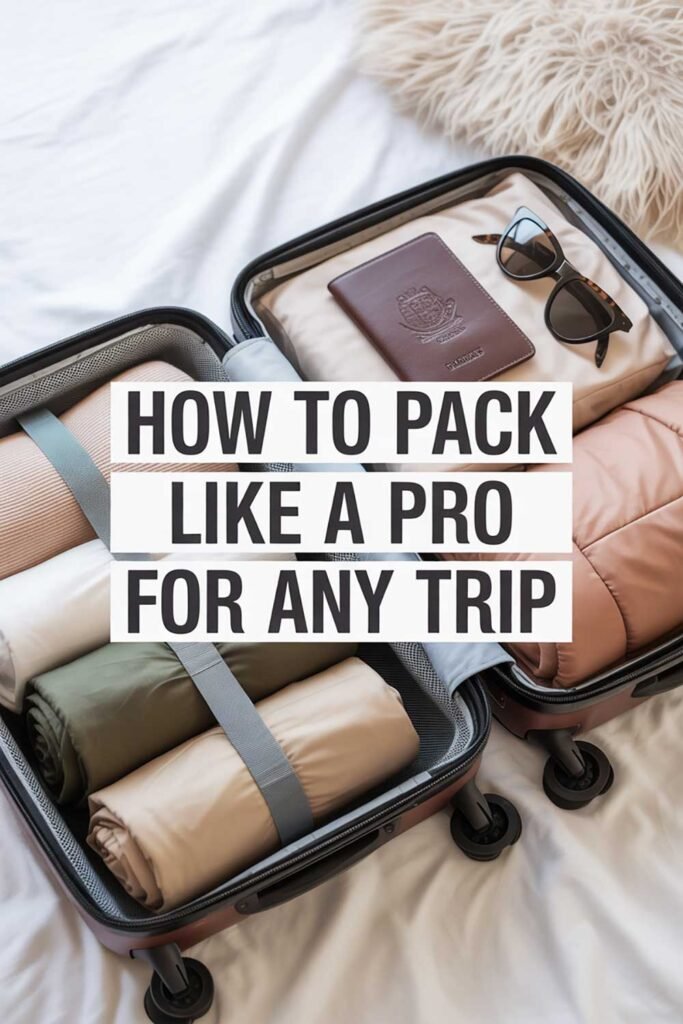
Rolling is the fashion packer’s most consistently useful physical packing technique for the soft, casual pieces whose wrinkle behavior under rolling is acceptably soft and distributed. A rolled jersey top, silk-blend blouse, lightweight trousers, or cotton knitwear occupies roughly one-third of the space of the same item folded flat and produces wrinkles that hang out within minutes rather than fold lines that require steaming to address. Structured items — the blazer, the tailored trouser, the dress with boning or structure — respond to rolling by creasing in ways that require intervention, and belong flat in a dry cleaning bag at the suitcase’s top layer. Matching the technique to the fabric is what produces the travel wardrobe that arrives looking as it was packed rather than as the transit determined. Roll the soft. Fold the structured. The arrival outfit is worn without a steaming session when the packing method was chosen to match the garment’s fabric behavior.
Re-wearing is not the fashion problem — it is the fashion solution
The wardrobe anxiety that packs one fresh outfit for every day of the trip is the anxiety whose audience — the café table across the room, the museum corridor, the beach, the street — does not exist as described. Nobody at the dinner on Wednesday was at the dinner on Monday and made a note of the dress. Nobody in the market on day four was in the market on day two. The observation that someone is wearing the same thing twice requires the specific overlap of the same two people at the same location twice, which vacation life rarely produces. Re-wearing is how every stylish frequent traveler travels lightly — the jeans worn for the full trip, the blazer paired differently with every top in the wardrobe, the dress that earned three separate nights. Give explicit permission to re-wear every piece as many times as the trip allows. The permission removes the last barrier between the fashion-forward packer and the lighter bag. The bag is lighter for it. The outfits are not worse for it.
The Details That Make a Light Bag Look Polished: Accessories That Do the Heavy Lifting
Two or three statement jewelry pieces weigh practically nothing and change the entire read of the outfit
Jewelry is the fashion packer’s most efficient tool — maximum visual impact at minimum weight, maximum outfit transformation in a pouch that adds grams rather than kilograms to the suitcase. Two or three statement pieces selected to work within the capsule palette — a bold beaded necklace, a pair of architectural earrings, a cuff in a metal that complements the palette’s tones — transform the same base outfit into visually distinct looks without adding a single extra garment. The difference between the simple black dress with delicate chain and the same dress with the statement necklace is the difference between a casual and an elevated look — entirely produced by the jewelry, which weighs less than the dress does per centimeter of visual impact. Pack statement jewelry. Leave the individual quiet pieces that make no specific contribution to any outfit’s impact. Two or three pieces that genuinely change things are more valuable than ten pieces that quietly supplement.
Pack one going-out top that elevates every single bottom in the bag
The going-out top is the single piece whose presence converts the travel wardrobe’s daytime clothing into evening-ready outfits without requiring separate evening outfits. A silk blouse, a structured bodysuit, a luxe knit with an interesting neckline — the specific piece that when paired with the jeans produces an outfit suitable for the dinner reservation and when paired with the tailored trouser produces the outfit for the elevated evening activity. This one piece covers every evening occasion the trip holds without adding separate evening outfits to the suitcase. Its selection is the most important single piece in the fashion-forward travel wardrobe: it needs to work with every bottom in the bag and translate into the specific elevated register the evening occasions require. Identify it before packing anything else. Everything in the bag is built around its ability to work with this piece. The going-out top that works with every bottom is the piece that lets the daytime wardrobe double as an evening one.
Bring earrings for every mood — they pack completely flat and cost nothing to carry
Earrings are the most argument-free item on the fashion packer’s space-versus-impact analysis: they are flat, they stack, they weigh nothing individually, and a small flat pouch holds ten or fifteen pairs in the space of a folded t-shirt corner. The earring that transforms the casual daytime look into the polished afternoon outfit, the statement drop that makes the simple dinner dress look intentional, the simple hoop that makes the travel day outfit look less like a travel day outfit — these are the micro-adjustments that experienced fashion travelers reach for daily. A small dedicated jewelry pouch or roll with ten or fifteen earring pairs is the most efficient accessory investment in the fashion-forward travel wardrobe: ten different looks produced in the space and weight of nothing meaningful. Pack the earrings. Pack more than feel necessary. They are the most consequence-free indulgence available to the traveler trying to pack light while staying polished.
A small crossbody bag transforms any casual daytime outfit into an evening look
The difference between a casual daytime look and an evening-ready one is often nothing more than the bag. The canvas tote of the afternoon market visit does not carry the same register as the structured leather crossbody of the evening restaurant. A compact crossbody in a neutral from within the palette — black, tan, warm brown, or metallic — works across every outfit in the wardrobe and produces the specific visual signal that the occasion has shifted from casual to intentional without requiring a different outfit underneath it. The crossbody also serves a practical function on the evening out: compact, secure, hands-free. Pack one. Choose it in a neutral that complements the palette’s entire range. Let it be the bag that converts the afternoon dress into the dinner look without any other change to the outfit. The single accessory that changes the occasion register of any outfit is the single most versatile accessory in the travel wardrobe.
Pack one belt — the right one turns a casual dress into a structured, intentional outfit
The belt is the styling detail that receives the least packing attention and produces some of the most consistent impact per gram in the travel wardrobe. A structured belt in a complementary neutral — black leather, tan leather, or a woven metallic — cinched over a flowy dress creates a waist-defining silhouette that transforms the dress from casual to intentional. The same belt over a blazer adds a detail that elevates a simple work-appropriate look into something more considered. Over a shirt tucked into high-waisted trousers it produces the polished version of the most basic capsule combination. One belt, two or three specific outfits it actively improves, and the styling versatility to work with everything else in the bag as an accessory option. Pack it in the accessories pouch alongside the jewelry. It weighs under a hundred grams. It earns those grams on every trip that uses it.
One small nail polish in a shade that works with the capsule palette changes the whole feeling
Nail polish is subject to the TSA’s liquids rule and belongs in the quart bag, but a single small bottle — the specific shade that feels right for this trip, in the tonal family of the palette — is a carry-on liquid whose aesthetic contribution to the travel wardrobe’s overall effect is disproportionate to its physical space in the quart bag. A rich burgundy against a palette of navy, cream, and tan. A warm terra cotta against a palette of olive, rust, and camel. A nude-pink that grounds any look in effortless polish. The nail polish that travels is the one that works across the entire trip’s outfits rather than being color-matched to one specific occasion. Pack one. Make it count across the full trip. The small bottle that travels is the one whose shade was considered before the quart bag was closed.
Pack one piece that photographs beautifully — you will reach for it more than you think
Every travel wardrobe benefits from one piece whose specific combination of color, silhouette, and character produces beautiful photographs at the destination — the dress whose color reads perfectly against the destination’s textures, the top whose neckline photographs elegantly, the look whose specific palette works with the light and architecture of the places the trip visits. This is not vanity for its own sake — it is the practical acknowledgment that the piece worn in the destination’s most significant photographs is the piece reached for most often across the trip, because the desire to photograph well at the trip’s memorable moments consistently drives the outfit choice at those moments. Identify this piece before packing. It is almost always already in the capsule if the foundation was built from the destination’s character. It is the piece that photographs beautifully because it was chosen for the destination’s specific aesthetic context. Pack it. It earns its space every time the camera comes out.
Celeste’s Capsule That Finally Made Looking Good and Packing Light the Same Thing
Celeste had a packing problem that was also, if she was being precise about it, a fashion problem: she was good at both, individually, and the combination consistently produced a suitcase that was heavier than any reasonable packing advice suggested it should be and a departure morning that involved sitting on the bag. She packed well in the sense that everything was organized, rolled, and cubed. She dressed well in the sense that people regularly complimented her travel outfits. The problem was that the well-dressed and well-packed versions of herself required two entirely different suitcases to achieve simultaneously, and she had been managing the overlap by buying a slightly larger bag every couple of years.
The trip that changed the system was a ten-day European city break for which she decided, as an experiment, to pack in a carry-on only. Not because the carry-on philosophy appealed philosophically but because the airline charged a genuinely uncomfortable amount for checked bags and the specific trip’s budget could be more valuably used elsewhere. The constraint was the intervention. With the carry-on’s volume as the finite limit, she laid every intended piece out on the bed and looked at the pile. The pile was designed for three different trips. The palace ball was not on the itinerary. The hiking excursion was not confirmed. The beach day was a possibility rather than a booking. She removed everything that belonged to the imagined trip rather than the planned one and was left with a pile that was approximately half the original.
The color palette came from realizing that the remaining pile still did not work — because four of the tops did not share a color language and required four different bottom options rather than sharing two. She pulled three tops out and replaced them with two that worked with everything. The statement earrings pouch replaced the two individual necklaces that each worked with only one outfit. The crossbody for evenings went in. The going-out silk blouse — the one that elevated every bottom in the bag — went in. The dress that worked for three occasions went in. The single belt that changed the silhouette of the dress and the blazer went in alongside the jewelry roll. The carry-on closed. It weighed less than any bag she had taken on a trip of this length. She was better dressed for ten days in European cities than she had been on any previous trip — because every piece worked, every outfit had been confirmed on the bed before it was packed, and nothing was there for a version of the trip that the itinerary had not confirmed. The thirty-five tips in this article are the system that produced that carry-on. The larger bag has not come off the shelf since.
The Practical Techniques: Pack for Style and Arrive Looking Like It
Use packing cubes organized by complete outfit rather than by clothing category
The standard packing cube assignment — tops in one, bottoms in another — is the organizational method for the traveler who packs by category. The fashion-forward traveler who packs by confirmed outfit benefits from organizing the cubes by occasion: Casual Day cube, Elevated Dinner cube, Active Day cube, Travel Day cube. Each cube contains the complete outfit for its occasion type — the top, bottom, and accessory components that were confirmed together on the bed. At the destination, selecting an outfit is opening the relevant cube rather than assembling components from multiple cubes. The morning routine is faster and more certain. The accessories associated with each outfit are in the same cube as the garments rather than requiring a separate jewelry search. The outfit photographed on the bed the night before departure is the outfit in the cube in the order it was confirmed. This system requires more intentional pre-packing but produces more deliberate dressing at the destination — and more consistently delivered on the style vision that was the whole point of the packing effort.
Keep delicate fabrics inside a dry cleaning bag or silk garment bag to prevent creasing during transit
The delicate fabric — the silk blouse, the evening dress, the structured blazer — packed directly into a packing cube in a compressed suitcase arrives with the specific creasing that the combination of fabric weight, transit duration, and compression produces without the protection of a garment bag. A lightweight dry cleaning bag slipped over each delicate piece before it goes in the cube allows the fabric to shift and redistribute under pressure rather than holding a fixed, compressed crease. The garment inside the dry cleaning bag arrives with the soft, manageable wrinkles of light handling rather than the set creases of direct compression. Dry cleaning bags are available at any dry cleaner at no cost and add zero meaningful weight or volume to the packing system. Keep a small supply in the travel supplies bag. Slip one over every delicate piece before packing. The arrival inspection of the suitcase’s most important pieces produces the result the care was worth.
Pack the heaviest pieces — denim, structured blazers, shoes — closest to the wheels for a balanced bag
Weight distribution in the suitcase determines how it handles through every transit and how the body carries its load through every airport corridor. Heavy items at the top or toward the handle produce a bag that tips away from the wheels and strains the grip over distance. The same heavy items — denim jeans, structured blazers, shoes, the toiletry kit — packed at the wheel end produce a bag that rolls balanced and upright with minimum physical effort. For the fashion packer whose suitcase often contains the densest items in the capsule as its most important pieces — the well-made leather boots, the blazer that structures every outfit, the jeans that provide the wardrobe’s versatile base — placing these at the wheel end converts the transit experience from a physical struggle into a smooth roll. Pack the heaviest items first, at the base near the wheels. Build the lighter, softer pieces above them. The bag whose weight is correctly distributed is the bag that feels lighter than it weighs.
Tuck jewelry inside rolled socks or a dedicated jewelry roll to prevent tangles and loss
Jewelry packed loose in a suitcase or allowed to live freely in a toiletry bag or main compartment produces the specific arrival discovery of a tangled necklace that takes twenty minutes to address, a lost earring that was separated from its partner somewhere between packing and unpacking, and a bracelet whose clasp has been damaged by the weight of items placed on top of it in transit. The preventative solutions are simple and inexpensive: fine chains and delicate necklaces each in their own small zip bag or threaded through a drinking straw to keep them from tangling, earring pairs in a small fabric pouch, bracelets and cuffs in their own compartment of a jewelry roll. A dedicated travel jewelry roll — a fabric roll with individual pockets for each piece, rolling closed and secured with a tie — organizes and protects every piece for the weight and space of a rolled scarf. The jewelry that arrives intact and untangled is the jewelry that was packed with the intentionality the rest of the travel wardrobe received.
Bring a travel garment steamer or steamer sheets for the pieces that need to look their best
The compact travel garment steamer — a handheld device slightly larger than a large cosmetics bottle, available from most travel retailers — addresses the wrinkles that wrinkle-resistant fabric selection and dry cleaning bag protection reduce but occasionally do not eliminate entirely for the pieces that need to look polished on specific confirmed occasions. Used for under five minutes on the pieces that matter — the evening dress, the silk blouse, the structured blazer — the travel steamer converts the transit-wrinkled garment into the freshly pressed one without the hotel’s laundry service delay or cost. Steamer sheets — single-use sheets that remove wrinkles when pressed against the fabric — are the lighter alternative for one or two uses without the steamer’s weight or water-fill requirement. For the fashion-forward traveler whose travel wardrobe includes one or two pieces whose specific occasion requires them to look their best, the travel steamer is the tool that delivers the standard the occasion requires regardless of what the transit produced.
Choose shoes that are both genuinely comfortable for a full walking day and genuinely stylish — this is not negotiable
The shoe compromise — the beautiful shoe that requires a taxi after two hours on cobblestones, or the comfortable shoe that feels like the one element of the outfit that did not belong — is the compromise that fashionable travel most reliably produces in the bag of the traveler who separated style and comfort into two different options. With only two pairs in the bag, each pair must cover both dimensions without exception: full-day walking comfort and the visual register required for the outfit it anchors. This standard exists and these shoes exist — the leather loafer with a low block heel, the ankle boot with a cushioned insole, the quality slide whose sole provides real support, the white leather sneaker clean and classic enough to work with most of the capsule. Find these shoes before the trip. They are the investment whose return is paid across every hour of the trip rather than the specific beautiful hour before the blisters begin.
Protect every shoe pair in a dedicated shoe bag to keep them from touching the clothes
The shoe packed without protection against the suitcase’s clothing layer above it distributes whatever the sole has encountered — the street, the airport floor, the accommodation’s bathroom tile — across the fabric of the items directly in contact with it. For the fashion-forward traveler whose suitcase contains carefully selected pieces, the unwanted transfer of the shoe’s sole contact onto the evening dress fabric is a problem that a lightweight shoe bag prevents entirely at the cost of a few grams and almost no space. A fabric shoe bag for each pair — one bag, one pair, sole contained, fabric protected — is the most consequence-free protection available in the travel packing system. Dedicated shoe bags are inexpensive and reusable across every trip. The clothing they protect from contamination is almost always worth the cost several times over. Pack every pair in its bag. The suitcase’s clothing layer above the shoes is the clothing that arrives looking the way it was selected to look.
Our Curated Collection of Trusted Tools and Official Sources
Everything we use to plan, prepare, and travel with confidence — from official government travel tools to practical planning aids. We have pulled together the resources we trust most so every trip you take is better informed, better prepared, and a lot less stressful from start to finish.
DND ResourcesThe Lasting Habits: Make the Stylish Light Bag the Permanent Default
Do a final edit and deliberately remove anything with only one outfit match before closing the suitcase
After the suitcase is packed and every outfit has been confirmed, do one final pass with a single question: is this piece part of more than one confirmed outfit? Everything with two or more confirmed outfit matches stays. Everything with only one goes back to the closet. The piece with one outfit match earns its weight once and occupies space for the whole trip. The piece with three outfit matches earns its weight three times in the same space. The fashion packer who applies this filter consistently ends up with a travel wardrobe that is proportionally more stylish than the larger wardrobe it came from — because the editing process keeps only the most versatile, most interconnected pieces and returns the single-use items to the closet where they belong for this specific trip. The suitcase that closes after this filter is the suitcase whose every piece is genuinely working. It is also almost always the suitcase that closes without assistance from body weight.
Leave the just-in-case formal piece at home unless a specific confirmed occasion requires it
The formal piece in the fashion-forward travel wardrobe is almost always there for an occasion that was possible at packing time and did not materialize by the trip’s last evening — the upscale restaurant that the vacation’s pace and the casual beach town’s restaurant landscape never quite led to, the event that remained tentative from booking through departure and through the entire trip. The formal option occupies more suitcase space per wearing than any other category and comes home more consistently unworn than any other piece. Leave it unless the specific confirmed occasion — the reservation with a dress code, the event with a known requirement, the dinner whose specific character was communicated in advance — is on the confirmed itinerary with a date and a time. The trip whose formal piece was left home almost never produces the regret of having left it. The trip whose formal piece traveled without being worn produces the regret of having carried it every time. The confirmed occasion is always the right standard.
Photograph each outfit laid out on the bed and use the photos as a styling reference at the destination
The outfits laid out and photographed before packing are the reference that makes the daily morning routine at the destination a ten-minute process rather than a thirty-minute styling session. The photo shows exactly which earrings go with which look, which belt was assigned to which dress, which scarf tie was planned for which outfit, and which shoe pairs with which bottom. This styling reference is especially valuable for the first morning at a new destination when the suitcase has just been unpacked and the decision of where each piece lives in the new space is still being made. The photographs also serve as the pre-departure packing record — the visual checklist that confirms all the planned pieces actually made it into the suitcase before it closed. Take them before packing. Use them at the destination. The morning that begins with a clear reference to the planned look is the morning that delivers on the styling intention the packing effort was designed to produce.
Plan the first and last day outfits deliberately — they frame the whole trip’s style
The first day outfit is the first impression of the travel wardrobe at the destination — the one worn in the arrival photographs, the one seen by the accommodation’s staff at check-in, and the one that sets the tone for the traveler’s own relationship with the trip’s aesthetic from the opening moment. The last day outfit is the last impression: the departure morning, the transit home, and for some trips the outfit that appears in the final destination photographs. Both deserve deliberate selection rather than being whatever was conveniently accessible in the suitcase that morning. The first day outfit should be comfortable for transit and arrive looking polished at the destination. The last day outfit should be comfortable for the return journey and still represent the travel wardrobe well in the final hours. Pack them specifically. Know which they are before the trip begins. The trip that starts and ends with intentional dressing is the trip whose full-length photograph memory reflects the wardrobe that was designed for it.
Leave deliberate space in the suitcase for the souvenir scarf or market find that becomes the trip’s best piece
The most consistently reported post-trip fashion experience is the piece purchased at the destination — the silk scarf from the market, the hand-embroidered blouse from the artisan stall, the specific jewelry piece from the local maker — that becomes the most-worn item in the wardrobe for the following year and the one that carries the most specific memory of the trip that produced it. Leaving deliberate space in the suitcase for this piece — packing to approximately three-quarters of the bag’s capacity on the outbound journey rather than to absolute limit — means the return journey can accommodate the destination’s best find without requiring the specific frustration of deciding what to leave behind in order to bring it home. The space is not empty. It is reserved for the piece the destination will produce. Pack with this gap intentionally. The best item in the post-trip wardrobe is almost always the one that came from a destination and needed room to come home.
Reset the travel wardrobe system within 24 hours of returning home while the trip’s memory is fresh
The fashion packer’s equivalent of the suitcase reset is the travel wardrobe reset: the pieces returned to their designated storage, the jewelry roll restocked with the pieces that traveled, the shoe bags cleaned and returned to their pairs, and the travel accessories — the dry cleaning bags, the steamer, the jewelry roll itself — returned to the dedicated travel storage where they live between trips. The wardrobe whose travel components are always maintained and always ready reduces the preparation time for the next trip to the creative work — palette selection, outfit confirmation, occasion planning — rather than the logistical work of locating scattered components. The reset within twenty-four hours happens while the memory of what worked, what was worn every day, what came home unworn, and what was wished for is still specific and accurate. These memories inform the update to the travel wardrobe system that is the foundation for the next trip’s packing. Reset while the trip is still recent. The next capsule begins from there.
Update the capsule system after every trip — the best travel wardrobe is the one that keeps getting better
The travel wardrobe that improves across trips is the one whose packer is honest about what actually worked and what did not, and whose capsule list is updated from that honesty before the next trip’s planning begins. After every trip: identify the pieces worn every day and confirm they stay on the permanent capsule list, identify the pieces that came home untouched and remove them from future lists or flag them for reconsideration, and note the pieces that were wished for and should be acquired before the next trip. The capsule that has been refined across five or six trips is the capsule that takes thirty minutes to pack because every piece is already known to work, every combination is already confirmed, and the only decisions left are the destination-specific adjustments on top of the permanent foundation. The most stylish traveler with the lightest bag is almost never the one who figured it out on the first trip. She is the one who updated the list after every trip until the system was right.
Book the Trip That Makes Every Carefully Built Capsule Worth the Effort
The travel wardrobe built for the specific destination, the confirmed itinerary, and the places worth looking your best deserves a trip planned with the same intention. Our travel agents book the destinations that give every outfit in the capsule somewhere genuinely worth wearing it — and every polished arrival the experience it was dressed for.
Book A TripTwo colors. Every outfit confirmed on the bed. The statement earrings did the work the statement outfit would have done at a tenth of the weight. The dress wore three times. The scarf was a belt on Thursday. The crossbody converted the afternoon look into the evening one. The suitcase closed on the first try. Every look landed. The larger bag stayed home. That is thirty-five tips. That is looking great on vacation without carrying everything you own to do it.
Picture the Trip Where You Looked Exactly the Way You Planned and the Bag Was Half the Size
The palette was two colors and everything mixed. Every outfit was laid out on the bed and confirmed before it was packed. The tops provided the variety and the two neutral bottoms provided the base for all of them. The going-out silk blouse elevated every bottom into an evening look without a separate evening wardrobe. The statement jewelry roll held twelve earring pairs, two necklaces, and a cuff in the space of a paperback. The scarf tied three different ways across the trip. The crossbody turned the afternoon dress into the dinner outfit. The one beautiful dress worked for the market morning, the elevated lunch, and the final evening dinner. The carry-on closed. At the destination every look was photographed in the reference photos and assembled in under ten minutes each morning. The last day outfit was planned before the trip began and was worn on the return exactly as intended. The market on day four produced the embroidered blouse that the deliberate gap in the suitcase had been waiting for. It became the most-worn piece in the following year’s wardrobe. That is thirty-five tips. That is the few great pieces worn differently every day — and they were better than a bag full of options she never ended up wearing.
One More Thing Before the Capsule Is Built
Print our free Travel Packing Checklist and use it as the foundation for the travel wardrobe system — every category organized, the outfit-first confirmation structure built in, and the final edit step included so every piece that earns a spot in the suitcase arrives at the destination ready to be worn exactly as planned.
Get the Free ChecklistExplore Our Top Picks for a Better Trip
After years of exploring the globe together, these are the exact tools, platforms, and services we rely on for every single trip — personally tested, traveler approved, all in one place. We don’t recommend anything we wouldn’t use ourselves, and this is the collection of booking platforms and travel tools that have made our adventures smoother, smarter, and more memorable.
See Our Top PicksLove Helping Women Travelers Look Great and Pack Smart for Every Trip?
Helping a traveler build the capsule that looks great at every destination — and booking the trip it is heading to — is the kind of practical expertise that makes a home-based travel agent genuinely worth coming back to. If turning your love of travel into a business sounds like the right next move, see how the TravelPreneur system works.
Become An AgentFashion Travel Printables at Premier Print Works
Visit Premier Print Works for travel wardrobe planners, capsule outfit builders, packing checklists, and travel style guides that make every packing session more intentional and every trip more stylish — from the palette chosen before the first piece is selected to the market find packed in the deliberate gap that waited for it.
Visit Premier Print WorksDisclaimer
The information shared in this article is provided by Don and Diana’s Travels for general informational, educational, and inspirational purposes only. It reflects our personal experiences, opinions, and the experiences of travelers we have worked with. It is not professional travel, legal, or financial advice.
Airline and Baggage Policies
Airline baggage allowances, carry-on restrictions, weight limits, and liquids rules vary by carrier and are subject to change without notice. Always confirm current requirements with your specific airline before traveling. We are not responsible for any fees or outcomes arising from reliance on baggage information in this article.
TSA Liquids Rule
The TSA liquids rule referenced in this article reflects general current practice. Security regulations are subject to change. Always confirm current requirements at tsa.gov or from the relevant security authorities before traveling.
Affiliate and Partner Links
This article may contain affiliate and partner links that pay us a commission at no extra cost to you. Our recommendations are based on real use and genuine belief in the products and services we share.
Composite Stories
Stories on this site combine real experiences from Don, Diana, clients, and travelers we have worked with. Details may be adjusted for privacy and narrative clarity.
No Guarantees
We do not guarantee any specific packing or travel outcome from using the information in this article. Results vary by traveler, destination, and trip type.
Copyright and Use
All content is the copyrighted property of Don and Diana’s Travels. You may not copy or republish our content without prior written permission. You are welcome to share a direct link with proper credit.
By reading this article, you acknowledge that you have read and agree to this disclaimer.