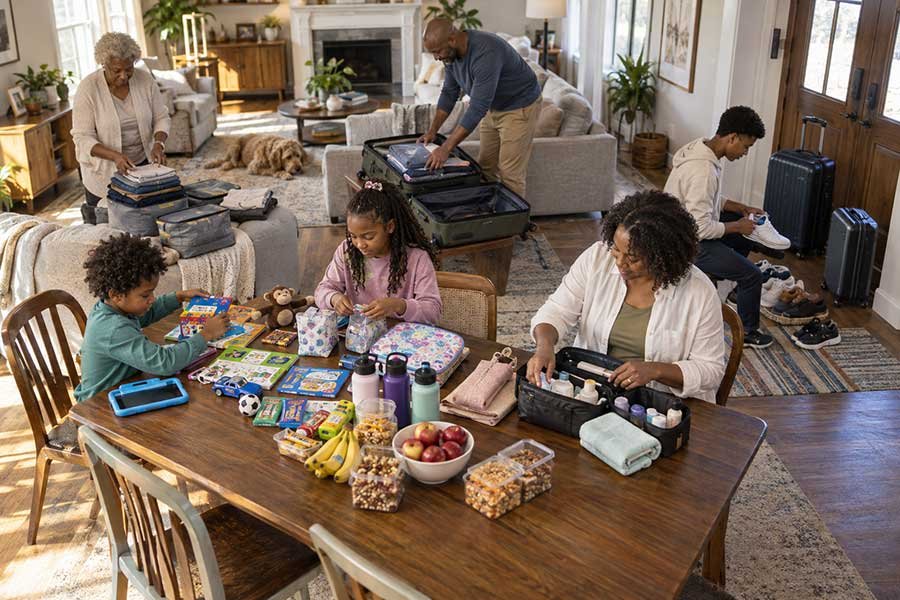
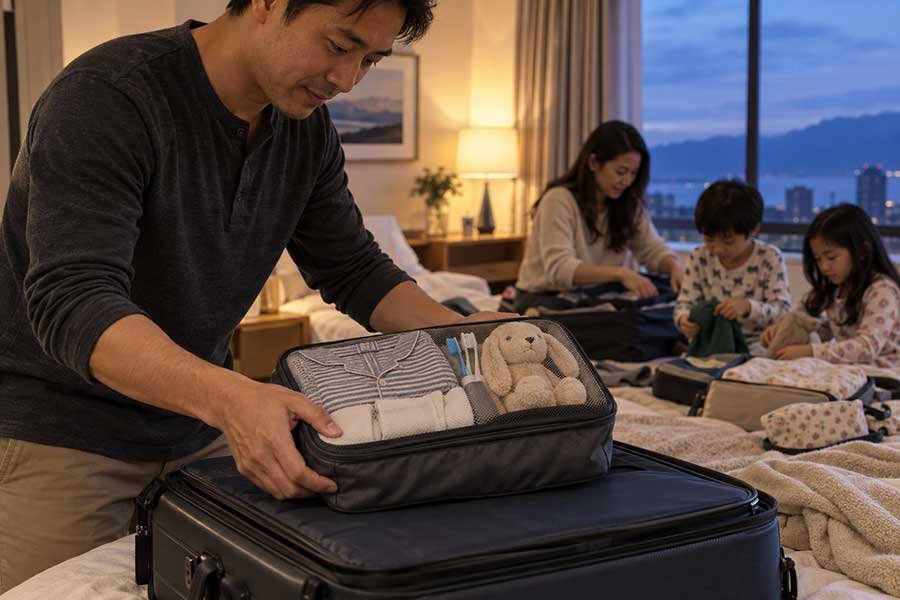
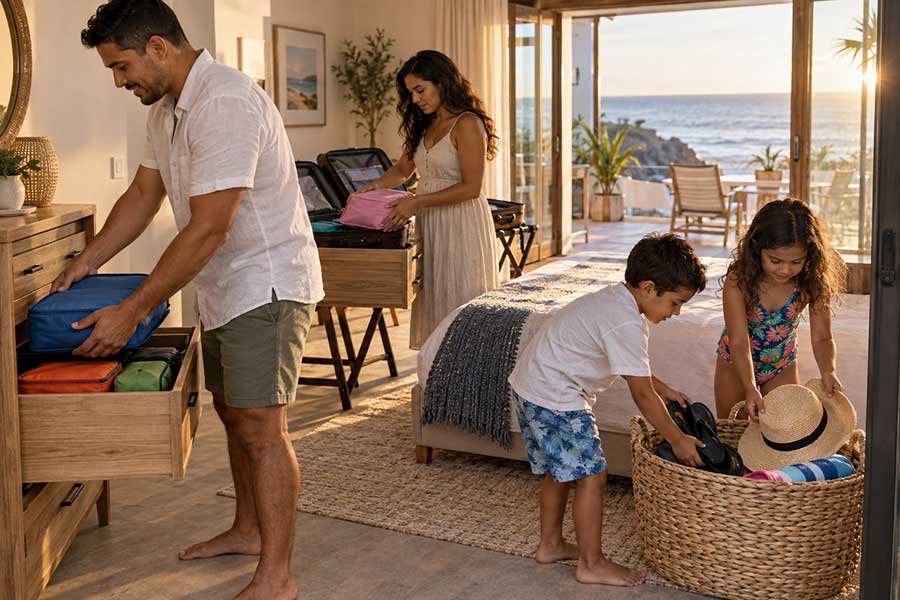
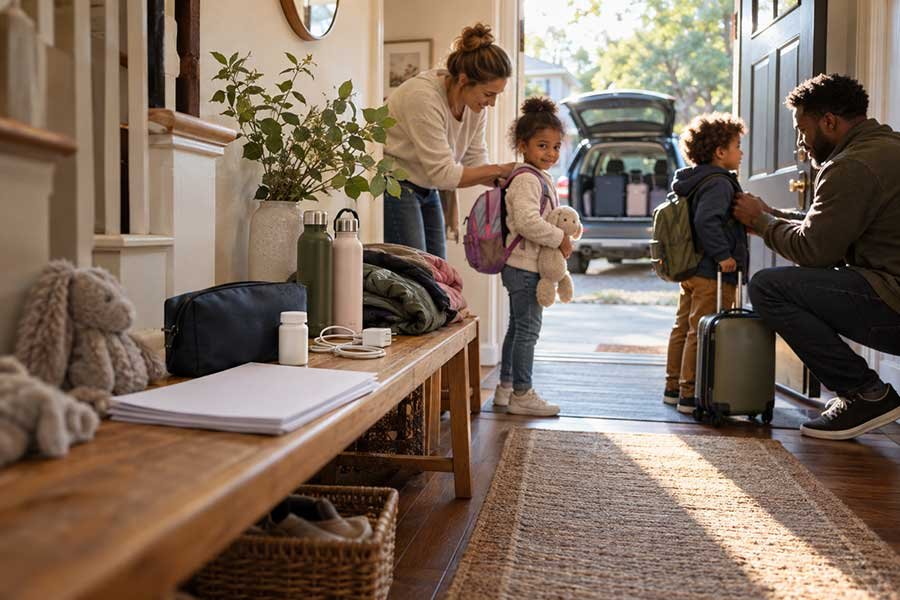
Packing for a family vacation without losing your mind comes down to one thing — starting earlier than you think you need to and having a system for every single person in the group. Twenty-nine tips for every parent who has arrived somewhere missing half of what the kids needed and is ready to make sure it never happens again.

Best For
Every Parent Who Has Arrived Missing Half of What the Kids Needed
Tips Count
29 Family Packing Tips
Read Time
12 Minutes
Walk Away With
The Family Packing System That Starts the Vacation Right
Free Download

Grab Our Travel Packing Checklist

Our free packing checklist is the foundation for the family packing system in these twenty-nine tips — every category organized, the travel-day pouch included, medications and extra outfits confirmed for the carry-on, and the final check built in so every bag closes with everything the family actually needs for the trip.

Get the Free Checklist

The most stress-free family trips almost always start with the most prepared bags because nobody wants to spend the first day of vacation hunting for something they forgot to pack.

Packing for a family vacation without losing your mind comes down to one thing — starting earlier than you think you need to and having a system for every single person in the group.

Start Early and Build the System: The Family Trip That Goes Smoothly Started Two Weeks Before Departure

01

Start the family packing process two weeks before departure — not the weekend before

Family packing is a different category of preparation from solo or couple travel — its complexity scales with the number of people, the age range of the children, the number of bags being managed, and the number of items across all of those bags whose absence is discovered at the destination rather than at home. Starting two weeks before departure converts this complexity from a last-weekend pressure session into a staged process whose component tasks fit comfortably into the time available. The first week is for the lists: one per family member, filtered against the confirmed itinerary, with each child’s list given to them for review. The second week is for the packing: each bag assembled against its list, confirmed complete, and finalized by the forty-eight-hour deadline. The departure morning is for the final checks against the confirmed complete bags — not for packing. Two weeks is not excessive for a family trip. It is the lead time that converts the packing from the source of the departure morning’s stress into the preparation that the vacation’s smooth start was built on.

02

Build a separate packing list for every member of the family from the start

The single family packing list — one document covering all four or five or six family members’ items — is the document that produces the departure morning uncertainty about whether the specific item was packed for the specific person, which bag it is in, and whether the oversight discovered at the airport has a remedy that does not involve going home. A separate list per family member produces clarity: this person’s items are confirmed on this list, packed in this bag, checked off at the final review. The lists are also the foundation for the responsibility distribution that makes family packing more manageable — older children with their own lists can confirm their own items, and the parent’s final review is a check rather than an assembly. Build the lists separately from the beginning. Each person’s list is their bag’s bill of materials. The final check confirms every bill against every bag before anything moves toward the departure.

03

Pack with each child rather than packing for them — it teaches the system and prevents gaps

The child whose parent packs their bag for them has a bag that is complete and whose contents are unknown to the child. The child whose parent packs with them has a bag that is complete and whose contents are known to the child — which means the child knows where their toothbrush is, where their favorite toy is, and where the spare outfit lives when the first one becomes unusable at a meal on day two. The packing session as a shared activity between parent and child also builds the child’s own understanding of the packing system over time: what the categories are, why certain items go in certain positions, and which bag holds which items. This knowledge earns its value at the destination, where the child who knows their bag can find what they need without the parent searching. Packing together takes a few extra minutes per child. The independence it produces at the destination saves those minutes back across every vacation that follows.

04

Give each child their own age-appropriate packing list and let them own it

A packing list built specifically for the child’s age and this specific trip — not a generic template but the actual items this child needs for these specific activities at this specific destination — is the list the child can use as their own reference. Older children, given their list and their bag, can pack the majority of their own items with spot-checking rather than supervision, which distributes the parent’s packing effort across the family rather than concentrating it entirely in the parent’s departure preparation. Younger children with simplified lists — the four items in the backpack, the three things in the bag — can participate in the confirmation and develop the vocabulary of the packing system at the appropriate complexity for their age. The age-appropriate list is not about burdening children with packing responsibility — it is about engaging them in the process in a way that reduces the parent’s cognitive load and develops the capability that makes every subsequent family trip more manageable.

05

Set a packing completion deadline 48 hours before departure for every bag

The family packing completed forty-eight hours before departure is the packing that has a two-day window to address anything the review surfaces: the item on the list that turns out not to be in the house and needs a quick purchase, the bag that exceeds the airline’s weight limit and needs editing, the child’s shoe that is in the bag and the matching one that is not. The packing completed the night before departure has none of these windows — every discovery at that point is either a crisis or a compromise. Forty-eight hours is not excessive margin for a family trip. It is the minimum time between packing completion and departure that the complexity of multi-person packing genuinely requires. Set the deadline. Meet it. Use the forty-eight hours before departure for final review and confirmation rather than for assembly. The departure morning is for leaving, not packing.

06

Give each child their own small bag they are responsible for carrying and tracking

The child with their own small bag — a compact backpack or a daypack sized for their age — has a defined space whose contents are theirs and whose location is theirs to manage. This bag holds the items most personal and most immediate to the child: the entertainment for the travel day, the snack they specifically wanted, the comfort item they always bring, and the small personal items that belong to them rather than to the family bag. The personal bag also serves a practical organizational function: the items that would otherwise be distributed across the family’s main bags — the child’s charger, their book, their small toy — are consolidated in the one bag whose contents they own and can find without asking a parent. The bag appropriate for the child’s age and strength is the one they carry themselves through airports without complaint, because it holds their things and they chose what went in it.

We Plan the Family Trip the Prepared Bags Are Heading To

Let Us Build the Family Vacation That Makes Every Packing Effort Worth It

The family trip worth the two-week preparation, the color-coded cubes, and the travel-day pouch deserves to be planned as carefully as it is packed. Tell us where your family wants to go and we will build the vacation that earns every organized bag from the first departure morning to the last checkout.

Plan Our Escape

The Clothing System: Organize Everyone’s Clothes Before the Bags Open

07

Roll every piece of clothing for every family member to cut bulk in half

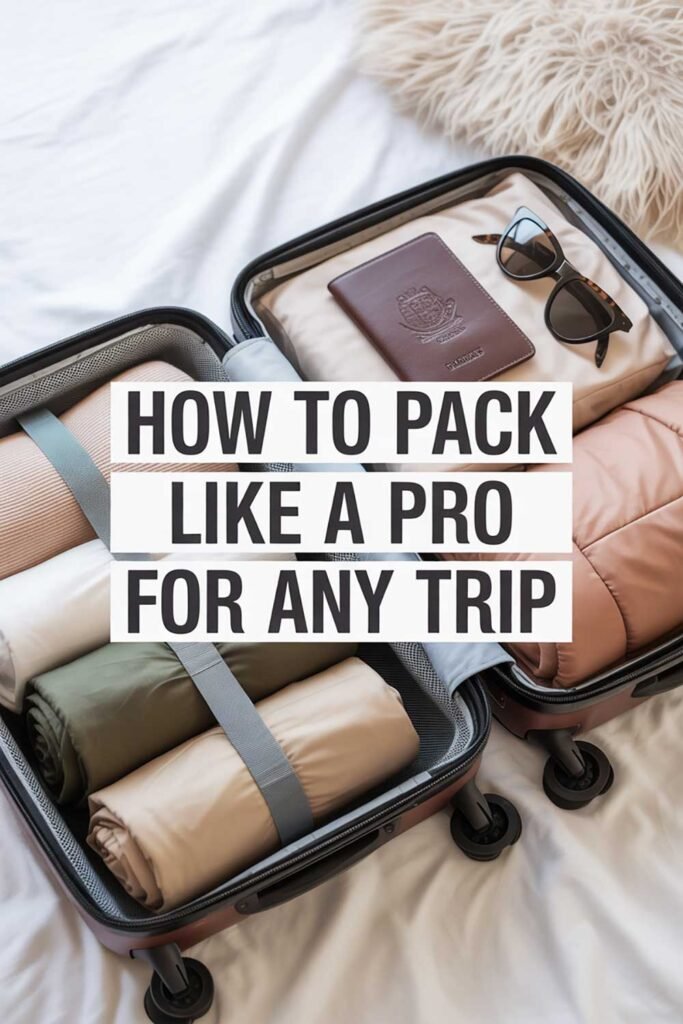
Family travel produces the most dramatic space pressure of any packing scenario — the aggregate clothing for four or five people whose combined wardrobe easily exceeds any reasonable bag allocation when packed conventionally. Rolling is the technique whose benefit scales most meaningfully with group size: the t-shirt occupying one-third of its flat-fold volume multiplied across four people’s travel wardrobes produces a different bag situation than the same volume packed flat. Roll every soft, casual item for every family member — the children’s t-shirts, shorts, and sleepwear especially, whose small size makes the rolled cylinder efficient and the space savings per item proportionally higher than for adult clothing. The family bag that could not close by flat-folding often closes easily by rolling, without any items removed. For families managing luggage weight limits across multiple bags, rolling is the technique that most consistently brings bags within limits before any packing decisions about what to leave behind need to be made.

08

Use one packing cube per person — color-coded or labeled so every family member’s items are instantly identifiable

The family suitcase packed without a per-person organization system is the suitcase whose contents require full excavation to locate a specific item belonging to a specific person — a process whose time cost scales with the number of people and whose chaos potential at a hotel room with four people looking for four different things simultaneously is significant. One packing cube per person, color-coded so each family member’s cube is immediately identifiable by color or label, converts the family suitcase from a shared container into an organized system whose sections are predictable. The specific child’s items are in the specific child’s cube, in the specific color that belongs to them, accessible without disturbing any other person’s items. The parent’s evening unpack and morning assembly are organized by cube rather than by full-bag archaeology. Choose the colors with the children’s input — the child who chose their cube color is the child who knows which one to open.

09

Pack every family member’s outfits as confirmed complete sets — especially the children’s

The child’s outfit assembled at the destination from individual pieces distributed across the family suitcase requires finding the specific top, the matching bottom, the right socks, and the appropriate shoes — a search across multiple bags and multiple layers whose result occasionally confirms that one component of the outfit did not make it or is in a different bag. The child’s outfit assembled flat and packed as a confirmed set — top, bottom, underwear, socks, and the specific shoes that go with it, rolled together inside the child’s color-coded cube — arrives as a unit whose components were confirmed complete at packing time. The morning routine at the accommodation is the extraction of one complete unit per person rather than the assembly of individual items from multiple locations. This approach takes an extra few minutes per child at packing and saves the daily search that the individually-packed version requires every single morning of the trip.

10

Build every family member’s vacation wardrobe around two or three colors that all mix together

The capsule palette applied to family travel serves the same function it serves for individual travel — fewer items that combine into more outfits — but with the additional benefit of producing family wardrobe coordination without deliberate effort. Two or three shared accent colors across the family’s clothing means that the group’s outfits are naturally complementary without any individual item being prescribed: the child in the navy top and khaki shorts coordinates naturally with the parent in the olive layer and neutral trousers because the palette was built to work across both. The practical packing benefit is the same as for individual travel: the bag that contains a coherent palette holds fewer items that dress everyone for longer than the bag that contains uncoordinated individual pieces. Build the palette for the family before buying or selecting any specific items for the trip. The clothing selected from within it dresses the family well and travels efficiently.

11

Pack fewer outfits than days for every family member and plan to re-wear and wash

The family trip’s clothing budget is the sum of all individuals’ clothing, and the individual who packs a fresh outfit for every day multiplied across four family members produces a bag load that reflects the overpacking anxiety of each individual person rather than the reality of what a family trip requires. Children re-wear clothes on vacation exactly as adults do, and the parent’s permission for this significantly reduces the total clothing packed for the trip. Plan on five outfits for a seven-day trip and one laundry stop at the trip’s midpoint — a hotel laundry service, a self-service laundromat, or an evening sink wash of the quick-dry items. The space and weight recovered by the two-outfits-not-packed per child on a family of four is the space that made the bags manageable and within the airline’s limits without the weight-distribution rearrangement that the fully-packed family bags otherwise require at the check-in counter.

12

Wear the family’s bulkiest shoes and layers on the travel day to free up bag space

Every item worn on the body on travel day is an item that does not occupy bag space or contribute to bag weight, and for families the aggregate of all members’ bulkiest items is the most significant available space recovery at zero cost beyond the outfit choice. Each family member wears their heaviest footwear and their warmest or bulkiest layer through the airport — the children’s sneakers rather than sandals, the adults’ walking boots rather than the lighter pair, the thick hoodies or jackets rather than the compressible fleeces. The combined space and weight these items would have occupied in the bags is recovered from the aggregate across the whole group. On a family of four, the space and weight of four pairs of bulky shoes and four warm layers carried rather than packed is often the margin between the overweight bag fee and the bags that board within their limits. Wear the heavy. Pack the light. This habit multiplies across every family member it is applied to.

The Travel Day Bag: Separate, Accessible, and Ready for Every Child’s Need

13

Pack a separate easy-access pouch specifically for the family’s travel day needs

The family travel day produces a specific category of need — the snack reached for at the security queue, the entertainment deployed at the gate, the wipe needed in the taxi — that is different from the trip’s regular daily needs and that is best served by a single, dedicated pouch rather than by searching across multiple bags in multiple positions for each item as it becomes necessary. A compact, brightly colored zip pouch packed the evening before departure with the travel-day essentials for all family members — separated from the main packing, sitting on top or in the carry-on’s exterior pocket — converts the travel-day need from a bag search into a single pouch opening. Everything the travel day is likely to require, in one accessible location, organized before the day that makes organization difficult. This pouch earns its weight on every travel day and saves the specific parent-search-while-managing-a-child-in-a-crowded-corridor that the unprepared travel day consistently produces.

14

Include all medications for every family member in the travel-day pouch — never in checked bags

The family’s medications — every child’s prescriptions, every adult’s daily medications, any condition-management items, the children’s pain reliever, the antihistamines, and the travel sickness remedies — belong in the carry-on at the travel-day pouch level for exactly the same reason individual medications always travel in the carry-on: the carry-on is the bag that arrives at the destination because the family carried it. The checked bag is the bag that arrives because the airline put it on the same aircraft, which is usually the case and occasionally is not. A delayed medication for a child is not an inconvenience — it can be a medical situation. The travel-day pouch includes every family member’s medication with clear labeling and the dosage note or prescription information that any medical professional at the destination might require. Pack them in the pouch before anything else is added. They are the non-negotiable contents around which everything else is organized.

15

Include entertainment for each child in the travel-day pouch — chosen specifically for the journey’s length

The entertainment deployed reactively from a main bag at altitude — unpacking the carry-on, searching for the tablet charger, locating the headphones that were not in the exterior pocket — is the entertainment that arrives after the child has been waiting for it through the first hour of the flight. The entertainment in the travel-day pouch is the entertainment deployed proactively: the tablet charged the previous evening and placed in the pouch with its short cable and child-sized headphones, the activity book alongside the colored pencils, the small toy or card game whose pieces fit a zip bag. Each child’s travel entertainment chosen specifically for the journey’s length and their specific age and preference, confirmed complete and assembled in the travel-day pouch before the departure morning begins. The travel-day pouch is the parent’s ability to deploy the right distraction at the right moment without any search. Its contents determine much of how the long transit feels.

16

Pack enough snacks for the full travel day plus a generous buffer for every family member

Family travel days are longer than their scheduled duration — the connection that runs close, the delay that produces an unplanned two-hour wait, the meal service that arrives much later than expected, and the child who is hungry at a moment the service cart has not yet reached the row. Pack snacks calculated for the full travel day’s confirmed duration, multiplied across every family member, plus a meaningful buffer for the scenarios that family travel reliably produces. Individual portions of familiar, non-messy foods that each child reliably likes are more valuable than novel or complex options whose rejection wastes the snack budget when the aircraft meal was equally rejected. The snack that a hungry child accepts without complaint in the middle of a travel day is one of the most practically useful items in the travel-day pouch. Pack enough of it. The surplus that comes home unused from the travel day is the emergency supply for an unexpected delay. It is never wasted.

17

Pack one extra outfit per child in the carry-on in case checked bags are delayed

The checked bag delayed by twenty-four hours is an inconvenience for an adult whose carry-on contains overnight essentials. For a child, the delayed checked bag without the extra outfit in the carry-on is the first morning of the vacation in the travel day’s clothes, which is the specific outcome the extra outfit is packed to prevent. One clean set of clothes per child — the next day’s outfit, including underwear and socks — rolled and tucked into the family’s carry-on beside the travel-day pouch, covers the delay scenario completely. It adds minimal weight and volume to the carry-on relative to the benefit it provides: the child in fresh clothes at the destination’s first morning regardless of where the checked bag is. Most family trips never use the extra outfit because the checked bags arrive as expected. The trip where a bag is delayed uses it before breakfast and makes the start of the vacation exactly what it was supposed to be rather than what a delayed bag determined.

Maya’s Family Trip Where Nothing Was Missing and the Vacation Started the Moment They Arrived

Maya had taken enough family trips to have a reliable departure morning experience that she would not describe as relaxing. The week before the trip always produced the same sequence: a general intention to pack early that yielded to the actual week’s demands, a Saturday evening of packing that went later than planned because one child’s items were scattered across two rooms, a Sunday morning discovery that the youngest’s swimsuit was in the wash and had not dried, a departure morning search for the specific brand of car sickness tablets that had been confirmed purchased and not located in the family bags until they were found in the bathroom cabinet where they had been sitting since being bought. The trips were good. The departure mornings were not. She had accepted this as the condition of traveling with children.

The trip that changed it was one she started two weeks early for the specific reason that the destination required multiple vaccinations for the children whose appointments had taken three of the planning weeks, and the packing started as a byproduct of the organizational energy that the vaccination appointments had already produced. She wrote a list for each child. She sat with each one and went through their list with them — not a supervision session but an actual collaborative exercise in which the seven-year-old made three additions that were correct and the ten-year-old identified two items on the original list that had been outgrown since the previous trip. The lists were accurate before anything was packed because the children who owned the lists had made them accurate.

The color-coded cubes assigned to each child were a suggestion from a friend and the single most practically useful change she made — the specific cube whose color belonged to the youngest was the cube found in thirty seconds at the accommodation rather than the five-minute search across the family suitcase that had characterized every previous trip. The travel-day pouch assembled the evening before departure held every medication for every family member, every child’s entertainment, and enough snacks for six hours longer than the actual transit. The extra outfit per child, rolled and tucked into the carry-on, was never used on this trip. On the following trip, when the eldest’s checked bag was delayed by a day, it was used before breakfast and the morning was unaffected. The twenty-nine tips in this article are the system that produced the family departure morning that was just a departure morning — not the performance it had always been before the system existed.

Smart Family-Specific Extras: The Items Family Travel Needs That Solo Travel Does Not

18

Keep a small family first aid kit in the carry-on for every trip

The family first aid kit — the compact zip pouch with children’s pain reliever in the correct dosage, adhesive bandages in multiple sizes, antiseptic wipes, antihistamine for allergic reactions, and any family-specific medical items — is the kit that earns its space on the trip where a child scrapes a knee before the nearest pharmacy is found, a blister forms on the second day’s walking, or an unexpected allergy response requires an antihistamine before it escalates. A pre-assembled family first aid kit kept permanently in the travel supplies and restocked after every trip is ready before the packing begins rather than assembled from the bathroom cabinet each time. Keep it in the carry-on because the scenarios it addresses happen at the destination — which is where the carry-on is — rather than at the airline’s baggage claim, which is where the checked bag might or might not be on the day it is needed most.

19

Designate a dirty laundry bag and use it from the family’s first night at every accommodation

The family accommodation without a designated dirty laundry container produces the specific end-of-stay scenario where the clean items and the worn items have commingled across several days of the children moving between the bag and the room’s surfaces, and the final repack requires a smell-test assessment of every item of clothing to determine which bag it belongs in. A lightweight laundry bag — one per family member or one shared family one — placed at the base of the family suitcase before departure is the container that collects worn items from the first evening at every accommodation. The clean-dirty boundary maintained from the first night keeps the packing cubes honest, makes the mid-trip laundry sort straightforward, and means the final checkout repack contains items whose status is known rather than items whose recent history requires investigation. One laundry bag. Used immediately. The whole trip organized around it without a moment’s thought.

20

Bring a packable tote for family outings and days when the main bags stay at the accommodation

The family’s day at the beach, the market morning, the afternoon excursion where the hotel or rental property holds the main luggage — all of these require a bag that is not the main suitcase, is light enough for the specific outing, and large enough for the family’s daily requirements: the sunscreen, the water bottles, the snacks, the towels, the children’s needs for the day. A packable tote folded flat inside the family’s carry-on or in the main bag’s lid pocket adds grams and centimeters, serves every destination outing, functions as the overflow carrier for the return journey’s purchases, and prevents the alternative of using the main suitcase as a day bag or buying a bag at the destination. Pack one for family travel. It earns its weight from the first destination outing and costs practically nothing to carry to the trip.

21

Let older children pack their own entertainment, accessories, and personal items into their bag

The older child who is capable of packing their own entertainment, their personal accessories, and their specific personal items into their own bag has done several things that benefit the family’s departure preparation: they have reduced the parent’s packing load, they have created their own familiarity with their bag’s contents and organization, and they have exercised a meaningful degree of travel responsibility whose accumulation across multiple trips builds the independent traveler the teenager eventually becomes. The parent’s role with the older child’s self-packed items is the review and the spot-check rather than the initial assembly. The child who packed their own bag knows where their charger is, knows which pocket their earbuds are in, and knows what they chose to bring — which makes them a more functional travel partner at every transit and destination moment where their bag’s contents are relevant.

22

Pack a compact power strip for accommodations with fewer outlets than the family requires

The family of four arrives at the accommodation with four phones, two tablets, a portable speaker, a child’s nightlight, and the charging cables for all of them — and discovers two wall outlets shared between the bed area and the bathroom. The compact travel power strip — a three or four-outlet device with USB ports, weighing under a hundred grams — multiplies the accommodation’s outlet count by the number of receptacles it adds and charges every family device simultaneously from a single occupied outlet. It is among the most consistently valued items in the family travel bag for domestic and international stays alike, and at its weight is among the easiest items to justify packing. Include it in the family carry-on rather than the checked bag so it is available at the first overnight accommodation before the checked bags arrive. One power strip. Every device charged. Every member of the family’s entertainment and navigation functional for the following day.

23

Check the accommodation’s listed amenities before packing what it already provides

Family accommodations at hotels, resorts, and vacation rentals typically provide a range of items whose presence in the family bag represents redundant weight: the hairdryer, the shampoo and conditioner and body wash, the high chair and cot for the youngest, the beach towels at the resort, the beach toys at the beachfront rental. Two minutes checking the accommodation’s listed amenities against the family packing list before a single family member’s item is packed removes every item the accommodation already provides. On a family trip where the aggregate weight across multiple bags is a genuine constraint, the accommodation items removed from the packing list are the weight that kept the bags within their airline limits. The beach toys bought at the destination cost a fraction of the checked bag overweight fee for the beach toys packed from home. Check the amenities. Pack only what the accommodation does not already have.

Travel Resources

Our Curated Collection of Trusted Tools and Official Sources

Everything we use to plan, prepare, and travel with confidence — from official government travel tools to practical planning aids. We have pulled together the resources we trust most so every trip you take is better informed, better prepared, and a lot less stressful from start to finish.

DND Resources

The Final Habits: Close Every Bag Right and Start Every Trip Ready

24

Do a final check of every bag against every person’s packing list before closing anything

The final check — every bag opened one last time, every item confirmed against the specific list for the specific person — is the quality control step that catches the item on the list that never made it into the bag, the item in the wrong bag, and the item whose presence in the bag was assumed but not confirmed. For family travel this check is not a quick pass through one bag — it is a systematic review of every bag for every family member, ideally performed with the list holder present to confirm their own items. The final check takes twenty minutes for a family of four and catches the specific discoveries that the departure morning finds instead when this step is skipped: the child’s prescription not in the travel-day pouch, the extra outfit not in the carry-on, and the entertainment that was confirmed packed and is in the living room rather than the bag. Do the check. Do it before the forty-eight-hour deadline rather than on the departure morning. The family trip that starts with every bag confirmed is the one that starts as planned.

25

Photograph every packed bag before closing them — including the children’s

A photograph of each packed bag before it is closed provides the visual inventory the airline’s lost luggage claim requires when it asks what was in the bag, and the return journey’s completeness check when the same photograph is compared to the checkout repack to confirm everything is present. For the children’s bags specifically, the photograph taken with the child present at packing time is the reference for what was packed — visible to the parent and to the child for the return checkout confirmation that each child’s items are all in the bag. The photograph habit takes two minutes across all bags and produces documentation that most family trips never need and occasional ones urgently do. It also makes the return checkout systematically thorough: the photograph is the complete list of the bag’s contents, available at the accommodation’s last morning, confirming what should be in the bag and allowing the room check to be specific rather than general.

26

Give every bag a color-coded or personalized luggage tag for instant identification at every carousel

The family’s checked bags on the baggage carousel at the destination — identifiable immediately by the distinctive luggage tags whose color matches each family member’s packing cube — are the bags claimed without the round-by-round scrutiny of every similar black suitcase that the untagged bags require. A personalized or brightly colored luggage tag costs a few dollars, takes under a minute to attach, and produces the family baggage claim experience where each child can identify their bag from a distance by its tag color, which distributes the carousel watching across multiple family members rather than concentrating it in the parent whose attention is also managing the youngest through the arrival hall. Tag every bag distinctively. Make the color or design associated with the person it belongs to. The carousel claim for the family whose bags are all instantly identifiable by their tags takes half the time and a fraction of the stress of the carousel claim for the bags that look like every other bag on the belt.

27

Weigh every checked bag at home before leaving — with a bathroom scale, before the departure morning

The overweight bag fee at the check-in counter is one of the most consistently avoidable family travel costs — avoidable because the weight information is freely available at home in the sixty seconds it takes to step on the bathroom scale while holding each bag. For family travel, the aggregate weight issue is more common than for individual travel because the family’s collective bag load is larger and the weight estimate for multiple people’s items is less accurate than for one person’s. Weigh every checked bag at home. Compare the number to the airline’s specific limit for the specific carrier on the specific leg of the journey. If any bag is over limit, edit it at home where the closet is available and the edit costs nothing but a decision. The overweight fee paid at the counter on the departure morning is the cost of the home weigh-in that did not happen. Do the weigh-in. Know every number before the departure morning produces one as a surprise.

28

Do a room check with the children before every accommodation checkout

The room check conducted with the children — each child responsible for checking the surfaces, the bathroom, and the corners of the space they used — distributes the departure-morning room sweep across the family rather than concentrating it in the parent who is simultaneously managing the bags, the checkout time, and the family’s readiness to leave. Children assigned specific room zones to check are engaged in the departure process rather than waiting for it, and the items they find — the charger in the outlet by the bed, the shoe under the cot, the stuffed animal on the shelf above the wardrobe — are the items whose absence the subsequent transit day would otherwise have been spent mourning. Make the room check a family habit from the first accommodation of the first trip. The children who have done it on every trip know exactly what to look for and where the most frequently forgotten items tend to be. The habit is learned young and serves them for life.

29

Reset every family bag within twenty-four hours of returning home — before the week absorbs the intention

The family bag reset within twenty-four hours of returning from the vacation is the investment that makes the next family trip’s preparation measurably easier. The laundry comes out and goes to the wash. Each packing cube is emptied and returned to its designated bag. The travel-day pouch is restocked: medications confirmed complete, snacks replaced, each child’s entertainment items returned to their pouch positions. The first aid kit is checked and restocked. The master packing lists are updated with the post-trip adjustments that were noticed during the vacation and should be captured before the memory of them fades. Every bag is closed and stored in its organized, ready state. The next family trip’s packing session begins from a complete foundation rather than from the dismantled aftermath of the last one — which is the difference between the packing that takes two weeks of calm preparation and the packing that takes a frantic weekend under pressure. Reset within twenty-four hours. The next trip starts better for it.

Book With Us

Book the Family Vacation That Makes Every Prepared Bag Worth the Effort

The family trip worth two weeks of packing preparation, color-coded cubes, and a dedicated travel-day pouch deserves a destination planned with the same care. Our travel agents book the family vacations that give every organized bag somewhere genuinely worth arriving to — and every first morning the smooth start the preparation was built to produce.

Book A Trip

The lists were written two weeks early. The cubes were color-coded and each child knew their own. The travel-day pouch had the medications on top and the snacks beside them and enough entertainment for a flight twice as long. The extra outfits were in the carry-on. Nothing was missing at the destination. The first day of the vacation was the first day of the vacation. That is twenty-nine tips. That is the family trip that started the moment they arrived.

Picture the Family Departure Morning That Was Just a Morning

The packing started two weeks before departure and each child had their own list and their own color-coded cube. The outfits were packed as confirmed complete sets. Everything was rolled. The heaviest shoes and layers were worn through the airport. The travel-day pouch was assembled the evening before: medications at the top, entertainment for each child ready, snacks packed for a travel day longer than the actual one in case. The extra outfit per child was rolled in the carry-on beside the pouch. Every bag was weighed at home and confirmed within the airline’s limit. Every bag was photographed before closing. The departure morning was the morning of getting into the taxi, not the morning of finding what was missing. At the destination the eldest’s bag identified instantly by its tag at the carousel. The youngest’s cube produced the complete Day One outfit in twelve seconds. The travel-day medications were in the pouch exactly where they were packed. The first day of the vacation was the first day of the vacation because the bags were right before the family left home. That is twenty-nine tips. That is the stress-free family trip that started with the most prepared bags.

Free Download

One More Thing Before the Family Bags Open

Print our free Travel Packing Checklist and use it as the foundation for every family member’s individual list — organized by category, with the travel-day pouch section, the medications in carry-on confirmation, and the final check built in. The same checklist we use before every family trip we take.

Get the Free Checklist

Explore Our Top Picks for a Better Trip

After years of exploring the globe together, these are the exact tools, platforms, and services we rely on for every single trip — personally tested, traveler approved, all in one place. We don’t recommend anything we wouldn’t use ourselves, and this is the collection of booking platforms and travel tools that have made our adventures smoother, smarter, and more memorable.

See Our Top Picks
Turn Travel Into Income

Love Helping Families Show Up to Every Vacation Completely Prepared?

Helping a family pack the right bags for the right trip — and booking the family vacation they are heading to — is the kind of practical care that makes a home-based travel agent genuinely worth coming back to. If turning your love of travel into a business sounds like the right next move, see how the TravelPreneur system works.

Become An Agent

Family Travel Printables at Premier Print Works

Visit Premier Print Works for family packing checklists, per-child packing lists, travel-day pouch guides, trip planners, and printables that make every family departure more organized and every vacation easier from the moment you arrive — because nothing was missing and everyone knew where their bag was.

Visit Premier Print Works

Disclaimer

The information shared in this article is provided by Don and Diana’s Travels for general informational, educational, and inspirational purposes only. It reflects our personal experiences, opinions, and the experiences of travelers we have worked with. It is not professional travel, medical, legal, or parenting advice.

Medical and Medication Information

References to medications, first aid, and health items in this article are general educational information only. Always consult a qualified healthcare provider for advice about your family’s specific medical needs, medication management, and travel health preparation. We are not medical professionals and nothing in this article constitutes medical advice.

Airline and Baggage Policies

Airline baggage allowances, weight limits, carry-on restrictions, and related policies vary by carrier and are subject to change without notice. Always confirm current requirements with your specific airline before traveling. We are not responsible for any fees or outcomes arising from reliance on baggage information in this article.

Children’s Safety

All decisions about children’s bags, responsibilities, and participation in travel activities should be made based on each child’s individual age, maturity, and capabilities. The suggestions in this article are general guidance and may not be appropriate for every child or family situation.

Affiliate and Partner Links

This article may contain affiliate and partner links that pay us a commission at no extra cost to you. Our recommendations are based on real use and genuine belief in the products and services we share.

Composite Stories

Stories on this site combine real experiences from Don, Diana, clients, and travelers we have worked with. Details may be adjusted for privacy and narrative clarity.

No Guarantees

We do not guarantee any specific packing or travel experience from using the information in this article. Results vary by family, destination, and trip type.

Copyright and Use

All content is the copyrighted property of Don and Diana’s Travels. You may not copy or republish our content without prior written permission. You are welcome to share a direct link with proper credit.

By reading this article, you acknowledge that you have read and agree to this disclaimer.