The best travel hacks are the ones that quietly solve three problems at once — and these twenty-five do exactly that across every stage of the trip, from packing to booking to getting through the airport and spending wisely at the destination. Every hack here saves something real: space in the bag, time in transit, or money at every step between home and the trip worth taking.

Best For
Every Traveler Who Wants to Do More and Spend Less
Hacks Count
25 Travel Hacks
Read Time
10 Minutes
Walk Away With
The Shortcuts That Save Space, Time, and Money Every Trip
Free Download

Grab Our Travel Packing Checklist

Our free packing checklist covers the space-saving side of these twenty-five hacks — rolling, cubes, outfit-first packing, and every pre-departure confirmation — so the bag is half the size, the departure is stress-free, and more of the budget stays in the trip where it belongs.

Get the Free Checklist

The smartest travelers are not the ones with the biggest budgets — they are the ones who figured out where the shortcuts were and used every single one of them.

The best travel hacks are the ones that quietly solve three problems at once — and these twenty-five do exactly that across every stage of the trip from packing to booking to the destination itself.

Saving Space: Pack Half as Much Without Leaving Anything Behind

01

Roll soft clothes instead of folding them to cut bag volume significantly

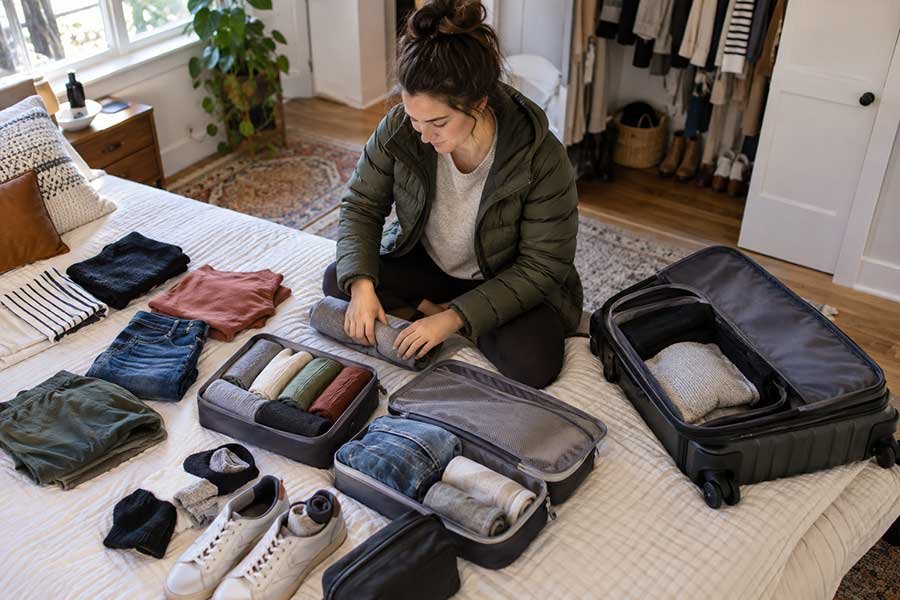
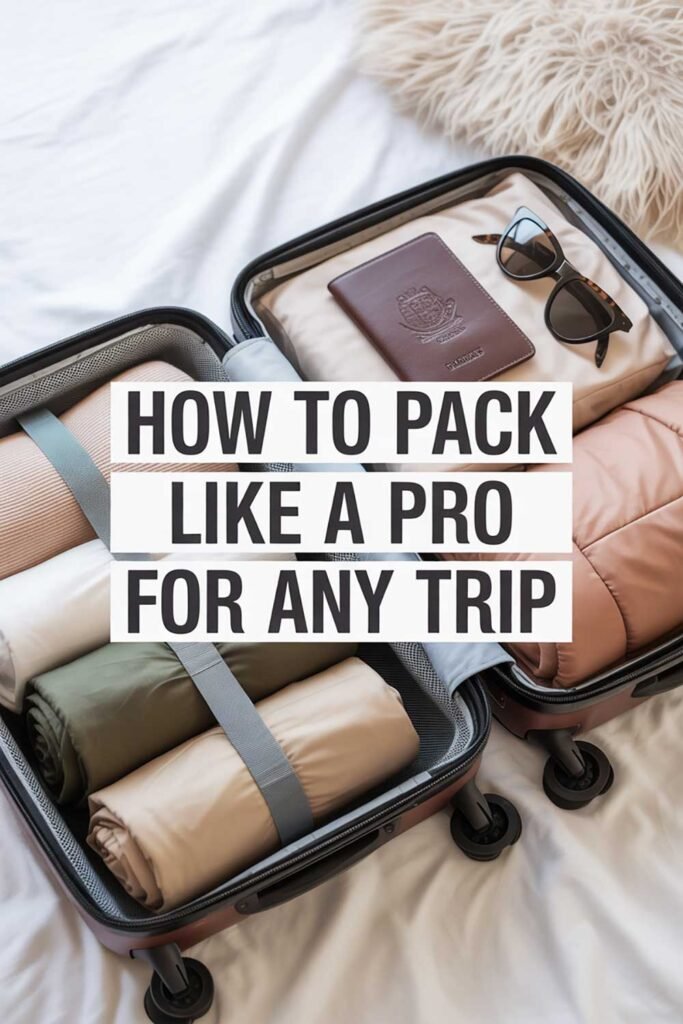
A t-shirt rolled into a tight cylinder occupies approximately one-third of the space the same shirt occupies folded flat. A bag of rolled soft items — t-shirts, casual trousers, knitwear, underwear — holds measurably more clothing than the same bag packed by the flat-fold method that most travelers use by default without ever examining whether it is the most efficient approach. Rolling also produces softer, more distributed wrinkles that resolve quickly on a hanger rather than the sharp fold line pressed into the fabric each time the garment is packed flat in the same orientation. Roll every soft, casual item. Fold the structured garments that wrinkle differently when rolled — blazers, linen shirts, formal trousers. Apply both techniques correctly and the bag that previously required sitting on to close will close without assistance, with room for the items that did not fit before the rolling habit was established.

02

Use packing cubes with one category per cube — and keep the assignments the same every trip

Packing cubes transform a single open compartment that gradually collapses into general disorder across the trip into a system of organized, category-specific containers that maintain the bag’s organization from the first day to the last. One cube for tops, one for bottoms, one for underwear, one for layers — consistent across every trip so the location of every item category is known without searching. The cubes compress as they close, reducing rolled items to the smallest practical volume. The organization they maintain means checkout repacking takes minutes rather than the full sort-and-repack that the uncubed bag requires. For the space-saving specifically: the compression each cube applies to its contents produces a bag that holds more than the same items packed loosely into the same volume. Assign the categories. Keep them. The system saves space on the first trip and time on every subsequent one.

03

Use compression cubes for bulky soft layers to make them take their fair share of space

The bulky layer — the fleece, the hoodie, the packable down jacket — is the item whose air-to-fabric ratio is highest and whose bag impact is most dramatic when compressed versus uncompressed. A medium fleece in a standard cube occupies a third of the bag. The same fleece in a compression cube, zipped down through the secondary zipper, occupies the space of a t-shirt stack. Compression cubes are not general purpose — they are specifically for the soft, insulating, air-filled items that compression reduces most effectively. Standard cubes for everything else. The two systems together extend the bag’s functional capacity to cover the full trip without requiring a larger bag or a lighter packing choice between warmth and space. The compression cube is the specific tool for the specific category whose absence from the bag is otherwise the most common reason trips require an extra checked bag.

04

Tuck socks and small items inside shoes to use space that travels in the bag anyway

Every shoe in the bag occupies space regardless of whether its interior is filled. Rolling socks and tucking them into the shoe’s cavity — alongside a compact adapter, a folded belt, a small accessories pouch — converts air into storage. The shoes at the bag’s base with socks and small items inside them consolidate multiple categories into the shoe layer and free the cube space above for items that genuinely need it. For the traveler trying to fit two weeks of clothing into a carry-on, this technique recovers a meaningful amount of space from what would otherwise be dead interior volume. Every shoe packed without socks inside it is space that was paid for in weight, volume, and carry-on allowance and contributed nothing. Fill the shoes before they go in. The inch matters when the bag needs every one of them.

05

Pack outfits rather than individual pieces so nothing takes up space without a confirmed purpose

The bag packed by category — all tops together, all bottoms together — is the bag whose outfit chemistry is assumed rather than confirmed, producing the item that traveled the full trip because it seemed like a reasonable individual piece but had no complete outfit partner. The bag packed by outfit assembles each complete look before any piece is moved: top, bottom, shoes, layer, accessories. Every item confirmed against a complete outfit before it is packed. Every item without a complete outfit left in the closet. The difference in volume is the difference between the items that were packed with a confirmed purpose and the items that occupied space without one. The outfit-first method is the most consistently effective single packing habit for reducing the bag’s size while maintaining its utility — because it removes the pieces that were taking space but serving no confirmed function on the trip.

We Find the Trips Worth Every Saved Dollar

Let Us Plan the Trip That Puts the Savings Where They Belong — In the Experience

The space saved by rolling and cubing, the fare saved by alert-setting, and the budget kept by eating one neighborhood from the tourist center — these are savings that belong in the trip rather than in the inefficiencies. Tell us where you want to go and we will plan the trip that makes every saved dollar count for more.

Plan Our Escape

Saving Money on Flights and Bookings: Catch the Price Before It Climbs

06

Set fare alerts weeks before you are ready to book — not when you need to buy

Airfare does not move on a schedule that is fully predictable, but its direction as departure approaches is consistent: prices tend to rise as availability decreases and booking windows close. The traveler who sets a fare alert at the moment the destination and dates are decided monitors the fare’s movement across the entire planning period and buys when the alert fires at an acceptable price — rather than the traveler who decides to research fares when ready to book and discovers whatever the market is that specific day. Most flight search tools offer free fare alerts that require under three minutes to configure. They replace the anxiety of wondering whether to book now or wait with a monitoring system that notifies when the target price is reached. Set them the day the trip’s destination and dates are confirmed. Let the alerts do the watching. Buy when they signal rather than when urgency forces the decision.

07

Fly mid-week rather than on Friday or Sunday to save money on most routes

Most air travel routes follow a demand pattern whose peak is the business-travel week’s bookend days — Sunday evenings outbound and Friday evenings return — and whose off-peak is mid-week, typically Tuesday and Wednesday, when business travel has settled and leisure travel has not yet mobilized for the weekend. Fares reflect this demand pattern: the same route on the same airline can vary meaningfully between the peak-demand Sunday evening and the off-peak Tuesday morning. Flexible travelers who can shift departure or return by one or two days to a mid-week option consistently find lower fares for the same seats. Use the flexible-date view available in most flight search tools to compare fares across a range of departure and return dates. The calendar view converts the fare search from a single-date lookup into a pattern-recognition exercise whose savings can be applied to the experiences the saved money was intended for.

08

Search for flights in incognito or private browsing mode

Flight search tools and airline websites use cookies and session tracking to monitor which routes and dates are searched repeatedly — and some have been observed presenting higher prices to the returning searcher whose behavior suggests high interest or limited alternatives. Searching in incognito or private browsing mode resets this tracking on every search session, presenting prices from a clean session state rather than one whose search history the pricing algorithm may have already assessed. Whether this produces consistently lower prices is debated, and the effect varies by search tool and airline. The habit costs nothing — opening a private browsing window takes three seconds — and removes the possibility of dynamic pricing based on search history from the equation entirely. It is the cheapest possible hedge against a fare increase mechanism that the traveler cannot verify but also cannot disprove. Search privately. The saving, when it exists, is captured for free.

09

Book accommodation one neighborhood away from the tourist center for meaningfully lower prices

The accommodation on the main tourist square, on the waterfront promenade, and in the most photographed neighborhood at any destination commands a premium that reflects the location’s convenience and visibility rather than a proportionally better room, breakfast, or service standard. The accommodation one metro stop, one tram ride, or a fifteen-minute walk from this center is frequently thirty to forty percent less expensive, equally well-reviewed for the qualities that determine daily satisfaction — cleanliness, comfort, staff service — and provides the specific benefit of the local neighborhood experience rather than the tourist infrastructure that the premium-location accommodation is surrounded by. Research the destination’s neighborhood layout before booking. Identify the areas adjacent to the tourist center that have their own residential and local character. The accommodation found there is often the one the best trip memories come from, at a fraction of the price of the one on the tourist square.

10

Always check cancellation policies before booking — free cancellation costs nothing and covers everything

Two accommodations at the same price with the same rating present a meaningful difference when one offers free cancellation and the other does not — a difference that is invisible at booking time when the intention is to use the reservation and becomes very visible when plans change, a delay shifts the arrival date, or a better option is found after the non-refundable booking is made. Defaulting to free cancellation options across every booking — accommodation, tours, transport — where the price difference is minimal or nonexistent converts the trip’s bookings from fixed commitments into flexible ones that can be updated as the trip approaches and the plan clarifies. The flexibility is free when the cancellation policy is free. When it is not free, the cost of cancellation is the true price of the inflexibility. Check the policy before completing every booking. The free cancellation option is the one that maintains the ability to make better decisions as the trip develops.

Saving Money at the Destination: Spend on the Experience, Not the Infrastructure

11

Bring a card with no foreign transaction fees for every purchase abroad

Foreign transaction fees — the two to three percent surcharge that many credit and debit cards apply to purchases made outside the issuing country — are among the most consistent and least noticed travel costs, compounding across every card transaction from the airport taxi to the final dinner. On a two-week international trip with moderate daily card spending, the cumulative foreign transaction fee can represent a meaningful amount charged in addition to every purchase for no service received by the traveler. Cards with no foreign transaction fees are widely available and often come with additional travel benefits. Applying for and using one before every international trip converts the foreign transaction fee from an ongoing travel cost to a line item that is simply not incurred. The saving is automatic, applies to every card purchase across the trip, and requires no behavioral change at the destination beyond using the right card.

12

Never exchange currency at the airport kiosk — use the city ATM instead

The airport currency exchange kiosk’s pricing model is built around the traveler’s immediate need for local currency and the absence of competitive alternatives at the moment of arrival. The spread between its buy and sell rates, combined with the service fee or commission charged on top, consistently produces one of the worst exchange rates available at any legal exchange point. The city ATM produces the same local currency from the same home-currency amount at significantly better terms — typically the card network’s standard interbank rate, with only a modest ATM withdrawal fee. The difference on a single transaction can represent the cost of a good meal. Across a full trip with multiple ATM visits, the cumulative saving is material. Use the city ATM for local cash. If local currency is genuinely needed immediately on arrival, the airport’s own ATM is a better option than the exchange kiosk — even the airport’s ATM rate typically beats the exchange kiosk’s margin by a meaningful percentage.

13

Always eat one neighborhood away from the main tourist area for a fraction of the price

The restaurant on the main tourist square charges for its location as well as its food — the premium associated with the foot traffic, the view, the tourist infrastructure, and the convenience of being the first thing visitors see when they arrive. The restaurant one street back, in the neighborhood where the locals eat, charges for the food. The quality difference between these two meals at many destinations favors the neighborhood option — the tourist-center restaurant has optimized for volume and visibility, while the neighborhood one has optimized for the repeat local customer whose return depends on the meal’s quality rather than the location’s convenience. Walk away from the main tourist concentration. Follow the absence of menus translated into ten languages, the presence of handwritten specials boards, and the sight of tables occupied by people who live nearby. The best meal of the trip is often found there. It is almost always meaningfully cheaper.

14

Get a local SIM card or international data plan before you need navigation, not after

The roaming data charge on a domestic SIM used internationally, the in-app data purchase made in desperation at the destination when navigation is immediately needed, and the hotel Wi-Fi dependency that makes every time outside the accommodation a connectivity gap — all of these are more expensive than the local SIM or the international data plan that costs a fixed amount and covers the full trip. Research the destination’s options before departure: a local SIM purchased at the destination’s airport is typically the cheapest and fastest option for stays of several days or more. An international data add-on through the home carrier is the most convenient option for short trips where the hassle of the SIM swap is not worth the potential saving. Either option, confirmed before arrival, converts connectivity from a recurring uncertainty into a solved infrastructure problem. Connectivity purchased in advance is cheaper than connectivity purchased in a moment of need.

15

Buy transit day passes or multi-trip cards instead of single tickets at every destination

The city’s day pass or multi-trip transit card almost always costs less than the sum of individual tickets for the same number of journeys — a pricing structure deliberately designed to encourage regular transit use and accessible to tourists who make the purchase intentionally rather than defaulting to single tickets at each journey’s start. The break-even is typically three or four individual journeys in a single day, which most travelers on city exploration days exceed by midday. A multi-day pass extends this saving across the full trip. Transit cards also save time — the contactless tap or card scan that replaces the ticket machine queue at every station, the reduced mental overhead of not calculating whether the next journey requires another single ticket purchase. Research the destination’s transit options the night before arrival. Buy the day pass or the multi-trip card on the first morning. The saving compounds across every subsequent transit use and requires no further decision-making for the remainder of the trip.

How Luca Started Doing More and Spending Less on Every Trip Without Changing the Destinations

Luca traveled three or four times a year and had accepted a specific version of travel economics as fixed: flights were what they cost when he looked for them, hotels were priced at what they were priced at, and the daily costs at the destination were what they were. His bag was always the maximum carry-on size and always at or above its weight limit. Security always involved some degree of reorganization at the bin. And the trips were good — he enjoyed them — but he had a persistent feeling that other travelers were getting more from the same budget while carrying less and moving through airports with less friction, and he could not entirely account for why.

The first change was accidental. He set a fare alert on a whim three weeks before deciding to actually book the flight and discovered that the price he ended up booking at was forty-two dollars less per person than the price he had been monitoring manually for the previous two weeks. The alert had caught a midweek dip that his manual checks — done on weekend evenings when he had time — had consistently missed. He set the alert on the next trip at the moment the destination was decided. Then the trip after that. The habit saved something on every trip that used it and confirmed what he had always suspected: the price at the moment he was ready to book was not the price that had been available if he had been watching.

The rolling habit followed after a trip where a friend had packed the same number of days’ clothing in a bag half the size by rolling everything and using four packing cubes whose assigned categories never changed. The sight of the friend moving efficiently through the airport with a bag that could go overhead without the weight-at-the-counter anxiety was the motivation. The no-foreign-transaction-fee card came from calculating what he had paid in fees across the previous two years of international trips and finding the number large enough to be worth an afternoon of research and an application. The neighborhood restaurant habit came from following a local recommendation away from the main square on one trip and discovering that the meal was better and cost a third less. He has not eaten on the main tourist square since.

None of these were dramatic changes. Each one was a small adjustment that saved something consistently and required no sacrifice of quality, comfort, or trip experience. The twenty-five hacks in this article are the system that produced the traveler who does more and spends less on every trip — not because the budget grew, but because the shortcuts were found and used every single time.

Saving Time in Transit: Move Through Airports the Way It Looks Easy

16

Check in online the night before and screenshot the boarding pass offline

Online check-in the night before produces the preferred available seat in the fare class — the aisle or window that was still open at the twenty-four-hour check-in window’s opening — rather than whatever remains by the morning of departure. The screenshot of the boarding pass immediately after check-in confirmation produces the boarding pass that opens in one second from the camera roll regardless of connectivity, battery, or app status — at the security bin, at the gate, and at the jetway. These two habits together save the time spent at the morning-of check-in desk, the time spent waiting for the boarding pass app to load at the gate, and the specific time lost when the app fails to load at the moment it is most needed. Each takes under three minutes the evening before. The time they recover is distributed across every checkpoint the following morning — small amounts each time, meaningfully different across the whole airport day.

17

Organize the carry-on for security the night before — liquids bag and laptop in the outermost pockets

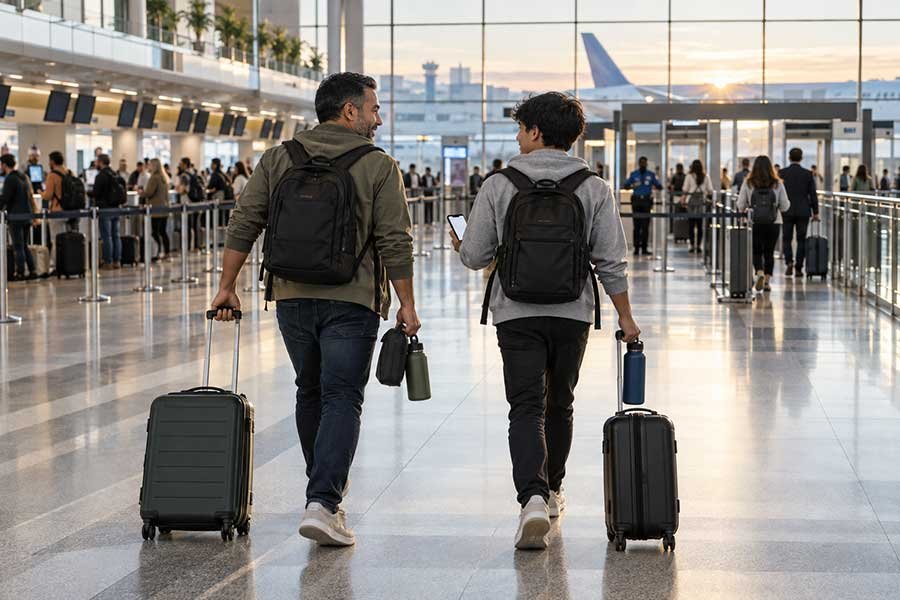
The two items required to be removed from the carry-on at every security checkpoint — the laptop and the liquids bag — belong in the outermost accessible pockets of the carry-on rather than the main compartment, and this positioning should be established the night before departure rather than at the security bin. The liquids bag in the outermost front pocket comes out in two seconds, goes into the tray, and returns to the same pocket after the checkpoint. The laptop in its dedicated outer sleeve does the same. The carry-on organized for security before the airport is reached saves the full two-minute main-compartment excavation that the unorganized version requires at the bin, keeps the security queue moving, and begins the security lane interaction with the bag already prepared rather than still being prepared while the queue waits. Two minutes of evening preparation. Every security checkpoint faster for it.

18

Wear slip-on shoes and put all metal items in the bag before joining the security queue

Slip-on shoes come off at the security checkpoint in three seconds and go back on in three seconds. Lace-up shoes cost the traveler and the queue behind them the thirty seconds of kneeling and re-lacing that the slip-ons replace with nothing. The belt, watch, and all metal items put into the carry-on’s outer pocket before the security queue is joined cost the same thirty seconds in the empty space at the queue’s entry rather than at the conveyor where the time cost is shared. These two habits combined — slip-ons on, metal in the bag before the line — convert the security interaction from the production it can occasionally be into the twenty-second process it should always be. Wear the slip-ons specifically for travel and change into the destination shoes after arrival. The security lane time saved across a year of trips adds up to a number that would be hard to justify spending on lace-up shoes no matter how attractive they are.

19

Find the gate before anything else after clearing security — always, without exception

The gate found before the food, coffee, and terminal browsing is the gate whose distance is known before any other commitment in the terminal is made. The gate found after is the gate whose distance is discovered when the return walk is already competing with the departure time. Walking to the gate first, confirming the departure time on the gate display, and confirming the gate number against the current departures board — not the boarding pass from the previous evening — takes five minutes and produces every piece of information needed to plan the remaining time in the terminal accurately. The coffee is better when it is drunk with the gate confirmed. The browsing is better when it is bounded by the known return walk time. The gate found first converts the terminal time from an ambient uncertainty into a known quantity that can be used rather than managed. Gate first. Always. The five minutes is the most consistently valuable pre-boarding investment the terminal offers.

20

Build a buffer into every connection at booking time — not at the airport when it is too late

The airline’s minimum connection time covers the ideal scenario: on-time inbound, nearby gate, no secondary process. Real connections include late inbounds, gate changes that add walking distance, and passport control or terminal transfers whose time cost the minimum does not account for. A thirty-minute buffer beyond the airline’s minimum, added at booking when the schedule is still a preference rather than a fixed constraint, converts the close connection from a consistent source of transit anxiety into a managed scenario whose buffer absorbs routine delays without any sprint. The time saved by this approach is not measured in minutes at the gate — it is measured in the reduction of the anxiety that the minimum-time connection carries from booking to arrival, and in the number of trips that proceed smoothly because the margin existed rather than the ones that cascade into missed connections and their downstream costs. Build the buffer when the booking is made. The airport is too late.

Travel Resources

Our Curated Collection of Trusted Tools and Official Sources

Everything we use to plan, prepare, and travel with confidence — from official government travel tools to practical planning aids. We have pulled together the resources we trust most so every trip you take is better informed, better prepared, and a lot less stressful from start to finish.

DND Resources

The System Habits: Make the Shortcuts Automatic on Every Single Trip

21

Keep a master packing list and update it after every trip while the memory is fresh

The master packing list is the cumulative record of every trip that refined it — the items that were wished for and not there, the items that came home untouched, and the adjustments that each trip’s honest post-trip review produced. A packing list updated after every trip becomes progressively more accurate and useful: by the fifth or sixth trip it reflects the genuine experience of what was needed rather than the theoretical coverage of what might be, and the bag built from it is lighter, more functional, and less likely to include the item that traveled four trips in a row without being used. Update the list within twenty-four hours of returning from each trip, while the memory of what was useful and what was not is still specific. The space saved by the increasingly accurate list compounds across every trip that contributes to it. The tenth trip’s bag is lighter than the first’s because the list was honest about the nine before it.

22

Keep one dedicated travel wallet for all cards and documents — organized before every trip

The travel wallet — a single, dedicated organizer holding the passport, boarding pass screenshots, travel insurance card, foreign currency, the no-foreign-transaction-fee card, and any other document needed across the trip — is the system that makes every airport checkpoint, border crossing, and payment moment a single-item retrieval rather than a bag search. The time saved across a trip by having the right document always in the same known location is the time that was previously spent searching the main compartment of the carry-on, the trouser pocket, and the jacket pocket for the specific document whose location at any given moment depended on where it was last put down rather than where the system said it always lived. Organize the travel wallet before every trip. Keep it in the personal item’s exterior pocket throughout the journey. The travel day’s document interactions take three seconds each from this position. From anywhere else, they take longer and occasionally produce the moment of searching that time and stress cost at a checkpoint.

23

Download offline maps for the destination before leaving home

The offline map downloaded at home on the home network is available at full detail regardless of the destination’s connectivity situation — in areas with poor signal, in moments before the local SIM is activated, and during the specific arrival hours when connectivity is most uncertain and navigation is most needed. Most mapping applications offer an offline map download for any geographic region at no cost beyond the storage the download occupies on the device. Download the specific areas for each destination before departure: the arrival city, the accommodation’s neighborhood, and any day-trip area. The navigation app that loads in two seconds from offline storage and displays the route to the accommodation from the airport does not require data connectivity, does not run the foreign data meter, and does not produce the specific anxiety of the phone searching for signal at the arrivals exit while the taxi queue builds behind. Download before departure. Navigate without data cost. Arrive knowing the route.

24

Always notify your bank before every international trip to prevent a frozen card abroad

The card frozen at the first international ATM — the bank’s fraud detection system flagging an unfamiliar transaction as suspicious because no travel notification is on file — is the most common and most avoidable international travel financial problem. The notification takes five minutes online or by phone: the destination countries, the travel dates, and a confirmation that both the primary and backup cards are covered. The card that works at every ATM and every payment terminal across the trip is the card whose bank was told the trip was coming. The frozen card at the moment funds are most immediately needed is the card whose bank was not. This is not a one-time setup — it is a pre-trip habit for every international departure. Five minutes per trip. The card that always works at the destination ATM. Never the card declined at the moment the taxi is waiting and the accommodation needs a deposit. Five minutes. Every international trip. Without exception.

25

Reset the full travel system within twenty-four hours of returning — so the next trip starts ready

The travel system reset within twenty-four hours of every return is the investment that makes every subsequent trip’s pre-departure preparation faster, cheaper, and less stressful. The carry-on is reorganized with the rolling and cube structure intact. The personal item’s exterior pockets are restocked. The toiletry kit is restocked with whatever ran low. The master packing list is updated. The travel wallet is reviewed and refreshed. The fare alerts for the next trip are set if the destination is already decided. The whole reset takes twenty to thirty minutes and converts the next trip’s preparation from an assembly of a disbanded system into a confirmation of a maintained one. The traveler whose system is always reset is the traveler who starts every new trip’s preparation from the right place — which is the place where the shortcuts are already in position, the bag is already organized for them, and the only thing left to do is use them. That is the trip that costs less and delivers more, every single time.

Book With Us

Book the Trip That Makes Every Saved Dollar, Minute, and Inch of Space Worth It

The shortcuts are most satisfying when the destination they deliver the traveler to is genuinely worth arriving at efficiently. Our travel agents plan the trips that make the fare alert, the neighborhood accommodation, the no-fee card, and the half-size bag feel like exactly the right preparation for exactly the right destination.

Book A Trip

The clothes were rolled and the bag was half the size. The fare alert fired three weeks before booking and caught the dip. The no-fee card paid for every meal abroad without a surcharge. The restaurant was one street from the tourist square and better and cheaper. Security took forty-five seconds. The connection had a buffer. The system was reset within twenty-four hours. That is twenty-five hacks. That is doing more and spending less on every single trip.

Picture the Trip Where Every Shortcut Was Already in Place Before You Left Home

The fare alert was set three weeks before the booking decision and fired on a Tuesday when the price dropped to the right number. The accommodation is a twelve-minute walk from the tourist center, in the neighborhood the locals eat in, at thirty percent of the price of the one on the main square. The bag is half its previous size because everything soft is rolled, the cubes are assigned, and the outfit-first edit removed the items that were occupying space without a confirmed purpose. The no-foreign-transaction-fee card pays for every purchase. The city ATM provides the local cash at the market rate. The restaurant for the third-day dinner is one street back from the tourist zone and the meal costs what two courses on the tourist square cost. The boarding pass screenshot opens in one second. Security takes under a minute. The connection’s buffer absorbed the delay. The offline maps load without data. The bank notification is already on file. The system was reset within a day of the last trip and is ready for this one. That is twenty-five hacks. That is the smartest traveler on the plane — not because of a bigger budget, but because the shortcuts were found and used every single one of them.

Free Download

One More Thing Before the Bag Is Packed

Print our free Travel Packing Checklist and use it to confirm the rolling system is in place, the cubes are assigned, the outfit-first edit is done, and every pre-departure task that saves space, time, and money is completed before the departure morning begins. The same checklist we use before every trip we take.

Get the Free Checklist

Explore Our Top Picks for a Better Trip

After years of exploring the globe together, these are the exact tools, platforms, and services we rely on for every single trip — personally tested, traveler approved, all in one place. We don’t recommend anything we wouldn’t use ourselves, and this is the collection of booking platforms and travel tools that have made our adventures smoother, smarter, and more memorable.

See Our Top Picks
Turn Travel Into Income

Love Helping Travelers Do More and Spend Less on Every Trip They Take?

Helping a traveler find the shortcuts across packing, booking, transit, and the destination itself — and planning the trip all of it is heading to — is the kind of practical expertise that makes a home-based travel agent genuinely worth coming back to. If turning your love of travel into a business sounds like the right next move, see how the TravelPreneur system works.

Become An Agent

Travel Planning Printables at Premier Print Works

Visit Premier Print Works for packing checklists, travel planners, budget trackers, and trip planning guides that make every departure more organized, every transit faster, and every travel budget go further — from the fare alert set three weeks before booking to the master list updated on the day of returning home.

Visit Premier Print Works

Disclaimer

The information shared in this article is provided by Don and Diana’s Travels for general informational, educational, and inspirational purposes only. It reflects our personal experiences, opinions, and the experiences of travelers we have worked with. It is not professional travel, legal, or financial advice.

Financial and Banking Information

Information about credit cards, foreign transaction fees, ATM rates, banking notifications, and currency exchange in this article is general educational content. Always confirm current terms, conditions, fees, and policies with your specific financial institution. We are not licensed financial advisors. Consult a qualified financial professional for advice specific to your circumstances.

Airline and Booking Information

Fare information, connection time guidance, cancellation policy advice, and booking suggestions in this article are general educational guidance. Airline fares, policies, and availability vary by carrier and are subject to change. Always confirm current policies directly with the airline or booking platform before purchasing.

Airport and Security Information

Airport security procedures vary by location, carrier, and country and are subject to change without notice. Always confirm current requirements with the relevant security authorities before traveling.

Affiliate and Partner Links

This article may contain affiliate and partner links that pay us a commission at no extra cost to you. Our recommendations are based on real use and genuine belief in the products and services we share.

Composite Stories

Stories on this site combine real experiences from Don, Diana, clients, and travelers we have worked with. Details may be adjusted for privacy and narrative clarity.

No Guarantees

We do not guarantee any specific savings, travel, or booking outcome from using the information in this article. Results vary by traveler, destination, carrier, and trip type.

Copyright and Use

All content is the copyrighted property of Don and Diana’s Travels. You may not copy or republish our content without prior written permission. You are welcome to share a direct link with proper credit.

By reading this article, you acknowledge that you have read and agree to this disclaimer.