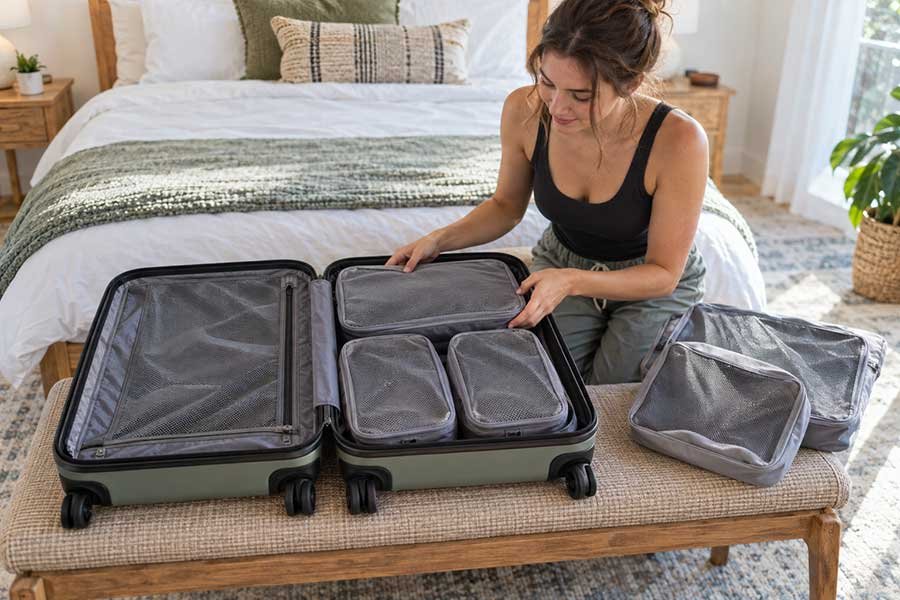
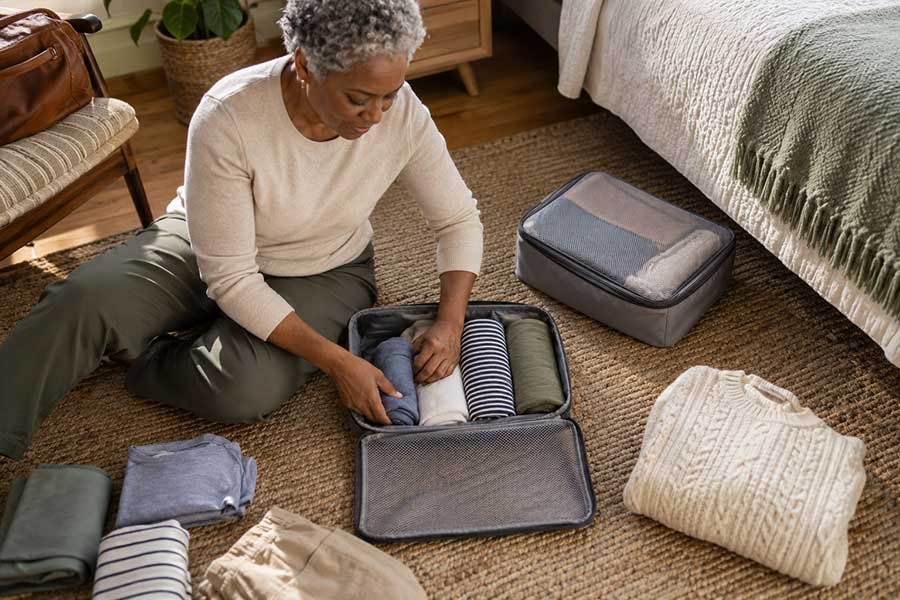
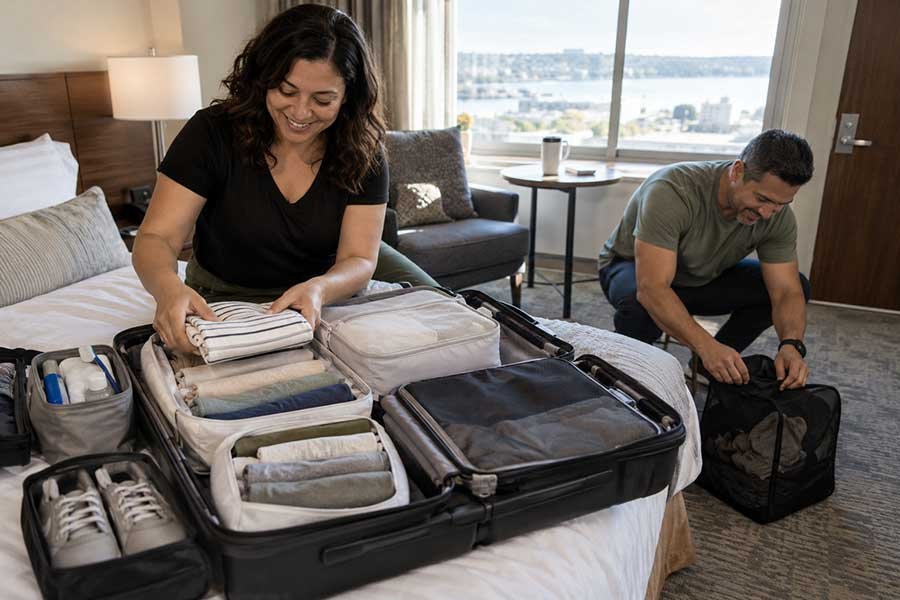
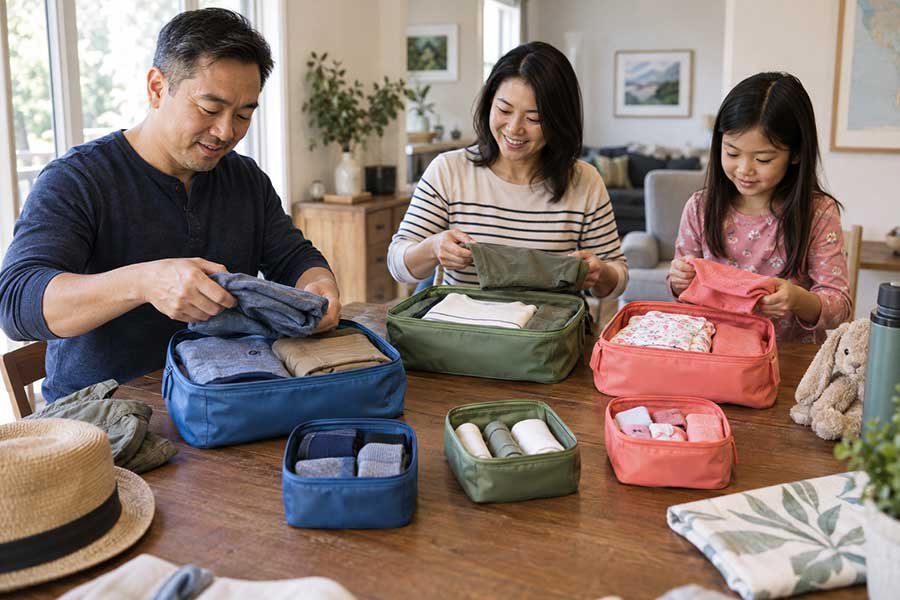
Packing cubes are the single most life-changing travel purchase most travelers wish they had discovered on their very first trip. One trip with packing cubes and you will look back at every trip before them and wonder how you ever managed without them. This article shows beginners exactly how to start — simply, correctly, and in a way that works for every bag and every destination from the first cube forward.

Best For
First-Time Packing Cube Users
Vibe
Simple, Organized, Converted
Read Time
10 Minutes
Walk Away With
The Complete Beginner Packing Cube System
Free Download

Grab Our Travel Packing Checklist

Our free packing checklist is organized by the packing cube category system this article describes — one section per cube, one cube per category — so the first packing session with cubes is as intuitive as every session after it.

Get the Free Checklist

Why Packing Cubes Change Everything

The suitcase without packing cubes is a single large volume whose contents distribute themselves according to how they were placed and redistribute themselves according to how the bag was handled in transit. After a connection, a taxi, a cobblestone street approach to the hotel, and the bag’s brief encounter with the baggage carousel’s handling, the carefully packed items of departure morning have migrated into the specific arrangement that gravity, motion, and the bag’s movement produce rather than the arrangement the packer intended. The specific item needed at the hotel room’s first fifteen minutes is the item at the bottom of the bag’s rearranged interior.

Packing cubes convert the suitcase’s single large volume into a set of specific, contained zones whose contents do not migrate because they are enclosed within a cube’s rigid-enough structure to maintain their arrangement regardless of how the bag was handled in transit. The tops cube contains the tops in the arrangement they were packed in. The bottoms cube contains the bottoms. The underwear cube contains the underwear. Each cube is a closed system within the bag’s larger system, and the item needed at the hotel room’s first fifteen minutes is in the specific cube, in the specific position it was placed, accessible by removing one cube and retrieving the item rather than excavating the full bag’s rearranged interior.

Beyond the organization benefit, the cube system produces the daily repacking efficiency that the trip’s middle days benefit from most. At the destination, the daily routine is take out the tops cube, select the day’s top, return the cube. Return the used top to the cube at the day’s end. The end-of-stay repacking is the reverse of the arrival’s unpack — the cubes go back into the bag in the same positions, and the bag is organized on departure day as it was on arrival day. The traveler without cubes repacks from the room’s scattered items each departure morning. The traveler with cubes moves cubes back into the bag. The cubed departure morning takes four minutes. The uncubed departure morning takes twenty, and produces the bag that arrives at the next destination in the same disorder the packing session tried to avoid.

One trip with packing cubes and you will look back at every trip before them and wonder how you ever managed without them.

Packing cubes are the single most life-changing travel purchase most travelers wish they had discovered on their very first trip.

Insider Note

The packing cube’s most underappreciated benefit is the hotel room organization it produces at the destination. The bag arrived organized into cubes. The cubes can be placed directly on the hotel room’s luggage rack or on the dresser beside the bag — tops cube here, bottoms cube there, accessories pouch beside them — converting the hotel room into the organized dressing area that the scattered suitcase unpacked across every surface does not produce. The traveler whose cubes are on the dresser knows where everything is for the full stay without the daily search through the bag. The cubes are the organization system that travels with the bag and sets up in the room in under two minutes.

We Book the Trips Worth Organizing For

Let Us Plan Your Next Trip While You Build Your First Packing Cube System

The packing cube system works best when the trip is confirmed and the itinerary is clear — the specific occasion registers, the duration, the bag size. Tell us where and when you want to travel. We will build the trip. You pack for it with the system this article describes.

Plan Our Escape

Start Simple: One Cube Per Clothing Category

The beginner’s first packing cube setup should be as simple as possible: one cube per clothing category, nothing more complex. Over-engineering the cube system on the first trip — a cube per day, a cube per outfit, a cube per color — produces the organization system that is harder to maintain than the chaos it replaced. The category system — one cube for tops, one cube for bottoms, one cube for underwear and socks — is the system that every experienced cube user comes back to after experimenting with more complex approaches, because its simplicity is the source of its resilience: it is easy to pack, easy to unpack, easy to repack, and impossible to get wrong.

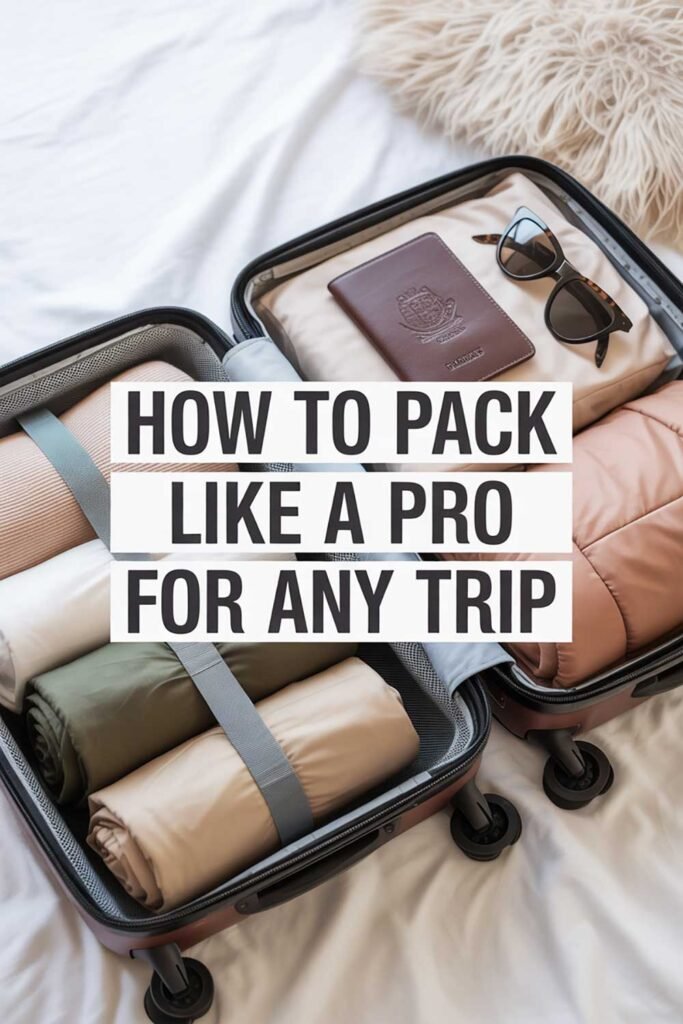
For the beginner’s first cube set, three cubes cover the core clothing categories for any trip: the medium cube for tops (t-shirts, blouses, casual shirts — rolled and stacked vertically within the cube for maximum compression and visual access), the medium or large cube for bottoms (trousers, jeans, skirts, shorts — folded flat or rolled depending on the fabric), and the small cube for underwear and socks (rolled pairs of socks, folded underwear — the items that scatter most reliably through the bag without containment). These three cubes convert the bag’s three most frequently accessed clothing categories from the scattered mess to the organized system from the first packing session.

A fourth cube covers the items that do not fit cleanly into the three-category system: the structured items (blazer, dress, formal top) that require flat folding protection, or the sleepwear and loungewear category that is used differently from the daytime clothing and benefits from its own accessible cube. For the beginner who is not sure whether to add the fourth cube, the rule is simple: if a category of items is causing access friction — if finding the sleepwear requires moving other cubes to get to it — the category needs its own cube. The cube system’s purpose is zero access friction. A category without its own cube that requires moving other cubes to access it has not yet been given the organizational home it needs.

Insider Note

Pack the tops cube with items standing vertically — the file-fold method — rather than stacked horizontally. The file-folded tops cube displays every item’s top edge when the cube is opened, allowing visual selection of the specific top without removing any other top from the cube. The horizontally stacked tops cube requires removing the items above the specific top to reach it, which is the specific access friction the cube system was designed to eliminate. Fold each top into a rectangle approximately the cube’s interior height, then stand the folded tops vertically side by side. Open the cube. See every top simultaneously. Select the one. Close the cube. Zero other items disturbed.

Add a Slim Cube for Documents and Small Essentials

The slim packing cube — a flat, thin cube approximately the depth of a passport — is the cube type that most beginners do not include in their first set and that most experienced packing cube users consider the most valuable single cube in their collection. The slim cube addresses the specific category of small flat items — the travel documents, the reservation confirmations, the extra credit card, the notebook, the pen, the charging cables in their organized coil — that have no natural home in the categorical clothing cube system and that scatter into the bag’s corners and pockets without their own dedicated container.

For the beginner’s slim cube, the travel document essentials make the most natural starting contents: the printed accommodation confirmations with addresses, the travel insurance policy reference, the itinerary, the destination’s local currency note with the exchange rate written on it, and any printed reservation or ticket that needs to be accessible at specific moments during the trip. These items, loose in the bag, produce the specific five-minute search at the hotel check-in or the restaurant entry when the specific printed item is needed immediately. In the slim cube in the bag’s exterior pocket, every item is found in thirty seconds and returned to the same location after use.

The slim cube’s secondary contents for the day-trip context: the daily essentials removed from the main bag for the city walk, the market visit, or the cultural site — the map, the afternoon snack, the sunscreen, the compact umbrella — that the full-size bag does not need to carry but that a daily compact version of the slim cube’s system does. Some travelers use the slim cube as the daily transition bag that moves from the suitcase to the day bag and back, keeping the daily essentials organized in a single small container that slots into both the suitcase’s main compartment and the day bag’s main pocket without any repacking between them.

Insider Note

Label each cube — with a small tag, a color code, or a written label on the zipper pull — for the trips where the cubes are traveling in a checked bag that the TSA or customs may inspect. The labeled cube tells the inspector exactly what is in each container without requiring them to open every cube and redistribute the contents. Beyond the inspection context, the labeled cube produces the faster selection at the carousel when multiple bags are in the group’s pile and the correct bag needs to be identified quickly, and the faster packing session when the cube set has been in storage between trips and the correct cube for each category needs to be confirmed before the session begins.

Helpful for Your Journey

Find Booking Ideas and Travel Essentials on Our Favorites Page

Our favorites page has helpful booking ideas and travel essentials that we have found genuinely useful for organized travelers at every experience level. Whether you are buying your first cube set or looking for resources that make every trip more organized, it is worth a look.

DND Favorites

Use a Compression Cube for Bulky Items

The compression packing cube — a cube with a double-zipper system that compresses the cube’s contents by thirty to forty percent when the compression zipper is closed over the standard zip — is the cube type that produces the most tangible volumetric impact on the bag’s total packing capacity. Standard cubes organize the bag’s contents at their natural volume. Compression cubes reduce that volume by removing the air that soft, compressible fabrics trap between their layers — the specific air volume that makes the bulky sweater, the fleece layer, the thick pyjama set, and the down jacket occupy bag space disproportionate to their actual fabric weight.

For the beginner’s compression cube, the single most valuable use is the bulky layer category: the fleece, the thick cardigan, the cold-weather base layer, the puffy jacket that is too bulky to pack in the standard clothing cube without dominating its volume. One compression cube compresses these items to approximately sixty percent of their natural volume, freeing the equivalent space in the bag for the other items that the bulky layer would have displaced. For summer travel with no cold-weather layers, the compression cube performs the same space-reduction function on the nightwear and loungewear category — the items whose fabric is soft and compressible but whose cut and construction make them volumetrically large relative to their use frequency during the trip.

The compression cube should not be used for structured or delicate items that compression would damage — the tailored blazer, the silk blouse, the formal dress, the structured trousers with a crease. These items require the flat-fold protection of the standard cube at minimum compression. The compression cube’s contents should be limited to the items whose fabric tolerates compression without permanent deformation, wrinkling, or damage: casual soft fabrics, fleece, wool base layers, jersey materials. The test is simple: if the item can be squeezed in the hand without any concern about damaging it, it can be compressed in the cube without concern. If it would not be squeezed in the hand, it should not be compressed in the cube.

Insider Note

Compress the cube fully at packing and decompress it partially at the destination to use the cube as a mid-trip laundry holder. The compression cube that travels compressed arrives at the destination with significant additional compressed volume — the cube’s full uncompressed capacity minus the items inside it. This residual capacity makes the compression cube the ideal mid-trip dirty laundry holder: the worn items go into the cube, the compression zipper is partially applied to keep the cube’s contents contained, and the used and clean items are separated within the bag without requiring a dedicated laundry bag. At the trip’s end, the compression cube holds the last days’ laundry, compressed for the return journey, alongside the fresh items in the standard cubes.

How to Choose the Right Cube Sizes for Your Bag

The packing cube set that fills the specific bag to eighty percent of its volume is the set whose organization benefit is fully realized. The cube set that leaves significant empty space in the bag is the set that allows the bag’s remaining empty volume to become the disorganized space that the cubes were meant to eliminate. The cube set that overfills the bag is the set that requires forcing the bag closed and that compresses the cubes’ contents beyond their compression cube’s design intention. Neither extreme produces the packing cube system’s full benefit. The correctly sized set fills the bag efficiently and leaves the remaining twenty percent for the personal care items, the shoes, and the day bag that the cube system does not contain.

For a standard check-in suitcase (around 68x46x26 cm interior), the typical beginner cube set is a large cube for tops, a medium cube for bottoms, a small cube for underwear and socks, and a slim cube for documents and cables — four cubes that collectively fill approximately seventy to eighty percent of the suitcase’s main compartment volume when the clothing item count is appropriate for the trip’s duration. For a standard carry-on (approximately 55x40x20 cm interior), the set reduces to two medium cubes and one small cube — tops in one medium, bottoms in the other, underwear and socks in the small — with the slim cube in the carry-on’s exterior pocket rather than the main compartment.

The cube sizing rule for beginners who are not sure which sizes to buy: measure the specific bag’s main compartment dimensions before purchasing the cube set, and choose cubes whose combined footprint fills approximately eighty percent of the compartment’s flat area in a single layer. Most cube sets sold for travel use list the bag size compatibility on the product packaging. For travelers whose bag inventory is mixed — sometimes a carry-on, sometimes a check-in — the medium and small size combination is the most versatile: the same cubes work in both bags, with one fewer cube used in the carry-on configuration and the full set deployed in the check-in.

Insider Note

Buy cube sets rather than individual cubes for the beginner’s first purchase. The cube set is designed by the manufacturer to fill a specific bag size category, and its sizes are proportioned to work together in the intended bag. Individual cubes purchased without reference to the specific bag’s dimensions produce the specific mismatch of cubes that fit awkwardly together — the large cube that takes most of the bag’s flat area and the small cube that fits in the remaining corner but leaves unused space between them. The set’s proportioning is the manufacturer’s work. Use it. Refine the system with individual additional cubes after the first trip has revealed which category needs more dedicated space than the set provides.

The Complete Beginner Packing Cube System

The complete beginner packing cube system for a standard seven-night check-in trip uses four to five cubes in a consistent category assignment that is identical for every trip, building the specific muscle memory that makes every packing session faster than the previous one.

The cube assignments: large or medium cube for tops — all tops, rolled vertically in file-fold format. Medium cube for bottoms — trousers, shorts, skirts, folded or rolled by fabric type. Small cube for underwear and socks — rolled sock pairs, folded underwear, sleepwear if it fits. Compression cube for the bulky layer — the fleece, the thick cardigan, the cold-weather base layer, compressed for transit. Slim cube in the bag’s exterior pocket — travel documents, cables, the flat essentials that belong accessible rather than buried.

The load order in the bag: shoes at the wheel base with socks inside. Toiletry kit beside the shoes. Compression cube above the shoes — heaviest remaining item. Standard cubes above the compression cube — tops, bottoms, underwear — in order of access frequency, with the most frequently accessed cube on top. Slim cube in the exterior pocket, accessible without opening the main compartment.

The destination routine: cubes lifted from the bag and placed on the dresser in their category positions. Items retrieved from cubes rather than from the bag. Items returned to cubes at the day’s end. Departure morning: cubes lifted from dresser and replaced into bag in the same load order. Four minutes. Organized arrival at the next destination.

Insider Note

Use the same cube set with the same category assignments on every trip, regardless of the trip’s duration, destination, or bag size. The category consistency is the system’s most important single property for the beginner. The traveler who uses tops in the large cube and bottoms in the medium cube on every trip builds the automatic retrieval knowledge — the tops are always here, the bottoms are always here — that makes the mid-trip access as fast as the first-day access. The traveler who reassigns categories trip to trip rebuilds the system from scratch each time and loses the efficiency benefit that category consistency produces. Choose the assignments. Keep them. The consistency is the point.

The Conversation at the Gate That Organized Every Trip After It

Aaliyah’s first international trip had produced a bag that looked, by the third day, like it had been packed by someone who had never used a suitcase. The tops and the bottoms had migrated through the bag’s main compartment over two connections and a taxi and the hotel’s lobby stairs, and the specific top she wanted for the city’s afternoon had been at the bottom of the full bag’s rearranged interior. She found it after removing approximately everything above it. She repacked the bag for the next destination by putting things back roughly where they had been, which was roughly everywhere.

The gate conversation happened on the third leg of the trip. The woman at the adjacent gate seat was packing something back into her carry-on — a small cube of a type Aaliyah had not seen before — with the specific efficiency of someone whose packing motion was completely automatic. Aaliyah watched the cube go in, the zipper close, the carry-on zip shut, in about fifteen seconds. She asked what the cube was.

The woman said: packing cube. She said she had one for every category — tops, bottoms, underwear, the bulky cardigan in the compression one, the slim one in the outside pocket for her cables and documents. She said she had been using them for four years and had never gone back to the bag without them. She said the first trip with them would be the last trip without them. The gate was called. Aaliyah bought a cube set at the airport’s travel shop before her connecting flight departed.

The return journey from that trip was the first time she repacked the hotel room in under five minutes. The tops cube held the tops. The bottoms cube held the bottoms. The small cube held the underwear and socks. The slim cube held the documents and the charging cable and the printed return transfer confirmation that she had been searching for in the main bag since day one. At the airport, she set the carry-on upright and it rolled straight. At the connecting gate, she needed the specific blouse for the connection city’s customs inspection — it was at the top of the tops cube, which was at the top of the bag, retrieved in under thirty seconds. The woman at the gate three days earlier had been right. This article is the cube set, the category assignment, the vertical file-fold in the tops cube, and the slim cube in the exterior pocket that have been on every trip since the gate conversation.

Six More Packing Cube Tips for Beginners

Beyond the five core packing cube principles, these six additional tips address the specific beginner scenarios that the category system and the cube selection guidance do not fully cover.

Color-code the cube set so each category is visually identifiable without reading a label. Many packing cube sets are available in coordinated color sets — a large navy cube for tops, a medium teal cube for bottoms, a small grey cube for underwear — where the color assignment is consistent across trips and the specific cube is retrieved by color rather than by size comparison. The color-coded system produces the fastest possible cube retrieval in the dim light of the early departure morning or the fatigue of the long-haul arrival. The tops are always the navy cube. The bottoms are always the teal. No reading required.

Use the cube system in hotel drawers rather than on the dresser surface for trips where the hotel room’s dresser surface is limited or where the cube-on-surface organization interferes with the room’s other surface use. The hotel drawer lined with cubes — the tops cube in the top drawer, the bottoms cube in the second — produces the specific organized drawer that the scattered individual items do not. The cubes slide in and out of the drawer as a unit. The drawer is empty at checkout because the cube is removed, not because every individual item is individually retrieved from the loose drawer arrangement.

Transition to the cube system on a short domestic trip before using it on the first international trip. The first cube experience on a complex international multi-city itinerary produces the specific learning curve of both the trip’s logistics and the cube system’s mechanics simultaneously. The first cube experience on a two-night domestic trip produces the cube system’s mechanics in a low-stakes context where any mistakes are easily corrected. The second trip — the international one — benefits from the cube system that is already understood rather than being learned for the first time in the context of a more complex travel experience.

Fill each cube to approximately eighty percent of its volume to allow the cube’s zipper to close without strain and to maintain a small volume buffer for the destination’s purchase additions. The cube stuffed to its full volume closes with the specific strain that shortens the zipper’s useful life and that the items at the cube’s edges experience as the compression the soft cube’s structure applies to them when its zipper is at maximum tension. The eighty-percent rule produces the cube that closes easily, travels without zipper stress, and arrives at the destination with a small volume reserve for the item purchased at the destination’s market that needs to travel home in the cube alongside the items that came in it.

Pack the cube system in the same sequence every trip — shoes and toiletry kit at the wheel base, compression cube above, standard cubes in category access order, slim cube in the exterior pocket — so the packing session is a motor memory rather than a decision sequence. The traveler who packs in the same sequence every trip develops the specific packing efficiency that makes the departure morning’s packing a rhythm rather than a project. The sequence is decided once, on the first cube trip. It is executed automatically on every trip after that. The decision cost is paid once. The efficiency benefit is collected on every subsequent departure.

When traveling with a companion, maintain separate cube colors or sets for each person’s items rather than sharing cubes. The shared cube system — both people’s tops in the same tops cube — produces the specific retrieval friction of identifying whose top is whose in the dark at the morning’s early departure, and the specific ownership confusion at the destination’s dresser organization. Separate cube sets, even if they use the same size and category structure, produce the clear ownership that makes the shared room’s organization as efficient as the solo traveler’s. One traveler’s set in one color. The other’s in another. The dresser organizes itself by person as clearly as by category.

Insider Note

The packing cube system’s lifetime value — the cumulative benefit across all future trips of the initial investment — makes it one of the highest return travel purchases available at its price point. A quality cube set lasts five to ten years of regular travel use at a total cost comparable to a single checked bag fee. The organization benefit it produces on every trip — the faster packing, the faster unpacking, the faster repacking, the access efficiency, the mid-trip organization — is a benefit that compounds with each trip’s use and improves slightly as the specific category and sequence consistency the cube system rewards develops over time. The beginner’s first cube set is the investment that produces the best organized bag on the first trip it is used and on every trip for the decade after that.

Book With Us

Book the Trip Worth Packing the Cube System For

The cube system reaches its full value on the trip that moves — multi-city, multi-climate, multiple occasion registers across multiple bags. Our travel agents build those trips. Let us plan yours.

Book A Trip

Beginner Packing Cube Mistakes That Undo the Benefits

Each of these converts the cube system’s organization benefit into a different version of the original chaos. Each has a simple resolution.

1

Over-engineering the category system with too many cubes on the first trip

The beginner who buys eight cubes and creates eight categories produces the organization system that is harder to navigate than the bag without cubes. Start with three to four categories. Use the system on one trip. Add cubes only where access friction reveals a category that needs its own dedicated cube. The simple system maintained is better than the complex system abandoned after one trip.

2

Stuffing each cube to its maximum volume so the zipper strains to close

The overfilled cube is the cube whose zipper shortens its useful life and whose contents are compressed beyond the standard cube’s design tolerance. Pack to eighty percent. The residual twenty percent is the destination purchase buffer, the zipper’s preservation, and the travel day’s compression tolerance. An overfilled cube is more disorganized than a correctly filled one because its zipper stress and its access difficulty are exactly what the cube was bought to eliminate.

3

Stacking tops horizontally in the tops cube instead of filing them vertically

The horizontally stacked tops cube requires removing the items above the specific top to reach it. The file-folded vertical tops cube displays every top simultaneously and allows single-item retrieval without disturbing any other item. Fold each top into a rectangle approximately the cube’s interior height. Stand them vertically side by side. Open the cube. See everything. Select one. Close the cube. Zero friction.

4

Using the compression cube for structured or delicate items that compression damages

The compression cube’s double zipper applies significant pressure to its contents. Structured items — blazers, creased trousers, tailored pieces — and delicate fabrics experience permanent deformation, unwanted creasing, or fabric damage at the compression cube’s pressure level. Compression cubes are for soft, resilient fabrics: jersey, fleece, wool base layers, casual cotton. Structured and delicate items travel in standard cubes at minimum compression. The compression test: if the hand squeeze would damage it, the cube’s compression will too.

5

Reassigning cube categories trip to trip rather than maintaining consistent assignments

The consistent category assignment — tops always in the large cube, bottoms always in the medium — builds the automatic retrieval knowledge that makes the mid-trip access as fast as the first-day access. The reassigned system rebuilds from scratch each trip and produces the access uncertainty that is a less organized version of the bag without cubes. Decide the categories once. Keep them. The consistency is the efficiency. The efficiency is the reason for the cubes.

6

Buying individual mismatched cubes rather than a coordinated set sized for the specific bag

Individual cubes bought without reference to the specific bag’s dimensions produce the specific fit problem of cubes that do not fill the bag efficiently or that fill it unevenly. Buy the set designed for the bag size being used. Use it as a complete system before making individual additions. The set’s proportioning is correct for the intended bag. The individual cube assortment is correct for the specific need that a specific category’s overflow reveals after one trip with the set.

Turn Travel Into Income

Love Helping Travelers Discover the Tools That Change How They Pack?

Travel bookings are more enjoyable when the traveler arrives organized and ready to begin. If becoming a home-based travel agent who helps people travel smarter from their very first organized trip sounds like the right next step, see how the TravelPreneur system works.

Become An Agent

Frequently Asked Questions

These are the questions beginner packing cube users ask most often before and after their first organized trip.

Do packing cubes actually help or are they just hype?

Packing cubes are one of the most genuinely and consistently useful travel accessories available, with a benefit that is immediately apparent from the first trip they are used correctly on. The specific benefits — the organized bag that does not require excavation for item access, the four-minute departure morning repack, the hotel room organization that sets up in two minutes from the dresser — are all experienced on the first trip and improve with the category consistency that builds across subsequent trips. The hype around packing cubes is proportionate to the benefit — which is unusual for a travel accessory category, where many products are marketed beyond their actual utility. The cube’s benefit is structural and mechanical: it converts a single large volume into organized contained zones. This benefit exists on every trip regardless of the destination, the bag, or the traveler’s packing style.

How many packing cubes do I actually need?

Three to four cubes cover the core clothing categories for any trip at any duration, and three cubes is the correct starting number for the beginner’s first cube set. The three-cube starter — one medium for tops, one medium for bottoms, one small for underwear and socks — organizes the three clothing categories that produce the most bag chaos without cubes and covers the basic packing needs for any trip. The fourth cube — the compression cube for bulky layers or the slim cube for documents and cables — adds a meaningful benefit for the specific categories it serves without requiring the beginner to manage a more complex category structure on the first trip. More than five cubes on the first trip produces more category management than the beginner system needs to deliver its primary benefit. Start with three to four. Add only when a specific category’s access friction reveals the need for an additional dedicated cube.

Should I use packing cubes in a carry-on or do they only work in checked luggage?

Packing cubes work in every bag format — carry-on, personal item, checked suitcase, backpack, duffel — because the organization benefit they provide is independent of the bag’s size. In carry-on bags, the cube set is typically two medium cubes and one small cube rather than the larger set that a check-in suitcase accommodates, and the slim cube goes in the carry-on’s exterior pocket rather than the main compartment. In a personal item, one small cube contains the essentials for the flight — the change of clothes, the toiletry travel size, the socks — organized within the personal item’s smaller volume. The cube format is more impactful in smaller bags than in larger ones because the organization benefit of containing categories is most felt in the small volume where the alternative is the fully mixed item set that the personal item without cubes produces.

What is the difference between standard and compression packing cubes?

Standard packing cubes contain and organize items at their natural volume — they provide structure and categorization without reducing the volume of the contents. Compression packing cubes have a double-zipper system: the inner zipper closes the cube’s contents into the cube, and the outer compression zipper applies pressure to the filled cube, squeezing the air from the soft fabric contents and reducing the cube’s total volume by approximately thirty to forty percent. Compression cubes are most effective for soft, compressible fabrics — jersey t-shirts, fleece layers, wool base layers, lightweight pyjamas — whose compressed volume is significantly less than their natural volume. Compression cubes should not be used for structured or delicate items that compression would permanently deform or damage. For the beginner’s first cube set, one compression cube alongside two to three standard cubes covers the full packing need efficiently.

Do packing cubes add weight to a bag?

Packing cubes add a modest weight — typically one hundred to two hundred grams per standard cube, depending on the material and quality — to the bag’s total weight. A set of four cubes adds approximately four hundred to eight hundred grams total. For travelers packing to a specific checked luggage weight limit, this cube weight should be accounted for when planning the item count. The cube weight is a consistent, predictable overhead that does not change from trip to trip, unlike the variable weight of packed items, and it is easily accommodated in the weight budget by reducing one or two lower-priority items from the packing list. For most travelers, the organization benefit produced by the cube weight overhead is far greater than the value of the items that weight would alternatively carry, particularly for trips where the cube system’s organization benefit materially improves the travel experience.

Can packing cubes help with overpacking?

Packing cubes help with overpacking indirectly — the cube system’s physical constraint produces a more natural item limit than the open suitcase’s unlimited acceptance of additional items. The tops cube that is full at eight rolled t-shirts signals more clearly than the open suitcase that the ninth t-shirt does not fit, because the cube’s physical fullness is a direct visual and tactile feedback that the open suitcase’s unfocused depth does not provide. Experienced cube users report packing fewer items with cubes than without them, partly because the cube system’s category containers make it easier to see how many items are in each category and whether the category’s count is appropriate for the trip’s duration. However, the cube system is not a substitute for the packing list and the overnight test — these are the practices that prevent the overpacking before the bag is opened, while the cube system organizes what the list-and-intention approach decided to pack. Both systems work best together.

The traveler who discovered packing cubes at the airport gate bought a set before her connecting flight departed. The organized bag on the return journey was the last disorganized bag she ever packed. That is what one trip with cubes does. One trip. Every trip after it is organized.

Picture the Hotel Room on Day Three

The tops cube is on the dresser. Every top is visible standing vertically in the file fold. The specific top for this morning was retrieved in under ten seconds without disturbing any other top. The bottoms cube is beside it. The small cube is in the drawer. The slim cube is on the nightstand, cables accessible. The bag is closed in the corner — organized, not excavated. The departure morning is three days from now. It will take four minutes. The tops will be in the tops cube. The bottoms will be in the bottoms cube. The slim cube will be back in the exterior pocket. The bag will close easily. The trip after this one will be packed the same way. And the trip after that. That is what one trip with packing cubes produces. That is the system.

Free Download

One More Thing Before Your First Cubed Trip

Print our free Travel Packing Checklist — organized by the packing cube category system with one section per cube — and use it to confirm every category has its cube, every cube has its category, and the slim cube is in the exterior pocket before the bag is closed. The same checklist we use before every trip.

Get the Free Checklist

Explore Our Top Picks for a Better Trip

Visit our favorites page for helpful booking ideas and travel essentials that we have found genuinely useful for organized travelers. Whether you are buying your first cube set or looking for resources that make every packing session and every trip more organized, it is worth exploring.

See Our Top Picks

Travel Prints and Printables From Our Shop

Visit Premier Print Works for packing checklist printables, cube category guides, trip planners, travel journals, and wall art that makes every journey a little more beautiful and a lot more organized — from the first packing session with the category cubes to the departure morning that takes four minutes for the first time.

Visit Premier Print Works

Disclaimer

The information shared in this article is provided by Don and Diana’s Travels for general informational, educational, and inspirational purposes only. It reflects our personal experiences, opinions, and the experiences of travelers we have worked with. It is not professional travel or product advice.

Airline Baggage Policies

Baggage weight limits, carry-on size restrictions, and baggage policies vary by airline, fare class, and route. Packing cubes contribute to the total bag weight and should be accounted for when packing to a specific weight limit. Always confirm current airline policies before travel.

Product Information

Packing cube products, sizes, and specifications vary by manufacturer. The dimensions, weight capacities, and compression ratios described in this article are approximate general guidance and may not reflect the specifications of any specific product. Always confirm product specifications before purchase.

Affiliate and Partner Links

This article may contain affiliate and partner links that pay us a commission. Our recommendations are based on real use and genuine belief in the products and services we share.

Health, Safety, and Personal Responsibility

Travel involves personal risk. You are solely responsible for your own health, safety, and travel decisions. Don and Diana’s Travels accepts no liability for any loss, injury, delay, or inconvenience arising from information in this article.

Composite Stories

Stories on this site combine real experiences from Don, Diana, clients, and travelers we have worked with. Details may be adjusted for privacy and narrative clarity.

No Guarantees

We do not guarantee any specific result from using the information in this article. Your results depend on your own choices and circumstances.

Copyright and Use

All content is the copyrighted property of Don and Diana’s Travels. You may not copy or republish our content without prior written permission. You are welcome to share a direct link with proper credit.

By reading this article, you acknowledge that you have read and agree to this disclaimer.