Suitcase Packing Tips for Women
A well-packed suitcase starts before you ever open the bag — with a list, a capsule wardrobe, and the discipline to put back everything that does not earn its place. The most organized suitcase belongs to the woman who packed with intention and left the what ifs at home. This article builds that intention into a system that works for every destination, every duration, and every occasion range the trip requires.
Grab Our Travel Packing Checklist
Our free packing checklist is organized by the capsule wardrobe and packing cube category system this article describes — clothing by occasion register, toiletries and accessories by cube, and the pre-packing intention check that keeps the what ifs in the wardrobe rather than the suitcase.
Get the Free ChecklistThe well-packed suitcase begins not with the bag but with the list — the specific, trip-calibrated inventory of what the trip actually requires rather than what might come in useful or what would be nice to have available. Building the list before opening the bag is the step that most overpacking skips: the clothes go into the bag as they are thought of, each one justified in the moment of its placing, and the bag fills to capacity with items whose individual justification felt sound but whose collective weight and volume only became apparent at the check-in scale. The list built before the bag is opened is the list that can be edited without the psychological resistance of removing something already packed — the specific moment where the what-if item earns its place in the bag because taking it out would feel like admitting it should not have been put in.
The effective trip packing list is organized by occasion register — the specific contexts the trip will produce — rather than by category or by day. What does the trip actually contain? A mix of casual days, one or two evenings at a restaurant, the business meeting or the cultural site requiring covered shoulders, the beach day, the overnight train? Each occasion register is populated with the minimum item count that covers it, and the shared items — the piece that works for both the dinner and the cultural site, the layer that bridges the beach morning and the evening walk — are identified and their double-counting is resolved before the bag is opened. The list that results from this process is the list whose contents justify themselves against the trip’s actual occasions rather than against the what-if occasions that would justify almost any item in the wardrobe.
The discipline to put things back is the second half of the same principle. For every item placed in the bag during the packing session, the single question — does this item earn its place against the trip’s actual occasions? — produces either the confirmation that it does and it stays, or the honest acknowledgment that it does not and it is returned to the wardrobe. The what-if item — the formal outfit for the event that is not on the itinerary, the fourth pair of shoes for the occasion that none of the scheduled days will produce, the extra cardigan for a destination whose forecast shows no day below eighteen degrees — is the specific category of packing decision that the list prevents from reaching the bag in the first place, and that the put-things-back discipline removes when it reaches the bag despite the list.
The most organized suitcase belongs to the woman who packed with intention and left the what ifs at home.
A well-packed suitcase starts before you ever open the bag — with a list, a capsule wardrobe, and the discipline to put back everything that does not earn its place.
After building the list and before opening the bag, apply the overnight test: review the list the evening before packing and again the morning of departure, removing any item that the overnight gap reveals as a what-if rather than a genuine need. The item that seemed essential at 9 p.m. and feels unnecessary at 8 a.m. is the what-if item — the late-evening addition made under the anxiety of impending departure rather than the daylight clarity of the trip’s actual occasions. The overnight test catches these items before they reach the bag. The morning packing session with the cleared list is the packing session that produces the bag the trip actually requires rather than the bag the departure anxiety produced.
Let Us Book Your Next Adventure So You Know Exactly What to Pack
The capsule wardrobe is easiest to build when the itinerary is confirmed — the specific occasions, the climate range, the formality level. Tell us where and when you want to travel. We will build the itinerary and you will build the bag around it.
Plan Our EscapeThe capsule wardrobe principle applied to travel is the specific approach that produces more outfit variety from fewer items than any other packing strategy available for any duration of trip. A capsule wardrobe for travel is a deliberately selected group of pieces — typically seven to ten clothing items — in a shared color palette whose every item pairs with every other item, producing a significantly larger number of distinct looks than the item count alone suggests. The woman who packs seven capsule pieces in a neutral palette — white, navy, tan, and one accent — has access to more than thirty distinct outfit combinations from those seven items before any accessory variation is applied. The woman who packs fourteen isolated outfit units has access to fourteen looks from twice the weight and volume.
Building the travel capsule wardrobe begins with the base palette: two to three neutral colors that mix freely with each other and with the one accent color that the trip’s context warrants. Navy, white, and tan as the base, with olive or a warm rust as the accent, cover the full occasion range from casual beach day to smart casual dinner to cultural site without any combination that reads as mismatched. Within this palette, the specific items: two to three tops in different silhouettes — the fitted t-shirt, the relaxed linen shirt, the smart blouse — that cover the casual and the elevated registers. One to two bottoms — the slim trouser or the tailored mid-length skirt that reads as polished and the casual jean or shorts for the beach and walking days. One dress that can be casual in flat sandals and elevated in a wedge or low heel. One blazer or structured jacket that elevates every combination beneath it. The outerwear layer determined by the destination’s climate.
The capsule wardrobe’s practical packing test: lay every item on the bed and count the number of distinct outfit combinations available from the specific palette. Every top should pair with every bottom. Every layer should work with every base combination. The dress should be the outfit that requires no additional item to function across the trip’s occasion range. The blazer should be the single piece that takes the smartest item in the wardrobe and makes it the most elevated combination available. If an item does not produce at least three distinct combinations with the other items on the bed, it is the what-if item in capsule clothing form — the piece that was selected for the specific situation that the trip’s list does not contain.
Photograph the bed layout — every capsule item arranged side by side — before packing the bag. The photograph serves two purposes: the visual confirmation that the palette is cohesive (colors that looked similar in the wardrobe sometimes reveal a mismatch in the flat lay), and the packing reference at the destination that shows exactly what was brought without opening the suitcase. When the dress is needed for the evening and the top for the morning’s walk, the bed photograph confirms which items are in which cube without the full suitcase excavation that the mental inventory alone sometimes requires after a few days of daily unpacking and repacking.
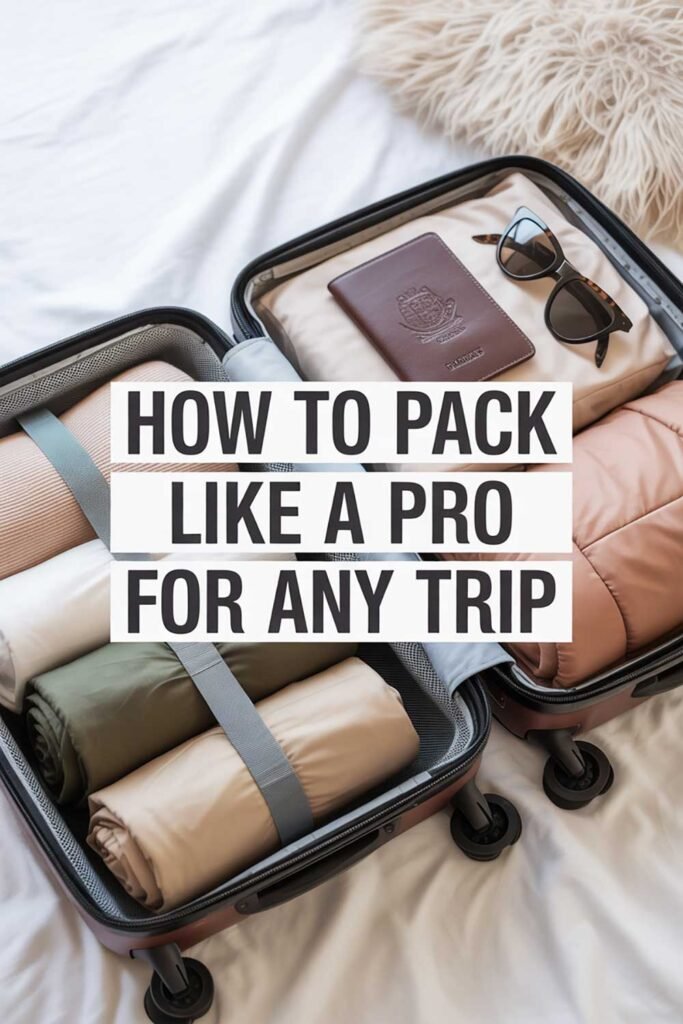
Packing cubes are the suitcase organization system that converts the suitcase’s single large volume into a structured set of smaller, categorized compartments that each contain a specific item group and can be located, accessed, and repacked independently without disturbing any other group. The suitcase without packing cubes is the suitcase whose entire interior must be disturbed to access the item at the bottom — the specific item that is always at the bottom because it was packed first and needed last. The suitcase with packing cubes organized by category is the suitcase where the item at the bottom of one cube is accessed by removing and setting aside one cube rather than excavating through the full interior.
The category organization for packing cubes: one cube for tops, one cube for bottoms, one cube for underwear and socks, one compression cube or cube for the bulkier items — the blazer, the heavier layer, the dress folded flat. Some travelers prefer a functional organization — the daytime cube and the evening cube, the beach cube and the city cube — that aligns with the trip’s activity register rather than the garment type. Either approach produces the same core benefit: every category of item has a designated location in the suitcase, and every item in the category returns to the same location at the end of each destination day when the repacking begins. The repacking at checkout is the reverse of the arrival unpack — the cubes go back into the suitcase in the same positions, and the suitcase is as organized on departure day as it was on arrival day.
Choose packing cubes in a size set that fills the specific suitcase’s volume efficiently — the suitcase with one large cube and empty space around it is not organized; it is contained. A set of three to four different-sized cubes that fills the suitcase’s main compartment to eighty percent of its volume provides the organization without the wasted space that one large cube produces. Mesh-top packing cubes allow visual identification of the cube’s contents without opening it. Compression packing cubes reduce the volume of soft items — t-shirts, leggings, underwear — by thirty to forty percent through compression, expanding the effective volume of the suitcase for the same item count. Both formats serve the organization principle. The compression cube adds the volume reduction benefit for the traveler whose category organization is correct but whose item volume still exceeds the suitcase’s capacity.
Use a separate small pouch or the suitcase’s interior zip pocket for accessories — jewelry, belts, scarves, the items that have no home in the categorical cube system but that scatter through the suitcase interior without a designated space. The accessories pouch is the suitcase’s miscellaneous drawer: everything not a garment and not a toiletry has a home in it, and the home is the same on arrival as on departure. A pill organizer or a small fabric roll is the standard jewelry travel format for preventing tangling and loss; the roll’s loops hold necklaces without contact with other necklaces, and the pill organizer’s compartments contain earring pairs individually. The accessory pouch beside the cubes in the suitcase converts the last packing session’s scatter into the same organized system as the clothing cubes.
Find Booking Ideas and Travel Essentials on Our Favorites Page
Our favorites page has helpful booking ideas and travel essentials that we have found genuinely useful for organized, intentional travel. Whether you are planning your next trip or looking for resources that make packing smarter and easier, it is worth a look.
DND FavoritesThe rolling versus folding question in travel packing has a specific answer that depends on the item rather than a single universal technique. Soft, flexible fabrics — t-shirts, leggings, casual dresses, underwear, socks, casual tops in jersey or cotton knit — roll tightly and efficiently, reducing volume by twenty to thirty percent compared to a flat fold and producing the cylindrical shape that fits into packing cubes and the suitcase’s corners more compactly than a flat-folded stack. The roll also distributes any fabric creasing along the roll’s continuous surface rather than at the sharp fold lines that flat folding produces — which means the casual t-shirt unrolled at the destination is the t-shirt without fold creases that the flat-folded equivalent has.
Structured items — blazers, trousers with a crease, dress shirts, structured skirts — are folded rather than rolled because their specific shape and finish is maintained by the flat fold’s broad surface rather than by the roll’s tight cylinder. The blazer rolled into a cylinder produces the compressed shoulder, the broken lapel, and the sleeve crease that the flat fold avoids. The creased trouser rolled produces the crease in the wrong position. Fold the structured items inside the cube that is positioned in the flattest area of the suitcase, with the folded items lying flat and protected from the compression that the adjacent cube’s items would produce. The flat fold in the suitcase’s most stable zone is the fold that arrives at the destination in closest to departure condition.
The weight distribution principle — heavy items closest to the wheels — addresses the specific physical management of the suitcase on the travel day. The suitcase rolled on its wheels with the heavy items closest to the wheel base moves with its weight low and stable, producing the rolling dynamic where the suitcase tracks straight and remains upright. The suitcase with the heavy items at the top of the bag, furthest from the wheels, produces the forward-lean rolling dynamic where the bag wants to tip and the handle must be held to maintain the upright position. Shoes, the toiletry kit, the heavier electronics, and the dense clothing items belong at the wheel base. The lighter items — the rolled soft clothes, the lightweight layers — go above them. The suitcase carries itself correctly when its weight is at its base.
Pack shoes in the suitcase’s wheel base section in shoe bags — one per pair — with socks rolled inside each shoe to fill the shoe’s interior volume without wasting the shoe’s interior space. The shoe stuffed with its socks maintains its shape during transit rather than compressing under the adjacent items’ weight, and the socks travel at zero additional volume because the shoe’s interior accommodates them. The shoe bag protects the bag’s contents from the shoe sole’s contact and contains any sole debris within the bag rather than distributing it through the suitcase. Two pairs of shoes at the wheel base, socks inside, shoe bags on the outside, contribute their total weight to the suitcase’s most stable zone while their interior space hosts the trip’s socks at zero additional volume expenditure.
The return journey’s suitcase is almost always heavier than the departure journey’s. The souvenir purchases, the destination’s market finds, the gift for the person left at home, the local product too interesting to leave behind, and the accumulated small items that every trip produces — each of these adds to the return bag’s volume and weight at a rate that the departure bag’s packing left no room for. The woman who packed the suitcase to its comfortable traveling capacity on departure is the woman who is creative-packing the return bag on the final morning, redistributing items across every available surface of the bag to fit what would not fit if the bag was repacked as carefully as it was originally packed.
A foldable bag — a lightweight tote, a packable nylon duffel, or a quality reusable shopping bag — packed flat at the bottom of the suitcase under the wheel-base layer adds under one hundred grams to the departure bag and is available at the destination as the overflow system for the return journey’s additional items. The foldable bag with the overflow items becomes the personal item for the return flight — kept under the seat in front — and carries the purchases and the accumulated items at zero additional checked luggage cost. At the destination, the foldable bag doubles as the daily exploration tote for the markets and the beach days and the afternoon city walk, adding daily utility to the return-journey insurance that it was packed as.
Choose the foldable bag in a style and material that serves the trip’s daily context as well as the return journey’s overflow function. A high-quality canvas tote or a technical nylon packable tote looks intentional rather than improvisational at the destination’s market, the beach, and the afternoon café, while also carrying the return journey’s overflow in the same bag that spent the trip’s days doing useful work. A foldable bag used only for the return journey is a bag that spends most of its trip inside the suitcase. A foldable bag that earns daily use is a bag that was worth packing for reasons beyond the return journey’s overflow capacity.
The complete suitcase packing system assembles the list, the capsule wardrobe, the packing cubes, the rolling and folding technique, and the foldable bag into the single organized approach that produces the well-packed suitcase for any trip.
Before opening the bag: build the trip list organized by occasion register. Apply the overnight test — review the evening before and remove any item that the morning reveals as a what-if. Photograph the capsule wardrobe flat lay for the visual cohesion check and the destination reference. Confirm the cube set fits the suitcase’s volume at eighty percent capacity across the planned items.
Opening the bag: place the shoe bags at the wheel base with socks inside each shoe. Add the toiletry kit and any heavy electronics beside the shoes at the wheel base. Load the cubes — tops cube, bottoms cube, underwear and socks cube, structured items cube — in the layers above the wheel base. Place the accessories pouch in the suitcase’s interior zip pocket or beside the cubes in the remaining space. Place the foldable bag flat at the top of the cubes, available without excavation for the first destination day’s market trip.
The intention check: close the suitcase. If it does not close without force, open it and remove the last three items added — the what-if items that pushed the bag past its comfortable capacity. The suitcase that closes without pressure is the suitcase packed correctly. The suitcase that requires sitting on is the suitcase with items that did not earn their place and were packed despite not earning it.
Update the packing list after every trip with what was worn, what was used, what came home unworn, and what was missing. The post-trip list update is the most valuable five minutes of packing improvement available — the inventory of what the trip actually used versus what was packed turns the next trip’s list from a theoretical construction into an empirically calibrated one. The cardigan that came home untouched becomes the cardigan not packed on the next similar trip. The top not on the list that was purchased at the destination’s market becomes the top that goes on the list for the next similar destination. The post-trip list is the learning system that makes every subsequent packing session better than the previous one.
The Suitcase She Carried Herself for the First Time
Sienna had packed with the same approach for every trip she had taken since her first adult vacation: everything that might be useful, everything that might be needed, everything that covered the scenarios the trip might produce and the scenarios the trip probably would not produce but could not be ruled out. The suitcase was always checked. It was always heavy. At the check-in scale, it was sometimes over the limit, which she paid without discussion. At the destination’s staircase or the cobblestone street or the airport’s short connector sprint between gates, she managed the bag with the specific physical effort that its contents had accumulated to require.
On a ten-day European trip, she had packed for seventeen days of scenarios. The formal dinner outfit for the event that was not on the itinerary. The four pairs of shoes for the occasions distributed across the ten days in a way that required no shoe to be worn on more than three days. The backup swimsuit for the beach day that was not in the itinerary but that could theoretically be added. The three cardigans for the weather variation that the ten-day forecast had consistently predicted would not appear. The suitcase weighed twenty-six kilograms. She paid the overweight fee without discussion.
At the destination’s hotel, the check-in was on the third floor. There was no lift. She and the hotel porter negotiated the suitcase up the stairs together. At the first city’s departure three days later, the transit to the train station involved cobblestone streets that the suitcase’s wheels crossed with the specific juddering that cobblestones apply to a heavily loaded bag. At the second city’s short connection through the airport, the sprint between gates was not quite a sprint. The trip’s occasions used the two pairs of shoes the list would have built, the eight outfits the capsule wardrobe would have produced, and the one cardigan that the actual weather required. The other items made the journey in the bag without leaving it.
The packing list she wrote on the plane home was the list of what was actually worn. She added it to a notes file on her phone under the heading: what the trip required. Before the next trip, she built the suitcase from the what-the-trip-required approach. Capsule wardrobe in neutral palette. Packing cubes by category. Shoes at the wheel base with socks inside. Rolling for the soft items. Folding for the structured ones. Foldable tote for the daily market and the return overflow. Overnight test the evening before to remove the what ifs that the excitement of impending departure re-introduces. The suitcase weighed fourteen kilograms. She carried it herself up the stairs at the next hotel. For the first time, nobody helped her with it. For the first time, nobody needed to. This article is the list she wrote on the plane home and the system she built from it.
Beyond the five core packing system principles, these six additional approaches address the specific suitcase packing scenarios the core system does not fully cover.
Decant all liquid toiletries into travel-size containers before the trip and store them in a TSA-compliant clear zip bag within the suitcase’s wheel-base section. The full-size shampoo, the full-size conditioner, and the full-size moisturizer packed for a seven-night trip carry at least six nights’ worth of product that is not needed at the destination because the trip ends before the full-size is used. Travel-size containers filled before departure carry exactly the amount the trip requires — a week’s shampoo in a fifty-milliliter container rather than a four-hundred-milliliter bottle, at a fraction of the weight and volume. The liquids bag at the suitcase’s wheel base is the weight-reduction decision that most consistently produces meaningful gram savings per item across the full toiletry kit.
Pack an outfit change in the carry-on personal item for flights over six hours or for itineraries with a high-risk first leg. The checked suitcase that is delayed at the connection or misdirected at the destination arrives at the accommodation on day two rather than day one, which means the outfit packed for day one’s evening is available on day one’s evening only if the carry-on contains an alternative. One change of clothes in the personal item — top, bottom, underwear — weighs under five hundred grams, takes minimal personal item volume, and converts the checked bag delay from a first-evening disruption into a managed inconvenience.
Use the pillowcase as a laundry bag throughout the trip rather than packing a separate laundry bag. The hotel room’s pillowcase, placed inside the suitcase’s top compartment at arrival, becomes the trip’s laundry collection point — the used items go in, the clean items stay in the cubes, and the separation is maintained without any dedicated packing space for a dedicated laundry bag. At the trip’s end, the laundry is already sorted and bagged for the home’s washing machine from the pillowcase that did its second job for the full trip without weighing anything or occupying any additional suitcase volume.
Pack a small over-door organizer or a set of suction cup hooks for the accommodation’s bathroom. The bathroom at a hotel, Airbnb, or villa is almost universally undersupplied with the hooks and hanging points that the morning routine’s items — the hair tools, the beauty bags, the towels — require for organized use. A set of small suction cup hooks or a lightweight over-door organizer that hangs on the bathroom door converts the flat bathroom surface into the hanging organization system that the morning routine requires without displacing any packing volume when rolled or folded flat into the toiletry area at departure.
Research the specific destination’s laundry access before the trip and plan the mid-trip laundry session that extends the capsule wardrobe’s coverage across longer trips. For trips of ten days or more, a single mid-trip laundry session — either at the accommodation’s laundry facility, at a local laundromat, or through the hotel’s laundry service for the specific items whose care requires it — effectively doubles the wardrobe’s coverage from the same seven-to-ten-piece capsule. The trip planned with one mid-trip laundry session packs for five days rather than ten, halving the clothing volume for the same trip duration. Most accommodations for trips of ten days or more have some form of laundry access; confirming it before departure allows the packing session to reflect the actual coverage requirement rather than the theoretical one.
Pack a flat travel jewelry roll or a small jewelry box organizer for the trip’s accessories rather than placing loose jewelry in a zip bag or letting it travel freely in the packing cube. Tangled necklaces, lost earrings, and scratched statement pieces are the three specific jewelry travel problems that the travel roll’s individual loops and padded compartments prevent. A quality travel jewelry roll weighs under one hundred grams, lies flat in the suitcase beside the cubes, and produces the specific morning-routine efficiency of knowing exactly where each piece is and retrieving it without the five-minute untangling that the zip bag alternative reliably produces at the worst moment of the packing morning.
The suitcase packing system’s maintenance across a trip requires one discipline that is different from the pre-trip discipline of the list and the overnight test: the end-of-day repack. The item worn during the day that is returned to its cube rather than dropped on the room’s chair is the item that is in its place the following morning when the outfit decision is made, and in its place on departure morning when the suitcase is repacked for the next destination. The end-of-day repack takes three minutes and produces the organized suitcase throughout the trip rather than only at its beginning. The trip’s day two, day five, and departure morning all begin from the same organized suitcase that the packing system produced on day one if the end-of-day repack is maintained. Skip it once and the suitcase loses its system for the remaining days. Maintain it consistently and the system holds across the full trip’s duration.
Book the Trip Worth Packing With This Much Intention
The suitcase packed with intention is at its best when the trip it is packed for is planned with equal care. Our travel agents build the itineraries worth every item in the capsule wardrobe. Let us plan yours.
Book A TripThe Suitcase Packing Mistakes That Show Up at the Check-In Scale
Each of these is a kilogram on the scale that the intentional packing system prevents. Each has a specific resolution.
Opening the bag before building the list
The bag opened before the list is built is the bag that fills with individually justified items whose collective weight only becomes apparent at the check-in scale. Build the list first. Apply the overnight test. Open the bag with a confirmed, edited list in hand and the discipline to pack only what is on it. The bag opened before the list is the bag that requires the overweight fee payment. The bag opened after the list is the bag that travels within its limit.
Packing isolated outfit units rather than a capsule wardrobe in a shared palette
Ten days of isolated outfit units requires ten days of items at the weight and volume of separate, non-combinable pieces. Ten days of capsule wardrobe items in a shared neutral palette produces more than thirty combinations from seven to ten items at less than half the weight. Build the palette before selecting the items. Select the items against the palette. The capsule wardrobe’s combination system does the outfit variety work that the isolated outfit unit approach requires item volume to accomplish.
Packing without packing cubes and arriving with a suitcase that requires full excavation for every item
The suitcase without packing cubes is the suitcase that distributes its entire interior at every access. The suitcase with packing cubes organized by category is the suitcase where every item has a location and every access requires moving one cube rather than the full interior. Organize by category. Assign each category its cube. The item needed at 6 a.m. is the item at the top of the correct cube, not the item at the bottom of the full bag’s excavation.
Rolling structured items and folding soft ones — the reverse of the correct technique
Rolling the blazer produces the broken shoulder, the crushed lapel, and the sleeve crease that the flat fold avoids. Folding the jersey t-shirt produces the fold crease that the roll avoids. Roll soft, flexible fabrics. Fold structured garments. The technique is determined by the fabric’s response to each method rather than by the personal preference of the packer. The structured item that arrives at the destination in fold-crease-free condition is the item packed by the technique the fabric actually benefits from.
Packing heavy items at the top of the bag and rolling a forward-leaning suitcase all day
The heavy items at the top of the bag produce the forward-lean rolling dynamic where the suitcase wants to tip toward its handle rather than rolling straight behind its owner. Heavy items — shoes, toiletry kit, electronics — at the wheel base produce the low-weight, stable rolling that the suitcase tracks straight from. The weight placement determines the rolling experience. Place the heavy items at the base where the wheels are. The suitcase rolls itself.
Not packing a foldable bag and creative-packing the return suitcase on the final morning
The souvenir, the market find, the gift, the local product — each of these is certain enough to plan for and manageable enough to accommodate with one foldable bag packed flat at the suitcase’s top. The foldable bag available at the destination for the overflow does the daily utility work of the market tote and the return journey work of the overflow bag from one item at under one hundred grams. Pack it before departure. Use it every day. Carry the return journey’s additional items in it on the flight home. The final morning’s creative-packing session is the problem the foldable bag prevents.
Love Helping Women Travel Smarter and More Intentionally?
Women’s travel bookings — the girls trips, the solo adventures, the anniversary getaways — are among the most joyful travel agent work. If becoming a home-based travel agent who helps women discover the world with confidence sounds like the right next step, see how the TravelPreneur system works.
Become An AgentFrequently Asked Questions
These are the questions women travelers ask most often about packing a suitcase smarter.
How many outfits should you pack for a one-week trip?
For a one-week trip, seven to ten clothing items in a shared neutral palette produce the outfit variety the week requires without the what-if items that push the bag past its comfortable traveling weight. In practical terms: three tops in different silhouettes, one or two bottoms, one dress that works across multiple occasions with accessory variation, one blazer or structured layer worn on the travel day, and the appropriate footwear for the trip’s occasion range. This item count, when built in a shared palette that allows every piece to combine with every other, produces more than twenty-five distinct looks from eight pieces — significantly more variety than the seven isolated outfit units at the same item count but with the what-if additions. The capsule wardrobe at seven to ten items for a one-week trip produces everything the week’s occasions require and nothing it does not.
Do packing cubes actually save space or just organize better?
Standard packing cubes organize rather than compress — they provide the same volume of clothing in a structured format rather than reducing the total volume. Compression packing cubes actively reduce volume by thirty to forty percent through a compression zipper that squeezes the air from the cube’s contents, and these do genuinely save space for soft items like t-shirts, underwear, leggings, and rolled casual clothing. For maximum suitcase efficiency, the combination of standard cubes for structured items and compression cubes for soft rolled items produces both the organization benefit of the standard cube and the volume reduction benefit of the compression cube from the same suitcase. The organization benefit of standard cubes — the specific location for every category, the end-of-day repack efficiency, the arrival-to-destination organization maintenance — is valuable independent of the space question, and is the primary reason to use packing cubes even on trips where the volume is already within the suitcase’s capacity.
What is the best way to prevent wrinkles in packed clothing?
Wrinkle prevention in suitcase packing combines the correct folding and rolling technique for each garment type with the garment’s specific fabric’s response to packing compression. Structured items in wrinkle-prone fabrics — linen, cotton dress shirts, structured trousers — benefit from the flat fold in the suitcase’s flattest zone, with tissue paper or a dry cleaning bag placed between the folded layers to reduce the friction that produces fold creases. Soft jersey fabrics tolerate rolling without significant wrinkle development and benefit from the roll’s crease-free technique. Merino wool and travel-stretch synthetic fabrics are specifically engineered for wrinkle resistance and are the fabric choices whose investment at purchase produces the most consistent wrinkle-free arrival regardless of packing technique. For items that arrive with minor wrinkles, hanging in the bathroom during a hot shower — the steam from the shower relaxes most fabric wrinkles without any ironing — resolves them for most garment types within thirty minutes.
How do you pack a formal outfit or a special occasion dress without damaging it?
A formal dress or special occasion outfit requires the most protected zone in the suitcase — the area with the least compression from adjacent items and the flattest laying surface. Fold the dress as few times as possible with tissue paper between each fold layer to reduce fabric-on-fabric contact and friction. Place the folded dress in the suitcase’s interior flat zone — typically the top layer above the cubes in a hard-shell suitcase, or within a dedicated garment layer in a suitcase with a garment section. For suits, blazers, and formal trousers, the dry cleaning bag technique — packing the item inside its dry cleaning bag — creates a slip layer that prevents the garment from pressing against adjacent items and reduces creasing. On arrival, hang the formal item immediately in the wardrobe and allow it to hang naturally for at least two to three hours before the occasion. Any remaining creases from transit typically relax from hanging within this window without requiring any pressing for most formal fabrics.
How do you pack shoes efficiently in a suitcase?
The most space-efficient shoe packing approach places each pair in a shoe bag with socks stuffed inside each shoe to use the shoe’s interior volume rather than adding separate volume for the socks. Position the shoe bags at the suitcase’s wheel base — the densest, most structurally supported area — with the shoes oriented so the soles face the suitcase walls rather than each other, protecting the bag’s interior fabric from the sole’s contact. For heels, the heel-to-toe positioning — one shoe’s heel in the other’s toe — reduces the pair’s footprint within the shoe bag. The general shoe packing principle: the minimum shoe count that covers the trip’s full occasion range. Two pairs is the carry-on standard: one worn on the travel day, one in the bag. Three pairs is the checked suitcase standard for trips with three distinct occasion registers — casual, smart casual or beach, and formal or elevated. Each shoe pair beyond three requires its specific occasion to be on the trip’s confirmed list rather than the what-if list.
What should always go in the carry-on rather than the checked suitcase?
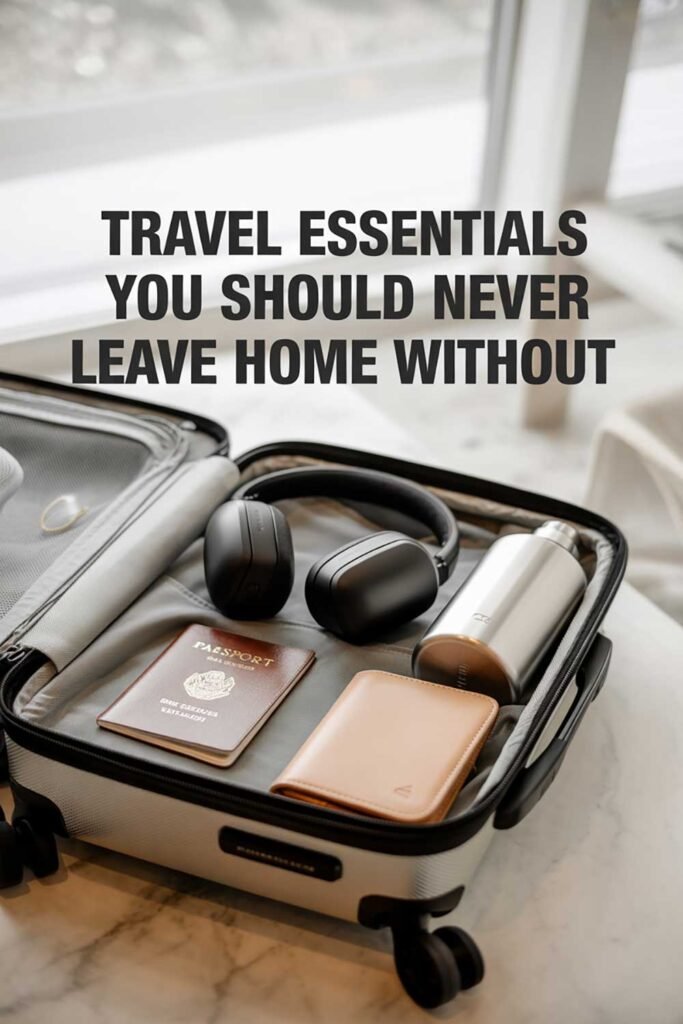
The items that should always travel in the carry-on rather than the checked suitcase are the items whose loss or delay would disrupt the trip in a way that the checked bag’s delay or loss makes unrecoverable within the trip’s timeframe. These include all travel documents — passport, boarding passes, visa documentation; all medications in their labeled original containers; any electronic devices and their chargers; the valuables — jewelry, anything irreplaceable or difficult to replace; a change of clothes for trips with a checked bag, in case the checked bag is delayed; and any items specific to the first day at the destination that the checked bag delay would prevent accessing. The carry-on’s function is to carry the trip’s continuity items — the documents, the medications, the first day’s essentials — so the trip can begin from the checked bag’s recovery if the bag is delayed, rather than requiring the delay to be resolved before the trip can start. Pack the checked bag for the trip. Pack the carry-on for the contingency.
The suitcase she carried herself up the stairs weighed fourteen kilograms and contained everything the trip required. The one she needed help with weighed twenty-six and contained the same trip plus twelve kilograms of what ifs that never left the bag. Intention is the best packing tool. Leave the what ifs at home.
Picture the Morning Before Departure
The list is on the phone, edited last night after the overnight test removed the third cardigan and the backup swimsuit and the shoes for the event that is not on the itinerary. The capsule wardrobe is photographed on the bed — seven pieces, all neutral, all combinable. The cubes are packed: tops cube, bottoms cube, underwear and socks, accessories pouch. Shoes at the wheel base with socks inside. Toiletry kit beside them. Structured items folded flat above the cubes. Soft items rolled inside. Foldable tote at the top for the destination’s first market visit. The suitcase closes without pressure. It lifts with one hand. The trip has begun, and it has begun correctly. That is the system. That is every packing session from here.
One More Thing Before the Next Trip
Print our free Travel Packing Checklist and use the women’s suitcase section to build the capsule wardrobe by occasion register, assign each category its cube, confirm the shoes are at the wheel base and the foldable bag is at the top, and apply the intention check before closing the bag. The same checklist we recommend before every trip.
Get the Free ChecklistExplore Our Top Picks for a Better Trip
Visit our favorites page for helpful booking ideas and travel essentials that we have found genuinely useful for organized, intentional travel. Whether you are planning your next trip or looking for resources that make every packing session smarter and every suitcase lighter, it is worth exploring.
See Our Top PicksTravel Prints and Printables From Our Shop
Visit Premier Print Works for packing checklist printables, capsule wardrobe planning guides, trip planners, travel journals, and wall art that makes every journey a little more beautiful and a lot more intentional — from the evening the overnight test removes the what ifs to the morning the suitcase is carried up the stairs alone.
Visit Premier Print WorksDisclaimer
The information shared in this article is provided by Don and Diana’s Travels for general informational, educational, and inspirational purposes only. It reflects our personal experiences, opinions, and the experiences of travelers we have worked with. It is not professional travel, legal, or fashion advice.
Airline Baggage Policies
Suitcase weight limits, carry-on size restrictions, and baggage policies vary by airline, fare class, and route. Always confirm current policies before travel. We are not responsible for any baggage fee or policy outcome arising from information in this article.
Affiliate and Partner Links
This article may contain affiliate and partner links that pay us a commission. Our recommendations are based on real use and genuine belief in the products and services we share.
Third-Party Websites
We may link to third-party sites for convenience. We are not responsible for their content, pricing, or availability.
Health, Safety, and Personal Responsibility
Travel involves personal risk. You are solely responsible for your own health, safety, and travel decisions. We strongly recommend comprehensive travel insurance for every trip. Don and Diana’s Travels accepts no liability for any loss, injury, delay, or inconvenience arising from information in this article.
Composite Stories
Stories on this site combine real experiences from Don, Diana, clients, and travelers we have worked with. Details may be adjusted for privacy and narrative clarity.
No Guarantees
We do not guarantee any specific result from using the information in this article. Your results depend on your own choices and circumstances.
Copyright and Use
All content is the copyrighted property of Don and Diana’s Travels. You may not copy or republish our content without prior written permission. You are welcome to share a direct link with proper credit.
By reading this article, you acknowledge that you have read and agree to this disclaimer.