Long international flights do not have to wreck you before your trip even begins. The traveler who arrives fresh off a long international flight treated the journey as the first rest of the vacation, not the last obstacle before it. This article builds the system — physical, practical, and mindset — that makes a twelve-hour flight the beginning of the trip rather than something the trip has to recover from.

Best For
International Long-Haul Travelers
Vibe
Rested, Arrived, Ready
Read Time
12 Minutes
Walk Away With
The Complete Long-Haul Arrival System
Free Download

Grab Our Travel Packing Checklist

Our free packing checklist includes a long-haul flight essentials section covering the compression socks, sleep mask, neck pillow, snack kit, water bottle, and personal care items that make a twelve-hour flight the beginning of the trip rather than the thing the trip has to recover from.

Get the Free Checklist

Set Your Watch to Destination Time the Moment You Board

The single most impactful jet lag management action available to the long-haul traveler at the beginning of the journey costs nothing, takes five seconds, and is the specific physiological and psychological signal that begins the body’s time zone transition from the departure point rather than at the destination’s arrival. Setting the watch — or the phone, the seat display, any time reference used throughout the flight — to the destination’s time zone at the moment of boarding converts every subsequent in-flight decision from a departure-time-zone decision into a destination-time-zone decision: whether to sleep or stay awake is determined by whether it is currently night or day at the destination rather than at home, what to eat at the meal service is determined by whether the destination considers this breakfast or dinner, and when to begin the final hour’s preparation is determined by the destination’s morning rather than the departure point’s middle of the night.

The watch-set-at-boarding approach is the beginning of the circadian adjustment that the body will spend the first days at the destination completing. It is not a complete jet lag solution — the body’s internal clock does not reset as quickly as the watch does — but it is the correct orientation of the flight’s activities that gives the body the clearest possible signal about which direction the adjustment needs to go. The traveler who spends a fifteen-hour flight in their departure time zone is the traveler who arrives at the destination with the full fifteen-hour gap to close from the arrival moment. The traveler who spent the same fifteen hours eating and sleeping by the destination’s time has closed some of that gap during the flight itself.

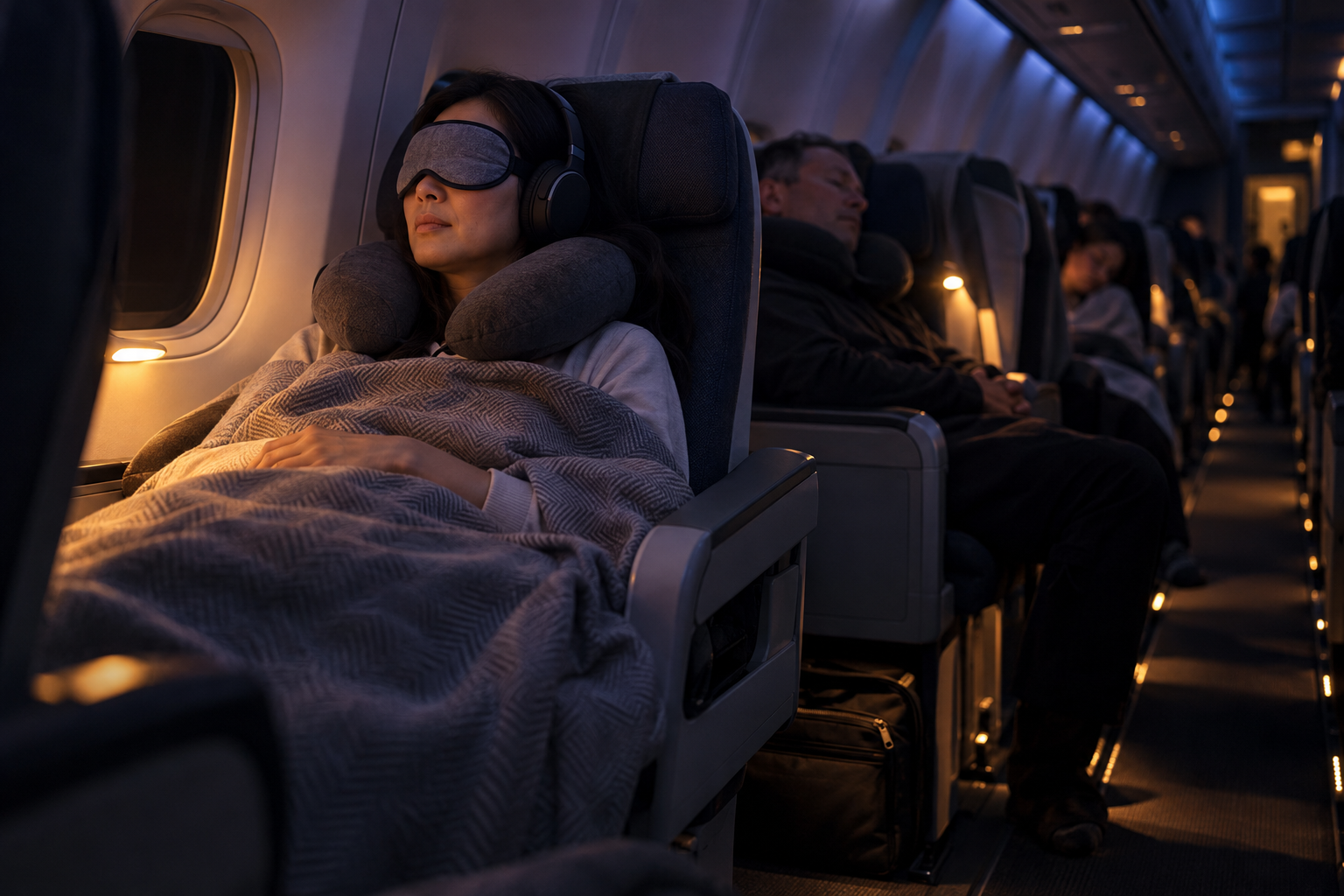
For eastward long-haul flights that advance the local time significantly — the overnight flight from North America to Europe that arrives at morning after a seven or eight hour time zone advance — the watch-set approach means attempting sleep during the flight’s period that corresponds to nighttime at the destination, even if the departure-point body clock is treating the same hours as late afternoon. This is the hardest version of the approach because it asks the body to sleep when it is not physiologically ready. Noise-canceling headphones, a quality sleep mask, and the permission to rest rather than be productive are the specific tools that make this sleep attempt possible rather than an exercise in lying in the dark waiting for a sleep that does not come.

The traveler who arrives fresh off a long international flight treated the journey as the first rest of the vacation not the last obstacle before it.

Long international flights do not have to wreck you before your trip even begins. The flight is not the obstacle. The flight is the transition. Pack for the transition and arrive ready for the destination.

Insider Note

Tell the flight attendant at boarding whether you prefer to be woken for the meal service or prefer to sleep through it. Most airlines ask this question proactively, but not all do. For eastward long-haul flights where the destination’s nighttime corresponds to the flight’s early hours, the decision to sleep through the meal service rather than be woken for it at a time that disrupts the destination-time-zone sleep window is a legitimate and valuable choice. A missed meal service is a missed meal that the personal snack kit in the bag compensates for without any circadian disruption. An interrupted sleep at the wrong time is a jet lag setback that the next day at the destination manages.

We Plan International Trips

Let Us Book the International Trip Worth the Long-Haul Flight

The long-haul flight that is worth taking is the one that leads to a destination worth arriving at rested and ready. Tell us where in the world you want to go. We will build the itinerary, book the flights, and make sure the arrival experience matches the trip’s quality.

Plan Our Escape

Drink Water Constantly and Bring Your Own Snacks

The aircraft cabin’s humidity environment — typically ten to twenty percent relative humidity compared to thirty to sixty percent in most indoor environments — produces continuous dehydration through increased moisture evaporation from the respiratory system and the skin throughout the full flight duration. At ten to twenty percent humidity, the body loses moisture measurably faster than in normal indoor environments. A fifteen-hour flight produces the specific cumulative dehydration that accounts for a significant proportion of the fatigue, headache, dry mouth, and cognitive fog that travelers associate with long-haul flights and attribute to the travel itself rather than to the specific and preventable mechanism of the cabin’s dehydrating effect.

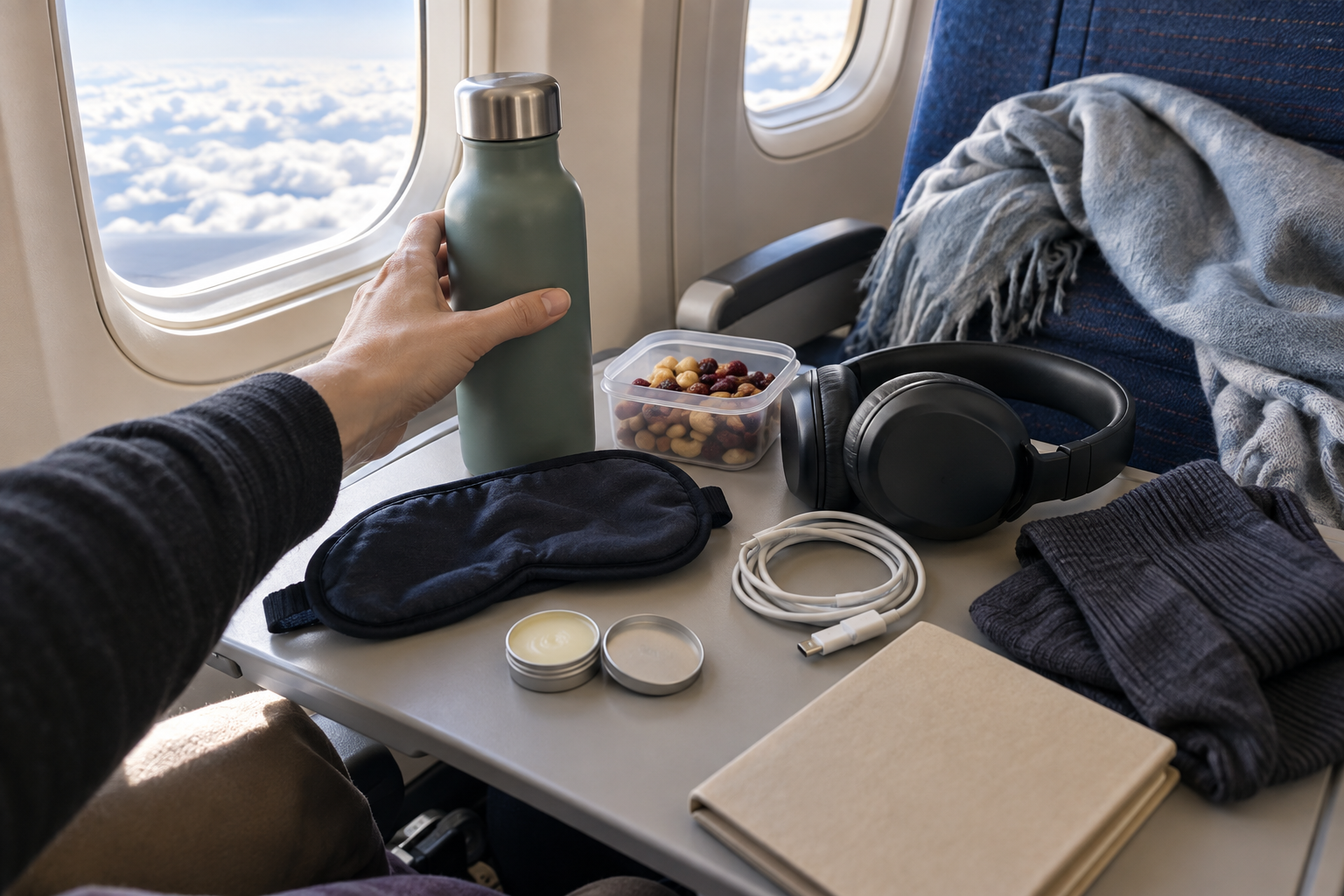
Drink water proactively — before thirst develops — throughout the full flight. Thirst is a lagging indicator that dehydration is already present. In the cabin’s humidity environment, waiting for thirst to signal the need for water allows the dehydration to develop before the response begins. A reusable water bottle filled after security, refilled at the galley during movement intervals, and supplemented by accepting every water service the airline offers maintains the hydration baseline that the cabin’s environment is continuously reducing. The minimum effective long-haul hydration: two liters of water across a twelve-hour flight, independent of any other beverages consumed. Alcohol and caffeine both increase fluid loss and add to the dehydration the cabin’s humidity is already producing — consume both in moderation and supplement each diuretic beverage with a full additional glass of water.

The personal snack kit is the long-haul flight’s nutritional supplement to the airline’s meal service, which provides one to two meals across twelve to fourteen hours at the airline’s timing rather than the traveler’s hunger. Mixed nuts, a protein bar, dried fruit, and dark chocolate in the personal item’s accessible exterior pocket provide the gap coverage that prevents the mid-flight hunger that makes the airline’s limited meal selection feel more appealing than it genuinely is. The personal snack kit is also the traveler’s nutritional agency on a long flight where the meal service’s menu and timing are entirely outside their control — an agency that the destination’s first day’s energy level reflects directly.

Insider Note

Pack a small facial mist spray alongside the water bottle and the snack kit in the accessible exterior pocket. The cabin’s dehydrating effect on the skin is the visible external manifestation of the same process producing the internal dehydration. A light mist of water or facial mist spray applied to the face every two hours alongside the movement interval provides the immediate sensory refresh that the cabin’s air removes continuously and that the water bottle addresses internally but not externally. Thirty milliliters of facial mist weighs under fifty grams, provides forty or more applications, fits in the carry-on liquids bag at the 100ml limit, and produces the specific mid-flight facial freshness that the cabin air alone cannot maintain across fourteen hours.

Wear Compression Socks for Any Flight Over Four Hours

Extended periods of seated immobility in a pressurized aircraft cabin reduce the leg muscle activity that normally assists venous blood return from the lower extremities. The result for many travelers is the swollen feet and ankles and the heavy-leg sensation that make the first hours at the destination physically uncomfortable — the swollen feet that make removing and replacing shoes difficult at arrival, the ankles whose circumference has noticeably increased from the boarding gate to the arrival hall. Compression socks apply graduated pressure from the ankle upward that supports venous return during the periods of seated immobility that long-haul flights produce.

Travelers with specific health conditions — cardiovascular conditions, a history of blood clots, pregnancy, recent surgery, peripheral artery disease, peripheral neuropathy, or other conditions affecting circulation — should consult a qualified healthcare provider before any long-haul flight and before wearing compression garments. The information in this article is general wellness guidance for typical healthy travelers and is not a substitute for professional medical advice for any individual’s specific health circumstances. For typical healthy travelers without circulatory contraindications, wearing correctly sized compression socks from the departure gate through the arrival and removing them once movement and circulation are restored at the accommodation is the standard approach that addresses the lower leg circulation effects of extended seated immobility.

Put the compression socks on before boarding — at home, at the airport, or before the gate — rather than on the aircraft after the flight has been underway for an hour or more. The compression sock applied before any extended seated period begins provides support from the start of the travel day’s sedentary period rather than after the venous pooling that the first hour of seated immobility produces. Pair the compression socks with the movement interval schedule and the water intake for the most complete lower leg circulation support available in economy class — a combination that costs under twenty dollars in total preparation investment and produces the arrival leg comfort that the unprepared long-haul passenger does not achieve until the destination’s second morning.

Insider Note

Choose compression socks rated at 15-20 mmHg (mild compression) or 20-30 mmHg (moderate compression) for long-haul travel. The sock should be snug but not uncomfortable — a correctly sized compression sock produces light pressure throughout without any area of tight constriction or pain. Compression socks that are too small produce the opposite of their intended effect by restricting blood flow rather than supporting it. Try the specific socks at home before the long-haul flight departure to confirm the sizing is correct and the fit is comfortable for extended wearing periods. A compression sock that is uncomfortable at hour one of the flight will be removed by hour two. The sock worn for the full flight duration is the sock that provides the full duration’s benefit.

Helpful for Your Journey

Find Booking Ideas and Travel Essentials on Our Favorites Page

Our favorites page has helpful booking ideas and travel essentials that we have found genuinely useful for long-haul international travel. Whether you are planning your next big trip or looking for resources that make the flight itself more comfortable and the arrival more refreshed, it is worth a look.

DND Favorites

Move Every Two Hours Without Exception

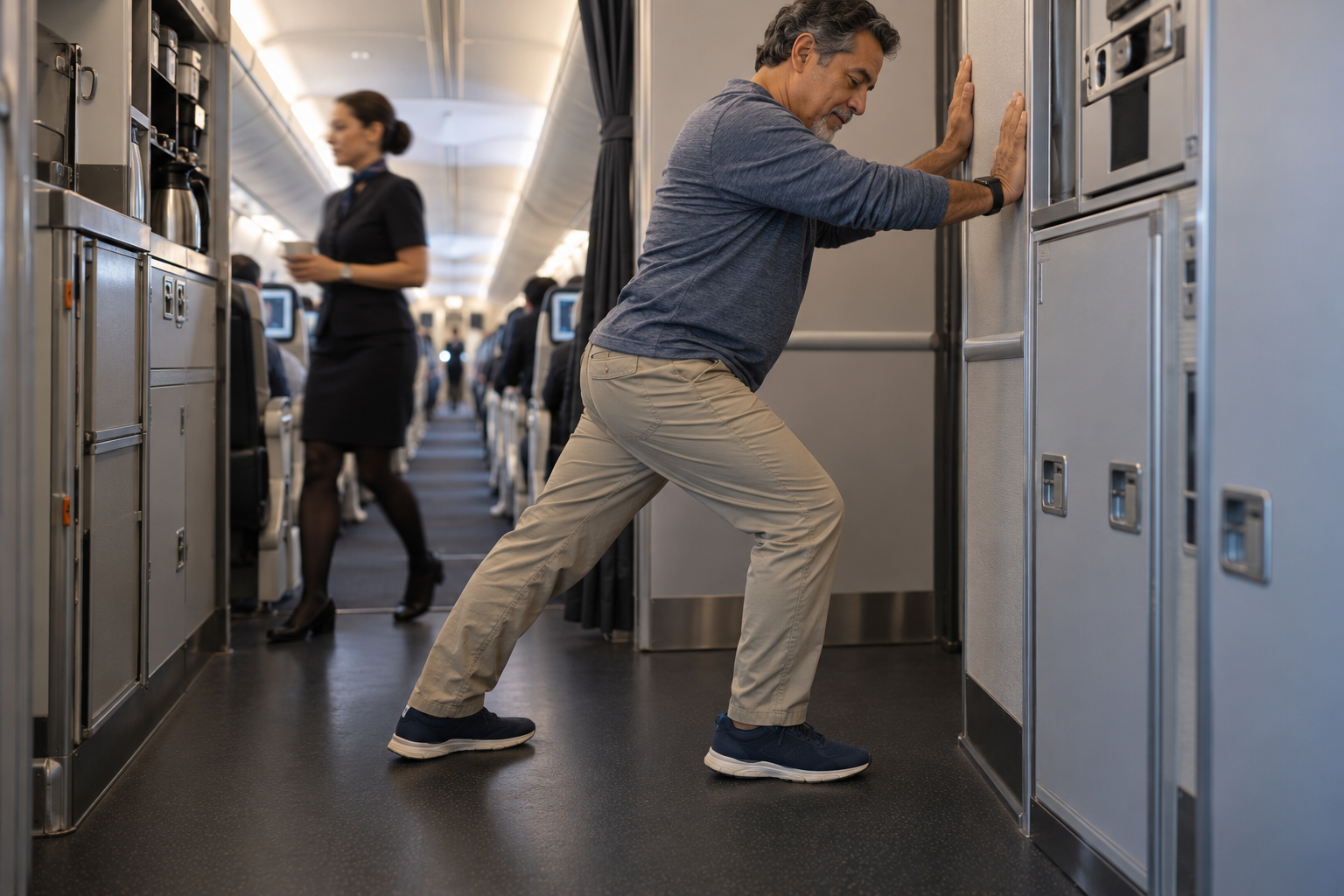
Set a phone timer for two hours at boarding and reset it after every movement interval for the full flight’s duration. The two-hour movement interval — standing, walking to the galley or the aircraft’s rear, performing ten to fifteen calf raises, walking the aisle once, returning to the seat — activates the leg muscle pump that extended seated immobility deactivates. The leg muscles, when contracted during standing and walking, actively assist blood return from the lower extremities toward the heart in a way that the passive mechanisms of gravity and respiration alone cannot replicate during extended seated immobility. Three to five minutes of movement every two hours is the minimum active circulation support available to the seated traveler, and it is available at any point in the flight when the seatbelt sign is not illuminated.

The timer is the movement system’s critical component. Without the timer, the movement that was planned at boarding is displaced by the immersive activity of the flight — the film, the sleep attempt, the meal service, the general absorption of the long-haul hours — and the two-hour interval becomes the vague intention that was not acted on across the flight’s middle section. The timer fires. The movement happens. The timer is reset. This three-minute activity five to seven times across a twelve-hour flight is the difference between arriving with normal-weight legs and arriving with the specific lower leg heaviness that the first destination morning is spent recovering from.

Pair in-seat exercises with the standing intervals for the periods when the seatbelt sign is illuminated — during takeoff, landing, and any turbulence period. Ankle circles, alternating heel lifts and toe presses, and seated knee raises performed at the seat provide lower-leg muscle activation that supports circulation without requiring standing. These are not equivalent to the full movement interval’s effectiveness but they provide meaningful lower leg activation during the constrained periods between full movement intervals, particularly on the final descent when the seatbelt sign is on and all tray tables are stowed and the movement interval cannot happen in the normal way.

Insider Note

The galley area at the aircraft’s rear is the standing and movement zone that most flight attendants are familiar and accommodating with for passengers who use it for movement during non-service periods. A brief conversation with the galley’s flight attendant — “I try to stand and move every couple of hours on long flights for circulation” — is typically met with understanding and occasional conversation that breaks the monotony of the movement interval’s repetition across the flight. Some flight attendants on long-haul routes actively encourage the practice and will occasionally initiate the conversation themselves. The galley standing is not an imposition. It is the circulation practice that the aircraft’s design specifically accommodates by providing the galley space, and it is used by experienced long-haul travelers on every flight of this duration.

Give Yourself Full Permission to Do Nothing Productive

This is the hack that the others in this article support but cannot produce alone. The sleep mask, the noise-canceling headphones, the destination time zone watch setting, the hydration system, the compression socks, and the movement intervals are the physical infrastructure of the long-haul flight’s rest approach. The permission to actually rest — to genuinely not use the flight for work, email management, document review, professional development, language study, or any of the other productive activities that the guilt of spending twelve hours in a seat produces — is the psychological infrastructure that the physical preparation requires to be effective.

The long-haul flight is not a productive environment by design. The pressurized cabin at altitude produces mild cognitive effects on many travelers — reduced concentration, slower processing, lower creative output — that make the work produced on the aircraft genuinely lower quality than the same work done at sea level in a normal cognitive state. The email written at hour seven of a fourteen-hour overnight flight, in the specific mild cognitive environment that altitude and fatigue and dehydration together produce, is the email that the sender often revises upon arrival at the destination when the full cognitive state is restored. The flight is not taking time from productivity. It is protecting the destination’s first day from the depleted arrival state that productivity-oriented long-haul flying consistently produces.

The flight watched as two films and an audiobook chapter and a genuine five-hour sleep with the mask and the headphones on is the flight that arrives at the destination with the energy that the destination’s first day deserves. The flight worked through as the email backlog and the report and the language app is the flight that produces the destination arrival where the first day is managed from a deficit rather than begun from a reserve. Give the flight permission to be the rest it can be. The work will be there at the destination. The destination will not.

Insider Note

The specific permission that the most productive long-haul travelers grant themselves is the one that reframes the flight’s purpose entirely: not as time to be managed efficiently but as the transition space between who they are at the departure and who they will be at the destination. The long-haul flight is the decompression chamber, the threshold, the in-between that has no obligations on either side of it for the twelve hours it lasts. The destination’s obligations begin at the gate. The departure’s obligations ended at the security line. The twelve hours between them belong to the transition. Use them to arrive rather than to continue. The arrival that begins from rest is the arrival that the destination was worth taking a twelve-hour flight for.

The Complete Long-Haul Arrival System

The complete long-haul arrival system assembles the flight’s physical management and the mindset into the single set of practices that produces a consistent fresh arrival regardless of the flight’s duration or direction.

At boarding: watch set to destination time. Compression socks on if not already wearing. Movement timer set for two hours from takeoff. Sleep mask and noise-canceling headphones at the top of the personal item. Personal snack kit in the accessible exterior pocket. Water bottle filled after security in the exterior bottle pocket. The flight attendant notified of meal service preference for the sleep segment.

During the flight: water drunk proactively at the two-hour movement interval — drink, stand, move, sit, reset the timer. Meal service accepted when it falls within the destination time zone’s waking hours. Slept during the destination time zone’s nighttime hours with the mask and the headphones on, regardless of the departure time zone’s indication. The film watched, the audiobook listened to, the nothing done — each of them acceptable, each of them better for the arrival than the work not rested from.

The final hour: the change of clothes retrieved from the personal item for the arrival refresh in the lavatory before landing. Compression socks worn through the arrival hall and removed at the accommodation when walking and circulation are restored. The destination time already on the watch — the body partially oriented to the new time zone by the flight’s activities within it.

Insider Note

The most reliable single predictor of whether a long-haul traveler arrives refreshed or depleted is not the seat class, the airline, the aircraft type, or the flight duration. It is whether the traveler slept on the flight and whether they arrived hydrated. Everything else in this article supports these two outcomes. The compression socks and the movement intervals protect the physical comfort that makes sleep easier. The destination time zone watch set produces the sleep at the right time. The water intake prevents the dehydration headache that disrupts sleep. The snack kit prevents the hunger that interrupts it. The permission to rest removes the productivity guilt that overrides it. The entire system serves the sleep and the hydration. Prioritize both. Arrive fresh. Begin the trip.

The Thirteen-Hour Flight That Changed How She Arrived Everywhere

Vivian had taken long international flights for years and had never arrived at a destination without a specific private accounting of what she had accomplished during the flight. Reports reviewed. Emails answered. Documents prepared. Presentations refined at thirty-five thousand feet in the specific combination of fatigue, cabin pressure, and mild dehydration that she had normalized as the long-haul flight’s working condition. The work was always worse than her usual standard, a fact she consistently noticed when she reviewed it at the destination, but it was work done and the productivity guilt had been managed.

The arrivals from these flights were consistent: a specific fog that the first destination morning was spent in, a particular kind of tired that was not the tired of not sleeping but the tired of sleeping badly while also trying to work and also not drinking enough water because the water bottle was not filled before boarding because the boarding was managed in the last minutes available. The destinations were excellent. The first days in them were managed from a deficit. She attributed this to the time zone change rather than to the choice she was making about how to spend the twelve hours before the time zone change began.

The specific flight that changed this was a thirteen-hour segment that she took for a personal trip — not a business trip, a holiday — and on which she sat down at boarding, set her watch to the destination time, put on the compression socks she had started wearing two trips ago, filled the water bottle at the gate, put the headphones on, and thought: I am going somewhere I want to be. There is nothing I need to do on this flight. There is genuinely nothing. For the first time on a long international flight, she had nowhere to be and nothing to produce and the permission to treat the next thirteen hours as the beginning of the rest she was going there for.

She slept for six hours. She watched two films she had been meaning to watch for months. She drank water every time the timer fired and stood and walked each time alongside it. She ate one of the airline’s meals and the protein bar from the snack kit at the mid-flight gap. She arrived at the destination having not answered a single email, not reviewed a single document, and not accomplished anything measurable. She also arrived without the fog. She also arrived with the energy to go directly to the destination’s first activity rather than to the hotel for the recovery nap that every previous long-haul arrival had required. The first day was the first day rather than the rest of the last day’s flight. This article is the permission she gave herself on that specific flight and the system she built around it for every international long-haul she has taken since.

Six More International Long-Haul Flight Hacks

Beyond the five core long-haul arrival principles, these six additional approaches address the specific in-flight scenarios that the core system does not fully cover.

Bring a quality sleep mask that fully blocks light rather than the airline’s thin foam equivalent. The aircraft cabin during the overnight or mid-flight sleep segment is never fully dark — the passenger in 14A’s reading light, the crew’s galley light, the seatback screen of the adjacent passenger who is still watching something — and the airline’s provided sleep mask’s foam perimeter allows light through its edges. A quality sleep mask with a contoured face seal that blocks ambient light from every edge is the specific sensory condition that converts the airline’s partial darkness into the genuine darkness that sleep onset requires. A quality sleep mask weighs under sixty grams, costs minimally at most travel retailers, and is the highest return-per-gram comfort investment in the long-haul personal item after the noise-canceling headphones.

Use a travel pillow specifically designed for neck support rather than relying on the airline’s headrest or the rolled jacket against the window. The neck is the body part most consistently reported as stiff or sore after long-haul flights, and the sleep posture in an economy seat without neck support — the forward head drop, the side roll against the hard headrest edge — is the posture that produces the neck stiffness that accompanies the arrival and the first destination morning. A compact travel pillow — inflatable for minimal pack size or memory foam in a compression sack — provides the specific neck support that prevents the sleeping posture damage that the headrest alone does not address.

Change into comfortable, loose clothing at boarding or in the airport’s pre-boarding restroom rather than wearing the travel day’s outfit for the full flight duration. The long-haul flight in jeans and a structured top is the flight spent in the clothing that the destination requires rather than the clothing the flight requires. A pair of soft travel trousers or joggers, a comfortable top, and slip-on shoes or travel socks converts the economy seat’s constrained space from the clothes that restrict it into the clothes that accommodate it. The change at arrival refreshes both the body and the appearance for the destination’s first impressions — the clean outfit from the personal item item, the face washed and moisturized in the lavatory before descent, the compression socks removed at the accommodation. The arrival that begins the destination rather than extending the flight.

Download a full film or series and a substantial audiobook before departure rather than relying on the seatback entertainment system alone. The seatback entertainment system on most long-haul aircraft provides a reasonable selection of films and entertainment, but its audio quality through the airline’s provided headphones in the cabin’s 80-85 decibel ambient noise environment is the specific audio experience that the personal noise-canceling headphones and personally downloaded content improves significantly. The film downloaded to the phone or tablet, played through noise-canceling headphones that reduce the cabin’s ambient noise to a manageable level, is the superior entertainment experience at the same seat on the same aircraft for the same duration.

Moisturize the hands and face at the movement interval alongside the water intake and the facial mist. The cabin’s humidity depletes the skin’s moisture barrier continuously across the full flight, producing the specific dry, tight skin sensation that many travelers notice increasing across long-haul hours. A travel-size moisturizer applied at the two-hour interval — applied in the seconds after the calf raises and before sitting back down — addresses the skin dehydration that the water bottle addresses internally. The specific fifteen seconds of moisturizer application at each movement interval cumulatively maintains the skin’s comfort across the full flight and contributes to the arrival appearance that the fresh clothes and the washed face complete.

Adjust the final sleep segment to end one to two hours before the scheduled arrival. The traveler who sleeps through the final approach, the landing, and the taxi to the gate wakes at the gate in the specific disorientation of a sleep that ended at an airport rather than a bed. The traveler who sets a final alarm to wake one to two hours before arrival uses that final period for the arrival preparation — the clothes change, the face wash, the moisturizer, the dental hygiene, the compression sock management, the personal item organization — and lands awake, organized, and already in the destination’s first hour rather than in the flight’s last one. The last two hours of the flight are the transition from the flight to the destination. Use them as the transition rather than extending the sleep past the landing.

Insider Note

The long-haul flight’s greatest gift to the traveler who treats it correctly is not the miles it covers. It is the specific decompression it provides — the twelve hours between the departure’s obligations and the destination’s beginning, during which neither set of obligations applies. The email cannot be answered. The next meeting cannot be attended. The destination cannot be reached early. The departure cannot be returned to. For exactly the flight’s duration, the traveler exists only on the aircraft, in the transition, in the space between. This is a specific kind of rest that life outside of long-haul flights rarely provides: the enforced release from both ends. The traveler who recognizes this space and uses it for genuine rest arrives at the destination carrying nothing from the departure and ready to begin. That is the long-haul flight’s specific gift. Accept it.

Book With Us

Book the International Destination Worth Every Hour of the Long-Haul Flight

The long-haul flight is easier when the destination at the other end is genuinely worth arriving at. Our travel agents plan the trips worth taking the long way to reach. Let us book yours.

Book A Trip

The Long-Haul Mistakes That Make the First Day of the Trip a Recovery Day

Each of these converts the destination’s first day from the trip’s beginning into the flight’s extended recovery. Each has a preparation-based resolution.

1

Not setting the watch to destination time at boarding

The watch kept at departure time for a fifteen-hour flight is the fifteen-hour extension of the departure time zone’s orientation before the circadian adjustment begins. The watch set to destination time at boarding begins the adjustment during the flight. Five seconds at boarding. The circadian signal begins before the gate closes.

2

Not drinking water proactively throughout the flight

The dehydration that produces the specific long-haul fog — the headache, the cognitive slowing, the fatigue that persists beyond normal tiredness — develops during the flight from the cabin’s humidity environment at a rate that thirst does not communicate until the dehydration is already present. Drink proactively. Fill the bottle before boarding. Refill at the galley. Accept every water service. The arrival hydration state determines the first day’s energy level more directly than any other single in-flight variable.

3

Not wearing compression socks and arriving with swollen legs

The swollen feet and heavy legs that make the destination’s first walk uncomfortable are the predictable outcome of extended seated immobility without circulatory support. Compression socks worn from the departure gate through the arrival address the venous return that seated immobility reduces. Travelers with relevant health conditions should consult a healthcare provider. For typical healthy travelers, correctly sized compression socks from the gate to the accommodation is the standard long-haul leg comfort approach. Wear them before boarding. Remove them at the accommodation when walking and circulation are restored.

4

Not moving every two hours and sitting immobile for the full flight

The two-hour movement timer is the habit that the flight’s immersive activities consistently prevent from forming without external enforcement. Set the timer. When it fires, stand and move. The three to five minutes of movement per two-hour interval is the total active investment across the flight that produces the arrival leg comfort the twelve-hour immobile flight does not. Set the timer before the first film begins. The timer will fire. Move each time it does.

5

Trying to be productive throughout the long-haul flight and arriving depleted

The work done at altitude in the cabin’s cognitive environment is lower quality than the same work done at the destination at sea level rested. The productivity that justifies the long-haul flight’s non-rest is the productivity that produces the recovery day at the destination rather than the first day. Give the flight permission to be a rest. The destination will provide the productive environment that the altitude and the dehydration and the mild cognitive effects of the pressurized cabin specifically do not.

6

Not using a sleep mask and a neck pillow for the sleep segment

The sleep attempted in the airline’s partial darkness without neck support is the sleep that is interrupted by the adjacent passenger’s reading light and ended by the neck stiffness at hour three. The sleep in a quality mask’s genuine darkness with the neck pillow’s specific neck support is the sleep that extends through the full rest window and ends naturally rather than from discomfort or light. The mask and the neck pillow together weigh under three hundred grams. They are the most impactful physical items in the long-haul personal item for the arrival quality they produce.

Turn Travel Into Income

Love Helping Travelers Arrive at International Destinations Rested and Ready?

International travel bookings — the transatlantic, the transpacific, the long-haul routes to the destinations worth the flight — are among the most meaningful travel agent work. If becoming a home-based travel agent who helps people discover the world sounds like the right next step, see how the TravelPreneur system works.

Become An Agent

Frequently Asked Questions

These are the questions travelers ask most often about arriving fresh from long international flights.

What is the best way to prevent jet lag on international flights?

Jet lag prevention on international flights is most effectively approached as a process that begins before the flight, continues during it, and extends into the first days at the destination. Before the flight: adjusting sleep timing toward the destination’s time zone in the days before departure reduces the gap the body needs to close on arrival — going to bed and waking an hour or two earlier for eastward travel, or later for westward travel, in the days preceding the flight. During the flight: the watch-set-at-boarding approach, aligning eating and sleeping with the destination’s time zone, proactive hydration, and the movement intervals described in this article. At the destination: maximizing exposure to natural daylight at the appropriate times for the destination’s time zone accelerates circadian adjustment more effectively than any other single approach — bright morning light for eastward travel, afternoon light for westward travel. Some travelers use melatonin to support sleep onset at the new time zone’s nighttime; consult a healthcare provider before using any supplement for jet lag management, as appropriate timing, dosage, and suitability vary by individual circumstances. Complete jet lag elimination is not possible for most travelers on long international flights with significant time zone changes. What these approaches reliably produce is a reduced severity and shorter duration of jet lag’s effects compared to the unmanaged alternative.

Is it better to sleep or stay awake on a long-haul flight?

Whether to sleep or stay awake on a long-haul flight is determined by the destination’s time zone rather than personal preference or habitual sleep timing. The goal is to be sleeping when it is nighttime at the destination and awake when it is daytime at the destination, regardless of what the departure time zone indicates about the same period. For eastward long-haul flights that advance the local time significantly, this typically means attempting sleep during the first half of the flight even when the departure time zone’s body clock is not ready for sleep — which is the hardest and most important of the jet lag management approaches. For westward long-haul flights, the body’s natural tendency to delay sleep onset often aligns more naturally with the destination’s nighttime, making the sleep timing less challenging to manage. In both cases, the destination time zone’s schedule is the governing factor, and the flight’s activities — sleeping, eating, and staying awake — are calibrated to it rather than to the comfort of the departure time zone’s familiar schedule.

Are compression socks safe to wear on long flights?

Compression socks are used by a wide range of travelers on long-haul flights and are generally safe for typical healthy travelers when correctly sized and worn as intended. However, compression garments are not appropriate for everyone. Individuals with certain conditions including peripheral artery disease, certain types of peripheral neuropathy, significant heart failure, certain skin conditions affecting the lower legs, or other conditions affecting blood flow or sensation should consult a healthcare provider before wearing compression socks for any purpose, including long-haul travel. Compression socks that are too small or too tight can restrict rather than support circulation and should be replaced with correctly sized alternatives. Travelers with any relevant health condition, any uncertainty about whether compression socks are appropriate for their specific health circumstances, or any discomfort when wearing compression socks should consult a qualified healthcare provider before using them. The information in this article is general wellness guidance for typical healthy travelers and is not a substitute for professional medical advice.

What should you eat and drink on a long international flight?

The general guidance for eating and drinking on a long international flight to support the best arrival condition: water proactively throughout the flight as the primary beverage, supplemented by the personal snack kit’s protein and healthy fat options for the gaps between meal services. Alcohol in moderation — if at all — noting that alcohol is a diuretic that increases fluid loss and adds to the cabin’s dehydrating effect, and that each alcoholic beverage requires an additional full glass of water to maintain the hydration baseline. Caffeine similarly in moderation, timed away from the sleep segment that the destination time zone’s nighttime requires. The airline’s meal service provides reasonable nutrition at the meal service’s timing — accepting the available meal and supplementing with the personal snack kit for the gap hours produces more consistent nutrition across the flight than either the airline’s service alone or the personal kit alone. Large, heavy meals before or during the early flight hours can make sleep onset more difficult; lighter eating in the hours before the destination time zone’s nighttime and a more substantial meal at the destination time zone’s meal hours produces better sleep quality during the sleep segment.

How do you manage a long-haul flight with a connection?

Long-haul flights with one or more connections add the specific transit logistics of moving between aircraft within a constrained time window, often across terminals, sometimes across different airports in the same city, and occasionally through immigration and customs clearance for international connections. The preparation for the connection: confirmed connection time adequacy — the minimum connection time varies by airport and connection type, and a connection that feels adequate on paper may be insufficient at a large airport with distant gates or at an airport with known delays. Keep all essential documents — passport, boarding passes for all segments — in the outermost pocket of the personal item throughout all flight segments. Compression socks worn throughout the connecting day including during the connection’s transit period, as the transit involves its own extended sitting and walking that benefits from the same circulatory support as the flight. Eat and drink during the connection’s available time if the transit allows it — the connection’s airport food may be the meal that replaces the flight segment’s missed service. Arrive at the connecting gate early, especially for international connections where the boarding process may involve additional security screening.

How long does it take to recover from a long international flight?

The general guidance for jet lag recovery time is approximately one day per time zone crossed, though individual variation is significant — some travelers adjust more quickly, others more slowly, and the direction of travel, the specific time zones, and the individual’s age and general health all affect the recovery timeline. Eastward travel (gaining time) is generally considered more challenging to adjust to than westward travel (losing time) because it requires advancing the body’s internal clock, which is physiologically more difficult than delaying it. The approaches in this article — in-flight sleep alignment with the destination’s time zone, proactive hydration, movement, and early arrival in good physical condition — consistently reduce both the severity and the duration of jet lag compared to the unmanaged alternative. Travelers who arrive hydrated, rested, and with some circadian adjustment already begun during the flight typically experience a shorter and milder jet lag period than those who arrive depleted. Light exposure at the appropriate times on arrival, physical activity on the first day, and adherence to the new time zone’s sleep schedule without napping outside of the new night hours are the most impactful post-arrival jet lag management approaches.

The traveler who arrived with energy for the first day gave the flight what it asked for: rest. Not productivity. Not efficiency. Rest. The twelve hours between the departure and the destination belong to the transition. Use them to arrive. The destination is waiting.

Picture the Arrival Hall

The watch has been on destination time since boarding. The compression socks are still on from the gate. The movement timer fired five times and you stood and walked each time. The water bottle was refilled twice at the galley. The sleep mask and the headphones produced five hours of actual sleep during the destination’s night. The personal snack kit covered the gap at hour seven. The clothes were changed in the lavatory before landing. The face was washed. The moisturizer was applied. You walked off the aircraft into the arrival hall having done nothing productive for twelve hours. The first day of the trip is beginning. You are beginning it. That is the permission. That is the system. That is every long haul from here.

Free Download

One More Thing Before Your Next Long Haul

Print our free Travel Packing Checklist and use the long-haul flight section to confirm the arrival kit is complete: compression socks on, sleep mask at the top of the personal item, water bottle filled after security, snack kit in the exterior pocket, movement timer set at boarding, watch on destination time. The same checklist we use before every international flight.

Get the Free Checklist

Explore Our Top Picks for a Better Trip

Visit our favorites page for helpful booking ideas and travel essentials that we have found genuinely useful for long-haul international travel. Whether you are planning your next big trip or looking for resources that make the flight itself more comfortable and the arrival more refreshed, it is worth exploring.

See Our Top Picks

Travel Prints and Printables From Our Shop

Visit Premier Print Works for flight preparation checklists, international travel planners, packing list printables, travel journals, and wall art that makes every trip a little more beautiful and a lot more organized — from the evening the compression socks are confirmed to the morning the destination’s first day begins from rest rather than recovery.

Visit Premier Print Works

Disclaimer

The information shared in this article is provided by Don and Diana’s Travels for general informational, educational, and inspirational purposes only. It reflects our personal experiences, opinions, and the experiences of travelers we have worked with. It is not professional medical, health, or travel advice.

Medical and Health Information

This article discusses compression socks, hydration, movement, and jet lag management. This information is general educational content for typical healthy travelers and is not professional medical advice. Travelers with cardiovascular conditions, a history of blood clots, pregnancy, recent surgery, peripheral artery disease, peripheral neuropathy, or any other health condition that may be relevant to long-haul flight wellness or compression garment use should consult a qualified healthcare provider before any long-haul flight and before using compression garments. All health and supplement decisions including melatonin use for jet lag should be made in consultation with a qualified healthcare provider. We are not responsible for any health outcome arising from information in this article.

Airline Policies

Airline policies, meal service procedures, and in-flight services change frequently. Always confirm current information with the specific airline before travel.

Affiliate and Partner Links

This article may contain affiliate and partner links that pay us a commission. Our recommendations are based on real use and genuine belief in the products and services we share.

Third-Party Websites

We may link to third-party sites for convenience. We are not responsible for their content, pricing, or availability.

Health, Safety, and Personal Responsibility

Travel involves personal risk. You are solely responsible for your own health, safety, and travel decisions. We strongly recommend comprehensive travel insurance for every trip. Don and Diana’s Travels accepts no liability for any loss, injury, delay, or inconvenience arising from information in this article.

Composite Stories

Stories on this site combine real experiences from Don, Diana, clients, and travelers we have worked with. Details may be adjusted for privacy and narrative clarity.

No Guarantees

We do not guarantee any specific result from using the information in this article. Your results depend on your own choices and circumstances.

Copyright and Use

All content is the copyrighted property of Don and Diana’s Travels. You may not copy or republish our content without prior written permission. You are welcome to share a direct link with proper credit.

By reading this article, you acknowledge that you have read and agree to this disclaimer.