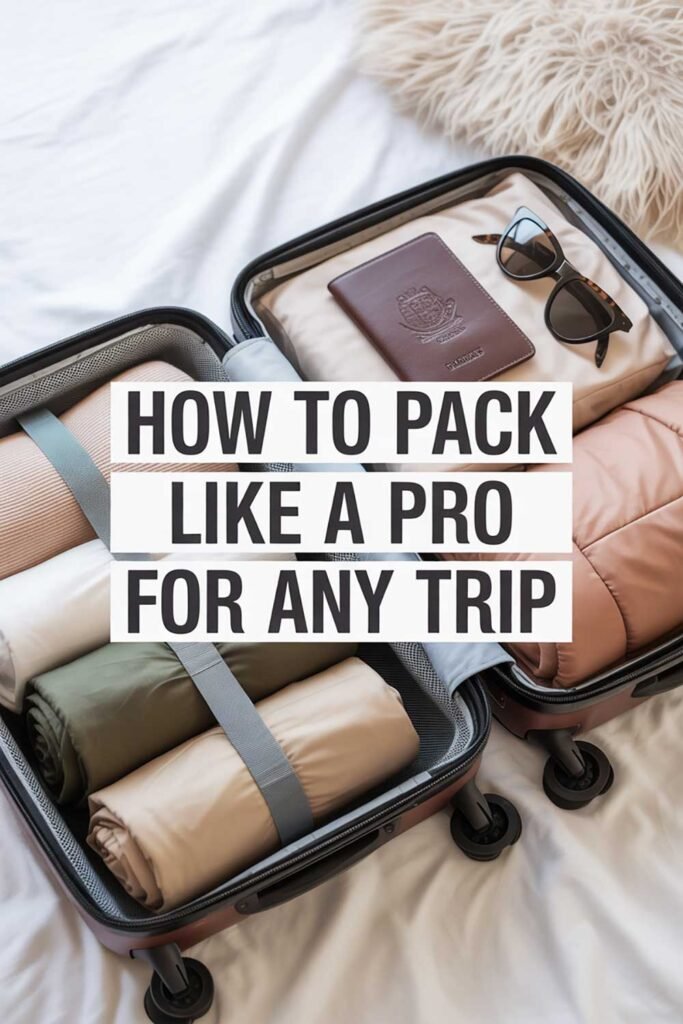
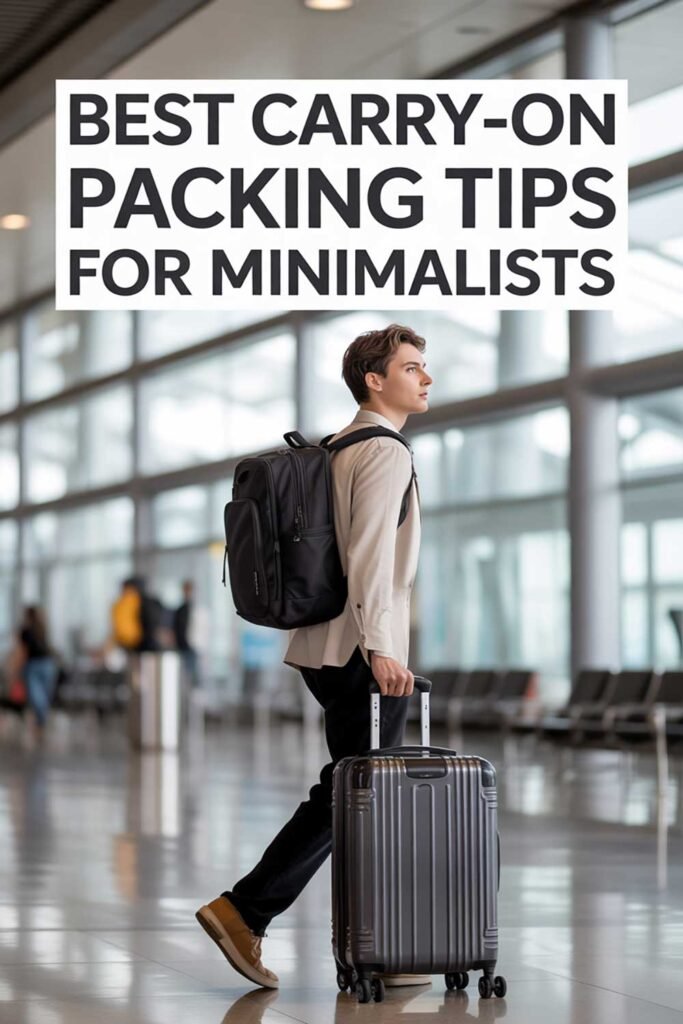
International packing for men comes down to one simple principle: versatile pieces that work harder so you can pack less. The smartest international packers bring less than they planned and spend zero time at baggage claim on either end of the trip. This article builds the system that makes that possible for any international destination, any duration, any occasion range.

Best For
Men Traveling Internationally
Vibe
Light, Sharp, Global-Ready
Read Time
11 Minutes
Walk Away With
The Complete Men’s International Packing System
Free Download

Grab Our Travel Packing Checklist

Our free packing checklist includes a men’s international section organized by the versatile-pieces system this article describes — clothing by outfit register, the essential international non-negotiables, and the document and health preparation checklist — so the international bag is built correctly before the destination’s specific requirements add their own items.

Get the Free Checklist

Choose Neutral Colors That Mix and Match Across Every Day

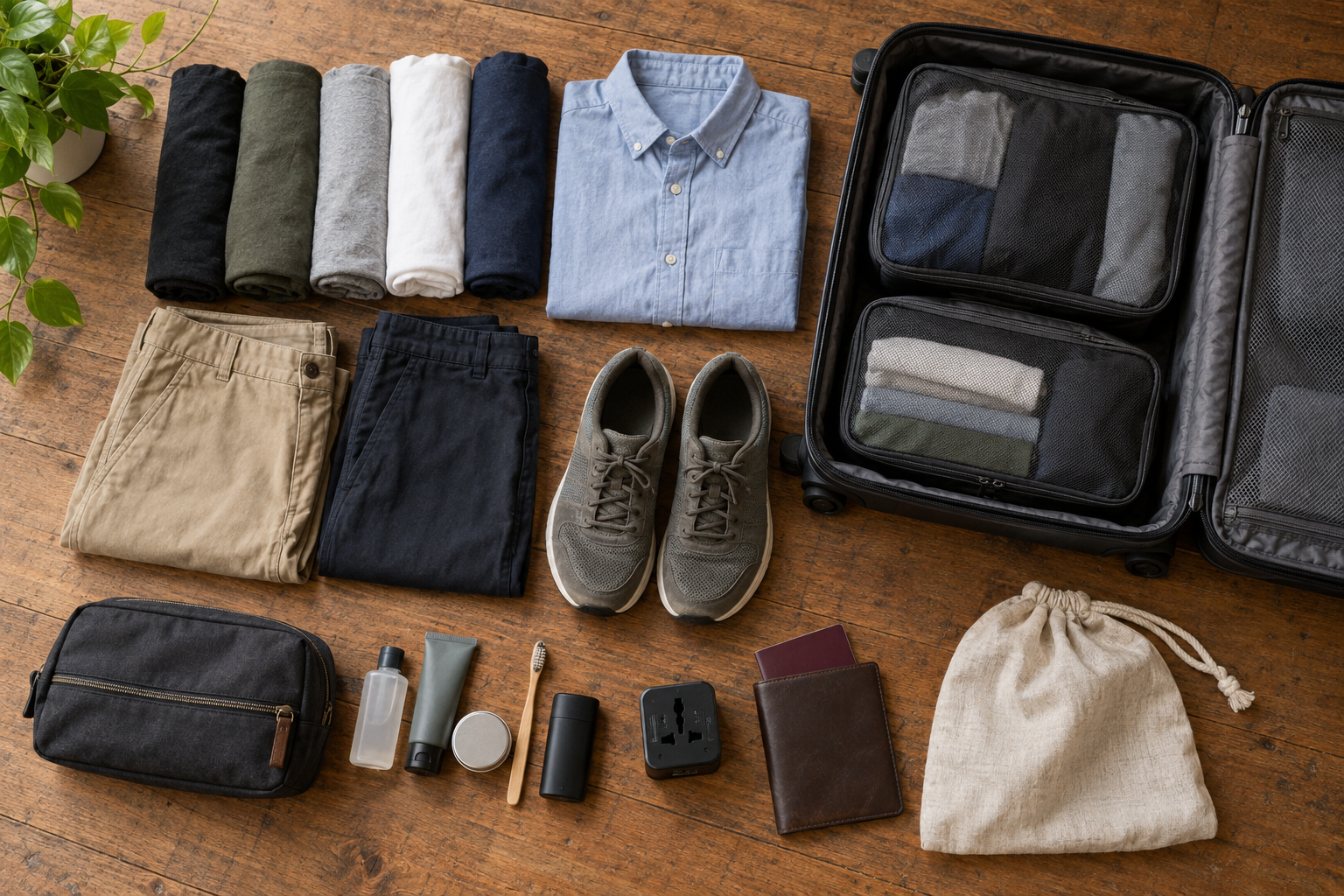
International travel’s specific packing challenge is the occasion range the trip produces — the cultural site that requires conservative dress, the beach that requires casual dress, the city restaurant that requires smart casual, and the business meeting or formal event that requires the elevated register — across a duration that may be ten days in multiple cities with a carry-on as the only bag. The outfit-unit approach, where each day’s look is a separate, self-contained item set, fails this challenge by requiring the full wardrobe for every occasion type packed simultaneously at the full item count of days planned. The neutral palette wardrobe, where every item pairs with every other item across every occasion register, solves this challenge by producing more outfit variety from fewer pieces through combination rather than through item accumulation.

The men’s international neutral palette for a carry-on wardrobe: navy, grey, white, and a fourth neutral — olive, camel, or black depending on personal preference — as the complete color range for the trip’s full duration. Within this palette, every trouser pairs with every shirt, every jacket elevates any combination, and every shoe works across the full occasion range. The navy chino and the white shirt is a smart casual combination. The same navy chino with the grey merino and the blazer is an elevated smart casual combination. The same navy chino with the olive t-shirt is a casual daytime combination. Three tops and one trouser from a shared palette produce six distinct looks before any accessory variation. The neutral palette is the international wardrobe’s multiplier — it produces more combinations from fewer pieces than the multi-color approach at every item count level.

Choose fabrics specifically for international travel performance: merino wool for the t-shirt and base layer positions (odor resistant through two to three wearings, temperature regulating, wrinkle recovering), travel-stretch synthetic or wool-blend for the trouser (wrinkle resistant through bag transit, quick drying for the mid-trip sink rinse), and a quality cotton or linen for the casual shirt (packs smaller than poplin, appropriate across casual and smart casual registers in most destinations). These fabric choices are not fashion compromises. A well-fitted merino t-shirt in navy or white is visually indistinguishable from a quality cotton equivalent. It packs to a third of the size, manages odor across three wearings without washing, and emerges from the bag without any of the compression wrinkles the cotton equivalent produces after twelve hours of transit.

The smartest international packers bring less than they planned and spend zero time at baggage claim on either end of the trip.

International packing for men comes down to one simple principle — versatile pieces that work harder so you can pack less.

Insider Note

Build the neutral palette around the two items that will be worn most frequently — the trouser that handles every occasion from casual to smart casual and the shoe that handles every occasion from casual to formal — and select every other item to coordinate with these two foundation pieces rather than as independent choices. The navy travel chino worn on the travel day and again twice during the trip is the trip’s most-used piece. Every top, every layer, and every shoe selected against it rather than independently produces the specific cohesion that the neutral palette promises but that requires the two-foundation-piece approach to reliably deliver.

We Book International Trips

Let Us Plan the International Adventure the Carry-On Wardrobe Was Built For

The international trip where the carry-on wardrobe’s versatility is most valuable is the trip that moves — multiple cities, multiple occasion registers, multiple climate variations. Tell us where in the world you want to go. We will build the itinerary and book the accommodations. You build the twelve-item bag.

Plan Our Escape

Bring a Universal Adapter

The universal adapter is the international travel essential that weighs under one hundred and fifty grams, costs under twenty dollars, and is the item whose absence is discovered at the first hotel room outlet in a country where the plug standard is different from the departure country’s — which is most of them. The specific outlets in European hotels, UK outlets, Australian outlets, South African outlets, and dozens of other international standards are each incompatible with the North American two-pin or three-pin plug without an adapter, and the hotel’s front desk adapter loan option is typically one adapter for the whole property, already lent to another room by the time it is needed.

A quality universal travel adapter covers the full range of international outlet standards including Type A and B (North America, Japan, parts of Central America), Type C and E/F (Europe, South America, Asia), Type G (UK, Ireland, Hong Kong, Malaysia, Singapore), Type I (Australia, New Zealand, China), and the other less common standards encountered at specific destinations. The modern universal adapter that also includes integrated USB-A and USB-C charging ports eliminates the need to pack separate phone and device chargers alongside the adapter, producing the most compact possible electronics charging solution from a single plug-in item. Both the phone and the laptop charge from the adapter’s integrated USB-C at the destination’s outlet, without any additional plug, cable, or converter.

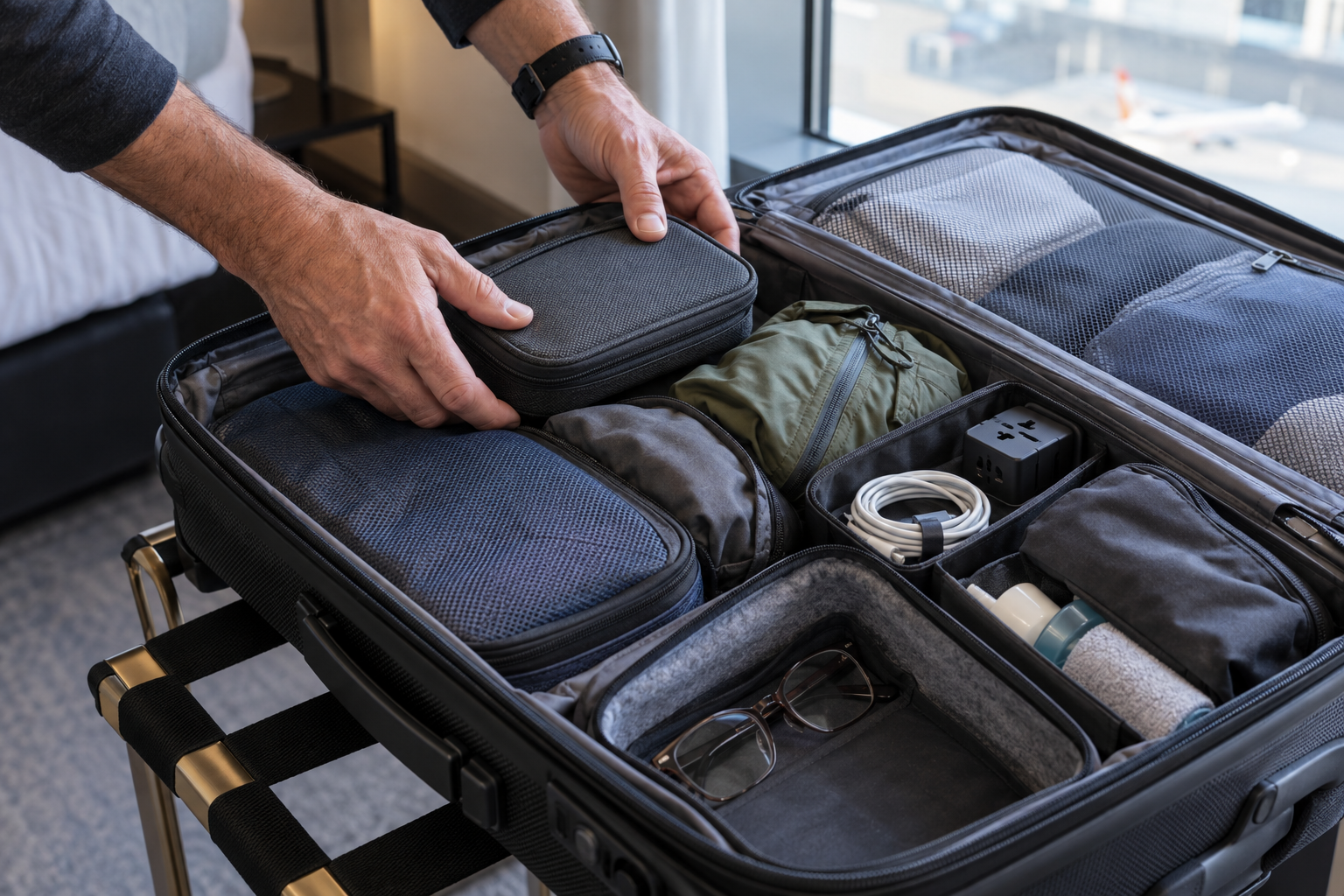
Pack the universal adapter in the personal item’s cable organizer pocket rather than the carry-on’s main compartment, ensuring it is accessible from the first hotel room arrival without any bag excavation. The adapter packed in the main compartment arrives at the hotel room already there but found only after the phone cable and the laptop cable and the toiletry kit have been removed from the bag first. The adapter in the cable organizer is plugged in within thirty seconds of entering the room. This is not a large improvement in absolute terms. It is the small frictionlessness that the international trip’s first evening benefit from — arriving, plugging in, and being charged without any unpacking or search that the cable organizer’s organization produces.

Insider Note

Research the specific destination’s voltage standard before packing. Most countries outside North America operate at 220-240V rather than the North American standard of 110-120V. Modern devices — laptops, phones, tablets — almost universally use switching power supplies that accept 100-240V input automatically, meaning the universal adapter is the only requirement for these devices at any destination. However, some hairdryers, electric shavers, and other personal care appliances do not accept the dual voltage and will be damaged by the 220-240V standard even through an adapter. Check the power rating label on any personal care appliance before bringing it on an international trip. The specific appliance model’s voltage range is printed on its power supply label and resolves the question definitively before packing rather than at the destination outlet.

Pack Medications You Cannot Guarantee Finding Abroad

The international destination’s pharmacy infrastructure varies from the highly comprehensive and accessible to the specific and limited, and the traveler’s ability to locate a specific medication at an international pharmacy varies from straightforward to genuinely difficult depending on the medication, the destination’s pharmaceutical regulations, the local brand names for equivalent products, the language barrier at the pharmacy counter, and the specific location within the destination — a major international city versus a rural area or a small island destination where the nearest pharmacy is a significant journey from the accommodation.

The medications to pack for international travel fall into two categories: the medications used regularly at home that the trip cannot do without (ongoing prescriptions, specific over-the-counter items whose consistent use is medically relevant, the specific brand of pain reliever that works reliably when others do not) and the destination-specific health preparations that the trip’s context requires. Consult a healthcare provider or a travel medicine specialist before any significant international trip — particularly travel to destinations with specific health risks, required vaccinations, or recommended prophylaxis — and pack the specifically recommended health preparations rather than assuming the destination’s pharmacies will provide any specific item on demand. This includes the specific antidiarrheal, the water purification tablets for destinations with uncertain water quality, the altitude sickness medication for high-altitude destinations, and any country-specific vaccination documentation or prophylaxis medication.

All medications travel in their original labeled containers in the carry-on rather than the checked bag. The carry-on medication is accessible throughout the travel day — during the long-haul flight, at the connection, at the destination’s arrival — rather than only at the accommodation after the checked bag arrives. Prescription medications should be accompanied by the original prescription documentation or a letter from the prescribing healthcare provider for any destination where the traveler may need to refill the prescription or explain the medication at customs. Some medications legal in the departure country are controlled or restricted at the destination — verify the specific destination’s import regulations for any non-standard medication before the trip rather than discovering the restriction at the arrival’s customs inspection.

Insider Note

Pack a small travel health kit alongside the specific medications: a broad-spectrum antidiarrheal, an oral rehydration packet, a basic antihistamine, and a thermometer. These four items together weigh under one hundred grams, cover the most common international travel health disruptions, and are consistently the items that the travel medicine consultation recommends and that the unprepared traveler buys at the destination pharmacy at the worst possible moment — the first evening when the stomach is processing the destination’s food adjustment, or the second morning when the allergy response to the new environment’s specific pollen is the reason the day’s plans need to adjust. Pack the kit. Use it if needed. It is available at the specific moment it is needed rather than at the pharmacy’s operating hours.

Helpful for Your Journey

Find Booking Ideas and Travel Essentials on Our Favorites Page

Our favorites page has helpful booking ideas and travel essentials that we have found genuinely useful for international travel. Whether you are planning your next international adventure or looking for resources that make global travel more organized and more confident, it is worth a look.

DND Favorites

Always Keep Your Most Important Documents in Your Carry-On

The passport, the boarding passes for all flight segments, the visa documentation where required, the travel insurance policy number and emergency contact, and the accommodation confirmations with physical addresses are the documents that the international trip requires at specific high-stakes moments throughout the journey — the immigration desk, the customs declaration, the airline gate, the hotel check-in, the taxi to the first accommodation in an unfamiliar city. Every one of these moments requires immediate document access at a time when the luggage may not be accessible, may be gate-checked, may be in the overhead bin during seatbelt restrictions, or may be at the baggage belt rather than in the traveler’s hand.

The document wallet in the carry-on’s outermost accessible pocket is the international traveler’s most important packing decision, and it is the packing decision that the traveler who put the passport in the checked bag discovers the significance of at the first passport check of the trip. Checked bags are inaccessible from the moment they are checked at the departure counter to the moment they arrive at the destination’s baggage belt — which includes the entire long-haul flight, the connection’s transit, the customs and immigration inspection, and the ground transport to the first accommodation. The passport in the carry-on is present at every one of these moments. The passport in the checked bag is not present at any of them.

Email copies of all critical international documents to a personal email address before departure: the passport data page, the visa documentation, all accommodation confirmations with addresses and check-in instructions, the travel insurance policy, the return flight confirmation, and the emergency contact information for the destination country’s embassy or consulate. The email backup is accessible from any internet-connected device anywhere in the world — the destination’s hotel lobby computer, the airport’s public terminal, the phone even if the passport itself has been lost or stolen — and provides the identity documentation and the logistical information that the lost document’s immediate replacement and the trip’s continuation both require. Five minutes before the international departure. The email that is never needed on most trips and is the specific email that makes the one trip where it is needed manageable rather than a crisis.

Insider Note

Research the specific destination’s entry requirements — visa, entry stamps, registration requirements, customs declaration procedures — before departure rather than at the destination’s airport. Entry requirements vary by nationality, destination, and current international relations, and change with some regularity. The visa that was not required at the last visit may be required at this one. The entry stamp that the previous passport received may trigger questions about the specific country at the current destination’s immigration. The destination’s official immigration and foreign ministry websites provide the most authoritative current entry requirement information, updated more reliably than travel blog advice that may not reflect the current requirements. The traveler who arrives at international immigration having researched the specific requirements is the traveler who moves through the desk efficiently. The traveler who arrives having assumed the requirements are the same as the last time is the traveler the desk asks to step aside.

The Complete Men’s International Packing System

The men’s international packing system assembles the neutral palette wardrobe, the international non-negotiables, and the document security into the single carry-on and personal item that cover every aspect of the international trip from departure to destination and back.

The wardrobe layer: the neutral palette — navy, grey, white, plus one additional neutral — built around the foundation trouser and the foundation shoe. Three to four tops in merino or travel-performance fabrics. One blazer or structured jacket worn on the travel day. One smart casual collared shirt. Two pairs of trousers for trips of seven days or more. Two shoe pairs: one on the body, one in the bag. The complete wardrobe packs to fifty to sixty percent of a standard carry-on’s volume.

The international essentials layer: the universal adapter in the cable organizer pocket of the personal item. The medication kit and the destination-specific health preparations in the carry-on’s accessible top section. The travel insurance documentation confirmed and the policy number accessible on the phone offline. The destination’s offline maps downloaded before departure. The destination’s entry requirements confirmed and the visa documentation present in the document wallet.

The document layer: the document wallet in the carry-on’s outermost pocket. Passport, boarding passes for all segments, visa documentation, accommodation addresses, travel insurance emergency number. All critical documents emailed to personal email before departure. Passport photocopied with the copy stored separately from the original — in the luggage or in the phone’s photo library.

Insider Note

The international carry-on’s most important quality is not that it fits in the overhead bin. It is that it arrives at the destination with everything the trip requires regardless of what happens to any checked luggage. The traveler who carries the carry-on — and only the carry-on — on international trips never loses the passport, never waits at the baggage belt, and never experiences the specific international travel disruption of the lost or delayed checked bag arriving without the items needed for the first day. Carry-on international travel is the most resilient international travel format available. The neutral palette wardrobe that fits in the carry-on is the specific packing approach that makes this resilience possible. Build it once. Use it every trip. Improve it after each one.

The International Arrival That Changed How He Packed for Every Trip After It

Leon had taken international trips before this one and had checked a bag on every one of them. The international trip was different from the domestic trip, he reasoned, because the occasion range was broader, the duration was longer, and the uncertainty of the destination’s specific requirements warranted the additional clothing that only a checked bag could accommodate. Adaeze had been carry-on only for every trip they had taken together, domestic and international, and had arrived at every international destination at the same time as the other carry-on passengers while Leon waited at the baggage belt with the checked luggage passengers, typically for between fifteen and twenty-five minutes.

The specific international trip where the system changed was a ten-day trip to a European city sequence — three cities, each with its own character, each requiring clothing that worked across the cultural sites, the restaurant dinners, and the casual city walking that the days produced. Leon packed for ten separate days, one outfit per day, with additional options for scenarios he was uncertain about and backup options for weather variations the forecast suggested. The bag weighed twenty-three kilograms. He paid the overweight fee without discussion because he had paid overweight fees before.

At the first city’s arrival, Adaeze cleared immigration and was at the taxi stand by the time Leon’s bag appeared at the belt, twenty-two minutes after the aircraft door opened. At the second city, the airline informed him at the gate that the aircraft was full and his bag needed to be checked at the gate. It would be available at the destination’s baggage belt rather than at the aircraft door. The second city’s bag arrived forty minutes after the aircraft landed. The afternoon’s first activity was already underway when Leon reached the accommodation. At the third city, the bag arrived with a broken wheel from the transit handling. Leon spent forty minutes of the third city’s first morning at the airline’s baggage services desk completing the damage report.

The return trip from the third city had a four-hour layover at the hub. Leon spent one hour of it buying a cheap replacement wheeled bag at the airport’s travel shop. He spent the remaining three hours thinking about what he had actually worn across the ten days. The specific items: three tops he had worn repeatedly. One trouser. The blazer he had put on for the restaurant dinners. The casual shoe worn every day. The dress shoe worn twice. Everything else had been in the bag and on his back and at the baggage belt and at the airline damage desk and in the airport shop’s purchase receipt. Everything else had not been worn.

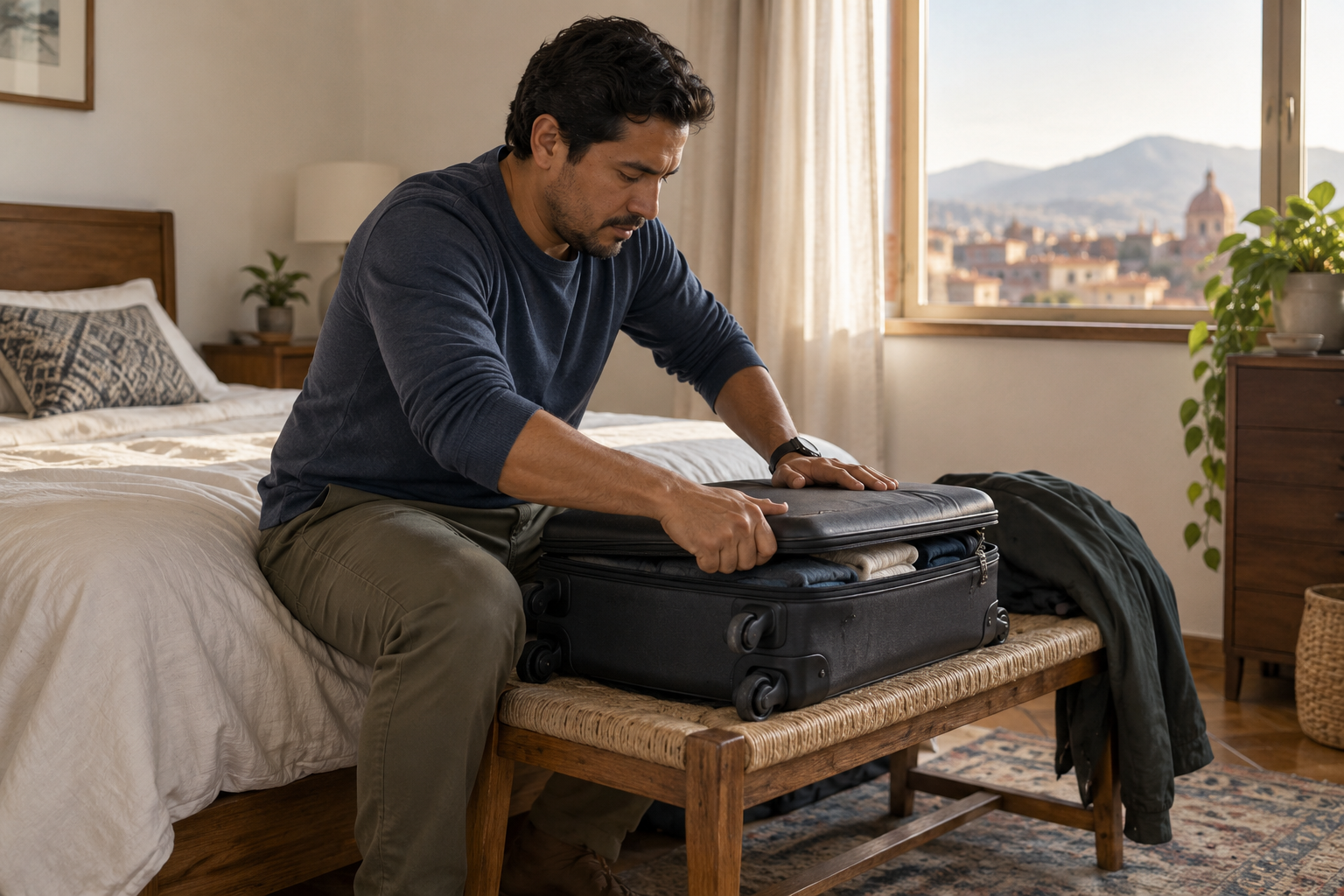
The next international trip was packed in a carry-on. Navy and grey. Three tops in merino. One trouser. The blazer on the travel day. The dress shoe on his feet and the casual shoe in the bag. The universal adapter in the cable organizer. The medications in the accessible top section. The document wallet in the outermost pocket. The bag passed the carry test. At the destination, he walked off the aircraft, through immigration, past the baggage belt area, and out of the arrivals hall at the same time as the other carry-on passengers. Adaeze was already there. He had not been behind her by twenty-two minutes at a baggage belt for the first time on an international trip. He has not checked a bag on an international trip since. This article is the bag he built from the broken wheel, the damage report, and the arrival he kept missing while he waited for the bag to appear.

Six More Men’s International Packing Hacks

Beyond the four core international packing principles, these six additional approaches address the specific international travel scenarios the core system does not fully cover.

Pack a portable battery bank in the carry-on’s personal item for the travel day’s device charging independence from outlet access. The international travel day often produces the specific device battery scenario of the long layover at a hub airport where every outlet is occupied, the gate without any visible outlets, and the phone at eleven percent when the boarding call comes for the eight-hour second segment. A compact portable battery bank — ten thousand milliamp hours charges most smartphones twice — in the personal item’s accessible pocket provides the travel day’s charging independence regardless of airport outlet availability, and is fully charged at home the evening before departure rather than competed for at the departure gate.

Research and note the destination country’s emergency services number before departure and save it in the phone’s contacts alongside the travel insurance emergency line. The international emergency services number — 999 in the UK, 112 in Europe, 000 in Australia, 119 in Japan and Korea, varying by country — is not the same as the departure country’s standard and is the specific number the traveler in an emergency at an international destination needs to reach. This thirty-second research is done before departure rather than at the moment the knowledge is needed, which is the specific reason to do it.

Pack a silk sleep sack or a lightweight sleeping bag liner for budget accommodations, overnight trains, and long-haul ferry crossings where the provided bedding’s cleanliness is uncertain or the bedding is not provided at all. A silk sleep sack weighs under two hundred grams, compresses to the size of a large fist, and provides the specific comfort and hygiene buffer that budget-category international accommodations occasionally require. It is not the luxury sleep system. It is the specific item that converts the concern about the hostel’s sheets into a non-issue for the overnight train segment of the route.

Choose a daypack that fits under the seat in front on aircraft and doubles as the international exploration pack for each destination. The daypack serves as the personal item on the flight — holding the long-haul essentials: headphones, snacks, documents, water bottle — and as the daily exploration bag at each destination: holding the camera, the guidebook, the day’s water bottle, the light layer for the temperature-managed museum interior, and the jacket for the evening. The single bag in two contexts reduces the packing by one dedicated travel day bag and one dedicated exploration bag while fully serving both roles.

Research the specific destination’s tipping norms, currency situation, and expected cash access before departure. Some international destinations are primarily cash economies where ATM access is limited and card payment is not standard. Some have specific tipping expectations that differ significantly from the departure country’s norms. Some have currency restrictions on the amount imported or exported. The thirty minutes of pre-departure financial research produces the cash supply and the card backup that the specific destination requires, rather than the arrival discovery that the ATM at the destination airport was out of service and the card was not accepted at the accommodation.

Pack a small combination lock for any accommodation with locker storage — hostels, budget hotels with shared facilities, overnight trains with luggage storage areas. A combination lock weighs under forty grams, fits in the daypack’s exterior pocket, and is the specific security item that makes budget international accommodation’s shared storage genuinely usable rather than theoretically available but practically impractical without a lock the accommodation typically does not provide. The combination lock is the forty-gram international packing addition that makes a meaningful difference at the specific accommodation type that budget-conscious international travel regularly involves.

Insider Note

The international packing system’s most important property is not its weight or its volume. It is its resilience — the ability to continue the trip at full function regardless of what happens to any specific item during international transit, which is the most luggage-handling-intensive travel format available. A carry-on that contains the passport, the adapter, the medications, the clothing for the full trip, and the critical documents is a carry-on whose loss or theft constitutes a significant disruption. A carry-on whose contents are backed up — the documents emailed, the passport photographed, the critical items distributed between the carry-on and the personal item rather than concentrated in one bag — is a carry-on that a trip can continue from even in the worst case scenario. Pack the backup. Email the documents. Travel prepared for the unlikely event and present for the trip the likely event produces.

Book With Us

Book the International Trip Worth Building This System For

The international trip that earns the carry-on wardrobe is the trip that moves — the multi-city route, the cultural deep dive, the adventure itinerary — where the light bag’s freedom is felt at every transit and every arrival. Our travel agents build those trips. Let us plan yours.

Book A Trip

International Packing Mistakes That Add Weight and Friction to Every Trip

Each of these is a Leon story. Each has a neutral-palette carry-on resolution.

1

Packing one outfit per day in isolated outfit units rather than a versatile neutral palette

Ten days of isolated outfit units requires ten days of items at ten times the bag volume of the wardrobe that produces the same ten days through combination. The neutral palette that produces twelve looks from six items is the international packing approach that fits in the carry-on. The one-outfit-per-day approach is the approach that fills the checked bag, produces the overweight fee, and arrives at the belt twenty-two minutes after the carry-on passengers have already cleared arrivals.

2

Not bringing a universal adapter and discovering the outlet standard is different at the destination

The universal adapter is one hundred and fifty grams. The hotel’s front desk loaner is typically unavailable when needed. The destination’s airport shop’s replacement is expensive and often limited. The universal adapter purchased at home before departure weighs less than a passport and is present at every outlet in every country for the product’s full useful life. Pack it. Carry it in the cable organizer. Never look for an outlet in a different country without it.

3

Assuming the destination’s pharmacy will have the specific medication needed

The destination’s pharmacy has the medication the destination uses for the condition the traveler has, in the brand the destination sells, in the regulation the destination’s pharmaceutical system applies, at the counter the traveler must communicate with in the destination’s language. Bring the specific medication from home. Bring enough for the full trip plus a buffer. Consult a healthcare provider before the trip for the destination-specific health preparations. The travel health kit is the hundred grams that converts the international stomach situation from a pharmacy navigation challenge into a managed inconvenience resolved at the hotel.

4

Putting the passport or critical documents in the checked bag

The checked bag is inaccessible from check-in to baggage belt. Every immigration desk, every customs inspection, every gate scanner, and every accommodation check-in between those two points requires the passport that is in the bag that is not accessible at any of those points. Documents in the carry-on’s outermost pocket. All of them. Every international trip. Without exception.

5

Not emailing document copies to a personal email before international departure

The document copies emailed before departure are never needed on most trips. On the trip where the passport is lost or the phone is stolen or the carry-on is gate-checked at the wrong moment, they are the specific backup that makes the problem manageable rather than a crisis. Five minutes. Personal email. The passport page, the travel insurance, the accommodation addresses, the return flight confirmation. Every international trip. The email costs five minutes and occasionally saves the trip.

6

Not researching the destination’s entry requirements before departure

Entry requirements — visa, vaccination records, customs declaration specifics, currency limits — change, vary by nationality, and are enforced at the destination’s immigration desk rather than communicated at the departure gate. The traveler who researched the requirements before departure arrives at immigration with the correct documentation confirmed and in hand. The traveler who assumed the requirements were unchanged from the last visit negotiates the desk with whatever they have. Research the specific requirements from the destination’s official sources before every international trip.

Turn Travel Into Income

Love Helping Men Pack Smart and Travel the World More Freely?

International travel bookings are among the most meaningful travel agent work. If becoming a home-based travel agent who helps people discover the world with confidence sounds like the right next step, see how the TravelPreneur system works.

Become An Agent

Frequently Asked Questions

These are the questions men ask most often before packing for international travel.

How do you pack for a two-week international trip in a carry-on?

A two-week international carry-on trip requires the neutral palette wardrobe, merino wool or travel-performance fabrics that manage odor through multiple wearings, one mid-trip laundry session (available at most international accommodations and most destination cities’ laundromats), and the two-shoe approach with the bulkier shoe worn on the travel day. The clothing count for a two-week carry-on trip with one mid-trip laundry session: three to four tops (merino wool for the base layers), two pairs of trousers, one blazer worn on the travel day, two shoe pairs, and the decanted-to-trip-size toiletry kit. This wardrobe fits comfortably in a standard carry-on with volume remaining for the universal adapter, the medication kit, and the electronics. The two-week international carry-on trip is achievable for most men and is standard practice for experienced international travelers regardless of the trip’s occasion range.

Do you need to declare anything at international customs?

Customs declaration requirements vary by destination country and by the specific items being imported. Most countries require declaration of amounts above specific thresholds of cash or cash equivalents, commercial goods in quantities suggesting import for resale, food items including fresh produce and meat products (prohibited at most international borders), prescription medications above a personal-use supply quantity, and items of significant value above a duty-free threshold. The specific declaration requirements for any destination are available from the destination country’s customs authority website and from the customs declaration form distributed on the inbound flight. Always complete the declaration form honestly — declaring an item does not automatically mean paying duty, but failing to declare an item subject to declaration may produce penalties significantly more significant than any duty owed. When uncertain whether a specific item requires declaration, declare it. The customs officer’s guidance on declared items is the correct guidance for that specific item at that specific border.

What is the best way to carry a passport safely when traveling internationally?

The passport is most safely carried in a document wallet in the carry-on’s outermost accessible pocket during transit and stored in the accommodation’s safe or in the room’s secure location during the daily exploration at the destination. At most international destinations, carrying the passport on the person during daily sightseeing is not required — a high-quality passport photocopy and the accommodation card with the address are sufficient for most daily identification situations while the original passport is stored securely at the accommodation. In some destinations, carrying the original passport or a certified copy is specifically required by local regulations; research the specific destination’s requirements before the trip. A slim RFID-blocking passport holder provides modest additional protection for electronic passport data for travelers concerned about electronic skimming, though the practical risk in most destinations is low. The most important passport security practice is the emailed copy and the photocopy stored separately from the original, which makes the lost passport situation a manageable disruption rather than a trip-ending event.

How do you handle money and payments when traveling internationally?

The most reliable international payment approach uses a combination of a no-foreign-transaction-fee credit or debit card for the majority of purchases and a modest amount of local currency cash for the specific situations where cards are not accepted — small vendors, markets, transit systems, tips, and rural or less commercially developed areas. The no-foreign-transaction-fee card avoids the two to three percent fee that standard credit cards charge on international purchases, which accumulates meaningfully across a ten-day international trip’s purchases. Research the specific destination’s card acceptance norms and cash dependency before departure; some destinations are primarily card economies where cash is rarely needed, while others remain primarily cash economies where card acceptance is limited to major hotels and international chain restaurants. Withdraw local currency from an international ATM at the destination rather than exchanging currency at the airport’s currency exchange desks, which typically offer significantly worse exchange rates than the bank ATM’s current market rate. Notify the card issuer of the travel dates and destinations before departure to prevent security blocks on international transactions.

What is the best bag for international carry-on travel for men?

The best carry-on bag for international travel for any specific man is the bag that meets the specific airlines’ carry-on size limits for the routes being traveled, provides a dedicated laptop sleeve accessible from the exterior for security checkpoints, has multiple exterior pocket access for the document wallet, adapter, and personal care items this article describes, fits under the international aircraft’s overhead bin without excessive effort, and suits the traveler’s personal aesthetic for the destination’s context. Hard-shell carry-ons protect contents from compression damage but do not flex to fit into overhead bins with limited remaining space. Soft-shell carry-ons provide volume flexibility at the cost of content protection. Both formats are used successfully by experienced international travelers. The specific dimensions, construction, and brand that best serve any individual traveler’s international packing habits and routes are best identified through current carry-on bag reviews from travel-focused platforms rather than general retail product pages, as international airline carry-on standards vary and the best current products change as new options enter the market.

How do you pack for international travel to destinations with very different climates or seasons?

Multi-climate international travel — the trip that moves from warm coastal lowlands to cold mountain highlands, for example — is the packing scenario where the layering principle produces its highest return. The same neutral palette base pieces worn across the full temperature range, supplemented by a packable down jacket and a merino mid-layer for the cold segment, produces the multi-climate international wardrobe from a carry-on that would be impossible with separate warm and cold wardrobes packed for each segment. The packable down jacket compressed to its stuff sack, the merino wool base layer that manages temperature across a wide range, and the blazer that serves as both a smart casual garment and a cold weather outer layer in moderate temperatures together cover the full multi-climate international trip’s thermal requirements from a carry-on’s interior. Research the specific temperature ranges at each destination segment before packing to confirm the specific combination of packable layers that the trip’s full climate range requires rather than over-packing for a cold segment that turns out to be mild.

The man who walked past the baggage belt at the international arrival carried everything he needed in one bag that fit in the overhead bin. He packed less than he planned. He arrived before everyone who did not. He has never packed any other way for an international trip since.

Picture the International Arrival Hall

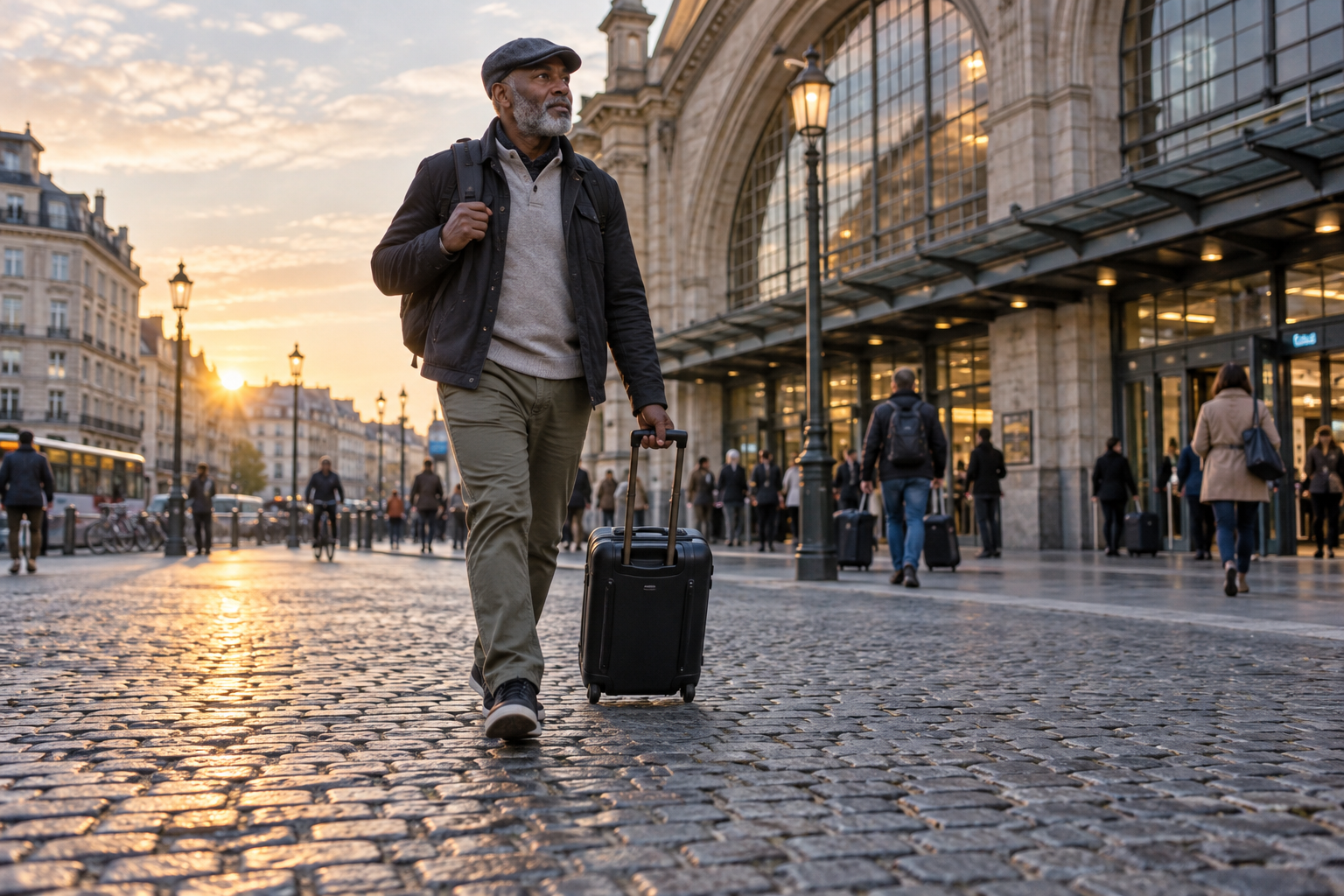
The carry-on is in the overhead bin. The document wallet is in the outermost pocket. The passport cleared immigration. The universal adapter is in the cable organizer. The medications are in the accessible top section. The bag is off the overhead bin before the aircraft door is fully open. Immigration cleared. Customs passed. The arrivals hall is ahead. The baggage belt area is to the left. You walk past it to the right. You are out of the arrivals hall. The trip has begun. You brought less than you planned. You spent zero time at the belt. That is the system. That is every international trip from here.

Free Download

One More Thing Before Your Next International Trip

Print our free Travel Packing Checklist and use the men’s international section to build the carry-on from the neutral palette foundation, confirm the universal adapter is in the cable organizer, verify the medications are packed, and confirm all critical documents are in the outermost pocket and emailed to personal email. The same checklist we recommend before every international trip.

Get the Free Checklist

Explore Our Top Picks for a Better Trip

Visit our favorites page for helpful booking ideas and travel essentials that we have found genuinely useful for international travel. Whether you are planning your next international adventure or looking for resources that make global travel lighter and more confident, it is worth exploring.

See Our Top Picks

Travel Prints and Printables From Our Shop

Visit Premier Print Works for international packing checklist printables, travel planners, wardrobe capsule guides, travel journals, and wall art that makes every international trip a little more beautiful and a lot more organized — from the evening the neutral palette is assembled to the arrival hall where the belt is walked past and the trip has already begun.

Visit Premier Print Works

Disclaimer

The information shared in this article is provided by Don and Diana’s Travels for general informational, educational, and inspirational purposes only. It reflects our personal experiences, opinions, and the experiences of travelers we have worked with. It is not professional medical, legal, financial, or travel advice.

Medical and Medication Information

All medication decisions for international travel must be made in consultation with a qualified healthcare provider or travel medicine specialist. Always confirm appropriate medications for the specific destination, travel context, and individual health circumstances before any international trip. The medication information in this article is general educational guidance and is not a substitute for professional medical advice.

Entry Requirements and Customs

International entry requirements, visa policies, customs regulations, and declaration requirements change frequently and vary by nationality, destination, and specific circumstances. Always verify current requirements from official government sources before any international trip. We are not responsible for any border, customs, or immigration outcome arising from information in this article.

Financial and Currency Information

Currency, payment, and financial information in this article is general guidance and may not reflect current exchange rates, card acceptance norms, or local regulations. Always research current financial conditions at the specific destination before travel. We are not providing financial advice.

Airline Baggage Policies

Carry-on size limits and baggage policies vary by airline, fare class, and route. Always confirm current policies before travel.

Affiliate and Partner Links

This article may contain affiliate and partner links that pay us a commission. Our recommendations are based on real use and genuine belief in the products and services we share.

Health, Safety, and Personal Responsibility

Travel involves personal risk. You are solely responsible for your own health, safety, and travel decisions. We strongly recommend comprehensive travel insurance for every international trip. Don and Diana’s Travels accepts no liability for any loss, injury, delay, or inconvenience arising from information in this article.

Composite Stories

Stories on this site combine real experiences from Don, Diana, clients, and travelers we have worked with. Details may be adjusted for privacy and narrative clarity.

No Guarantees

We do not guarantee any specific result from using the information in this article. Your results depend on your own choices and circumstances.

Copyright and Use

All content is the copyrighted property of Don and Diana’s Travels. You may not copy or republish our content without prior written permission. You are welcome to share a direct link with proper credit.

By reading this article, you acknowledge that you have read and agree to this disclaimer.