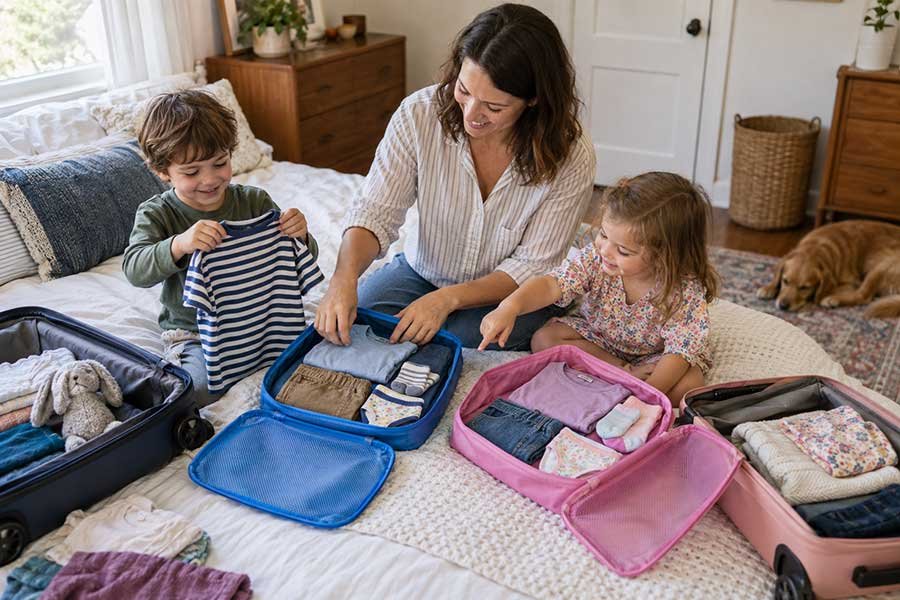
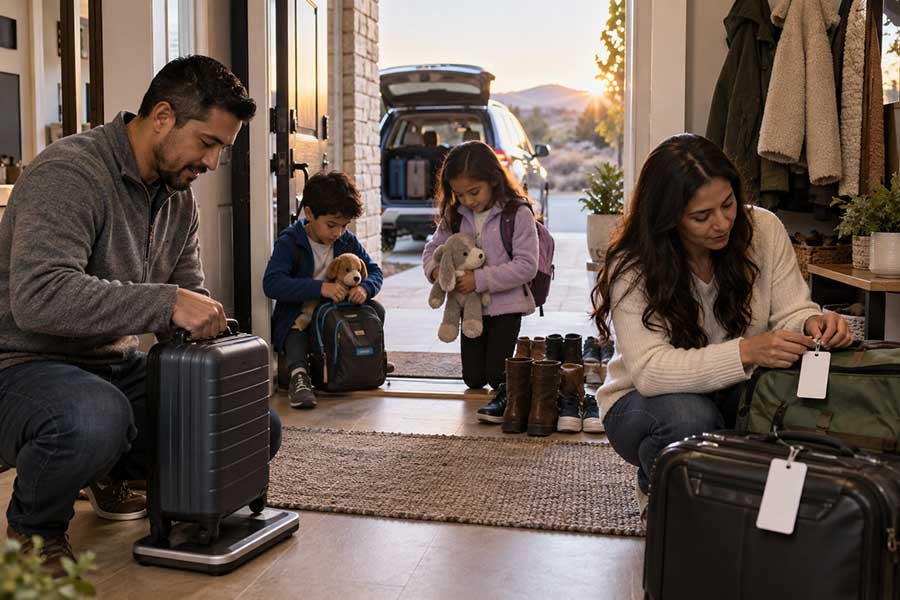
Packing for kids works best when the kids are part of the process. The parents who travel most smoothly with kids are the ones who built a packing system once and used it on every trip after that. This article is that system — built once, used forever, and genuinely better every time the family travels with it.

Best For
Families With Kids of Any Age
Vibe
Organized, Calm, Prepared
Read Time
12 Minutes
Walk Away With
The Reusable Family Packing System
Free Download

Grab Our Travel Packing Checklist

Our free packing checklist includes a family section organized by the child-ownership system this article describes — each child’s backpack, the activity bag, the snack kit, and the carry-on change of clothes — so the family packing session has a framework rather than a free-for-all. Print it before the next family trip.

Get the Free Checklist

Give Each Child Their Own Backpack With Their Own Responsibility Items

The family packing session without individual child ownership is the packing session where the parents pack for everyone — every child’s items disappearing into the family’s collective luggage where they are accessible in theory and located by excavation in practice. The child’s stuffed animal is in the large checked bag. The child’s specific comfort item is in the carry-on under the clothing. The child’s preferred activity is somewhere in the family bag that someone else is carrying. Every request from the back seat or the aircraft seat for a child-specific item requires the adult to locate, access, and retrieve it from the family bag’s general inventory while managing whatever else the travel moment requires.

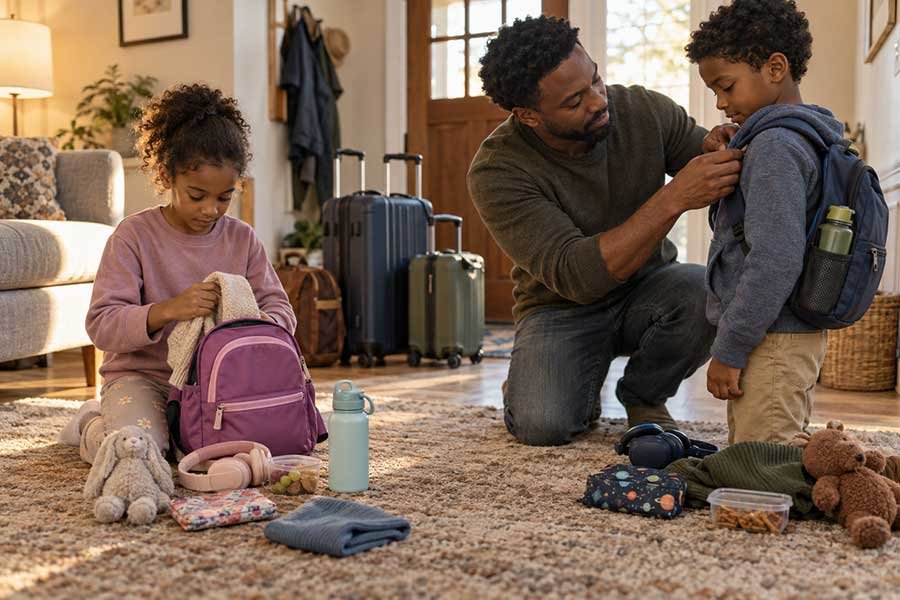
The individual child backpack — sized and configured for the specific child’s age and carrying capacity — changes the ownership model of family travel from parents managing everything for everyone to each child managing their own specific travel category. The backpack’s contents are the child’s responsibility items: the items that belong to the child, travel with the child, and are managed by the child throughout the trip. For a child five years and older, the backpack’s responsibility contents typically include the small stuffed animal or comfort item, the headphones or earbuds, the tablet or device in its protective case, the water bottle in the exterior pocket, and the small activity kit for waiting moments. The child carries the backpack through the airport. The child locates their own comfort item on the aircraft. The child manages their own device rather than asking the adult to retrieve it from the family bag. The adult manages the logistics. The child manages their own zone.

The responsibility backpack also builds the child’s genuine travel competence across trips. The five-year-old who carries and manages a small backpack on the first trip is, by the third trip, a child who packs their own backpack from a simple list and announces when the backpack is ready. By the fifth trip, the child’s backpack preparation has become a natural part of the family’s departure system, and the child’s ownership of their travel experience has produced the specific child traveler who is engaged with the journey rather than managed through it. The system builds itself across trips. The investment is in the first one.

The parents who travel most smoothly with kids are the ones who built a packing system once and used it on every trip after that.

Packing for kids works best when the kids are part of the process — because the child who packed their own backpack is the child who knows exactly where everything is.

Insider Note

Create a simple visual packing list for each child’s backpack — a printed or laminated card with pictures for young children who cannot yet read — and make the backpack packing a pre-trip ritual rather than an adult task. The child who checks their own list and confirms each item is present before the backpack is zipped is doing the ownership work of the system from the beginning. The list card stays in the backpack between trips and is used every time. By the second trip, the child does not need the card to check. By the third trip, the child may not need the card at all. The list card is the training wheels of the child’s travel ownership. It comes off when the child is ready.

We Plan Family Adventures

Let Us Book the Family Trip Worth Packing This System For

The family packing system works best when the destination on the other end is worth the preparation. Tell us where you want to take the family. We will plan the itinerary and book the accommodations that work for every age in the group. You build the system. We find the destination.

Plan Our Escape

Pack a Dedicated Travel Day Activity Bag

The travel day — the airport, the flight, the connection, the transit from the destination airport to the accommodation — produces the specific combination of waiting, confined sitting, and transition logistics that is the most activity-intensive period of any family trip from the children’s experience. The entertainment and activity needs of the travel day are distinct from the destination’s needs: they are the waiting-room games, the security-queue distractions, the gate-area activities that prevent the pre-boarding energy from becoming the pre-boarding challenge, and the in-transit engagement that makes the travel day feel like part of the trip rather than the obstacle before it.

The dedicated travel day activity bag — a separate, accessible bag distinct from the children’s individual backpacks and the family’s main luggage — holds the travel day’s specific engagement items: a new small toy or activity that was purchased specifically for the trip and revealed at the airport rather than at home (the novelty produces genuine engagement that the familiar toy does not); a selection of sticker books, small colouring pages, or a dry-erase activity board; a deck of travel-sized playing cards; a small container of modelling clay or a travel activity kit; and the headphone-and-device combination for the screen time portion of the travel day. The bag is assembled before departure, stored in the accessible top layer of the carry-on or the personal item, and opened at the airport’s first waiting moment.

The new small toy or activity is the travel day activity bag’s highest-return item and its lowest-cost one. A small new toy — a mini figure, a puzzle, a travel-sized board game, a small craft kit — purchased for under ten dollars and withheld until the airport produces forty-five minutes to an hour of genuine engagement from the novelty effect alone. The child who received the new toy at the departure gate’s seating area is occupied for the boarding wait, often still occupied during the early flight, and has a specific memory of the travel day as the day the new toy arrived. The travel day activity bag is the investment in the travel day being a part of the trip rather than the part the trip has to recover from.

Insider Note

Rotate the travel day activity bag’s contents rather than using the same items on every trip, and let the children know that the bag has something new inside that they have not seen yet. The anticipation of the new item — built by mentioning it in the days before the trip without revealing what it is — produces the specific pre-trip excitement that extends from the home to the airport to the bag’s opening at the gate. The child who is excited about the bag’s contents is the child in the airport’s gate area who is asking to open the bag rather than asking how long until the flight. Same bag. New contents. New anticipation. Every trip.

Bring Twice as Many Snacks as You Think You Need

The snack calculation for family travel with children follows a simple and consistently underestimated formula: the number of snacks that seems sufficient for the travel day, doubled. Not as a precaution against the rare exceptional travel day. As the accurate estimate for the normal travel day, because children’s snack needs during travel are governed by a combination of hunger, boredom, anxiety, and the specific appetite-amplifying effect of waiting in novel environments that does not respond to the same hunger management that normal daily snack quantities address. The child who eats a normal mid-morning snack at home does not eat a normal mid-morning snack at the airport. They eat the mid-morning snack plus the check-in-queue snack plus the security-wait snack plus the gate-area snack plus the boarding snack that happened because there was twenty minutes before boarding and everyone was hungry again.

The family travel snack kit: a parent-managed bag with the full doubled quantity of each child’s preferred snacks, distinct from the children’s individual backpack snack pouches (which hold the child-managed portion). The parent-managed snack kit covers the snack requests that arrive faster than any pre-travel estimate predicted, the sibling whose individual pouch was consumed early, the travel day’s unexpected extension when the connection is delayed and the airport food options are the airport food options, and the accommodation arrival’s hungry family who needs something before dinner can be arranged. The parent-managed kit is never the snack the parent planned to eat before the child asked. It is always larger than the first trip’s estimate suggested it needed to be.

Include snacks that address the range of travel day hunger moments: the savory snack for the mid-travel hunger that sweetness does not satisfy, the fruit or fruit snack for the quick energy mid-afternoon moment, the protein item for the sustained energy across the delayed connection, and the small treat for the travel milestone — the landing, the accommodation arrival, the first destination moment — that makes the travel day feel celebrated rather than endured. The snack kit’s variety is as important as its quantity, because the child who is hungry for something specific at hour seven of a travel day and cannot find it in the snack kit is in a different emotional state from the child who reaches into the snack kit and finds the thing they were hoping was there.

Insider Note

Pack the family travel snack kit in a reusable bag that is clearly visually distinct from the children’s individual snack pouches — a different color, a different size, a labeled tag. The visual distinction prevents the child from accessing the parent-managed reserve during the portions of the travel day when the individual pouch is the intended food management. The parent-managed kit stays in the carry-on’s top accessible section for the parent to distribute when needed. The individual pouches stay in the children’s backpacks for child-managed access. The visual distinction between the two is the physical boundary that maintains the system’s two-tier snack management without requiring the parent to verbally manage the boundary at every snack moment of the travel day.

Helpful for Your Journey

Find Booking Ideas and Travel Essentials on Our Favorites Page

Our favorites page has helpful booking ideas and travel essentials that we have found genuinely useful for family travel. Whether you are planning the next family adventure or looking for resources that make traveling with kids more organized and more enjoyable, it is worth a look.

DND Favorites

Always Include a Change of Clothes for Every Family Member in the Carry-On

The change of clothes in the family carry-on is the preparation that addresses the specific travel-with-children scenarios that children’s travel reliably produces: the spilled drink that soaks through to the skin at hour two of a five-hour flight. The motion sickness that was unexpected but in retrospect perhaps not entirely surprising given the turbulence and the snack quantity. The nappy or toileting accident that the normal travel day’s schedule extension and the child’s specific travel digestion schedule together produce at a moment that the destination’s accommodation cannot provide the fresh clothes the situation requires for another three hours. Each of these scenarios, handled with a change of clothes available in the carry-on, is a manageable travel moment. Handled without, it is the specific family travel story that gets told for years as the worst part of the trip.

Every family member — not just the youngest child — needs a change of clothes in the carry-on. The parent who packed a change of clothes for the toddler but not for themselves is the parent who manages the toddler’s accident cleanly and efficiently and then spends the remainder of the flight in the specific discomfort that the toddler’s management required. Each family member: one top, one pair of underwear or nappy, one pair of socks. The toddler and younger child add a full outfit change including bottoms. The total for a family of four — two adults, two children — is under five hundred grams and rolls into approximately the volume of a dinner plate in the carry-on’s main compartment. The weight is negligible. The return is potential and occasionally very high.

Pack the changes of clothes in a single clear zip bag at the accessible top of the carry-on’s main compartment, with each person’s change labeled if the children’s sizes are similar. The clear bag means the changes are identifiable in under three seconds at the aircraft’s lavatory or at the airport’s restroom without any carry-on excavation. The label means the correct size is retrieved without the trial-and-error that the unlabeled mixed-size contents of an opaque bag produce. The accessible position means the bag is reached without standing, without the overhead bin, and without any disruption to the family’s seated configuration in the aircraft row.

Insider Note

After any travel day that required the change of clothes — for any family member — replace the used item in the carry-on bag the same evening at the accommodation before the next travel segment. The carry-on change of clothes that is used and not replaced is not available at the next travel day’s moment that requires it, which is frequently the connection or the return journey rather than the initial departure. The replacement takes two minutes, produces the same preparation for the next segment that the initial packing produced for the first, and is the specific post-incident action that converts the change of clothes from a one-use preparation into a consistent travel resource that is always present and always ready.

The Complete Family Packing System

The family packing system that gets built once and used on every trip after is organized around ownership layers: what each child owns and manages, what the travel day bag provides, and what the family carry-on holds for everyone.

Each child’s layer: the individual backpack containing the responsibility items — comfort item, device, headphones, water bottle, individual snack pouch, small activity kit. The backpack is the child’s to pack from their visual checklist, carry through the airport, and manage at their seat. The parent confirms the backpack is complete before departure but does not pack it. The child packs it.

The travel day layer: the dedicated activity bag with the new toy or activity revealed at the airport, the sticker book or activity pages, the travel cards, and the secondary entertainment for the waiting and transit moments. The activity bag is the parent’s responsibility — assembled before departure, stored in the accessible carry-on top layer, opened at the airport’s first waiting moment.

The family carry-on layer: the parent-managed snack kit with doubled quantity in the visually distinct bag, the change of clothes for every family member in the clear labeled zip bag at the carry-on’s accessible top, the toiletry kit and the family travel essentials, and the destination items in the packing cubes below. The carry-on holds what every family member needs but what no family member manages individually — the communal resources of the family travel system.

The packing session for this system: two evenings before departure, the children pack their backpacks with the checklist card. The evening before, the adult assembles the travel day activity bag, the snack kit, and confirms the carry-on change of clothes bag. The departure morning is breakfast, backpacks on, and the door. The system has already been run. The departure is the execution of yesterday’s preparation.

Insider Note

After each trip, spend ten minutes updating the family packing system based on what was used and what was not. The snack quantity that ran out by mid-afternoon needs adjusting upward for the next trip. The activity bag item that did not get opened can be rotated to the next trip’s new-item reveal. The change of clothes size that the child has grown out of needs replacing before the next departure. The ten-minute post-trip system update converts the family packing system from a static list into a living system that improves with each trip rather than repeating the same gaps. By the family’s fifth trip with the system, it produces a packing session that runs in one focused evening and a departure morning that is calm. That is the return on building it once.

The Packing Session That Became the System

Priya and Marcus were organized people who became temporarily disorganized people at the packing stage of every family trip. At home, they had systems for everything. On the morning before a family flight, the systems evaporated and were replaced by the specific family packing dynamic of two adults making simultaneous decisions about four people’s items with incomplete information, competing priorities, and a departure time that was already closer than either of them had planned for when they started.

On a specific trip — a four-day family flight to a beach destination with their two children, ages four and seven — the packing session began the morning of departure because the previous evening had been the children’s school event and there had simply been no time. Priya packed both children’s clothing into the family checked bag while Marcus packed the carry-on with everything else. The seven-year-old’s specific comfort item — a worn fabric rabbit that was the non-negotiable sleep companion — went into the checked bag because it was a clothing item and Priya was packing clothing. The comfort rabbit arrived at the destination on the baggage belt two hours after the family did, which was also the two hours during which the four-year-old had an entirely predictable travel-day overflow moment and the clean change of clothes that Marcus had thought about but not actually packed was not in the carry-on when the situation required it. The checked bag was eventually retrieved. The seven-year-old had managed the rabbit’s absence for two hours. The four-year-old had managed the absence of a clean shirt for the same two hours in a way that was less quiet about it.

That evening, in the accommodation, Priya and Marcus made the list. The comfort rabbit travels in the child’s backpack, managed by the child. Each child gets a backpack with their own responsibility items — theirs to pack, theirs to carry, theirs to know where everything is. The change of clothes for every family member goes into a labeled clear bag in the carry-on’s top accessible position, packed the evening before departure. The snack kit is doubled and distinctly packaged from the children’s individual pouches. The activity bag is assembled with one new item to reveal at the airport.

The next trip’s packing session happened over two evenings rather than one departure morning. The seven-year-old packed her own backpack from the laminated checklist card Priya had made. The rabbit was in the backpack and the seven-year-old confirmed it herself. The four-year-old packed her backpack with help, including her comfort item, which she located independently because it was her backpack and she knew exactly where it was. The carry-on change of clothes bag was labeled and at the top of the carry-on. The snack kit was larger than the previous trip’s by exactly the amount the previous trip had revealed was needed. The departure morning was breakfast and backpacks and the door. Priya looked at Marcus as they locked the front door. The house was as quiet as a house can be with a four-year-old and a seven-year-old ready for a trip. This article is the system they built from the evening in the beach accommodation with the fabric rabbit and the unlabeled carry-on bag.

Six More Packing Hacks for Families Who Travel With Kids

Beyond the four core family packing principles, these six additional approaches address the specific family travel packing scenarios the core system does not fully cover.

Use packing cubes color-coded by family member so any item can be located in the family bag by opening the correct cube rather than excavating the full bag. A navy cube for the parent, a green cube for the older child, a pink cube for the younger child — consistent across every trip so the color-to-person association becomes automatic. The family bag with packing cubes is the family bag where the seven-year-old’s specific item is found in under thirty seconds by opening the green cube. The family bag without packing cubes is the family bag where the same item is found after the full bag is searched and everything else is temporarily arranged on the accommodation bed.

Pack each child’s complete outfits together rather than tops in one section and bottoms in another. A complete outfit — top, bottom, underwear, and socks rolled or bundled together — means that the morning’s clothing decision for each child is a single retrieval from the packing cube rather than a multi-item assembly from different sections. For young children who participate in their own morning dressing, the complete outfit bundle is the tangible, grab-able thing they take to the bathroom rather than the item-by-item collection that requires adult assembly before the child can begin. Pack by day-outfit rather than by item category.

Pack one more nappy or pull-up than seems needed for any trip segment involving a young child who uses them, multiplied by the number of travel segments. The travel environment produces nappy and pull-up use at a higher frequency than the home environment in most young children, due to the combination of schedule disruption, new food and drink consumption, and the general physiological response to new environments. The calculation of nappies needed for a travel segment that uses the home-routine number almost always arrives at the destination one short. The calculation that adds one per segment arrives at the accommodation with one spare. The spare is the specific nappy that exists at the moment the last one is used and the accommodation’s nearest shop is thirty minutes away.

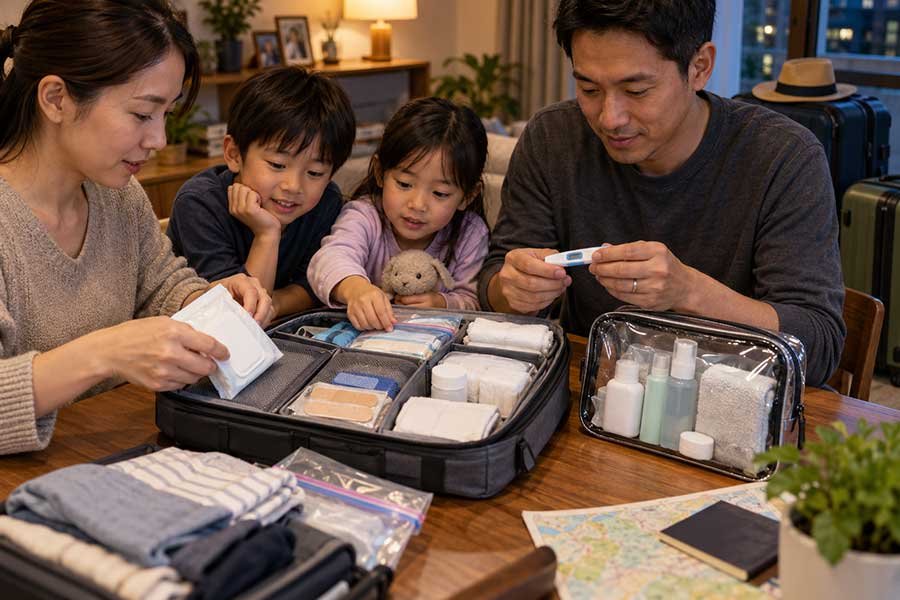
Bring a small first-aid and comfort kit in the family carry-on: a child-appropriate pain reliever (in the correct dosage form and dosage for the child’s weight and age, confirmed with the child’s healthcare provider before travel), a digital thermometer, a few adhesive bandages in child-appealing designs, antiseptic wipes, and any child-specific medication the child uses regularly. Consult the child’s healthcare provider before any family trip about appropriate over-the-counter medications for the travel context and the child’s specific age and health circumstances. The minor illness or minor injury that occurs during family travel — the fever at the accommodation, the scraped knee at the playground — is managed in ten minutes with the kit present and managed with a forty-five-minute search for an open pharmacy in an unfamiliar city without it.

Pack the children’s travel items at the top of the main family luggage rather than below the adult items. The children’s items are accessed first and most frequently during the travel day: the change of clothes, the activity bag, the snack kit. The adult items — the clothing for the destination, the toiletry kit beyond the carry-on version — are accessed at the accommodation rather than during transit. Packing by access frequency rather than by size or convenience means the items needed at the airport and on the aircraft are at the top of the bag and the items needed on day three of the trip are below them.

Keep a master family packing list in a shared digital document or a physical card that lives in the travel bag between trips, updated after each trip with the additions and removals that the trip’s actual experience required. The master list eliminates the blank-page reconstruction that the family packing session without a living list produces before every trip. The first trip’s list is built from scratch. The second trip’s list is the first trip’s list adjusted for what was missing and what was unnecessary. By the fifth trip, the master list is the accurate representation of the family’s specific travel packing needs, tested across multiple trips and updated after each one. The document does not require rebuilding. It requires confirming and adjusting. That is the ten-minute annual packing session investment that the families who travel most smoothly with children made early and have been using ever since.

Insider Note

Involve each child over five years in one decision in the family packing session — which outfit to bring for the special occasion activity, which book to include in the backpack, which activity from the options list goes in the travel bag. One decision per child, made with the child’s genuine input rather than the parent’s preference offered as a choice. The child’s ownership of one decision in the packing session is the child’s ownership of one part of the trip, and the child who made one packing choice is fractionally more invested in the travel experience from the moment the bag is closed. Over multiple trips, these single decisions accumulate into the child’s genuine sense of participation in the family’s travel preparation, and the child who has been part of the process from an early age is the child who eventually asks to help pack without being asked.

Book With Us

Book the Family Adventure Worth Building This System For

The family packing system is the preparation. Our travel agents provide the destination worth preparing for. Let us plan the family trip that the kids will talk about and the parents will want to repeat. Tell us where you want to go.

Book A Trip

Common Family Packing Mistakes That Make Trips Harder Than They Need to Be

These are the family packing decisions that the departure morning chaos produces. Each has a system-based resolution in this article.

1

Packing the children’s comfort and essential items in the family checked bag

The comfort item that travels in the checked bag is the comfort item that is inaccessible during the entire travel day and unavailable if the checked bag is delayed or lost. The comfort item belongs in the child’s backpack, managed by the child, carried in the cabin from departure gate to destination. Whatever the child specifically needs for the travel day and the first night travels with the child. Everything else can go in the checked bag.

2

Not having a change of clothes for every family member in the carry-on

The change of clothes packed for the children but not the adults is the preparation that manages the child’s travel day overflow event and leaves the parent managing the aftermath in the original clothing. Every family member — adults included — has a change of clothes in the accessible top of the carry-on. The weight is negligible. The potential return is high enough that the one trip where it is needed retroactively justifies every trip where it was not.

3

Estimating snack quantity based on home-routine consumption

Children’s snack consumption during travel is not governed by the home routine’s schedule or quantity. It is governed by the travel day’s specific combination of hunger, boredom, waiting, and novel environment appetite. Double the estimate. Pack the doubled quantity in a visually distinct parent-managed bag. When the travel day ends with snacks remaining, adjust the estimate slightly downward for the next trip. When it ends with empty bags and a hungry child, the estimate was already correct and the doubling was necessary.

4

Packing the travel day’s entertainment in the checked bag or the inaccessible main luggage

The activity bag, the devices, the headphones, and the travel day entertainment belong in the carry-on’s accessible top layer or in the children’s backpacks — in the cabin, available from the gate through the landing. The travel day entertainment that is in the checked bag or buried in the main luggage is the entertainment that the travel day cannot access at the specific moments it is most needed: the gate wait, the boarding delay, the turbulence period when the tray tables must be stowed and the back of the seat is the only available surface.

5

Packing the family as one undifferentiated unit rather than with individual ownership layers

The family packed as one unit — all clothing in one bag, all snacks in one bag, all activities in one bag — is the family where everything belongs to everyone and no one knows where anything is. The individual ownership layers in this article — each child’s backpack, the travel day bag, the family carry-on’s organized sections — are the physical and organizational structure that makes the family travel system navigable. Each person knows their zone. Each item has an owner. The family bag is not a shared mystery. It is a managed system with clear ownership at every level.

6

Rebuilding the packing list from scratch before every trip rather than maintaining a living master list

The family packing list rebuilt from scratch before each trip rebuilds the same items, forgets the same items that were added after the previous trip, and does not incorporate the improvements the previous trip’s experience produced. The living master list updated after each trip accumulates the family’s actual travel packing knowledge across trips rather than starting from the beginning before each one. Build it once. Update it after each trip. The packing session gets easier every time the list is used rather than harder every time it is reconstructed.

Turn Travel Into Income

Love Helping Families Travel With Confidence and Joy?

Family travel planning is among the most meaningful work a travel agent does — these are the trips that become the family’s story. If becoming a home-based travel agent who helps families travel better sounds like the right next step, see how the TravelPreneur system works.

Become An Agent

Frequently Asked Questions

These are the questions traveling parents ask most often about packing for family trips with children.

At what age can children start packing their own backpack?

Most children between three and four years old can participate in a simple version of backpack packing with direct adult guidance — placing specific named items into the backpack one at a time as the adult describes each one. Children between four and five can use a visual checklist with pictures to pack their own backpack with supervision. Children six and older can typically pack independently from a simple written or visual list and confirm completion with the adult before the backpack is zipped. The age at which each child is ready for independent backpack packing varies with the individual child’s development and attention. The important principle is that the child’s involvement begins as early as the child is able to participate in any meaningful way, because the habit of travel ownership — knowing that their backpack is their zone and their responsibility — is built through repeated participation from the beginning rather than transferred from adult management at a specific age.

How do you pack efficiently for a family trip without checking a bag?

A family trip in carry-on only requires the five-piece neutral-palette wardrobe applied to each family member at an age-appropriate level, the decanted-to-trip-size toiletry kit, and the rolling-and-packing-cube system that maximizes carry-on volume efficiency. For young children, clothing items are smaller and pack more efficiently than adult equivalents, which means a child’s three to four days of clothing occupies approximately the same volume as one adult’s single outfit. One mid-trip laundry session — available at most accommodations and most destination cities — halves the clothing count for trips over five days. The specific items most likely to push a family travel kit over carry-on dimensions are multiple shoe pairs per family member, full-size toiletry products, and the children’s large comfort items and toys. Address each of these with the shoe-on-body principle, decanted toiletries, and comfort items in the child’s backpack rather than the family carry-on.

What is the best way to manage medications and medical items for children during travel?

Before any family trip, consult the children’s healthcare provider about appropriate travel medications for the specific trip’s context — the destination’s health risks, any motion sickness preparations, fever management, and any child-specific ongoing medications. All child medications should travel in their original labeled containers and be accessible in the carry-on rather than the checked bag. A brief letter from the child’s healthcare provider is helpful for any controlled medication or for travel to destinations with strict medication import rules. Over-the-counter medications for children — pain relievers, anti-nausea medications — should be selected in the correct formulation and dosage for the child’s current weight and age, confirmed with the healthcare provider or pharmacist before departure rather than relying on labels from a previous trip when the child was a different weight or age. We are not qualified to provide medical advice, and all medication decisions for traveling children should be made in consultation with a qualified healthcare provider.

How do you handle packing for a baby or toddler on a flight?

The infant and toddler travel packing category has the highest volume-to-child-size ratio of any family travel age group. The nappy kit — nappies, wipes, a portable changing mat, nappy cream, and a small plastic bag for disposal — belongs in the most accessible section of the carry-on for the flight. The feeding supplies — formula in a labeled pre-measured container, breast pump equipment if applicable, appropriate snacks for the toddler’s food stage — require the knowledge that formula and breast milk are exempt from the standard liquids rule and can be carried through security in quantities appropriate for the trip. The comfort item, the sleep aid, and any white noise device that the infant or toddler uses for sleep travel in the carry-on. The clothing change for the baby or toddler should cover at minimum two full outfit changes in the carry-on, since infants and toddlers produce clothing changes at a significantly higher rate during travel than older children. Confirm the specific security rules for baby food, formula, and breast milk with the TSA or the relevant security authority before each trip, as these rules are subject to change.

What do you pack in the travel day activity bag for different age groups?

The travel day activity bag’s contents vary significantly by the child’s age and the travel day’s likely duration. For children two to four years old: a new small toy with no small parts, a sticker activity book, window clings, a simple board book, and a soft small figurine. For children four to seven: a new small activity kit or craft set, a sticker book, a travel-sized game, playing cards in a child-friendly design, and the device with downloaded content as the screen-time portion of the travel day. For children seven to twelve: a new small puzzle or brain teaser, a journal and colored pens for the trip’s observations, a chapter book chosen specifically for the trip, playing cards, and the device. For the teen traveler, the activity bag’s role is largely replaced by the individual device and headphone combination, supplemented by a journal or sketchbook for the traveler with creative interests and a new book chosen by the teen rather than the parent. The governing principle across all age groups: the new item’s novelty provides the initial engagement; the familiar formats provide the sustained engagement when the novelty has been absorbed.

How do you prevent kids from over-packing their own backpacks?

The child backpack’s over-packing tendency is managed most effectively by the physical constraint of the backpack’s size and the explicit checklist of what belongs in it. A backpack sized appropriately for the child’s age and carrying capacity — a small daypack for young children, a standard child’s school-sized backpack for older children — naturally limits the volume of items it can accept. The checklist defines the specific items that belong in the backpack and provides a natural stopping point for the packing session: when every item on the checklist is confirmed present, the backpack is packed. Items not on the checklist require a specific conversation about why they should be added rather than a general permission to include whatever fits. For the child who wants to bring five stuffed animals on a two-day trip, the checklist’s one comfort item designation is the specific boundary that the list provides rather than the arbitrary adult decision that the no-five-stuffed-animals rule otherwise appears to be.

The family trip that started with a calm departure morning started the evening before, when the children packed their backpacks from the checklist card, the snack kit was assembled with room to spare, and the carry-on was closed with every family member’s change of clothes at the top. The system was built once. The trip ran on it every time after that.

Picture the Departure Morning

The children packed their backpacks last night. The seven-year-old confirmed her rabbit was in the front pocket. The four-year-old has her backpack on already. The snack kit is in the carry-on. The change of clothes bag is labeled and at the top. The activity bag has something new inside that no one has seen yet. The carry-on passed the carry test. The master packing list is updated from the last trip. The departure morning is breakfast and the door. Nothing is assembled this morning. Everything was assembled last night. The trip started when the bags were closed. The destination is waiting. That is the family packing system. That is every trip from here.

Free Download

One More Thing Before the Next Family Trip

Print our free Travel Packing Checklist and use the family section to build the master list from. Add the children’s backpack items, the activity bag contents, the snack kit quantities, and the carry-on change of clothes to the framework. Update it after the trip. Use it on the next one. Same checklist, better system, every time.

Get the Free Checklist

Explore Our Top Picks for a Better Trip

Visit our favorites page for helpful booking ideas and travel essentials that we have found genuinely useful for family travel. Whether you are planning the next family adventure or looking for resources that make traveling with kids more organized and more enjoyable, worth a look.

See Our Top Picks

Travel Prints and Printables From Our Shop

Visit Premier Print Works for family packing list printables, children’s backpack checklist cards, activity bag planners, travel journals for kids, and wall art that makes every family trip a little more beautiful and a lot more organized — from the evening the backpacks are confirmed and closed to the morning the door opens on the adventure.

Visit Premier Print Works

Disclaimer

The information shared in this article is provided by Don and Diana’s Travels for general informational, educational, and inspirational purposes only. It reflects our personal experiences, opinions, and the experiences of travelers we have worked with. It is not professional medical, safety, legal, or parenting advice.

Child Health and Medication

This article references over-the-counter medications and a first-aid kit for children. All medication decisions for traveling children must be made in consultation with a qualified healthcare provider. Always confirm appropriate medications, dosages, and formulations for a child’s specific age, weight, and health circumstances with the child’s healthcare provider before travel. We are not responsible for any health outcome arising from information in this article.

Child Safety

Child safety during travel is the first priority of all travel planning. Always follow current guidelines for child car seat use, child restraints on aircraft, and age-appropriate travel safety for your children’s specific ages and needs. We are not responsible for any safety outcome arising from information in this article.

TSA and Security Rules

TSA rules for baby food, formula, breast milk, medications, and carry-on items change frequently. Always confirm current rules with the TSA or relevant security authority before travel. We are not responsible for any security outcome arising from information in this article.

Affiliate and Partner Links

This article may contain affiliate and partner links that pay us a commission. Our recommendations are based on real use and genuine belief in the products and services we share.

Third-Party Websites

We may link to third-party sites for convenience. We are not responsible for their content, pricing, or availability.

Health, Safety, and Personal Responsibility

Travel involves personal risk. You are solely responsible for your own and your family’s health, safety, and travel decisions. We strongly recommend comprehensive travel insurance for every family trip. Don and Diana’s Travels accepts no liability for any loss, injury, delay, or inconvenience arising from information in this article.

Composite Stories

Stories on this site combine real experiences from Don, Diana, clients, and travelers we have worked with. Details may be adjusted for privacy and narrative clarity.

No Guarantees

We do not guarantee any specific result from using the information in this article. Your results depend on your own choices, your children, and circumstances outside our control.

Copyright and Use

All content is the copyrighted property of Don and Diana’s Travels. You may not copy or republish our content without prior written permission. You are welcome to share a direct link with proper credit.

By reading this article, you acknowledge that you have read and agree to this disclaimer.