Forgetting something on every trip is not bad luck. It is the absence of a system. The traveler who never forgets anything did not get lucky. They built a list and actually used it. This article builds that system and explains exactly why the system is the only thing that works when memory alone keeps failing.

Best For
Chronic Forgetters
Vibe
Organized and Confident
Read Time
11 Minutes
Walk Away With
The Complete Never-Forget-Again System
Free Download

Grab Our Travel Packing Checklist

The system in this article starts with a foundation checklist you build once and use forever. Our free packing checklist is that foundation — a complete category-organized starting point you personalize to your own travel needs. Print it, adapt it to your own trips, and use it as the never-forget-again document this article describes. It is free. The system it starts is permanent.

Get the Free Checklist

Build One Master Packing Checklist You Reuse Every Single Trip

The packing session that begins without a checklist is a packing session that relies entirely on memory. Memory during packing is the specific cognitive context where the items most likely to be forgotten are the ones used most automatically at home — the phone charger that has always been in the same outlet by the bed, the daily medication taken so automatically it does not register as a packing item, the toothbrush used minutes before the bag is zipped and therefore still on the bathroom counter when the door closes. These items do not surface during the packing session because they are not thought of as items that need packing. They are thought of as items that are always in their place, which is where they remain when the bag leaves without them.

The master checklist exists to offload the memory task entirely. The item is on the list. The list is checked. The item is in the bag. Whether the item is thought of during the packing session is irrelevant because the checklist thinks of it regardless. The toothbrush is on the list. The charger is on the list. The daily medication is on the list. The checklist does not forget any of these because it is a document rather than a cognitive process, and documents do not have the specific failure mode of automatic-habit items that the human brain consistently produces during packing.

Building the master checklist takes thirty to forty-five minutes once. It is built from the traveler’s own travel history, not from a generic downloaded list. Start with every category relevant to the specific travel pattern: clothing, toiletries, documents, electronics and chargers, medications, money and cards, and any trip-specific categories that apply. Within each category, list every item used on the last three to five trips — not every item that might theoretically be needed, but every item that was actually needed and used. After the first draft, review it against the items forgotten on those same trips and add each of them. The result is a personalized document that reflects both what gets packed and what gets forgotten, which is the specific combination that produces the accurate minimum packing inventory.

The checklist must be used in a format that allows checking and resetting between trips without rebuilding it from scratch. A digital note with checkboxes, a printed laminated version used with a dry-erase marker, or a shared note in a travel app: whatever format the traveler will actually use consistently is the correct format. The checklist that is built once and then never opened before any subsequent trip is documentation of the intent to have a system rather than the system itself. The checklist that is opened before every trip and checked item by item before the bag is zipped is the system that replaces memory, catches the forgotten items before departure, and converts the chronic forgetter into the traveler who arrives at the destination with everything they left home intending to bring.

The traveler who never forgets anything did not get lucky — they built a list and actually used it.

Forgetting something on every trip is not bad luck. It is the absence of a system. The system is a list. The list is thirty minutes of work. The return is every trip after it.

Insider Note

Maintain a running note on the phone titled next trip additions for the items thought of between trips. The medication that was needed and not packed on the last trip. The item read about in a travel article that should go on the list. The specific product that was purchased at the airport gift shop and whose presence on the list would have prevented the purchase. Each addition is captured in the note at the moment it is thought of — not trusted to memory at the next packing session when the between-trips addition is not available because the memory of why it was needed has faded. Review the next-trip-additions note as the first step of the next packing session and add everything in it to the master checklist before the session begins.

We Plan, You Pack

Let Us Book the Trip the Checklist Was Built to Prepare For

The system you build from this article works best on the trip worth building a system for. Tell us where you want to go. We will handle the booking. You handle the checklist.

Plan Our Escape

Do a Final Sweep of Chargers, Bathroom, and Bedside Table

The final sweep addresses the specific category of forgotten items that the checklist cannot fully prevent: the items that were confirmed packed on the checklist and then moved, used, or left behind between the checklist confirmation and the departure moment. The charger that was on the checklist, was placed in the bag, and was then removed to charge the phone overnight and is now in its outlet rather than in the bag. The toiletry item used this morning, not on the overnight trip, but for the specific routine before departure and placed back on the bathroom counter rather than back in the toiletry bag. These items were packed. They were removed after packing. The checklist does not catch them because the checklist was accurate when it was checked. The final sweep catches them because it searches the specific surfaces where items migrate between the packing session and the departure.

The chargers category of the final sweep covers the specific locations where charging cables and power adapters live when they are actively in use rather than packed: the bedside outlet for the phone charged overnight, the desk outlet for the laptop charged after the packing session confirmed it was at 40 percent, the bathroom outlet for the electric toothbrush or the grooming device, and the kitchen outlet for the tablet or the portable speaker. These are the locations that the charger occupies when it is not in the bag, and the final sweep confirms every outlet is empty before the door closes.

The bathroom category of the final sweep covers the counter, the shower, the medicine cabinet, and any surface that holds personal care items in daily use. The toothbrush and toothpaste that are used the morning of departure and placed on the counter rather than in the toiletry bag that is already packed. The face wash used in the morning and placed next to the sink. The medication taken from the bag for the morning dose and set on the counter rather than returned to the bag. The contact lens case that was on the counter when packing was confirmed complete and is still on the counter when the sweep is walked.

The bedside table category covers the phone, the phone charger, the reading glasses, the earplugs, the sleep mask, the book being read before bed, and any other item typically placed on the nightstand before sleep that was there when the packing session was completed and may still be there at departure. The bedside table is the specific surface that holds items used in the last waking and first waking moments of the home day, which makes it the highest-probability location for the item that was packed, confirmed, and then used in the gap between packing completion and departure morning’s beginning.

Insider Note

Walk the final sweep as a physical room-by-room movement rather than a mental checklist review performed from the doorway. A mental sweep performed from the doorway confirms whether the traveler can think of anything left behind, which is the same cognitive process that produced the forgetting in the first place. The physical room-by-room sweep confirms what is actually on each surface rather than what the traveler thinks might be on each surface. The charger in the outlet is visible to the person who physically walks to the outlet and looks at it. It is not reliably visible to the person who mentally scans the room from six feet away and believes they can see it well enough to confirm its absence. Three minutes of physical walking through every room and surface catches the item that the mental doorway scan does not.

Always Pack Your Most Important Items the Night Before

The most important items — passport, travel insurance documentation, all medications, all chargers, the toiletry bag in its complete configuration — are the items that carry the highest consequence if forgotten and the items most consistently left to the departure morning under the assumption that they are too important to forget. The assumption is incorrect. The items too important to forget are the items whose importance makes them feel so obviously present in the mind that they are not treated as needing the same checklist confirmation as the socks and the extra book. The too-important-to-forget items are the items that produce the car-turnaround, the airport terminal phone call, and the traveler who arrives without their prescription medication because the medication’s importance felt so certain that actually placing it in the bag was postponed to the very obvious last step that was then not taken in the departure morning’s accumulated rush.

The night-before packing of the most important items eliminates the departure morning rush from the equation entirely. The passport is in the document wallet in the carry-on’s interior zip the night before departure. The medications are in the bag the night before. The chargers are in the cable organizer in the personal item the night before, with the phone and laptop connected to their charges specifically so they are at 100 percent for the departure morning and can be disconnected and placed in their travel locations as the morning’s first bag-related action rather than as one of many departure morning tasks competing for attention under time pressure.

The night-before packing session for the most important items also serves as the final confirmation that every critical item is actually present in the home and available for packing. The prescription medication that is almost out and needed to be refilled before the trip is discovered on the night before, when there is still time to visit the pharmacy or arrange an emergency prescription fill, rather than on the departure morning when the pharmacy is not yet open or the departure timing prevents the stop. The passport that needed renewal and was submitted eight weeks ago but whose replacement has not yet arrived is confirmed as present or absent on the night before at the planning stage where something can be done about it, rather than at the security checkpoint where nothing can.

Insider Note

Create a departure morning confirmation routine of exactly three items that are the only things that move from overnight positions to the bag on the morning of departure: the phone, disconnected from its overnight charge and placed in the personal item’s most accessible pocket; the laptop or tablet, disconnected from its overnight charge and placed in the carry-on; and any food or drink prepared for the travel day. Everything else — documents, medications, chargers for all other devices, the toiletry bag, the clothing, the entertainment downloads — is confirmed and in the bag from the night before. The departure morning routine that requires three actions instead of thirty is the departure morning that happens without the specific forgetting that thirty actions under time pressure produces.

Helpful for Your Journey

Find Booking Ideas and Travel Essentials on Our Favorites Page

We have put together a favorites page with helpful information for booking and travel essentials that can make packing smarter and traveling easier. Whether you are in the planning stage or looking for travel resources that genuinely help, it is worth a look.

DND Favorites

Why You Keep Forgetting and How the System Stops It

The chronic traveler who forgets something on every trip is not forgetful in a general sense. They are forgetful in the specific way that packing produces: through the combination of interrupted attention, automatic habits that make certain items invisible to conscious thought, and the specific time pressure of the departure morning that compresses the quality of every packing-adjacent decision. Understanding exactly why the forgetting happens is the foundation for understanding why the three-part system in this article is the specific remedy rather than simply trying harder to remember.

The automatic habit problem is the most consistent forgetting mechanism for items used daily. The toothbrush is used every morning without conscious thought. The phone charger is plugged in every night without conscious thought. The daily medication is taken every morning without conscious thought. These items are so automatic that they are not processed as items requiring action during the packing session. The packing session is consciously attended to. The toothbrush is not consciously attended to during packing because the toothbrush’s use is not conscious. It is a habit, and habits are specifically the cognitive domain where conscious attention is minimal. This is why the checklist, which is explicitly conscious and explicitly places every habit-items on the list that consciousness must confirm, is the specific remedy for the automatic habit forgetting pattern.

The time window problem is the second most consistent forgetting mechanism. The charger was in the bag. It was removed after the bag was packed to charge the phone overnight, which happens in the window between the packing session and the departure, when the checklist has already been checked and the bag is already confirmed complete. The final sweep is the specific remedy for the time window problem because it addresses the period after the checklist confirmation, not the packing session itself.

The importance illusion is the third pattern. The most important items feel so certain to be packed that the actual act of placing them in the bag is postponed to the final moments rather than confirmed during the systematic packing session. The passport never feels like an item that could be left behind, which is exactly why it is the item that the departure morning rush occasionally leaves on the desk where it was placed when the mail was checked three days before departure and where it remains because its obvious importance made putting it in the bag feel like a later and obvious action that was never separately taken. The night-before packing of important items is the specific remedy for the importance illusion because it requires the physical placement of the item in the bag as a deliberate action on the night before, when the illusion of obvious packing is replaced by the confirmed physical reality of it being in the bag.

Insider Note

After every trip, note specifically what was forgotten or nearly forgotten on that trip, what the consequence was, and at what point in the departure process the forgetting would have been caught by each of the three system components: the checklist, the night-before packing, or the final sweep. This post-trip analysis converts every forgetting incident from a frustrating isolated experience into a diagnostic event that reveals which component of the system was missing, which was applied but failed to catch the item, and what specific addition or adjustment to the system would have prevented it. A system that is analyzed and improved after every failure becomes more accurate with each trip rather than repeating the same failures indefinitely.

The Complete Never-Forget-Again System

The complete never-forget-again system applies all three components in sequence, with each component addressing a specific forgetting pattern that the other two cannot catch. The checklist catches the items that memory does not surface during the packing session. The night-before packing catches the important items that the importance illusion leaves to the departure morning. The final sweep catches the items that were packed and then used in the window between packing completion and departure.

Step one: the master checklist, maintained on the phone or in a dedicated format, is opened before the packing session begins. The items added to the next-trip-additions note since the last trip are reviewed and incorporated into the master checklist. The packing session proceeds by category, checking each item off the list as it goes into the bag. No item is assumed present. Every item is physically confirmed in the bag before it is checked off. The packing session ends when every category is complete and every item is checked. The bag is confirmed complete at this stage.

Step two: the night-before routine. After the packing session, the most important items are physically placed in their specific bag locations as a separate deliberate action: passport and all travel documents in the document wallet in the carry-on’s interior zip. All medications in their original packaging in the medication pouch in the bag. All chargers except the phone and laptop in the cable organizer in the personal item. The toiletry bag confirmed and placed at the top of the carry-on. The items being left charging overnight placed in visible sight lines near the outlets rather than in their habitual overnight positions, so the departure morning sweep immediately notices them rather than leaving them in the places where they are automatically invisible.

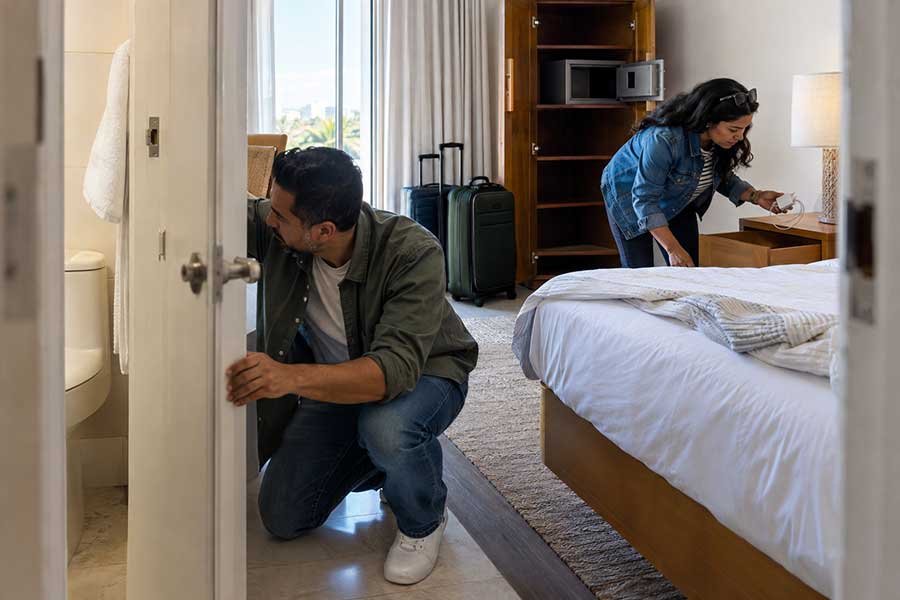
Step three: the final sweep, performed as a physical walk-through of every room and surface three to five minutes before closing the door. The charger sweep: every outlet in every room confirmed empty. The bathroom sweep: counter, shower, medicine cabinet, each surface confirmed empty. The bedside sweep: every nightstand surface confirmed empty. The desk and other surface sweep: any surface where travel-adjacent items might have been placed in the days before departure confirmed empty. The door closes after the sweep, not before it. The sweep is not optional. It is not skippable because the packing felt complete. It is the last step of every departure, every time, for every trip.

Insider Note

Add a departure morning written confirmation to the three-step system as an optional fourth step for high-stakes trips — long-haul international travel, trips involving irreplaceable prescription medications, or travel with children. Before closing the front door, write or type a three-sentence confirmation in the phone’s notes: documents confirmed in bag, medications confirmed in bag, chargers confirmed in bag and outlets confirmed empty. Writing the confirmation forces a final conscious review of the three highest-consequence categories and produces a physical record that the confirmation was performed rather than assumed. The thirty seconds of writing is the difference between boarding the flight with certainty and boarding with the specific background wondering that the chronic forgetter knows as the trip’s companion from departure through arrival.

The Fullest Bag and the Most Consistently Forgotten Toothbrush

Jasmine had a reputation among her travel companions for packing everything. Her bag was always heavy. It was always organized in the broad sense that things were in there rather than in the specific sense that anything was findable without excavation. It contained products she had not used at home since she bought them, backup items for things that had never failed, and enough scenario coverage to accommodate a trip three times longer than the one she was actually taking. And on almost every trip, she forgot something.

The specific pattern was the items she used every single day. The toothbrush used every morning without thinking about it. The charger in the outlet where it always was. The daily vitamin on the kitchen counter where it always was. The items so automatic that packing them required conscious thought she never applied because they felt too obvious to require it. Her bag had fourteen products she used occasionally and was missing the one item she used twice a day every day of her life.

The accumulation: the toothbrush bought at the airport gift shop before the flight. The charger purchased at the hotel gift shop on day two. The vitamins replaced at the destination pharmacy on day three. The glasses case left on the bedside table discovered at the first accommodation and shipped home by the hotel at a fee that exceeded the case’s replacement cost. Across four years of travel, the forgotten-item purchases added up to what she calculated was slightly over two hundred dollars of items she already owned at home and paid to replace at tourist prices at destinations where she had not planned to spend two hundred dollars on things she already owned.

After the glasses case incident, Jasmine built the checklist. It took forty minutes. She included every item she had ever bought at an airport gift shop, a hotel gift shop, or a destination pharmacy because she had left it at home. She added the next-trip-additions note to her phone and populated it immediately with the three items she could think of that were not on the original draft. She committed to the final sweep before every departure, physically walking every outlet and the bathroom counter and the bedside table as the last action before closing the front door. She committed to packing the passport, the medications, and all chargers except the phone and laptop the night before every departure.

Her next trip: she opened the checklist. She checked every item off as it went into the bag. The toothbrush was third on the toiletries category. She packed it immediately rather than leaving it for the morning. The charger went in the night before along with the medications and the document wallet. The departure morning sweep found the phone charger in the outlet and the reading glasses on the nightstand, both of which would have been left behind. She boarded the flight with everything she had packed for. She arrived at the destination without purchasing anything she already owned. She has not bought a toothbrush at an airport gift shop since. This article is the system she built from two hundred dollars of forgotten-item replacements and one pair of glasses shipped home by a hotel in a foreign city.

Six More Tips for Travelers Who Always Forget Something

Beyond the three core system components and the understanding of why forgetting happens, these six additional approaches address the specific patterns and edge cases that the chronic forgetter encounters even after the core system is in place.

Keep a travel-specific toiletry kit permanently stocked and ready rather than rebuilding it from the home bathroom before every trip. A small bag or case with pre-filled travel bottles of every product used regularly on trips, kept filled and ready rather than emptied after each trip and rebuilt before the next one, eliminates the rebuilding session that most consistently forgets the small items: the lip balm that was not put back, the travel bottle of face wash that was not refilled after the last trip, the nail file that was not returned to the kit after use at the hotel. The permanent travel kit is confirmed complete by checking it against the toiletries category on the master checklist. Its permanent readiness means the toiletries category is a confirmation task rather than an assembly task before every trip.

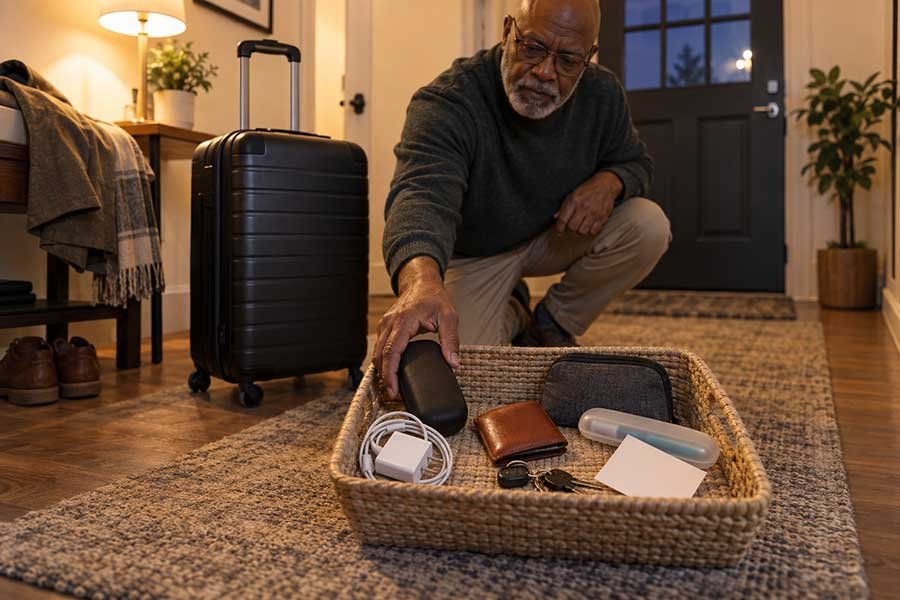
Use a designated travel tray or bin in the home where trip-relevant items accumulate in the days before departure. The travel insurance card printed from the email. The foreign currency retrieved from the drawer. The specific book chosen for the trip. The neck pillow that needs to come back from the guest closet. The travel adapter that is in the other bag from the last trip. As these items are identified and gathered in the week before departure, they go in the travel tray rather than in the various locations they are currently in. The packing session transfers the travel tray’s contents into the bag rather than trying to remember which items were scattered across which locations in the house.

Take a photograph of the packed bag’s contents laid out flat before they go in the bag. The photograph is the departure-day record that confirms what was packed and serves as the return-trip packing reference to confirm that every item that left home is returning with it. It is also the visual evidence for any insurance claim that requires documentation of the bag’s contents. And for the traveler whose forgetting is partly spatial, the photograph provides the confirmation that visually verifies what the checklist confirms categorically: both the document and the image together produce the certainty that the checklist-confirmed list and the actual laid-out bag match.

Place the most often forgotten specific item in an unusual and highly visible location as the specific physical reminder that it needs to go in the bag. The traveler who forgets the phone charger every trip places the phone charger on top of the bag the night before departure rather than in its outlet. The traveler who forgets the medications places the medication pouch on top of the toilet seat lid the night before. The unusual and visible placement creates the specific visual interruption that the item’s automatic location at home prevents: the charger in the outlet is invisible because it is always in the outlet, but the charger on top of the suitcase is visible precisely because it is never on top of the suitcase. The interruption of the normal location is the visual trigger that catches the specific chronic forgotten item.

Update the master checklist after every trip with the items that were forgotten on that trip, items that were nearly forgotten and caught by the sweep, and items that were packed and genuinely not needed across three or more consecutive trips. The checklist that is updated after every trip is a document that becomes more accurate with each iteration, approaching the genuine minimum necessary inventory for the specific traveler’s actual travel needs. The checklist that is never updated after it is built is a document that starts at eighty percent accuracy and remains there rather than improving to the ninety to ninety-five percent accuracy that ten post-trip updates produce.

Build a separate departure day checklist for the home security and handoff tasks that are not packing tasks but that produce the same mid-flight anxiety as forgotten items: locks confirmed, appliances addressed, pets and plants covered, mail held, smart home devices set to absence mode. These items are not in the bag but their omission is felt during the trip as the specific wondering that undermines the destination experience in the same way a forgotten item does. A departure day home checklist, distinct from the packing checklist, closes these loops before the door closes and prevents the mid-flight did-I-turn-off-the-stove that the packed-and-swept traveler still experiences when the home departure was incomplete.

Insider Note

The items most consistently forgotten by chronic forgetters cluster in three categories: daily routine items used automatically and therefore not consciously registered as packing items (toothbrush, daily medications, glasses, chargers), items used in the window between packing completion and departure (items removed from the bag overnight for use and not returned, items placed out for the departure morning and not picked up), and items stored in non-primary locations at home that require a specific retrieval action rather than being in the usual packing-adjacent locations (travel adapter in the other bag, foreign currency in the desk drawer, travel pillow in the guest closet). The master checklist catches the first category. The night-before packing catches the most important items in the first and second category. The final sweep catches the second category. The travel tray catches the third category. The four-part system — checklist, night-before, sweep, travel tray — covers all three forgetting clusters. The traveler who uses all four has eliminated the systematic causes of forgetting rather than simply trying harder to remember.

Book With Us

Book the Trip Worth Never Forgetting Anything For

A complete and well-organized departure is best followed by a trip worth departing for. Our travel agents handle the booking while you handle the checklist. Let us plan yours.

Book A Trip

Common Forgetting Patterns to Recognize and Break

Most forgetting is not random. It follows the same patterns on every trip. These are the most consistent ones and the specific system component that breaks each.

1

Packing from memory rather than from a checklist

Memory during packing selectively surfaces the items that require conscious thought and consistently misses the items that do not. The toothbrush does not require conscious thought. The daily medication does not require conscious thought. The charger does not require conscious thought because it is always in the same outlet. The checklist bypasses this selective memory entirely by listing every item regardless of whether it surfaces consciously during the packing session. The item is on the list. The list is checked. The item is in the bag. Memory’s selective failure mode is irrelevant to the list’s complete confirmation process.

2

Leaving the most important items for the departure morning because they feel too obvious to forget

The most important items feel the most certain to be packed and are therefore the most likely to be left for the departure morning’s final action that never separately happens. The importance illusion is the specific cognitive pattern that produces the travel day’s worst forgettings: the passport not picked up from the desk, the medications not transferred from the kitchen counter, the charger not disconnected from the wall. The night-before packing of the most important items converts the importance illusion into a confirmed physical reality rather than a feeling of certainty that substitutes for the action.

3

Treating the completed packing session as the final confirmation that nothing is forgotten

The packing session is complete. The checklist is confirmed. And between the packing session and the departure, the phone is charged overnight and the charger is left in the outlet, the face wash is used in the morning and returned to the counter, and the reading glasses end up on the nightstand after the pre-departure reading. The packing session confirms the bag’s contents at the moment of packing. It does not confirm the bag’s contents at the moment of departure. The final sweep is the only confirmation that addresses the time window between those two moments.

4

Performing the final sweep as a mental scan from the doorway rather than a physical room-by-room walk

The mental scan from the doorway confirms whether the traveler can think of anything left behind, which is the same cognitive process that produced the forgetting in the first place and will produce the same result. The charger in the outlet is visible to the person who physically walks to the outlet and looks at it. It is not reliably visible to the person performing a visual or mental scan from across the room. Three minutes of physical walking through every room and surface catches the items the mental doorway scan consistently misses, which is the entire point of the sweep.

5

Building the checklist once and never updating it after trips

The checklist built from the first trip’s experience is an eighty percent accurate document. The checklist updated after every trip for ten trips is a ninety to ninety-five percent accurate document. The difference is the fifteen to twenty items added from actual forgetting incidents across ten trips that the first draft did not include. The post-trip five minutes of adding the forgotten items to the checklist converts every forgetting incident from a frustrating experience into an improvement to the system that prevents the same item from being forgotten again. The checklist that is never updated is the checklist that makes the same mistakes trip after trip.

6

Not using a travel tray for items gathered in the days before departure

Items identified as needed for the trip in the days before departure, but not in the bag-adjacent locations that the packing session naturally draws from, are the items most likely to be in-hand the day they are thought of and missing the morning the bag is zipped. The foreign currency retrieved from the desk drawer and left on the desk. The travel adapter confirmed as being in the other bag and left in the other bag. The travel tray — a bin or basket designated for trip-relevant items that accumulate before the packing session — collects these items as they are identified and transfers them to the bag during the packing session rather than leaving them in the various locations across the home where they will not be visible when the packing session’s attention is on the bag.

Turn Travel Into Income

Love Helping Travelers Plan Better Trips From the Very First Step?

The traveler who arrives fully prepared, never paying for a forgotten toothbrush, is the traveler who worked with someone who knew what preparation looked like. If becoming a home-based travel agent who helps people travel better sounds like the right next step, see how the TravelPreneur system works. Earn commissions and build a real business from anywhere.

Become An Agent

Frequently Asked Questions

These are the questions chronic forgetters ask most often about building a system that actually works. Real answers from real packing experience.

What is the single most effective thing a chronic forgetter can do right now?

Build the master checklist. Not download a generic one, not plan to build one before the next trip — build it today, in the next forty-five minutes, from the actual items used and forgotten on the last three to five trips. The checklist built from real travel history is significantly more effective than any generic list because it includes the specific items this specific traveler specifically forgets, which are almost always different from the items the generic list’s author specifically forgets. The process: open a note on the phone, write every category heading, spend five minutes per category listing every item genuinely used on previous trips, add every item bought at an airport or destination because it was left at home. That checklist is the most impactful forty-five minutes the chronic forgetter spends before the next departure. Every trip after it is better than every trip before it.

Why do I always forget the same item trip after trip even when I try to remember it?

Trying to remember a specific item is the cognitive approach that has already failed on every previous trip. The item is forgotten not because the trying was insufficient but because trying to remember is a memory task, and memory during the packing session’s departure pressure consistently fails for the specific categories of items that are automatic habits, items that are in non-standard locations, and items used in the time window between packing and departure. The item needs to be on the checklist in its specific category so that the checklist finds it rather than the memory. It also needs to be addressed by whichever system component matches its forgetting pattern: the checklist for habitual-use items, the night-before packing for important items subject to the importance illusion, and the final sweep for items used after packing. Trying harder to remember will not work because the item’s forgetting is structural rather than motivational. The structure is what needs to change.

How do you handle packing for someone else, such as packing for children?

Packing for children introduces the specific challenge that the items being packed are not automatically registered in the packer’s habitual-use memory because they are not the packer’s habitual-use items. A parent who uses their own toothbrush every morning has their own toothbrush reliably if imperfectly in memory during packing. The child’s toothbrush is not in the parent’s automatic habit memory and requires explicit list inclusion. Build a separate checklist section for each child with every item specific to that child’s needs: medications, comfort items, specific food items if needed, entertainment items for travel, and any medical or health-related items specific to the child’s circumstances. The children’s section of the master checklist is particularly important for items like prescription medications and medical equipment where forgetting has health consequences rather than only inconvenience consequences.

Is it possible to get to zero forgotten items across multiple trips or will there always be something?

The three-part system combined with consistent post-trip updates to the master checklist produces a significant and measurable reduction in forgotten items. Whether it reaches absolute zero across all trips depends on the specific traveler’s consistency with the system’s three components and the accuracy of the master checklist after multiple refinement iterations. Most travelers who apply the full system consistently across five to ten trips reach a state where the forgotten item is no longer a regular feature of their travel experience and becomes an occasional occurrence with a specific identifiable cause — a new item type not yet on the checklist, a new forgetting scenario not yet addressed by the system, or a departure in unusual circumstances that disrupted the routine. The honest answer is that the system minimizes forgetting to the point where it is no longer a source of consistent travel stress rather than eliminating it entirely at every departure for every traveler. The specific forgotten item at the destination pharmacy after ten trips of near-perfect departures is a data point for the checklist update rather than evidence the system does not work.

What items do travelers most commonly forget?

The items most consistently forgotten across the broadest range of travelers fall into three categories. First, daily-routine items so automatic they are invisible to conscious thought during packing: toothbrush and toothpaste, phone and device chargers, daily medications and vitamins, reading glasses, and any personal care item used as part of the morning routine immediately before departure. Second, items stored in non-primary locations that require a specific retrieval action: travel adapters in a different bag from the last trip, foreign currency in a desk or junk drawer, travel pillows and comfort items stored in guest closets or storage, travel documents printed and left on the desk rather than in the document wallet. Third, items removed from the packed bag between packing completion and departure: the charger reconnected to the wall for overnight charging, the toiletry item used the morning of departure and returned to the counter, the medication removed from the bag for the morning dose and placed next to the bag rather than back in it. The master checklist addresses the first category. The travel tray addresses the second. The final sweep and the night-before packing of the most important items together address the third.

How do you make sure you do not forget anything on the return trip?

The return trip forgetting is a specific and underaddressed category distinct from the departure forgetting. The departure bag was packed from home, in familiar surroundings, with the checklist and the sweep available. The return bag is packed from an unfamiliar accommodation, often under the time pressure of a checkout deadline, sometimes in a state of post-trip fatigue, and without the same systematic process that the departure packing had. The practices that prevent return trip forgetting: the departure bag photograph, taken before the bag was packed at home, which shows every item that should be in the return bag and serves as the return packing checklist. The accommodation room sweep before every checkout, following the same physical route as the home departure sweep: outlet by outlet, bathroom counter, bedside table, any drawer that was opened, the safe if one was used, and any surface where items were placed during the stay. The return bag is confirmed by the departure photograph rather than by memory, and the accommodation sweep is the final sweep that catches the phone charger left at the bedside outlet and the toiletry item that did not make it back to the toiletry bag after the final morning.

The traveler who arrives at the destination with everything they left home intending to bring is not the lucky one. They are the one who built the list, swept the room, and packed the important things before they went to sleep. The system is simple. The payoff is every trip after the first one you use it.

Picture the Departure Morning Three Trips From Now

The checklist was checked and confirmed last night. The passport and medications and chargers except the phone went in the bag last night. The phone charger is disconnected and placed in the personal item as the first action of the morning. The bag is closed. You walk the final sweep: the bedroom outlet is empty, the bathroom counter is clear, the bedside table has nothing travel-relevant on it. The door closes. In the car you do not wonder whether the toothbrush is in the bag because you checked it off the list. You do not wonder about the charger because you disconnected it from the wall with your own hands and placed it in the cable organizer last night. The trip starts before the airport. That is the system working. That is every departure from here.

Free Download

Start With the Foundation Checklist

Our free Travel Packing Checklist is the starting point for the master checklist this article describes building. Print it, add every item specific to your own travel history, note every item you have ever forgotten or bought at an airport gift shop, and use it for the next trip and every trip after it. The first version takes forty-five minutes to build. Every subsequent trip takes ten minutes to confirm. The investment is entirely in the first session.

Get the Free Checklist

Explore Our Top Picks for a Better Trip

Our favorites page has helpful booking ideas and travel essentials that we think are genuinely worth knowing about. Whether you are planning your next trip or simply looking for ideas that make travel easier and more enjoyable, take a look when you have a moment.

See Our Top Picks

Travel Prints and Printables From Our Shop

Visit Premier Print Works for packing list printables, master checklist templates, departure day planners, travel journals, and wall art that makes every trip a little more beautiful and a lot more organized from the afternoon the master checklist is built to the departure morning the door closes behind a traveler who left nothing behind.

Visit Premier Print Works

Disclaimer

The information shared in this article is provided by Don and Diana’s Travels for general informational, educational, and inspirational purposes only. It reflects our personal experiences, opinions, and the experiences of travelers we have worked with. It is not professional travel, legal, financial, or medical advice, and it should not be relied on as such.

Medical and Medication Information

The information in this article about packing medications refers to general packing organization guidance only and is not professional medical advice. Always ensure prescription medications are packed in sufficient quantity for the full trip plus an adequate buffer, in original labeled packaging. Consult a healthcare provider for guidance on any medication-related travel preparation. We are not responsible for any health outcome arising from medication packing decisions based on information in this article.

Affiliate and Partner Links

This article may contain affiliate links, partner links, referral links, and links to products or services that pay us a commission. If you click a link and make a purchase or complete any qualifying action, we may earn a small commission at no extra cost to you. Our recommendations are based on real use and genuine belief in the products and services we share.

Third-Party Websites and Services

We may link to third-party websites, services, and resources for your convenience. We do not control these sites and are not responsible for their content, terms of service, pricing, availability, or any product or service they sell. Your use of any third-party site is entirely at your own risk.

Health, Safety, and Personal Responsibility

Travel involves personal risk. You are solely responsible for your own health, safety, travel insurance, medications, vaccinations, documentation, financial decisions, and choices while planning or taking any trip. We strongly recommend purchasing comprehensive travel insurance for every trip. Don and Diana’s Travels, its owners, employees, contractors, and affiliates accept no liability for any loss, injury, illness, delay, cancellation, damage, theft, or inconvenience arising from your use of the information in this article or from any travel decisions you make.

Composite Stories and Characters

Some stories, examples, and traveler experiences shared on this site are composites drawn from the real experiences of Don, Diana, clients, friends, and travelers we have worked with over the years. Names, identifying details, locations, and circumstances may be combined, changed, or fictionalized to protect privacy. Any resemblance to a specific real person beyond the composite portrayal is unintentional.

No Guarantees

We do not guarantee any specific result, outcome, savings, or experience from using the information, tips, services, or products mentioned in this article. Your results depend on many personal factors including your own choices, effort, circumstances, and external conditions outside of our control.

Copyright and Use

All content in this article is the copyrighted property of Don and Diana’s Travels unless otherwise noted. You may not copy, republish, redistribute, modify, sell, or reuse our content without our prior written permission. You are welcome to share a direct link to this article with proper credit.

By reading and using the information in this article, you acknowledge that you have read, understood, and agree to this disclaimer in full.