Your carry-on toiletry bag should be packed before you even think about your clothes. The lightest toiletry bag belongs to the traveler who finally stopped packing for every possible scenario and started packing for the trip they were actually taking. This article builds that bag from the airport security tray up.

Best For
Carry-On Only Travelers
Vibe
Light and Streamlined
Read Time
11 Minutes
Walk Away With
The Complete Carry-On Toiletry System
Free Download

Grab Our Travel Packing Checklist

Our free packing checklist includes the carry-on toiletry section that distinguishes essential from aspirational in every personal care category, organized by the liquids-rule categories that airport security requires. Print it before your next trip and pack the toiletry bag from the checklist rather than from the bathroom cabinet, which always produces twice the necessary volume at full-size container weight.

Get the Free Checklist

Decant Everything Into Travel-Size Bottles

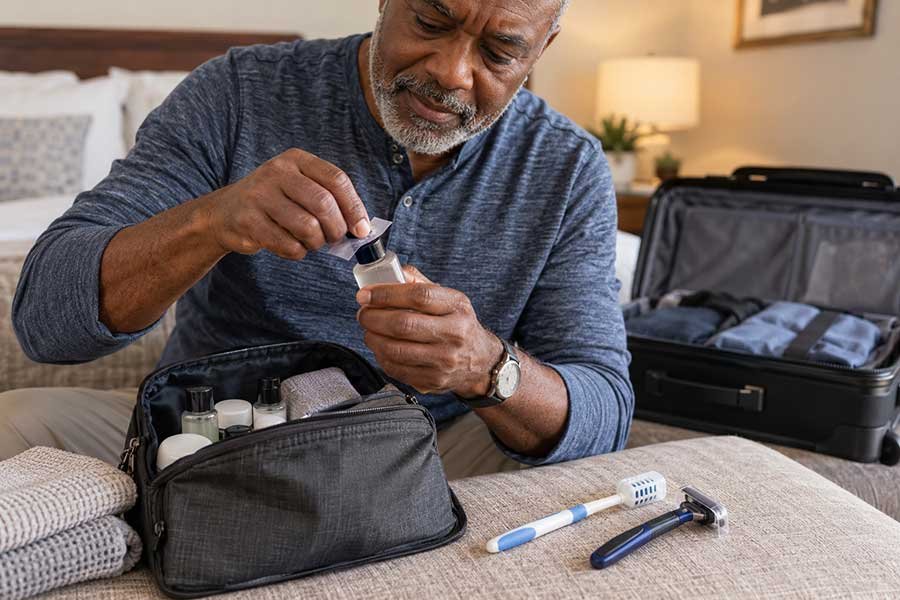
The full-size bottle of shampoo that lasts four months at home contains approximately ninety times the volume needed for a one-week trip. The full-size bottle of conditioner. The full-size face wash. The full-size moisturizer. A toiletry bag assembled from the bathroom’s full-size products contains the same items a travel toiletry bag should contain but at a volume and weight ratio that is dramatically disproportionate to the trip’s actual consumption and that fails the carry-on liquids rule at almost every security checkpoint in the world. The decant is the five-minute process that right-sizes every product in the toiletry bag to the trip’s actual needs rather than the home bathroom’s storage format.

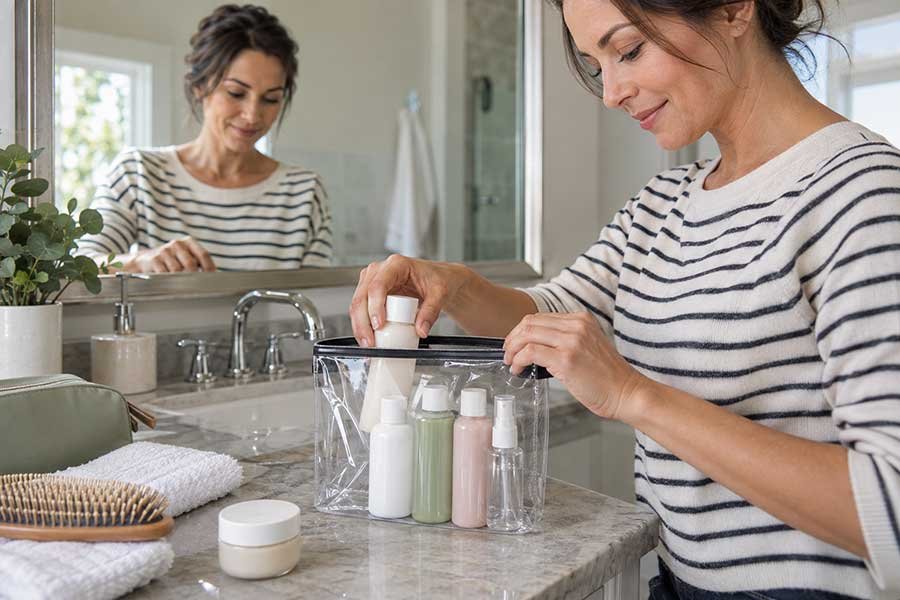
Travel-size silicone squeeze bottles in two to four-ounce sizes are the correct decant containers for most liquid and semi-liquid personal care products. Silicone squeezable containers provide better product dispensing than rigid plastic travel bottles because the squeeze mechanism prevents the aerating that rigid bottle-flipping produces, keeps product from settling at the bottom inaccessibly, and allows the container to flatten and be discarded or compressed as the product depletes across the trip. Label each bottle with a permanent marker or a small label before filling to prevent the destination bathroom morning of trying to remember which unlabeled bottle is the conditioner and which is the face wash when they have the same consistency.

The quantity calculation for decanting: most people use approximately five milliliters of shampoo and conditioner per hair wash, five milliliters of face wash per use, and two to three milliliters of moisturizer per use. A one-week trip with daily hair washing and twice-daily face washing requires approximately 35 milliliters of shampoo, 35 milliliters of conditioner, 70 milliliters of face wash, and 21 milliliters of moisturizer. A two-ounce or sixty-milliliter travel bottle holds more than the trip’s full requirement of each product for most of these categories. The quantity calculation prevents the overfilling of travel bottles to the brim just in case, which is the travel bottle equivalent of the full-size product reasoning it was intended to replace.

Products that do not decant well and should be purchased in travel size rather than decanted: toothpaste, which deteriorates rapidly once opened in a travel container; aerosol dry shampoo and sunscreen, which cannot be transferred between pressurized containers; and thick creams and balms that are easier to control in their original dispensing format than in a generic squeeze bottle. For these products, purchasing travel-size versions from the full-size brand before departure produces the most reliable result. The travel-size purchases for these specific categories add minimal weight relative to the products they replace and are significantly easier to manage at security than the full-size equivalents they would have required being discarded at the checkpoint.

The lightest toiletry bag belongs to the traveler who finally stopped packing for every possible scenario and started packing for the trip they were actually taking.

Your carry-on toiletry bag should be packed before you even think about your clothes. It sets the volume limit that the bag’s organization depends on getting right first.

Insider Note

Build and maintain a permanent travel toiletry kit rather than decanting from the home bathroom before every trip. A small zippered bag with pre-filled travel bottles of every product used regularly on trips, kept filled and ready rather than emptied after each trip and rebuilt from scratch before the next one, reduces the pre-departure toiletry preparation from thirty minutes to a one-minute confirmation that the kit is adequately stocked. After each trip, refill any depleted travel bottles immediately while the kit is still unpacked, so the kit is always at least seventy percent filled and ready to go with a pre-departure top-off rather than a full rebuild. The permanent travel kit is the toiletry equivalent of the pre-loaded suitcase: it is ready before the packing decision, not assembled during it.

Ready to Go

Let Us Book the Trip This Streamlined Toiletry Bag Was Built For

A carry-on-only travel system earns its full return when the trip is the kind that rewards the freedom of no checked bag: the weekend break, the multi-city itinerary with connecting flights, the international trip where the no-checked-bag efficiency is the difference between arriving at the first accommodation an hour earlier and standing at the baggage carousel. Tell us where you want to go. We will book the trip. You pack the toiletry bag.

Plan Our Escape

Switch to Solid Bars to Skip the Liquids Bag Entirely

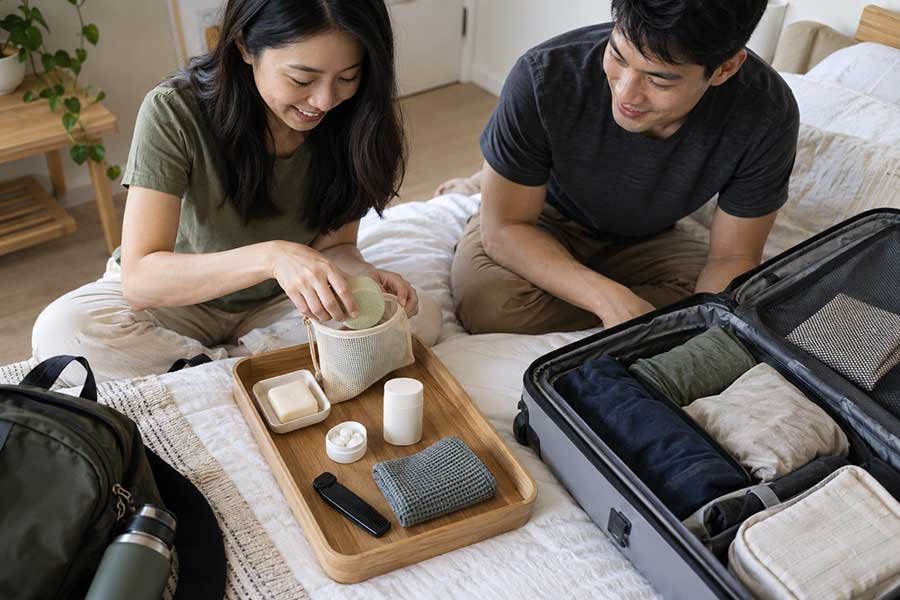
The airport security liquids rule, which limits carry-on liquids, gels, and aerosols to containers of one hundred milliliters or less in a single transparent resealable bag, applies to liquid and gel products and not to solid products. A solid shampoo bar, a solid conditioner bar, a solid face cleanser bar, and a solid deodorant bar are not subject to the liquids rule because they are not liquids or gels. A toiletry kit built primarily from solid products eliminates the clear bag requirement entirely, removes the container count anxiety from the security preparation, and reduces the toiletry bag weight significantly because the solid products contain no water weight and are typically smaller and lighter than even the travel-size decanted versions of their liquid equivalents.

The solid shampoo bar has been the most widely adopted solid toiletry conversion for frequent travelers, and the quality of solid shampoo bars has improved dramatically with the growth of the market for them. A full-size solid shampoo bar lasts approximately sixty to eighty washes depending on hair length and density, making it the equivalent of two to three standard liquid shampoo bottles in a product that weighs under an ounce and takes no significant space in the toiletry bag. The shampoo bar lathers effectively in both hard and soft water when the bar is wetted before application and does not require a liquid container that can spill, burst, or violate the carry-on liquids rule regardless of its size.

The solid conditioner bar, solid face cleanser bar, and solid moisturizer bar follow the same principle. Each delivers the product’s function in a waterless concentrated form that weighs and sizes significantly smaller than the liquid equivalent and requires no container for security purposes. Solid deodorant bars and solid sunscreen sticks extend the solid format to the categories that the early solid toiletry conversion typically left in liquid form. A toiletry kit that has converted every practical category to solid format contains only items that cross every security checkpoint without the clear bag, without the liquids container count, and without the weight of the liquid products and their containers.

The transition to solid products requires a brief adjustment period. Solid shampoo bars may produce a temporary waxy or buildup feeling on the hair during the first two to four washes as the hair adjusts from liquid shampoo’s typical silicone coating to the solid bar’s different formulation. This adjustment period is shorter with a clarifying wash on the last liquid shampoo use before switching and is typically completed within the first days of a trip, after which the solid bar’s results are equivalent to or better than the liquid equivalent for most hair types. Test any new solid product at home before the trip rather than first using it on the trip, so any adjustment period or personal incompatibility with a specific product is discovered in the bathroom at home rather than at the destination hotel.

Insider Note

Use a small metal tin or a soap-saving mesh bag for solid bar storage in the toiletry kit. A solid bar that sits loose in the toiletry bag accumulates product residue on everything adjacent to it and dissolves unevenly from the surface contact with the bag’s other contents. A small metal tin with a locking lid keeps the solid bar contained, prevents cross-contamination with other toiletry items, and produces even product use by protecting the bar surfaces that are not in use from humidity and contact. A mesh soap bag, which holds the bar and allows it to dry between uses, is the alternative for bars that are used in the shower rather than removed before use. Both the tin and the mesh bag weigh under thirty grams and solve the solid bar storage problem that prevents many travelers from completing the liquid-to-solid conversion.

Keep Your Clear Bag at the Very Top of Your Carry-On

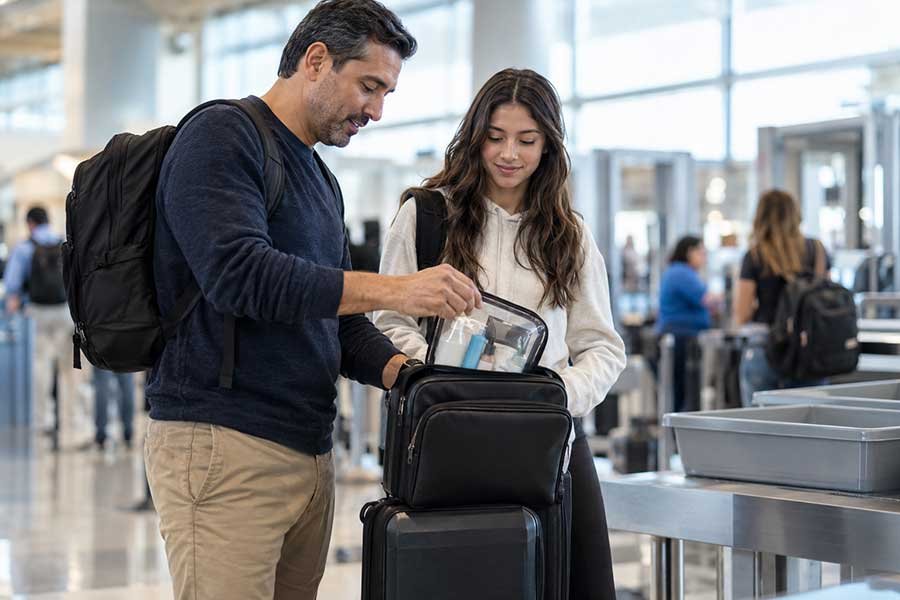
The clear liquids bag that is buried at the bottom of the carry-on under clothing, electronics, and everything else packed for the flight requires a full carry-on excavation at the security checkpoint to retrieve it, which produces the specific airport security moment of holding up the queue while unpacking the carry-on on the conveyor belt to reach the buried liquids bag, repacking the carry-on after security while other travelers flow past, and beginning the gate walk already slightly behind the pace the trip’s timing requires. The clear bag at the very top of the carry-on, packed last and removed first, is the security preparation decision that eliminates this specific scenario completely.

The clear liquids bag’s position in the carry-on should be structurally enforced rather than aspirationally intended. The carry-on that is organized with the clothing packing cubes at the bottom, electronics in the middle, and the clear liquids bag as the last item placed at the very top before the carry-on is closed produces a bag where the clear bag is always in the same position, always the first item encountered when the carry-on is opened, and always retrievable without moving anything else. This position is maintained across every access to the carry-on during the journey: if the carry-on is opened at the gate, in the overhead bin, or at the accommodation, the clear bag’s position at the top is preserved by returning it to the top of the bag after each access rather than allowing it to migrate to wherever there is space.

The clear liquids bag itself should be the correct size for its contents rather than the largest available. The security requirement is for all liquids to fit in a single transparent resealable bag, typically one liter in capacity. A one-liter clear bag is significantly larger than the correctly decanted liquids kit requires. A half-liter or smaller clear bag that fits the actual decanted contents snugly is a cleaner, more organized container that is easier to open, inspect, and close at security than the overfull or underladen one-liter bag that the liquids kit was transferred to without consideration of fit. The correctly sized clear bag also takes less space at the top of the carry-on and provides a visual reminder that the liquids kit is appropriately minimized: a small clear bag that is three-quarters full is a correctly sized liquids kit; a large clear bag that is one-quarter full is a correctly sized liquids kit in the wrong container.

Insider Note

Use a clear toiletry bag with a solid base that stands upright on the security conveyor belt rather than a flexible resealable bag that collapses and tips. A clear toiletry bag with a zippered top, a flat rigid base, and transparent sides meets the security liquids requirement for most airports while providing a significantly more organized and functional container than the single-use resealable bag. It sits upright on the conveyor, opens easily for inspection, closes securely, and can be labeled with the traveler’s name or contact information for the rare scenario where it is left behind at a security checkpoint and needs to be returned. The rigid base also prevents the product leakage that flexible bags occasionally produce when the bag’s shape allows a partially-open container to press against the bag’s bottom seam under the pressure of the items above it.

Our Real Favorites

The Toiletry Products We Pack on Every Trip

The solid shampoo bar that has replaced the liquid bottle on every trip since the first trip we tried it, the silicone decant bottles with the wide mouth for easy filling and the squeeze mechanism that does not require flipping the bottle, and the clear rigid-base toiletry bag that stands upright at every security checkpoint and has never been buried at the bottom of the carry-on since we started using it. Real toiletry picks from real trips.

DND Favorites

Only Pack What You Genuinely Cannot Live Without

The essential question for every item in the carry-on toiletry bag is not whether it would be nice to have. It is whether the trip genuinely cannot proceed comfortably without it for its duration. The distinction matters because most items in a typical overpacked toiletry bag fail the genuine necessity test in ways that only become clear when the traveler is at the destination using the bag. The overnight face mask was not used. The hair oil was packed but the hair dried without it because the hotel hairdryer was adequate. The four different lip balm options were reduced to one by day two because only one was actually carried in the day bag. The cosmetics collection that represented a full ten-step routine at home was reduced to three steps by the trip’s third morning because three steps produce ninety percent of the result and the additional seven feel less necessary when the day is full of something worth doing outside the hotel bathroom.

The genuine necessity test applied to the toiletry bag’s common contents: the toothbrush and toothpaste are genuine necessities. The prescription medications are genuine necessities. The sunscreen at any sun-exposure destination is a genuine necessity. The moisturizer for the traveler whose skin genuinely requires it is a genuine necessity. Everything else in the bag is on a spectrum from high utility to pure aspiration, and placing every non-necessity item on that spectrum honestly before packing produces the toiletry bag that is genuinely light rather than aspirationally light.

The destination pharmacy or hotel shop is the insurance policy that makes the genuine necessity test honest rather than anxiety-provoking. The item that is left home because it does not pass the genuine necessity test can be purchased at the destination’s pharmacy if it proves to be more necessary than the pre-departure assessment indicated. This is very rare in practice: the items left home rarely prove necessary at the destination because the genuine necessity test, applied honestly, accurately predicts what the trip actually requires. The exception is prescription medication, which should be packed in full supply plus buffer regardless of the necessity test, and any personal care product not available at the destination for specific health or skin care reasons. Everything else the destination’s pharmacy handles if genuinely needed, and the items genuinely needed that were left home represent a pharmacy trip cost that is lower than the carrying cost of packing them for the full trip on the chance they might be needed.

The aspiration toiletry items, the products packed because they might improve the trip experience rather than because their absence would genuinely impair it, are the specific category that produces the heaviest, most crowded toiletry bags and the least used items at the return unpack. A single face serum used daily at home is a genuine necessity. A three-serum routine for morning and evening is aspiration packing for the travel context where the bathroom routine competes with activities worth doing. The genuinely necessary version of the home routine is the minimum version that the traveler would describe as fine if asked how the trip went in terms of personal care. The aspiration version is what the traveler would describe as ideal if the trip involved the same amount of bathroom time as the home routine. Most trips are not designed for the ideal version. Pack for the fine version and use the saved time and bag space for whatever the trip was actually planned for.

Insider Note

After every trip, note the items in the toiletry bag that were not used. After three to five trips with this record, the unused items list becomes the packing exclusion list for that specific traveler: the products that are packed trip after trip and never used because the trip context, the time, or the need for them never materializes the way the pre-packing imagination suggested it would. The toiletry bag built from the exclusion list is the toiletry bag that carries only what is actually used, because the exclusion list is built from trip data rather than from pre-trip imagination. It is the same approach that works for clothing overpacking, applied to the toiletry category where the accumulation of unused aspirational products is the most consistent source of unnecessary weight in the carry-on.

The Complete Carry-On Toiletry System

The complete carry-on toiletry system organizes the decant, solid, and essential-only principles into a bag that packs before the clothing, sits at the top of the carry-on, and requires less than five minutes to assemble for any trip after the permanent travel kit has been built and maintained.

The clear bag contents for the liquid and gel products that remain liquid after the solid conversion: the decanted shampoo if not using a solid bar, the decanted conditioner if not using a solid bar, the decanted face wash if not using a solid bar, the decanted moisturizer, sunscreen in travel size or decanted, toothpaste in travel size, any medicated liquid skincare product, and any other liquid or gel product that genuinely passes the necessity test. The total clear bag volume for a fully optimized liquids kit is typically two hundred to three hundred milliliters for a one-week trip, comfortably fitting in a half-liter or smaller clear bag with space to spare.

The solid products that sit outside the clear bag in a separate small zippered pouch or in their individual tins: solid shampoo bar, solid conditioner bar, solid face cleanser if used, solid deodorant if converted, and any other solid product that has replaced its liquid equivalent. These items require no container transparency and no liquids rule compliance, which means they can be stored in any pouch or tin within the toiletry bag without needing to be accessible for the security tray.

The additional toiletry items organized by type: an electric or disposable razor in its own small case or pouch, nail care items in a small zippered pouch, feminine hygiene products in their own small sealed pouch, prescription medications in their original labeled packaging in a designated section of the toiletry bag, over-the-counter medications in a small resealable bag with the appropriate identification markings, and the cosmetics collection reduced to the minimum necessary items in a separate small clear or translucent pouch.

The toiletry bag itself: a medium-sized hanging toiletry bag with multiple organized compartments, a hook for bathroom use, and a flat base that allows it to stand independently on the sink counter without tipping is the format that makes the toiletry system functional at each accommodation. The hanging hook provides access to every compartment without placing the bag on the bathroom counter where it may be set down in water, and the organized compartments maintain the system’s category separation between the clear liquids bag, the solid products pouch, the medications, and the cosmetics at each accommodation rather than requiring reassembly of the organization at each new bathroom.

Insider Note

Pack a small leak containment bag, a resealable freezer bag or a silicone zippered pouch, around every liquid product in the clear bag as a second layer of leak protection. Liquid containers in a carry-on are subject to pressure changes during the flight that can force product through imperfectly sealed caps, producing the specific arrival scenario of opening the toiletry bag to find the conditioner has escaped its travel bottle and coated the inside of the clear bag and everything adjacent to it. A resealable bag around each liquid container catches any leakage within the individual container’s bag rather than allowing it to reach the clear bag’s other contents or the carry-on itself. The resealable bag per container adds under ten grams per product to the system and eliminates the product leakage scenario entirely.

The Carry-On That Could Not Close and the Security Tray That Explained Why

Jasmine had packed toiletries the same way for her first several trips: open the bathroom cabinet, pack the things she used, put them in the carry-on with the clothes. She did not think of the toiletry bag as a specific packing challenge. She thought of it as the category that sorted itself out automatically once the important packing decisions, the clothes and shoes, were made. The toiletry bag was whatever was left over from the bathroom that fit around the clothes.

On a trip that was her first attempt at carry-on only, the toiletry bag did not sort itself out. The full-size face wash, the full-size shampoo and conditioner, the full-size moisturizer, the full-size toner, the full-size body lotion, and the assorted other items from her bathroom routine occupied approximately forty percent of the carry-on before a single clothing item had been packed. She packed the clothes around the toiletry items rather than the other way around. The carry-on did not close on the first attempt. On the second attempt, with a compression method that was more aggressive than she had needed on previous trips, it closed.

At security, she discovered she had three full-size products in the clear bag that were over one hundred milliliters. The security officer asked her to discard them or check the bag. She checked the bag. It was twenty minutes of processing at the check-in counter, a checked bag fee, and the carry-on only goal abandoned at the first security checkpoint for the reason that was entirely predictable in hindsight and was not predicted at all in the bathroom where the packing decisions had been made. At the destination she bought travel-size versions of the three products she had discarded. They cost twelve dollars and were exactly the same products she had discarded, in sizes that would have fit in the clear bag at security without any problem.

She spent the trip noticing which products she actually used and which ones she had brought because she used them at home. By the last day, the answers were clear. Six products had been used. Four had been used occasionally. Three had not been opened. Two of the three unopened products were items she had specifically worried about not having and had been part of the original justification for packing the full-size versions that had caused the checked bag situation. She came home and bought a set of travel-size silicone bottles and a solid shampoo bar. She researched the carry-on liquids rule properly for the first time. She rebuilt her toiletry kit from the six products she had actually used, decanted into the correct travel bottles, with the solid bar replacing the shampoo bottle entirely. Her next trip’s toiletry bag fit in her personal item. The carry-on had the clothing, the shoes, and everything else the trip required, with room for the souvenirs she came home with. The security tray at the next airport took ten seconds. This article is the system she built from the twelve-dollar lesson at the destination pharmacy.

Six More Toiletry Packing Tips That Experienced Travelers Always Use

Beyond the four core principles and the complete system, these six additional toiletry packing approaches address the specific gaps, habits, and edge cases that most carry-on travelers encounter and that the experienced traveler has already solved.

Use a travel-size razor rather than a full-size cartridge razor or a disposable multi-pack. The travel-size cartridge razor with one or two replacement heads provides exactly the same shave quality as the full-size version in a format that is a third of the size and weight. The multi-pack of twelve disposable razors that was grabbed from the bathroom because travel-size versions were not in stock produces eleven unused razors at the return unpack and occupied more space than the entire solid products collection. One travel-size razor with one spare blade handles any trip duration comfortably and returns home at the same size it departed.

Replace perfume or cologne with a solid perfume or a small rollerball rather than bringing the full glass bottle. A glass perfume bottle is the highest-density fragile item in the toiletry bag, the most likely to break in transit, and the product whose security container limitations (liquids under one hundred milliliters) are most consistently exceeded by standard commercial fragrance sizes. A solid perfume compact weighs under ten grams, requires no liquids bag compliance, and provides the same fragrance experience in a format that is not going to break in the overhead bin. A rollerball perfume in under ten milliliters fits easily in the clear bag and provides the same fragrance with zero breakage risk.

Pack dry shampoo as a solid bar or powder rather than as an aerosol. Aerosol dry shampoo is subject to the carry-on liquids rule in many interpretations and is specifically prohibited as a carry-on aerosol in some jurisdictions because of its pressurized container. Solid dry shampoo powder applied with a brush or rubbed between the palms and worked through the roots provides an equivalent result with no aerosol, no liquids rule concern, and significantly less weight and volume than the aerosol can equivalent.

Consolidate sunscreen to a single broad-spectrum SPF 50 or higher rather than separate face and body sunscreens. The face sunscreen that is a specific tinted formulation or a mineral-only formula for sensitive skin may genuinely require its own product, in which case both are in the clear bag. The face sunscreen that is simply the preferred brand for face use and is used at SPF 30 while the body sunscreen is SPF 50 is a consolidation opportunity: one broad-spectrum SPF 50 product serves both face and body application at the higher protection level, eliminating one container from the clear bag and one more decanting step from the pre-departure preparation.

Bring a small sewing kit rather than assuming the hotel will have one. A travel-size sewing kit, available pre-assembled at most travel accessories retailers, weighs under ten grams and holds two needles, four thread colors including black and white, three spare buttons in varying sizes, two safety pins, and a small pair of nail scissors. The hotel sewing kit is not guaranteed at every property level and the specific thread color or button needed is never the one the hotel kit happens to have. The ten-gram travel sewing kit solves the mid-trip wardrobe maintenance need that the hotel kit would have addressed approximately half the time at the cost of ten grams of toiletry bag weight.

Pack a few sheets of solid laundry detergent rather than travel laundry soap liquid for any trip where hand-washing at the accommodation is part of the plan. Laundry detergent sheets, available in individual sheets that dissolve in water, weigh under one gram each and require no liquid container for the liquids bag. Two to three laundry detergent sheets handle the mid-trip hand-washing session that a week-long trip or longer typically requires, eliminate the liquid laundry detergent from the clear bag entirely, and leave no residual soap residue in the toiletry bag when unused sheets remain at the return. The liquid laundry soap alternative, which many carry-on travelers bring in a small travel bottle, occupies clear bag space and produces exactly the same laundry result at approximately fifteen times the weight.

Insider Note

Keep a photographed or written master toiletry kit list in the phone and update it after every trip based on what was used, what was not used, and what was missing. After three to five trips with the same managed kit, the master list stabilizes into the accurate minimum inventory for this specific traveler’s travel context: the products actually used, in the quantities actually consumed, in the containers that work best for the security and accommodation use. This stable master list replaces the pre-departure bathroom cabinet review with a ten-minute kit confirmation against the master list, which is the toiletry packing process that takes ten minutes rather than forty-five and produces the correct kit rather than the anxiety-inflated version of it.

Book With Us

Book the Trip the Streamlined Carry-On Was Built For

Carry-on only travel earns its full return when the destination, the itinerary, and the trip duration are all calibrated to what the carry-on can hold. Our travel agents know the trips where the carry-on lifestyle is the right one and the accommodations and routes that make it work. Let us plan yours.

Book A Trip

Common Carry-On Toiletry Mistakes to Avoid

Most carry-on toiletry problems come from the same consistent preparation failures. These are the most common ones and what to do differently before the next departure.

1

Packing full-size products that violate the liquids rule and are discarded at security

A full-size product discarded at the security checkpoint is a full-size product paid for at home, carried to the airport, and surrendered without any trip benefit before the flight has departed. The decant into a travel bottle sized for the trip’s actual consumption takes five minutes and costs approximately two dollars per bottle. The security discard of a full-size product costs the full price of the product plus the trip benefit that was never received. The math requires doing once to understand why the five minutes of decanting always wins over the convenience of not doing it.

2

Burying the clear liquids bag under the carry-on’s other contents

The clear bag at the bottom of the carry-on requires unpacking the carry-on at the security checkpoint, which holds up the queue, delays the traveler, and begins the trip with a mild public embarrassment that is entirely preventable with a packing order decision made at home. The clear bag is packed last and placed at the top of the carry-on, always. This is a once-per-packing-session decision that produces the correct position at every security checkpoint of every trip for the rest of the traveler’s life. It requires remembering to make it, and then it requires no further effort.

3

Packing the full home bathroom routine without assessing what the trip context actually requires

The home bathroom routine exists in the context of a home environment with unlimited bathroom time, a full product range, and no competing activity for the time that the routine occupies. The travel bathroom routine exists in the context of an accommodation where time is a resource competing with everything worth doing outside the hotel bathroom. The travel version of the routine is the minimum version that keeps the traveler comfortable and presentable. It is not the full version in smaller containers. It is a deliberately reduced version packed deliberately rather than defaulted to by transferring the full home routine into travel-size format.

4

Not building and maintaining a permanent travel toiletry kit

The toiletry bag assembled from scratch before every trip from the home bathroom is the toiletry bag that produces the most inconsistent results: sometimes complete, sometimes missing a critical item that was used on the last trip and not restocked in the travel kit, always heavier than necessary because the assembly from the full bathroom products rather than from a calibrated travel kit does not enforce the quantity discipline that a pre-built travel kit provides. The permanent travel kit, built once to the correct calibration and maintained with post-trip restocking, is assembled in ten minutes before any departure rather than assembled under time pressure from a full bathroom cabinet with no governing constraint.

5

Bringing liquid versions of products available in solid format that require no liquids bag

Every liquid or gel product that occupies space in the clear bag is a product that a solid equivalent could have replaced without any liquids bag space, any container count, or any security checkpoint concern. The solid shampoo bar, the solid conditioner bar, the solid deodorant, the solid perfume, and the dry shampoo powder represent the most common and most impactful solid conversions available to most travelers. Each conversion removes one liquid container from the clear bag and either reduces the bag’s volume or frees the space for a product that has no solid equivalent and genuinely needs to be in the liquid format.

6

Overfilling travel bottles because the trip might take longer or more might be needed

An overfilled travel bottle filled to the brim just in case is a travel bottle that reproduces the full-size product reasoning it was intended to replace. The quantity calculation, five milliliters per shampoo application per wash, produces the correct fill level for any trip duration. Fill the travel bottle for the trip’s duration, not for the worst-case scenario of the trip doubling in length. If the trip extends, the destination’s pharmacy provides the refill at a cost lower than the overfilled bottle’s weight penalty across every day of the trip.

Turn Travel Into Income

Love Helping Travelers Travel Lighter and Better?

The carry-on only traveler is the most mobile traveler in any airport, and helping more travelers reach that level of travel efficiency is genuinely satisfying work. If becoming a home-based travel agent who helps people plan better trips, pack smarter, and travel more freely sounds like the right next step, see how the TravelPreneur system works. Earn commissions and build a real business from anywhere.

Become An Agent

Frequently Asked Questions

These are the questions carry-on travelers ask most often about toiletry packing. Real answers from real carry-on experience across destinations, trip lengths, and product types.

What exactly is the airport liquids rule and what counts as a liquid?

The airport liquids rule, formally known as the 3-1-1 rule in the United States and with similar provisions in most countries, limits carry-on liquids, gels, aerosols, and creams to containers of one hundred milliliters or 3.4 ounces or less, with all containers fitting in a single transparent resealable bag of approximately one liter capacity, with one bag per passenger. Items that count as liquids or gels and are subject to the rule: liquid shampoo and conditioner, liquid body wash, liquid foundation and liquid makeup, gel moisturizer, gel sunscreen, toothpaste in standard gel form, mouthwash, liquid perfume and cologne, gel deodorant, aerosol deodorant and dry shampoo, aerosol sunscreen, and any other substance that pours, flows, or spreads. Items that do not count as liquids and are not subject to the rule: solid shampoo and conditioner bars, solid deodorant, powder makeup in compact form, mascara cake, solid perfume, bar soap, lip balm in stick form, and any product in solid or powder form that does not pour or flow. The specific implementation of the liquids rule varies between airports and countries and is updated periodically. Always check current TSA or the relevant country’s aviation authority guidance before traveling with any item whose liquid or solid status is unclear.

Can you bring medications in a carry-on and do they count toward the liquids limit?

Prescription and medically necessary over-the-counter medications are generally exempt from the standard carry-on liquids rule limitations in most countries, though the specific exemptions and required documentation vary by country and are subject to change. In the United States, medically necessary liquids in quantities exceeding one hundred milliliters are permitted in carry-on bags and are screened separately from the standard liquids bag. Prescription medications should be carried in their original labeled packaging whenever possible. A letter from the prescribing physician for medically necessary liquid medications above the standard limit is advisable though not always required. Liquid medications including cough syrup, liquid vitamins, eye drops, contact lens solution, and insulin are typically permitted beyond the standard limit with appropriate medical justification. The specific rules for prescription and medically necessary medications vary by destination country and airline. Always confirm current regulations with the relevant aviation authority and the airline before traveling with any medication, particularly for international travel where the same medication may have different import regulations at the destination.

How do solid shampoo bars work and are they as effective as liquid shampoo?

Solid shampoo bars work by lathering directly on the wet hair or between the wet palms and applying the lather to the hair and scalp in the same way liquid shampoo is applied. Effective use requires wetting both the hair and the bar thoroughly before application, since a dry bar applied to dry hair produces poor lather and uneven product distribution. The bar is run directly over the wet hair two to three times, the lather is worked through from root to tip, and the bar is set aside while the hair is washed and rinsed exactly as with liquid shampoo. Quality solid shampoo bars are formulated to provide comparable cleansing, moisturizing, and lather to their liquid equivalents, though the specific formula varies significantly between brands and the best bar for a given hair type requires some trial to identify. The most common issue with solid shampoo bars is the adjustment period in the first two to four washes, during which the hair may feel different as it adjusts from liquid shampoo’s typical silicone coating to the bar’s formulation. This adjustment period shortens significantly if the first bar wash follows a clarifying shampoo that removes silicone buildup. After the adjustment period, most users report equivalent or better results than their previous liquid shampoo for most hair types.

What is the best way to prevent travel bottles from leaking in the carry-on?

Travel bottle leaks in carry-on bags are most commonly caused by pressure changes during flight, which force product through imperfectly sealed or overfilled containers, and by container designs that allow caps to be pressed open when the bag’s contents shift in the overhead bin. The most effective prevention: do not fill travel bottles completely to the top, as the air space in the bottle compresses and absorbs pressure changes that a completely full bottle cannot accommodate. Squeeze any remaining air out of silicone squeezable bottles before capping, reducing the internal air volume that pressure changes affect. Use squeeze bottles with a flip cap rather than a screw cap, as flip caps are more reliably sealed against pressure than screw caps that can work loose. Place each liquid container in its own small resealable bag within the clear liquids bag as a second containment layer. Test every travel bottle for leaks after filling and before packing by turning it upside down over the sink for thirty seconds to confirm the seal is complete. Travel bottles that have leaked once should be replaced rather than reused, as the seal that failed once will fail again under the same conditions.

Do you need to bring toiletries at all if the hotel provides them?

Whether to rely on hotel-provided toiletries depends on the property category, the specific products provided, and the traveler’s personal care requirements. Most hotels at the mid-scale and above provide shampoo, conditioner, body wash, soap, lotion, and a hair dryer as standard in-room amenities. Many luxury properties provide premium brand toiletries in generous quantities. Budget properties and hostels may provide only soap or no toiletries at all. The traveler who is comfortable with the hotel’s provided brands and product types can leave the shampoo, conditioner, body wash, and lotion at home entirely, reducing the clear liquids bag to the products the hotel does not provide: the specific face wash and moisturizer, the prescription medications, the feminine care products, the specific cosmetics, and any personal care product the specific traveler requires that the hotel’s standard provision does not include. Researching the specific property’s toiletry provision before packing and removing the hotel-provided products from the packing list is the habit that produces the smallest possible carry-on toiletry kit for hotel travel.

How do you handle sunscreen in a carry-on for a beach or outdoor trip?

Sunscreen for a beach or outdoor trip presents the most significant volume challenge in the carry-on toiletry kit because adequate sun protection requires more product per application and more applications per day than most other toiletry products. A full-day beach trip requires approximately thirty milliliters for full-body application plus reapplication every two hours of direct sun exposure, producing a total daily sunscreen volume of sixty to ninety milliliters for one person. A seven-day beach trip requires four hundred to six hundred milliliters of body sunscreen per person, which significantly exceeds the clear bag’s single-container one-hundred-milliliter limit. The most effective solution: decant the maximum one-hundred-milliliter volume of sunscreen into the clear bag for the first two days’ use, and purchase a full-size local sunscreen at a pharmacy at the destination on arrival day. The local purchase at the destination costs the same or less than the home price, provides the full trip’s supply without any carry-on restriction, and eliminates the weight of the sunscreen from the carry-on entirely from day two onward. For reef-safe specific sunscreen at marine destinations where local pharmacy availability of reef-safe formulations is uncertain, the initial one-hundred-milliliter decant provides the immediate arrival coverage while the destination pharmacy is located and assessed for the full-trip supply.

The carry-on that clears security in ten seconds and arrives at the destination with everything actually needed contains at least one decision that felt like a sacrifice at home and felt like nothing at all at the destination.

Picture the Security Tray on Your Next Flight

The clear bag is at the top of the carry-on. It comes out in five seconds. It sits on the conveyor belt upright. The security officer glances at it and sends it through. The carry-on goes on the belt behind it. The whole tray operation takes ten seconds. You collect everything on the other side without repacking. You walk to the gate ahead of the people who are still organizing what the security tray produced from the bottom of their carry-ons. The flight boards. The overhead bin accepts the carry-on on the first attempt. At the destination there is no baggage claim. There is the exit. That is the system. That is every trip from here.

Free Download

One More Thing Before You Pack

Print our free Travel Packing Checklist and use the toiletry section to build the carry-on kit from the essential categories rather than from the bathroom cabinet. The checklist is organized to distinguish liquid products requiring the clear bag from solid products that bypass the liquids rule and from dry products that require neither. The same checklist we use and recommend before every trip.

Get the Free Checklist

Explore Our Top Picks for a Better Trip

From the solid shampoo bar that replaced the liquid bottle on every trip to the silicone squeeze bottles with the wide-mouth fill opening that made decanting a two-minute job instead of a frustrating one, see the carry-on toiletry products and travel resources we actually use and recommend. Real picks from real carry-on only trips where the toiletry bag was the first thing packed and the last thing everyone else at security was looking for.

See Our Top Picks

Travel Prints and Printables From Our Shop

Visit Premier Print Works for packing list printables, travel preparation checklists, trip planning journals, and wall art that makes every trip a little more beautiful and a lot more organized from the moment the travel kit comes off the shelf to the last product decanted for the return flight home.

Visit Premier Print Works

Disclaimer

The information shared in this article is provided by Don and Diana’s Travels for general informational, educational, and inspirational purposes only. It reflects our personal experiences, opinions, and the experiences of travelers we have worked with. It is not professional travel, legal, financial, or medical advice, and it should not be relied on as such.

Airport Security and Liquids Rules

Airport security regulations, liquids rules, carry-on restrictions, and related aviation security requirements change frequently and vary by country, airport, and airline. The information in this article about the carry-on liquids rule reflects general guidance at the time of writing and may not reflect current regulations at every airport or country. Always confirm current carry-on restrictions with the relevant aviation authority, the TSA or equivalent, and the specific airline before every flight. We are not responsible for any security checkpoint outcome, product confiscation, or travel disruption arising from information in this article.

Medication and Health Information

The information in this article about traveling with medications is general educational information only and not professional medical or legal advice. Regulations for carrying prescription and non-prescription medications on flights and across international borders vary by country and change frequently. Always confirm current regulations with the relevant aviation authority and the destination country’s customs or health authority before traveling with any medication. Consult a healthcare provider for guidance on any medication-related travel preparation.

Product Information

Product recommendations, formulations, and availability change frequently. Always test any new product, including solid bars, before using it on a trip. We are not affiliated with any product manufacturer and receive no compensation for mentioning any specific product type. Product efficacy varies by individual skin type, hair type, and personal preference.

Affiliate and Partner Links

This article may contain affiliate links, partner links, referral links, and links to products or services that pay us a commission. If you click a link and make a purchase or complete any qualifying action, we may earn a small commission at no extra cost to you. Our recommendations are based on real use and genuine belief in the products and services we share.

Third-Party Websites and Services

We may link to third-party websites, services, and resources for your convenience. We do not control these sites and are not responsible for their content, terms of service, pricing, availability, or any product or service they sell. Your use of any third-party site is entirely at your own risk.

Health, Safety, and Personal Responsibility

Travel involves personal risk. You are solely responsible for your own health, safety, travel insurance, medications, vaccinations, documentation, financial decisions, and choices while planning or taking any trip. We strongly recommend purchasing comprehensive travel insurance for every trip. Don and Diana’s Travels, its owners, employees, contractors, and affiliates accept no liability for any loss, injury, illness, delay, cancellation, damage, theft, or inconvenience arising from your use of the information in this article or from any travel decisions you make.

Composite Stories and Characters

Some stories, examples, and traveler experiences shared on this site are composites drawn from the real experiences of Don, Diana, clients, friends, and travelers we have worked with over the years. Names, identifying details, locations, and circumstances may be combined, changed, or fictionalized to protect privacy. Any resemblance to a specific real person beyond the composite portrayal is unintentional.

No Guarantees

We do not guarantee any specific result, outcome, savings, or experience from using the information, tips, services, or products mentioned in this article. Your results depend on many personal factors including your own choices, effort, circumstances, and external conditions outside of our control.

Copyright and Use

All content in this article is the copyrighted property of Don and Diana’s Travels unless otherwise noted. You may not copy, republish, redistribute, modify, sell, or reuse our content without our prior written permission. You are welcome to share a direct link to this article with proper credit.

By reading and using the information in this article, you acknowledge that you have read, understood, and agree to this disclaimer in full.