35 Travel Essentials That Make Every Trip More Comfortable
The travel essentials that actually earn their spot in the bag are not the ones bought because a packing list said so. They are the ones that have already quietly saved a trip when they were needed most. The portable charger that kept a boarding pass alive at the gate. The slim travel wallet that made every border crossing faster. The packable day bag that became the only bag needed for three days of the destination. The small first aid kit that handled a blister before it became the thing that defined the afternoon. The sleep mask that turned a red-eye into something close to actual rest.
These thirty-five essentials are built around that standard — not what sounds useful in theory, but what has proven useful in practice across the specific moments that travel produces. Every item here earns its weight across multiple trips and serves a function that would be genuinely missed if it were not there. The goal is not a longer list. It is the right one.
Free Download: Our Travel Packing Checklist
Before the next trip, use our free Travel Packing Checklist to confirm every essential is in the right place before the bag closes. It is the same checklist we use before every trip we take.
Get the Free ChecklistTech and Power Essentials
The modern travel day runs on battery life. The devices that hold boarding passes, navigate unfamiliar cities, translate menus, and keep families connected are also the devices that die at the worst possible moments — mid-terminal, mid-city, mid-flight. These essentials exist to make sure that never happens on a trip where it matters.
1. Portable charger
The single most consistently valuable item in any travel kit. A portable charger with enough capacity to fully charge a phone twice — roughly ten thousand milliampere-hours — is the device that keeps the boarding pass accessible at the gate, the offline map loaded during the walk back from dinner, and the family communication functional on arrival day. Charge it fully the night before every departure. Keep it in the personal item where it is accessible throughout the flight and travel day. The specific moment a boarding pass or navigation app runs out of battery at a critical point is the moment every traveler who does not have a portable charger wishes they did.
2. Universal travel adapter
The wall outlet configuration changes across countries and regions in ways that make a universal travel adapter one of the most practically necessary items for any international trip. A compact adapter covering the major outlet types — UK, Europe, Australia, and North America — handles every destination without requiring a different adapter for each region. Keep it permanently in the travel kit rather than assembling it before each trip. The adapter that is always in the bag is the adapter that is never forgotten.
3. Compact power strip
The hotel room with two wall outlets is the hotel room that greets the modern traveler with multiple devices and inadequate infrastructure. A compact travel power strip — three or four outlets plus USB ports, under one hundred grams — multiplies the room’s charging capacity from the first evening without any negotiation about which device charges overnight and which waits. Earns its space on every trip with a hotel stay of more than one night.
4. Short charging cable
A short cable — thirty centimeters — is the cable that charges the phone from the seat’s USB port or the gate outlet without dangling across the tray table or requiring the phone to be placed on the floor. Full-length cables are right for the desk at home. The short cable is right for the travel day. Keep one in the personal item’s outer pocket where it is accessible without opening the bag.
5. Noise-cancelling headphones or earbuds
The noise-cancelling headphone’s primary value on long-haul flights is not audio quality — it is the reduction of the cabin’s constant low-frequency engine drone, which is the ambient noise that makes sleep lighter and rest shallower than it would otherwise be. A quality pair of noise-cancelling earbuds at a compact size provides this benefit at the weight and volume of a small pouch. The long flight with noise cancellation on is measurably quieter and measurably more restful than the same flight without it. Worth the investment for anyone who flies more than twice a year on routes over three hours.
6. E-reader or loaded tablet
A single device loaded with multiple books, downloaded shows, and offline content is the entertainment system that covers a fourteen-hour flight, a two-hour departure delay, a rainy afternoon at the accommodation, and every transit in between. The e-reader specifically — lighter than a tablet, battery life measured in weeks rather than hours, readable in direct sunlight — is the device that handles every reading scenario a trip produces at a fraction of the physical weight of the equivalent printed books.
7. Offline maps downloaded before departure
Not a physical item but an essential that belongs on this list: the offline map downloaded before leaving the accommodation each morning is the navigation tool that works in the narrow alley with no signal, underground, in the taxi whose driver takes an unexpected route, and on arrival day before the local SIM is activated. Download the destination’s specific areas before each day begins. The map that loads from local storage in two seconds is never the map being waited on at a street corner in an unfamiliar city.
“The right travel essentials do not make a trip more complicated — they make every part of it easier in ways you only fully appreciate when something would have gone wrong without them.”
Plan Our Escape
Let us plan the trip that gives every one of these essentials somewhere genuinely worth using. Tell us where you want to go and we will handle the rest.
Plan Our EscapeBags and Organization Essentials
The right bag structure — the main bag, the personal item, the day bag, and the organizational layers inside all of them — is what keeps the trip running smoothly from check-in to checkout. These essentials are the infrastructure that makes every other item findable, accessible, and correctly positioned for the moment it is needed.
8. Packing cubes
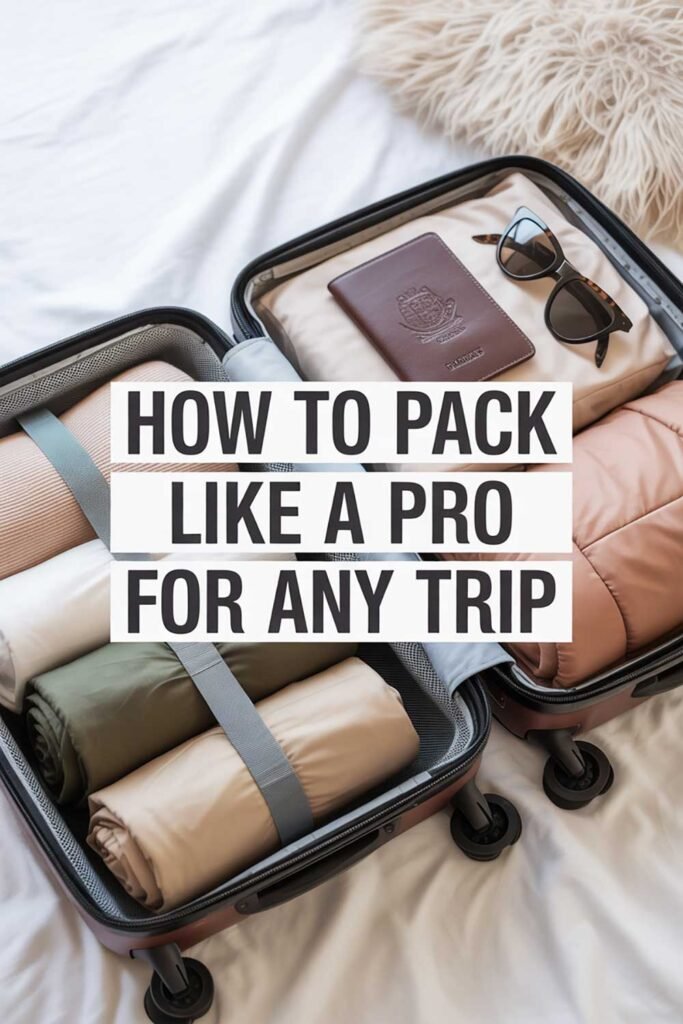
A set of packing cubes with one permanent category per cube is the organizational infrastructure that converts a single open suitcase compartment into a navigable system. The tops cube is always opened for tops. The bottoms cube is always opened for bottoms. The organization is maintained throughout the trip rather than degrading by day two into the general disorder that the uncubed bag produces. Keep the category assignments permanently. After a few trips the system is automatic and the bag stays organized with almost no active management required.
9. Slim travel wallet
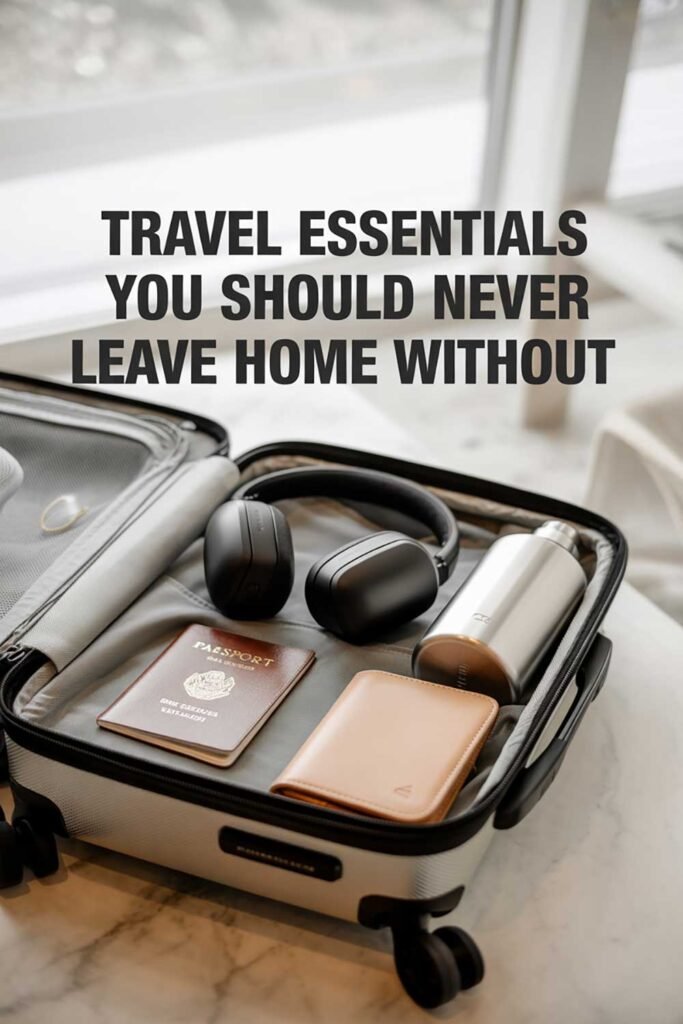
The slim travel wallet with assigned slots — passport in one, boarding pass in one, backup card in one, local currency in one — is the document system that produces every needed item in one reach at every checkpoint. The wallet that holds everything in one place and is organized the same way on every trip is the wallet that never produces a public search through multiple pockets at the ID check or the border crossing. Choose one with RFID blocking for additional card security. Keep the slot assignments permanently.
10. Packable day bag
The packable day bag — a lightweight backpack or tote that folds to the size of a paperback and lives in the main bag — is the item that earns its space on every destination day when the main luggage stays at the accommodation. The market morning, the beach afternoon, the day trip that requires a bag but not a suitcase — all of these are handled by the packable day bag at the weight and volume of almost nothing in the main bag. It also serves as the overflow carrier for the return journey when purchases need a home for the flight home.
11. Luggage tags with contact information
A distinctive luggage tag on every checked bag makes the carousel identification immediate rather than a round-by-round scrutiny of every similar dark suitcase on the belt. Include name and email address rather than a home address for privacy. The bag identified instantly from a distance is the bag whose carousel time is measured in seconds rather than the minutes required to read labels on identical-looking suitcases until the right one appears.
12. Small electronics organizer pouch
All cables, adapters, earbuds, and small electronics in one flat zippered pouch that lives in the same position in the carry-on on every trip. The cable needed at the gate outlet is in the pouch. The adapter needed at the hotel is in the pouch. The pouch is where they go back after every use. The traveler who knows where every cable is at any point in the trip is the traveler whose electronics pouch has never changed position between trips.
13. Compression packing cubes for bulky layers
The standard packing cube holds soft clothing efficiently. The compression cube — with a secondary zipper that reduces the contents to a fraction of their uncompressed volume — holds the fleece, the down jacket, and the thick hoodie at the footprint of a folded t-shirt stack. One compression cube used specifically for the trip’s bulkiest soft layer recovers more carry-on space than almost any other single addition to the packing system.
DND Resources
Our travel resources page has trusted tools, official sources, and planning guides for every stage of the trip — from the first booking to the last checkout.
DND ResourcesComfort and Wellness Essentials
The comfort essentials are the items whose presence on a trip is noticed most acutely in their absence — the sleep mask left at home on the overnight flight, the neck pillow forgotten on the connection that turned into a four-hour wait, the lip balm not packed on the ten-hour flight whose cabin ran at ten percent humidity. These are the items that do not add to the trip’s interest but protect the physical quality of the traveler experiencing it.
14. Sleep mask
The sleep mask that achieves genuine darkness — not a thin fabric that reduces light, but a contoured mask that blocks it entirely — removes the cabin’s ambient light from the sleep environment and allows the body to move toward sleep regardless of whether the overhead lights are on, the window shade is open, or the screen two rows ahead is running a bright scene. For overnight flights and long daytime journeys, the sleep mask is one of the highest-return items in the travel kit relative to its weight, cost, and volume.
15. Travel neck pillow
The neck pillow that supports the side of the head rather than just the back of the neck is the one that actually prevents the head from falling sideways during sleep. Position the U-shape so the bulk is at one side of the neck, supporting the head against the seat’s headrest or the window. The correctly positioned neck pillow changes the quality of sleep on long flights in a way that the same pillow worn in the standard orientation — bulk at the back, head dropping forward — does not. Test the positioning before the flight that needs it.
16. Compression socks
Compression socks on any flight over four hours meaningfully reduce the swelling, heaviness, and circulation restriction that prolonged seated immobility produces in the lower legs. Put them on before boarding rather than mid-flight when the feet are already swollen and the application is more difficult. The feet that deplane in compression socks after a ten-hour flight feel measurably different from the feet that deplaned without them on the previous trip. Available at pharmacies in a range of compression levels — fifteen to twenty millimeters of mercury is appropriate for general travel use.
17. Lip balm and saline nasal spray
The cabin’s relative humidity runs between ten and twenty percent — drier than most deserts — for the full duration of a long-haul flight. Lip balm applied every two hours prevents the cracking that the cabin’s dryness produces across a long flight. A travel-size saline nasal spray used every three to four hours keeps the nasal passages hydrated and reduces the congestion that pressurization and dry air combine to produce. Both items are small, inexpensive, and among the most consistently under-used items in the travel kit relative to their impact on how the landing feels.
18. Reusable water bottle
An empty reusable water bottle carried through security and filled at the airport’s water refill station after the checkpoint provides unlimited water across the full travel day at zero cost beyond the bottle’s purchase price. The hydration standard for a long flight — approximately eight ounces per hour — is most easily met by a bottle that can be filled repeatedly rather than a series of small cups from the service cart whose intervals are determined by the crew’s schedule rather than the body’s needs.
19. Travel blanket
A compact travel blanket — a lightweight packable throw that folds to the size of a paperback — covers every cold hour of a long flight regardless of what the airline’s blanket service provides and when it distributes. Cabin temperature on long-haul flights varies unpredictably across the journey. The traveler with their own blanket manages their own temperature rather than depending on the service cart’s allocation. Under two hundred grams. Packs to the size of a large paperback. Earns its space on every overnight or long-haul flight.
20. Earplugs
Earplugs as a backup or supplement to noise-cancelling headphones — for the traveler who removes the headphones during sleep — provide meaningful reduction of the cabin’s ambient noise at zero weight cost worth measuring. A small travel pouch with two or three pairs is the preparation that covers the overnight flight, the noisy hotel neighbor, and the early morning in a city that starts louder than expected. The pair used once on a trip justifies the entire pouch.
The Trip Where Cleo Finally Understood What “Essential” Actually Means
Cleo had a reliable travel habit of researching essentials lists before every trip and then not buying most of what was on them because nothing on the list felt essential enough to justify adding an item to the bag. The portable charger seemed redundant because she had never run out of battery. The compression socks seemed excessive because her legs had never been a problem. The sleep mask seemed like a luxury because she could sleep on planes without one. None of this reasoning was wrong. It was just based on trips that had not yet produced the specific moment that would change her mind.
The portable charger moment came at an international airport during a three-hour connection when the phone hit four percent battery with the gate confirmation still not loaded and the boarding pass app requiring an internet connection to open. A stranger with a portable charger lent it to her. She bought her own the same day. The compression socks came after a transatlantic flight where the swelling in her feet lasted through the first full day at the destination and made the city walk she had planned the most uncomfortable version of itself. The sleep mask came after realizing that the red-eye she had assumed she could sleep through had produced three hours of dozing rather than the six she had planned for, because the cabin lights on that specific route were never fully dimmed.
None of these were dramatic travel disasters. They were the specific low-grade travel degradations that the right essentials exist to prevent — the kind that do not ruin a trip but quietly reduce its quality in ways that are entirely avoidable. The essentials on this list are the ones that have produced the most consistent version of that realization across the most travelers across the most trips. They are not on this list because a packing guide said so. They are on this list because the moment of needing them and not having them is the moment they became essential.
Become An Agent
Love helping travelers find the essentials and plan the trips that make every journey more comfortable? See how to turn that into a home-based travel business.
Become An AgentHealth, Safety, and Practical Essentials
The practical essentials are the items that handle the small emergencies, the logistical friction points, and the daily maintenance tasks that travel produces in environments that are not the traveler’s home. They are not exciting. They are the reason the trip continues smoothly past the blister, the stomach issue, the currency confusion, and the hotel room with one outlet and five devices.
21. Compact first aid kit
A small, pre-assembled first aid kit — adhesive bandages in multiple sizes, antiseptic wipes, pain reliever, antihistamine, blister treatment, and any personal medical requirements — in the carry-on at all times is the kit that earns its space on the trip where a child scrapes a knee before the nearest pharmacy is found, a blister forms on the second walking day before it becomes the thing that defines the afternoon, or an unexpected allergic response needs an antihistamine before it escalates. Pre-assemble it. Keep it permanently stocked. Restock immediately after every trip that draws from it.
22. Prescription medications in the carry-on — always
Every prescription medication for every family member belongs in the carry-on — the bag that is never gate-checked and never delayed by baggage handling. The checked bag is the bag that arrives when the airline delivers it, which is usually on the same flight and occasionally not. A missed dose of a daily medication is a medical situation whose prevention is one habit: carry-on, always, without exception for any trip of any length to any destination.
23. Travel insurance confirmation accessible offline
The travel insurance policy number, the emergency assistance phone number, and the claims procedure — screenshot and saved in the camera roll before departure. The medical situation at a foreign destination that requires calling the insurance provider is the situation least compatible with searching through a slow email inbox for the confirmation email sent six weeks ago. The information saved offline is the information available in the thirty seconds before it is needed rather than the ten minutes after it should have been found.
24. Small laundry bag
A lightweight mesh laundry bag — the item that maintains the clean/dirty boundary in the main bag from the first evening of every trip. Every worn item goes into the laundry bag. Every clean item stays in its packing cube. The boundary maintained from the first evening keeps the bag organized through the trip’s full duration and makes the checkout repack a five-minute confirmed sort rather than a mixed-content excavation. Under twenty grams. Packs flat. Earns its space on every trip longer than one night.
25. Reef-safe sunscreen in travel size
Not universally available at beach and outdoor destinations, and where it is available it is almost always significantly more expensive than the same product purchased before the trip. A travel-size reef-safe sunscreen in the toiletry kit is both the environmentally appropriate choice and the practical one for any trip with outdoor or beach content. Pack it before leaving rather than counting on the destination’s availability unless that availability has been specifically confirmed.
26. Waterproof phone pouch
For any trip with water activities — kayaking, snorkeling, boat trips, beach days with surf — a waterproof phone pouch is the item that costs very little, weighs almost nothing, and is the difference between the phone that survived the afternoon and the phone that did not. Pack it before leaving home. The destination’s version of this item, when available, is almost always more expensive and sometimes unavailable until after the moment it was needed.
27. Blister treatment and prevention
The blister that forms on the second day of a walking-intensive destination is the thing that shapes the rest of the trip’s pace, footwear choices, and daily distance more than almost anything else that could have been packed for and was not. Blister prevention tape or balm applied before the walk that produces blisters is the preparation that costs nothing and prevents the specific degradation that the unprepared version of the same walk reliably produces. Pack it. Apply it before the walk. The afternoon is better for it in a way that is only fully understood by the traveler who has experienced the alternative.
Documents, Money, and Security Essentials
The document and money essentials are the items that make every payment, every border crossing, every check-in interaction, and every emergency scenario faster and more secure. They are the least exciting category on this list and the one whose absence or disorganization is felt most acutely at exactly the moments when the trip is already demanding the most attention.
28. No-foreign-transaction-fee credit card
The standard credit card used internationally charges a two to three percent foreign transaction fee on every purchase. Across a two-week international trip with moderate daily card spending, the cumulative fee represents a meaningful amount charged for no service received. A card with no foreign transaction fee is widely available and often includes additional travel benefits. Apply for one before the next international trip. The saving is automatic, applies to every card transaction across the trip, and requires no behavioral change at the destination beyond using the right card.
29. Backup payment method stored separately from the primary wallet
A backup card stored separately from the primary travel wallet — in the main bag, in a different compartment, anywhere other than where the primary wallet lives — is the financial continuity plan for the lost or stolen wallet. The trip without a separately stored backup has one financial option. The trip with a separately stored backup has two. The backup is never needed on most trips and is the only thing that matters on the trip where the primary wallet is lost.
30. Small amount of local currency kept on hand at all times
The destination that accepts cards everywhere is the destination the traveler has never fully explored — because the market stall, the street food vendor, the small neighborhood café, and the local transport whose card reader is not working are all cash-only situations that travel outside the tourist center reliably produces. A small daily cash baseline covers every cash-only scenario without requiring an ATM hunt at the moment the situation occurs. Keep the equivalent of twenty to thirty dollars or euros in local currency accessible. Replenish from a city ATM rather than an airport exchange kiosk.
31. RFID-blocking travel wallet or card sleeve
Contactless card skimming — the theft of card data from RFID-enabled cards in crowded public spaces — is a real risk in high-tourist environments. An RFID-blocking travel wallet or a set of card sleeves provides passive protection against this specific theft method at no behavioral cost to the traveler. The wallet does the blocking automatically. No scanning behavior, no special handling, no active management required. A small, permanent addition to the travel kit that addresses a specific vulnerability without adding any friction to the trip.
32. Luggage lock for checked bags
A TSA-approved luggage lock — openable by TSA agents with a master key when inspection is required — provides a meaningful deterrent against opportunistic bag access at baggage handling and in shared accommodation storage. It does not prevent a determined theft but it does make the checked bag substantially less accessible than the unlocked alternative at no additional cost to the inspection process. TSA-approved locks can be inspected and re-locked without being cut. Standard locks cannot and are cut whether or not anything is found.
33. Printed backup of critical documents
A printed page — passport photo page, travel insurance policy number, accommodation addresses, emergency contacts, airline booking references — folded and stored separately from the phone and the digital backups is the document system that functions when the phone is dead, lost, or stolen and the offline camera roll is unavailable. The printed backup is the last resort that never needs to be used on most trips and is the only available resource on the trip where every digital option has failed. One page. Printed before every international trip. Stored in the main bag’s interior pocket.
Small Comfort Items That Earn Their Weight Every Time
The final category is the small items — individually light, individually inexpensive, individually easy to overlook — whose collective contribution to travel comfort is larger than their combined weight suggests. Each one addresses a specific friction point that travel reliably produces and that the traveler who has encountered it once packs for specifically on every subsequent trip.
34. Snacks from home in the personal item
Familiar, reliable, low-sodium snacks in the personal item cover the hunger that arrives between service cart passes on a long flight, the delayed connection whose only food option is an overpriced terminal sandwich, and the first two hours at a new destination before the nearest market is located. Keep enough for the full transit duration plus a generous buffer. The snack that a hungry traveler accepts without complaint at hour six of a nine-hour flight is worth more than the space it occupied in the personal item for the previous five.
35. A small notebook or the notes app used consistently
The running note — the restaurant name the hotel host recommended, the market opening time confirmed that morning, the thing noticed on day two worth revisiting on day four, the two sentences about the day’s best moment written before sleeping — is the record that makes the trip recoverable in memory months after it has become a pleasant general impression. A small physical notebook or the consistent use of a phone notes app across the full trip produces the specific, detailed record that photographs capture the appearance of but not the feeling of. Start it before departure. Add to it throughout. The trip’s best memories live in the specifics that the general impression swallows first.
Picture This
The portable charger was fully charged the night before departure and in the personal item’s outer pocket. The boarding pass was in the camera roll. The slim travel wallet had every slot confirmed filled. The packable day bag was folded flat at the base of the main bag. The compression socks were on before boarding. The sleep mask and neck pillow were in the personal item ready for the overnight flight. The noise-cancelling earbuds reduced the engine drone to a quiet background. The reusable water bottle was filled after security. The small first aid kit was in the carry-on and never needed — which is exactly when it is most useful.
At the destination, the packable day bag came out on day two for the market morning and stayed out for the rest of the trip. The no-foreign-transaction-fee card paid for every purchase without a second thought. The small cash baseline covered the market stall whose card reader was not working and the street food that became the best meal of the trip. The blister tape applied on day three’s morning prevented the thing that the previous trip’s afternoon had been defined by. The sleep mask earned its space again on the red-eye home.
At the final checkout, the printed backup page was still in the main bag’s interior pocket, never needed and still there. The small notebook had twelve entries. The last one was written the night before departure and described the market stall in specific enough detail to still be recoverable a year later. That is thirty-five essentials. That is the trip that was more comfortable from the very first day — not because of luck, but because the right things were in the right places before it began.
Before the Next Trip: Grab the Free Packing Checklist
Our free Travel Packing Checklist is the confirmation step that makes sure every essential is in the right place before the bag closes. Download it and use it before the next trip.
Get the Free ChecklistExplore Our Top Picks for a Better Trip
After years of travel together, these are the booking platforms and travel services we personally rely on — tested, trusted, and recommended because they have consistently made our own trips smoother and more comfortable.
See Our Top PicksTravel Printables at Premier Print Works
Visit Premier Print Works for packing checklists, travel essentials guides, trip planners, and organization printables that make every departure more prepared and every trip more comfortable from the first day to the last.
Visit Premier Print WorksDisclaimer
The information shared in this article is provided by Don and Diana’s Travels for general informational, educational, and inspirational purposes only. It reflects our personal experiences, opinions, and the experiences of travelers we have worked with. It is not professional travel, medical, legal, or financial advice.
References to compression socks, medications, first aid, and health-related travel items are general educational information only. Always consult a qualified healthcare provider for advice specific to your health circumstances before making changes to your travel health practices. Airline carry-on policies, security procedures, and baggage rules vary by carrier and are subject to change. Always confirm current requirements before traveling.
This article may contain affiliate and partner links that pay us a commission at no extra cost to you. Our recommendations are based on real use and genuine belief in the products and services we share. Stories on this site combine real experiences from Don, Diana, clients, and travelers we have worked with. Details may be adjusted for privacy and narrative clarity. All content is the copyrighted property of Don and Diana’s Travels. You may not copy or republish our content without prior written permission. By reading this article you acknowledge that you have read and agree to this disclaimer.