Airport days feel slow and stressful almost entirely because of habits that are completely easy to fix once you know what they are. Thirty tips for the traveler who dreads airport days more than any other part of the trip — because the habits that make airports hard are not inevitable, and the ones that make them easy are not complicated.

Best For
Every Traveler Who Dreads Airport Days
Tips Count
30 Airport Travel Tips
Read Time
12 Minutes
Walk Away With
The Habits That Stop Making Airport Days Hard
Free Download

Grab Our Travel Packing Checklist

Our free packing checklist includes the airport-day essentials — the boarding pass screenshotted, the carry-on organized for security, the laptop in the outer pocket — so every habit that makes airport days easier is confirmed the night before rather than improvised at the bin. Stop dreading it. Start breezing through it.

Get the Free Checklist

The people who move through airports like it is easy are not luckier than everyone else — they just stopped doing the things that make it hard.

Airport days feel slow and stressful almost entirely because of habits that are completely easy to fix once you know what they are.

The Night Before: The Airport Day Starts Here, Not at the Terminal

01

Check in online the night before — not the morning of the flight

Online check-in opens twenty-four hours before departure and the seat selection available at the opening of that window is the most complete it will be across the entire check-in period. The window seat before anyone else has taken it, the aisle seat before the middle-seat passengers have displaced it, and the exit row before it has been allocated to frequent flyer status upgrades — these are all available at the check-in window’s opening and progressively unavailable as the hours pass. Completing online check-in the night before produces the preferred seat, the boarding pass confirmation, and the specific calm of knowing the check-in is done before the departure morning’s other tasks begin. The morning-of check-in produces whatever seat remains and adds one more task to the departure morning’s list. Do it the night before. The two minutes from the sofa are better spent than the same two minutes from the taxi.

02

Screenshot the boarding pass offline the moment check-in is confirmed

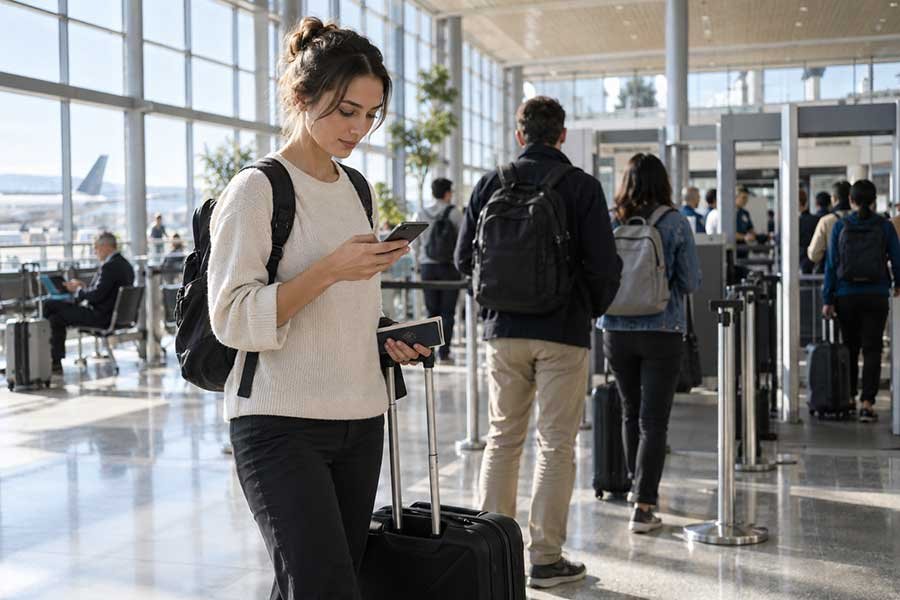
The boarding pass in the airline app requires the app to load, the account to be accessible, and the network to cooperate — three conditions that congested airport Wi-Fi and peak security queues test simultaneously at the specific moment the boarding pass is most needed. The boarding pass screenshot in the camera roll requires one tap and opens in one second regardless of signal, battery level, or app status. Take the screenshot immediately after check-in confirmation. Switch the phone to airplane mode and confirm it opens without connectivity. Save one screenshot per leg per passenger. The camera-roll boarding pass is the one that has never failed at a gate because the app was updating, the one that scanned cleanly in low gate lighting, and the one that was available the second the gate agent’s scanner appeared. Take the screenshot the night before. Use it at every checkpoint the following morning without a single moment of doubt.

03

Confirm gate and terminal the evening before departure

Gate assignments are finalized close to the departure day, which means the gate in the booking confirmation from six weeks ago may not be the gate the flight actually departs from. The airline app shows the current gate assignment the evening before and sends push notifications for any changes — enabling these notifications and checking the flight status once in the evening before means the departure morning begins with the correct current gate rather than the one assigned at booking. The terminal is equally important on trips involving large hub airports with multiple terminals: the taxi heading to Terminal B when the flight departs from Terminal E is the error that no amount of early arrival fully compensates for. Thirty seconds of evening check. The gate and terminal that are current when the taxi is booked are the gate and terminal that the airport day is built around.

04

Organize the carry-on for security the night before — never at the airport

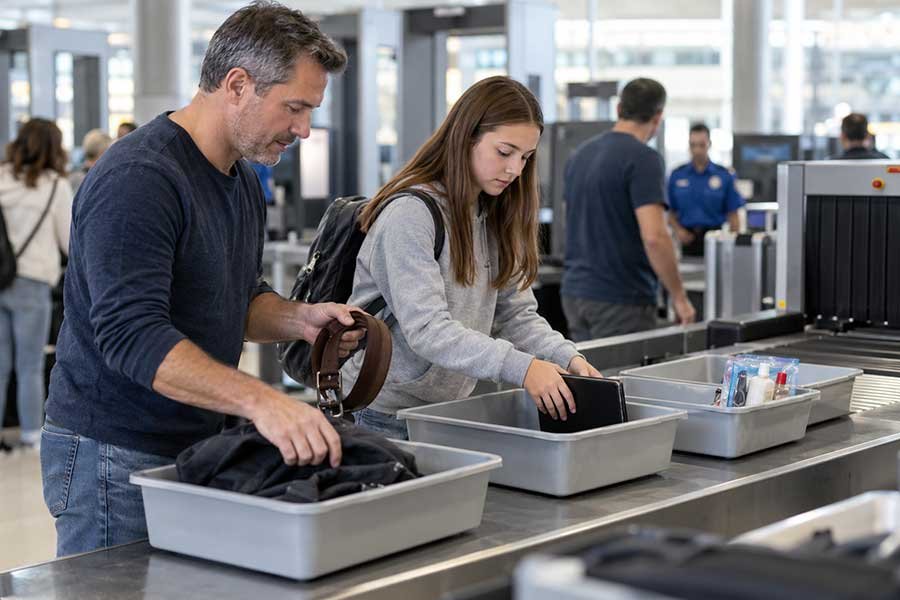
The two items that make security slow are the laptop and the liquids bag — both required to be removed and placed in the tray separately, and both buried in the main compartment of every carry-on that was not organized for security before the airport was reached. Moving the liquids bag to the carry-on’s outermost front pocket and the laptop to its dedicated exterior sleeve the night before costs two minutes and converts the security interaction from a two-minute main-compartment excavation into a two-second outer-pocket reach. The carry-on organized for security before the departure morning also confirms the liquids bag is within the quart-bag limit and the laptop is accessible — discoveries that are far easier to address at home than at the conveyor with the queue behind. Organize the night before. Arrive at security already ready. This is the single most consistent habit among the travelers who move through security quickly.

05

Charge every device before going to sleep the night before the flight

Every device arriving at the airport fully charged is a device that does not require a gate outlet, does not compete with other travelers for the available charging stations, and does not create the specific anxiety of watching the percentage approach the boarding pass threshold while the gate agent is already scanning. Put every device — phone, tablet, earbuds, portable charger itself — on charge the night before the flight as the last pre-departure task before bed. The phone with a full battery at departure is the boarding pass available, the maps loaded, and the navigation ready from the first airport exit to the destination’s first street. The portable charger at full capacity is the full travel day covered without a wall outlet being involved after the home charger. Full batteries are not luck. They are the result of charging the night before instead of the morning of.

06

Confirm the baggage rules for every airline on the trip before packing a single item

A multi-carrier trip may involve more than one set of baggage rules, and the budget carrier on the connecting leg is almost always the strictest one. The budget carrier’s carry-on size limit, personal item dimension restriction, and weight allowance apply to the same bag that the full-service outbound carrier accepted without comment, because the full-service carrier’s generosity does not transfer to the connecting carrier’s gate agent. Five minutes of checking every carrier’s specific allowances before packing determines the limit that applies to the entire journey. Pack within the most restrictive standard any carrier on the trip imposes. Every leg boards without a gate-check demand, without an overweight fee, and without the specific improvisation of transferring contents between bags at an airport gate while the boarding queue watches. Check every carrier the night before. Pack once, correctly. Never discover a baggage rule at the airport.

We Handle the Details Before the Airport Day Begins

Let Us Plan the Trip Where Every Airport Day Is Already Set Up to Go Smoothly

The connections with built-in buffer, the accommodation confirmed, and the itinerary organized before the first boarding pass is screenshotted — that is what booking a trip with us looks like. Tell us where you want to go and we will handle the planning that makes airport days the easiest part.

Plan Our Escape

The Security Line: Stop Making It Slower Than It Has to Be

07

Wear slip-on shoes every single time you fly — without exception

Shoes are removed at security at airports across the United States and at many international checkpoints, and the time difference between slip-on shoes and lace-up ones at this specific moment is the specific time everyone behind in the queue is waiting for. Slip-ons come off in three seconds and go back on in three seconds. The lace-up boots whose laces require kneeling at the security belt cost the traveler and the queue behind them the specific time that the conveyor and the tray were waiting to move. Designate a pair of slip-ons as the travel shoes for every flight — loafers, slip-on sneakers, Chelsea boots, mules — and wear them through every security checkpoint the trip produces. The destination shoes travel in the bag. The travel shoes move through security in seconds. This is one of the smallest, cheapest, most effective single-habit changes available for the traveler who wants airport days to stop being slow.

08

Remove the belt, watch, and all metal items before joining the security queue

Every metal item removed at the security bin costs time at the conveyor — the belt unfastened and pulled through its loops, the watch unclasped, the keys extracted, the loose change retrieved — while the queue behind waits. The same items removed at the back of the security queue, before the belt is reached, cost the same time in a space designed for waiting rather than throughput. Put the belt, watch, keys, and any other metal or electronic item into the carry-on’s outer pocket before joining the line. Arrive at the conveyor already prepared — shoes in hand, outer pockets open to the liquids bag and laptop, no metal anywhere on the body. The security interaction that follows takes twenty seconds rather than the two minutes that the traveler still removing a belt at the bin produces. Thirty seconds of pre-line preparation. Every checkpoint faster for it.

09

Keep the laptop and the liquids bag in the carry-on’s outermost pocket at all times

The laptop and the liquids bag are the two items required to come out of the carry-on at every security checkpoint, and their position in the bag determines whether that process takes two seconds or two minutes. Buried in the main compartment, they require opening the bag fully, moving whatever is above them, removing them, placing them in the tray, and rebuilding the bag before it goes on the belt — a sequence that produces the held-up line whose downstream effects extend beyond the immediate moment. In the outermost front pocket, each item comes out in one motion, goes into the tray in two seconds, and returns to the same pocket when the tray comes back. Set up this configuration the night before and leave it unchanged for every airport transit on the trip. The carry-on whose outer pockets hold the security items is the carry-on that sails through every checkpoint it encounters.

10

Empty every pocket before reaching the security bin

The pocket item discovered at the scanner — the phone still in the jacket, the coins in the trouser pocket, the pen in the shirt pocket that triggers the secondary wand — is the item that sends the traveler back through the scanner and holds the interaction open while the additional check happens. Empty every pocket before joining the security queue: phone into the carry-on’s outer pocket, wallet into the bag, all small items confirmed absent from every pocket. The traveler whose pockets are empty before the bin is the traveler whose scanner interaction takes five seconds and ends with a clear signal. The one who still has something in a pocket at the bin is the one whose interaction produces a secondary check that neither party planned for. Empty the pockets at the queue entry. Arrive at the scanner with nothing left to discover. The five seconds it saves compounds across every checkpoint the trip encounters.

11

Know the airport’s security layout before arriving

Most major airports publish detailed terminal maps with security lane positions, dedicated lane options, and security checkpoint locations that are available for review the evening before the departure — from the terminal map in the airport’s app, the airline’s booking confirmation, or the airport’s official website. Knowing which terminal’s security lanes are positioned where, which lane is designated for passengers without checked bags, and which entrance produces the shortest path to the departure gates converts the arrival from an orientation exercise into a navigation of a known route. The traveler who walks through the departure terminal to the correct security lane without pausing to read signs moves faster than the one making the same navigation decisions for the first time at the airport under time pressure. The map review takes two minutes the evening before. The benefit is every checkpoint that day.

12

Consider TSA PreCheck or Global Entry if flying three or more times a year

TSA PreCheck converts the standard security lane — shoes off, laptop out, liquids bag out, body scanner — into a dedicated lane where shoes stay on, electronics stay in the bag, and liquids stay in the bag. Global Entry adds expedited re-entry from international destinations at U.S. Customs and Immigration, plus PreCheck access on every subsequent domestic flight for five years. Both programs require a background check, an application fee, and an in-person interview — a one-time process that produces a Known Traveler Number added to every booking. For the traveler who passes through airport security three or more times per year, the cumulative time saved, the consistent reduction in the security process’s friction, and the specific calm of approaching security knowing the shoes are staying on add up to a meaningful quality-of-life improvement across every airport day for the program’s five-year validity period.

Security to Gate: Move With a Plan, Not a Guess

13

Always find the gate before you find food, coffee, or anything else in the terminal

The food or coffee purchased before the gate is located is the food eaten with the gate’s distance unknown, the departure time not yet confirmed against the current departures board, and the walk back unplanned. The meal that takes fifteen minutes to eat twenty-five feet from the gate is the same as the meal that takes fifteen minutes to eat with a ten-minute walk back to a gate that turns out to be boarding. The gate found first is the gate whose distance is known before any other commitment in the terminal is made. Walk to it. Confirm the departure time on the gate display matches the boarding pass. Check that the gate number has not changed since last evening. Then find the food, with the gate visible or the return walk timed, and eat without the specific awareness that the gate’s status is unknown. Gate first. Always. The coffee is better with that information already confirmed.

14

Never exchange currency at the airport kiosk — the rate is always the worst available

The airport currency exchange kiosk operates on a captive-market pricing model: the traveler who arrives needing local currency and has no better option at this specific moment is the customer whose transaction is priced to reflect the absence of competition. The kiosk’s spread between the buy and sell rates, combined with the commission or fee charged on top, consistently produces one of the worst exchange rates available at any legal currency exchange point. The same currency obtained from the destination city’s local ATM produces significantly more local units from the same home currency, with only a modest ATM withdrawal fee. If local currency is genuinely needed before the city’s ATMs can be reached, the airport’s ATM is the correct alternative to the exchange kiosk — still a better rate by a meaningful percentage. The exchange kiosk is the option whose real estate in the arrivals hall is paid for by the margin it charges. Use the ATM. The savings are real and the habit costs nothing once it is established.

15

Check the departures board the moment you clear security for current gate information

The departures board at the security exit is the most current source of flight status and gate assignment available at the moment of clearing security, and the thirty seconds spent reading it catches gate changes before they become discoveries at the wrong gate. Gate changes happen between the evening’s check and the morning’s departure: delayed inbound aircraft, aircraft type swaps, operational reroutes, and runway sequencing reassignments all produce gate changes that appear on the board in real time. The traveler who reads the board on clearing security has the current gate and departure time before moving anywhere in the terminal. The one who walks directly to the gate from the boarding pass assumes nothing changed overnight — an assumption that is usually correct and occasionally produces the ten-minute walk in the wrong direction. Read the board. The thirty seconds is the most reliable information available at the cheapest possible cost.

16

Charge devices at the gate while you wait rather than looking for outlets mid-terminal

Gate seating areas at most airports include accessible power outlets — floor outlets, charging stations, or USB ports in the armrests — and the time between clearing security and boarding is long enough to add a meaningful charge to any device whose overnight charging did not fully complete or whose departure morning consumed more battery than anticipated. The short cable in the personal item’s exterior pocket connects to the gate outlet and adds charge to the phone, the earbuds, and the portable charger without requiring any deviation from the gate wait. The phone that boards at full charge is the boarding pass available, the navigation loaded, and the entertainment ready for the entire flight without reaching for the portable charger before the first hour has passed. Use the gate outlet. It is there specifically for this purpose. The device fully charged at the gate is the device that is never thought about for the rest of the travel day.

17

Build a thirty-minute buffer into every connection at the time of booking

The airline’s minimum connection time is the time required when the inbound flight is on schedule, the gates are nearby, no secondary process is required, and nothing unusual happens at the airport on that specific day. Real connections encounter late inbounds, crowded deplaning corridors, gate changes that add distance, and transit requirements whose time cost the minimum does not account for. Booking connections with thirty minutes of margin beyond the airline’s minimum at the time when the schedule is a preference rather than a fixed constraint converts the missed connection risk from a real and consequential scenario to an edge case that the buffer absorbs. The thirty minutes used on the delay day is the trip that still happened as planned. The minimum-time connection on the delayed inbound is the rebooking, the missed hotel, and the tour that cannot be undone. The buffer is not pessimism. It is the correct reading of what connection times are built around and what they are not.

18

Know the connecting gate before the inbound flight lands

The connection navigated without information about the connecting gate is the connection navigated from the deplaning door to the arrivals display to wherever the connecting gate turns out to be — a sequence that begins at the highest-stress moment of the connection’s clock and requires acquiring information that was available thirty minutes earlier at no cost. In the final thirty minutes of the inbound flight, confirm the connecting gate from the seatback entertainment screen, the airline app, or the crew’s announcement. Note whether the connection requires a train, a terminal change, or a security re-entry. Plan the route based on the terminal map reviewed the night before. The traveler who stands up at the deplaning door already knowing the gate, the direction, and the approximate walking time is the traveler whose connection is managed rather than improvised. The information takes sixty seconds to acquire while still seated. The walk that follows is a plan rather than a navigation under pressure.

How Zara Stopped Dreading Airport Days and Started Moving Through Them Like They Were Easy

Zara had always disliked airports. Not the flying — she liked flying well enough — but the airports themselves: the specific combination of slight confusion, mild time pressure, and the recurring sense that everyone else knew something she did not. She had never been late for a flight. She had never missed a connection. She had, however, spent a significant portion of every airport day in the low-grade alert state of someone who was not quite sure what was happening and was managing it through constant vigilance rather than preparation. The vigilance was exhausting. The airport dread was its direct result.

The habits she changed were not dramatic. She started checking in online the night before after arriving at a gate with a middle seat that the five people who had checked in before her had already taken every other option from. She moved the laptop to the outer sleeve after standing at the security bin while her neighbor in the queue waited for her to locate it in the main compartment. She bought the slip-ons after reading an article — not this one, an earlier one — and wore them for the first time on a trip and found the security lane interaction so noticeably shorter that she wore them on every subsequent flight without ever considering the alternative.

She found the gate first on the trip where she had bought coffee before locating the gate and discovered the gate was seven minutes away, finished the coffee in four minutes at a pace that was less enjoyable than it was intended to be, and arrived at the gate slightly breathless for no logistical reason beyond the order she had chosen. She stopped exchanging currency at the airport kiosk after reading a comparison that made the rate difference visible and concrete. She built buffer time into her connections after being one of twelve passengers who made a forty-minute connection when the inbound landed twenty minutes late and the gate was closer than it might have been.

None of these were revelations. Each was a small habit that stopped producing a small friction that she had not previously identified as optional. The accumulated effect across the following year’s flights was the specific transformation that these thirty tips describe: she stopped dreading airport days. Not because airports changed, but because she stopped doing the things that made them hard. The people who move through airports like it is easy, she discovered, are not luckier. They just learned this earlier than she did.

Boarding and the Aircraft: Get On and Get Set Without the Friction

19

Board when your group is called — not before, and not significantly after

Early boarding produces a crowded jetway and a delayed process because the groups ahead have not completed their boarding yet — the pre-group boarder adds a body to the jetway without adding to the sequence’s efficiency. Late boarding produces no overhead bin space and the specific inconvenience of locating a bin three rows behind the seat and deplaning against the flow of everyone who boarded in order. Boarding when the specific group number is called produces the seat, the overhead space allocated to the fare class, and the boarding sequence the airline designed to load the aircraft efficiently. This is not a significant behavioral discipline — it is hearing the group number and standing up. The departure gate’s ambient energy to board early is not a requirement to comply with. Group-appropriate boarding is the calm, unremarkable middle that produces the right outcome for everyone in the sequence including the traveler who responded to their number and nothing else.

20

Have the boarding pass open and ready before the jetway queue starts moving

The boarding pass opened in the moving jetway queue — app loading on congested airport Wi-Fi, screen requiring a second unlock, the specific loading spiral visible while the gate agent’s scanner is already aimed — is the boarding pass that holds the line. The boarding pass screenshot in the camera roll, opened in the seats before joining the jetway, scans in one second in any lighting and requires nothing from the network. Confirm the screenshot shows the correct flight and passenger before standing for boarding. Hold it ready at the start of the jetway walk rather than opening it at the scanner. The gate agent scans, a confirmation tone sounds, and the jetway continues moving. The traveler who had the pass ready before the queue moved is the traveler whose boarding interaction the queue did not notice. That is the goal of every document exchange in the airport. Have it ready before you need it.

21

Place the carry-on in the overhead bin correctly on the first attempt

The carry-on placed wheels-first in the overhead bin occupies the bin inefficiently because the wheels are the bag’s widest point. Handle-first placement — wheels toward the back wall, handle toward the aisle — positions the narrower profile against the bin’s depth and leaves the most accessible part toward the aisle for retrieval. Before placing the bag, check whether there is actually space for the specific configuration — the bin that appears to have space may not have the right-shaped space, and confirming before the lift avoids the rotation and re-lift that the boarding aisle watches. The first-attempt placement that works correctly moves the boarding aisle forward. The two-lift rotation that does not holds the aisle. First attempts are controlled by preparation — knowing the correct orientation before the bag goes up rather than determining it while holding the bag over the seat at shoulder height.

22

Know what goes overhead and what goes under the seat before boarding begins

The boarding aisle is the wrong place to make the overhead-versus-under-seat decision. The carry-on goes overhead. The personal item goes under the seat in front of the traveler. This decision belongs to the boarding preparation rather than the boarding aisle, because the decision made while standing in the aisle with bags on both shoulders and a queue behind is the decision made under exactly the wrong conditions. The personal item is packed for the flight — charger, snacks, comfort items, documents — and needs to be accessible throughout. The carry-on holds the trip’s other contents and the overhead bin holds the carry-on. The traveler who makes this decision before boarding moves through the aisle, places each bag in its designated location, and is seated before the passenger behind has reached the row number. The decision made in the aisle takes longer and produces the same result. Make it before the jetway.

23

Set up for the flight before the aircraft door closes

The window between sitting down and the door closing is the preparation window for the full flight — the last opportunity to extract items from the overhead carry-on before the seatbelt sign goes on, position the personal item correctly under the seat, confirm the boarding pass for the connecting flight is in the camera roll, set the phone timers for any reminders the flight requires, and have the comfort items ready rather than stowed. Everything needed for the flight should be in hand or in the accessible top layer of the personal item before the door closes. The flight from door-close to destination is either set up before it begins or accessed reactively throughout it. The reactive version involves the seatbelt sign, the neighbor’s patience, and the overhead bin at thirty-five thousand feet. The thirty seconds before the door closes replaces all of that with the simple experience of being ready when the flight starts.

24

Set a movement reminder on any flight over four hours before the door closes

The movement reminder set before takeoff — a two-hour repeating silent vibration on the phone — is the commitment device that makes the aisle walk happen across a long flight rather than being continuously deferred by a good film or the inertia of a reclined seat. Long-haul immobility accumulates in the lower legs and lower back in ways that are not always felt acutely during the flight and are consistently felt on arrival. Three short aisle walks across a twelve-hour flight take under fifteen minutes total and produce a measurably different arrival feeling than the same flight managed without them. Set the reminder before the door closes. The walk happens when the timer fires. The arrival benefits from every walk the timer produced. This is the ten-second setup before takeoff whose return on investment is measured across the entire subsequent travel day at the destination.

Travel Resources

Our Curated Collection of Trusted Tools and Official Sources

Everything we use to plan, prepare, and travel with confidence — from official government travel tools to practical planning aids. We have pulled together the resources we trust most so every trip you take is better informed, better prepared, and a lot less stressful from start to finish.

DND Resources

Arrival and the Last Mile: Finish the Airport Day the Same Way It Started

25

Know where baggage claim is before the aircraft lands

Baggage claim directions are in the in-flight magazine, on the seatback entertainment screen at many airports, and available from the thirty-second terminal map review the night before. The direction confirmed before the aircraft door opens is the direction the deplaning traveler walks immediately rather than pausing at the arrival hall’s directional signs while other passengers move around them. The head start over the passengers orienting to the terminal determines position at the baggage carousel and the ground transport queue — both of which are first-come contexts whose efficiency is proportional to arrival order. For carry-on only travelers, the same knowledge applies to the ground transport exit. Know the direction. Walk the plan. The airport that feels effortless is almost always the airport that was familiar before arrival because someone reviewed a map the evening before.

26

Have ground transport arranged before the aircraft lands

The ground transport decision made in the arrivals hall — comparing rideshare options, locating the taxi stand, finding the shuttle pickup point — is the decision made at the end of a travel day when the energy for comparison and research is lowest and the options are assessed from a position of mild exhaustion. The same decision made before the flight, in the comfort of the accommodation’s pre-arrival research or the night-before preparation session, produces an arrivals hall that is an execution rather than a decision: the rideshare queued with the destination address, the taxi stand location confirmed on the terminal map, the hotel shuttle’s pickup point noted from the accommodation’s confirmation email. Exit the arrivals hall and move toward the transport that was already planned. The first minutes outside the arrivals hall are the best minutes of the travel day when the plan exists and the least comfortable when it does not.

27

Do a complete seat, pocket, and overhead check before standing to deplane

The item left on the aircraft is the item most difficult to recover — handled by the cleaning crew, logged with the airline’s lost property system, and available for collection from a process that takes days and works well for some items and not others. A thirty-second check before standing eliminates this process for every item it catches: the phone in the seat pocket, the earbuds between the armrest and the seat cushion, the jacket in the overhead, the passport that slid to the back of the seat pocket during the document check at the connection. Check the seat pocket, both armrests, the floor under the seat, and the overhead bin above the row. The check takes thirty seconds. Do it every time at every landing. The item that is there to be found comes home. The item not found by the check stays on the aircraft and enters the lost property system. The check is always worth thirty seconds.

28

Move away from the baggage carousel opening immediately after claiming the bag

The carousel’s throat — the opening from which bags emerge onto the belt — is the point of maximum congestion because the passengers waiting for their bags stand as close to it as possible. Once a bag is identified and claimed, moving immediately to the open space beyond the carousel’s perimeter clears the sightline for the passengers still waiting and creates the space for the next person to reach the belt without the claimed-bag holder as an obstacle. This is the airport behavior that costs nothing and contributes to the speed of everyone around it, including the traveler who just moved — who is now positioned for customs, the arrivals exit, and the ground transport more efficiently than the carousel’s congested immediate area allows. Claim the bag. Move to the open space. Exit. The airport day finishes here. Make it clean.

29

Know the destination’s local currency situation before arriving

The currency situation at the destination — whether cards are widely accepted, whether cash is needed immediately, whether ATMs are available outside the arrivals terminal, and what the local ATM fee and exchange rate situation looks like — is information that prevents the specific airport mistake of exchanging currency at the arrivals kiosk because nothing else is understood. Research the destination’s payment landscape before the trip: the percentage of transactions that require cash, the location of the first reliable ATMs outside the arrivals hall, and the approximate daily cash need for the first day. The destination where cards are universally accepted requires no airport ATM visit and no exchange kiosk transaction. The destination where cash is needed from the first taxi requires the airport ATM — not the exchange kiosk, which remains the worst available rate regardless of the urgency. Know before you land. Act accordingly. Never let the kiosk win by default.

30

Reset the full travel system within twenty-four hours of arriving home

The airport day that starts easier is the one built on a travel system that was maintained after the last trip rather than rebuilt from scratch before this one. The carry-on reset within twenty-four hours of every return — laptop back in its outer sleeve, liquids bag restocked and back in the outer pocket, belt and watch back in the adjacent pocket, every device recharged, boarding pass screenshots cleared and the folder ready for the next trip — is the carry-on that requires no reorganization the night before the next departure. The reset is what makes the night-before preparation a ten-minute confirmation rather than a thirty-minute assembly. It is what allows tip one through tip five to take less than fifteen minutes the evening before the next flight. Close the loop within twenty-four hours. The next airport day starts better because this one was properly finished.

Book With Us

Book the Trip That Makes Every Airport Day Worth Having These Habits For

The airport day at its best is the easy transit between home and somewhere genuinely worth going. Our travel agents plan the destinations that make the slip-ons, the outer pockets, and the screenshotted boarding pass feel like the effortless beginning of something rather than the stressful obstacle before it.

Book A Trip

The check-in was done from the sofa. The gate was found before the coffee. The security took forty-five seconds. The kiosk was not used. The connection buffer absorbed the delay. The seat check found the earbuds. The ground transport was already queued. That is thirty tips. That is stopping the things that make airport days hard.

Picture the Airport Day That Finally Felt Easy

The check-in happened last night. The boarding pass screenshot opens in one second. The gate was confirmed before bed and has not changed. The slip-ons are on and the belt is in the outer pocket. The laptop and the liquids bag are in their outer pockets, set up the night before, not touched since. The pockets are empty. Security takes under a minute. The departures board on the way out of security confirmed the gate. The gate was found before the coffee — which was finished with fifteen minutes to spare at a seat thirty feet from the jetway. The device was charged from the floor outlet. The connection had a buffer that caught the delay comfortably. The boarding pass was ready before the jetway line moved. The bag went overhead on the first attempt, correctly. The seat check at landing found the phone charger in the seat pocket. The ground transport was already queued before the aircraft door opened. The kiosk in the arrivals hall was walked past without stopping. The carry-on was reset within twenty-four hours of arriving home. That is thirty tips. That is the person who moved through the airport like it was easy — because they stopped doing the things that made it hard.

Free Download

One More Thing Before the Next Airport Day

Print our free Travel Packing Checklist and use it to confirm the carry-on is organized for security, the boarding pass is screenshotted, the devices are charged, and every habit that makes airport days easier is in place before the departure morning begins. The same checklist we use before every airport day we take.

Get the Free Checklist

Explore Our Top Picks for a Better Trip

After years of exploring the globe together, these are the exact tools, platforms, and services we rely on for every single trip — personally tested, traveler approved, all in one place. We don’t recommend anything we wouldn’t use ourselves, and this is the collection of booking platforms and travel tools that have made our adventures smoother, smarter, and more memorable.

See Our Top Picks
Turn Travel Into Income

Love Helping Travelers Have Airport Days That Actually Go Smoothly?

Helping a traveler move through airports without dread — the right connections, the right habits, the right booking — is the kind of practical expertise that makes a home-based travel agent genuinely worth coming back to. If turning your love of travel into a business sounds like the right next move, see how the TravelPreneur system works.

Become An Agent

Airport Day Printables at Premier Print Works

Visit Premier Print Works for airport day checklists, travel planners, night-before preparation guides, and printables that make every departure more organized and every arrival more efficient — from the boarding pass screenshotted the night before to the seat check completed before the aircraft door opens.

Visit Premier Print Works

Disclaimer

The information shared in this article is provided by Don and Diana’s Travels for general informational, educational, and inspirational purposes only. It reflects our personal experiences, opinions, and the experiences of travelers we have worked with. It is not professional travel, legal, or financial advice.

Airline, Airport, and Security Policies

Airport security procedures, online check-in policies, baggage allowances, boarding procedures, connection minimums, and all related airline and airport practices vary by carrier, airport, and country and are subject to change without notice. Always confirm current requirements with your specific airline and the relevant security authorities before traveling. We are not responsible for any outcome arising from reliance on information in this article.

Currency and Financial Information

Currency exchange rate information in this article is general educational content. Exchange rates, ATM fees, and financial terms vary by institution and destination and are subject to change. We are not financial advisors. Consult your financial institution for advice specific to your circumstances.

TSA PreCheck and Global Entry

TSA PreCheck and Global Entry program details, fees, and eligibility requirements are subject to change. Always confirm current program requirements from official U.S. government sources before applying.

Affiliate and Partner Links

This article may contain affiliate and partner links that pay us a commission at no extra cost to you. Our recommendations are based on real use and genuine belief in the products and services we share.

Composite Stories

Stories on this site combine real experiences from Don, Diana, clients, and travelers we have worked with. Details may be adjusted for privacy and narrative clarity.

No Guarantees

We do not guarantee any specific airport or travel experience from using the information in this article. Travel involves inherent uncertainty and personal responsibility.

Copyright and Use

All content is the copyrighted property of Don and Diana’s Travels. You may not copy or republish our content without prior written permission. You are welcome to share a direct link with proper credit.

By reading this article, you acknowledge that you have read and agree to this disclaimer.