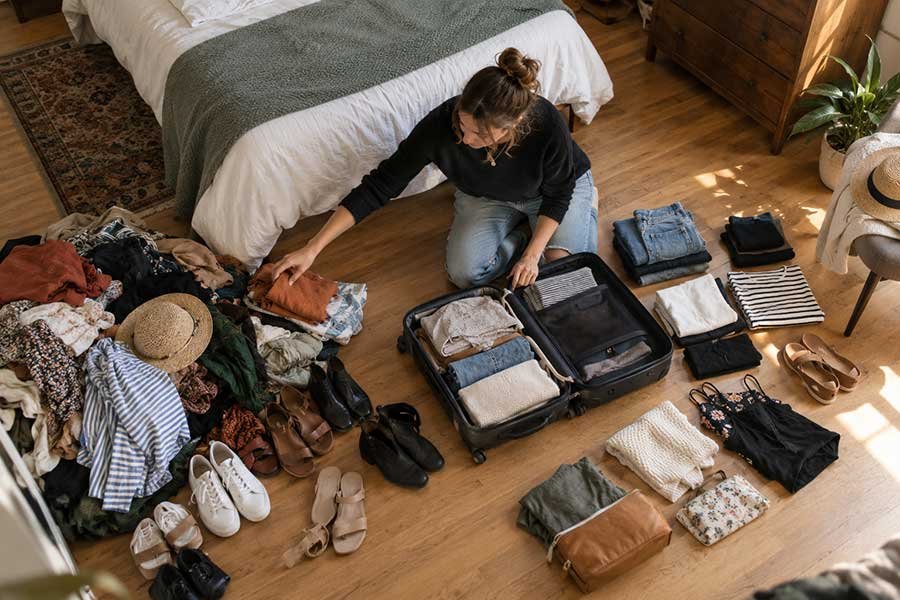
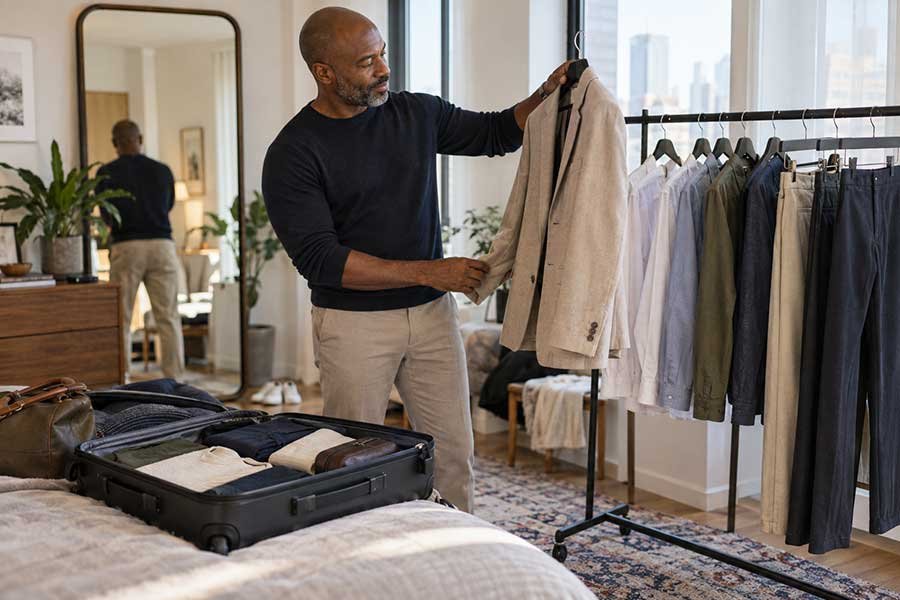
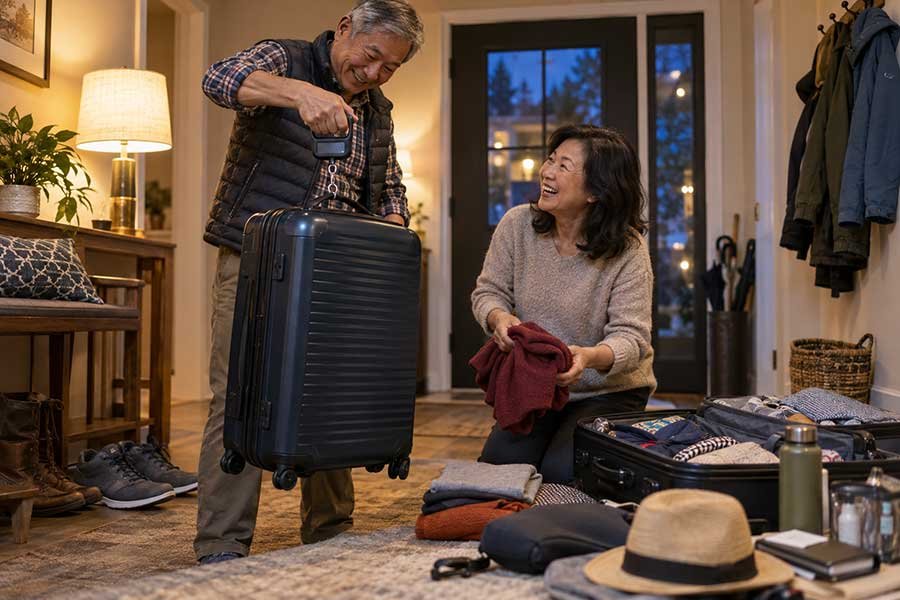
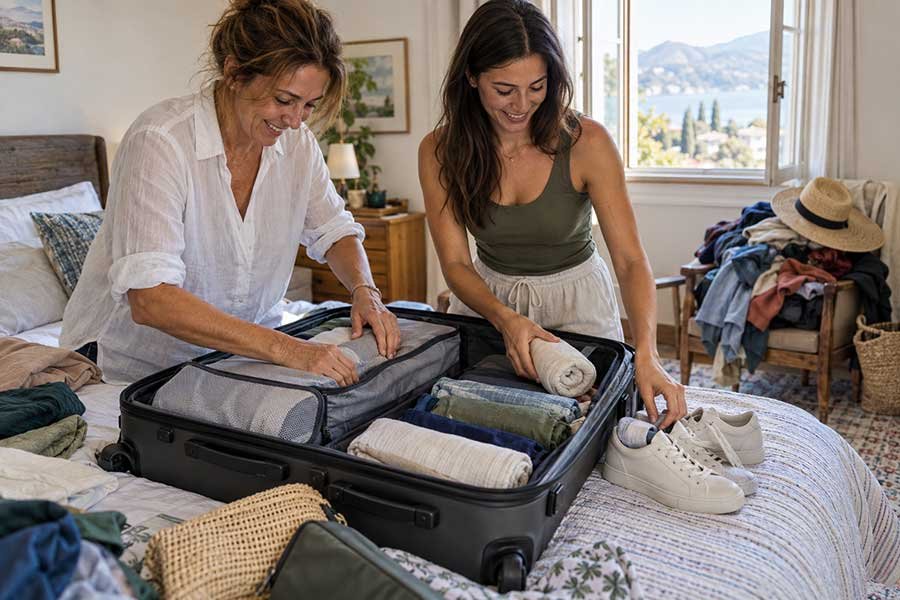
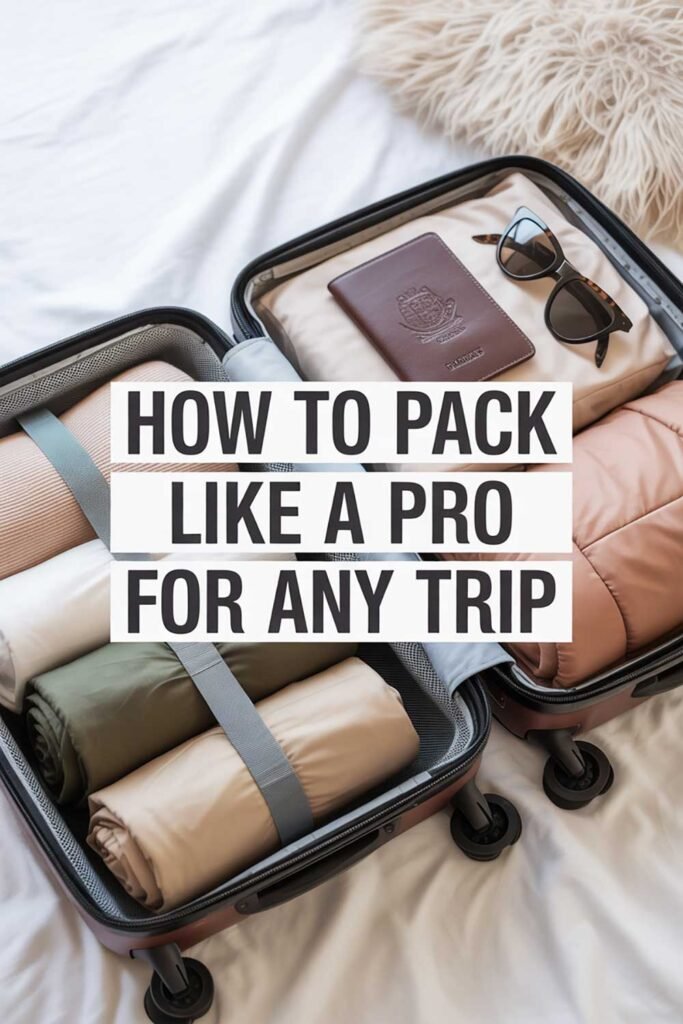
If you have ever stood on a suitcase just to get it closed, these hacks were written specifically for you — and they will change the way you pack every single trip from here forward. Twenty-five packing hacks for the chronic overpacker who is ready to stop hauling everything and start traveling with exactly what the trip needs.

Best For
Every Traveler Who Has Stood on a Suitcase to Get It Closed
Hacks Count
25 Overpacking Hacks
Read Time
10 Minutes
Walk Away With
The System That Finally Gets the Bag Right
Free Download

Grab Our Travel Packing Checklist

Our free packing checklist is built around stopping overpacking before it starts — every category organized, the outfit-first structure built in, the final-edit habit included, and the fresh-eyes review step noted at the end. The same checklist that gets the bag closed on the first try, every time.

Get the Free Checklist

The overpacker almost never regrets what they left behind — but they almost always regret what they brought.

If you have ever stood on a suitcase just to get it closed, these hacks were written specifically for you — and they will change the way you pack every single trip from here forward.

The Mindset Shift: Stop Packing From Fear

01

Lay everything out on the bed — then remove anything you are not certain about

Not anything you are unlikely to wear. Anything you are not certain about. The standard is higher than it sounds and the edit it produces is dramatically more honest than the one the question “will I wear this?” generates. The item you are not certain about is the item whose presence in the bag depends on a scenario that is possible rather than confirmed. The dinner that might be fancy. The weather that might turn cold. The situation you cannot specifically name but that the item seems to cover. Remove all of these. Put them back in the closet. Pack only the items whose presence answers to a specific, confirmed moment in the actual itinerary. The pile that remains after this honest edit is almost always smaller than expected — and the trip that follows almost always confirms that every item removed was correctly identified as unnecessary before it ever reached the bag.

02

Pack for the trip you have actually planned, not every possible version of it

Overpacking is almost always optimistic rather than realistic — the bag packed for the imagined trip that is more eventful, more varied in weather, and more formally demanding than the trip the itinerary actually describes. Open the confirmed itinerary before a single item is selected and pack only for what is on the calendar. The hiking gear for the trail not yet booked, the fourth outfit for the evening whose venue has not been researched, the extra layer for the weather scenario that every local in the destination city would consider unusual for the travel dates — these are the items of the imagined trip rather than the planned one. The planned trip’s items are the ones that earn their presence in the bag. The imagined trip’s items are the ones that earned the overweight fee, the suitcase sat on, and the repack at the final checkout when it was too late to leave any of them behind.

03

Genuinely accept that you almost never regret what you left behind

The overpacker’s fear is the specific moment at the destination where a left-behind item is needed and its absence is felt. This moment exists in theory and rarely in practice — the item left behind is almost always either unnecessary, available at the destination in another form, or manageable without. The items that came home untouched from the last trip are the honest record of the items that were not needed despite being packed from exactly this fear. Review them before the next trip. The hat never worn on the trip that was packed in case the sun was too strong. The second pair of shoes carried through every transit for an occasion that did not arise. The what-if layer worn on zero of the fourteen days it traveled. The regret is almost always for what was brought, not what was left. Accept this as a factual description of overpacking’s outcome and pack accordingly.

04

Remind yourself that almost every destination has a store

The forgotten item whose absence justifies the insurance of packing for every scenario is, in the vast majority of cases, available at a pharmacy, a supermarket, or a corner shop within walking distance of the accommodation. Toothpaste in the wrong brand. A replacement phone charger that works with the local voltage. Sunscreen that was not packed because one more bottle would have broken the weight limit. A light scarf for the unexpectedly cool evening. These items are available at destinations across the world precisely because residents of those destinations also need them. Packing extensively against the possibility of forgetting them is packing against a problem that the destination’s retail sector has already solved. Carry the medications, the travel documents, and the genuinely irreplaceable items. Leave the insurance versions of the things any pharmacy stocks. The store at the destination has them. It has had them the whole time.

05

Give the packing list a hard deadline and refuse to add after it

The packing list that stays open until the departure morning expands to fill the available time — each approaching hour generating new what-if items whose anxiety-driven additions are never questioned because the list has no closing point. Set the packing list deadline at forty-eight hours before departure and treat it as final. New items after the deadline may replace something already on the list — if they are genuinely more appropriate — but may not be added alongside existing items. The deadline converts the packing list from an open document accumulating anxiety additions into a closed system whose contents are confirmed rather than still growing. The forty-eight hours before departure are enough time to confirm items are available, make any genuinely necessary last additions, and do the physical packing without pressure. The packing list with no closing time is the bag stood on. The one with a deadline closes on the first try.

We Plan the Trip the Lighter Bag Is Heading To

Let Us Build the Vacation Worth Finally Packing Right For

The best packing system is built around a real itinerary — one that tells you exactly what the trip requires so the bag contains only what belongs. Tell us where you want to go and we will plan the trip that makes every item in the bag earn its place.

Plan Our Escape

The Clothing System: Build Less and Wear More

06

Build every trip’s wardrobe around two or three colors that all mix and match

The structural reason the overpacker’s bag is large is not a quantity problem — it is a compatibility problem. The bag full of beautiful individual pieces whose outfit pairings are limited produces a large bag to cover the limited combinations, and the wardrobe built around a coherent color palette produces a small bag that covers a larger number of complete outfits with fewer pieces. Two or three colors chosen so that every top works with every bottom, and every layer works with both, means that five tops and three bottoms produce fifteen combinations rather than five or six. The palette is chosen before any piece is selected. The pieces are selected from within it. The outfit flexibility that results makes the smaller bag feel like it has more options than the large one — because it does. The combinations are multiplicative rather than fixed. Choose the palette. Let it do the work the extra bag weight was doing before.

07

Pack complete outfits, not individual pieces — and remove any piece without a partner

The overpacker’s bag almost always contains items that traveled the full trip without finding a complete outfit to belong to — the top whose bottom was left behind because the combination was not confirmed before packing, the shoes that worked with one outfit and were brought in case the second outfit happened, which it did not. Assembling each complete outfit flat on the bed before any component goes in the bag catches these items before they travel. Every top confirmed against its bottom, its layer, and its shoes. Every item without a complete confirmed outfit returned to the closet. The bag packed by outfit contains only the pieces belonging to complete, wearable combinations. The bag packed by category contains the pieces that seemed reasonable individually and produced a wardrobe gap at the destination. Outfit by outfit. Every time. The gap closes before the bag does.

08

Limit shoes to ones you can actually walk five miles in

Shoes are the heaviest, bulkiest, least compressible category in any bag, and the category whose overpacking is most reliably justified by occasions that never materialize. The shoes that require the specific occasion — the heels for the restaurant whose reservation was never made, the dress shoes for the evening event that stayed tentative — travel the full trip and contribute nothing except weight and volume to every transit between them. Limiting shoes to ones that are actually comfortable for five miles of walking produces the specific test that eliminates the uncomfortable shoes whose occasion is aspirational: if the occasion requires shoes that could not be walked to from the hotel, the occasion will require a taxi anyway, and the comfortable shoes are still the right choice for everything else the trip produces. Walk-ready shoes cover every real situation the trip generates. The dress shoes cover the one that almost never arrives.

09

Pack one genuinely versatile layer instead of three single-purpose warm items

The overpacker’s weather preparation is the category that contributes the most volume per pound of utility: the cardigan, the fleece, and the light jacket packed for three separate temperature scenarios that the layering system covers with two items working together. A thin warm layer plus a windproof or water-resistant shell handles a wider temperature range together than any single item alone and produces more outfit combinations per piece than three single-purpose garments of similar total weight. The versatile layer is also the one whose presence in the bag feels justified across the most days of the trip — worn at altitude one morning, over a shirt on a cool evening, and under the shell on the cold day that arrives unexpectedly. Three single-purpose items take up three times the space for a fraction more range. One versatile system takes up a third of the space and covers everything the trip actually delivers.

10

Accept once and for all that re-wearing clothes on vacation is completely normal

The social calculation that produces a fresh outfit for every day of the vacation — the assumption that re-wearing a garment is visible to and noted by people who have no knowledge of the previous wearing’s context or location — is the calculation that fills the extra day of the bag for every day of the trip beyond the first. Nobody at the restaurant tonight was at the market three days ago. Nobody on this street was on the street in the previous city. The people sharing the hotel floor are tracking their own trips, not the rotation of the traveler in room fourteen. Give explicit, genuine permission to re-wear jeans across the full trip, wear the jacket for every cool evening regardless of what was worn with it the day before, and count re-wearing as the sustainable, practical, universally practiced behavior that experienced travelers use without a second thought. The permission is the most useful single thought in this list. Use it freely.

The Edit: Come Back With Fresh Eyes and Cut It Down Again

11

Pack the bag, close it, leave it for an hour, then come back and cut it down again

This is the single most effective overpacker-specific technique in this list and it costs nothing beyond the hour of distance it requires. The packing session conducted in real time — in front of the open bag, item by item, each one evaluated in the context of the packing anxiety that produces overpacking — cannot produce the honest evaluation that the same bag viewed an hour later can. The hour of distance is enough to cool the anxiety that packed the just-in-case items, the backup option for the backup option, and the four-outfit day that was anticipated for the one day the trip holds. Come back to the closed bag with the itinerary open and the fresh question: what in here belongs to the trip I have actually confirmed? The items that do not have a clear answer to that question come out. This single additional edit round removes more from the average overpacker’s bag than all the tips before it combined.

12

Remove three more things after every packing session — no exceptions

The overpacker’s bag always has three more things. Not three obvious items — three items that made it past the main packing session’s filters and are sitting in the bag on the strength of the same just-in-case logic that the whole packing session was supposed to address. Opening the fully packed bag and removing three items without negotiation — not the three most obvious ones but the three that are closest to optional — is the habit that produces the bag that closes on the first try rather than the one stood on. The three items removed are not missed on the trip. They were the items that made it past every other filter and would have traveled to every destination and returned home untouched. Remove them before the bag closes. The trip does not know they are gone. The bag does.

13

Ask of every item in the bag: would I pack this again on the return journey?

This question is the most reliable single-item filter available to the overpacker because it asks the question from the perspective of the informed traveler who has already taken the trip rather than the anxious one who has not. Imagine standing at the final accommodation repacking to go home. The clothes that were worn. The shoes that covered every occasion that actually appeared. The just-in-case layer used twice. Now look at the items in the current packing session whose journey-home version would be a clear no — the shoes never worn, the outfit assembled for the event that did not happen, the backup toiletry whose primary never ran out. Those items are identifiable now, before the trip, with the exact same certainty they would be identifiable at the last checkout. Remove them now. The trip that just confirmed they were unnecessary has not happened yet. The conclusion is available in advance. Use it.

14

Cut the just-in-case pile down to one item whose scenario has a genuine answer

The just-in-case pile is where the overpacker’s extra weight lives — the collection of items assembled not for confirmed occasions but for scenarios that might occur. Before any just-in-case item stays in the bag, it must provide a genuine answer to the question: just in case of what, specifically? The rain jacket for a trip to a destination with a confirmed wet season has a specific answer. The backup shoes for a trip whose itinerary has no occasion that requires them do not. The medication backup whose primary supply is already packed has a specific answer. The evening wrap for the dinner that has not been booked does not. Keep the just-in-case items whose specific answers are genuinely in the itinerary. Return every item whose answer is “you never know” or “it might come up” to the closet. One item with a real answer can stay. The pile whose answer is collective uncertainty belongs at home.

15

Leave the formal option at home unless a specific confirmed occasion requires it

The formal item in the overpacker’s bag is almost always there for an occasion that was possible when packing and had become unlikely by the trip’s third day — the nicer restaurant that the exhaustion of two long activity days made unappealing, the event that seemed more likely before the trip than it turned out to be during it, the dress code that the actual venue’s casual atmosphere made irrelevant. Leave the formal option unless a specific booking with a specific dress code is already on the confirmed itinerary. The dinner reservation made before departure at the restaurant with an actual dress code justifies the item. The possibility of booking such a dinner justifies carrying it to a destination where most dinners turn out to be casual. The confirmed occasion is always the right standard. The possible occasion is always the one that comes home with the item still folded the way it was packed.

Sasha’s Last Overweight Bag and the Trip That Finally Changed How She Packs

Sasha had paid the overweight bag fee on her last four international trips. Not the same airline, not the same route — four different occasions on which she had arrived at the check-in desk with a bag that exceeded the limit and had paid to check it at a weight the limit was not designed to accommodate. She had calculated the total once and stopped before it was complete. The number was not useful information. What was useful was the pattern: she packed from fear, and the fear was consistent enough to produce an overweight bag on every trip long enough to require a checked bag.

The trip that changed things started with a different approach. Before packing, she opened the itinerary — the actual confirmed itinerary, not the mental version she normally packed for — and read it against the pile on the bed. The pile was larger than the itinerary required by roughly half. The hiking gear was for a trail she had not booked and would book when she arrived if the weather and energy warranted it, and the outfitter at the trailhead rented everything she would need. The formal dress was for a dinner that existed as a possibility. The four pairs of shoes covered two confirmed occasion types and two she could not specifically name. She removed the items without a confirmed occasion and without a specific itinerary answer. The pile went from thirty-one items to seventeen.

She packed the seventeen. Closed the bag. Left it for an hour. Came back and opened it. Three items came out in the second pass — the fourth pair of shoes whose function was covered by the first pair, the backup cardigan because the light jacket and the first cardigan together covered the temperature range without it, and the “going out” top for an occasion the restaurant bookings did not actually require. The bag went back in. The scale read two kilograms under the limit. She did not stand on it. She did not redistribute contents between bags at the desk. She checked it and walked to security with a specific feeling she could not immediately name and eventually identified as the absence of the low-grade packing anxiety that had been present at every departure for years.

She came home having worn every item in the bag. The unworn count was zero — the first time she had been able to say that. The twenty-five hacks in this article are the ones that produced that number and that have produced it on every trip she has taken since the one that finally got the bag right.

The Practical System: Fit More by Bringing Less of It

16

Roll soft clothes instead of folding them to recover space and reduce wrinkles

Rolling is the overpacker’s most consistently useful physical packing technique because it addresses two of the problems overpacking creates simultaneously: the bag that cannot close and the clothes that arrive wrinkled from the compression that results from trying to close it anyway. A rolled t-shirt occupies roughly one-third of the space of the same shirt folded flat. A bag of rolled soft items — t-shirts, casual trousers, underwear, knitwear — holds measurably more clothing than the same bag folded. Rolling also produces soft, distributed wrinkles that resolve quickly on a hanger rather than sharp fold lines pressed into the fabric by the bag’s weight across a long transit. Roll the soft and casual items. Fold the structured items that roll poorly. Apply the distinction correctly and the bag that previously required sitting on to close will close without physical assistance from the traveler’s body weight.

17

Use packing cubes and assign one per category — never mix

Packing cubes do two things that matter for the overpacker. First, they create physical limits for each category — the tops cube that is full tells the packer the tops category is at capacity more clearly than an open suitcase layer does, which would simply accommodate one more item by compressing the ones already there. Second, they make the total visible category by category: when five cubes are closed and the sixth does not close, the excess is identifiable and removable from a specific category rather than distributed invisibly across the whole bag. Assign one cube per category — tops, bottoms, underwear, layers — and keep the assignment consistent. The cube that will not close is the category that needs editing. The cube system converts the bag from a container that expands to accommodate everything to a structured system whose capacity limits are visible, manageable, and honest.

18

Tuck socks and small items inside shoes to use space that travels anyway

The interior of each shoe in the bag is volume already committed to the journey — it takes up space and adds weight regardless of whether it is occupied. Rolling socks into cylinders and tucking them inside the shoe cavity, alongside any small item that fits — a compact adapter, a folded belt, a mini accessories pouch — recovers space that would otherwise be air. For the overpacker specifically, this habit matters because every square centimeter of recovered space is space that does not need to be compensated for by a larger bag or a tighter zip. The shoes at the base of the bag with socks and small items inside them have consolidated multiple categories into the shoe layer. The bag above them has the space their contents would have claimed. Pack the shoes. Fill the shoes. The overpacker’s bag is made of accumulated small items that each seem harmless. Consolidating them into the shoe layer removes one layer’s worth of the problem.

19

Use compression cubes for bulky soft layers to make them take their fair share of space

The fleece, the hoodie, the thick cardigan — these are the items whose air-to-fabric ratio is highest and whose compression benefit is therefore greatest. A medium compression cube containing a bulky fleece, compressed with the secondary zipper, occupies the space of a folded t-shirt stack. Without the compression cube, the same fleece occupies a third of the bag and is the item most frequently cited as the one that pushed the bag over its limit. Compression cubes are not general-purpose — they are specifically for the soft, insulating, air-filled garments whose bulk is reducible. Use standard cubes for everything else. The compression cube applied to the right items extends the bag’s effective capacity without increasing its physical size. The overpacker who discovers compression cubes is the overpacker who can keep the warm layers without sacrificing the space that everything else in the bag legitimately needs.

20

Weigh the bag at home before leaving — not at the check-in desk

The overpacker’s natural habitat is the airport check-in desk, where the scale’s verdict is delivered publicly with a fee as the only available response. The home scale delivers the same information privately, with time to respond, with the closet available, and with no audience and no additional cost. Step on the bathroom scale while holding the packed bag, subtract personal weight, and compare the result to the airline’s limit for every carrier on the trip. If the bag is over, remove items at home rather than redistributing contents into the carry-on at the desk. The items that come out when the bag is over weight at home are the items that were borderline — the ones whose contribution to the bag’s weight exceeded their contribution to the trip’s enjoyment. The scale at home delivers that judgment from a chair rather than from a queue. Weigh it before you leave. Every single time.

Travel Resources

Our Curated Collection of Trusted Tools and Official Sources

Everything we use to plan, prepare, and travel with confidence — from official government travel tools to practical planning aids. We have pulled together the resources we trust most so every trip you take is better informed, better prepared, and a lot less stressful from start to finish.

DND Resources

The Permanent Habits: Never Stand on a Suitcase Again

21

Build a master packing list and use it as the starting point for every trip

The overpacker rebuilds the packing list from anxiety before every trip, which is why the list keeps producing the same result — anxiety-built lists are optimized for coverage rather than accuracy, and coverage produces overpacking by design. A master packing list built once from a specific trip’s confirmed categories — and refined after that trip and every subsequent one — is a list that reflects the honest experience of what was actually used rather than the theoretical coverage of what might be needed. Use it before every trip as the starting point. Customize the top layer for the specific destination’s climate, occasion, and duration. Keep everything below the customization layer consistent and confirmed across trips. The master list is the accumulated honesty of every trip that refined it. Packing from it is packing from experience rather than anxiety. The bag that starts from a master list starts from the right place every time.

22

Track what you actually wore after every trip and update the list before the memory fades

The most honest packing feedback available is the repack at the final checkout — the moment when the unworn items are identified in their folded state and the worn items go into the dirty laundry. Before repacking from the final accommodation, do a brief honest review: what was worn multiple times and belongs permanently on the list, what came home untouched and should be removed, what was genuinely missed and should be added for next time. Update the master packing list before the return journey based on this review. The list updated from the honest feedback of a completed trip is more accurate than the one that was not — and the improvement compounds across every trip that contributes to it. The overpacker who has taken ten trips and updated the list after each one has a packing list that reflects ten trips’ worth of evidence rather than one trip’s worth of anxiety.

23

Photograph the packed bag before the outbound trip and compare it to the return repack

Two photographs, one comparison: the organized bag before the outbound zip closes and the return repack at the final checkout. The outbound photograph is the record of what traveled. The return photograph — or the memory of which items went into the dirty laundry and which went in unchanged — is the record of what was actually used. The comparison between the two is the most precise overpacking diagnostic available to the chronic overpacker and the most honest input for the master packing list’s next update. The items that were in the outbound photograph and came home folded exactly the same way are the items that should not have been in the photograph. Identify them by name. Remove them from the master list or flag them for justification next time. The overpacker who makes this comparison consistently builds a packing system that converges on accuracy over time.

24

Reset and restock the bag within twenty-four hours of returning home

The overpacker’s bag left partially unpacked between trips is the bag that starts the next packing session from disorder rather than from a clean foundation — and disorder is the condition that produces the reassembly-from-scratch packing session where anxiety has the most influence. Reset the bag within twenty-four hours of returning: laundry to the wash, cubes emptied and repositioned, packing list updated, bag closed and ready. The reset takes fifteen minutes and costs nothing except the intention to do it before the return day’s momentum runs out. The bag that is reset after every trip starts the next packing session from a complete, organized system. The master packing list is the starting point. The itinerary determines the customizations. The anxiety that previously drove the whole process has been reduced to a consultation rather than a command. That is the bag that closes without being stood on.

25

Take one deliberately light trip and let the experience be the permanent argument

All twenty-four tips before this one address the overpacking habit through reasoning, system-building, and editing. This one addresses it through experience — which is the only argument that fully convinces the chronic overpacker, because the reasoning has always been available and the anxiety has always won anyway. Plan one trip with a deliberate commitment to a lighter bag than feels comfortable. Pack the two-color capsule, the two pairs of shoes, the one layer, the master list as the ceiling rather than the floor. Take the trip. Experience the transit through airports with a bag that does not require management. Experience the hotel checkout that takes four minutes. Experience the walking day unencumbered by the weight of what might be needed. That experience does what the twenty-four tips cannot do alone: it replaces the abstract benefit with a felt reality whose memory is more persistent than any anxiety the next departure produces. Take one deliberately light trip. The argument it makes is permanent.

Book With Us

Book the Trip That Makes Packing Right Feel Worth the Effort

The lighter bag is most satisfying when it is heading somewhere genuinely worth showing up unencumbered for. Our travel agents plan the destinations that give every packing decision a real answer — and every lighter arrival a first day that earns it.

Book A Trip

Everything was on the bed and half went back. The fresh-eyes pass removed three more. The just-in-case pile had one item with a real answer. The bag went on the scale at home and came in under. The zip closed on the first try. Nobody stood on anything. That is twenty-five hacks. That is the last overweight bag fee.

Picture the Trip Where You Came Home Having Worn Everything You Brought

Everything was laid out and half went back because the standard was certainty, not possibility. Two colors. Every outfit confirmed against its partners before any piece was packed. Shoes that could walk five miles. One layer doing the work of three. The just-in-case pile reduced to the one item with a real answer. The bag was packed and left for an hour and came back to with fresh eyes that removed three more things. The scale at home confirmed the bag was under the limit. The zip closed without help. At the final checkout the repack took four minutes and the unworn count was zero. The overweight bag fee was not paid at this airport or the last one or the one before it. The packing list was updated before the flight home with the two items that were missed and the three that would have come back untouched if they had been packed. The next trip starts from there. That is twenty-five hacks. That is the last time you stand on a suitcase to get it closed.

Free Download

One More Thing Before the Suitcase Opens

Print our free Travel Packing Checklist and use it as the master list that keeps every packing session honest — the outfit-first structure, the fresh-eyes edit step, and every category confirmed before the first item goes in the bag. The same checklist we use before every trip we take, and the one that gets the bag closed without any assistance from body weight.

Get the Free Checklist

Explore Our Top Picks for a Better Trip

After years of exploring the globe together, these are the exact tools, platforms, and services we rely on for every single trip — personally tested, traveler approved, all in one place. We don’t recommend anything we wouldn’t use ourselves, and this is the collection of booking platforms and travel tools that have made our adventures smoother, smarter, and more memorable.

See Our Top Picks
Turn Travel Into Income

Love Helping Travelers Show Up to Every Destination With Exactly What They Need?

Helping a traveler pack the right bag for the right trip — and booking the destination that makes packing carefully feel worth it — is the kind of practical expertise that makes a home-based travel agent genuinely worth coming back to. If turning your love of travel into a business sounds like the right next move, see how the TravelPreneur system works.

Become An Agent

Packing Printables for Overpackers at Premier Print Works

Visit Premier Print Works for master packing lists, outfit assignment sheets, fresh-eyes edit checklists, and packing planners that make every packing session more honest and every bag lighter — from the first item laid out on the bed to the final zip that closes without anyone standing on it.

Visit Premier Print Works

Disclaimer

The information shared in this article is provided by Don and Diana’s Travels for general informational, educational, and inspirational purposes only. It reflects our personal experiences, opinions, and the experiences of travelers we have worked with. It is not professional travel, legal, or financial advice.

Airline and Baggage Policies

Airline baggage allowances, weight limits, size restrictions, and related policies vary by carrier and are subject to change without notice. Always confirm current requirements with your specific airline before traveling. We are not responsible for any fees or outcomes arising from reliance on baggage information in this article.

Affiliate and Partner Links

This article may contain affiliate and partner links that pay us a commission at no extra cost to you. Our recommendations are based on real use and genuine belief in the products and services we share.

Composite Stories

Stories on this site combine real experiences from Don, Diana, clients, and travelers we have worked with. Details may be adjusted for privacy and narrative clarity.

No Guarantees

We do not guarantee any specific packing or travel outcome from using the information in this article. Results vary by traveler, destination, and trip type.

Copyright and Use

All content is the copyrighted property of Don and Diana’s Travels. You may not copy or republish our content without prior written permission. You are welcome to share a direct link with proper credit.

By reading this article, you acknowledge that you have read and agree to this disclaimer.