27 Road Trip Packing Tips for a Cleaner, Easier Car Ride | Don and Diana’s Travels

27 Road Trip Packing Tips for a Cleaner, Easier Car Ride

The road trip is the one travel format where the vehicle is both the transport and the living space for the full duration of the journey — and the quality of that living space is determined almost entirely by the decisions made before the first mile rather than by the car itself. The road trip car that stays clean, organized, and comfortable across eight hundred miles and three days was loaded correctly, supplied correctly, and maintained with a small number of consistent habits that most drivers do not build until after their first genuinely chaotic long drive has made their value obvious.

These twenty-seven tips cover every dimension of the road trip packing and organization challenge — how to load the car, what to keep accessible versus what goes in the trunk, how to keep it clean despite the snacks and the children and the rest stops, how to handle the overnight stays without unpacking everything, and how to reset at the end of each driving day so the next one begins from a clean starting point. The cleaner, easier road trip was organized before the first mile.

Free Download: Our Travel Packing Checklist

Before the car is loaded, our free Travel Packing Checklist confirms every item, every document, and every pre-departure step so nothing gets left behind and nothing important gets discovered missing at the first rest stop. Download it free.

Get the Free Checklist

Loading the Car: The Organization That Happens Before the First Mile

The road trip car loaded correctly before departure is the car that stays manageable across the full journey. The car loaded in the rush of the departure morning — bags thrown in wherever they fit, the snack cooler placed behind the driver’s seat, the entertainment items in the trunk with the luggage — becomes the car whose second hour is spent managing the consequences of a loading plan that was not a plan at all. These tips establish the loading system that makes the car work from the moment the first door closes.

1. Assign every passenger their own bag and their own zone in the car

Every passenger — adult or child — traveling with their own clearly assigned bag kept in their own zone of the car’s interior produces the specific organization benefit of knowing exactly where every item is and exactly whose responsibility each zone is. The child whose bag is in the seat-back pocket in front of them knows where their snacks, entertainment, and comfort items are and does not require the driver to search the floor, the back seat, or the trunk to locate what they need. The adult whose bag is at their feet or on the seat beside them manages their own items without them distributing across the shared space. Assign the zones before loading. Maintain them throughout the drive.

2. Separate the car needs bag from the luggage in the trunk

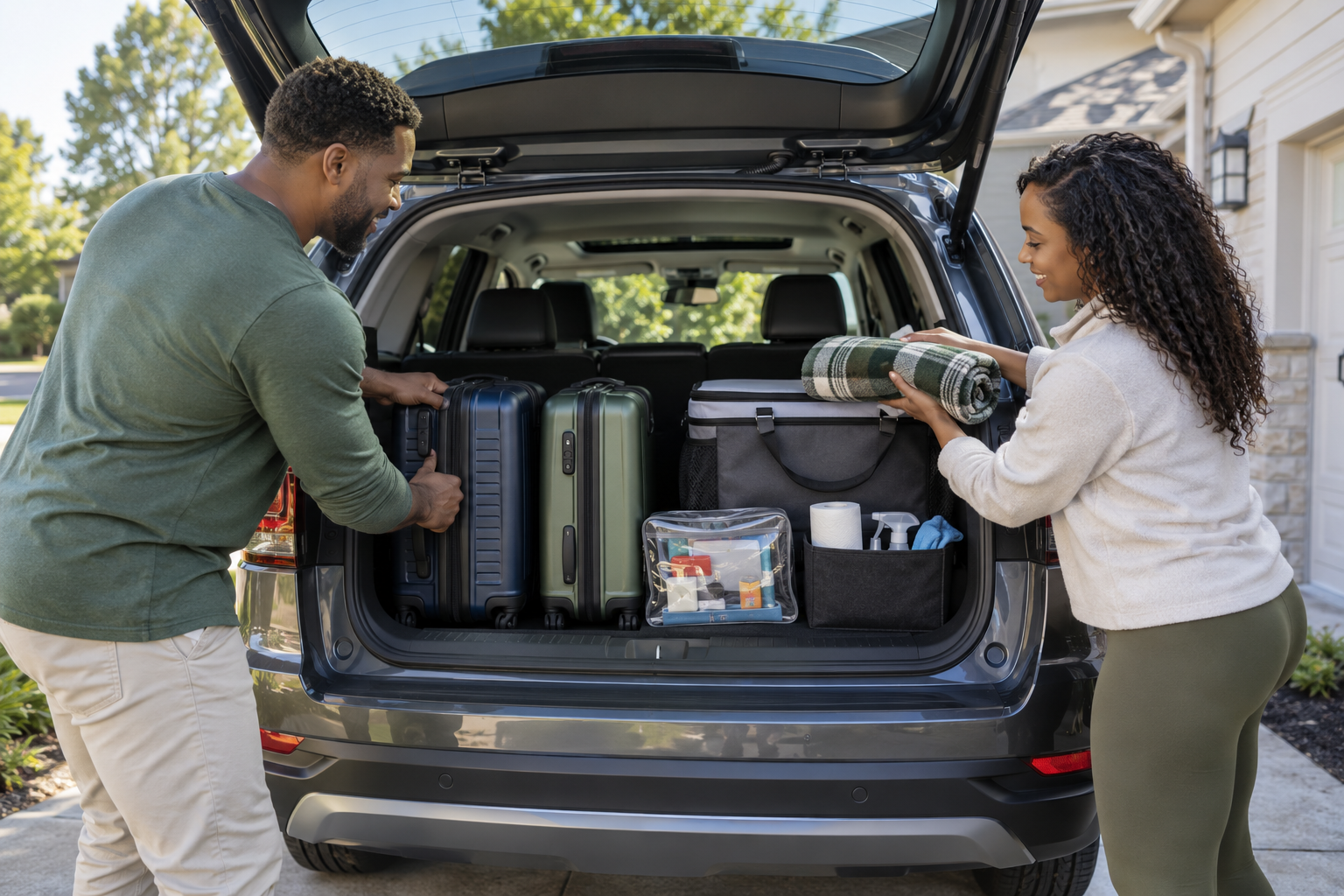
There are two categories of road trip items whose physical separation in the car is the single most practically useful organizational decision available: the items needed during the drive — the snacks, the wipes, the chargers, the first aid kit, the entertainment — and the items needed at the destination — the luggage, the toiletries, the clothing. The destination items live in the trunk and are not accessed during the drive. The drive items live in a dedicated bag in the cabin whose position is chosen for accessibility from the front and rear seats simultaneously. The trunk opened at a rest stop to search for the lip balm buried in the luggage is the avoidable consequence of not making this separation before departure.

3. Load the car the evening before departure — not the morning of

The road trip car loaded the evening before departure is the car that leaves on time with everything confirmed in its position. The car loaded the morning of departure under time pressure, with children who are already in various stages of readiness, with bags whose specific positions were not decided in advance, and with the discovery that the cooler does not fit where it was assumed to fit — this car leaves late, loaded imperfectly, and begins the drive from a position of mild disorder rather than confirmed readiness. Load the evening before. Walk around the car and confirm the loading before going inside. The morning is for getting in and leaving.

4. Position the cooler where it is accessible without stopping — not behind the driver

The cooler positioned in the back seat footwell, between rear seats, or in the boot within reach of rear passengers without requiring the car to stop is the cooler that reduces the driving-while-distracted moment of reaching toward the back seat for a drink. The cooler in the trunk is the cooler that requires a rest stop every time its contents are needed. Position the cooler for the specific car’s interior — ideally within reach of rear passengers who can distribute drinks and snacks to the front without requiring the driver to access it at all. One less reason to stop. One less distraction while moving.

5. Install the car organizer and the trash bag before anything else goes in the car

The seat-back organizer — the fabric panel that attaches to the back of the front seat and provides accessible pockets for snacks, tablets, water bottles, and small items — earns its space on every road trip with passengers in the rear seats by converting the otherwise unusable space between the front and rear seats into organized, accessible storage. Install it before loading anything else so its position is established before the items it holds are placed into the car. The trash bag clipped to the center console, the gear shift, or the seat organizer goes in at the same time. Both items anchor the car’s organization system before the drive begins.

6. Mount the phone and confirm navigation before leaving the driveway

The phone mount at the driver’s field of vision, the navigation confirmed open and loaded with the first destination, the charger cable connected — all confirmed before the car leaves the driveway rather than managed while the car is moving in an unfamiliar direction. The specific distraction cost of mounting the phone, entering the destination, and plugging in the charger while driving is eliminated by the thirty seconds of setup that the stationary car in the driveway allows. Leave the driveway with the navigation already running. The first turn is already on screen before the first mile.

Book A Trip

Planning a road trip and want help building the perfect itinerary? Let our travel agents plan the route, the stops, and the accommodations so the only decision left is which playlist goes on first.

Book A Trip

What to Keep Accessible in the Car

The road trip’s cabin items — everything that is needed during the drive rather than at the destination — determine the quality of every hour between stops. These tips cover the specific items that earn their place in the car’s accessible zone and how to position them so everything needed is reachable without stopping and without the driver extending a hand toward the back seat.

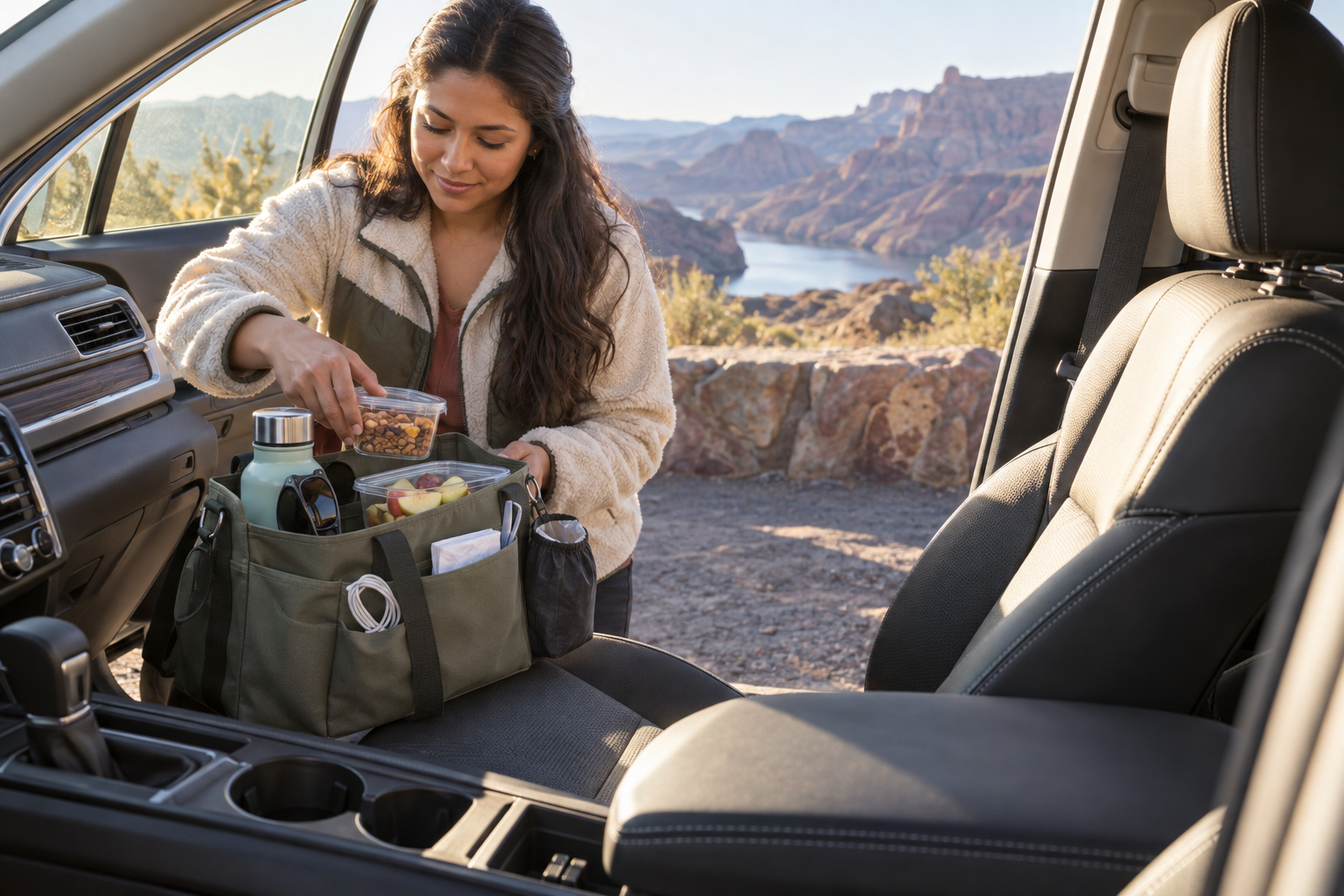
7. Pack a dedicated snack bag accessible from both front and rear seats

The snack bag — a soft-sided tote or an insulated pouch whose contents are familiar, reliable, and individually portioned — positioned between the front seats or at the edge of the rear seat footwell within reach of rear passengers is the road trip’s food system that eliminates the “what do we have?” request that produces either a rest stop or a search through the cooler while moving. Pack familiar snacks in individual portions. Mix savory and sweet. Include options for different times of the drive — lighter items for the first hours, more substantial ones for the midpoint. A drink per person in a cup holder or a bottle holder attached to the seat organizer eliminates the “can I have a drink?” sequence from the first hundred miles.

8. Keep a small first aid kit in the glove box — not in the luggage

The road trip first aid kit whose position is the glove box is the first aid kit available in thirty seconds at any point during the drive — the rest stop blister, the headache that arrives at hour four, the motion sickness medication needed before the winding mountain section rather than after it. The first aid kit in the trunk with the luggage is the kit that requires a full stop and a full unload to access, which is never the context in which a first aid kit is needed most calmly. Glove box. Always. Restocked after every road trip that draws from it before the next one begins.

9. Keep wipes and a small towel in the front seat door pocket

The specific moment when wipes are needed most on a road trip — the spilled drink at sixty miles per hour, the child’s face after the granola bar, the sticky surface from the sugary drink whose lid was not fully closed — is almost never the moment when stopping and accessing the luggage is available or appropriate. Wipes in the door pocket are wipes in one reach at any point during the drive. A small microfiber towel alongside them covers the larger clean-up that the wipes cannot complete alone. Both items cost almost nothing and address the specific road trip mess whose consequence accumulates from the first occurrence through every unaddressed subsequent one.

10. Download music, podcasts, and audiobooks offline before departure

The road trip’s entertainment system that depends on mobile data streaming works perfectly on the urban stretches of the route and fails on the rural, tunnel, and dead-zone sections that almost every long road trip eventually encounters. Downloaded offline content plays from local storage regardless of connectivity. Download the specific playlists, podcast episodes, and audiobook chapters needed for the full drive duration before leaving home. The specific silence that arrives when the last downloaded episode ends and the next one will not buffer is the silence that the pre-departure download prevented. Fill every device before departure. The drive’s entertainment system is then independent of every connectivity variable the route produces.

11. Pack paper maps or save offline navigation maps as backup

The GPS navigation that fails in a dead zone at a junction with three possible routes and no mobile data is the navigation failure whose offline backup resolves in ten seconds versus the twenty minutes of uncertain driving that the unequipped version produces. Download the full route’s offline map in the navigation app before departure. A paper map or a downloaded PDF of the route and key junctions is the final backup whose weight is negligible and whose one-time use value on the drive that needs it is significant. The dead zone is not unusual on long rural road trips. The preparation for it is simply a download made the evening before.

12. Keep a reusable water bottle per person in an accessible holder

The specific dehydration that long drives accumulate — particularly on hot days, particularly with air conditioning running, particularly with the passive inactivity of sustained seated travel — produces the arrival headache and fatigue whose cause the road-tripper who drank nothing for four hours cannot always identify immediately. One reusable water bottle per person, positioned in a cup holder or a seat organizer bottle pocket and refilled at every rest stop, covers the drive’s hydration requirement without the single-use plastic cost of the rest stop gas station’s bottled water supply and without the recurring expense across a multi-day road trip whose hydration needs are continuous.

Plan Our Escape

Let us plan the road trip route, the overnight stops, and the destination — so the only preparation left is loading the car correctly the evening before and enjoying every mile.

Plan Our Escape

Overnight Stays and Destination Packing

The road trip with overnight stops presents the specific challenge of needing to bring items into the accommodation each night without unpacking the full trunk — a process that is manageable with a one-bag overnight system and becomes the most time-consuming part of every stop without one. These tips build the overnight system that makes every roadside accommodation arrival a single bag carried to the room rather than an evening logistics operation.

13. Pack one dedicated overnight bag that comes into every accommodation

The overnight bag — a small duffel or weekender that holds everything needed for the night and the following morning — is the single bag that comes into the accommodation at every overnight stop regardless of the trip’s total duration. It holds the toiletry kit, the next day’s clothing, the pajamas, the phone charger, and any other item used between check-in and the following morning’s departure. Everything else stays in the trunk. The road trip whose overnight stays require carrying three bags from the car to the room at ten in the evening and three bags back to the car at seven in the morning is the road trip whose overnight system was not built before departure.

14. Keep changes of clothes for children accessible in the cabin — not in the trunk

The child’s clothing change that becomes necessary at a rest stop, at the roadside picnic area, or in the first thirty minutes of a drive whose departure morning spilled something — this is the change that requires the item to be accessible from the cabin, not located at the bottom of the trunk beneath everything loaded on top of it. A small bag with one complete change of clothes per child, positioned in the rear seat footwell or the seat organizer, is the preparation that converts the clothing emergency from a full trunk excavation into a single bag opening. Pack it before the drive begins. Every parent who has needed it at a rest stop has wished they had packed it this way.

15. Keep a freshen-up kit accessible for rest stop use

A small pouch in the cabin — toothbrush and travel toothpaste, face wipes, deodorant, lip balm, sunscreen — is the rest stop preparation that allows every extended stop to include a genuine refresh rather than a choice between a full bag excavation and arriving at the day’s destination feeling like the last four hours. The freshen-up kit in the cabin is accessible in thirty seconds at any rest stop. The same items in the checked luggage in the trunk require the stop to include unpacking and repacking to access. One small pouch. Everything for a comfortable refresh. In the cabin from the first mile.

16. Use a shoe bag to keep footwear organized and the car interior clean

Road trip footwear — the walking shoes worn out of the car at every stop, the sandals worn on driving days, the specific shoes needed at the destination — distributed loosely across the car’s boot or foot wells is footwear whose dirt, sand, and outdoor debris transfers to everything it contacts across the drive’s duration. A lightweight shoe bag per person’s footwear, or a single shared shoe bag for the trip’s non-worn pairs, contains the outdoor accumulation and keeps it separate from the clothing, the upholstery, and the other bag contents it would otherwise contaminate across hundreds of miles of varied terrain.

17. Keep a reusable bag accessible for items acquired during the trip

Every road trip acquires items between departure and return: the market purchase at the roadside stop, the souvenir from the destination town, the regional food product whose existence was not known before the trip and whose room in the luggage was not planned for. A reusable tote bag kept flat in the seat organizer or the door pocket is the acquisition system that holds every mid-trip addition without requiring trunk reorganization and provides the return journey bag for items that did not have a designated position in the outbound loading plan. One bag. Flat until needed. Available at every acquisition opportunity the road trip produces.

How Sage’s Road Trips Stopped Feeling Like Moving House and Started Feeling Like Travel

Sage took a family road trip every summer for six years — two adults, two children, one car, and a loading process that had been described at various points by various family members as “a game of Tetris we always lose.” The bags filled the trunk. The overflow filled the back seat foot wells. The snacks were in a bag somewhere in the trunk that required stopping to access. The wipes were in someone’s bag but nobody was sure whose. The children’s entertainment was on devices whose chargers were in the trunk. The overnight stops required carrying four bags from the car to the room and four bags back every morning. The road trips were wonderful. The car organization was not.

The change began with one decision made before the following summer’s trip: the car needs bag. A single designated bag whose contents were everything the drive required — snacks, wipes, chargers, first aid kit, entertainment, the freshen-up kit — loaded into the cabin before anything else went into the car, positioned between the front seats where both the driver and rear passengers could reach it without stopping. The trunk held the luggage. The cabin held the drive. The separation was the entire system, established in the car before the first bag of luggage was loaded.

The overnight stop that had previously required four bags from car to room required one — the overnight bag that had been packed specifically for that purpose before departure, held one night’s worth of everything for every person, and went back into the car the following morning as a single unit. The children’s entertainment was in the seat organizer pockets, charged before departure. The snacks were accessible from the back seat without a rest stop. The wipes were in the door pocket. The trash bag changed at every stop. The car looked approximately the same at the end of the trip as it had at the beginning. These twenty-seven tips are the complete version of the separation that the car needs bag established. The road trips have felt like travel ever since.

Become An Agent

Love helping families and travelers plan road trips that run smoothly from the first mile to the last? See how to turn that into a home-based travel business.

Become An Agent

Keeping the Car Clean: The Habits That Matter Every Mile

The road trip car that is clean at the end of the journey was maintained by a small number of consistent habits applied at every stop rather than by a single cleaning session at the destination. These tips cover the specific habits that prevent the accumulation of the crumbs, the wrappers, the general drift of items from their designated positions that produces the chaotic car interior by day two of any multi-day drive without them.

18. Use the trash bag consistently — change it at every stop without exception

The road trip trash bag is the single most impactful cleanliness habit available because it addresses the source of most car interior disorder before the disorder accumulates. A trash bag clipped to an accessible position — the center console, the seat organizer, a hook on the back of the front seat — and used by every passenger for every wrapper, every empty bottle, every used wipe and every food container converts the floor and seat surface accumulation into a contained bag whose contents are removed at every stop. The bag changed at every stop never becomes the full bag that nobody wants to deal with. One new bag from the glove box or the door pocket takes thirty seconds. Do it every time the car stops.

19. The no-loose-items rule: everything has a position and returns to it

The loose item — the sunglasses left on the dashboard, the phone set on the center console, the water bottle placed on the seat, the snack bag moved to the floor — is the item that becomes the rolling hazard on the next corner, the item searched for at the next stop, and the source of the general visual and physical disorder that makes a car feel chaotic even when it is not particularly dirty. Every item in the car has a designated position established at loading and returns to that position after every use. The sunglasses go in the console. The phone goes in the mount. The water bottle goes in the cup holder. The snack bag goes back in the seat organizer. The car that enforces this habit does not drift into disorder between stops.

20. No eating in the car without a specific cleanup plan for what follows

The road trip eating-in-the-car decision should include — at the moment the food is unwrapped — the specific answer to where the wrapper, the crumbs, and the container go when the food is finished. The trash bag is the answer for most items. The wipes in the door pocket are the answer for hands and faces. The small container in the seat organizer is the answer for the snack whose portioning produced more than was eaten. The eating-in-the-car rule is not no eating — it is eating with the cleanup already planned at the moment the food opens, rather than eating first and managing the result later when the result has had time to become the floor’s problem.

21. Do a five-minute car reset at the end of every driving day

The five minutes before leaving the car at each overnight stop — trash bag removed and deposited, all items returned to their designated positions, the front seat cleared, the floor checked for anything that fell — is the preparation that produces a car ready to drive from the moment of the following morning’s departure rather than the car whose first twenty minutes of the next day’s drive are spent managing what the previous day’s final hours left in place. The car reset at the end of each driving day takes five minutes and produces five minutes of effort. The car that was not reset produces considerably more than five minutes of reorganization across the following morning’s departure preparation.

22. Carry a small portable vacuum in the boot for multi-day trips

For road trips of three or more days, a small handheld cordless vacuum — charged from the car’s USB outlet during driving and used at each overnight stop’s five-minute reset — addresses the crumb accumulation that the trash bag and the wipes cannot. The road trip car that is vacuumed at every overnight stop arrives home in a condition whose comparison to the departure condition is minimal rather than dramatic. The same car without the vacuum arrives home in the condition that multi-day eating, loading, and unloading produces without any daily maintenance. Under one kilogram. Packs flat. Earns its space on any road trip longer than two days.

23. Keep the driver’s zone uncluttered — only what is needed within arm’s reach

The driver’s immediate zone — the cup holder, the center console, the phone mount, and the door pocket — should contain exactly the items the driver needs within arm’s reach while driving: the water bottle, the phone in its mount, and nothing else that requires reaching or searching. A cluttered driver’s zone is a driver who reaches, leans, and diverts attention for items that should either be in a designated accessible position or not in the driver’s zone at all. Clear it at loading. Maintain it at every stop. The drive is safer and the driver is calmer from a position whose only contents are the ones that belong there.

The Habits That Make Every Road Trip Better

These final tips cover the planning habits and the post-trip reset that make each road trip build on the last — the stops planned in advance, the entertainment confirmed offline, and the car reset after the trip that means the next road trip’s loading starts from a clean, organized vehicle rather than from the aftermath of this one.

24. Pre-plan stops at roughly two-hour intervals before the drive begins

The road trip whose stops are planned before departure — a rest area with facilities at roughly the two-hour mark, a specific town whose lunch option was identified the evening before, a viewpoint or roadside attraction at the midpoint — is the road trip whose driving rhythm is established in advance and whose passengers know approximately what comes next across the full day. The unplanned road trip stops at the point when the discomfort of not stopping exceeds the inconvenience of finding somewhere to stop, which is almost never the optimal stopping point. Plan the stops. Build them into the navigation. Drive toward them rather than away from the last one.

25. Confirm every accommodation booking the evening before arrival

The overnight accommodation whose check-in details, address, and parking instructions are confirmed the evening before arrival is the accommodation whose arrival is a smooth transition from the car to the room. The accommodation confirmed by the booking email six weeks ago and not revisited until the exit ramp approach may have changed check-in times, moved its entrance, updated its parking arrangement, or in rare cases been affected by something the provider did not communicate proactively. Two minutes with the booking confirmation the evening before the arrival day catches every change while the alternative route is still available and the contingency plan is still possible.

26. Reset the car within twenty-four hours of returning home

The road trip car reset on the day of returning home — all items removed from the cabin, the trash bag discarded, the car vacuumed, the seat organizer restocked with the drive items for the next trip, the cooler cleaned and dried — is the twenty-minute investment that means the next road trip’s loading begins from a clean, organized starting point rather than from the accumulated state of the last trip. The car never reset between road trips is the car that begins every subsequent trip in a compromised starting condition whose cleaning becomes the departure morning’s first task rather than a completed preparation.

27. Update the road trip packing list after every trip while the feedback is specific

The item wished for and not there. The snack that ran out at hour four and should be doubled next time. The entertainment item that the children used for the full drive and whose equivalent should be loaded for every subsequent trip. The wipe count that was insufficient for the specific children and the specific drive length. These details are most specific in the twenty-four hours after returning home and fade quickly into the general memory of a successful trip. Update the permanent road trip packing list before the car is returned to regular use. The list updated from the honest feedback of the trip just completed is the list that makes the next road trip’s packing better without requiring the same discoveries to be made a second time.

Picture This

The car was loaded the evening before departure. The car needs bag was positioned between the front seats with the snacks, the wipes, the chargers, the first aid kit, and the freshen-up kit inside it. The seat organizer on the back of the front seat held the children’s entertainment items, already charged, and a water bottle each. The trash bag was clipped to the center console. The overnight bag was on top of the trunk’s load for easy access at the first stop. The cooler was in the rear seat footwell within reach of the back passengers. The phone was mounted and navigation was confirmed running before the driveway was left.

The drive moved at a pace determined by the pre-planned stops rather than by accumulated discomfort. The snacks were accessible without stopping. The trash bag was changed at every stop without needing to be asked. The wipes handled the granola bar incident at hour two before it became the seat’s problem. The freshen-up kit at the midday stop produced the refresh that made the second half of the drive feel different from the first. The overnight accommodation was confirmed the previous evening. One bag carried to the room. One bag carried back to the car in the morning. The car was reset before sleeping each night.

At home, the car was cleared and vacuumed the same day. The packing list was updated with one note about the snack quantity. The next road trip starts from a clean car, a stocked car needs bag, and a list that is more accurate than the one this trip used. That is twenty-seven tips. That is the road trip car that stayed clean and organized from the first mile to the last because someone decided before the first mile that it would.


Before the Next Road Trip: Grab the Free Packing Checklist

Our free Travel Packing Checklist is the road trip packing foundation these twenty-seven tips describe — every category confirmed, every car item in its position, and every pre-departure step done before the first mile. Download it free.

Get the Free Checklist

Explore Our Top Picks for a Better Trip

After years of road trips and travel together, these are the booking platforms and travel services we personally rely on — tested, trusted, and recommended because they have consistently made our own journeys smoother and more memorable.

See Our Top Picks

Travel Printables at Premier Print Works

Visit Premier Print Works for road trip packing checklists, car loading guides, stop planners, and travel organization printables that make every road trip cleaner, more organized, and easier from the first mile to the last.

Visit Premier Print Works

Disclaimer

The information shared in this article is provided by Don and Diana’s Travels for general informational, educational, and inspirational purposes only. It reflects our personal experiences, opinions, and the experiences of travelers we have worked with. It is not professional travel, legal, safety, or automotive advice.

Road trip safety, vehicle preparation, and driving practices vary by jurisdiction and are subject to local road rules and regulations. Always follow current road rules and driving safety guidelines for the specific regions traveled. Emergency kit requirements and recommendations vary by destination and vehicle type — consult a qualified automotive professional for advice specific to your vehicle and route. We are not responsible for any outcome arising from reliance on information in this article.

This article may contain affiliate and partner links that pay us a commission at no extra cost to you. Our recommendations are based on real use and genuine belief in the products and services we share. Stories on this site combine real experiences from Don, Diana, clients, and travelers we have worked with. Details may be adjusted for privacy and narrative clarity. All content is the copyrighted property of Don and Diana’s Travels. You may not copy or republish our content without prior written permission. By reading this article you acknowledge that you have read and agree to this disclaimer.

Scroll to Top