The right travel tech turns a long flight from something to survive into something to actually enjoy. The most entertained traveler on any long flight downloaded their content at home and never once had to ask the flight attendant for the wifi password. This article builds the tech system that makes every long-haul flight the comfortable, connected, and well-entertained experience the ticket price was always meant to include.

Best For
Long-Haul Air Travelers
Vibe
Charged, Entertained, Independent
Read Time
11 Minutes
Walk Away With
The Complete Long-Haul Tech System
Free Download

Grab Our Travel Packing Checklist

Our free packing checklist includes a long-haul tech section covering the pre-flight download checklist, the overnight charging routine, the portable charger and cables setup, and the personal item tech organization — so the flight’s tech is confirmed ready before the carry-on is zipped.

Get the Free Checklist

Download Everything Before You Board

The inflight Wi-Fi on commercial aircraft is the most reliably disappointing internet connection available to any connected device at any altitude. It is available on some aircraft and not others. On the aircraft where it is available, it operates at speeds that vary from adequate to unusable depending on the flight’s route, the number of passengers connected, and the satellite connectivity over the specific stretch of ocean the aircraft is crossing at the specific moment the streaming attempt is made. The streaming service’s buffering indicator is the specific inflight entertainment experience that the downloaded content does not produce, because downloaded content does not buffer — it plays from local storage at the full quality it was downloaded at regardless of the aircraft’s altitude, route, or inflight Wi-Fi status.

Download the content the evening before departure rather than the morning of or at the gate. The evening-before download allows the full download to complete on the home’s Wi-Fi at the home’s connection speed — typically faster and more reliable than the airport’s public Wi-Fi — without the departure morning’s time pressure that compresses the preparation window. The Netflix episode that is downloading at eighty percent when the boarding announcement comes is the episode that boards at eighty percent and remains at eighty percent for the full flight because the downloaded content can only be used once fully downloaded. Finish the download before the bag is packed. The flight departs with the full content library available from the first minute of cruise altitude.

Build the download library for the specific flight’s duration rather than a general library that exceeds it. A twelve-hour flight’s download library: three films at approximately two hours each, one series season at eight to ten hours of episode content, one audiobook chapter loaded in the preferred audiobook app, and one podcast playlist for the sleep-to-wake transition hours that neither films nor series episodes serve optimally. This specific library covers the full flight’s waking hours with content variety — the film for the first two hours when the energy is highest, the series for the middle hours when the flight is at its longest, the podcast for the final hours when the lighter format is better suited to the approaching arrival preparation. Download the specific library for the specific flight. The general all-purpose library that always has more downloaded than needed is the better alternative to the library that runs out at hour eight of a twelve-hour flight.

The most entertained traveler on any long flight downloaded their content at home and never once had to ask the flight attendant for the wifi password.

The right travel tech turns a long flight from something to survive into something to actually enjoy.

Insider Note

Download content across multiple apps to cover the flight’s full duration without any single app’s library exhausting itself. Netflix for the films and series, Spotify for the music and podcast playlists, Audible or the preferred audiobook app for the audiobook, and the airline’s own app for any inflight entertainment content that requires the app’s offline access. The multi-app download spreads the flight’s entertainment across the specific library each app offers rather than concentrating it in one app whose offline library may not have the specific content the flight’s mood requires at hour seven. Each app’s download confirmation — the downloaded icon beside each piece of content — is checked before the device goes in the personal item the evening before departure.

We Book Long-Haul Trips

Let Us Plan the Trip Worth the Long-Haul Flight

The best travel tech makes the flight enjoyable. The destination worth arriving at makes the flight worth taking. Tell us where you want to go. We will plan the trip. You build the tech system for the journey.

Plan Our Escape

Charge All Devices the Night Before

Every device used on the long-haul flight — the phone, the tablet, the e-reader, the noise-canceling headphones, the portable power bank, the smartwatch — is charged to one hundred percent the night before departure. This is the single most neglected step in travel tech preparation and the step whose neglect is most disproportionately consequential: the phone at seventy percent that began the travel day’s drain from the boarding pass app, the navigation to the gate, the pre-boarding photo, and the entertainment streaming attempt produces the specific arrival scenario of the twelve-percent phone and the destination’s taxi queue without navigation access before any opportunity to charge. The device charged to one hundred percent the night before begins the travel day from the maximum available capacity and arrives at the destination from the highest possible end-of-flight charge level.

The charging routine: every device on its charger by 10 p.m. the night before departure. The phone on the bedside charger. The tablet and e-reader on their chargers in the travel kit. The noise-canceling headphones on their USB charging cable. The portable power bank on its charging cable — the power bank that begins the travel day at seventy percent rather than one hundred is the power bank that provides seventy percent of the emergency charging capacity rather than the full capacity, which is the specific reduction that matters precisely on the flight whose seat-side outlet is inoperative. Every device charged to one hundred. Every cable confirmed connected the evening before. The morning’s departure is the confirmed charged devices and the chargers returned to the travel kit.

Build the departure morning’s charging confirmation into the pre-flight routine: before any device goes into the personal item, confirm it reads one hundred percent or as close as the device’s battery management allows (some devices stop charging at ninety-eight or ninety-nine percent; this is normal and provides effectively full battery capacity). The device at seventy percent that was charging all night but whose cable was not fully seated in the charging port — the specific cable connection failure that overnight charging produces on the cable that was plugged in casually rather than confirmed — is the device whose charging failure is discovered at the departure morning’s device check rather than at the flight’s mid-point. Check every device before it goes in the personal item. The one hundred percent icon is the pre-flight confirmation.

Insider Note

The power bank is the travel tech system’s most important single item for the travel day’s charging independence, and it is the item whose charge level is most frequently assumed rather than confirmed. A power bank whose capacity is ten thousand milliamp hours charges most smartphones from zero to one hundred percent approximately twice. The same power bank at sixty percent capacity charges the phone from zero to one hundred percent once and has forty percent remaining. The power bank that began the travel day at sixty percent because it was used on the previous trip and not fully recharged before the current one is the power bank that may not have the capacity to charge the phone twice if the travel day’s battery drain requires two full cycles. Charge the power bank to one hundred percent before every travel day. Confirm the charge level on the power bank’s indicator before it goes in the personal item.

Bring a Portable Charger With at Least Two Cables

The portable power bank is the travel day’s charging independence from any outlet — the independence that produces the fully charged phone at the destination’s taxi queue, the e-reader that did not die at hour eight of the twelve-hour flight, and the headphones that powered through the full flight rather than the six hours that the headphone charge supported before the battery notification appeared. A portable power bank of at least ten thousand milliamp hours provides approximately two full smartphone charges from one fully charged bank — sufficient for the full travel day’s drain across all but the longest and most connectivity-intensive itineraries. A twenty-thousand milliamp hour bank provides four charges and covers the most demanding travel day scenarios, at the additional weight of approximately three hundred grams.

The two-cable requirement addresses the travel day’s specific cable scenario: one cable is the cable in use, connecting the phone to the power bank during the flight or the e-reader to the power bank during the connection. The second cable is the backup for the cable whose connector fails at hour three, the cable whose USB-C end was repeatedly stressed during the previous trip’s travel and does not make reliable contact, and the cable that was left in the seat pocket of the previous flight and was not in the personal item when the current flight’s power bank connection was attempted. One cable in active use. One cable in the personal item’s exterior pocket as the confirmed backup. Two cables. The second cable has never been needed on most flights. The one flight where it is needed, it is available.

The cable types to include: a USB-C to USB-C cable for the power bank to phone connection on modern devices, and a USB-A to USB-C cable for the seat-side USB-A outlet on the aircraft where the USB-C outlet is not available. These two cables cover the full range of aircraft charging scenarios — the power bank to phone connection via USB-C, the seat-side USB-A outlet to phone connection via the USB-A-to-C cable, and the seat-side USB-C outlet to phone connection via the USB-C-to-C cable. Three charging scenarios, two cables. Both cables in the personal item’s exterior pocket alongside the power bank.

Insider Note

Check airline and airport regulations for portable power bank capacity limits before packing. Most airlines allow portable power banks up to 100 watt-hours (approximately 27,000 milliamp hours at 3.7 volts) in carry-on baggage, with some airlines allowing up to 160 watt-hours with prior approval. Power banks above 100 watt-hours and all power banks are prohibited in checked baggage on most commercial airlines. The specific regulations vary by airline and by the departure country’s aviation authority, and are subject to change. Always confirm the specific regulations for the specific airline and itinerary before packing. A ten-thousand milliamp hour power bank at 3.7 volts is approximately 37 watt-hours — well within most airlines’ standard allowance. A twenty-thousand milliamp hour bank is approximately 74 watt-hours — also within the standard allowance on most carriers.

Helpful for Your Journey

Find Booking Ideas and Travel Essentials on Our Favorites Page

Our favorites page has helpful booking ideas and travel essentials that we have found genuinely useful for long-haul air travel. Whether you are planning your next big trip or looking for resources that make every flight more comfortable and better equipped, it is worth a look.

DND Favorites

Pack Your Tech in Your Personal Item

All the travel tech used during the flight — the phone, the tablet or laptop, the e-reader, the noise-canceling headphones, the power bank, the cables — belongs in the personal item stored under the seat in front rather than the carry-on bag in the overhead bin. The personal item is accessible throughout the flight: during cruise, during the meal service, during turbulence when the seatbelt sign is illuminated and the overhead bin is closed. The carry-on in the overhead bin is accessible only when the seatbelt sign is off, only when the passenger can stand without disturbing adjacent passengers, and only at the cost of the specific overhead-bin-opening sequence whose impact on the window seat’s neighbors and the cabin’s general aisle flow increases with the frequency of its repetition.

The tech in the personal item is the tech whose access requires a forward lean and an exterior pocket unzip rather than the standing-bin-opening-adjacent-passenger-managing-retrieving-closing sequence. The headphones needed immediately at boarding are in the personal item’s exterior pocket at zero cost to adjacent passengers. The power bank needed at hour three is in the personal item’s exterior pocket at zero cost to adjacent passengers. The tablet needed for the series at hour five is in the personal item’s main compartment at the cost of leaning forward once during the cruise’s uninterrupted hours. The same tech in the overhead carry-on requires standing three times across the flight’s duration — at boarding, at hour three, and at hour five — with the specific adjacent passenger interaction that window seat access involves each time.

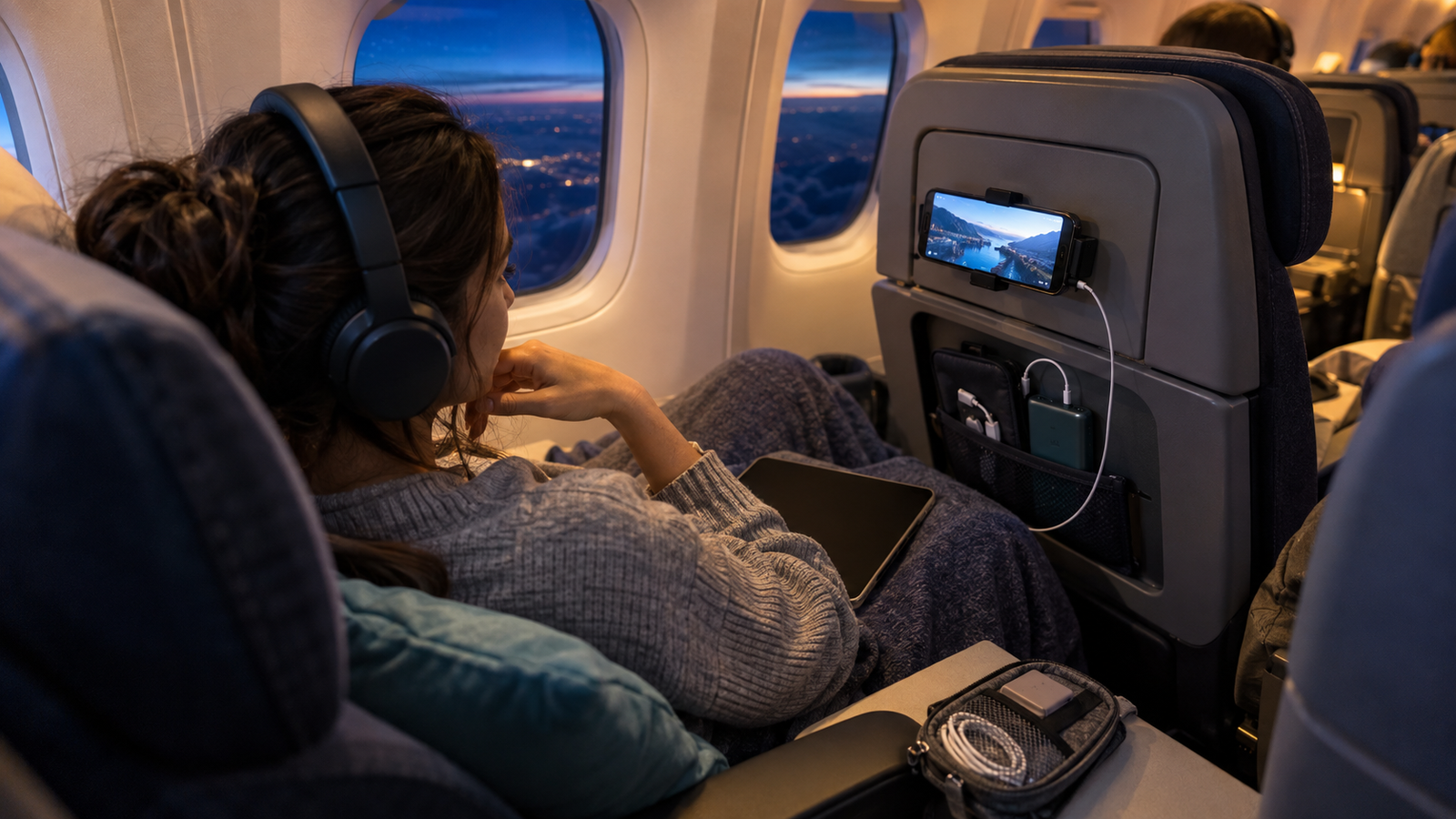
The personal item’s tech organization: the noise-canceling headphones in the exterior pocket at the very top for immediate boarding access. The cables and the power bank in the exterior pocket beside the headphones. The phone in the exterior pocket’s accessible slot. The tablet or e-reader in the main compartment’s top section — accessible with one lean-forward motion during cruise. The laptop in the dedicated laptop sleeve if the laptop is used during the flight rather than the tablet. Every tech item in its assigned position, loaded in that position before boarding, accessible from that position throughout the flight without standing, without opening the overhead bin, and without involving adjacent passengers more than the forward lean requires.

Insider Note

Load the personal item the evening before departure with the tech in its flight positions, charged to one hundred percent, with content downloaded. The personal item loaded the evening before is the personal item confirmed ready at departure — the headphones are where they should be, the power bank is charged, the cables are in their position, the tablet’s downloads are confirmed. The personal item loaded the morning of is the personal item whose headphones may be on the bedside table from the previous night’s use, whose power bank may be on the charger but not yet in the bag, and whose tablet may be running the final ten percent of its download. Five minutes the evening before. The departure morning is the personal item confirmed and the flight beginning.

Noise-Canceling Headphones: The Single Greatest Long-Haul Investment

Noise-canceling headphones are the long-haul flight’s single highest-value travel tech purchase, and the argument for them is specifically about the aircraft cabin’s acoustic environment rather than any general preference for quiet. Commercial aircraft cabin noise during cruise altitude typically measures eighty to eighty-five decibels — equivalent to the continuous sound level of a busy restaurant — produced by the engine’s compressor sound transmitted through the fuselage, the cabin air conditioning system, and the general ambient conversation and movement of the cabin’s passengers. This noise level is present for the full flight’s duration regardless of whether the passenger is sleeping, watching content, or trying to do nothing. Standard headphones attenuate this noise by the physical blocking of the ear cups. Noise-canceling headphones reduce it actively — they produce an inverted version of the ambient noise’s frequency pattern that cancels a significant proportion of the engine and cabin drone, producing a substantially quieter listening environment at the same seat on the same aircraft.

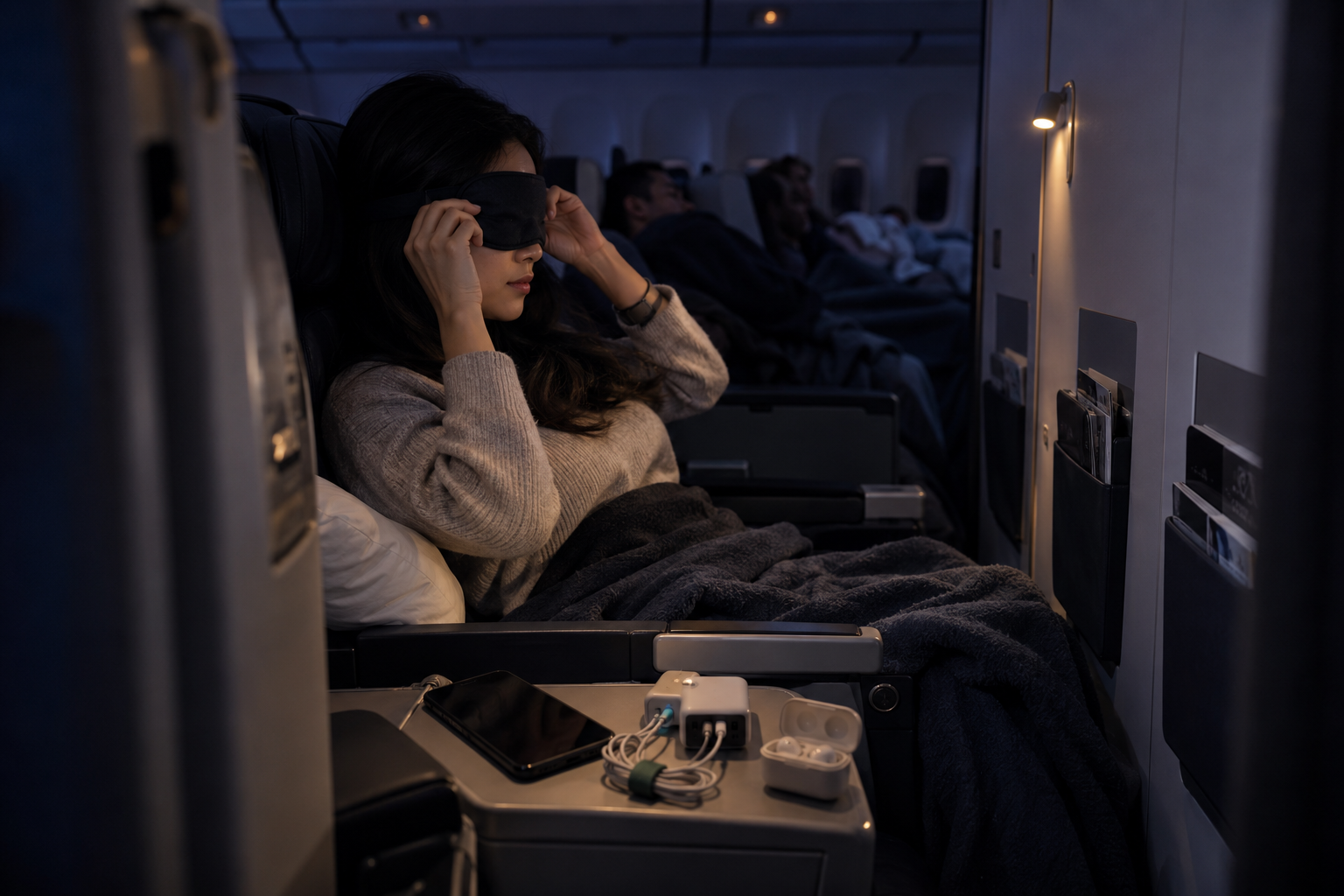
The noise-canceling effect specifically benefits the long-haul flight’s sleep segment, where the cabin’s drone is the consistent sleep-quality reducer that the noise cancellation alone — without any music or audio content — meaningfully addresses. The passenger who wears noise-canceling headphones with no audio playing during the sleep segment is the passenger sleeping in a substantially quieter acoustic environment than the passenger relying on the cabin’s residual ambient sound. The sleep quality produced by this quieter environment is meaningfully better for most passengers than the sleep in the unattenuated cabin — which is the specific sleep quality benefit that the long-haul flight’s arrival condition reflects. Arrive rested from the noise-canceling flight. Arrive from the unattenuated flight with the specific tiredness that the engine drone’s eight-hour accompaniment to the night produces.

The noise-canceling headphones are a one-time investment that produces the benefit on every subsequent long-haul flight. The cost amortized across the flights of a regular traveler’s three to five-year headphone lifecycle is measured in cents per flight hour. The specific comfort and sleep quality benefit they produce is measurable in the difference between the arrival that begins the trip and the arrival that begins from a deficit. For any traveler who takes long-haul flights more than once per year, noise-canceling headphones are the travel purchase whose return per dollar spent exceeds every other single item in the travel kit.

Insider Note

Pack the noise-canceling headphones in their case in the personal item’s exterior pocket at the very top — the first item out of the bag at boarding — and pack a set of compact wired earbuds as the backup in the same exterior pocket behind the headphones. The headphones are the primary audio system for the full flight. The earbuds are the backup for the headphones’ battery reaching zero at hour nine of an eleven-hour flight, for the aircraft seat’s audio jack requiring a wired connection rather than Bluetooth for the seatback screen, and for the specific preference of the sleep segment where the over-ear headphone’s contact pressure after several hours of wearing is replaced by the earbuds’ lighter physical presence. Both items together weigh under three hundred grams. The redundancy covers the scenarios where the headphones alone would not.

The Complete Long-Haul Tech System

The complete long-haul tech system organizes the device preparation, the charging system, and the personal item positioning into the single evening-before routine that produces the confirmed-ready tech for every long-haul flight.

The evening before departure: all content downloaded across all apps — streaming services, music, podcasts, audiobooks, airline app. All devices charged to one hundred percent and confirmed on their chargers by 10 p.m. — phone, tablet, e-reader, noise-canceling headphones, power bank. Personal item loaded in flight position order: noise-canceling headphones and backup earbuds in the exterior pocket top section. Power bank and two cables in the exterior pocket beside the headphones. Phone in the exterior pocket’s accessible slot. Tablet or e-reader in the main compartment’s top section. Laptop in the laptop sleeve if used during the flight.

The departure morning: confirm every device shows one hundred percent. Confirm the download library is complete by opening each app and confirming the downloaded indicator on each content item. Personal item confirmed and placed at the door. The departure morning’s tech system is a two-minute confirmation of the evening’s preparation.

At boarding: headphones out of the exterior pocket and on the head before the seatbelt sign illuminates. Personal item positioned under the seat in front with the exterior pocket facing toward the seat. Every tech item within reach of a forward lean for the full flight’s duration.

Insider Note

Build a travel tech checklist as a phone note or a laminated card in the personal item’s exterior pocket alongside the cables — a short list of the specific items and the specific preparation steps that the tech system requires before every long-haul flight. The checklist: download complete on all apps, phone charged to 100%, tablet charged to 100%, headphones charged to 100%, power bank charged to 100%, two cables in exterior pocket, headphones in exterior pocket top. Seven items. Checked once the evening before. The flight departs with the confirmed tech system rather than the assumed tech system whose assumptions produce the mid-flight discovery that the specific assumption was incorrect.

The Same Row. The Same Flight. Two Completely Different Ten Hours.

Eli and Cass were in the same row on their first long-haul flight together. They had the same seat class. The same flight duration. The same destination. The same departure time. The flight was ten hours. What each of them had in their personal item was the specific difference between the ten hours that felt like the trip beginning and the ten hours that felt like something to get through before the trip began.

Cass had spent forty-five minutes the evening before their departure doing what she called pre-flight prep. She downloaded three films on Netflix, two series episodes on her streaming app, a full audiobook, and a podcast playlist. She charged her phone to one hundred percent, her noise-canceling headphones to one hundred percent, and her power bank to one hundred percent. She packed the headphones in the exterior pocket of her personal item, the power bank and two cables beside them, and the downloaded tablet in the main compartment. She had a small cable-tidy organizer in the exterior pocket alongside the cables. She confirmed every download showed the offline indicator before the bag was closed.

Eli had thought about doing something similar. He had opened Netflix on the departure morning and noted that the films he wanted were available for download. He had confirmed in his own mind that the inflight Wi-Fi would be available because the airline’s website mentioned it as a feature. He had packed his phone and headphones in his carry-on in the overhead bin because the carry-on was where he put things. His phone was at eighty-two percent from the morning’s use. His headphones were at sixty percent from the previous day’s commute. His power bank was in the bag somewhere — at some charge level he had not checked.

The seatbelt sign extinguished at cruise altitude. Cass put on her headphones in thirty seconds from the personal item. Eli opened the overhead bin, located the carry-on, opened the carry-on, found the headphones at the bottom, disturbed the middle seat passenger who had been attempting to sleep, and sat down. The inflight Wi-Fi required a paid subscription that the airline’s website had implied was included but was not included in their fare class. The Netflix app informed Eli that the film he wanted required a wifi connection because he had not downloaded it. His headphone battery notification appeared at hour four. His phone was at forty percent at hour six. His power bank produced forty percent charge when he located it at hour seven, which was adequate for one phone charge rather than the two he needed for the remaining three hours and the arrival’s navigation.

At hour ten, when the aircraft began its descent, Eli looked at the seatback screen, which had the same content he had watched for the past three hours because the wifi-dependent alternatives were not available. He asked Cass how her flight was. She said excellent. She had watched two films, was halfway through the audiobook, and her phone was at sixty-eight percent because the power bank had kept it topped up throughout the flight. She had not asked the flight attendant anything because she had not needed anything. This article is the forty-five minutes Cass spent the evening before and the ten hours of flight that those forty-five minutes produced.

Six More Travel Tech Hacks for Long Flights

Beyond the five core travel tech principles, these six additional approaches address the specific in-flight tech scenarios the core system does not fully cover.

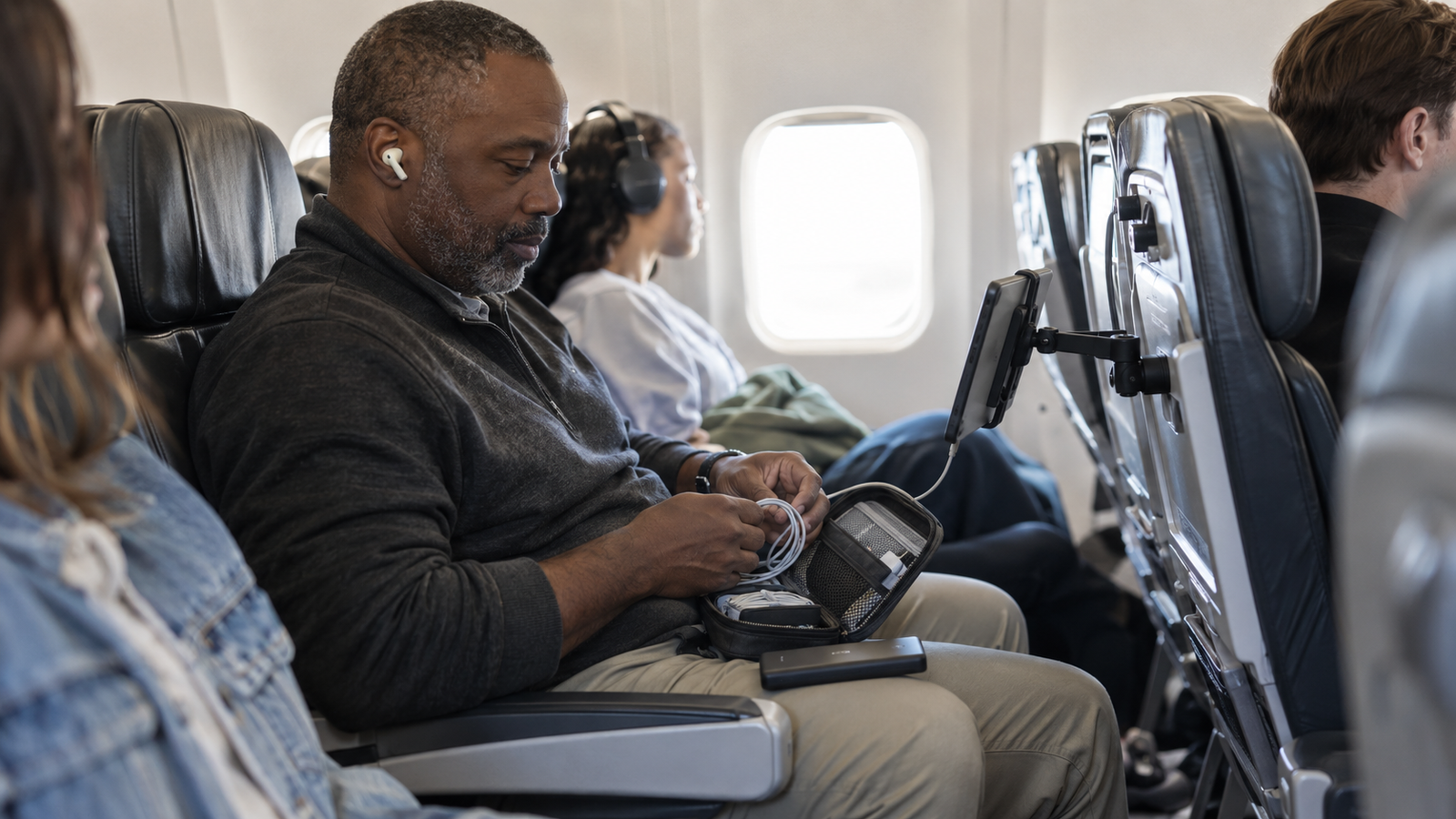
Bring a small cable-tidy organizer — a fabric roll, a zippered pouch, or a silicone cable organizer — to keep all cables and small tech accessories organized in the personal item’s exterior pocket. The cables without a cable organizer are the cables that tangle, the cable ends that are found by feel rather than sight in the personal item’s dark exterior pocket, and the specific cable situation at the seat-side power outlet that requires twenty seconds of untangling before the charging connection is established. The cable organizer weighs under fifty grams and contains every cable in its specific loop at the position it was last placed, available for immediate connection. The specific cable needed is retrieved from the organizer rather than the exterior pocket’s general tangle.

Enable airplane mode on all devices immediately at boarding and switch on Wi-Fi separately only if the inflight Wi-Fi is being used. Airplane mode with Wi-Fi enabled for inflight use conserves battery compared to the standard cellular-enabled mode — the phone searching for a cellular signal at altitude consumes battery without finding a connection, while airplane mode eliminates this drain. The battery conserved by airplane mode across a ten-hour flight is meaningful — typically fifteen to twenty percent of total battery capacity — which is additional charging capacity available for the arrival’s navigation and communication needs without any behavior change beyond the mode switch at boarding.

Download a white noise or ambient sound app and load it with several hours of content before the flight. The white noise track playing through the noise-canceling headphones during the sleep segment produces a consistent, non-distracting acoustic environment that is specifically designed for sleep onset rather than the music or podcast content that is designed for engagement. Brown noise, pink noise, rain sounds, and ocean ambient tracks are the long-haul sleep segment audio content that the noise-canceling headphones amplify from useful to excellent — the specific combination of noise cancellation reducing the engine drone and the ambient sound track replacing it with a consistent, sleep-compatible audio environment that the unattenuated cabin does not provide.

Use a tablet rather than a laptop as the primary entertainment device for long-haul flights where the work that requires a laptop is not being done. The tablet’s battery life — typically ten to twelve hours — exceeds the laptop’s typical six to eight hours and is more appropriate for the flight’s entertainment-only context. The tablet’s lighter weight and thinner profile also means more comfortable holding during extended entertainment sessions, a smaller tray table footprint, and a device that is charged to one hundred percent at the same charge level as the flight’s duration rather than requiring the power bank’s supplementation that the laptop battery typically does. The laptop belongs in the personal item for flights where work is planned; the tablet serves the same content needs at better battery life for flights where entertainment is the only device use.

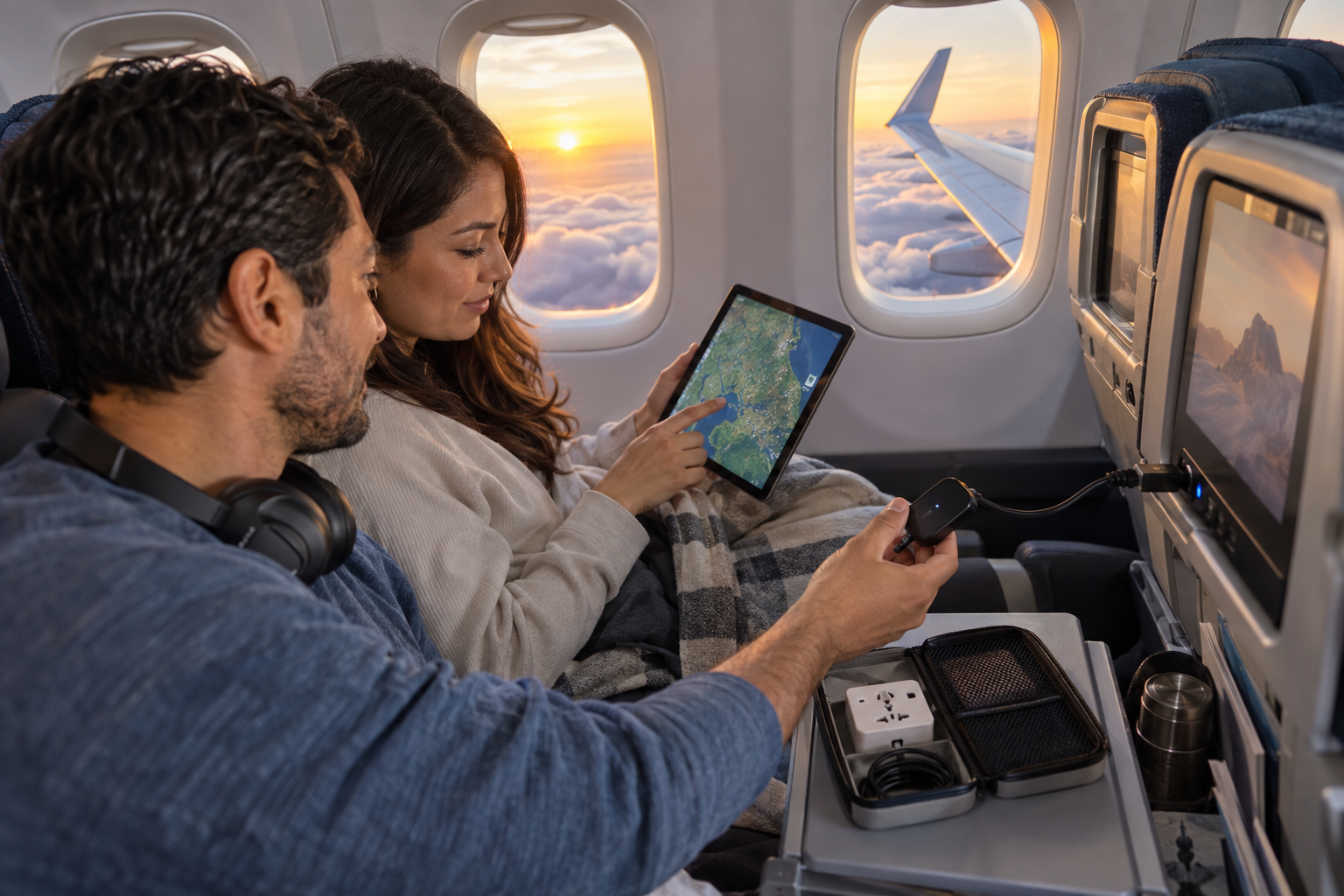
Research the specific airline’s seatback entertainment system before the flight and download any content that is also available on the airline’s app for offline viewing. Some airlines offer offline viewing of their seatback content through their app, which means the same content available on the seatback screen is also available on the personal device through the app without any Wi-Fi connection. For long-haul flights where the seatback screen’s content selection is extensive and well-curated, the airline app’s offline download supplements the personal streaming app’s download library with content specifically selected for the airline’s long-haul context — typically including new releases and long-form documentary content that the airline licenses for its passengers’ entertainment.

Pack a small travel extension cord or a compact USB hub for the airport connection during the boarding gate wait. The airport departure gate’s outlets are the most contested resource in any terminal — one or two outlets shared among the gate’s full passenger load, most already occupied by the time the early-arrival passenger finds the gate. The USB hub plugged into one outlet provides four to six USB charging ports from the single outlet, which simultaneously charges the phone, the power bank, and the tablet while a conversation with the adjacent outlet occupant about sharing the extra ports typically produces goodwill and occasionally a conversation. The travel extension cord with multiple outlets converts the single wall outlet into the full charging station for the full gate wait. Arrive at the flight with every device at one hundred percent from the home preparation. If the gate wait reveals any device below ninety percent, the USB hub or extension cord restores it before boarding.

Insider Note

The long-haul tech system’s most important characteristic is that it is prepared before the travel day rather than during it. The content downloaded at home plays offline throughout the flight. The devices charged to one hundred percent at home begin the travel day at full capacity. The cables confirmed in the personal item the evening before are in the personal item at boarding. Each of these preparations costs minutes the evening before and produces hours of benefit during the flight. The alternative — the content to be downloaded at the airport, the devices to be topped up at the gate, the cables to be located in the carry-on at boarding — compresses the preparation into the departure morning’s time pressure and produces the specific gaps that the in-flight discovery of their consequences reveals. Prepare the evening before. Board with the confirmed system. The flight is the return on the preparation.

Book With Us

Book the Long-Haul Destination Worth Every Tech Preparation

The long-haul flight that is genuinely worth taking leads to a destination that is genuinely worth arriving at. Our travel agents book both. Let us plan the trip the tech system was built for.

Book A Trip

Long-Haul Tech Mistakes That Leave You Staring at the Seat Map

Each of these is Eli’s ten hours. Each has a preparation-based resolution.

1

Assuming the inflight Wi-Fi will work for streaming

Inflight Wi-Fi is available on some aircraft and not others. On the aircraft where it is available, it works at speeds that vary from adequate to unusable depending on the route, the passenger load, and the satellite coverage. Streaming-quality Wi-Fi on a long-haul flight over the Pacific at peak connection hours is not a reliable assumption. Downloading is. Download the content the evening before. The flight departs with a full offline library. The inflight Wi-Fi password is a question that is never asked.

2

Not charging all devices to 100% the night before departure

The device at eighty percent at boarding begins the travel day twelve hours behind the device at one hundred percent. The device charged the night before arrives at the destination from its highest possible charge level minus the travel day’s drain. The device charged the morning of, or not charged at all, arrives from a lower starting point with a commensurately lower arrival charge. Charge everything the night before. Confirm every device shows one hundred percent at the departure morning’s tech confirmation.

3

Packing tech in the overhead carry-on rather than the personal item under the seat

The tech in the overhead carry-on is the tech accessed by standing, opening the bin, retrieving the bag, locating the item, restoring the bag, closing the bin, and sitting — involving the adjacent passenger at least once per access. The tech in the personal item under the seat is the tech accessed by leaning forward and unzipping a pocket. Both tech items are the same. The personal item’s access is the one that does not require standing three times across the flight. Tech in the personal item. Every flight.

4

Bringing only one cable and watching it fail at hour three

The cable that fails at hour three of a ten-hour flight leaves the remaining seven hours without the charging connection that the power bank contains the capacity for. The second cable in the exterior pocket beside the first is the confirmed backup that restores the charging connection in under thirty seconds. Both cables weigh under forty grams. The second cable’s cost is forty grams and the peace of mind that every subsequent long-haul flight benefits from. Pack two cables.

5

Not bringing noise-canceling headphones for a flight over six hours

The aircraft cabin at eighty to eighty-five decibels for six or more hours is the acoustic environment that the noise-canceling headphones reduce significantly and the standard headphones manage less effectively. The sleep quality on a long overnight flight is meaningfully better for the passenger whose noise cancellation reduces the engine drone below the threshold where it disrupts sleep onset and maintenance. The noise-canceling headphone investment pays its return on the first long-haul flight’s improved arrival condition. Every subsequent flight pays it again.

6

Not confirming downloads before boarding and discovering they failed

The film whose download icon appeared at ninety-eight percent when the bag was packed and whose download stalled at ninety-eight percent because the home Wi-Fi disconnected is the film that the flight’s opening selection reveals is not available offline. Confirm every download by opening each app and verifying the offline indicator — the specific downloaded icon rather than the in-progress download indicator — on each piece of content before the personal item is zipped. The confirmation takes two minutes. The unconfirmed download’s discovery happens at thirty-five thousand feet when two minutes is the preparation cost that would have prevented the specific discovery moment.

Turn Travel Into Income

Love Helping Travelers Get the Most From Every Journey?

Long-haul travel bookings are among the most meaningful travel agent work — these are the trips that cross oceans and time zones and change people’s relationship with the world. If becoming a home-based travel agent who helps people reach those destinations sounds like the right next step, see how the TravelPreneur system works.

Become An Agent

Frequently Asked Questions

These are the questions long-haul travelers ask most often about getting the tech right for every flight.

Is inflight Wi-Fi reliable enough to stream on long-haul flights?

Inflight Wi-Fi reliability on commercial long-haul flights varies significantly by airline, aircraft, route, and the number of passengers connected simultaneously. At its best — on short-haul domestic flights on well-equipped aircraft with few passengers connected — inflight Wi-Fi can support low-quality video streaming. On long-haul international flights over ocean routes where satellite coverage is less dense, at peak connection times when many passengers are connected simultaneously, inflight Wi-Fi reliability is inconsistent to the point where streaming is unreliable. Airlines that offer inflight Wi-Fi describe it accurately as available rather than reliable for streaming. For the traveler whose in-flight entertainment plan depends on streaming, the inflight Wi-Fi’s unreliability in the scenarios where it matters most — the long transoceanic flight where no alternative entertainment is available — makes streaming-dependent entertainment a risky plan relative to the fully offline downloaded content whose playback is guaranteed regardless of Wi-Fi availability or quality.

How many hours of content should I download for a long-haul flight?

Download content for approximately one and a half times the flight’s duration to provide a comfortable buffer without exhausting the device’s storage unnecessarily. For a twelve-hour flight, download approximately eighteen hours of content — three films of approximately two hours each, one full series season of ten to twelve episodes, and one audiobook of approximately six to eight hours — across the different formats that the flight’s different segments benefit from. The film for the first high-energy hours, the series for the middle hours, the audiobook for the sleep-to-wake transition. The content library that exceeds the flight’s duration by fifty percent ensures that no single format’s exhaustion leaves the remaining hours without entertainment alternatives, and that format variety allows the flight’s mood to guide the entertainment selection rather than the content’s depletion forcing a specific choice.

Are noise-canceling headphones worth the investment for occasional travelers?

Noise-canceling headphones are worth evaluating for any traveler who takes long-haul flights — defined as flights over six hours — with any regularity, including occasional travelers who take one or two long-haul flights per year. The investment amortized across even two long-haul flights per year produces a cost-per-flight that reflects a meaningful comfort improvement per dollar at most quality tiers. For the occasional traveler whose long-haul flights are significant events rather than routine commutes, the arrival condition improvement from the noise-canceling headphones’ sleep quality benefit is most felt on those specific flights — the once-a-year long-haul vacation flight where arriving rested is the most direct contribution to the trip’s quality. The specific value of noise-canceling headphones for any individual depends on their noise sensitivity, their typical flying context, and their budget, but the comfort benefit on long-haul flights is genuinely significant rather than marginal for most travelers who try them.

What is the best portable power bank for travel?

The best portable power bank for travel balances capacity against weight at a format that fits in the personal item’s accessible section for in-flight use. For most travelers taking long-haul flights, a ten-thousand milliamp hour bank at approximately two full phone charges in a slim rectangular form factor is the practical optimum — large enough to cover the full travel day’s charging needs without being large enough to add significant weight or volume to the personal item. Twenty-thousand milliamp hour banks provide greater capacity at greater weight and are worth considering for travelers whose travel days are consistently long or whose devices include a laptop or tablet that drains the bank more quickly than a phone alone. The specific bank whose charging speed, port configuration (at minimum one USB-C Power Delivery port and one USB-A port), and form factor best suit any individual traveler’s devices and personal item are best identified through current travel power bank reviews from tech-focused platforms, as the best current products change with the technology’s rapid development pace.

How do you keep earbuds and cables organized in a personal item?

The most reliable cable and earbud organization in a personal item’s exterior pocket uses a dedicated cable organizer — a small zippered pouch, a fabric cable roll, or a silicone organizer with individual loops — that keeps each cable in its specific position and each earbud in its case rather than loose in the pocket’s general space. Without an organizer, cables tangle with each other and with other pocket contents, earbuds are found by feel in the dim overhead light, and the specific cable needed requires identifying it from the tangle rather than retrieving it from its known position. A small cable organizer weighing under fifty grams resolves all of these access friction points from the first flight it is used and on every flight after that. The specific format of cable organizer that best suits any traveler’s cable count and personal item’s pocket dimensions is a personal preference; the principle is consistent regardless of format: each cable in a designated position, accessible without untangling.

What should I do if my device runs out of battery mid-flight?

The mid-flight device battery depletion is most effectively prevented by the power bank system in this article rather than managed after it occurs. If the battery reaches zero mid-flight despite a power bank, the immediate steps: connect the device to the power bank via the backup cable in the exterior pocket. If the seat-side outlet is available and accessible, connect the power bank to the outlet via the USB-A-to-C cable to simultaneously recharge the device and the power bank. If no seat-side outlet is available, the power bank provides charging from its stored capacity alone — confirm the power bank’s remaining capacity by checking its indicator before connecting, to know whether the capacity is sufficient for the device’s needed charge level. For the device whose battery is depleted and whose power bank is also depleted — the situation that the overnight charging and the one hundred percent power bank preparation prevents — the seatback entertainment system is the fallback entertainment source for the remaining flight hours, and the device’s offline content is unavailable until charging begins at the destination or at the connection airport’s outlet.

The flight that felt like the trip beginning had downloaded content, charged devices, and noise-canceling headphones on before the seatbelt sign lit. The flight that felt like something to survive did not. Both flights were the same ten hours. The preparation was the entire difference.

Picture Your Next Long-Haul at Hour Two

The noise-canceling headphones have been on since the seatbelt sign extinguished. The film playing has been downloaded since last night and is playing at full quality without a single buffer indicator. The power bank in the exterior pocket is connected to the phone, which is at ninety-six percent from the charge level it had when it boarded. The tablet is in the main compartment for the series at hour five. The cables are in the organizer in the exterior pocket. The inflight Wi-Fi password is a question that does not need asking. The ten hours are not something to survive. They are the first ten hours of the trip. That is the tech system. That is every long-haul from here.

Free Download

One More Thing Before Your Next Long Haul

Print our free Travel Packing Checklist and use the long-haul tech section to confirm downloads are complete on all apps, all devices are charged to 100%, the power bank is charged, two cables are in the exterior pocket, and the noise-canceling headphones are in the personal item’s top position. The same checklist we confirm before every long-haul flight.

Get the Free Checklist

Explore Our Top Picks for a Better Trip

Visit our favorites page for helpful booking ideas and travel essentials that we have found genuinely useful for long-haul air travel. Whether you are planning your next big flight or looking for resources that make every journey more comfortable and better equipped, it is worth exploring.

See Our Top Picks

Travel Prints and Printables From Our Shop

Visit Premier Print Works for long-haul flight preparation checklists, travel planners, tech packing guides, travel journals, and wall art that makes every journey a little more beautiful and a lot better prepared — from the evening the downloads are confirmed to the hour two of the flight that feels like the trip already beginning.

Visit Premier Print Works

Disclaimer

The information shared in this article is provided by Don and Diana’s Travels for general informational, educational, and inspirational purposes only. It reflects our personal experiences, opinions, and the experiences of travelers we have worked with. It is not professional technical or travel advice.

Airline and Aviation Regulations

Portable power bank regulations, inflight Wi-Fi availability and quality, and other airline policies vary by airline, aircraft, route, and regulatory jurisdiction and are subject to change. Always confirm current regulations with the specific airline before travel. We are not responsible for any airline or aviation outcome arising from information in this article.

Product Information

Device battery life, power bank capacity, and cable compatibility vary by product and are subject to change. Always confirm product specifications before purchase. We are not providing product endorsements.

Affiliate and Partner Links

This article may contain affiliate and partner links that pay us a commission. Our recommendations are based on real use and genuine belief in the products and services we share.

Health, Safety, and Personal Responsibility

Travel involves personal risk. You are solely responsible for your own health, safety, and travel decisions. Don and Diana’s Travels accepts no liability for any loss, injury, delay, or inconvenience arising from information in this article.

Composite Stories

Stories on this site combine real experiences from Don, Diana, clients, and travelers we have worked with. Details may be adjusted for privacy and narrative clarity.

No Guarantees

We do not guarantee any specific result from using the information in this article. Your results depend on your own choices and circumstances.

Copyright and Use

All content is the copyrighted property of Don and Diana’s Travels. You may not copy or republish our content without prior written permission. You are welcome to share a direct link with proper credit.

By reading this article, you acknowledge that you have read and agree to this disclaimer.