Cruise Packing Tips for Men
Men who pack well for a cruise bring one wardrobe that works for every occasion the ship throws at them. The best packed man on any cruise ship brought exactly what he needed and spent zero time worrying about what he left behind. This article builds that wardrobe — from embarkation day to the final port farewell.
Grab Our Travel Packing Checklist
Our free packing checklist includes a cruise wardrobe section organized by the occasion register system this article describes — pool and port day items, evening items, formal night items — so every piece’s purpose is clear before anything goes in the bag.
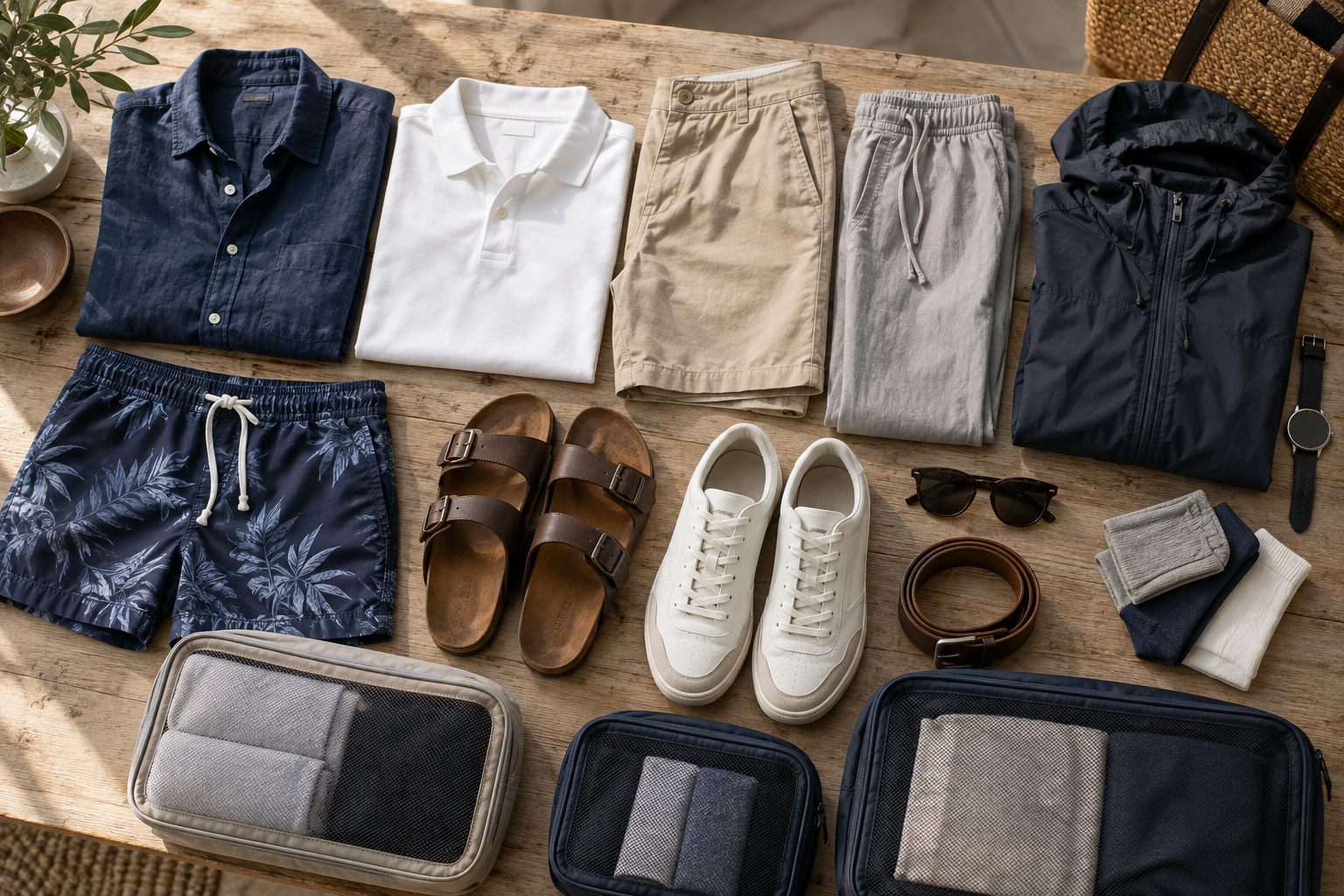
Get the Free ChecklistThe cruise’s daytime hours divide cleanly into two environments: the ship’s pool deck and public areas during sea days, and the port’s streets, markets, beaches, and excursion venues on port days. Both environments share the same dress code — casual, comfortable, warm-weather appropriate — and are served by the same items in the cruise wardrobe. The man who packs two to three pairs of quality swim trunks and two to three casual linen or lightweight shirts in neutral or complementary colors is dressed for every sea day pool session, every casual shipboard lunch, every port morning walk, and every beach excursion the itinerary includes.
The swim trunks earn their place in the cruise bag more effectively than any other item. On most warm-weather cruises, the sea days produce two to three pool or deck sessions per day for the passenger who uses the ship’s outdoor space, and the swim trunks are the item that makes the transition from pool to deck to casual lunch seamless — the swim trunk with the quick-dry fabric and the neutral color reads as shorts in the casual lunch venue, which eliminates the need for a separate pair of casual shorts in the bag. Two to three swim trunks, each in a neutral or classic print that works as shorts outside the pool context, cover the full cruise at the daytime register without requiring any item dedicated exclusively to pool use.
The casual linen or lightweight shirts: two to three, all in neutrals that pair with the swim trunks and with the evening’s chinos. White, light blue, pale olive, and pale grey are the most versatile linen shirt colors for a cruise wardrobe because they work across the full daytime and early-evening register without requiring any color management. The linen fabric is the right call for the warm-weather cruise — it breathes at the temperature that pool decks and tropical port days produce and it creases in a way that reads as intentional rather than neglected in the casual daytime context. Pack linen that is designed for wearing rather than for ironing.
The best packed man on any cruise ship brought exactly what he needed and spent zero time worrying about what he left behind.
Men who pack well for a cruise bring one wardrobe that works for every occasion the ship throws at them — from embarkation day to the final port farewell.
Bring a lightweight rash guard or UV-protective swim shirt for the cruise’s pool deck and beach excursion days. The sun at sea and in tropical port locations is more intense than most travelers anticipate, and the pool deck session that produces the painful sunburn on day two of a seven-night sailing affects the comfort of every subsequent day. A rash guard in a neutral color that can be worn as a casual layer over the swim trunks provides UV protection without the continuous sunscreen reapplication the open-shoulder swim trunk session requires. It also doubles as the early-morning deck walk layer when the ship’s motion produces a breeze before the day warms fully.
Let Us Find You the Sailing the Cruise Wardrobe Was Built For
The right cruise wardrobe works for a specific itinerary’s occasion range. Tell us where you want to sail — Caribbean, Mediterranean, Alaska, the Baltic — and we will identify the sailing with the right balance of sea days, port days, and formal nights for the wardrobe this article builds.
Plan Our EscapeThe cruise’s evening dress code — smart casual to the main dining room and the evening’s shows and entertainment venues — is the register that the greatest number of the sailing’s daily hours occupies and the register that the greatest number of first-time male cruisers pack inadequately for. Smart casual on a cruise ship means the chino-and-smart-shirt combination: a well-fitted pair of chinos in navy, grey, or khaki paired with a collared shirt that is more intentional than the casual linen shirt and less formal than the formal night’s dress shirt. The polo shirt in a quality pique fabric, the chambray or oxford cloth casual button-down, and the clean knit Henley at the more relaxed end of the smart casual range — all qualify for the main dining room and the evening’s entertainment venues on most cruise lines’ smart casual nights.
Two pairs of chinos cover the full seven-night sailing at the evening smart-casual register when alternated across the sailing’s non-formal nights. One pair in a neutral dark wash — navy or charcoal — works for the more dressed-up smart-casual occasions and transitions to the formal night’s elevated look with the blazer and the dress shirt. One pair in a lighter neutral — khaki, tan, or stone — covers the relaxed smart-casual evenings where the pool day transitions directly into the dinner without a full outfit change. Together, these two pairs cover every evening of the cruise at the appropriate register for the main dining room without requiring daily outfit decisions more complex than which color the evening calls for.
Three to four smart shirts covering the evening register: one classic white button-down that works for every evening from the most relaxed smart-casual to the formal night’s base layer, one short-sleeve printed or textured shirt for the more casual smart-casual evenings, one polo in a rich neutral for the sea day evenings when the look is intentionally relaxed rather than elevated. These three shirts, alternated across the sailing’s evenings alongside the two pairs of chinos, produce six distinct evening combinations before any accessory variation is applied — more than enough variety for a seven-night cruise without any evening outfit repetition.
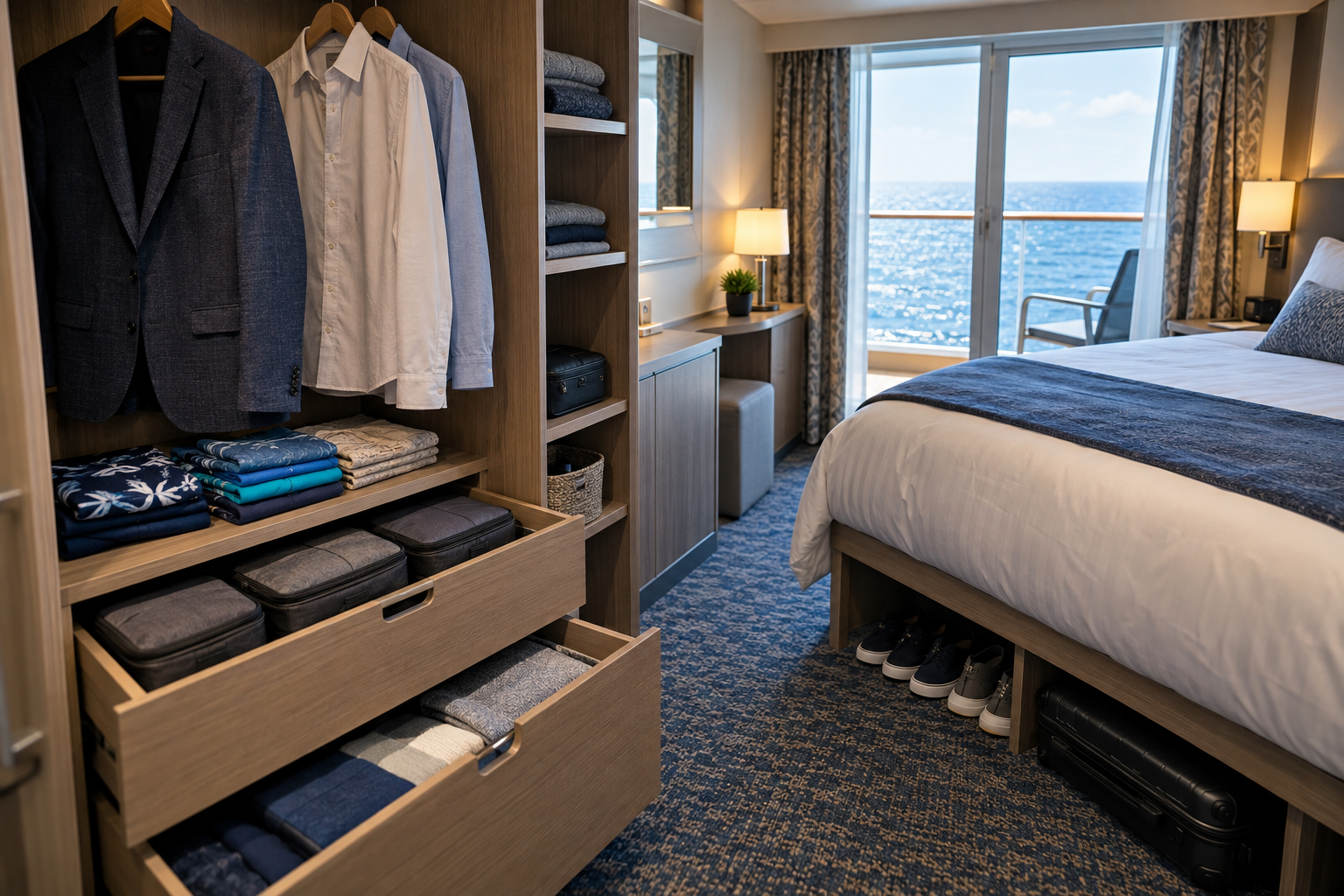
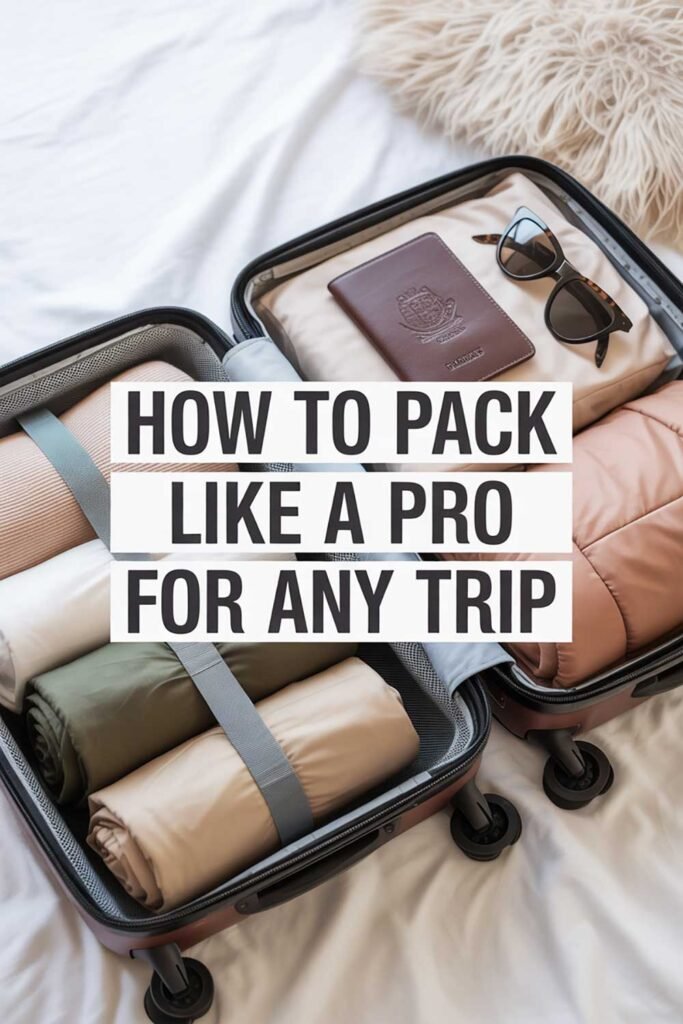
Pack the chinos in a flat-fold compression bag rather than rolling them, and hang them in the cabin immediately on arrival to allow any transit creases to fall out naturally. Chinos that are hung in the cabin for twelve hours before the first evening wear are chinos that arrive at the dinner table in the condition they were packed rather than with the specific fold-crease across the front of the leg that a rolled chino acquires in the bag. The ship’s cabin typically has a small wardrobe or hanging space adequate for two pairs of trousers alongside the formal night’s suit or blazer combination. Hang everything that will be worn to dinner on the first afternoon in port rather than leaving it in the bag until the evening it is needed.
Formal night — called elegant night on some cruise lines, black tie optional on others, and designated by the ship’s daily program as the evening with the elevated dress code — is the cruise’s most photographed occasion, the main dining room’s most festive evening, and the specific night for which the man who did not pack appropriately discovers the specific discomfort of being the underdressed person in the formal room. Most seven-night sailings have two formal nights. Most five-night sailings have one. The appropriate packing for formal nights is a specific formal outfit per formal evening — not the same outfit twice on different nights, though this is more of a personal preference than a strict social rule — that meets the cruise line’s formal night dress code as specified in the booking materials for the specific sailing.
The men’s formal night wardrobe for most cruise lines’ formal or elegant night designation: a dark suit — navy or charcoal — in a travel-friendly fabric like wool-poly blend or performance fabric that does not crease significantly in a bag, paired with a white dress shirt and a tie or bow tie. For cruise lines whose formal night is truly black-tie optional, a dinner jacket or tuxedo provides the most elevated option and is available for rental on most ships for passengers who do not wish to pack one. The suit is the most commonly worn and most broadly accepted men’s formal night option across the full range of mainstream cruise lines’ formal night interpretations. A well-fitted dark suit, a white dress shirt, and a classic tie is correct for every formal night on every mainstream cruise regardless of how the specific dress code is described.
The practical packing approach for the formal night suit: the suit jacket is worn on the travel day rather than packed, eliminating it from the bag entirely during transit and allowing it to arrive in the cabin in the condition it was purchased rather than in the condition a bag produces. The suit trousers travel in the bag’s flat-fold compression section. The dress shirt travels in the same flat-fold compression section as the chinos, pressed and ready to hang in the cabin on arrival. The tie travels in the suit jacket’s interior pocket, protected from the transit damage that a bag’s contents produce on a loosely packed tie. The shoes for formal night are the leather dress shoe that is also the evening’s smart-casual shoe for the nights the blazer is not required — the one pair of leather shoes that covers every formal and smart-casual evening of the sailing.
Check the specific cruise line’s formal night dress code in the booking documentation before packing rather than relying on general cruise dress code advice. Formal night standards vary meaningfully between cruise lines: luxury and ultra-luxury lines genuinely expect black tie; contemporary and premium mainstream lines describe a black-tie optional or elegant night standard where a dark suit is fully appropriate; some casual or theme cruise products have eliminated the formal night entirely in favor of a smart-casual evening. Packing for the formal night requires knowing the specific standard of the specific line’s specific product rather than the generic men’s cruise formal night advice that applies to the average across all lines. Two minutes of reading the booking confirmation or the ship’s FAQ resolves the specific standard before the bag is packed.
Find Booking Ideas and Travel Essentials on Our Favorites Page
Our favorites page has helpful booking ideas and travel essentials that we have found genuinely useful for cruise travel and men’s travel packing. Worth a look before the next sailing.
DND FavoritesThe navy blazer is the men’s cruise wardrobe’s single most valuable item — not because it covers the most occasions independently, but because it elevates every other item in the bag to the occasion above the item’s base register. The casual linen shirt and chinos combination is smart casual. Add the navy blazer and the same combination is elevated smart casual that reads as intentional and polished in the main dining room on any night of the sailing. The dark trousers and dress shirt is formal night base. Add the navy blazer and the combination is fully appropriate for every non-tuxedo formal night on any mainstream cruise line. The swim trunk and the linen shirt is daytime pool deck. Add the navy blazer at the evening transition and the same linen shirt beneath the blazer with the chinos is dinner-appropriate without any item change beyond adding the jacket.
The blazer’s cruise wardrobe value is specifically its versatility across the sailing’s three distinct registers — casual, smart casual, and formal — from one item’s bag contribution. A man with a navy blazer and the items in this article’s system has a complete outfit for every occasion the cruise produces. A man without the blazer has a gap at the elevated smart casual and formal occasions that requires either a separate formal jacket, a specific smart casual jacket, or the specific discomfort of being less dressed than the room on the evenings the ship’s dress code calls for more than chinos and a shirt.
The blazer packing approach: worn on the travel day over the smart-casual or casual travel outfit, hung in the cabin on arrival, and used at the occasions that call for it throughout the sailing. Worn on the travel day, the blazer costs zero bag volume and arrives at the cabin in better condition than any amount of bag packing produces. A navy blazer in a travel-friendly wool-poly blend or a performance fabric does not require pressing after the travel day’s wear and hangs out any minor collar and lapel compression naturally overnight in the cabin. It is the one item in the cruise bag that the man carries on his back rather than in his bag and whose arrival condition is therefore entirely within his control.
Choose a solid navy blazer rather than a patterned or double-breasted option for the cruise wardrobe. The solid navy blazer coordinates with every shirt, every trouser, and every chino in the bag by default. The patterned blazer requires pattern-on-pattern coordination management that the cruise packing approach does not have items to spare for. The double-breasted blazer is a more formal and more fashion-specific cut that produces fewer versatile outfit combinations from the other items in the bag than the single-breasted equivalent. One solid navy blazer. Worn with everything. Appropriate everywhere from the smart-casual evening to the formal night to the port-side café lunch when the weather is mild enough for a jacket.
The men’s cruise wardrobe requires three shoe types rather than the general travel rule of two, because the cruise’s three distinct physical environments — the pool deck’s wet surfaces, the port’s walking terrain, and the dining room’s evening register — are best served by three distinct shoe types rather than two versatile options. The pool sandal or flip-flop is the pool deck and beach excursion shoe: waterproof, quick-dry, and appropriate for the pool deck environment in a way that the casual walking shoe is not. The comfortable walking shoe or clean leather sneaker is the port day shoe: appropriate for the cobblestone streets, the market walking, the excursion terrain, and the casual shipboard day without being poolside appropriate or evening appropriate. The leather dress shoe is the evening shoe: appropriate for the smart-casual dinner, the elevated entertainment venue, and the formal night without being appropriate for walking distance excursions or pool deck activities.
Three shoes is the honest minimum for the full cruise occasion range. The man who tries to cover the cruise with two shoes — the walking shoe and the dress shoe, eliminating the pool sandal — spends the pool deck days managing the walking shoe’s exposure to the pool deck’s wet surfaces in a way that produces the specific walking shoe condition that makes it a less desirable port day shoe for the rest of the sailing. The pool sandal eliminates this problem entirely, costs minimal bag space, and is the lowest-investment, highest-return shoe in the cruise bag.
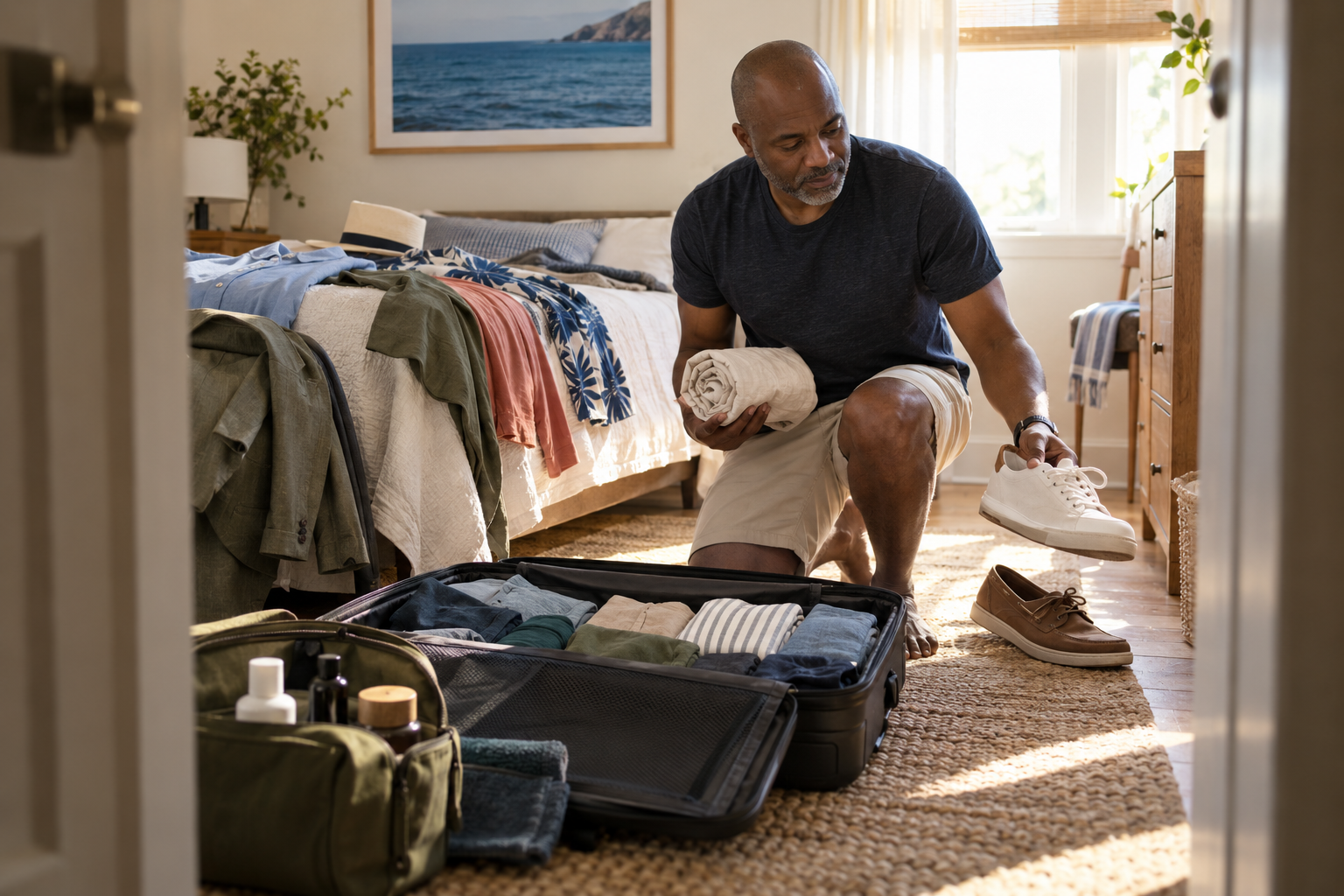
The packing approach for the three cruise shoes: the dress shoe is worn on the travel day, eliminating it from the bag entirely and delivering it to the cabin in good condition. The walking shoe and the pool sandal travel in the bag, positioned heel-to-toe at the bag’s base with the sandal’s flat profile consuming minimal space alongside the walking shoe’s larger volume. The socks for the dress shoe travel inside the walking shoe rather than in the bag’s main compartment, using the walking shoe’s interior volume rather than adding to the main compartment’s item count. Three shoes covering every shipboard and port occasion from the pool deck to the formal night dining room without any shoe-related outfit compromise.
Choose the pool sandal in a style that reads as presentable rather than exclusively beachwear. A leather or leather-look slide in a neutral — black, tan, or navy — transitions from the pool deck to the buffet to the casual afternoon promenade deck without looking specifically like beach footwear in a shipboard context. The rubber flip-flop, while entirely appropriate for the pool and beach, announces its category in every non-pool context and limits the sandal’s versatility to the pool environment exclusively. The neutral leather slide costs minimally more than the rubber flip-flop and provides three times the versatility across the cruise’s casual daytime environments.
The complete men’s cruise wardrobe system for a seven-night sailing covers every occasion from the pool deck to the formal night dinner from a single bag with a specific item count for each occasion register.
Daytime layer: two to three pairs of swim trunks in neutral or classic prints, two to three casual linen or lightweight shirts in neutral colors, one lightweight rash guard, one pair of casual shorts if the swim trunks do not double as shorts effectively in the specific travel group’s casual context.
Evening layer: two pairs of chinos — one dark neutral, one lighter neutral — three smart shirts covering the polo, the casual button-down, and the classic white button-down. The white button-down serves dual purpose as the evening’s smart-casual option and the formal night’s dress shirt base layer.
Formal layer: the dark suit’s trousers in the bag, the jacket worn on the travel day. One tie or bow tie in the jacket’s interior pocket. The suit trousers paired with the white button-down and the jacket for the formal night, or the suit trousers paired with the blazer and the white button-down for the elevated smart-casual evening when the full suit is not required.
The blazer: worn on the travel day. Hangs in the cabin. Covers every elevated smart-casual and secondary formal occasion of the sailing from one travel-day garment. The single most efficient item in the cruise bag.
Shoes: dress shoe on the travel day. Walking shoe and pool sandal in the bag. Three shoes, three registers, every occasion covered.
The cruise wardrobe’s neutral palette — navy, white, khaki, grey — is the specific choice that makes every item in the bag combinable with every other item, producing more outfit combinations from fewer pieces than the packing session that pulls items without a palette framework. The white linen shirt pairs with the navy chinos and the blazer for the smart-casual evening and with the swim trunks for the pool deck morning. The navy chinos pair with the polo, the casual button-down, and the white dress shirt for three distinct evening looks. The blazer pairs with the khaki chinos and the casual button-down for the relaxed smart-casual evening and with the dark chinos and the white dress shirt for the elevated evening. The palette does the combination work before the bag is packed. The specific items are selected to the palette, and the full voyage’s wardrobe is already coordinated before a single piece is retrieved from the closet.
The Formal Night That Kwame Did Not Know Was Coming
Kwame had packed for the cruise the way he packed for a beach holiday. It was, after all, a ship on warm water with a pool deck, and the booking confirmation had described it as a seven-night Caribbean sailing, which sounded exactly like a beach holiday that moved. He had packed swim trunks, casual shirts, shorts, sandals, and one pair of chinos with a polo shirt for the dinners. Serena had packed differently. Serena had read the cruise documentation and knew about the two formal nights.
The first formal night was on day three. Kwame learned about it from the ship’s daily program slipped under the cabin door the evening before. He read: Formal Night — Black Tie Optional. He reviewed his bag. He had chinos and a polo shirt and the swim trunks and the casual shirts. He had not brought a blazer. He had not brought a dress shirt. He had not brought anything that was formally optional in any direction. The polo shirt was dark green and had a small logo on the chest. He wore it to the formal night dinner with the chinos.
He was not alone in being underdressed. But he was aware of it in the specific way that the man in a dark green polo in a dining room where other men are in dark suits and ties is aware of it. The photographs from the formal night’s portrait station, which Serena wanted to take and which Kwame agreed to, exist and are stored somewhere neither of them looks at with full satisfaction. The second formal night was identical. He was at least comfortable with the situation by then.
Before the second cruise, he asked Serena what he needed. She said: dark suit, white shirt, tie, navy blazer, two pairs of chinos, three smart shirts, swim trunks, linen shirts, dress shoe, walking shoe, pool sandal. He asked what the blazer was for. She said everything. She was right. The blazer went on the travel day and hung in the cabin from the first afternoon. The dark suit jacket went on the travel day alongside it. The chinos and the dress shirt and the trousers were hung in the cabin by embarkation evening. The first formal night was three days into the sailing and he was ready for it by day one. He wore the suit. He had the portrait taken. He looks at this one. This article is the packing list he uses for every sailing now, assembled from the dark green polo photograph and the second sailing’s blazer-covered first evening.
Beyond the core cruise wardrobe system, these six additional approaches address the specific items and decisions that the wardrobe list alone does not cover.
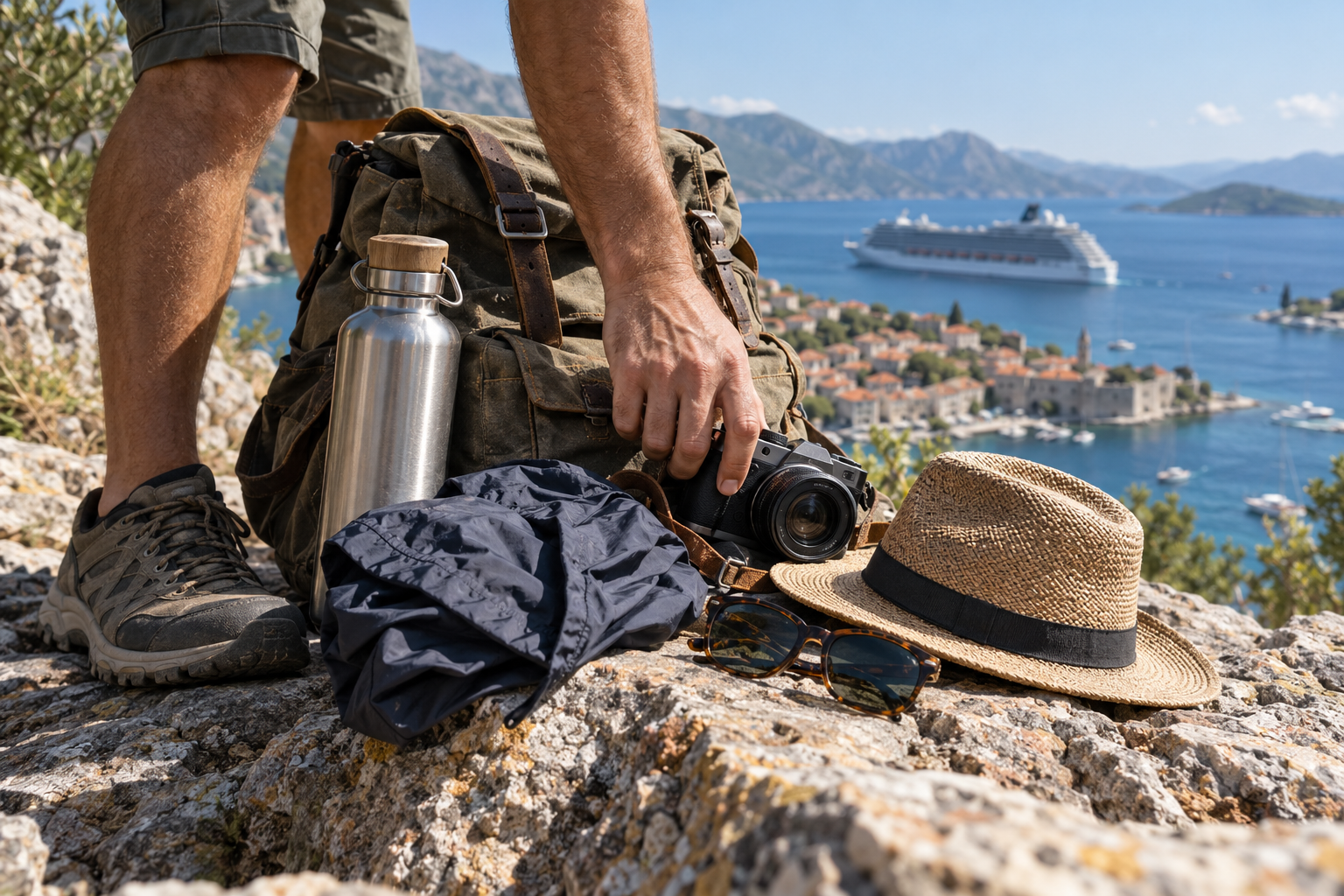
Pack a compact travel umbrella or a small packable rain jacket for port days. Even warm-weather Caribbean and Mediterranean itineraries produce the occasional port day shower, and the man in the port city without any rain protection is wet until the shop that sells ponchos is found. A packable rain jacket weighs under three hundred grams, compresses to the size of its own stuff sack, and clips to the day bag or the cargo pocket for every port walk. It is used on one in five port days and absolutely necessary on that one day.
Bring a crossbody day bag or a small packable backpack for port days rather than the carry-on or the cabin bag. The port day requires only the day’s essentials — wallet, phone, sunscreen, water bottle, the independent excursion confirmation, and a light layer — and benefits from a hands-free bag option that leaves both hands available for the market, the excursion, and the occasional cobblestone navigation. A flat crossbody bag in a plain, low-profile style is the ideal port day bag: holds the day’s essentials, does not advertise its contents, and collapses to a flat pack in the cabin when not in use.
Choose swimwear that doubles as casual shorts in port and pool deck contexts. The hybrid board short — a mid-length swim trunk in a quick-dry fabric with a neutral or classic print — functions on the pool deck, on the beach excursion, and in the casual port lunch venue without a clothing change. The hybrid board short eliminates the need for a separate pair of casual shorts in the cruise bag, reduces the item count by one dedicated garment, and produces the most flexible daytime coverage of any single cruise wardrobe item after the blazer.
Pack sunscreen with a higher SPF than the home routine requires and apply it before leaving the cabin on pool and port days. The sun intensity at sea level on open water and at tropical and subtropical port latitudes is higher than the intensity in most passengers’ home environments, and the sunburn that accumulates on day two of a seven-night sailing affects every day of the remaining trip. High-SPF sunscreen is less expensive purchased before sailing than purchased at the ship’s boutique or at a port pharmacy. Pack it. Use it before the pool deck. Reapply at the intervals the product recommends.
Bring a slim, packable belt for each pair of trousers rather than the heavy leather belt from the home wardrobe. A slim webbing belt in a neutral — black or tan — works with the chinos, the suit trousers, and the casual shorts context and compresses flat against the trouser waistband in the bag without the stiff leather belt’s rigid packing profile. The slim belt adds under fifty grams to the bag and eliminates the stiff-belt packing challenge that the full-grain home-wardrobe belt creates.
Pack a small, high-quality cologne travel spray rather than the full-size bottle. The full-size cologne bottle is the heaviest single toiletry item in most men’s bags and the item most consistently used at a quantity far below its total volume across the sailing’s duration. A travel-size spray — either the product’s official travel size or a refillable travel atomizer filled before departure — provides the same scent at the correct application amount at a fraction of the weight and volume. Most cruises of seven nights or fewer are served by a fifteen-milliliter travel atomizer with comfortable margin remaining. The full-size bottle stays home.
Read the specific dress code section of the cruise line’s guest FAQ for the specific ship and product before packing rather than relying on general cruise dress code descriptions. Some cruise lines have updated their formal night requirements toward smart casual across all ships; others maintain distinct formal and casual night schedules that vary by product tier within the same cruise line brand. Luxury and expedition lines have different standards from mainstream contemporary lines. The dress code information in the booking confirmation or on the cruise line’s FAQ page is the accurate standard for the specific sailing. Packing to that specific standard is the difference between the Kwame situation and the portrait that gets looked at.
Book the Sailing That Puts Every Item in This Wardrobe to Work
The right cruise itinerary has the right balance of sea days for the pool deck wardrobe, port days for the walking shoe and the day bag, and formal nights for the suit and the blazer. Our travel agents know the itineraries. Let us find yours.
Book A TripMen’s Cruise Packing Mistakes That the Dress Code Exposes
These are the specific packing decisions that the formal night dining room reveals. Every one is preventable with the wardrobe system in this article.
Not reading the specific cruise line’s formal night dress code before packing
The formal night’s existence and the specific standard it requires are both documented in the booking confirmation and the cruise line’s FAQ before any packing session begins. The man who packs without reading the dress code may pack correctly by chance if the wardrobe he brings happens to cover the standard. He may also pack the dark green polo. Read the dress code. Pack to the standard. The specific line’s specific product’s current standard is the only standard that matters for the specific sailing.
Leaving the blazer out of the cruise wardrobe
The blazer is the single item that covers the gap between every other item in the cruise wardrobe and the elevated occasions the ship produces. Without it, the smart-casual wardrobe has a ceiling below the dining room’s elevated smart-casual standard, and the formal night option is limited to the suit alone. With it, every item in the wardrobe gains an elevation layer and the full range of the cruise’s occasions is covered from one piece worn on the travel day. Pack the blazer. Wear it on travel day. Hang it in the cabin. Use it every evening worth using it.
Packing the suit jacket rather than wearing it on the travel day
The suit jacket packed in the bag arrives at the destination in the condition the bag produces: compressed, with the specific fold and crease pattern of a suit jacket that spent twelve hours among other packed items. The suit jacket worn on the travel day arrives at the destination cabin in the condition a suit jacket worn with reasonable care produces: minor wrinkles from sitting that hang out overnight in the cabin wardrobe. The travel day is the best suit jacket transport mechanism available and it costs zero bag volume.
Bringing four or five pairs of shoes rather than three purposeful ones
The four or five-shoe cruise bag is the bag where each shoe is justified individually and whose collective volume is the bag’s dominant packing challenge. Three shoes — pool sandal, walking shoe, dress shoe — cover every cruise occasion including the formal night, require two of the three to travel in the bag, and leave the bag’s remaining volume for the wardrobe, the toiletry kit, and the day bag. The fourth and fifth shoes have no occasion the first three do not cover. They add weight, volume, and the specific packing challenge of building a bag around the shoe shapes rather than building a wardrobe into the bag’s available space.
Packing separate swim trunks and casual shorts rather than hybrid board shorts that serve both
Two items that serve separate purposes at equivalent bag volume is the packing decision where one item that serves both purposes at half the volume is available. The mid-length hybrid board short in a neutral quick-dry fabric functions on the pool deck, at the beach excursion, and in the casual port lunch venue. It eliminates the casual shorts as a separate item, reduces the wardrobe’s item count, and frees the bag space for the items the cruise actually requires that the casual shorts cannot serve.
Not hanging the dress clothes in the cabin on arrival
The dress clothes that remain in the bag until the evening they are needed arrive at the formal night dinner in the condition four days of bag packing produced. The dress clothes hung in the cabin wardrobe on the first afternoon arrive at every formal and smart-casual evening in the condition a hanging garment in a climate-controlled cabin naturally settles to — which is significantly better than the bag’s four-day equivalent. Hang everything that will be worn to dinner within the first two hours of boarding. The cabin wardrobe is available immediately on embarkation. Use it from the first afternoon.
Love Helping Travelers Arrive Dressed Right for Every Moment of the Sailing?
Cruise travel agents who know the specific lines’ dress codes, itinerary structures, and onboard experiences provide genuine value to every first-time and returning cruiser. If becoming a home-based travel agent who helps people cruise smarter sounds like the right next step, see how the TravelPreneur system works.
Become An AgentFrequently Asked Questions
These are the questions men ask most often before their first cruise packing session.
What is the cruise ship dress code for men?
Cruise ship dress codes for men vary by cruise line, ship, itinerary, and occasion. Most mainstream contemporary and premium cruise lines operate a three-tier dress code across the sailing’s evenings: casual evenings in the ship’s buffet and casual venues (shorts and t-shirts acceptable), smart casual evenings in the main dining room (collared shirt and slacks or chinos required, swimwear not permitted), and formal or elegant nights (dark suit or tuxedo standard on most lines, black-tie optional on others). Daytime dress codes are generally relaxed throughout the ship, with swimwear acceptable on the pool deck and casual attire expected in all other areas. The specific standard for the specific sailing should always be confirmed from the cruise line’s booking documentation or guest FAQ before packing, as standards vary between cruise line products and have changed at some lines in recent years. Packing to the confirmed standard is the only reliable approach.
Can you do a cruise in a carry-on only?
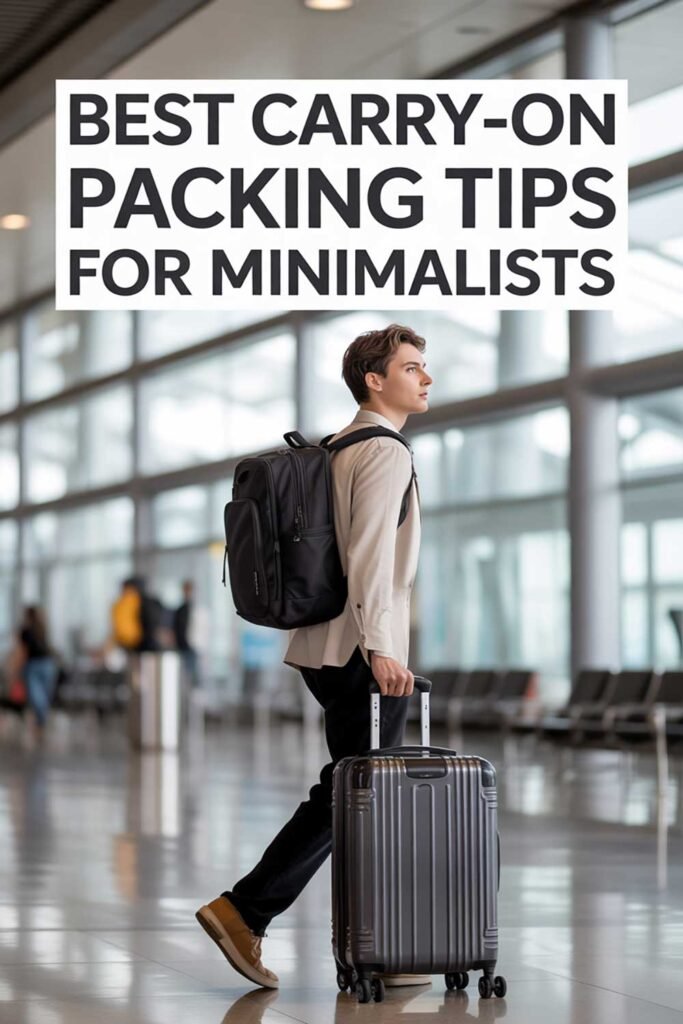
A cruise in carry-on only is achievable for shorter sailings — three to five nights — where the formal night count is one and the sea-to-port day ratio limits the wardrobe variety needed. For seven-night sailings with two formal nights, the suit jacket worn on the travel day, the blazer worn on the travel day, and the wardrobe items packed in a single carry-on require both the packing system in this article and the carry-on organization techniques from the site’s carry-on packing articles. The specific challenge is the suit trousers and the formal shirt alongside the cruise’s full wardrobe range in one carry-on. Achievable with the rolling and compression bag techniques that maximize carry-on volume efficiency. The specific combination of items in this article, with the suit jacket and blazer on the travel day, fits the full seven-night cruise wardrobe into a standard carry-on for most men with a medium casual wardrobe count.
Is a tuxedo required for cruise formal night?
A tuxedo is not required for formal night on most mainstream contemporary and premium cruise lines. On these lines, a dark suit — navy or charcoal — with a white dress shirt and tie is fully appropriate and is the most commonly worn men’s formal night outfit across the range of passengers. Tuxedos are worn by some passengers and are available for rental on most ships. On luxury and ultra-luxury lines whose formal night genuinely operates at a black-tie standard, a tuxedo or dinner jacket is more strongly aligned with the room’s standard, though a dark suit remains acceptable on most luxury products. The specific cruise line’s specific product’s current formal night standard is the correct reference — not the general category of cruise. A luxury line’s expedition product may have no formal night at all; a mainstream contemporary line’s premium-tier product may have a genuine black-tie night on longer itineraries. Confirm the specific standard from the booking documentation before assuming a dark suit or a tuxedo is the correct choice.
What do you wear on port days on a cruise?
Port day attire for men on most cruise itineraries is casual and comfortable, calibrated for the specific port’s environment. For beach and coastal ports: the hybrid board short or swim trunks with the casual linen shirt and the walking sandal or the pool sandal. For cultural and city ports: the walking shoe, a comfortable casual trouser or the more presentable hybrid board short, and a casual shirt appropriate for the specific port’s cultural context. Some ports with significant religious cultural heritage — churches, mosques, temples — require or strongly prefer covered shoulders and knees for entry, which the lightweight linen shirt and a longer trouser or chino addresses. Research the specific port’s cultural expectations and the specific excursion’s activity level before the port day to confirm the daytime wardrobe choice is appropriate for what the port’s specific visit involves. The port day walking shoe and the day bag with the independent excursion confirmation, the water bottle, and the sunscreen are the port day’s most important items regardless of the specific outfit.
How many outfits do you need for a seven-night cruise?
The men’s cruise wardrobe for a seven-night sailing requires enough distinct combinations to cover seven evenings without repetition — or near-repetition — at the appropriate dress code register for each night. The system in this article — two pairs of chinos, three smart shirts, the blazer, and the suit — produces more than seven distinct evening combinations at the smart-casual and formal registers. The daytime wardrobe of two to three swim trunks, two to three casual shirts, and the optional rash guard covers every sea day and port day at the casual register with rotation. The total item count is significantly lower than seven separate daily outfits because the neutral palette and the combination system produce outfit variety from piece combination rather than piece count. A man can dress for seven distinct evenings from twelve clothing items when those twelve items were selected with the combination system rather than as seven separate outfit units.
What should men pack for an Alaska or cold-weather cruise?
The Alaska or cold-weather cruise wardrobe differs from the warm-weather cruise wardrobe primarily in the daytime register. The pool deck and casual linen shirt layer is replaced by a thermal base layer, a mid-layer fleece or merino wool sweater, and a waterproof outer layer — all three of which are required for the glacier viewings, the excursion deck standouts, and the port walks in temperatures and weather conditions that the warm-weather cruise wardrobe does not address. The evening and formal night wardrobe remains similar — chinos, smart shirts, the blazer, the suit — because the ship’s interior is climate-controlled and the dress code applies to the indoor dining and entertainment regardless of the exterior temperature. The Alaska cruise packing challenge is the daytime layer’s volume: a waterproof jacket, a fleece or merino mid-layer, and a thermal base layer add significant bag volume relative to the warm-weather cruise’s swim trunks and linen shirts. The waterproof jacket worn on the travel day, the fleece worn as the mid-layer on the travel day, and the thermal base layer packed in the bag reduces the daytime layer’s bag volume to one item and delivers the other two to the cabin in good condition via the travel day’s carry-on approach.
The man who wore the blazer on the travel day and hung it in the cabin on the first afternoon arrived at formal night already dressed. The man who read the dress code before packing never had a dark green polo photograph. The wardrobe is built in the planning. The cruise is enjoyed in the wearing.
Picture Formal Night
The dark suit jacket came off the hanger where it has been since embarkation afternoon. The white dress shirt was pressed and ready. The blazer covered the smart-casual evenings. The swim trunks doubled as shorts for every port morning. The walking shoe did every excursion. The dress shoe is on now. The dining room is ahead. The wardrobe covered everything from the pool deck to this moment from a single bag whose contents were chosen before the ship left the dock. Zero time spent worrying about what was left behind. The sailing started wearing the blazer. It ends wearing the suit. Everything in between was covered. That is the cruise wardrobe done right.
One More Thing Before You Pack for the Sailing
Print our free Travel Packing Checklist and use the cruise section to confirm every occasion register is covered before the bag is closed. Pool deck, port day, smart-casual evening, formal night, shoes for all three. The same checklist we recommend before every sailing.
Get the Free ChecklistExplore Our Top Picks for a Better Trip
Visit our favorites page for helpful booking ideas and travel essentials that we have found genuinely useful for cruise travel. Whether you are planning your next sailing or looking for resources that make packing for the cruise easier and more confident, it is worth exploring.
See Our Top PicksTravel Prints and Printables From Our Shop
Visit Premier Print Works for cruise packing list printables, wardrobe planners, travel journals, and wall art that makes every voyage a little more beautiful and a lot more organized — from the afternoon the blazer is chosen to the formal night the portrait gets looked at.
Visit Premier Print WorksDisclaimer
The information shared in this article is provided by Don and Diana’s Travels for general informational, educational, and inspirational purposes only. It reflects our personal experiences, opinions, and the experiences of travelers we have worked with. It is not professional travel, legal, or fashion advice.
Cruise Line Dress Codes
Cruise line dress codes change frequently and vary significantly by cruise line, ship, product tier, and itinerary. Always confirm the specific dress code for the specific sailing from the cruise line’s official documentation or guest FAQ before packing. We are not responsible for any dress code outcome arising from information in this article that does not reflect the current standard for a specific sailing.
Sun Safety
Sun protection during cruise travel is important. Use appropriate SPF sunscreen, reapply as directed, and follow other sun safety practices for your specific circumstances. Consult a healthcare provider for guidance specific to your health situation. We are not responsible for any sun safety outcome arising from information in this article.
Airline Baggage Policies
Carry-on size limits and baggage policies vary by airline and fare class. Always confirm current policies before travel.
Affiliate and Partner Links
This article may contain affiliate and partner links that pay us a commission. Our recommendations are based on real use and genuine belief in the products and services we share.
Third-Party Websites
We may link to third-party sites for convenience. We are not responsible for their content, pricing, or availability.
Health, Safety, and Personal Responsibility
Travel involves personal risk. You are solely responsible for your own health, safety, and travel decisions. Don and Diana’s Travels accepts no liability for any loss, injury, delay, or inconvenience arising from information in this article.
Composite Stories
Stories on this site combine real experiences from Don, Diana, clients, and travelers we have worked with. Details may be adjusted for privacy and narrative clarity.
No Guarantees
We do not guarantee any specific result from using the information in this article. Your results depend on your own choices and circumstances.
Copyright and Use
All content is the copyrighted property of Don and Diana’s Travels. You may not copy or republish our content without prior written permission. You are welcome to share a direct link with proper credit.
By reading this article, you acknowledge that you have read and agree to this disclaimer.