Kids beach packing comes down to four things: sun protection, water safety, snacks, and something to play with. The parents having the most relaxed beach day packed everything their kids needed before they ever left the hotel room. This article builds that list — completely, specifically, and in the right order.

Best For
Parents Packing for Kids at the Beach
Vibe
Prepared, Relaxed, All Day
Read Time
11 Minutes
Walk Away With
The Complete Kids Beach Packing Checklist
Free Download

Grab Our Travel Packing Checklist

Our free packing checklist includes a kids beach vacation section organized by the four categories this article describes — sun protection, water safety, wet gear management, and snacks — so nothing that costs beach shop prices is forgotten before the family leaves home.

Get the Free Checklist

Reef-Safe Sunscreen: The Non-Negotiable Foundation

Children’s skin at the beach requires more sunscreen, more frequently applied, than the average adult packing estimate accounts for. The combination of a child’s higher surface-area-to-body-weight ratio, the generally thinner and more UV-sensitive skin of young children, the active movement that sweats and swims sunscreen off faster than a stationary adult, and the multi-hour beach sessions that family beach vacations produce makes sunscreen the single most important item in the kids beach bag and the single item most frequently packed in inadequate quantity. A family of four with two children will go through significantly more sunscreen than two adults on the same beach, because the children require more frequent and more generous reapplication across more active bodies.

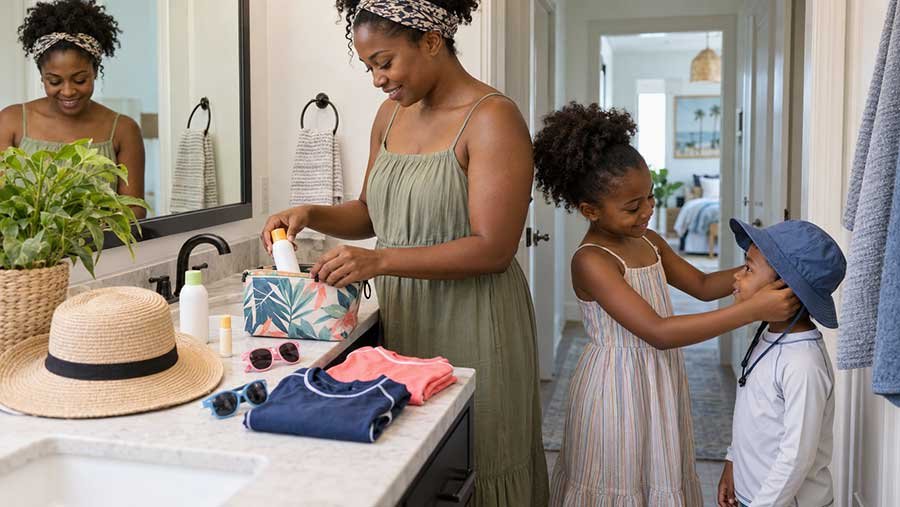
Pack reef-safe sunscreen specifically — a mineral formulation with zinc oxide or titanium dioxide as the active UV filters — for any beach vacation at a destination with coral reef access, reef-adjacent water, or destination regulations on chemical sunscreen. Several popular family beach destinations including Hawaii, Mexico’s Caribbean coast, the Florida Keys, and many other reef-adjacent locations have environmental guidance or legal requirements for reef-safe sunscreen use in the ocean. Chemical sunscreen ingredients including oxybenzone and octinoxate have been linked to coral reef bleaching and damage. Bringing reef-safe sunscreen from home confirms the correct formulation is available from the first beach entry without discovering the destination requirement at the beach access sign and paying the beach shop’s premium price for the reef-safe alternative.

For children specifically, consult the child’s healthcare provider about sunscreen formulations appropriate for the child’s age and skin type before the beach vacation. Infants under six months old are typically protected by shade and protective clothing rather than sunscreen, as most sunscreens are not recommended for use on infants under six months. Children over six months can generally use mineral sunscreen applied generously to exposed skin. Sunscreen sticks are easier to apply to children’s faces and around the eye area than lotion formats. The sunscreen applied before leaving the hotel room — allowing fifteen to twenty minutes of absorption before the first UV exposure — provides the most reliable initial coverage for any mineral sunscreen formulation.

The parents having the most relaxed beach day packed everything their kids needed before they ever left the hotel room.

Kids beach packing comes down to four things — sun protection, water safety, snacks, and something to play with. Pack those four and the beach day takes care of itself.

Insider Note

Pack sunscreen in two formats for kids: a large bottle for the hotel room’s pre-beach application and a smaller, more portable stick or spray for the beach bag reapplication. The large bottle stays in the hotel room and provides the generous pre-beach coverage that sets the day’s sun protection baseline. The stick or spray in the beach bag handles the two-hour reapplication, the post-swim reapplication, and the any-moment-needed coverage that the beach day with active children produces at unpredictable intervals. The stick format in the beach bag means reapplication requires no hands-free moment — the stick can be applied while a child is standing at the towel’s edge rather than requiring the child to be still for a lotion application. For sun-protective convenience at the beach, the sunscreen stick is one of the most underused kids beach bag items available.

We Plan Family Beach Vacations

Let Us Book the Beach Vacation Worth Packing This List For

The best family beach vacation has the right beach for the children’s ages — calm water for young swimmers, good sand for building, nearby amenities for the day’s needs. Tell us the family’s ages and travel preferences. We will find the beach destination that makes this packing list worth every item in it.

Plan Our Escape

Rash Guards: The Sun Protection That Stays On

A rash guard is the most reliable sun protection garment available for children at the beach because it provides its UV protection without requiring any child cooperation, any reapplication, any timer, and any resistance management. A child wearing a UPF 50+ rash guard has the covered area protected to a high standard for the full duration it is worn, regardless of how many times the child enters and exits the water, regardless of how much the child has sweated, and regardless of the last time the parent’s attention was on the sunscreen reapplication schedule rather than on the beach activity the child was engaged in. The rash guard’s UV protection is passive, continuous, and consistent in a way that sunscreen’s active management cannot reliably match across a full day with active children.

UPF 50+ is the rating standard worth knowing when selecting children’s rash guards. UPF stands for Ultraviolet Protection Factor — the fabric rating equivalent of sunscreen’s SPF — and indicates the fraction of UV radiation the fabric blocks. A UPF 50 fabric blocks approximately ninety-eight percent of UV radiation from passing through. Most rash guards designed for beach and water use are rated at UPF 50 or UPF 50+, making them excellent sun protection garments for the torso, upper arms, and neck areas they cover. The uncovered areas — the face, lower arms, legs below the swim shorts, and any other exposed skin — still require sunscreen application. The rash guard’s contribution is eliminating the largest single body surface area from the sunscreen management task, which is the torso that most children resist sunscreen application on most strongly.

Pack one rash guard per child per day minimum, or two per child for the freedom of always having a dry one available when the first is still wet from the morning session. Long-sleeve rash guards provide more coverage than short-sleeve versions and are worth the slight additional warmth in exchange for the additional sun protection at beach destinations where the UV index is high. For children who resist wearing rash guards, involving them in the selection — allowing them to choose the color or the design — produces the specific buy-in that the parent-chosen rash guard does not. The child who chose the dinosaur rash guard is the child who is more likely to be wearing it at 2 p.m. than the child who was told to wear it.

Insider Note

Rinse rash guards with fresh water after each ocean session and hang them to dry in the shade rather than leaving them wet in the beach bag or the hotel room’s dark corner. Salt water, if left to dry in the rash guard’s fabric without a fresh water rinse, degrades the fabric’s UV-protective properties over the course of the vacation and produces the specific stiffness and salt crystallization that makes the rash guard less comfortable for the child and less effective as a sun protection garment. A thirty-second fresh water rinse — at the beach’s rinse station or in the hotel shower — maintains the rash guard’s fabric quality and UV protection across the full vacation and extends its useful life to multiple beach seasons rather than one vacation’s worth of salt-damaged use.

Water Shoes: Small Protection, Big Return

Water shoes for children at the beach are the packing item with the highest protection return relative to their weight and cost of any item in the kids beach bag. A pair of children’s water shoes weighs under two hundred grams, costs minimally at retail, and provides the specific foot protection that the beach environment produces: the sharp reef fragment at the ocean entry, the shell fragment at the waterline, the hot sand of the midday beach that produces genuine discomfort on young feet, the pool deck’s concrete surface that bare feet manage with increasing reluctance as the day heats up, and the rocky substrate of the specific beach access point that the resort’s brochure described as a beach without specifying that the entry involved a twenty-meter rocky walk. Each of these is the specific beach foot injury or discomfort that the water shoe prevents and that the beach shop’s overpriced equivalent treats retroactively.

Choose close-fitting water shoes over loose water sandals for children. The loose water sandal — a sandal with a toe post or a loosely fitting sole — comes off during ocean entries and exits, which are the specific moments when foot protection is most needed at the beach. The close-fitting water shoe with an elasticized or neoprene upper stays on the foot through every water entry and exit and provides protection during the specific foot contact moments that the lose sandal is absent for. For young children who are just learning to navigate beach terrain, the close-fitting water shoe is the confidence-enabling footwear that allows independent exploration of the beach’s edge without the parent’s constant foot-safety monitoring that bare feet or loose sandals require.

Pack one pair of water shoes per child. Rinse with fresh water after ocean sessions and allow to dry. Most children’s water shoes dry within a couple of hours in the sun or the hotel room’s air conditioning, making a single pair manageable for a beach vacation of any length without requiring a second pair. If the beach vacation involves multiple beach sessions per day and the single pair does not fully dry between sessions, a second pair provides the dry shoe for the afternoon session and is worth the minimal additional packing weight for any child whose foot comfort is affected by wet footwear.

Insider Note

Size water shoes with half a size of growing room rather than a snug current fit for children whose feet are growing rapidly. The snug water shoe that fits perfectly at purchase may be uncomfortably tight by the second beach vacation three months later. The half-size of growing room provides a comfortable fit for the current vacation and extends the shoe’s useful life through the growth period that would otherwise require a replacement purchase. Pack a lightweight sock for each child to wear inside the water shoe if the half-size of growing room produces any slipping — the sock resolves the fit gap without requiring a different shoe and adds a comfortable fabric layer between the neoprene upper and the foot.

Helpful for Your Stay

Find Booking Ideas and Travel Essentials on Our Favorites Page

Our favorites page has helpful booking ideas and travel essentials that we have found genuinely useful for family beach vacations. Whether you are planning the next beach trip or looking for resources that make packing for kids at the beach easier and more complete, it is worth a look.

DND Favorites

A Dry Bag for Wet Gear and More Snacks Than You Think You Need

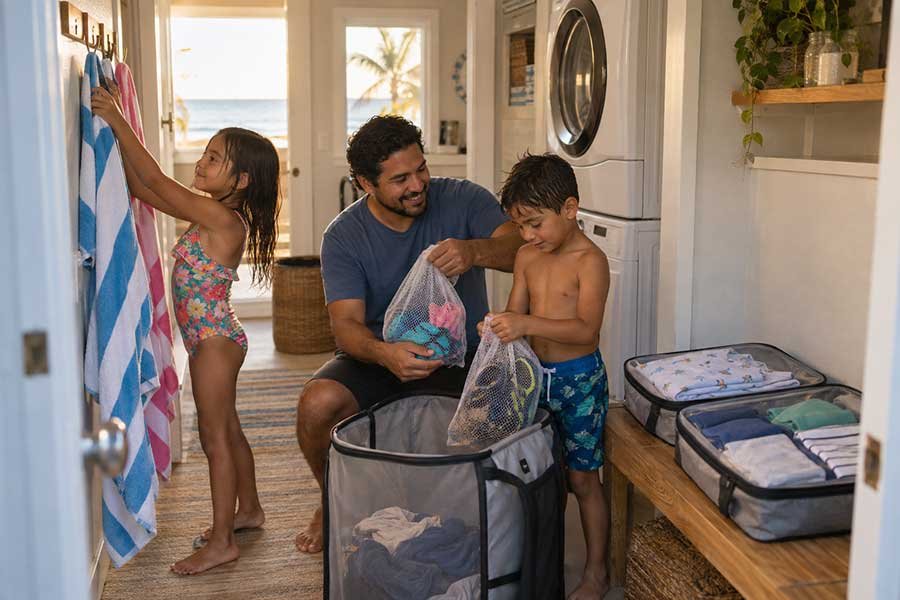
The dry bag — a waterproof bag that seals wet items inside without transferring the wet or the sand to everything around them — is the kids beach bag’s essential organizational item for the return journey and the hotel room re-entry. Children’s beach gear at the end of the beach day is wet gear: the rash guards, the swimsuits, the wet towels, the water shoes with the residual water in their uppers, and the swim goggles with the water droplets on the lenses. In a regular beach bag without a dry bag, these items distribute their wetness and their sand cargo to every other item in the bag during the walk from the beach to the car or the hotel. The sunscreen bottles are wet. The dry clothes change is wet. The book is warped. The car is damp. The hotel room carpet is sandy. The dry bag takes all of the wet items, seals them inside, and contains the wet within the bag rather than distributing it through everything outside it.

Pack one large dry bag or two medium dry bags per family — one for each child’s wet gear if the children’s items are kept separate. The dry bag rolls shut with a simple fold-and-clip closure that children old enough to manage it can operate independently, which connects the dry bag to the same ownership principle as the individual beach bag: the child puts their own wet gear in their own dry bag and clips it themselves. The wet is managed. The beach bag stays dry. The hotel room receives the family rather than the beach’s secondary inventory.

The snack addition to this section is the most important per-child packing quantity principle for the beach: sand and salt water make children genuinely hungrier at the beach than they are in any other environment, and the snack quantity that seemed generous at home empties by mid-morning. Pack per-child individual snack pouches with three distinct snack occasions covered — mid-morning, pre-lunch bridge, and afternoon — including one treat per child. The treat is not a reward. It is the specific snack moment that the child looks forward to from the morning and that motivates the behavior between the earlier snacks and the mid-afternoon. Double the estimate. Pack per child. Keep in the cooler. The beach snack shop’s pricing for the snacks the parent did not bring is the specific reminder that the individual snack pouches are worth every gram of their combined weight in the beach bag.

Insider Note

Choose snacks that hydrate as well as satisfy for children at the beach. Fresh fruit — grapes, sliced watermelon, orange wedges — provides both the snack satisfaction and the fluid that active beach children lose faster than plain water consumption replaces. The fruit snack in the cooler alongside the frozen water bottle produces the hydration that the beach day requires from a source the children genuinely want at the specific mid-morning and mid-afternoon moments. Watermelon in particular is one of the highest-hydration, highest-palatability beach snacks available — children eat it eagerly at any temperature, it provides significant water content, it is cold from the cooler, and it requires no preparation beyond slicing. The family that brings a container of watermelon slices to the beach has solved the mid-morning snack and the hydration simultaneously from one item.

The Complete Kids Beach Packing Checklist

The complete kids beach packing checklist organizes every essential category into the specific items that convert the beach day from one of improvised gaps into one of relaxed preparation.

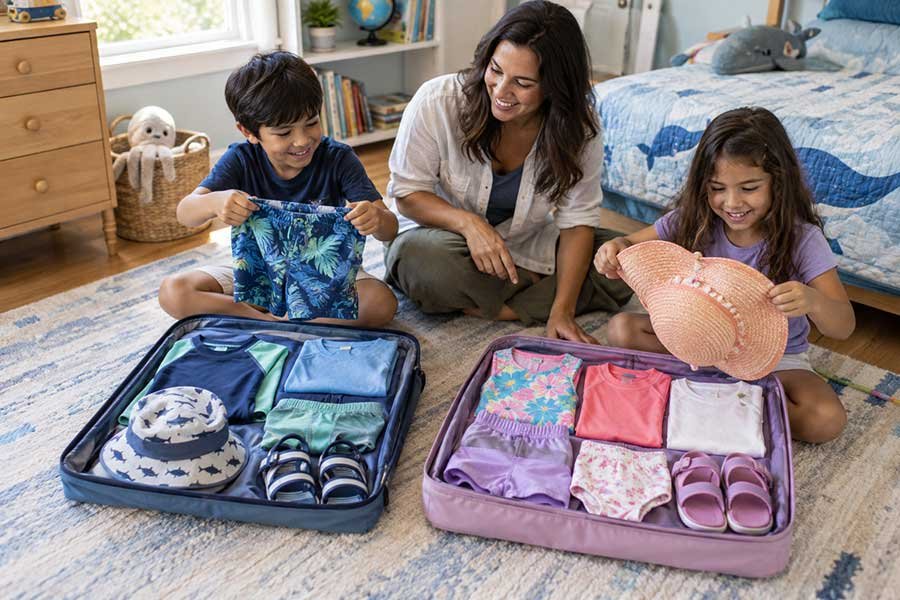
Sun protection layer: reef-safe mineral sunscreen — one large bottle for the hotel room pre-beach application and one sunscreen stick per child for the beach bag reapplication. UPF 50+ rash guard — one per child per day minimum. Sun hat with a full brim for each child. UV-protective sunglasses appropriate for each child’s age where they will wear them. After-sun lotion for the evening application after the day’s sun exposure.

Water safety layer: close-fitting water shoes — one pair per child. Swim goggles fitted for each child’s face. Personal flotation devices appropriate to the child’s swimming ability and the specific water conditions — consult current water safety guidelines and the specific beach’s recommendations for the child’s age and ability. Swim fins for older children comfortable with them at snorkeling access beaches.

Wet gear management layer: one large dry bag or one medium dry bag per child for wet gear return. One mesh bag for sandy toys and sandy items during the beach return. Spare swimsuits — at least two per child so a dry suit is always available. A changing poncho per child for the return trip change into dry clothes.

Snacks and hydration layer: individual snack pouches per child covering three snack occasions plus a treat. Frozen water bottles — one per child and one additional for the cooler. A reusable water bottle per child for the continuous hydration access between frozen bottle melt stages. Fresh fruit in a sealed container in the cooler.

Play layer: age-appropriate beach toys — bucket and spade minimum for all ages, snorkeling equipment for older confident swimmers, soft waterproof ball or frisbee for active beach play. A small trowel or sand-digging implement for the children whose beach engagement is primarily sand-based construction.

Insider Note

Laminate the kids beach packing checklist and keep it with the beach bag between trips. The laminated checklist is confirmed complete in five minutes before each beach day — each item checked off physically rather than mentally assumed to be present — and produces the hotel room departure that does not discover the forgotten water shoes at the beach parking lot. The laminated format survives the beach bag’s general moisture environment across multiple vacations. The five-minute check before departure is the specific investment that makes the beach shop visit for the forgotten item the exception across the family’s full beach vacation history rather than the recurring morning-of event that the un-checked beach bag produces.

The Beach Shop Receipt That Became the Kids Packing Checklist

Jasmine had a talent for forgetting things. She knew this about herself. She had developed systems at home and at work specifically because she knew it about herself — the calendar reminders, the door hook for the keys, the pre-bed confirmation of the next morning’s bag. These systems worked for her own life reliably. They did not, it turned out, automatically extend to her children’s beach vacation packing, which was a different category of items than her own and which required its own system that she had not yet built.

The beach vacation arrived with the children’s clothes packed, the adults’ beach items packed, and the specific items that the children needed at the beach — the reef-safe sunscreen (she had brought the adult sunscreen; the children’s formula was in a different cabinet at home), the rash guards (she had thought about them and then not confirmed them before closing the bag), the water shoes (she had put them on the list and not checked the list before departure), the children’s swim goggles (in the bathroom drawer at home where they lived when they were not being used at a beach) — each of them absent from the bag in their own way. The beach shop at the resort was well stocked. The beach shop’s prices for children’s rash guards, children’s water shoes, children’s reef-safe sunscreen, and children’s goggles were the resort beach shop’s prices: significantly higher than the equivalent retail at home for items that she had owned and simply not confirmed were in the bag before the family left.

She kept the beach shop receipt. Not as a document of the amount spent, which was not catastrophic but was genuinely unnecessary, but as a document of the specific items that the beach packing for kids required and that her existing packing system had not been designed to include. The receipt’s items became the checklist’s items. The checklist was written out on an index card, laminated at the office supply store, and placed inside the beach bag’s interior zip where it lived between vacations. Before the next beach trip, she opened the beach bag and found the laminated card. She went through each item: reef-safe kids sunscreen, sunscreen sticks for the bag, rash guards, water shoes, swim goggles, dry bag, individual snack pouches, frozen water bottles, sun hats. Every item confirmed and in the bag before the family left the hotel room.

The beach shop visit on the second beach vacation was for a small inflatable ball the younger child spotted at the entrance display and wanted for the waves. Nothing was missing. Nothing was improvised. The day started with everything the children needed already in the bag. The parents had the relaxed beach day that the first vacation’s beach shop detour had been specifically trading against. This article is the laminated checklist she built from the receipt that taught her what kids beach packing actually requires.

Six More Kids Beach Packing Essentials

Beyond the four core categories and the complete checklist, these six additional items address the specific kids beach vacation scenarios the core list does not fully cover.

Pack a small, lightweight pop-up beach tent or shade canopy sized for the children’s rest area. The shade canopy provides the specific midday shaded environment for young children who need a rest from the sun’s peak hours, for infants who require shade for the full beach session, and for the parent who wants to maintain sun protection for the children during the hours when the UV index is highest without leaving the beach. A children’s beach tent weighs under one and a half kilograms, sets up in under three minutes, and provides the specific beach day extension that the absence of shade would end at the earliest sign of a tired or overheated child.

Bring swim goggles specifically fitted to each child’s face rather than relying on the shared family goggles that fit imperfectly for any specific child. A swim goggle that seals properly is the goggle that stays on through ocean waves and pool entries and that produces the underwater visibility that makes snorkeling and wave jumping genuinely fun. The goggle that leaks at every water entry because its bridge width does not match the specific child’s face is the goggle that the child removes after the second entry and leaves on the beach towel for the rest of the session. Each child’s own fitted goggle is one of the most direct investments in that child’s water engagement at the beach vacation.

Pack a sand-free beach mat or blanket for the youngest children’s beach base area. Infants and toddlers who spend the beach session on a blanket or mat accumulate sand in the specific way that contact surfaces produce: lying on a sandy towel produces a sandy back, a sandy face, a sandy diaper area that requires the specific nappy change that the sand-free mat prevents. A sand-free mat — a mat woven to allow sand to fall through rather than accumulate on the surface — keeps the youngest family members’ beach contact surface genuinely sand-minimal across the full beach session and reduces the end-of-beach-session cleaning time significantly.

Include a small packet of saline eye wash in the kids beach first aid kit. Sand in a child’s eye is among the most common beach day minor incidents, and the appropriate response — not rubbing, gentle rinsing with clean saline solution — is most effectively executed with the saline eye wash that the prepared parent has in the beach bag rather than the improvised fresh water rinse from the drinking bottle. The saline eye wash packet weighs under thirty grams, is available at any pharmacy at minimal cost, and converts the sand-in-eye beach moment from a distressing incident to a resolved one in under two minutes.

Pack a lightweight cover-up or beach kaftan for each child to wear over their swimsuit during the walk between the beach and the accommodation, the restaurant lunch break, and any other context where the swimsuit-only appearance is socially or practically inappropriate. The cover-up for children serves the same modesty and light sun protection function as the adult beach cover-up and prevents the specific friction of a child in a wet swimsuit at a restaurant where the establishment’s family-friendly policy does not extend to wet swimwear at the lunch tables. A lightweight cotton or linen cover-up weighs under one hundred grams per child and is the specific item that converts the beach-to-lunch transition from a swimsuit conversation to a covered walk.

Pack a small portable waterproof first aid kit in the beach bag that covers the specific beach injury categories rather than the general home first aid kit’s comprehensive but beach-inappropriate contents. The kids beach first aid kit: waterproof bandages in assorted sizes, antiseptic wipes, the saline eye wash, a small tube of hydrocortisone cream for minor insect reactions and minor skin irritations, children’s pain reliever in the correct dosage for each child’s current weight confirmed with the healthcare provider before travel, and a small pair of tweezers for the occasional sea urchin spine or splinter. The entire waterproof first aid kit weighs under two hundred grams and fits in the beach bag’s exterior zip alongside the sunscreen sticks.

Insider Note

The kids beach packing checklist in this article covers the beach day’s specific needs for children. It works alongside, not instead of, the general family beach packing approach from this site’s other family beach articles. The combination of the family beach day system — frozen water bottles, mesh bag, early arrival, individual snack pouches — and the kids-specific beach packing checklist — reef-safe sunscreen, rash guards, water shoes, dry bag, fitted goggles, shade tent — produces the specific family beach day where every child’s need is covered from the hotel room’s departure to the beach day’s last entry in the water. Build both lists. Laminate both cards. Keep them in the beach bag. The beach shop visit is for the spontaneous inflatable ball. Nothing else.

Book With Us

Book the Family Beach Vacation Worth Every Item on This Checklist

The best family beach vacation has the right beach for the children’s ages and the family’s preferred beach experience. Our travel agents know the family beach destinations with calm water for young swimmers, excellent sand, and the facilities that make all-day beach visits genuinely comfortable. Let us find yours.

Book A Trip

Kids Beach Packing Mistakes That Show Up in the Beach Shop Receipt

Each of these is a line item in the beach shop receipt of the unprepared beach vacation. Each has a checklist-based solution.

1

Packing adult sunscreen rather than children’s reef-safe mineral sunscreen

The adult sunscreen is not the children’s sunscreen and is not the reef-safe formulation that many beach destinations require at reef-adjacent water. The specific kids reef-safe mineral sunscreen — appropriate for the children’s ages and confirmed with the healthcare provider — belongs in the beach bag as a separate and specifically selected item, not as the adult sunscreen’s assumed extension to the children’s use. Pack the children’s sunscreen specifically. Confirm it is reef-safe. Confirm it is in the bag.

2

Not packing rash guards and discovering the beach shop’s children’s rash guard price

The rash guard is the beach packing item with the highest sun protection return per item and the highest beach shop markup per forgotten item. At normal retail pricing from a sporting goods or swimwear retailer before the trip, children’s rash guards are accessible and affordable. At the beach resort’s boutique or the beach shop at the beach access, the same item’s price reflects its captive market status. Pack the rash guards before departure. The beach shop’s rash guard price is the specific reminder that the checklist is worth using.

3

Arriving at the beach without water shoes for the children

Water shoes for children at the beach are the specific foot protection item whose absence is discovered at the first beach entry — the rocky substrate, the reef fragment, the hot sand — and whose beach shop equivalent is available at the specific premium of the only available option at the only available moment. Pack water shoes before departure. Confirm they are in the bag. The water shoe’s packed weight is negligible. Its beach access contribution is significant from the first step onto the beach.

4

Not having a dry bag and arriving at the hotel with wet gear in every pocket

The wet rash guard, the wet swimsuit, and the wet towel distributed through a beach bag without a dry bag arrive at the hotel with their wetness and sand distributed through everything else in the bag. The dry bag weighs under one hundred grams, rolls shut in three seconds, and contains the wet within itself for the return journey. Pack it. The hotel room carpet does not need to be part of the beach.

5

Underestimating snack quantities for active beach children

The snack quantity calculated from the home routine’s amounts is the snack quantity that runs out by mid-morning at the beach. Children at the beach are more active, more sun-exposed, and in a more stimulating environment than at home, and their appetite at the beach reflects all three. Double the estimate. Pack per child in individual pouches. Include the treat as the afternoon’s specific item. The beach snack shop exists to serve the family that did not bring enough.

6

Using shared goggles that do not fit any specific child well

The shared family goggles are the goggles that leak for the child whose face they do not fit, who removes them after the second entry and leaves them on the towel for the rest of the session. Each child’s fitted goggle — sized and adjusted specifically for that child’s face before the vacation — is the goggle that stays on through the beach day and makes the underwater experience genuinely engaging rather than the wet-eye experience the leaking goggle produces. Fit the goggles at home. Confirm each child’s goggle is in the beach bag. The beach is the wrong place to discover the fit is wrong.

Turn Travel Into Income

Love Helping Families Arrive at the Beach Completely Ready for the Day?

Family beach vacation bookings are among the most joyful travel agent work. If becoming a home-based travel agent who helps families find and book the right beach for every age in their family sounds like the right next step, see how the TravelPreneur system works.

Become An Agent

Frequently Asked Questions

These are the questions parents ask most often about packing for kids at the beach.

What sunscreen is best for children at the beach?

Mineral sunscreen — with zinc oxide or titanium dioxide as the active UV filters — is generally recommended for children because these ingredients sit on the skin’s surface rather than absorbing into it, are less likely to cause skin irritation for sensitive children’s skin, and are reef-safe, meeting the requirements at destinations with coral reef protection regulations. Choose a broad-spectrum formulation that protects against both UVA and UVB radiation, with a minimum SPF of 30 and ideally SPF 50 for beach use on young children. Always consult the child’s healthcare provider for sunscreen recommendations specific to each child’s age, skin type, and any skin sensitivities. Infants under six months are typically protected by shade and UPF-rated clothing rather than sunscreen, as most sunscreens are not recommended for infants under six months old. Apply generously and reapply every two hours and after each swim session. Sunscreen sticks are easier to apply to children’s faces and reduce the risk of product entering the eyes during facial application.

At what age can children use water shoes at the beach?

Water shoes are available in sizes starting from infant sizing and are appropriate from the first beach visit for any child old enough to be walking, crawling, or being carried at the beach’s water edge. For very young children who are not yet walking, water shoes protect the feet during carrying over rocky or rough beach surfaces and during shallow water exploration. For walking toddlers and older children, water shoes provide the independent beach exploration confidence that bare feet and flip-flops do not, allowing the child to navigate the beach’s entry terrain without constant parental foot-safety monitoring. The primary consideration for water shoe use at any age is the fit — a water shoe that is too large slides off during water entries, which defeats its protective purpose. Confirm the fit is secure and comfortable at home before the beach vacation rather than at the beach entry. Water shoes are appropriate and beneficial at the beach for children of all ages from the first beach visit forward.

Do children need lifejackets or personal flotation devices at the beach?

Decisions about personal flotation devices for children at the beach depend on the specific child’s swimming ability, the specific beach’s water conditions — wave action, current, depth — and current water safety guidelines for the child’s age and ability level. We are not qualified to provide specific water safety advice, and all decisions about flotation devices for children should be made based on current guidance from recognized water safety organizations, the specific beach’s posted recommendations, and the parents’ knowledge of each child’s specific swimming ability and water comfort. In general, children who are not confident independent swimmers benefit from Coast Guard-approved life jackets or personal flotation devices in any open water environment, including the beach’s shallow areas where water conditions can change rapidly. Always maintain direct adult supervision of children in and near water, regardless of flotation device use. Floaties, inflatable armbands, and inflatable swimming aids are not substitutes for approved personal flotation devices and should not be relied upon as primary safety flotation for any child in open water.

How do you manage sunscreen application for children who resist it?

Sunscreen resistance in children is a common challenge most effectively managed by making sunscreen application a consistent pre-outdoor routine from an early age, so the beach application is experienced as a normal continuation of the daily routine rather than a novel imposition. For the beach vacation specifically, applying sunscreen at the hotel room before departure rather than at the beach chair — when the excitement of imminent beach arrival makes any pause frustrating — reduces resistance by removing the application from the beach’s immediate context. Sunscreen sticks are less intrusive than lotion for facial application, avoiding the lotion’s cold initial sensation and the risk of it entering the eyes. Rash guards covering the torso and upper arms eliminate the largest application surface, reducing the total sunscreen application task to the face, neck, lower arms, and legs. For children with specific sensory sensitivities that make any skin product application challenging, consulting the child’s pediatrician or occupational therapist for sensory-appropriate sunscreen application strategies is the most reliable path to consistent sun protection for that specific child.

How do you keep beach snacks from melting or spoiling in the heat?

Beach snacks for children are best kept in a small dedicated cooler bag — ideally separate from the adult cooler to reduce access frequency and maintain temperature — with frozen water bottles as the cooling element. The frozen water bottle serves as an ice pack alternative that melts slowly, keeps the cooler contents cold for several hours, and becomes the cold drinking water when it melts. Snacks that hold up best in a cooler at the beach without melting or spoiling: fresh fruit sealed in a container, cheese portions in individual packaging, crackers in sealed containers, dried fruit and nuts, protein bars, and any snack packaged in individual portions that does not require temperature control. Items to avoid packing for the beach if the cooler bag’s cooling capacity is limited: chocolate (melts rapidly in beach heat even in a cooler), ice cream (impractical without a dedicated freezer), and any perishable item that requires consistent refrigeration. The frozen water bottle system in this site’s beach hacks articles is the beach snack temperature management solution that requires no ice, no ice packs, and no separate equipment beyond the reusable water bottles already in the family’s kitchen.

What beach toys are worth packing for young children?

The beach toys with the highest play engagement return per unit of packing weight for young children are: a durable bucket and spade set in graduated sizes, which supports sand play from toddler digging to full sand castle construction; a set of sand molds in simple shapes — stars, fish, shells — that extend the sand castle to the imaginative structure; a waterproof ball soft enough for casual beach throwing; and for children comfortable in shallow water, a set of dive sticks or diving rings that can be thrown into shallow water for retrieval. These items collectively weigh under five hundred grams, pack flat or nested, and provide the full range of kids beach play from first arrival through mid-afternoon without any single toy dominating the bag space or requiring specific beach conditions. For children old enough to snorkel independently, a fitted snorkel mask and snorkel provide hours of underwater exploration at any beach with clear water and interesting underwater features. Research the specific beach’s water clarity and safety for snorkeling before packing snorkeling equipment, as some family beach destinations’ water conditions do not support safe independent snorkeling for young children.

The parents with the most relaxed beach day had a laminated checklist in the beach bag. The beach shop visit was for a spontaneous inflatable ball. Everything the children needed was already there. That is the checklist. That is every beach vacation from here.

Picture the Hotel Room Before the First Beach Morning

The kids beach bag is confirmed. The reef-safe sunscreen is in the bag and the stick format is in the exterior zip. The rash guards are folded at the top. The water shoes are in the mesh pocket. The dry bag is rolled flat inside. The individual snack pouches are in the cooler bag with the frozen water bottles. The goggles are fitted and confirmed for each child. The laminated checklist is back in the interior zip. Every item has been checked off. The sunscreen is applied to the children before the door closes. The beach morning starts at the beach, not at the beach shop. The whole day is ahead. The children have everything they need. The parents can say yes to everything. That is the checklist. That is the beach day.

Free Download

One More Thing Before the Next Beach Vacation

Print our free Travel Packing Checklist and use the kids beach section to confirm every item is in the bag before the family leaves home. Sunscreen, rash guards, water shoes, dry bag, goggles, snacks. Laminate it. Put it in the beach bag. Use it before every beach vacation. The same checklist we recommend to every family we help book a beach trip.

Get the Free Checklist

Explore Our Top Picks for a Better Trip

Visit our favorites page for helpful booking ideas and travel essentials that we have found genuinely useful for family beach vacations. Whether you are planning the next beach trip or looking for resources that make packing for kids at the beach more complete and more organized, it is worth exploring.

See Our Top Picks

Travel Prints and Printables From Our Shop

Visit Premier Print Works for kids beach packing checklist printables, family vacation planners, children’s travel activity printables, vacation journals, and wall art that makes every beach trip a little more beautiful and a lot more organized — from the afternoon the checklist is laminated to the morning the beach bag is confirmed complete and the door closes on the beach day.

Visit Premier Print Works

Disclaimer

The information shared in this article is provided by Don and Diana’s Travels for general informational, educational, and inspirational purposes only. It reflects our personal experiences, opinions, and the experiences of travelers we have worked with. It is not professional medical, safety, or parenting advice.

Child Sun Safety and Sunscreen

Sunscreen guidance in this article is general educational information and is not a substitute for professional medical or dermatological advice. Always consult your children’s healthcare provider for sunscreen recommendations specific to each child’s age, skin type, and health circumstances. Follow current pediatric sun protection guidelines. Infants under six months old require specific protective approaches — consult a healthcare provider for guidance. We are not responsible for any health or sun safety outcome arising from information in this article.

Water Safety

This article does not constitute water safety advice. All water safety decisions for children must be based on current guidance from recognized water safety organizations, the specific beach’s conditions and recommendations, and the child’s specific swimming ability. Never leave children unsupervised in or near water. Consult a qualified water safety professional for guidance specific to your children’s ages and abilities. We are not responsible for any water safety outcome arising from information in this article.

Child Medications and First Aid

All medication decisions for children must be made in consultation with a qualified healthcare provider. Confirm appropriate medications and dosages for each child’s current age and weight before any trip. We are not responsible for any health outcome arising from first aid information in this article.

Sunscreen Environmental Regulations

Sunscreen regulations vary by destination and are subject to change. Always research current requirements at the specific beach destination before travel.

Affiliate and Partner Links

This article may contain affiliate and partner links that pay us a commission. Our recommendations are based on real use and genuine belief in the products and services we share.

Health, Safety, and Personal Responsibility

Travel involves personal risk. You are solely responsible for your own and your family’s health, safety, and decisions. Don and Diana’s Travels accepts no liability for any loss, injury, or inconvenience arising from information in this article.

Composite Stories

Stories on this site combine real experiences from Don, Diana, clients, and travelers we have worked with. Details may be adjusted for privacy and narrative clarity.

No Guarantees

We do not guarantee any specific result from using the information in this article. Your results depend on your own choices and circumstances.

Copyright and Use

All content is the copyrighted property of Don and Diana’s Travels. You may not copy or republish our content without prior written permission. You are welcome to share a direct link with proper credit.

By reading this article, you acknowledge that you have read and agree to this disclaimer.