29 Packing Tips for Keeping Your Suitcase Neat and Organized
A neat suitcase is not about being a perfectionist — it is about having a simple system you actually use every single time you pack. Twenty-nine tips for the traveler who is ready to stop unpacking chaos at every destination and start arriving with a suitcase that is as organized on day seven as it was when it left home.
Grab Our Travel Packing Checklist
Our free packing checklist is the master list these twenty-nine tips are built around — every category organized, cube assignments included, and the pre-departure steps laid out so the ten minutes that keep the suitcase neat the whole trip are the ten minutes that actually get spent before the zip closes.
Get the Free ChecklistThe difference between a suitcase that stays organized the whole trip and one that becomes a pile by day two is almost always the ten extra minutes you spent packing it right before you left.
A neat suitcase is not about being a perfectionist — it is about having a simple system you actually use every single time you pack.
The Foundation: Set the System Before You Pack a Single Thing
Start every packing session from a master packing list
The master packing list is the foundation the organized suitcase is built on — the complete template, refined across trips, that transforms packing from a memory exercise into a confirmation exercise. When the list exists and is used, packing is a series of deliberate decisions made against a known structure: this category is complete, this one needs the item added yesterday, this section is done and the cube can close. Without the list, packing is a reconstruction from memory under time pressure whose gaps reveal themselves at the destination rather than at home. Build the master list once — every category, every subcategory, every pre-departure task — and use it before every trip. Customize it for the specific trip’s requirements on top of the permanent base. The suitcase that starts from a list starts organized. The suitcase that starts from memory starts with whatever order the memory produced.
Lay everything out on the bed before a single item goes into the suitcase
The physical act of laying out every intended item before the first thing is packed makes the total visible, the duplicates identifiable, and the organizational decisions possible before the suitcase’s constraints make them necessary. The pile on the bed is the honest version of the intended packing — and it is almost always larger and more duplicate-filled than the mental image of it suggested. Identifying the items that do not need to travel while they are still on the bed, with the closet immediately available to receive them, is the edit that keeps the suitcase neat from the first item placed. The suitcase packed by reaching into the closet and placing items directly in as the thought occurs produces a bag that reflects the order thoughts arrived rather than the order items belong in. Lay it out. Edit. Pack from the edited pile in the deliberate sequence the system requires.
Assign one packing cube per clothing category and keep the assignment consistent every trip
Packing cubes are the infrastructure that keeps a suitcase organized through the entire trip rather than just at the beginning of it — but only when each cube has a single, consistent, assigned category and that assignment never changes. Tops in one cube, bottoms in another, underwear and socks in a third, layers in a fourth: the category-per-cube rule is what makes the system work across the full duration of the trip and across every trip that uses it. The cube reached for is the cube that contains what is needed. No other cube needs to open. No search needs to happen. The cube whose category is known is the cube whose contents are predictable, and the suitcase whose cubes are predictable is the suitcase that is navigable at any hour of any day of the trip without reorganizing everything to find one item. Assign the categories. Keep them. Use them identically on every departure.
Designate a dedicated dirty laundry bag from the very first night of the trip
The suitcase that becomes a pile by day two is almost always the suitcase without a dirty laundry container — the one where worn items return to the general compartment rather than a designated space, mixing with clean items and erasing the category organization the packing cubes created. A lightweight mesh pouch, a compression cube reserved for worn clothing, or the hotel’s laundry bag claimed on the first evening: any dedicated container establishes the clean/dirty boundary from the first garment that comes off. Keep it at the base of the suitcase or in a consistent outer pocket. Use it immediately, every evening, from the first day of the trip. The suitcase that contains one cube for clean clothing and one for dirty stays organized throughout the stay. The suitcase without this distinction is the pile by day two that the ten extra minutes of packing correctly was supposed to prevent.
Pack the heaviest items closest to the wheels for a balanced, easy-to-roll suitcase
Weight distribution determines how the suitcase handles in transit — on airport floors, up hotel staircases, along cobblestone streets, and through every other surface the trip produces between departure and destination. Heavy items packed at the top or toward the handle end create a bag that tips against the handle when rolled and strains against the grip across a long terminal walk. Heavy items packed at the wheel end — shoes, the toiletry kit, electronics, and any dense clothing — sit at the center of gravity and produce a suitcase that rolls naturally upright, stays balanced on the handle, and moves without the corrective effort that the imbalanced version requires across every transit moment the trip produces. Pack the heavy first, at the base near the wheels. Build the organized structure above them. The suitcase that handles well is the suitcase that was organized from the floor up.
Keep shoes in dedicated shoe bags along the suitcase frame
Shoes packed loose in the suitcase distribute their sole’s grime across whatever they contact — most commonly the clean clothing in the same compartment — and occupy space inefficiently because they are not positioned against the bag’s rigid structure where their shape can be used rather than worked around. A lightweight shoe bag for each pair keeps the sole’s contents isolated from the clothing in the same layer. Placing the shoe-bagged pairs sole-to-sole along the frame at the suitcase’s wheel-end base positions them against the rigid perimeter where their profile fits naturally, uses the space that frame-adjacent positioning provides, and establishes a stable foundation for the packing cubes that go in above them. The shoes that go in first, in their bags, along the frame, are the shoes that never contaminate the clothing above them and never produce the reorganization that loose shoes stuffed in wherever they fit eventually require.
Let Us Build the Destination Worth Packing Carefully For
The most satisfying packing system is the one built for a specific trip with a real itinerary. Tell us where you want to go and we will plan the trip that gives every cube, every outfit, and every organized layer somewhere genuinely worth arriving to.
Plan Our EscapeClothing: Pack It Right the First Time
Roll soft clothes instead of folding them to fit more and wrinkle less
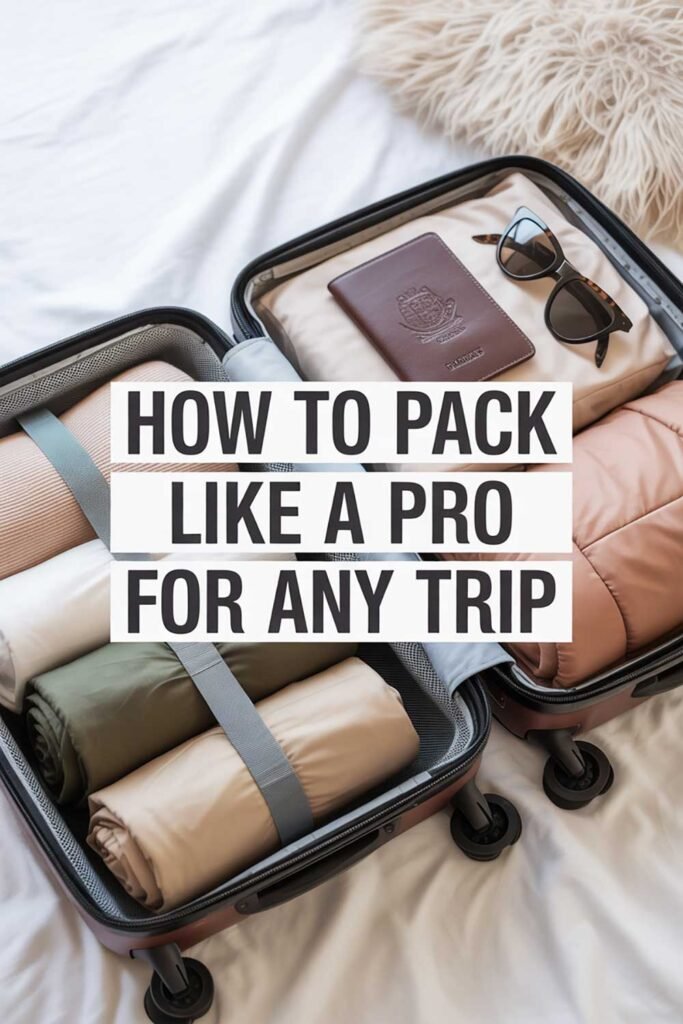
Rolling is the packing technique that earns its reputation consistently on every trip that uses it properly — not because it is a neat trick, but because it solves two real problems simultaneously. Rolled items pack into the corners, curves, and gaps of the suitcase that flat-folded stacks cannot reach, and a carry-on or suitcase of rolled soft items holds measurably more clothing than the same bag packed by flat folding. Rolling also produces softer, more distributed wrinkles that resolve quickly on a hanger compared to the sharp, repeated press of the fold line that packing the same garment flat in the same orientation every trip creates. The items that benefit most from rolling are the soft, informal garments — t-shirts, casual trousers, jeans, fleeces, knitwear — where the rolling result is perfectly acceptable. Roll these. Fold the rest. The suitcase that rolls its soft items is the suitcase with more room and better arrivals.
Fold structured items that will wrinkle badly if rolled
Rolling is not the right technique for every garment in the suitcase, and applying it without discrimination produces wrinkles in the items it was supposed to prevent them in. Blazers, formal trousers, linen shirts, structured dresses, and any garment whose shape relies on the fabric holding its form should be folded flat — ideally inside a dry cleaning bag that allows the fabric to shift under pressure rather than hold a fixed crease — and placed at the top layer of the suitcase in the last-packed, first-accessed position. A packing folder with a rigid board produces the consistent fold along the garment’s natural fold lines that freehand folding in a crowded suitcase cannot reliably replicate. Roll the casual. Fold the structured. The suitcase that applies both techniques correctly is the suitcase whose entire clothing contents arrive looking the way the trip requires them to.
Always put the things you will need first on top of the main compartment
The top layer of the suitcase’s main compartment is the most valuable organizational real estate in the bag — the layer accessed first at check-in, on arrival night, and at every hotel at the moment when energy for reorganization is lowest and the need for specific items is highest. Place the items needed immediately on arrival at this layer: the charger, the sleep clothes, the toiletry bag, the medication due that evening. Place the items needed last or in emergencies at the bottom. The suitcase whose top layer answers the first question the destination asks — where is the charger, where are the sleep clothes, where is the toiletry bag — is the suitcase that produces a calm first evening rather than a full unpacking session just to find three specific items. Pack in order of use. The layer needed first goes in last.
Use compression cubes for bulky layers and insulating garments
Bulky soft layers — fleeces, hoodies, down jackets, thermal base layers — are the category of items whose volume-to-use ratio creates the most tension between staying warm and staying organized in a suitcase. A standard packing cube containing a fleece occupies a third of the suitcase’s compartment. The same fleece in a compression cube, zipped closed after the initial fill closes the secondary compression zipper, occupies the space of a folded t-shirt stack. Compression cubes are specific tools for specific items — the air-filled, soft, compressible garments whose bulk is reducible — and using them for these items while using standard cubes for everything else produces a suitcase that holds the entire trip’s clothing in a genuinely organized, accessible structure without the compromise of leaving the warm layers at home because they would not fit.
Bundle-wrap delicate or easily wrinkled items in soft clothing
Bundle wrapping is the technique for the delicate items that need protection through transit without a dedicated hard case and for the easily wrinkled items that cannot be rolled or folded without arriving creased in ways that require significant effort to resolve. Place the delicate item at the center of the suitcase’s main compartment and surround it in concentric layers of soft, flexible clothing — the fleece, the casual trousers, the knitwear — that absorb the transit’s compression and movement rather than transmitting them to the item at the center. This protective wrapping keeps the central item safe from contact with the suitcase’s rigid edges and corners, and it keeps the surrounding soft items’ wrinkles minimal because they moved freely around the central structure rather than being fixed in a static fold. The fragile item travels safely. The soft items arrive softer than they would have had they been packed in fixed position.
Pack by complete outfit rather than by individual piece
The suitcase packed by category — all tops together, all bottoms together — is the suitcase whose outfit chemistry is assumed rather than confirmed, and whose gaps — the top that matches nothing packed, the shoes that work with two outfits but not the third, the layer whose color pairs with only one item — appear at the hotel rather than at home. Packing by outfit assembles each complete look before any of its components go into the suitcase: the top, the bottom, the shoes, the layer, any accessory that completes the occasion. Every item is confirmed against its full outfit before the decision to pack it is made. Every item without a complete outfit is left behind. The suitcase packed by outfit contains only the pieces that belong to confirmed, complete combinations — and the hotel room’s morning routine is a selection between complete looks rather than an improvisation between individual items.
Mid-Trip: The Habits That Keep the System Working Day by Day
Use the dirty laundry bag immediately every single evening — no exceptions
The dirty laundry bag established at packing time is only as useful as the habit of using it consistently throughout the trip — and the habit that matters is the daily one: worn items go directly into the laundry bag from the moment they come off, rather than being placed on a chair, left on the floor, or returned to a cube because the choice of where they belong is made later. The later moment is the moment the suitcase searches for a fresh item and finds a worn one in its place. Use the laundry bag immediately, from the first evening of the first night, for every item worn that day. The thirty seconds of daily habit is the clean-dirty separation that keeps the packing cubes honest, the arrival repack straightforward, and the hotel room from gradually accumulating the specific disorder of the trip whose laundry bag went unused until checkout.
Return every item to its designated cube when done with it
The micro-habit with the highest daily return for suitcase organization is the one that takes thirty seconds per item: the charger goes back in the electronics pouch after use, the sunscreen goes back in the toiletry bag after the morning routine, the book goes back in the lid pocket after the pool, the spare camera memory card goes back in the electronics pouch after the transfer. The item returned to its designated location after every use is the item whose location is known without searching at every subsequent moment it is needed. The item left wherever was convenient after the last use is the item searched for through multiple cubes and pouches before the taxi arrives at checkout. Return items to their places as a habit rather than as a cleanup. The suitcase that is always organized is the one whose items are always where they belong because they were always returned there after every use.
Unpack into the hotel drawers and wardrobe for stays of two nights or more
The suitcase used as a drawer — opened and searched through daily, with items migrating from cubes into general positions across repeated access — is the suitcase that gradually becomes the pile by day two regardless of how well it was packed. For stays of two nights or more, taking ten minutes to unpack the packing cubes into the room’s drawers and hang the structured items in the wardrobe keeps every category accessible, visible, and separately maintained for the entire stay. The daily routine accesses a drawer and a wardrobe rather than a suitcase. The departure repack takes five minutes because everything is organized by category in drawers rather than distributed across a bag that has been opened and imperfectly closed six times. Unpack when the stay warrants it. The suitcase maintained as living-out-of is the suitcase that requires reorganization at every checkout. The suitcase unpacked into the room stays organized effortlessly.
Keep the toiletry bag in the same spot every single time — at every accommodation
The toiletry bag that migrates to different surfaces at different accommodations — the bathroom shelf at one hotel, the desk at the next, the bedside table because the bathroom shelf was too small — is the toiletry bag whose location requires active memory at each new destination and whose checkout sweep requires confirmation at each different spot. Keep the toiletry bag in a single, consistent designated location at every accommodation: bathroom shelf, bathroom counter, or hanging from the bathroom door hook if a hanging bag is used. This consistency means the checkout toiletry confirmation is a single location check rather than a tour of the surfaces the bag may have moved to. The toiletry bag that is always in the same place is the toiletry bag that is always found without searching and never left behind because the standard location was confirmed and clear.
Do a thirty-second visual tidy before leaving any hotel room for the day
The thirty-second visual tidy — a quick scan of the room’s surfaces before leaving for the day — catches the item placed somewhere unusual the previous evening, confirms the toiletry bag is in its designated location, notices the charger left in the outlet, and verifies that the suitcase or the drawers are in a state that checkout preparation will not require addressing from a disorganized starting point. This is not a full checkout sweep — it is the daily maintenance pass that prevents the small organizational drift that accumulates across multi-night stays when unchecked. The room that is tidied once daily before leaving it stays organized throughout the stay. The room whose daily drift is left to accumulate until checkout requires the checkout reorganization that the daily tidy, thirty seconds at a time, was specifically designed to prevent.
How Rowan Stopped Arriving to Chaos and Started Arriving to a System
Rowan was a competent packer in the sense that everything he needed for a trip always made it into the bag. The bag was always closed when he left, always within the weight limit, and always contained the trip’s requirements. What it was not, consistently, was organized in any way that survived contact with the actual trip. By day two of most journeys, the suitcase had become the specific kind of mess that only travel produces: clean items mixed with worn ones, the charger somewhere in the main compartment rather than the electronics pouch he technically owned, the toiletry bag balanced on the bathroom shelf at the current hotel and occasionally left there entirely, and the lid pocket containing the receipts, the spare sim card packaging, and the hotel key card from the previous city rather than the items he had packed there for good reason.
The repack at every checkout was the price of the system, and he had come to accept it as a travel tax — the twenty minutes of reorganization before the taxi arrived, conducted with the specific urgency of someone who had left it too late and the specific inventory uncertainty of someone who could not remember whether the item was in the bag or on a surface somewhere in the room. He missed items at checkout less often than might be expected, which he attributed to luck rather than to the thirty-second room check he had never heard of at that point.
The packing cubes he had owned for two years before assigning them to specific categories rather than filling them with whatever fit. Assigning the categories changed how the whole system worked: the tops cube was always tops, the bottoms cube was always bottoms, and when the daily search began it began and ended at the right cube rather than touring all of them. The dirty laundry bag he placed at the bottom before the shoes went in and used from the first evening meant the clean-dirty question stopped being a question after the first night. He began returning items to their pouches immediately after use rather than leaving them wherever was convenient. The thirty seconds per item became the habit within a week of consistent practice.
The checkout on the fourth trip under the new system took four minutes and twenty-two seconds — he timed it to confirm the improvement was real. The room sweep found nothing because the daily tidy had kept the surfaces clear throughout. The suitcase zip closed in one motion. He arrived at the next destination with a suitcase as organized as the one that had left home, because the trip had been spent maintaining the system rather than gradually degrading it. The twenty-nine tips in this article are the system he built across those trips. The ten extra minutes at the beginning was the only investment the whole thing required.
Space and Smart Packing: Use Every Inch Intentionally
Tuck socks and small items inside shoes to recover dead space
The interior of each shoe in the suitcase is packing space that is already committed to the bag’s weight and volume — it travels regardless of whether it is occupied. Rolling socks into cylinders and tucking them inside the shoe’s cavity, alongside any small item that fits the space — a compact adapter, a folded belt, a small accessories pouch — recovers space that would otherwise be air. In the context of an organized suitcase, this is specifically useful because it keeps the sock category within the shoe layer at the base rather than requiring a separate cube or pouch position. The shoes packed with socks inside them have consolidated two categories into one layer. The corresponding space in the main compartment is available for items that need it. Small habits applied consistently across the whole bag produce a suitcase that holds more than expected and remains organized because everything has a deliberate location.
Fill every gap, corner, and curve — organized does not mean half-empty
A suitcase with packing cubes neatly placed and corners left empty is an organized suitcase with wasted capacity. The gaps between cubes of unequal size, the corners the cube’s rectangular profile cannot fill, and the taper along the bag’s sides are all usable space that small, flexible items can occupy without disrupting the cubes’ organizational integrity. A folded lightweight scarf fills the corner between two cubes. A small flat electronics pouch slides into the gap at the bag’s side. A pair of sandals whose flat sole fits the taper fills the frame edge that a cube cannot. Filling these spaces deliberately — with items that belong in the bag rather than items added because space exists — produces a suitcase that uses its full volume efficiently without becoming the indiscriminate stuffing that chaotic packing produces. Fill the gaps with purpose. Every inch of space in the bag has already been paid for.
Use the suitcase’s lid pocket for arrival essentials and the items needed most quickly
The lid pocket — the zippered compartment inside the suitcase’s top flap — is the most accessible space in the bag when it opens: the first layer visible, reachable without moving anything in the main compartment, and perfectly positioned for the items needed first at every accommodation. Use it deliberately: the charger and cable for the arrival night’s immediate setup, the sleep clothes for the first night, the toiletry bag’s travel documents, and any other item that needs to be retrieved before the main compartment’s cubes need to be touched. This consistent use means the lid pocket’s contents are predictable and its access is purposeful rather than the catch-all position for items that did not have another designated spot. The lid pocket with a purpose is the lid pocket that earns its space. The one without a consistent use is the one whose contents are a surprise at every arrival.
Keep all liquids in a sealed bag completely separated from clothing
Toiletry liquids and clothing occupy the same suitcase but should never share unmediated contact — the toiletry bottle whose lid fails under cargo hold pressure or whose pump releases under the weight of the packed bag above it produces its contents on whatever is immediately adjacent, which without proper containment is the clothing the packing cubes organized. A dedicated toiletry pouch with a secondary sealed bag inside it containing every liquid provides two layers of isolation between the liquids and the clothing: the pouch itself and the sealed bag within. This arrangement contains the occasional leak to the inside of the pouch rather than the contents of the clothing cube beside it. The contained leak is a five-minute cleanup. The uncontained one is the specific laundry emergency that a mid-trip destination’s nearest dry cleaner is not always equipped to resolve before the garment is needed.
Always leave a small deliberate gap for what you pick up along the way
The suitcase packed to absolute capacity on the outbound journey is the suitcase with no answer for the market purchase, the local product worth bringing home, the gift that needed buying, and the few items that every trip produces. Pack to roughly three-quarters of the suitcase’s capacity and treat the remaining quarter as the planned return margin — not as a packing failure or wasted space, but as the deliberate room that keeps the return journey as organized as the outbound one. The gap is not empty: it is reserved. The traveler who built it in comes home with the suitcase closed cleanly, every purchase properly placed in the organized structure the outbound packing established. The traveler who did not returns with the purchases in a separate bag and the suitcase fighting back the whole way. The gap is part of the system. Leave it intentionally.
Pack fragile souvenirs in the suitcase’s center, padded by soft clothing on all sides
The fragile souvenir — the ceramic piece, the glass bottle, the small decorative item — requires the suitcase’s most protected location for the return journey, and the center of the main compartment surrounded on all sides by soft clothing is the position furthest from the rigid suitcase walls, the frame channels, and the direct impact transmission that contact with those surfaces produces through transit handling. Wrap the fragile item in the softest available garment, place it at the physical center of the main compartment, and ensure soft items are packed on every side rather than only on top. The suitcase’s center is the location where the soft layers absorb the handling forces rather than the fragile item bearing them. An item packed this way can travel in a checked suitcase without a dedicated hard case and arrive at its destination intact because the packaging was the organized clothing around it rather than the foam wrap that was not available at the market.
Our Curated Collection of Trusted Tools and Official Sources
Everything we use to plan, prepare, and travel with confidence — from official government travel tools to practical planning aids. We have pulled together the resources we trust most so every trip you take is better informed, better prepared, and a lot less stressful from start to finish.
DND ResourcesThe Closing Habits: Finish Every Trip the System Started
Do a deliberate final edit and remove three items before closing the suitcase
Once the suitcase is fully packed and the zip is about to close, open it one more time and remove three items. Not the obvious essentials — three of the borderline items: the fourth outfit assembled for an occasion the confirmed itinerary holds only tentatively, the backup shoes beyond the two pairs that cover every confirmed activity, the what-if item that honest assessment reveals would be manageable without. Almost every packed suitcase contains at least three such items, and removing them before departure is the action that makes the suitcase feel like a well-edited bag rather than one packed to its limit with items competing for space. The three items removed in the final edit will not be missed on the trip. They would have traveled the full journey unused, displaced organized items, and confirmed at checkout as the ones that came home without having been touched. Remove them at home while the closet is available. The edit is always easier before the trip than after it.
Weigh the suitcase at home before leaving for the airport
The scale at home is the right place to discover the suitcase is over the airline’s limit — where the closet is immediately available, the time pressure is zero, and the decision about what to remove can be made calmly and completely. The scale at the check-in counter is the wrong place: the queue is moving, the decision involves public negotiation between what goes in the carry-on and what goes back to the hotel, and the fee is the alternative if neither is available. Step on the bathroom scale while holding the suitcase, subtract personal weight, and compare the number to the airline’s limit before leaving for the airport. If the bag is within the allowance, board with confidence. If it is not, the ten minutes of re-editing the packing is the version of the problem that is solved without an audience and without a fee. Weigh it at home. Arrive at the airport with nothing left to discover about the number.
Photograph the packed suitcase before zipping it for departure and again for the return
Two thirty-second photographs from two moments of the trip: the organized suitcase before the outbound zip closes and the same suitcase packed for the return. The outbound photograph documents the contents before they enter transit — the visual inventory that any lost luggage or damage claim requires when the airline asks what was inside. The return photograph is the checkout confirmation: the visual check that every item packed for the trip has made it back into the bag before the accommodation’s door closes. Both photographs are timestamped automatically by the phone’s camera. Both require nothing beyond the phone that is already in hand. The habit costs sixty seconds per trip and provides documentation that most trips never need and that the trip where it is needed cannot be reconstructed after the fact.
Pack the outbound suitcase with the return journey’s organization already in mind
The outbound packing is where the return journey’s organization is either built in or left to chance — and the suitcase that returns home in organized condition is almost always the one whose outbound packing included the return as a deliberate consideration. The dirty laundry bag at the base is a return decision made at outbound packing time. The deliberate gap for purchases is a return decision made before the zip closes. The packing cubes whose category assignments remain consistent throughout the stay are the return’s filing system, established on the first day and maintained by the mid-trip habits throughout. Think about the return as the outbound packing happens: where will the worn items go, where will the purchases land, where will the toiletries go after the last morning’s use, and how will the suitcase’s organization be confirmed complete before the checkout taxi arrives. Pack the return into the outbound. The organized return is the reward for the planning that went in before departure.
Reset and restock the suitcase within twenty-four hours of arriving home
The suitcase reset within twenty-four hours of every return is the suitcase that is ready for the next trip from the day after the current one ends — not a bag in a corner requiring a sort before packing can begin, but a system whose permanent components are confirmed present, whose cubes are emptied and positioned, whose toiletry kit is restocked to the items that ran low, and whose laundry bag is empty because the laundry was done. The reset takes fifteen minutes and costs nothing beyond the intention to do it before the return day’s energy is entirely consumed by everything the trip away produced at home. The suitcase that is reset after every trip is the suitcase that starts every future packing session from a complete foundation rather than a partially dismantled system that needs rebuilding before the real preparation can begin. Reset it within twenty-four hours. The next trip starts from there.
Update the master packing list after every trip while the memory is fresh
The master packing list improves with every trip that tests it — but only if the testing produces an update while the memory of what was needed and what was unnecessary is still specific rather than general. After every trip, before the return’s details fade, open the master list and make the adjustments: add the item that was wished for and not there, remove the item that came home unused on this trip and the one before it, add the destination-specific note that will help on a similar future trip, adjust the cube assignments based on how the categories actually worked in use. The list that is updated after every trip is progressively more accurate and useful, and the traveler who maintains it reaches the point — usually within a handful of trips — where packing is a confirmation of a known system rather than a reconstruction of it. Update it after every return. The ten extra minutes that keep the suitcase organized begin with the list that was honest enough to improve.
Book the Trip the Organized Suitcase Deserves to Travel To
The suitcase that stays neat from departure to checkout deserves a destination planned with the same intention. Our travel agents build the trips that give every packing decision somewhere genuinely worth arriving organized to — the right place, the right pace, and every detail confirmed before the first cube is filled.
Book A TripThe cubes were assigned and the shoes were along the frame. The dirty laundry bag was at the bottom before the first item was packed. The soft clothes were rolled and the structured ones were folded. The things needed first were on top. The gap for the return was built in. The final edit removed three things. The zip closed in one motion. That is twenty-nine tips. That is the suitcase that stays neat the whole trip.
Picture the Suitcase That Is as Neat on Day Seven as It Was on Day One
The master list was open before anything was laid out. The cubes are assigned and the same assignment they always are. The shoes are along the frame in their bags with socks inside them. The heaviest items are at the wheel end. The rolls are in their cube, the folds are in theirs, and what needs first is on top. The dirty laundry bag is at the base, ready for the first evening’s worn clothes. Three items were returned to the closet in the final edit. The gap for the return is built in. The photograph was taken. The zip closed cleanly on the first attempt. At every accommodation the daily return habit keeps every item where it belongs. At every checkout the suitcase is as organized as it was at departure because the system was maintained rather than abandoned by day two. The repack takes four minutes. The room sweep finds nothing. The next destination opens the same organized suitcase rather than the pile that the ten extra minutes were specifically spent to prevent. That is twenty-nine tips. That is the suitcase that stays neat because the system was worth the ten minutes it took to build it right before you left.
One More Thing Before the Suitcase Opens
Print our free Travel Packing Checklist and use it as the master list that every organized packing session starts from — cube assignments ready, outfit groupings confirmed, pre-departure tasks listed, and the ten extra minutes accounted for before the first roll is made. The same checklist we use before every trip we take.
Get the Free ChecklistExplore Our Top Picks for a Better Trip
After years of exploring the globe together, these are the exact tools, platforms, and services we rely on for every single trip — personally tested, traveler approved, all in one place. We don’t recommend anything we wouldn’t use ourselves, and this is the collection of booking platforms and travel tools that have made our adventures smoother, smarter, and more memorable.
See Our Top PicksLove Helping Travelers Show Up Organized to Every Destination?
Helping a traveler arrive with a suitcase that works — and booking the trip it is heading to — is the kind of practical expertise that makes a home-based travel agent genuinely valuable to their clients. If turning your love of travel into a business sounds like the right next move, see how the TravelPreneur system works.
Become An AgentPacking Organization Printables at Premier Print Works
Visit Premier Print Works for master packing lists, cube assignment guides, outfit planners, and travel organization printables that make every packing session ten minutes better and every suitcase neat from the moment the zip closes to the moment it opens at the destination — because the system was worth the time it took to build it right.
Visit Premier Print WorksDisclaimer
The information shared in this article is provided by Don and Diana’s Travels for general informational, educational, and inspirational purposes only. It reflects our personal experiences, opinions, and the experiences of travelers we have worked with. It is not professional travel, legal, or financial advice.
Airline and Baggage Policies
Airline baggage allowances, weight limits, size restrictions, and related policies vary by carrier and are subject to change without notice. Always confirm current requirements with your specific airline before traveling. We are not responsible for any fees or outcomes arising from reliance on baggage information in this article.
Fragile and Valuable Items
Packing suggestions for fragile items in this article are general educational information. We make no guarantees about the safety of any specific item packed using the methods described. For valuable or irreplaceable items, consider dedicated hard-case protection and appropriate travel insurance regardless of packing method.
Affiliate and Partner Links
This article may contain affiliate and partner links that pay us a commission at no extra cost to you. Our recommendations are based on real use and genuine belief in the products and services we share.
Composite Stories
Stories on this site combine real experiences from Don, Diana, clients, and travelers we have worked with. Details may be adjusted for privacy and narrative clarity.
No Guarantees
We do not guarantee any specific packing or travel outcome from using the information in this article. Results vary by traveler, destination, and trip type.
Copyright and Use
All content is the copyrighted property of Don and Diana’s Travels. You may not copy or republish our content without prior written permission. You are welcome to share a direct link with proper credit.
By reading this article, you acknowledge that you have read and agree to this disclaimer.