30 Suitcase Packing Tips for Organized Travel
A well-packed suitcase is not something that happens by accident — it is the result of a handful of simple habits that take about one trip to learn and make every single trip after that genuinely easier. Thirty suitcase packing tips for organized travel, from the first thing laid out on the bed to the last inch of space used before the zip closes cleanly on the first try.
Grab Our Travel Packing Checklist
Our free packing checklist is the master list these thirty tips are built around — every category covered, every pre-departure task included, organized so packing becomes a confirmation exercise rather than a guessing game. Use it as the foundation before every suitcase is touched.
Get the Free ChecklistA suitcase packed with intention is the quiet difference between a traveler who spends the first hour of every trip looking for things and one who walks straight out the door ready to go.
A well-packed suitcase is not something that happens by accident — it’s the result of a handful of simple habits that take about one trip to learn and make every single trip after that genuinely easier.
Before You Pack: Set the Foundation Before the Suitcase Opens
Lay everything out on the bed before a single item goes into the suitcase
The single most effective pre-packing step costs no time in the bag and saves a significant amount at every stage after it. Laying every intended item out flat on the bed before packing begins makes the total volume visible, the duplicates identifiable, and the over-packing correctable while the items are still easy to return to the closet. The pile that appears on the bed is almost always larger than the packer expected, which is the useful information that motivates the edit — the cut from what is there to what is actually needed. The pile that goes into the bag without this step is the pile that reveals itself as too much only after the zipper is strained and the bag is overweight on the scale at home rather than on the airline’s conveyor. Lay it out. Look at it honestly. Pack what remains. The suitcase that goes in organized stays organized.
Pack forty-eight hours before departure, not the night before the flight
Packing forty-eight hours before departure turns a stressful last-minute assembly into a calm deliberate process with a built-in review period. The bag packed at ten on the night before a six in the morning flight is the bag that contains the charger left on the desk, the medication still in the bathroom cabinet, and the item noticed as missing while boarding rather than while there is still time to add it. The bag packed two evenings before departure is the bag that sits closed while the brain runs the background check — the item spotted on the bathroom shelf the following morning that can be added without drama, the thing remembered at lunch that gets packed before dinner, the final confirmation that everything intended made it in. Pack early. Close the bag. Let the next forty-eight hours catch anything the packing session missed.
Choose the right suitcase size for the actual trip length and type
The suitcase that is too large for the trip is the suitcase that fills to match its size regardless of what the trip actually requires — the empty space becomes an invitation to fill rather than a discipline test, and the bag that could have been a carry-on becomes a checked bag because the extra space was used. Match the suitcase to the trip: a carry-on for trips under a week with the right packing system, a medium checked bag for one to two weeks, a large only when the trip type genuinely requires it. The traveler who uses the smallest bag the trip allows is the traveler who moves through airports faster, pays fewer or no checked-bag fees, and arrives at every accommodation with a bag they can manage independently. The bag size sets the upper limit. Use the lower one whenever the trip allows it.
Check the airline’s luggage rules for every leg of the journey before packing
A multi-leg journey that includes a budget carrier, a regional connection, or an international leg with different weight allowances is a journey that may have more than one baggage standard to meet — and the strictest one determines what the suitcase can weigh for the entire trip. Budget carriers in particular enforce weight limits firmly at the gate, charge overweight fees that can exceed the cost of the flight itself, and do not honor the allowance from the preceding full-service carrier. Check every carrier’s checked and carry-on baggage policy before packing a single item. The five minutes of pre-packing research is the overweight fee that never happens, the public gate-area repacking that never occurs, and the departure morning anxiety that never starts. Pack within the strictest limit the journey produces and every leg boards without incident.
Weigh the suitcase at home before you leave for the airport
The airport scale is the worst place to discover the suitcase is overweight — standing at the check-in counter with a queue behind, a departure time ahead, and the only options being an unexpected fee or a frantic public repack on the terminal floor. A bathroom scale at home, used by stepping on it while holding the suitcase and subtracting personal body weight, gives the exact number while there is still a closet to put things back into, a carry-on to redistribute weight into, and no time pressure to make the decision under. Weigh the bag fully packed, with everything intended inside it, before leaving for the airport. If it is over the limit, use the edit at home rather than the edit at the counter. The scale check takes sixty seconds and is the calm version of a conversation that is considerably less calm at thirty kilograms on an airline’s conveyor belt.
Start every packing session from a master list rather than packing from memory
Packing from memory is the method that produces the consistent forgotten item — the one that was not on a list, was not missed until the destination, and required either a purchase at the destination’s prices or an entire trip’s worth of doing without. A master packing list — built once, refined after every trip, covering every category from documents to clothing to toiletries to electronics — turns packing from a memory exercise into a confirmation exercise. Every item on the list is either in the bag or deliberately excluded, not simply forgotten. The list also catches the items that have not been used since the last trip and can be removed from the rotation, and the items that were missed on the last trip and need to be added. Build the list once. Refine it after every trip. Use it before every departure. The forgotten item belongs to the traveler who packed from memory.
Let Us Plan the Trip the Perfectly Packed Suitcase Is Heading To
The suitcase packed with intention deserves a destination planned with the same care. Tell us where you want to go and we will build the trip that makes every item in the bag earn its place — the right destination, the right length, and the right pace for the traveler who shows up ready to go.
Plan Our EscapeThe System: Organize Before You Fill
Use packing cubes and assign one cube per category without exception
Packing cubes transform a suitcase from a single large space that everything occupies randomly into a filing system where every category has a container, every container has a location, and every item is findable in the time it takes to open one cube rather than the time it takes to search through an entire suitcase at the hotel after a long travel day. Assign one cube per category and keep the assignment consistent on every trip: tops in one, bottoms in another, underwear and socks in a third, workout or swimwear in a fourth if needed. The category-per-cube rule is what makes the system work — the cube reached for is the cube that contains the item without requiring any other cube to be disturbed. The suitcase packed with cubes repacks at checkout in the time it takes to fold each cube closed. The suitcase without cubes repacks in the time it takes to find everything first.
Pack the heaviest items closest to the wheels for a balanced, easy-to-roll suitcase
The weight distribution of a suitcase determines how it handles in motion — on the airport floor, up the hotel staircase, across the cobblestone street, and in every other context where it is pulled rather than lifted. Heavy items packed at the top of the suitcase away from the wheels create a top-heavy bag that tips, strains against the handle, and requires more effort to maintain in motion than it should. Heavy items packed closest to the wheels — the side of the bag that faces the ground when rolling — sit at the center of gravity and produce a suitcase that rolls upright, stays balanced on the handle, and is significantly easier to maneuver through the transit contexts that every trip produces. Shoes, toiletry bags, electronics, and dense clothing go in first, at the wheel end. Lighter items fill in above and around them.
Place shoes sole-to-sole in shoe bags along the suitcase frame
Shoes packed sole-to-sole — one shoe facing each direction, the soles together between them — fit into the frame channels of the suitcase’s wheel-end layer more efficiently than shoes packed in any other configuration, because the sole-to-sole pair is roughly the same profile as the available space along the suitcase’s rigid perimeter. A lightweight shoe bag for each pair keeps the sole’s dirt and grime isolated from the clothing in the same layer, which is the specific problem that shoes packed without containment produce across a week of travel. Pack shoes first, at the wheel end, sole-to-sole in their bags along the frame. Build the rest of the suitcase around them. The shoes that go in first establish the most space-efficient foundation for everything packed above.
Tuck socks and small items inside shoes to use every inch of space
The interior of each shoe is packing space that is already committed to the bag’s weight — it goes regardless of whether it is occupied or empty. Rolled socks, a small power adapter, a folded belt, a compact pouch of small accessories, or any other item that fits inside the shoe’s cavity uses space that would otherwise be air. This is the small-spaces habit that experienced packers apply without thinking: every hollow space in the suitcase is either occupied by something that fits it or wasted. The shoes packed sole-to-sole in their bags at the wheel end, with each shoe’s interior holding a day’s worth of socks or a small item, contribute meaningfully to the total packing efficiency of the bag without adding any structural weight to the shoes themselves. Fill the shoes before they go in. Every centimeter counts toward the bag that closes on the first try.
Roll soft clothes instead of folding them to cut wrinkles and fit more
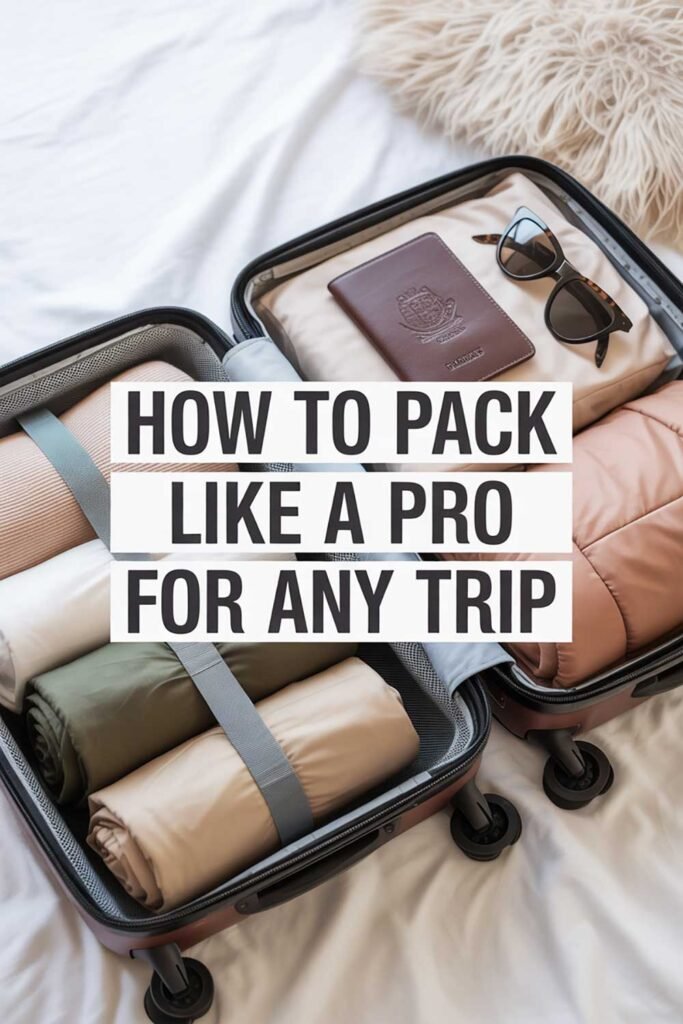
Rolling is the packing technique whose benefits experience confirms most clearly on the first trip that uses it properly. Rolled clothes pack into the gaps and curves of a suitcase that flat-folded stacks cannot reach — the corners, the spaces between cubes, the taper at the bag’s frame edge. They also carry different wrinkles than folded clothes — the soft, distributed creases of a rolled garment rather than the sharp, repeated press of a fold along the same line every time. Items that benefit most from rolling: t-shirts, casual trousers, jeans, fleeces, leggings, and any other soft, informal garment where the roll’s result is acceptable. Roll the items that work with rolling. Fold or hang the items that need a different approach. The distinction between the two produces a suitcase that fits more and arrives better than the one that folds everything out of habit.
Fold structured items that wrinkle badly if rolled
The roll is not the right technique for every garment, and applying it universally is the source of the specific wrinkle problem it is supposed to solve. Structured items — blazers, dress trousers, linen shirts, formal dresses, and anything with a defined shape that relies on the garment’s structure rather than its softness — wrinkle along the roll’s compression lines in a way that a flat fold avoids. Fold these items as they would be folded in a drawer, smooth the fabric flat, place them at the top of the suitcase’s main compartment in the layer accessed last, and if the trip requires them in perfect condition, use the dedicated packing folder or the dry-cleaning-bag technique covered in tips nineteen and twenty-one. Roll the casual. Fold the structured. The suitcase that applies both techniques to the right garments arrives with everything looking the way the trip requires.
Maximizing Space: Use Every Inch the Suitcase Offers
Fill every gap, corner, and curve — dead space is wasted space
A suitcase packed with neat stacks and well-organized cubes still contains a meaningful amount of unused space in the corners, the curves at the bag’s base, the taper at its sides, and the gaps between cubes of unequal size. These spaces are not too small to be useful — they are exactly the right size for the items that cannot justify their own cube: a folded lightweight belt, a rolled scarf, a pair of sandals whose flat sole slides into the corner, a small electronics pouch whose dimensions fill the gap between two larger cubes. Look at the suitcase from above after the cubes are in and identify every visible gap. Fill each one deliberately with an item that fits it. The bag that is efficiently filled is not the bag that is packed harder — it is the bag whose contents are distributed across the full three-dimensional space the suitcase offers rather than stacked in its center.
Use compression cubes for bulky layers and insulating garments
Compression packing cubes — those with a secondary zipper that compresses the cube’s contents after the initial zip closes — are specifically useful for the category of items whose volume-to-weight ratio is highest: fleece layers, down jackets, hoodies, winter base layers, and any other insulating garment that takes up significant space before compression and a fraction of that space after it. A compression cube containing a bulky fleece that would otherwise occupy a third of the suitcase’s main compartment compresses to the size of a folded t-shirt stack, freeing the space for items that cannot be compressed. Use compression cubes for the soft, air-filled garments whose bulk is compressible and standard cubes for everything else. The two types of cubes working together produce a suitcase whose total capacity is measurably larger than either system alone.
Pack the laundry bag flat at the very bottom before the shoes go in
The laundry bag — the dedicated container for worn items that keeps clean and dirty separated throughout the trip — is most effective when it is established from the suitcase’s first layer on day one rather than introduced mid-trip when the need for it becomes apparent. Pack it flat at the bottom of the suitcase before the shoes go in, below the organizational system, ready to be opened and accessed from the first evening of the trip. Its flat, empty starting position takes up negligible space and ensures that it is always in the same location throughout the trip — the traveler never has to remember where the laundry bag ended up, because it is always at the bottom, always accessible through the other layers, and always containing whatever came off that day rather than finding its way into the general compartment with the clean items.
Bundle-wrap delicate or easily wrinkled items in layers of soft clothing
Bundle wrapping is the packing technique specifically designed for delicate or wrinkle-prone items that need protection without a dedicated hard case. The principle is layering: delicate items — a silk blouse, a soft-knit dress, a fragile souvenir — are placed at the center of the suitcase’s main compartment and wrapped in concentric layers of soft, flexible clothing that cushion and protect the central item through transit. The surrounding soft layers absorb the compression and movement that transit produces without transmitting them directly to the item at the center. Bundle wrapping is also the technique that produces the fewest wrinkles in the wrapped items themselves, because the surrounding clothing absorbs the fold pressure rather than the central item. Place the item to protect at the center. Wrap it in soft layers. Let the suitcase’s structure do the rest.
Wear the bulkiest outfit and heaviest shoes on travel day
Every item worn on the body on travel day is an item that does not occupy suitcase space or contribute to the checked bag’s weight — and the bulkiest items contribute most to both when packed. Wearing the heaviest shoes, the thickest trousers or jeans, and the bulkiest jacket or outerwear on the travel day rather than packing them eliminates the single largest category of volume and weight from the suitcase at no cost other than a deliberate outfit choice. Most travel days involve significant ambient temperature variation across the departure city, the aircraft, and the arrival context, making a layered, adaptable outfit — which is naturally the bulkiest — also the most practical one for the travel day itself. Wear the heavy. Pack the light. The suitcase that boards without the heaviest items is a measurably different suitcase from the one that carries them.
Use the suitcase’s interior pockets, lid compartment, and frame channels
Every suitcase contains structural features that most packers underuse: the lid’s mesh or zippered compartment that sits flat against the top of the packed bag, the frame channels along the perimeter’s interior edge, and any secondary zippered pockets on the bag’s interior walls. These spaces are designed for specific types of items and work best when used for them: the lid compartment for documents, the day’s essentials, or items needed immediately on arrival; the frame channels for flat items like charging cables, travel adapters, or a folded document organizer; the interior pockets for the toiletry kit, small pouches, or accessories that would otherwise sit loose in the main compartment. Use every designed space deliberately. The suitcase that has been packed to its full structural capacity rather than just its central volume holds significantly more than the same bag packed with the built-in features ignored.
Carmen’s Last Trip With a Suitcase She Could Barely Close
Carmen had a packing style she described, with some affection and more resignation, as organized chaos. She knew where everything was — roughly. She could find most things within thirty seconds — usually. Her suitcase closed on the first try — occasionally. The rest of the time it closed on the second or third try, after a compression process that involved sitting on it, which she did not find undignified exactly but which she was aware was not how the zipper was designed to operate. She arrived at every destination having packed well, in the sense that everything she needed was technically in the bag. She arrived having packed badly in the sense that the bag had weighed forty-seven pounds on a forty-five pound limit twice, that the first evening of two different trips had been spent repacking in the hotel room to find what was at the bottom, and that one white blouse had arrived with a crease so specific and so deep that she considered it a structural feature rather than a temporary wrinkle.
The trip that changed it started with a packing cubes purchase and a decision to actually use them in a system rather than as loose containment. She laid everything out on the bed first, which she had been told to do before and had always found faintly theatrical until the pile on the bed made her genuinely reconsider four of the items she had not thought twice about. She rolled the t-shirts and the casual layers. She folded the structured pieces. She packed the shoes sole-to-sole with socks tucked inside them at the wheel end. She put the heaviest cube on the wheel side and the lightest at the top. She wore her heaviest jacket and boots on the travel day. She weighed the bag before leaving: thirty-eight pounds. She had packed for the same trip length as usual.
The suitcase closed on the first try with a small amount of room remaining. At the hotel she found what she needed in the time it took to open one cube. At checkout she repacked in four minutes because everything had a designated location it was returning to rather than a general compartment it had drifted away from. The white blouse arrived smooth, having spent the journey wrapped in the soft fleece that had been surrounding it rather than compressed under the rest of the bag. The thirty tips in this article are the system she built across that one trip and has not meaningfully changed since, because the habits took one trip to learn and have made every single trip after that genuinely easier exactly as promised.
Wrinkle and Damage Prevention: Arrive Looking Like You Meant To
Use dry cleaning bags for suit jackets, blazers, and formal dresses
The thin plastic dry cleaning bag — saved from any dry cleaning pickup or purchased in bulk at minimal cost — is the packing tool that prevents the specific wrinkle that structured garments develop in checked luggage: the compression crease along the fold line that steam, hanging, and patience do not always fully release before the event the garment was packed for. Place the garment inside the dry cleaning bag before folding and packing. The slippery plastic surface allows the fabric to shift and redistribute pressure as the suitcase is handled rather than holding a fixed fold under the weight of everything packed above. The result is a jacket or dress that arrives with the soft, organic settling of a garment that moved in transit rather than the hard crease of one that was held in a single compressed position for eight hours of baggage handling.
Button every shirt completely before packing it
A shirt packed unbuttoned is a shirt whose collar, placket, and front panels are free to fold, twist, and compress independently of each other during transit, producing crease patterns that the shirt’s structure was not designed to hold and that resist straightening after arrival. A shirt buttoned fully before packing holds its shape as a unit — the front panels lie flat against each other, the collar maintains its structure, and the fold, when it occurs, falls along lines the fabric accommodates naturally rather than the arbitrary lines that loose fabric finds for itself in a packed bag. Button the shirt before it goes in the bag. Fold it along the shoulder seam and sleeve lines. Place it flat in the packing folder or the top layer of the relevant cube. The shirt that arrives ready to wear is almost always the one that was treated like a garment rather than a piece of fabric on the way there.
Pack formal shirts and blouses using a dedicated packing folder
A packing folder — a flat, rigid board around which garments are folded rather than folded freehand — produces consistent, fabric-appropriate folds along the same lines every time, rather than the varied compression folds that occur when garments are folded wherever the suitcase’s geometry dictates. The fold produced by a packing folder falls along the shirt’s shoulder seam and the blouse’s natural folding line, arrives as a single clean horizontal crease that a warm iron or hotel steam resolves in thirty seconds, and does not involve the additional random folds that freehand packing in a crowded suitcase creates. For trips that require business-appropriate or formal attire, the packing folder is the investment that eliminates the ironing-board request at check-in and the first-morning delay of steaming out a garment that arrived ready to wear except for the packing.
Place fragile items in the center of the suitcase, surrounded by soft layers
The suitcase’s center is its most protected location — furthest from the rigid walls and the frame channels where direct impact is transmitted most directly, and surrounded on all sides by the soft clothing layers that absorb the handling, the conveyor drops, and the overhead bin compression that checked and carry-on luggage both experience in transit. Fragile items — a souvenir purchased on the way home, a glass bottle, a ceramic piece, a camera body — belong in the center, wrapped in soft clothing, with the softest and most compressible items immediately surrounding them and the harder, more structured items at the perimeter. The center-surrounded-by-soft principle is the packing approach that allows fragile items to travel in a suitcase rather than requiring a dedicated hard case for every purchase made on the road.
Keep all liquids in a sealed bag, completely separate from clothing
The toiletry bottle whose lid fails under the pressure change of a cargo hold, the liquid foundation whose pump releases under the weight of a packed bag, and the shampoo bottle whose cap was not fully secured before the zip closed are the items whose contents appear on the clothing of the packing cube they were closest to at a rate that has surprised every traveler who has experienced it. Keep every liquid — toiletries, skincare, sunscreen, anything that pours or pumps — in a dedicated sealed bag within the toiletry kit, separate from any clothing cube in the suitcase. A ziplock bag inside the toiletry pouch provides the secondary containment that the pouch’s fabric alone cannot. The leak that happens in transit is contained. The clothing it would otherwise have reached stays clean. The damage is a single item in a bag rather than a category of items in a cube.
Pack electronics in accessible, padded pouches rather than loose in the main compartment
Electronics packed loose in the suitcase’s main compartment are electronics that move during transit, collect impact from every drop and shift the bag experiences, and arrive at the destination either intact by luck or damaged by the specific impact that a padded pouch would have absorbed. A dedicated electronics pouch — padded, zippered, sized to the devices it holds — keeps cables organized, protects screens and lenses from the hard edges of other items in the bag, and makes the full electronics kit retrievable as a single unit rather than as a search through the general compartment. Keep the electronics pouch in a consistent location in the suitcase — the lid compartment or a top-layer position in the main compartment — so it is the first thing accessible on arrival, before the rest of the bag is unpacked. The devices that need to be charged and connected on arrival should not require finding them first.
Our Curated Collection of Trusted Tools and Official Sources
Everything we use to plan, prepare, and travel with confidence — from official government travel tools to practical planning aids. We have pulled together the resources we trust most so every trip you take is better informed, better prepared, and a lot less stressful from start to finish.
DND ResourcesSmart Habits: The Finishing Touches That Work on Every Trip
Always leave a deliberate amount of room for what you pick up along the way
The suitcase packed to absolute capacity on the outbound journey is the suitcase that has no answer for the market purchase, the gift that needed buying, the bottle of local wine for the dinner at home, and the few extra items that every trip produces in one form or another. Pack out at roughly three-quarters of the suitcase’s capacity and treat the remaining quarter as reserved space for the return — not as a packing failure or wasted room, but as the planned margin that makes the return journey as organized as the outbound one. The traveler who leaves room comes home with a closed suitcase and a purchased souvenir properly packed inside it. The traveler who did not leaves with the purchase in a separate bag bought at the destination’s airport shop, which was almost certainly more expensive than it needed to be.
Keep a permanent always-in-the-suitcase section for items that travel on every trip
The travel essentials that pack every trip — the universal adapter, the shoe bags, the laundry bag, the travel-size toiletry kit, the spare charging cable — are the items whose pre-trip preparation costs the same amount of time whether they live in the suitcase between trips or in a drawer that needs to be searched before every departure. Designate a permanent section of the suitcase — a specific pocket, a specific cube — for the items that travel on every trip and that return to the suitcase after every return rather than being unpacked into the home. The benefit compounds across every trip: the pre-trip packing confirms these items are present rather than locating them from wherever the last trip’s unpack left them. The permanent section is the foundation the trip-specific items are added to, not the whole system rebuilt from scratch each time.
Pack with the return journey already in mind
The outbound packing is where the return journey’s organization is either built in or left entirely to chance. The laundry bag at the bottom is a return-journey decision made at outbound packing time. The reserved space at the quarter-full mark is a return-journey decision made before the suitcase closes. The cubes assigned by category are the return-journey filing system that makes the checkout repack a four-minute process rather than a fifteen-minute one. Think about the return as you pack the outbound: where will the worn clothes go throughout the trip, where will the purchases fit, where will the toiletries that were partially used during the trip be reorganized to, and where will the souvenir that was not planned for find a place. The return journey’s suitcase is exactly as organized as the outbound one allowed it to be. Pack the outbound with the return in mind.
Do a final edit before closing the suitcase and remove three things
The final edit — performed after the suitcase is fully packed and before it is closed — is the step that consistently trims the bag without any real loss, because the items removed in the final edit are almost always the borderline items that were talked into the bag rather than needed into it. Open the packed suitcase. Identify three items that are there because they might be useful, not because they are necessary. Remove them. Close the bag. This ritual costs nothing and produces a suitcase that is consistently lighter, easier to manage, and more honest about what the trip actually requires versus what the anxiety of preparation suggested. The three items removed in the final edit will not be missed on the trip. They would have been carried for the full duration, used exactly zero times, and returned home having added weight without adding value. Remove them before the trip rather than rediscover them at checkout.
Photograph the fully packed suitcase before closing it for departure and for return
Two photographs, each taking thirty seconds: one of the packed suitcase before the outbound departure and one before the return. The outbound photograph is the visual inventory that documents the contents before transit — useful for any lost luggage or damage claim that requires describing what was in the bag. The return photograph confirms that every item packed for the trip is in the bag at checkout, catching the forgotten item before the accommodation’s lost property system is the only way to recover it. Both photographs are timestamped by the phone’s camera automatically and are retrievable months later if any claim or query requires them. The habit costs sixty seconds per trip. The documentation it produces is available without any effort at every subsequent moment where it might be needed.
Reset and restock the suitcase within twenty-four hours of returning home
The suitcase that is reset within twenty-four hours of every return is the suitcase that is ready for the next trip from the day after the current one ends. The laundry bag contents go directly to the wash. The toiletry kit is restocked to the items that ran low. The permanent section is confirmed complete. The universal adapter and the shoe bags are back where they belong. The suitcase is zipped, empty of the last trip’s detritus, and available for the next packing session without the sort-and-search that the suitcase left open and half-unpacked for a week requires. The reset costs fifteen minutes after every trip. It is the habit that keeps the system functioning across every departure without the rebuild that the neglected return produces. The next trip starts from a clean, complete foundation. That is the whole point of having a system.
Book the Trip the Perfectly Packed Suitcase Was Built For
Every suitcase packed with intention is heading somewhere worth the care. Our travel agents plan the trips that make every packing decision feel purposeful — the right destination, the right length, and the right itinerary for the traveler who shows up organized and ready to go.
Book A TripThe cubes were assigned. The shoes were sole-to-sole with socks inside them. The heavy items were at the wheel end. The rolls were in. The structured pieces were folded. The three edit items were back in the closet. Room was left for the return. The suitcase closed on the first try. That is thirty tips. That is walking straight out the door ready to go.
Picture the Suitcase That Closes on the First Try
Everything was laid out on the bed first — and four things went back before packing started. The master list was open. The shoes went in sole-to-sole at the wheel end, each one holding a pair of rolled socks inside it. The heaviest cube went down first. The rolls went around and between the cubes, filling every gap and corner. The structured pieces were folded with dry cleaning bags and placed at the top. The electronics are in their padded pouch in the lid. The laundry bag is flat at the bottom, ready for the first worn item tonight. Three-quarters full, by design, with room for what gets picked up along the way. The bag was weighed at home: well within the limit. The final edit removed three things that had been talked in rather than needed. The photograph was taken. The zip closed in one smooth motion. At checkout it reopened cleanly, repacked in four minutes because everything had a designated place it was returning to. That is thirty tips. That is the suitcase packed with intention, every trip from here.
One More Thing Before the Suitcase Opens
Print our free Travel Packing Checklist and use it as the master list that every packing session starts from — categories organized, pre-departure tasks confirmed, and every item that makes the difference already on the list before the first cube is filled. The same checklist we use before every trip we take.
Get the Free ChecklistExplore Our Top Picks for a Better Trip
After years of exploring the globe together, these are the exact tools, platforms, and services we rely on for every single trip — personally tested, traveler approved, all in one place. We don’t recommend anything we wouldn’t use ourselves, and this is the collection of booking platforms and travel tools that have made our adventures smoother, smarter, and more memorable.
See Our Top PicksLove Helping Travelers Show Up to Every Destination Organized and Ready?
Helping travelers prepare well — the right bag packed the right way, the right trip planned around them — is the kind of care that makes a home-based travel agent genuinely worth coming back to. If turning your love of travel into a business sounds like the right next journey, see how the TravelPreneur system works.
Become An AgentPacking Organization Printables at Premier Print Works
Visit Premier Print Works for suitcase packing checklists, master packing lists, travel planners, and printables that make every packing session more intentional and every suitcase more organized — from the first item laid out on the bed to the final edit that removes three things that were never going to be needed.
Visit Premier Print WorksDisclaimer
The information shared in this article is provided by Don and Diana’s Travels for general informational, educational, and inspirational purposes only. It reflects our personal experiences, opinions, and the experiences of travelers we have worked with. It is not professional travel, legal, or financial advice.
Airline and Baggage Policies
Luggage size limits, weight allowances, baggage fees, and all related airline policies vary by carrier and are subject to change without notice. Always confirm current requirements directly with your specific airline before traveling. We are not responsible for any fees, delays, or outcomes arising from reliance on baggage information in this article.
Fragile and Valuable Items
Packing suggestions for fragile or valuable items in this article are general educational information. We make no guarantee about the safety of any specific item packed using the methods described. For valuable or irreplaceable items, consider appropriate insurance and dedicated hard-case protection regardless of the packing method used.
Affiliate and Partner Links
This article may contain affiliate and partner links that pay us a commission at no extra cost to you. Our recommendations are based on real use and genuine belief in the products and services we share.
Composite Stories
Stories on this site combine real experiences from Don, Diana, clients, and travelers we have worked with. Details may be adjusted for privacy and narrative clarity.
No Guarantees
We do not guarantee any specific packing or travel outcome from using the information in this article. Results vary by traveler, destination, and trip type.
Copyright and Use
All content is the copyrighted property of Don and Diana’s Travels. You may not copy or republish our content without prior written permission. You are welcome to share a direct link with proper credit.
By reading this article, you acknowledge that you have read and agree to this disclaimer.