25 Personal Item Packing Tips for Flights
The overhead bin is for things you can forget about. Your personal item is for everything you actually need — so pack it like the difference matters, because it does. Twenty-five tips for turning the bag under the seat in front of you into the reason the flight goes smoothly from the moment you sit down.
Grab Our Travel Packing Checklist
Our free packing checklist includes a personal item section covering everything from the non-negotiables in your main compartment to the small essentials that belong in your outside pockets — organized so the bag under your seat is working for you before the aircraft door even closes.
Get the Free ChecklistA well-packed personal item is the difference between a flight you survive and a flight you actually enjoy from the moment you sit down.
The overhead bin is for things you can forget about. Your personal item is for everything you actually need — so pack it like the difference matters.
The Approach: Pack It Like the Difference Matters
Treat your personal item as your in-flight survival kit, not your overflow bag
Most passengers treat the personal item as a second suitcase — wherever the carry-on ran out of space, the personal item absorbs the rest. This is the habit that produces the mid-flight root around for a charger that is somewhere in there, possibly in the middle, under the jacket, possibly in the wrong pocket. The personal item is not overflow. It is the bag that holds everything you will actively want or need between takeoff and landing, selected deliberately and placed intentionally before the flight begins. When you approach it that way — as a flight kit rather than a leftover bag — everything in it has a reason and a place, and the flight goes better because of it.
Think in zones before you pack a single thing
The most useful personal item is one organized into three loose zones: what you reach without thinking during the flight, what you reach once or twice, and what sits at the bottom in case something unexpected happens. The top and outside pockets are zone one — the things that need to be reachable with one hand while seated. The main compartment’s upper half is zone two — the things you access but do not constantly need. The bottom of the main compartment is zone three — the backup layer that earns its place without being touched. Pack in this order and you stop digging. Everything you need is exactly where the moment you need it most expects it to be.
Pack your personal item last, after everything else is done
The personal item packed first — before the carry-on, before the checked bag — ends up with the items that were conveniently nearby when packing started, not the items most needed on the flight. Pack it last, when you have a clear picture of what is going where across all your bags and can make deliberate choices about what belongs under the seat rather than overhead. This also prevents the common habit of loading the personal item as a dumping ground for the things that did not fit elsewhere. The personal item should be curated, not filled by default. Packing it last is the one step that makes that curation actually happen.
Choose a bag that genuinely fits under the seat in front of you
A personal item that is technically within airline dimensions but only fits under the seat if it is forcefully wedged in is a personal item that travels overhead instead, which defeats its entire purpose. The bag under the seat is the bag you can reach at any point in the flight without standing, without asking your row to shift, and without waiting for the seatbelt sign to go off. Choose a bag that slides under the seat with room to spare — one that stays accessible the whole flight rather than half-fitting into a space it was never designed for. The shape matters as much as the size. A soft-sided bag compresses into tight underseat spaces far more reliably than a rigid one.
Know your specific airline’s personal item dimensions before you pack
Personal item size limits vary meaningfully between airlines, and the gap between a generous carrier’s allowance and a budget carrier’s strict enforcement is the gap between a bag that boards without comment and one that costs an unexpected fee at the gate. Budget airlines in particular measure personal items at the gate with real measuring boxes and charge real fees for bags that do not fit. Check the specific airline’s personal item size requirement before the trip rather than estimating from another carrier’s standard. The dimensions are in the booking confirmation or easily found in the airline’s baggage policy page. One check before packing is the fee that never happens and the gate delay that never occurs.
Let Us Plan a Trip Where the Only Thing You Focus on Is the Experience
The best travel days are the ones where every detail — including what goes in which bag and what the airline actually allows — is handled before you arrive at the airport. Tell us where you want to go and we will build a trip where you show up ready to enjoy every minute of it.
Plan Our EscapeThe Non-Negotiables: What Every Personal Item Needs
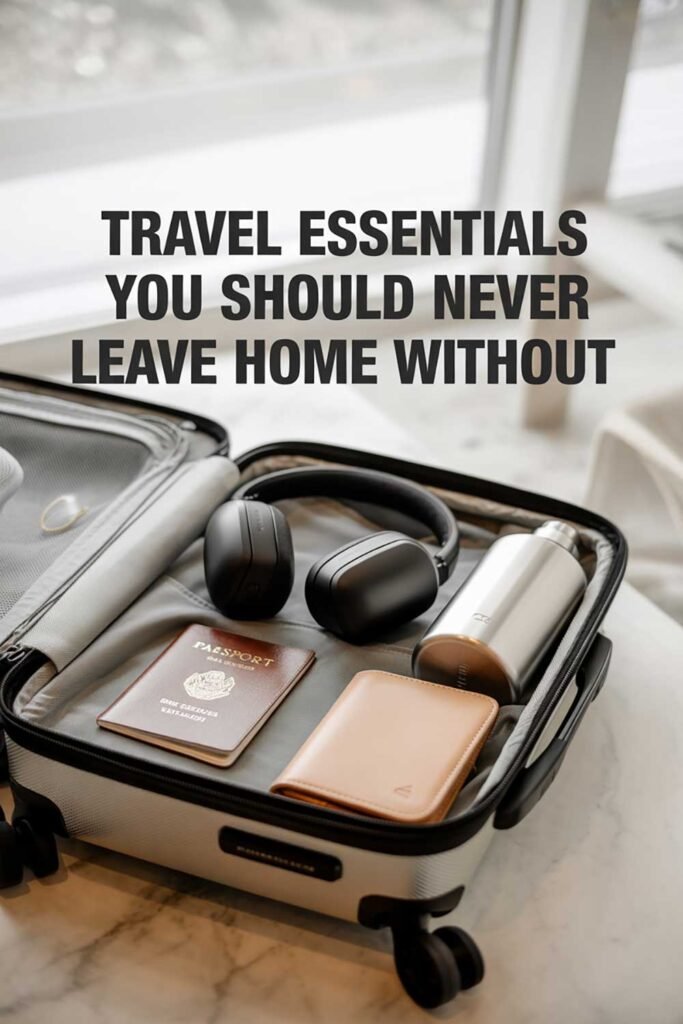
A refillable water bottle in a spot you can reach while seated
Cabin air at altitude is drier than most passengers expect, and the dehydration that builds quietly across a long flight is responsible for more headaches, fatigue, and general discomfort than most travelers connect back to their water intake. The airline’s drink service reaches you when it reaches you — not when you are thirsty. A refillable water bottle filled at the airside water fountain after security gives you hydration on your schedule, at no cost, and in exactly the amount you need. Keep it in an exterior pocket or at the very top of the main compartment — the place you can reach while buckled, without pulling out everything else. Staying hydrated is the cheapest in-flight upgrade that exists.
Your headphones — not in the carry-on, not in the checked bag
Headphones are the single most-used item on most flights and the one most frequently packed in the wrong bag — in the carry-on that went overhead, discovered missing two minutes after takeoff. They belong in the personal item’s main compartment upper half or an exterior pocket, accessible from the seat before the aircraft door even closes. Noise-cancelling headphones make a longer flight noticeably quieter and more restful. If you do not have noise-cancelling, standard earbuds still carry your audio and give the cabin around you something else to fill the space. Whatever you use, they go in the personal item. The overhead bin is exactly far enough away to make the first hour of a flight quietly worse.
A portable charger — because your phone’s battery does not care about flight length
The phone at twenty percent battery two hours into a four-hour flight is the specific discomfort that a portable charger weighing a few ounces in the personal item prevents entirely. In-seat power outlets exist on many flights and work on most of them, but not on all and not always reliably, and the middle seat’s outlet is frequently the one that is not working. A small but sufficiently large portable charger — large enough to fully charge a phone at least once — in the personal item’s main compartment means the phone is at whatever percentage you want it at when the wheels touch down. Keep the charging cable in an exterior pocket, not buried with the charger, so both are available in the same reach.
Every medication you need — all of it, always in the personal item
Medications belong in the carry-on or personal item on every flight, without exception, for a single reason: the checked bag can be delayed, diverted, or lost, and the medication you need every day does not become less necessary because the airline misrouted your suitcase. Prescription medications, over-the-counter essentials, motion sickness remedies if the flight could need them, and anything related to a chronic condition all go in the bag that stays with you. Keep them in their original packaging where possible and carry a copy of any prescription or medical documentation for anything that could raise questions at security. The personal item is the right place specifically because it stays under the seat — within reach, not overhead, for the entire flight.
A light layer for the cold cabin — not in the overhead bin
Aircraft cabins are cold in a specific, hard-to-predict way: comfortable during boarding, noticeably cold at altitude, and occasionally uncomfortably cold on long overnight flights regardless of what the passengers immediately around you are experiencing. The light layer — a thin packable jacket, a soft hoodie, a travel-sized fleece — belongs in the personal item where it can be pulled out and put on from the seat without a request for the seatbelt sign to go off. The same layer packed in the carry-on overhead is the layer that stays overhead because standing up mid-flight to retrieve it costs more inconvenience than the cold does. Pack it under the seat. Pull it out before you need it rather than while already cold.
Comfort and Wellbeing: Make the Cabin Work for You
Pack real snacks within arm’s reach — not at the bottom of the bag
The snacks in the personal item are not a luxury item. Hunger at altitude hits differently than hunger on the ground, and the airline’s snack service arrives on its schedule rather than yours. Packing a few real snacks — a protein bar, some nuts, a piece of fruit that travels well — in the top or an exterior pocket means you eat when you are hungry rather than when the cart reaches your row, and you avoid the specific mood that develops on a delayed flight when the last meal was at the departure terminal. Keep the snacks reachable. Snacks buried under everything else are snacks that get retrieved with the whole bag on your lap, which is exactly the kind of mid-flight inconvenience a well-packed personal item is designed to eliminate.
Hand sanitizer in a spot you can reach without unbuckling
The tray table, the seat armrest, the buckle, the overhead button, and the lavatory door handle are the surfaces that every passenger on the flight has also touched, and the hand sanitizer that addresses this is the one you actually use rather than the one technically in the bag somewhere. A small bottle of hand sanitizer in an exterior pocket — the same reach as your water bottle and your phone — is the one that gets used before the snacks, after the lavatory, and at any other moment the flight produces. It takes up almost no space, weighs almost nothing, and the flight feels cleaner and more comfortable for every hour of its duration when it is actually accessible.
A small moisturizer or facial mist for the dry cabin air
Cabin humidity runs significantly lower than the air most people spend their days in — dry enough that the effects on skin, eyes, and lips are noticeable within a couple of hours and genuinely uncomfortable on longer flights. A small tube of facial moisturizer or a travel-sized facial mist in the personal item’s accessible layer addresses this directly and makes a long flight feel less depleting on arrival. Apply it at altitude rather than waiting until landing when the dryness has already done its work. Keep it within the TSA’s liquid limit rules and in the reachable part of the bag. The difference between arriving at a destination looking and feeling fresh versus looking and feeling like you crossed a desert is often the small tube the prepared traveler packed.
Neck support in the personal item if you sleep on flights
A neck pillow or a compact travel support that keeps the head from falling sideways during sleep is the difference between waking up at the destination rested and waking up with a stiff neck that persists through the first day of the trip. Inflatable neck pillows pack down to almost nothing in a personal item and inflate in thirty seconds. Memory foam travel pillows are larger but compress enough to fit in most bags. Keep whichever you use in the personal item rather than the carry-on overhead, so it is accessible as soon as the seatbelt sign goes off and you are ready to sleep rather than available only after a mid-flight overhead retrieval that wakes up your whole row.
An eye mask and earplugs as backup to your headphones
Noise-cancelling headphones do not stay on comfortably through hours of sleep, and the eye mask that blocks the reading light of the passenger next to you and the ambient glow of the cabin is the item most often wished for and least often packed. A thin sleep mask and a pair of foam earplugs take up the space of a folded piece of paper and weigh almost nothing. They go in a small exterior pocket or the top of the main compartment, reachable as soon as the cabin dims. They also serve as a true backup on the flights where the headphones die, the battery runs low, or the noise level in the cabin demands more than earbuds alone can address. Small items. Big difference on a long overnight flight.
The Flight Simone Survived and the One She Actually Enjoyed
Simone was a practical traveler who approached her personal item the same way most people do: she packed her carry-on first, filled it until it was full, and put everything that did not fit into her tote bag, which technically qualified as a personal item if nobody looked too closely. On a long flight across several time zones, her tote contained a laptop, three books she was not going to read, a full-size water bottle she had bought airside, her jacket rolled into a ball on top, and somewhere near the bottom, her headphones, her charger, and two snacks she had specifically packed to eat on the flight.
She found the headphones twenty minutes after takeoff, during which time the passenger in the middle seat had to shift twice while Simone excavated the tote on her lap. The portable charger was at the bottom, discovered when her phone reached eleven percent. Her jacket had been sitting on top of everything the entire flight but she had not pulled it out because pulling it out meant reorganizing the whole bag in a middle seat with nineteen inches of legroom. By the time the snacks came out, she had been hungry for an hour. The flight was not a disaster. It was just steadily, quietly more uncomfortable than it needed to be.
Before the next flight, she repacked the same tote with the same items and a different approach. Jacket on top of the main compartment, pulled out before the door closed. Headphones in the exterior pocket. Charger and cable in the second exterior pocket. Snacks and hand sanitizer at the very top of the main compartment. Water bottle in the side mesh pocket. The things she would need mid-flight were in the first place she would reach. The things she hoped not to need were at the bottom where they stayed.
The second flight covered more distance than the first. She did not notice, because she was comfortable. The headphones were on before the safety demonstration. The jacket came out before the cabin got cold. The snacks came out when she was hungry rather than when the cart reached her. She charged her phone at altitude instead of sprinting for an outlet at the gate. A well-packed personal item is not a travel hack. It is the twenty minutes of deliberate packing before a flight that quietly changes how the whole day goes.
The Outside Pockets: Small Things That Earn Fast Access
Your phone charging cable in a dedicated exterior pocket
The charging cable is one of the most commonly needed items on a flight and one of the most frequently buried in the wrong place. Keeping it in the personal item’s exterior pocket — separate from the portable charger in the main compartment — means you can pull out the cable, plug one end into the seat’s USB port, and connect the other to your phone in a single ten-second motion without touching anything else in the bag. When the cable and the charger are both buried together in the main compartment, the operation requires pulling out the bag, opening the main compartment, finding both items in the same space, and reorganizing everything back. Exterior pocket for the cable. Main compartment for the charger. Two separate reaches that solve the same problem in a third of the time.
Boarding pass and ID in one dedicated pocket that never changes
The boarding pass and the ID — whether digital or physical — belong in a single, consistent, dedicated spot in the personal item that is always the same pocket on every trip. The reason is simple: these are the documents you retrieve under the specific pressure of a line moving at a pace that does not accommodate a search, and the pocket you reach for without thinking is faster and calmer than the pocket you are pretty sure you put them in this time. Designate one small exterior pocket for travel documents only and use it every flight. The habit takes one trip to establish and eliminates the specific stress of the boarding queue for every trip after it.
A pen — because you will need one before you expect to
A pen in the personal item is the small preparedness item that produces outsized gratitude at the specific moment it is needed. International arrivals require paper customs and immigration declarations on many routes. The person in the queue who has a pen is the person who completes the form before reaching the desk rather than at the desk. The airline’s in-flight magazine has a pen on the crossword page that belongs to no one and works sometimes. The pen in your personal item’s exterior pocket works every time. It also handles the gate agent’s paper, the hotel check-in form, the restaurant receipt, and every other document that arrives on paper at some point in the trip and needs a human mark on it.
Lip balm tucked in the same exterior pocket as your pen
Lip balm is the personal item essential that most people remember they needed about two hours into the flight when their lips are already dry and the lip balm is in the checked bag or not packed at all. Cabin air dries lips quickly and consistently across every flight long enough for the effect to become noticeable — which is most flights. A small tube of lip balm weighs almost nothing, takes no meaningful space in an exterior pocket, and produces the specific small comfort of a flight where your lips stayed comfortable throughout rather than a flight you spent lightly aware that they were not. Tuck one in the same pocket as the pen. It will be used on most flights and missed on every flight it is not there.
Gum or mints and a small hand cream in the same reachable layer
Gum or mints serve two purposes on a flight: the pressure equalization during ascent and descent that chewing supports, and the breath freshness that every close-quarters cabin hour makes quietly relevant. A small pack takes up the space of two stacked coins. Hand cream belongs in the same exterior layer as the lip balm for the same reason — dry cabin air affects hands over a long flight in a way that is minor enough to ignore but noticeable enough to appreciate when it is addressed. A small tube of hand cream that doubles for the rest of the trip as a travel essential costs nothing and takes almost no space. These are the items that cost nothing to pack and produce a flight that feels more comfortable, more considered, and more like a journey you prepared for rather than one you simply endured.
Our Curated Collection of Trusted Tools and Official Sources
Everything we use to plan, prepare, and travel with confidence — from official government travel tools to practical planning aids. We have pulled together the resources we trust most so every trip you take is better informed, better prepared, and a lot less stressful from start to finish.
DND ResourcesThe Bottom Layer: What You Hope Not to Need
Important documents at the bottom — because your checked bag might not arrive
Every important document for the trip — the passport’s data page photograph, the travel insurance policy and emergency number, the accommodation’s address and check-in details, the trip itinerary — belongs somewhere in the personal item in addition to wherever else you have stored it. The checked bag that arrives at a different airport than its owner arrives without its owner’s passport photocopy, travel insurance number, and accommodation address at the exact moment those documents are most needed. A small document folder at the bottom of the personal item costs nothing and covers every scenario where the main storage of these documents is unavailable at the moment they are required. The bottom layer is the layer you hope not to use. It earns its weight on the day it turns an emergency into an inconvenience.
A thin change of clothes tucked flat at the bottom
The checked bag’s detour — the airline’s polite term for the suitcase that arrived two days after its owner — is common enough that every frequent traveler has a story about it and organized enough to prevent it from mattering. A thin change of clothes rolled flat at the bottom of the personal item: a fresh shirt, a clean pair of underwear, and whatever small garment matters most to you on an unexpected overnight — weighs a few ounces and takes up the space of a folded magazine. This is not an overpacking instinct. It is a specific, bounded backup that covers the one travel scenario most likely to require it. The thin change of clothes at the bottom of the personal item is the reason the delayed bag is an inconvenience rather than a crisis.
Offline entertainment fully loaded before you board
In-flight Wi-Fi exists on many routes and works reliably on fewer of them. The streaming content that requires a connection, the podcast that needs a download, and the e-book that lives in the cloud are all unavailable at thirty-five thousand feet on the flight whose Wi-Fi is either not offered or not working today. Download movies, episodes, audiobooks, and reading material to the device before boarding from home Wi-Fi rather than attempting a last-minute airport download on a congested public network. Confirm each download shows the offline indicator. A fully loaded device for a long flight is six to eight hours of entertainment that never stops working regardless of what the airline’s Wi-Fi situation turns out to be — which is exactly the reliability that the personal item’s zone-one compartment is built around.
A packable tote bag folded flat
A lightweight packable tote folded flat at the bottom of the personal item takes up almost no space and earns its place the moment the flight lands. It becomes the day bag for the first day of the trip while the rest of the luggage goes to the accommodation. It holds the snack run, the beach bag, the souvenir purchase that would otherwise require buying a bag at the shop. It expands the personal item’s utility from a flight accessory into a travel tool that stays useful for the entire trip. Most packable totes fold to the size of a wallet. They weigh next to nothing. The traveler who arrives with a functioning day bag already in hand, without having packed extra, is the traveler who starts the trip moving instead of shopping for a bag first.
A mini toiletries kit for long flights and just-in-case arrivals
The mini toiletries kit at the bottom of the personal item is built around one question: what would you most want if the next time you see your checked bag is tomorrow morning? A travel toothbrush and a small tube of toothpaste. A deodorant wipe or a miniature stick. A face wash sheet or a cleansing wipe. These are the items that make arriving at a destination after a long flight — or unexpectedly without a bag — feel human rather than disheveled. A small zip pouch with these basics weighs under three ounces and fits in a corner of the personal item’s bottom layer. The flight where you need it turns from an uncomfortable arrival into a normal one. The flight where you do not need it costs you nothing to have brought it along.
Book the Trip That Makes Every Packing Decision Worth Making
A well-packed personal item starts with having a great trip to pack for. Our travel agents plan trips that are worth every detail — the right destination, the right pace, the right experience from wheels-up to touchdown. Let us plan yours.
Book A TripThe headphones were in the exterior pocket. The jacket was out before the cabin got cold. The snacks came out when they were actually hungry. The cable was in the first pocket they reached. The phone landed at full charge. That is twenty-five tips. That is the flight you actually enjoy from the moment you sit down.
Picture Yourself Already Settled Before Takeoff
The bag is under the seat in front of you and everything in it has a place. The headphones are on before the safety demonstration begins. The jacket is already out, because the cabin will be cold at altitude and you knew that before you boarded. The water bottle is full — filled at the airside fountain after security. The snacks are at the top where they belong. The charging cable is in the exterior pocket beside the lip balm and the pen, and the portable charger is right where it needs to be for the moment the phone dips below comfortable. The change of clothes and the important documents are at the bottom, quiet and ready, not hoped for but there. The overhead bin closed on something you will not think about until landing. The personal item under the seat is the flight. That is twenty-five tips. That is a well-packed bag making a flight you actually enjoy from the moment you sit down.
One More Thing Before Your Next Flight
Print our free Travel Packing Checklist and use it to confirm your personal item is packed in zones, your non-negotiables are within reach, your outside pockets hold the right small essentials, and your bottom layer is ready for anything the flight or the airline decides to throw at the day. The same checklist we use before every departure we take.
Get the Free ChecklistExplore Our Top Picks for a Better Trip
After years of exploring the globe together, these are the exact tools, platforms, and services we rely on for every single trip — personally tested, traveler approved, all in one place. We don’t recommend anything we wouldn’t use ourselves, and this is the collection of booking platforms and travel tools that have made our adventures smoother, smarter, and more memorable.
See Our Top PicksLove Helping Travelers Have Flights Like This Every Time?
Helping a traveler show up prepared — the right bag packed the right way, the right trip planned around them — is exactly the kind of work home-based travel agents do every day. If turning your love of travel into a business sounds like the right next journey, see how the TravelPreneur system works.
Become An AgentFlight Day Printables at Premier Print Works
Visit Premier Print Works for personal item checklists, flight-day planners, travel journals, and printables that make every departure a little more beautiful and a lot more organized — from the night you pack your bag to the moment the wheels touch down.
Visit Premier Print WorksDisclaimer
The information shared in this article is provided by Don and Diana’s Travels for general informational, educational, and inspirational purposes only. It reflects our personal experiences, opinions, and the experiences of travelers we have worked with. It is not professional travel, medical, or financial advice.
Airline and Travel Policies
Personal item size limits, baggage rules, fees, and airline policies vary by carrier and change frequently. Always confirm current requirements directly with your specific airline before you travel. We are not responsible for any fees, delays, or outcomes arising from reliance on information in this article.
Medical and Health Information
Any references to medications, hydration, or health-related packing in this article are general informational content only. Always consult a qualified healthcare provider for advice specific to your health circumstances, conditions, and medications.
Affiliate and Partner Links
This article may contain affiliate and partner links that pay us a commission at no extra cost to you. Our recommendations are based on real use and genuine belief in the products and services we share.
Composite Stories
Stories on this site combine real experiences from Don, Diana, clients, and travelers we have worked with. Details may be adjusted for privacy and narrative clarity.
No Guarantees
We do not guarantee any specific travel or flight experience from using the information in this article. Travel involves inherent uncertainty and personal responsibility.
Copyright and Use
All content is the copyrighted property of Don and Diana’s Travels. You may not copy or republish our content without prior written permission. You are welcome to share a direct link with proper credit.
By reading this article, you acknowledge that you have read and agree to this disclaimer.