25 Carry-On Packing Tips for Stress-Free Flights
Every stress-free flight starts with a carry-on packed so well that nothing is forgotten, nothing is scrambled, and everything you need for the journey is exactly where you expect it to be. Twenty-five trips later, every seasoned carry-on traveler packs the same way — light, intentional, and always with a system that never lets them down. Here are the twenty-five tips that build that system.
Grab Our Travel Packing Checklist
Our free packing checklist is the companion document to every tip in this article — organized by the same zones and categories so the carry-on that implements all 25 tips is confirmed complete before the bag is zipped.
Get the Free ChecklistTwenty-five trips later, every seasoned carry-on traveler packs the same way — light, intentional, and always with a system that never lets them down.
Every stress-free flight starts with a carry-on packed so well that nothing is forgotten, nothing is scrambled, and everything you need is exactly where you expect it to be.
Clothing: Pack Smarter, Not More
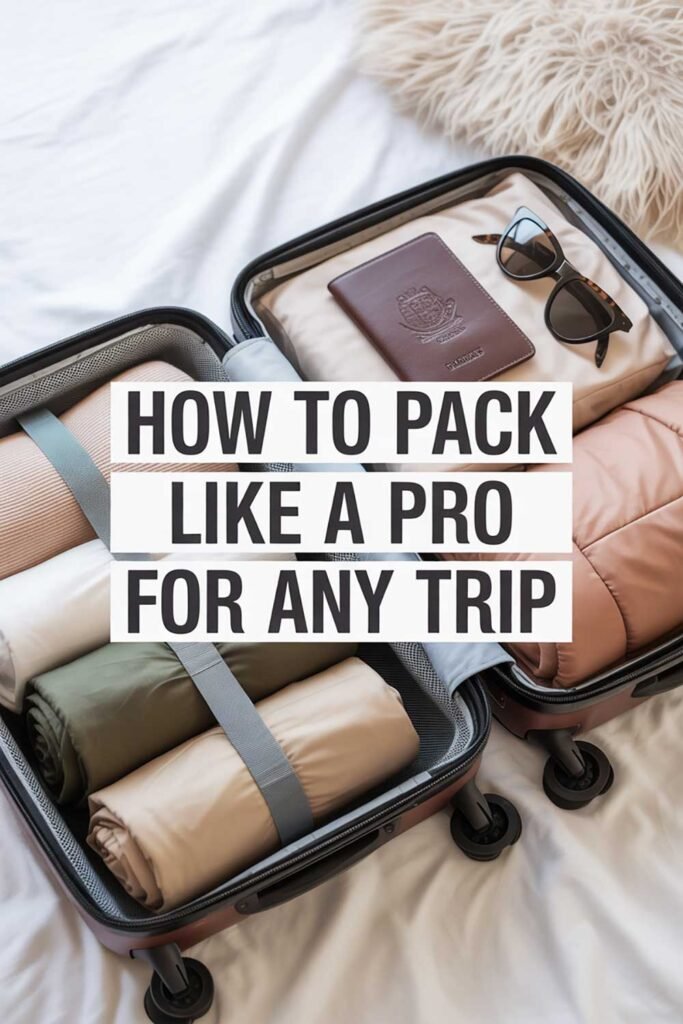
Roll soft clothes, fold structured ones
Soft fabrics — t-shirts, leggings, casual shirts, underwear, socks — roll tightly into compact cylinders that reduce volume by up to thirty percent and eliminate fold creases. Structured fabrics — blazers, trousers with a crease, dress shirts — fold flat and protected. The technique matches the fabric’s response. Apply it consistently and every item arrives as it was packed.
Build around a neutral palette
Navy, grey, white, and one warm neutral — every item in this palette pairs with every other item. Three tops and two bottoms in a shared palette produce more than twelve distinct looks before accessories vary. A multi-color random selection of the same item count produces fewer combinations at the same weight. Choose the palette first. Select every piece against it.
Use the three tops, two bottoms rule as your baseline
Three tops and two bottoms is the carry-on wardrobe’s minimum viable wardrobe for a five-to-seven day trip. In a neutral palette, these five pieces produce ten or more combinations. Add one dress or one layering piece and the count expands further. Every item above the baseline needs to earn its place by producing at least three distinct combinations with the items already in the bag.
Wear your blazer or heaviest layer on the travel day
The heaviest structured garment in the wardrobe — the blazer, the sport coat, the thick cardigan — occupies the most bag volume and weighs the most per item. Worn on the travel day, it occupies zero bag volume and arrives at the destination in good condition from the controlled environment of the travel day. Hang it in the aircraft’s overhead garment compartment if available. Fold it carefully over the personal item if not. It is always the better option than a bag.
Organization: A Place for Everything
Use packing cubes organized by category
One cube for tops, one for bottoms, one for underwear and socks. The category system produces automatic retrieval — the tops are always in the tops cube — and automatic repacking at every accommodation departure. The departure morning is lifting cubes into the bag rather than collecting items from every room surface. Choose consistent categories. Keep them on every trip. The system improves with every use.
Use a compression cube for bulky soft items
The compression cube’s double-zipper reduces soft items’ volume by thirty to forty percent. Fleece, thick cardigans, base layers, and casual soft fabrics compress significantly; the compression cube makes them carry-on viable. Do not use the compression cube for structured or delicate items — the compression damages them. Test by the hand-squeeze rule: if you would not squeeze it in your hand, do not compress it in the cube.
File-fold your tops cube vertically
Fold each top into a rectangle approximately the cube’s interior height. Stand them vertically side by side — the file-fold method. When the cube is opened, every top is visible simultaneously. Select the specific top without touching any other. One motion. Zero items displaced. The horizontally stacked tops cube requires removing everything above the desired item to reach it. Vertical is always better.
Put socks inside your shoes
The shoe’s interior volume is the bag’s hidden storage. Rolled socks inside each shoe use space that would otherwise be wasted, keep the socks from scattering through the bag, and maintain the shoe’s shape during transit. One pair of socks per shoe. Shoes at the wheel base. The interior is used. The bag is more efficient by the size of two rolled sock pairs without adding any additional bag volume consumption.
Pack a foldable tote inside for the return journey
The foldable tote weighs under one hundred grams and lies flat at the bag’s top. On the outward journey it is invisible. At the destination it serves as the daily market and beach bag. On the return journey it handles the purchases, the overflow, and the souvenir haul that the carefully packed outward bag had no room for. Never check a bag for the return because of market purchases when a foldable tote costs one hundred grams at departure.
Let Us Plan the Trip. You Pack the System.
The carry-on system built from these 25 tips works best when it is deployed on a trip worth taking. Tell us where you want to go. We will build the itinerary. You pack the fifteen items that cover every day of it.
Plan Our EscapeFootwear and Weight Distribution
Wear your heaviest shoes on the plane
The heaviest shoes in the wardrobe — boots, leather dress shoes, thick-soled trainers — worn on the travel day occupy zero bag volume and zero bag weight. The same shoes in the bag are the items most likely to push the bag over the weight limit and most likely to dominate the bag’s base volume. Wear them. The travel day is the free transport mechanism for the heaviest footwear in the trip’s inventory.
Place shoes at the wheel base with sole to the bag wall
Shoes are the densest items in the bag and belong at the wheel base — the heaviest point at the bag’s most stable area. Sole against the bag’s wheel-side wall protects the bag’s interior fabric from the sole’s contact and distributes the shoe’s weight correctly. The bag rolls straight with its weight low. The bag tilts forward with its weight at the top. Place shoes at the wheel base every time.
Weigh the bag before you leave home
The airline’s bag weight limit is enforced at the check-in desk and at the gate. The bag weighed at home is the bag whose weight is known before either location. A small inexpensive luggage scale confirms the specific weight in the specific moment when items can still be removed and either left at home or moved to the checked baggage. The bag weighed at the gate produces the specific gate-side redistribution of items between bags that the scale at home prevents.
Liquids and Toiletries: The Quart Bag Done Right
Keep liquids at the very top of the carry-on
The TSA 3-1-1 quart bag must be removed from the carry-on at the security checkpoint for separate screening. The quart bag at the very top of the carry-on’s main compartment is the bag removed in five seconds and placed in the bin in ten. The quart bag at the main compartment’s bottom behind the laptop, the packing cube, and the change of clothes is the bag that requires a full unpacking sequence at the security belt. Top of the bag. Every flight. No exceptions.
Decant all toiletries into travel-size bottles
The full-size shampoo does not travel in the carry-on. The 50-milliliter reusable travel bottle of shampoo does. Decant every liquid from the home supply into labeled TSA-compliant travel-size containers the evening before departure. Fill over the sink. Test for leaks. Place in the quart bag. The travel-size decanted supply carries exactly the trip’s required quantity at a fraction of the full-size weight. Label every bottle. The unlabeled bottle is found by smell in the dark.
Tech, Documents, and the Personal Item
Pack a change of clothes in your personal item
The change of clothes in the personal item — one top, one bottom, underwear, socks in a small zip bag — covers two scenarios simultaneously. The checked bag delay that arrives on day two rather than day one is managed by the personal item’s change for the first night. The twelve-hour flight’s final hour is improved by the fresh outfit applied in the lavatory before landing. Under five hundred grams. Fits in any personal item. Always worth the weight.
Keep all travel documents in the carry-on’s outermost pocket
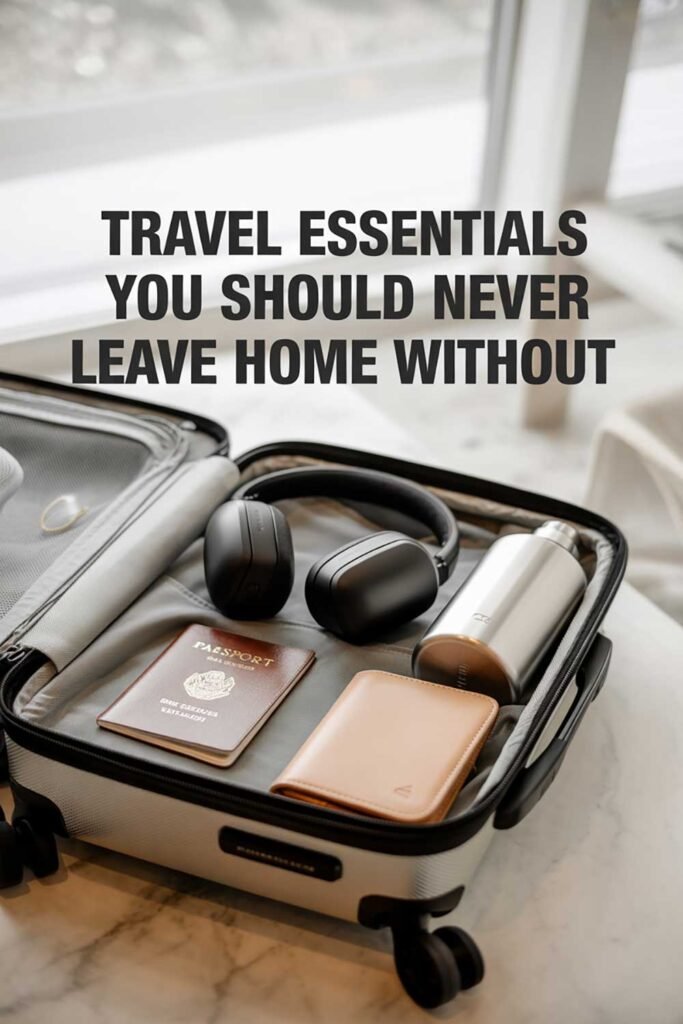
The passport, the boarding passes for all segments, the accommodation’s first address, and the travel insurance emergency number travel in the carry-on’s outermost accessible pocket rather than the checked bag, the personal item’s depths, or any other location. The checked bag is inaccessible from check-in to baggage belt. Every checkpoint between those two points requires the document that the outermost pocket produces in under five seconds.
Charge all devices to 100% the night before
The phone at 70% at boarding begins the travel day behind. The phone charged to 100% the night before begins from the maximum available capacity and arrives at the destination from the highest possible end-of-travel charge level. Every device on its charger by 10 p.m. the night before departure. Confirmed at one hundred percent before it goes in the bag the following morning. The arrival navigation works because the departure preparation started the night before.
Bring at least two cables
One cable in active use. One cable in the personal item’s exterior pocket as the confirmed backup for the cable whose connector fails at hour three, was left in the previous seat pocket, or whose USB-C end has been stressed through repeated travel use and no longer makes reliable contact. Two cables weigh under forty grams combined. The second cable is unused on most flights. On the one where the first cable fails, it is the entire difference between a charged phone at arrival and a seven-percent phone at the taxi queue.
Download all entertainment before you board
Inflight Wi-Fi is unreliable on most long-haul routes, unavailable on many short-haul aircraft, and paid for on most airlines where it is available at all. Downloaded content plays from local storage at full quality without any connectivity requirement. Download the full flight’s entertainment library — films, series, podcast playlist, audiobook — the evening before departure on the home Wi-Fi. Confirm every download shows the offline indicator. The flight departs with a complete entertainment library that never buffers.
Keep the power bank in your personal item, not the carry-on
The power bank in the overhead carry-on requires standing, opening the bin, retrieving the bag, and locating the power bank — the window seat’s specific four-step process that the adjacent passenger participates in involuntarily. The power bank in the personal item’s exterior pocket requires a forward lean. Both power banks are the same. One of them charges the phone at hour three of the flight without involving the person next to you.
Invest in noise-canceling headphones
The aircraft cabin at cruise altitude runs at eighty to eighty-five decibels for the full flight’s duration. Noise-canceling headphones reduce this ambient engine and cabin drone substantially, producing a genuinely quieter acoustic environment that improves both entertainment audio quality and sleep quality during the sleep segment. The investment pays its return on the first long-haul flight’s improved arrival condition. Every subsequent flight pays it again. This is the carry-on traveler’s highest-return single purchase after the carry-on itself.
Find Booking Ideas and Travel Essentials on Our Favorites Page
Our favorites page has helpful booking ideas and travel essentials that we have found genuinely useful for carry-on travel. Whether you are planning your next trip or looking for the specific gear that makes the 25-tip system work, it is worth a look.
DND FavoritesPlanning, Mindset, and Mastering the System
Pack the night before, not the morning of
The bag packed the morning of departure under departure time pressure produces the item left on the charger, the snack pouch forgotten on the counter, and the quart bag assembled in a rush whose leak test was skipped. The bag packed the night before is confirmed complete, leak-tested, and positioned at the door. The departure morning is the confirmed system and the closed door. Five minutes the night before. Every item where it should be at the gate.
Apply the overnight test to your packing list
Review the packing list the evening before departure. Sleep on it. Review it again the morning of departure. Every item that felt essential at 9 p.m. and feels unnecessary at 8 a.m. is the what-if item added under departure anxiety rather than the trip-requirement item the list was built around. Remove these items before opening the bag. The overnight test catches the fourth pair of shoes, the formal outfit for the event not on the itinerary, and the extra cardigan for the destination whose forecast shows no day below eighteen degrees.
Update your packing list after every trip
The packing list updated after every trip is the packing list calibrated to actual trip usage rather than theoretical trip needs. What was worn and used earns its place on the next trip’s list. What came home unworn is removed from the next trip’s list. What was missing and required an in-destination purchase is added to the next trip’s list. Three trips of post-trip list updates produce the packing list that is accurate rather than aspirational — the list the trip actually requires rather than the list the pre-trip anxiety assembled.
Trust the system and stop second-guessing at the gate
The gate-area second-guessing — the item considered adding at the airport shop, the what-if item retrieved from the personal item and transferred to the carry-on at the gate, the packing session extension into the boarding queue — is the departure anxiety speaking rather than the system requiring adjustment. The system was built the night before. The overnight test cleared the what-if items. The bag is confirmed complete. Trust it. The gate is not the place to improve the system. The next trip’s list update is. Trust the system. Board the flight.
The Trip Where the System Finally Clicked
When we first started traveling together, we packed the way most people pack — everything that might be needed, organized loosely, carried heavily. The first carry-on trip was three checked bags’ worth of items squeezed into two carry-ons and two personal items, carried by two people through three airports on a trip that lasted five days. We wore perhaps a third of what we brought. The rest was luggage management — reorganizing at the hotel, creative packing for the return, the overweight calculation at the gate. We arrived at every destination having survived the logistics rather than begun the trip.
The system developed across the next several trips — not all at once, but incrementally, each trip teaching the one adjustment that made the next trip better. The first discovery was packing cubes, which turned the chaotic main compartment into the organized system. The second was the neutral palette, which made every combination work and eliminated the what-if items that required their own isolated outfit set. The third was wearing the heavy shoes on the travel day. The fourth was the overnight test, which removed the gate-area anxiety’s additions before they ever reached the bag. The fifth was the post-trip list update, which made each subsequent trip more accurate than the previous one.
Twenty-five trips in, the system is not one decision but twenty-five. Every tip in this article is a trip that taught it. The bag that takes under forty-five minutes to pack for any destination, any duration, any occasion range — that bag was built one trip at a time. It is the same bag every experienced carry-on traveler eventually arrives at, and it is the bag this article puts in the hands of anyone who is ready to stop arriving and start beginning. These twenty-five tips are the twenty-five trips. All of them, compressed into the system that never lets you down.
Book the Trip the System Was Built For
The carry-on mastered is most satisfying at the destination worth arriving light and ready for. Our travel agents book those destinations. Let us plan yours.
Book A TripThe traveler who walked past the baggage belt had packed the night before. Every item was where they expected it. Nothing was scrambled. The system had not let them down. That is twenty-five trips in one carry-on.
Picture Your Next Airport Arrival
The carry-on is off the overhead bin before the aircraft door is fully open. The quart bag is back in the top of the main compartment from the security checkpoint. The documents are in the outermost pocket. The phone is at ninety-four percent from the power bank that has been doing its job since hour two. The change of clothes in the personal item is either used or available, depending on the flight. The bag is rolling behind on the one pair of shoes that was worn for the full journey. The baggage belt area is to the left. The exit is ahead. The system worked. It has never not worked. That is twenty-five trips. That is every trip from here.
One More Thing Before Your Next Flight
Print our free Travel Packing Checklist — the companion to all 25 tips in this article — and use it to confirm the system is complete before the bag is zipped. The same checklist we use before every trip we take.
Get the Free ChecklistExplore Our Top Picks for a Better Trip
Visit our favorites page for helpful booking ideas and travel essentials that we have found genuinely useful across all types of travel. Whether you are building your first carry-on system or refining a system you have used for years, it is worth exploring.
See Our Top PicksLove Helping Travelers Arrive Smarter and Pack Better?
Travel bookings are more enjoyable when the traveler arrives organized and ready to begin. If becoming a home-based travel agent who helps people travel with confidence sounds like the right next step, see how the TravelPreneur system works.
Become An AgentTravel Prints and Printables From Our Shop
Visit Premier Print Works for carry-on packing checklist printables, trip planners, packing system guides, travel journals, and wall art that makes every journey a little more beautiful and a lot more organized — from the night the bag is packed to the airport where the system works again.
Visit Premier Print WorksDisclaimer
The information shared in this article is provided by Don and Diana’s Travels for general informational, educational, and inspirational purposes only. It reflects our personal experiences, opinions, and the experiences of travelers we have worked with.
Airline Baggage Policies
Carry-on size limits, weight limits, and baggage policies vary by airline, fare class, and route and are subject to change. Always confirm current policies before travel. We are not responsible for any baggage outcome arising from information in this article.
TSA and Security Regulations
Security regulations including the 3-1-1 liquids rule are subject to change. Always confirm current requirements from official TSA and airport security sources before travel.
Affiliate and Partner Links
This article may contain affiliate and partner links that pay us a commission. Our recommendations are based on real use and genuine belief in the products and services we share.
Health, Safety, and Personal Responsibility
Travel involves personal risk. You are solely responsible for your own health, safety, and travel decisions. We strongly recommend comprehensive travel insurance for every trip. Don and Diana’s Travels accepts no liability for any loss, injury, delay, or inconvenience arising from information in this article.
Composite Stories
Stories on this site combine real experiences from Don, Diana, clients, and travelers we have worked with. Details may be adjusted for privacy and narrative clarity.
No Guarantees
We do not guarantee any specific result from using the information in this article. Your results depend on your own choices and circumstances.
Copyright and Use
All content is the copyrighted property of Don and Diana’s Travels. You may not copy or republish our content without prior written permission. You are welcome to share a direct link with proper credit.
By reading this article, you acknowledge that you have read and agree to this disclaimer.