Toiletry Packing Tips for TSA Liquids
Getting your liquids right for TSA is one of the simplest travel skills you can master and one of the most satisfying once you do. The traveler who breezes through security every single time sorted out their liquids bag before they ever left the house. This article builds that liquids bag — correctly, completely, and in a way that works from the very first flight forward.
Grab Our Travel Packing Checklist
Our free packing checklist includes a TSA liquids section organized by the decant-and-bag system this article describes — so the quart bag is assembled and verified before the carry-on is packed and the security line is the thirty-second smooth passage it should always be.
Get the Free ChecklistThe TSA’s 3-1-1 liquids rule is the security requirement that governs every liquid, gel, aerosol, cream, and paste in a carry-on bag on flights departing from US airports. The rule is named for its three numbers: each container must hold 3.4 ounces (100 milliliters) or less, all containers must fit in 1 quart-sized clear zip-top bag, and each passenger may bring 1 such bag through the checkpoint. The rule applies to liquids and semi-liquids broadly — shampoo, conditioner, body wash, toothpaste, sunscreen, moisturizer, face wash, toner, serum, foundation, mascara, lip gloss, hair gel, hand sanitizer, and any other product whose consistency is liquid, gel, cream, aerosol, or paste. Items that do not flow, drip, or spread — solid bar soap, solid shampoo bars, solid conditioner bars, stick deodorant in solid form — are not subject to the liquids rule and do not need to go in the quart bag.
The practical consequence of the 3-1-1 rule: the full-size shampoo bottle from home does not travel in the carry-on bag. The 400-milliliter conditioner bottle does not travel in the carry-on bag. The standard-size moisturizer, the regular sunscreen bottle, and the full-size toothpaste tube do not travel in the carry-on bag unless they are 100 milliliters or smaller. Items above the 100-milliliter limit discovered in the carry-on bag at the security checkpoint are subject to confiscation — the TSA officer will require the item to be discarded or returned to the check-in desk before the passenger proceeds through security. There is no partial exception for bottles that are mostly used and therefore less than 100 milliliters of product remaining if the bottle’s total capacity is above 100 milliliters: the rule applies to the container’s capacity, not its current contents.
The 3-1-1 rule is consistent across all US airport security checkpoints, but international security standards vary by country and airport. Some international airports apply the same 100-milliliter standard. Others have different limits or inspection procedures. Travelers connecting through international airports should verify the specific security requirements for each airport in the itinerary rather than assuming the US standard applies universally. The TSA’s current rules are the standard for flights departing from US airports, and the article’s system is specifically built for the US standard.
The traveler who breezes through security every single time sorted out their liquids bag before they ever left the house.
Getting your liquids right for TSA is one of the simplest travel skills you can master and one of the most satisfying once you do.
The TSA’s 100-milliliter container limit applies to the container’s labeled capacity, not its current fill level. A 200-milliliter bottle that contains 80 milliliters of product does not comply with the rule — the container’s capacity is 200 milliliters regardless of how much product is in it. A 100-milliliter bottle filled to its capacity complies fully. This distinction matters specifically for the larger bottles of frequently used products that the traveler reduces to a partial fill before the trip — the full-size shampoo whose current contents are below the 100-milliliter mark is still a full-size bottle and still does not comply. Only bottles whose labeled capacity is 100 milliliters or less comply with the rule.
Let Us Plan Your Next Trip So You Know Exactly What to Pack
The liquids kit that is right for a three-night city break is different from the kit for a two-week international trip with beach days, formal evenings, and mountain hiking. Tell us where and when you want to travel. We will build the itinerary. You build the liquids bag around it.
Plan Our EscapeThe decanting approach — filling reusable travel-size bottles with the specific products from the home routine’s full-size supply — is the most economical, most sustainable, and most customizable approach to building the carry-on toiletry kit. The traveler who decants uses exactly the products they know and trust rather than the products available in the airport’s overpriced travel kits or the hotel’s bathroom amenities of uncertain quality. The traveler who decants controls the quantity — the specific amount of each product the trip’s duration requires rather than the standard 30-milliliter bottle that may run short on a seven-night trip’s hair-washing frequency or the 100-milliliter bottle whose last half travels home unused for a three-night trip.
Reusable travel bottles are available in flat disc format, flip-cap cylinder format, and squeeze bottle format, each suited to different product consistencies. The flat disc bottle with the pop-up cap works best for thicker creams and lotions — the disc’s wide opening allows the thick product to be dispensed without the squeeze pressure that the cylinder format requires. The flip-cap cylinder works best for shampoo, conditioner, and body wash — its cylindrical shape packs efficiently in the quart bag alongside other cylinders, and the flip cap’s one-hand operation is convenient in the shower. The squeeze bottle with the small tip works best for serums, toners, and thin liquids whose dispensing benefits from the precision that the squeeze pressure provides. A set of travel bottles in different formats that together fill approximately eighty percent of the quart bag’s volume when filled for the specific trip’s duration is the decanting setup that serves the carry-on toiletry kit most completely.
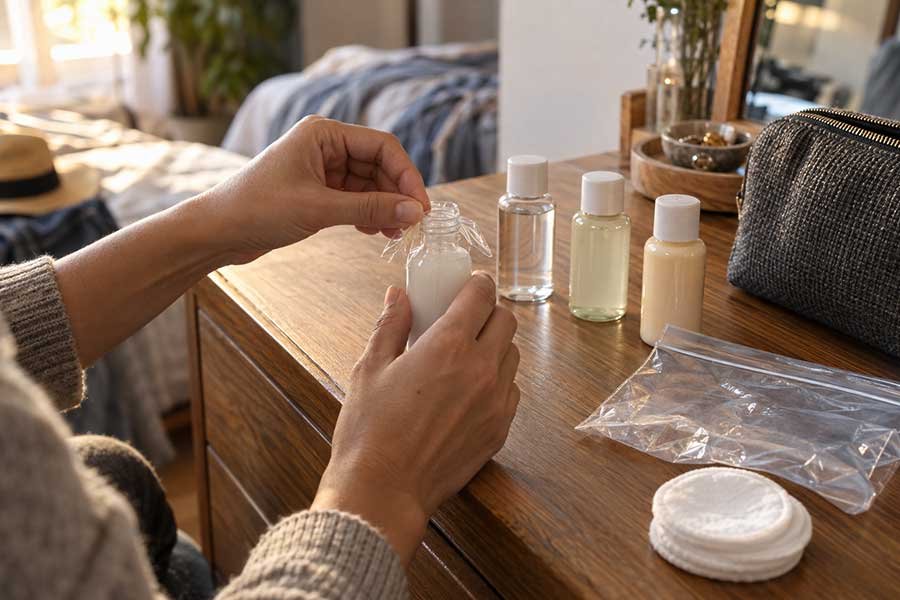
Label each travel bottle. The unlabeled travel bottle is indistinguishable from its adjacent unlabeled travel bottle until the cap is opened and the contents are identified by smell or appearance — which is the specific identification method that the half-awake hotel morning shower does not benefit from. A small piece of waterproof tape and a permanent marker, or a dedicated label set for travel bottles, produces the specific label that confirms the bottle’s contents at a glance and converts the morning routine from the smell-test identification sequence to the labeled grab-and-use efficiency that the labeled kitchen cabinets at home produce.
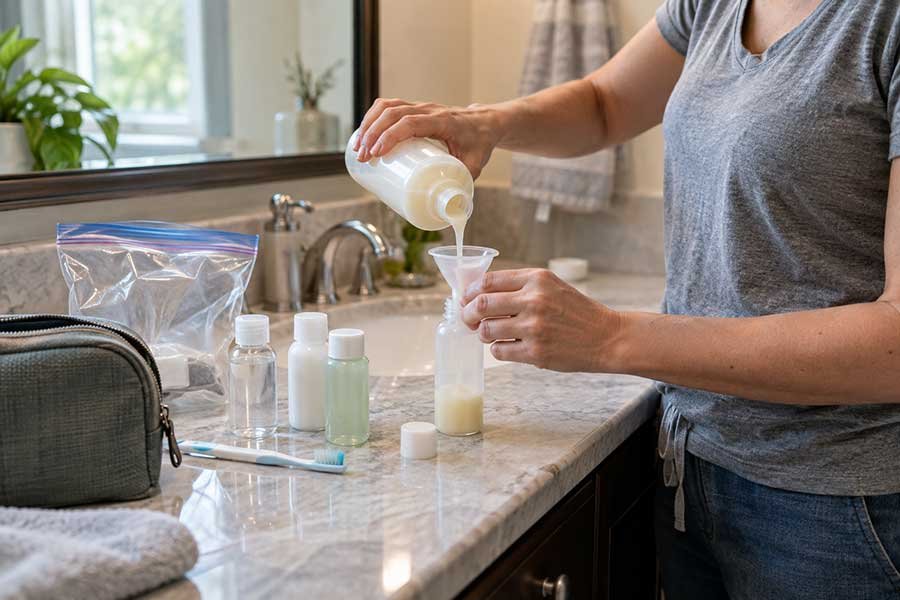
Fill travel bottles over the sink or bathtub rather than over the packed bag, and fill them at least the night before departure rather than the morning of. The filling session over the sink catches any leaks from bottles whose caps are not fully sealed before those leaks reach the quart bag’s contents and the carry-on bag’s other items. The night-before filling session also provides the time for the filled bottles to be wiped down, capped firmly, and confirmed leak-free before being placed in the quart bag. The morning-of filling session under departure pressure produces the cap that is not fully seated and the bottle that leaks in the quart bag before the security checkpoint, distributing the shampoo across the quart bag’s other contents with the specific morning efficiency that the night-before filling session would have prevented entirely.
The quart-sized clear zip-top bag is the TSA’s specific container requirement for the liquids at the security checkpoint. The bag must be clear — not tinted, not frosted, not opaque — and must be zip-top rather than fold-close or twist-tie. Its maximum size is one quart, which is approximately nineteen by eighteen centimeters or roughly the size of a standard one-quart freezer bag. The standard one-quart zip-top freezer bag from any grocery store meets the requirement. Purpose-designed TSA travel bags in a quart size also meet the requirement and typically offer a more durable closure and a layout specifically designed for the travel context. Either works. The requirement is the size and the clarity, not the brand or the purchase location.
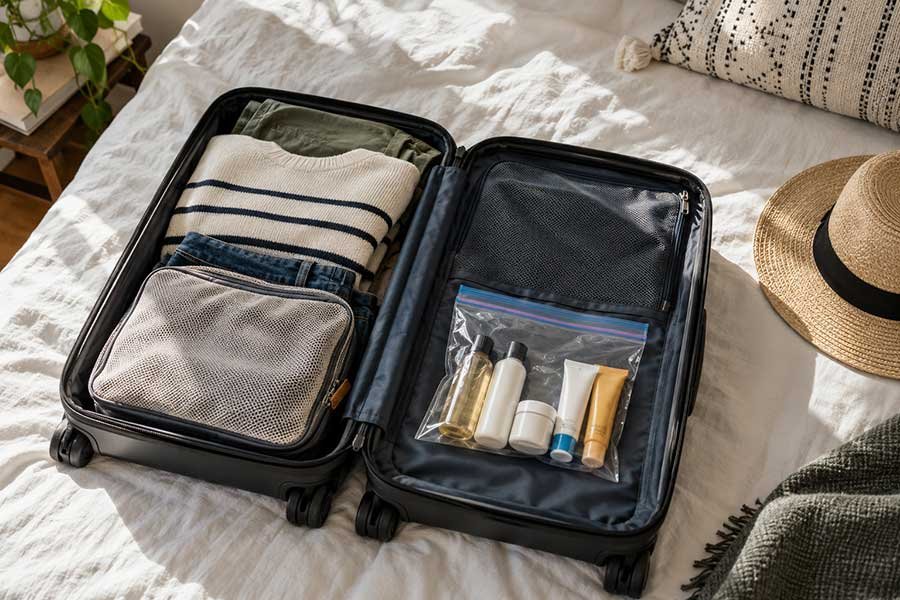
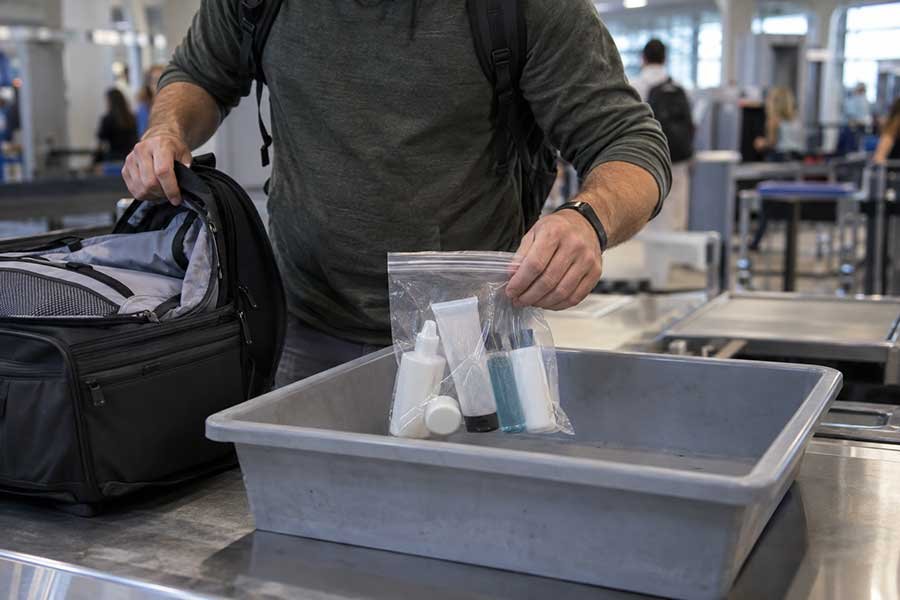
The liquids bag belongs at the very top of the carry-on’s main compartment — or in the carry-on’s exterior zip pocket if the exterior pocket is accessible without opening the main compartment. The specific positioning is for the security checkpoint’s efficiency: the TSA procedure requires removing the liquids bag from the carry-on and placing it in the security bin for separate X-ray screening. The bag at the very top of the carry-on’s main compartment is retrieved in five seconds and placed in the bin in ten. The bag buried in the carry-on’s main compartment behind the laptop, the change of clothes, the packing cube, and the day bag produces the security line’s specific unpacking sequence that the other passengers in the line experience as the extended delay at the belt. Top of the bag. Every time. Without exception.
The quart bag’s contents should be assembled and sealed before the carry-on is packed rather than assembled at the airport or at the security checkpoint from the carry-on’s scattered toiletry items. The pre-packed quart bag placed at the carry-on’s top produces the security checkpoint at which every item is where it needs to be, in the required container, in the required bag, at the required location in the required bag, removed from the carry-on in five seconds and placed in the bin for screening. This is the security checkpoint experience that the traveler on the other side of the bin from you produces and that makes the line move. Build the quart bag before packing the carry-on. The security line is grateful.
Buy two identical quart bags and maintain one as the permanent dedicated travel liquids bag that lives with the travel toiletry kit between trips. The permanent liquids bag — pre-filled with the labeled decanted bottles, capped and leak-tested — is the liquids bag that is confirmed ready when the carry-on is packed rather than assembled from scratch before each trip. The second bag is the backup for the trip where the first bag’s zipper fails at the security checkpoint’s bin. Both bags together weigh under twenty grams and cost less than two dollars. The pre-filled permanent liquids bag is the thirty-second security checkpoint from the first flight it accompanies.
Find Booking Ideas and Travel Essentials on Our Favorites Page
Our favorites page has helpful booking ideas and travel essentials that we have found genuinely useful for organized, stress-free travel. Whether you are planning your next trip or looking for resources that make every security checkpoint the smooth thirty seconds it should be, it is worth a look.
DND FavoritesSolid toiletry bars — solid shampoo, solid conditioner, solid body wash, solid facial cleanser, and solid sunscreen — are not subject to the TSA’s 3-1-1 liquids rule because they do not flow, drip, or spread at room temperature. A solid shampoo bar, a solid conditioner bar, and a solid body wash bar packed loose in the toiletry kit or in a small soap tin do not need to go in the quart bag, do not count against the quart bag’s volume, and do not need to be removed from the carry-on at the security checkpoint. For the traveler whose quart bag is consistently at capacity with the liquid products the trip requires, the solid bar alternative to the highest-volume liquid products — shampoo and conditioner represent the two largest-volume items in most quart bags — frees the quart bag’s most constrained volume for the products whose solid alternatives are less developed: the skincare serums, the prescribed medications, the specific sunscreen formulations.
Solid shampoo and conditioner bars have improved significantly in quality and variety over the past decade. Quality solid bars from established hair care brands produce the same lather, the same rinse-out, and the same hair result as the equivalent liquid formulations for most hair types. The specific experience of the solid bar is different from the bottle — the lathering technique is the application of the bar directly to wet hair rather than the palm-lather of the liquid — and it requires a brief adjustment period on the first use. For the carry-on traveler whose quart bag volume is the primary constraint on the trip’s toiletry options, the solid bar’s adjustment period is a worthwhile investment in the expanded quart bag capacity the switch produces.
The solid bar’s specific travel advantage beyond the quart bag exemption is the weight reduction: a solid shampoo bar that replaces a 100-milliliter liquid shampoo bottle is significantly lighter than the equivalent liquid volume, because the solid bar’s concentrated formula uses a fraction of the water content that the liquid formulation requires. A solid shampoo bar of approximately forty grams replaces approximately three to four 100-milliliter liquid shampoo bottles’ worth of washes — the same hair-washing coverage in less than half the weight at zero liquid container volume. For the carry-on-only traveler on longer trips, the solid bar switch for shampoo and conditioner produces the quart bag capacity and the bag weight reduction simultaneously from two items.
Pack solid bars in a small metal tin or a purpose-designed solid bar travel case to prevent the bar from leaving soap residue on the bag’s contents during transit. The solid bar packed loose in the toiletry kit or the packing cube is the solid bar that leaves the specific residue mark on the adjacent folded t-shirt that the solid bar’s convenience does not fully compensate for. A small metal tin — the travel soap tin available at most outdoor retailers and natural products stores — contains the solid bar’s residue within the tin, keeps the bar from softening and sticking to the tin’s surface by the tin’s vented design, and allows the bar to dry between uses at the destination by opening the tin’s lid in the bathroom’s air rather than storing the bar in the shower’s residual moisture.
The perfect travel toiletry kit is the kit assembled for the specific trip’s duration and occasion range rather than the kit that replicates the home bathroom’s full contents in travel-size format. The home bathroom’s full toiletry routine contains items for every daily scenario the home week produces — the formal evening, the gym morning, the casual day, the special occasion — and the trip’s toiletry kit is built from the subset of that routine that the trip’s specific daily scenarios require. A beach vacation’s kit has different items than a business conference’s kit. A three-night city break’s kit has different quantities than a fourteen-night multi-climate itinerary’s kit.
The core items that belong in almost every travel toiletry kit: shampoo or solid shampoo bar, conditioner or solid conditioner bar (liquid if the hair type requires leave-in; solid if the trip’s duration and the quart bag’s volume allow the substitution), body wash or solid body wash bar, facial cleanser, moisturizer with SPF for the daytime, nighttime moisturizer if the home routine requires it separately, toothpaste, deodorant (solid stick deodorant does not go in the quart bag; liquid or gel deodorant does), and any skincare serum or treatment that the home routine considers essential enough to continue during travel. Beyond the core, the trip-specific additions: sunscreen for beach or outdoor destinations (can be purchased at the destination if the destination’s retail access is good and the quart bag volume is tight), a small perfume travel atomizer filled from the home’s full-size bottle, the prescription medications in their labeled original containers outside the quart bag.
Assemble the kit on the bathroom counter before placing any item in the quart bag. The counter assembly reveals the full item count, the quart bag’s volume capacity against the items present, and the items that can be substituted for solid alternatives or eliminated without affecting the trip’s daily routine. The item count on the counter is the item count that needs to fit in the quart bag. If it does not fit, the solid bar switches, the quantity reductions, and the elimination of the items available at the destination resolve the discrepancy before the bag is packed rather than at the security checkpoint where the discrepancy is resolved by the TSA officer instead.
Test the assembled quart bag for leaks at home before the travel day. Lay the filled and sealed quart bag flat on the bathroom counter for five minutes, then check the surface beneath it for any liquid. A bottle that leaks at the quart bag’s testing stage leaks in the security bin, in the carry-on, and in the hotel bathroom without the testing stage’s early warning. Any leaking bottle should be identified — the cap not fully seated, the disc’s pop-top not fully closed — and corrected before the bag is placed in the carry-on. The five-minute leak test is the routine that confirms the quart bag is ready for the security checkpoint before the security checkpoint confirms it is not.
The complete TSA liquids system assembles the rule understanding, the decanting approach, the quart bag discipline, and the solid bar consideration into the pre-trip routine that produces the smooth security checkpoint on every subsequent flight.
Before the trip: assemble the full toiletry kit on the bathroom counter and confirm every liquid, gel, cream, aerosol, and paste item is in a container of 100 milliliters or less. Identify the items whose solid alternative would free quart bag volume. Fill the reusable travel bottles over the sink the evening before departure. Label each bottle. Let the filled bottles sit capped for five minutes and check for leaks. Place all liquids-rule items in the quart bag. Seal the quart bag. Test for leaks. Pack the quart bag at the very top of the carry-on’s main compartment or in the carry-on’s exterior accessible pocket.
At the airport: remove the quart bag from the carry-on before placing the carry-on on the belt. The quart bag goes in the bin. The carry-on goes on the belt. The laptop, if required, goes in its own bin. Three bins, clear process, thirty seconds, done.
After the trip: refill the travel bottles for the next trip while the trip’s routine is fresh. Return the quart bag to the travel toiletry kit’s storage location. The permanent pre-filled quart bag is the liquids system that is ready for the next trip before the current trip’s laundry is done.
The quart bag works best as a permanent part of the travel kit rather than a trip-specific assembly. The traveler who maintains a permanent quart bag pre-filled with the standard travel toiletry kit’s liquid items — topped up and leak-tested after each trip before being returned to storage — is the traveler whose quart bag is confirmed ready for the next trip before the packing session begins. The standard travel kit covers most trips without modification. The trip-specific additions — the extra sunscreen for the beach destination, the specific prescription medication for the international destination — are added to the permanent kit’s standard items before departure. The system is built once, maintained between trips, and deployed without any pre-trip toiletry assembly required.
The Security Bin That Taught the Only TSA Lesson Worth Learning
Jasmine had been told about the liquids rule. She had read about it. She had, in the technical sense, understood it before the specific morning when the security officer reached into the bin containing her carry-on and pulled out the full-size shampoo bottle with the expression of someone who was not surprised. The shampoo bottle was 400 milliliters. She had known about the 100-milliliter rule. She had also packed the shampoo from the bathroom shelf without checking the size, because she packed everything from the bathroom shelf without checking anything, which was her consistent packing approach across all categories.
The security line watched the extraction. The officer explained the rule with the specific patient clarity of someone who explains the same rule many times per morning. Jasmine could check the bag or check the shampoo in the nearby check-in agent’s drop-off point or dispose of it in the bin provided. The line waited. She disposed of the shampoo. It was most of a new bottle. She bought the airport’s travel-size shampoo at the departure gate’s minimart for four times the pharmacy price.
The specific experience of the security bin extraction — the line, the explanation, the disposal of the mostly full shampoo bottle, the airport minimart transaction — produced the specific motivation that the rule’s description had not. She bought a set of reusable travel bottles at the airport minimart alongside the shampoo. On the return flight, she had already filled them the evening before departure. She had assembled the quart bag on the bathroom counter. She had labeled each bottle. She had tested the sealed bag for leaks. She had placed it at the top of the carry-on’s main compartment. At the security checkpoint, the bag came out in five seconds. It went in the bin. It went through screening. The officer on the other side picked it up without opening it and handed it back. Thirty seconds. No extraction. No line audience. No minimart transaction. The quart bag at the top of the carry-on and the hundred-milliliter containers within it were the entire difference between the two security experiences. This article is the pre-departure bathroom counter assembly and the permanent pre-filled quart bag that she has taken on every flight since the morning of the shampoo.
Beyond the four core TSA liquids principles, these six additional approaches address the specific security scenarios the core system does not fully cover.
Pack a small dry bag or a zip-lock bag inside the carry-on to hold any liquids purchased after security — the water bottle from the departure gate newsstand, the drink from the gate café, the additional toiletry item from the airport pharmacy. Items purchased in the secure area past the checkpoint can be carried onto the aircraft without volume limits. Items purchased before the checkpoint are subject to the same 3-1-1 rule as the items packed at home. The dry bag or zip-lock bag in the carry-on provides the containment for the post-checkpoint purchases that ensures they do not leak onto the carry-on’s other contents during the flight’s pressure changes.
Know which items are specifically exempt from the liquids rule for medical necessity. Prescription liquid medications, liquid baby formula and breast milk in reasonable quantities, and certain medical items are specifically exempt from the standard 3-1-1 limits and may be carried in quantities exceeding 100 milliliters when declared at the checkpoint. These exemptions require the item to be declared separately from the quart bag and presented to the TSA officer for separate inspection. Travelers with prescription liquid medications or other medically necessary liquid items should confirm current TSA guidelines for the specific exemptions that apply to their items before travel, as the specific rules and documentation requirements are subject to change.
Apply the lip gloss, the foundation, and the liquid mascara at home or at the gate lounge rather than packing them in the quart bag if the quart bag’s volume is already at capacity with the skincare and hair care items. The cosmetics applied at home before the airport are cosmetics that do not need quart bag space. The full skincare routine — cleanser, toner, serum, moisturizer — and the hair care items — shampoo, conditioner — occupy the majority of most quart bags’ volume. The cosmetics that can be applied before departure and reapplied from small quantities in the quart bag at the destination are the cosmetics that give the quart bag its remaining space for the items that genuinely need liquid form throughout the trip.
Bring a small funnel for the decanting process. The specific challenge of filling a thirty-milliliter travel disc with the home-size shampoo bottle’s thick product is the challenge that the funnel resolves without the mess that the direct-pour approach produces. A small silicone funnel weighing under ten grams converts the five-minute counter-level decanting session into the clean, efficient transfer that the airport minimart’s pre-filled travel bottles charge a significant premium to avoid. The funnel is used before the trip rather than on the trip and lives in the toiletry kit’s storage container between trips.
Research international airport liquids rules before connecting through a non-US hub. Some international airports have different limits — the UK’s 100-milliliter standard aligns with the US; some other airports inspect differently, with some accepting the same standard and some applying additional scrutiny to specific product categories. Duty-free liquids purchased at the international airport’s secure zone and sealed in the airport’s tamper-evident security bag are typically allowed on the connecting flight in the amounts purchased; confirm the current rules for the specific itinerary’s airports rather than assuming the US 3-1-1 standard applies universally.
Keep a travel-size hand sanitizer outside the quart bag in the carry-on’s exterior pocket rather than inside the quart bag. The hand sanitizer is the most frequently accessed carry-on liquid during the travel day — at the airport, after the security bin handling, before the in-flight meal, after the connection’s food court — and its access is most useful from the exterior pocket rather than the security bag that needs to be removed from the main compartment for every access. As a liquid item, the hand sanitizer technically belongs in the quart bag for the security checkpoint; place it in the quart bag for the checkpoint and return it to the exterior pocket after screening. Most experienced travelers develop the habit of the quart bag extraction, the hand sanitizer placement, and the post-checkpoint redistribution as a single automatic sequence that takes under thirty seconds at the belt.
The most reliable TSA security experience is the one where the traveler has already done the TSA officer’s job for them at home: every liquid in a container under 100 milliliters, every container in one quart bag, the quart bag at the top of the carry-on, the carry-on’s other items organized in a way that confirms the bag’s contents without requiring excavation. The TSA officer who receives the organized carry-on from the organized traveler is the officer who processes the bin in under thirty seconds. The TSA officer who receives the disorganized carry-on with the oversized shampoo and the scattered toiletries is the officer whose extended inspection is the security line’s extended delay. The organized traveler is not the officer’s problem. Be the organized traveler. The security line is grateful every single time.
Book the Trip Worth Packing the Perfect Liquids Bag For
The liquids bag that breezes through security is at its best at the start of a trip worth taking. Our travel agents plan those trips. Let us book yours.
Book A TripTSA Liquids Mistakes That Slow Down Every Security Line
Each of these is the security bin extraction, the patient explanation, and the airport minimart transaction. Each has a pre-departure resolution.
Packing a full-size toiletry bottle over 100 milliliters in the carry-on
The full-size shampoo is the most common TSA confiscation at security checkpoints. The 400-milliliter bottle does not comply with the rule regardless of how much product is currently in it, because the rule applies to the container’s labeled capacity. Decant to a 100-milliliter or smaller travel bottle before departure. The travel bottle weighs less, takes less volume in the quart bag, and carries exactly the trip’s required product quantity rather than the home bathroom’s full supply.
Not having a quart bag at all and keeping toiletries loose in the carry-on
The loose toiletries distributed through the carry-on’s interior are the security checkpoint’s extended extraction — the bin search that pulls out each bottle individually for visual inspection while the line waits. Every liquid, gel, cream, aerosol, and paste in the carry-on belongs in one quart bag. Pre-assembled. Sealed. At the top of the bag. The quart bag at the top of the carry-on is the security checkpoint that takes thirty seconds. The loose toiletries are the security checkpoint that takes three minutes.
Burying the quart bag at the bottom of the carry-on rather than at the top
The quart bag at the bottom of the carry-on requires removing the laptop, the packing cube, the day bag, and the change of clothes to reach it for the security checkpoint. The quart bag at the top of the carry-on requires opening the main compartment and removing one bag. The TSA’s bin requirement is the same in both cases. The position within the carry-on determines whether the security belt experience takes fifteen seconds or ninety. Keep the quart bag at the top. Every single flight.
Using an opaque or tinted bag instead of a clear zip-top quart bag
The TSA’s requirement is a clear zip-top bag. An opaque bag, a tinted bag, or a zip-less bag does not meet the requirement and will require the officer to either inspect the bag’s contents with greater scrutiny or ask the traveler to transfer the contents to a clear bag at the checkpoint. Both outcomes slow the checkpoint. Clear. Zip-top. Quart-sized. The requirement is simple and the correct bag is available at any grocery store for under two dollars.
Filling travel bottles the morning of departure under time pressure
The morning-of filling session under departure time pressure produces the cap not fully seated and the bottle that leaks in the quart bag before the security checkpoint. Fill the travel bottles the evening before departure over the sink. Test the sealed quart bag for leaks at rest. Pack the confirmed leak-free bag at the carry-on’s top. The morning-of toiletry assembly is the assembly that produces the security line’s extended shampoo-scented bin inspection at the worst possible departure moment.
Not considering solid bar alternatives for the highest-volume liquid items
The shampoo and the conditioner are the two largest-volume items in most quart bags and the two items with the most developed solid alternative options. Solid shampoo bars and solid conditioner bars that replace the liquid equivalents free the quart bag’s most constrained volume for the items whose solid alternatives are less developed. The switch to solid bars requires a brief adjustment period on the first use. The quart bag volume it returns is available for every subsequent trip’s skincare, sunscreen, and specialty items that liquid form genuinely requires.
Love Helping Travelers Get the Simple Things Right So the Trip Can Be Great?
Travel bookings are more enjoyable for everyone when the practical elements — the security checkpoint, the liquids bag, the organized carry-on — are already handled before the fun begins. If becoming a home-based travel agent who helps people travel smarter sounds like the right next step, see how the TravelPreneur system works.
Become An AgentFrequently Asked Questions
These are the questions travelers ask most often about getting the TSA liquids right every single time.
What is the TSA 3-1-1 rule exactly?
The TSA’s 3-1-1 liquids rule governs carry-on liquids on flights departing from US airports: each container must hold 3.4 ounces (100 milliliters) or less, all containers must fit in 1 quart-sized clear zip-top bag, and each passenger may bring 1 such bag through the security checkpoint. The rule applies to all liquids, gels, aerosols, creams, and pastes regardless of their nature — shampoo, conditioner, body wash, toothpaste, moisturizer, sunscreen, perfume, makeup in liquid form, hand sanitizer, and any other product of liquid, gel, cream, aerosol, or paste consistency. Solid items — solid bar soap, solid shampoo bars, stick deodorant in solid form — are not subject to the rule and do not need to go in the quart bag. The TSA publishes its current rules at TSA.gov, and the current rules should be confirmed from that source before any flight, as security regulations are subject to change.
Can I bring a full-size moisturizer or sunscreen if it is almost empty?
No. The TSA’s 3-1-1 rule applies to the container’s labeled capacity, not its current fill level. A 200-milliliter moisturizer bottle that is ninety percent empty still has a labeled capacity of 200 milliliters and does not comply with the 100-milliliter limit. Only containers whose labeled capacity is 100 milliliters or less comply with the rule regardless of how much product they currently contain. The resolution is to decant the remaining product from the large container into a 100-milliliter or smaller travel bottle before the trip. The travel bottle’s labeled capacity is the compliant 100 milliliters or less, and it carries exactly the decanted product without the large container’s non-compliant capacity designation.
Does toothpaste count as a liquid for TSA?
Yes. Toothpaste is classified as a gel or paste under the TSA’s liquids rule and must comply with the 3-1-1 standard: it must be in a container of 100 milliliters or less and must go in the quart bag with the other liquid items. Standard-size toothpaste tubes are typically 100 to 170 milliliters — the 170-milliliter tube does not comply; the 100-milliliter tube does. Travel-size toothpaste in tubes of 75 milliliters or less is available at most pharmacies and grocery stores and complies fully. For travelers who prefer a specific toothpaste whose travel size is not available, decanting from the standard tube into a small travel container of 100 milliliters or less is the compliant alternative.
Can I bring a water bottle through TSA security?
A water bottle may be brought through TSA security in the carry-on bag if it is completely empty — containing no liquid — at the time of screening. An empty water bottle does not contain a liquid and therefore does not fall under the 3-1-1 rule. The empty water bottle passes through the checkpoint and can be filled at a water fountain or a hydration station in the secure area after the checkpoint. Many airports have water refill stations specifically for this purpose near the gate areas. A water bottle containing any liquid — including water — at the security checkpoint does not comply with the 3-1-1 rule unless the liquid volume is 100 milliliters or less and the bottle is included in the quart bag with the other compliant liquid items.
Are solid toiletry bars worth switching to for travel?
Solid toiletry bars are worth evaluating for travel for any traveler whose quart bag is consistently at or near capacity with liquid hair and body care items. The most mature and widely available solid alternatives are shampoo bars and conditioner bars, where the product quality from established hair care brands rivals liquid equivalents for most hair types. Solid body wash bars in the form of natural soap bars are the most widely available and lowest-cost solid alternative. Solid facial cleanser bars are available from natural and specialty skincare brands. Solid sunscreen is a more recent development and is available in stick and balm formats from several outdoor and skincare brands — the efficacy is comparable to liquid sunscreens for the body, though application to the face with the precision of a liquid or cream is more challenging from a stick format. Whether solid bars are worth the switch for any specific traveler depends on their specific product needs, hair and skin type, and the degree to which quart bag volume or the liquids rule itself is a travel constraint for them.
What happens if TSA finds a non-compliant liquid in my carry-on?
If a TSA officer finds a liquid item in a carry-on bag that does not comply with the 3-1-1 rule — a container over 100 milliliters, multiple quart bags, or liquids not contained in a quart bag — the passenger will typically be given the option to return to the check-in desk to check the item, send the item back through the airport’s baggage drop service for checked items if available, or voluntarily dispose of the item in the provided disposal bin at the security checkpoint. The TSA does not charge a fine for the first non-compliant liquid item discovery in routine screening, but passengers who repeatedly or deliberately attempt to bring non-compliant items through security may face additional scrutiny. The most practical outcome for a non-compliant liquid discovered at the checkpoint is the disposal, which means the item is lost. The cost of the disposed item — the full-size shampoo, the expensive moisturizer — is consistently higher than the cost of the travel bottle that would have contained the compliant quantity.
The security checkpoint that took thirty seconds had a quart bag at the top of the carry-on with labeled bottles under a hundred milliliters. The one that took three minutes had a full-size shampoo and a patient explanation. Both travelers got through. Only one of them had sorted it out before they left the house.
Picture Your Next Security Checkpoint
The carry-on is on the belt. The laptop is in its bin. The quart bag came out of the main compartment’s top in five seconds. It went in the bin. The belt is moving. The officer on the other side picks up the quart bag and hands it back without opening it. Thirty seconds from belt to shoes back on. The gate is ahead. The trip has already begun. The liquids bag was assembled the night before and leak-tested and placed at the top of the carry-on before the zip closed. That is the system. That is every security checkpoint from here.
One More Thing Before Your Next Flight
Print our free Travel Packing Checklist and use the TSA liquids section to confirm every liquid item is in a 100-milliliter or smaller container, all containers are in the quart bag, the bag is sealed and leak-tested, and the quart bag is at the top of the carry-on before the zip closes. The same checklist we confirm before every flight.
Get the Free ChecklistExplore Our Top Picks for a Better Trip
Visit our favorites page for helpful booking ideas and travel essentials that we have found genuinely useful for organized, stress-free travel. Whether you are planning your next flight or looking for resources that make every checkpoint, every packing session, and every arrival smoother, it is worth exploring.
See Our Top PicksTravel Prints and Printables From Our Shop
Visit Premier Print Works for travel toiletry checklists, packing list printables, trip planners, travel journals, and wall art that makes every journey a little more beautiful and a lot more organized — from the evening the quart bag is assembled and leak-tested to the morning the security checkpoint takes thirty seconds.
Visit Premier Print WorksDisclaimer
The information shared in this article is provided by Don and Diana’s Travels for general informational, educational, and inspirational purposes only. It reflects our personal experiences, opinions, and the experiences of travelers we have worked with. It is not professional legal, regulatory, or travel security advice.
TSA Rules and Security Regulations
TSA regulations, including the 3-1-1 liquids rule, are subject to change at any time. Always confirm current TSA and airport security rules from the TSA’s official website (TSA.gov) or the relevant national security authority before any flight. International airports may have different rules. We are not responsible for any security outcome arising from information in this article.
Medical Exemptions
Prescription medications and certain medically necessary liquids may have different TSA rules than standard liquids. Travelers with prescription medications or other medically necessary liquid items should confirm current TSA guidelines for their specific circumstances before travel.
Product Information
Solid toiletry bar quality and suitability varies by brand, formulation, and individual hair and skin type. Product recommendations in this article are general guidance. Always confirm product suitability for your specific circumstances.
Affiliate and Partner Links
This article may contain affiliate and partner links that pay us a commission. Our recommendations are based on real use and genuine belief in the products and services we share.
Health, Safety, and Personal Responsibility
Travel involves personal risk. You are solely responsible for your own health, safety, and travel decisions. Don and Diana’s Travels accepts no liability for any loss, delay, or inconvenience arising from information in this article.
Composite Stories
Stories on this site combine real experiences from Don, Diana, clients, and travelers we have worked with. Details may be adjusted for privacy and narrative clarity.
No Guarantees
We do not guarantee any specific security experience or outcome from using the information in this article. Security procedures vary by airport, officer, and specific circumstances.
Copyright and Use
All content is the copyrighted property of Don and Diana’s Travels. You may not copy or republish our content without prior written permission. You are welcome to share a direct link with proper credit.
By reading this article, you acknowledge that you have read and agree to this disclaimer.