Weekend Trip Packing List for Women Who Want to Pack Smart
A weekend trip only needs a weekender bag if you pack it with intention. Three outfits that mix into six looks, one versatile pair of shoes, a slim toiletry pouch with only the essentials, your charger, and one thing that makes wherever you sleep feel a little more like home. The best weekend travelers pack in twenty minutes and spend zero time at baggage claim. This article builds the weekend packing system that makes that happen.
Grab Our Travel Packing Checklist
Our free packing checklist includes a weekend trip section organized by the category system this article describes — three outfit components, one shoe pair, slim toiletry essentials, and the personal comfort item — so the weekend packing session builds the complete look before confirming the bag is ready. Print it before your next getaway.
Get the Free ChecklistThe weekend trip is two nights and three days. The weekend trip does not require seven outfit changes, five pairs of shoes, and twelve options for every possible weather or occasion scenario. It requires coverage for three to four occasions — typically a casual day activity, a nicer lunch or dinner, a morning or evening casual, and one additional look that the specific weekend’s plans produce — and the wardrobe that provides this coverage most efficiently is not the wardrobe of four complete separate outfits but the wardrobe of three pieces that combine into more than four looks through deliberate coordination.
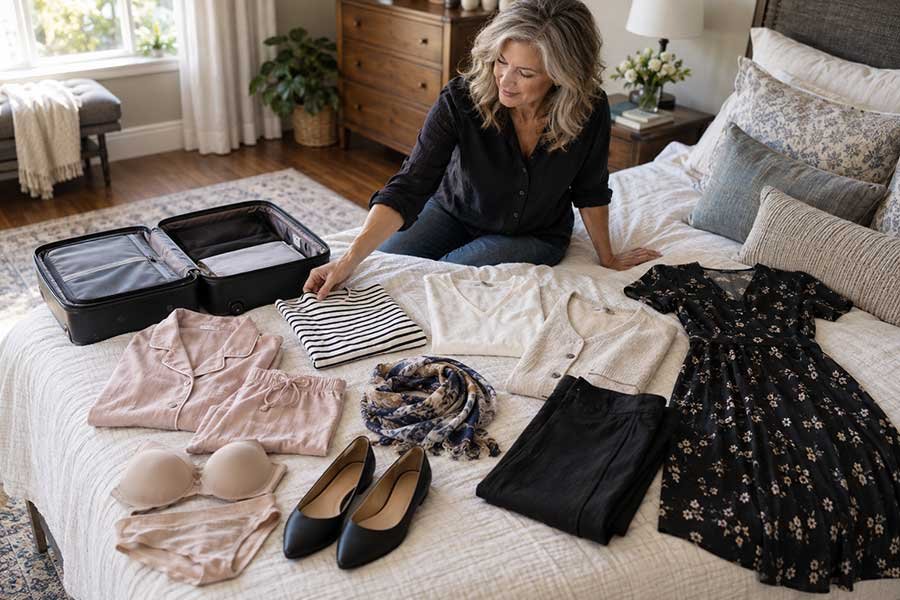
The three-outfit-into-six-looks system: three clothing items chosen to mix and match across every occasion the weekend presents. A versatile midi dress that reads casual with a denim jacket and sneakers and elevated with a blazer and the one pair of shoes. A well-fitted jeans or trouser that pairs with both the casual top and the nicer blouse. A soft casual top and a slightly more elevated blouse that each work with the jeans and with the dress worn as a skirt with a belt. The accessories, specifically a silk scarf or a statement necklace, change the register of each combination without adding a new clothing item. Six distinct looks from three clothing items plus two accessories, covering every occasion a two-night trip produces, in a packing volume significantly smaller than four separate complete outfits and at a fraction of the bag weight.
The coordination requirement for the three-piece weekend wardrobe is the same as for any travel wardrobe: a shared neutral palette where every piece works with every other piece. The cream blouse works with the dark-wash jeans and with the navy midi dress worn as a skirt. The denim jacket layers over the cream blouse and over the midi dress. The one pair of shoes works with the jeans, with the dress, and with the elevated blouse combination. If any piece requires its own separate partner that is not already in the bag, it is an orphan that adds volume without proportionally adding looks. The three pieces that produce six combinations justify their bag space. The fourth piece that adds one combination and requires a specific partner that was not going to be packed is the piece that converts the weekender bag into a rolling suitcase.
The combination test before packing any weekend bag: hold each piece against every other piece in the intended collection and count the complete outfit combinations. Three pieces with full cross-compatibility produce six combinations (three pairings of two plus the full three-piece look at two registers — casual and elevated versions). The piece that pairs with only one other piece is the piece to leave home. The weekend is two nights. Six combinations is two more looks than the weekend will ever require, which means there is room in the weekend bag for the one discovery the trip produces along the way.
The best weekend travelers pack in twenty minutes and spend zero time at baggage claim.
A weekend trip only needs a weekender bag if you pack it with intention. Intention is three pieces that become six looks and one bag that fits under the seat.
Pack the weekend wardrobe’s one accent piece — the silk scarf, the statement earrings, the bold necklace — rather than the fourth clothing item when the combination count is already sufficient for the weekend’s occasions. The accent piece weighs under fifty grams, takes no meaningful bag space, and produces more visual differentiation across the weekend’s photographs than a fourth top that is the same register as one of the three already in the bag. A woman wearing the same three neutral pieces across a two-night trip in different combination sequences looks like a deliberate and considered packer in the photographs. The same woman with the silk scarf in a different position in each photograph looks like a woman who travels with a full wardrobe that changes every scene. The accessory is the multiplication tool that replaces the additional clothing item.
Let Us Book the Weekend Getaway Worth Packing This Smartly For
The right weekend trip is close enough to get there in a few hours and interesting enough to fill three days completely. The coastal town, the mountain lodge, the city that is three hours away and always worth the drive. Tell us what kind of weekend you are looking for. We will build the trip. You build the six-look bag.
Plan Our EscapeThe shoe category is the weekend bag’s heaviest single item category and the category most consistently overpacked relative to the occasions a two-night trip actually produces. Four pairs of shoes for a weekend trip — a casual sneaker, a walking sandal, a dressed sandal, and a dinner shoe — is four shoes for a trip with a maximum of six outfit changes, of which approximately two will be at the nice-dinner register that might warrant the dressed shoe and four will be at the casual-to-smart-casual register that the single versatile pair handles. The weight and volume of the four-shoe weekend bag is disproportionate to the occasion differentiation it provides, and the single versatile shoe paired with the three-piece wardrobe handles every occasion the weekend produces at a fraction of the shoe category’s weight.
The single versatile weekend shoe is the shoe that occupies the middle ground between casual enough for the daytime activities and elevated enough for the evening dinner. For most women’s weekend travel contexts, this is a leather sneaker in a neutral color that reads as intentional rather than athletic, a low block-heeled mule or slide that works on a city’s day walks and the restaurant’s evening lighting, or a quality leather sandal that transitions between the afternoon’s cobblestone and the dinner’s candlelight without requiring the register change that a fully casual vs. fully formal shoe separation would produce. The specific shoe depends on the destination and the trip’s specific occasion mix. The criterion is the same: one pair that covers the full occasion range of the specific weekend without any moment where a second shoe would have been genuinely necessary rather than simply preferred for aesthetic differentiation.
Test the chosen single shoe for the full day’s wear demand before the trip rather than during it. A shoe that is comfortable for two hours at home may have a specific comfort limitation that reveals itself at hour five of a day that includes a morning walk to the farmers market, an afternoon gallery visit, and an evening dinner reservation. The pre-trip full-day wear test, wearing the chosen single shoe for a day of comparable activity before the trip, confirms the shoe handles the weekend’s actual demands and eliminates the day-two blister discovery that produces the specific weekend afternoon where the trip’s pace is determined by the feet’s tolerance rather than the destination’s offerings.
If the weekend’s specific occasion mix genuinely requires two distinct shoe registers — a hiking or beach morning and a formal evening dinner at the same destination — pack both but pack one as the worn-on-travel-day shoe and one as the bag shoe rather than both in the bag. The heavier or bulkier shoe worn on the body during the drive or the flight costs zero bag volume and zero bag weight. The lighter shoe in the bag is the only shoe the bag accommodates in the footwear category, which is still one pair rather than two. The two-shoe weekend trip that uses this approach has the same bag volume as the one-shoe weekend trip and zero bag weight contribution from the travel-day shoe.
The weekend toiletry pouch is the toiletry category stripped to the genuine two-night minimum rather than the home bathroom routine deployed in full. A two-night trip requires: toothbrush and a small amount of toothpaste, face wash and moisturizer or the combined products that handle both, the specific essential that cannot be skipped without discomfort (for most women, some combination of mascara, foundation or tinted moisturizer, and one lip product), deodorant, shampoo and conditioner if the accommodation does not reliably provide them, and any essential medication or personal care product specific to the individual’s needs. Everything else in the standard home bathroom routine is aspirational for a two-night trip — nice to have if the home routine were being replicated, genuinely unnecessary for the two nights’ actual personal care needs.
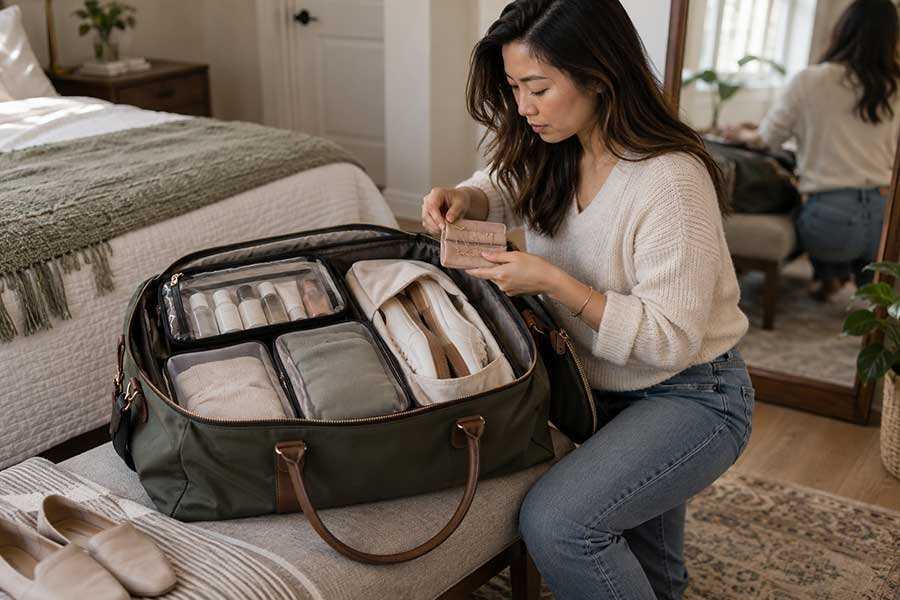
The slim toiletry pouch, rather than the full-size hanging organizer, is the container format that enforces the genuine essential standard. A small zippered flat pouch with enough interior space for the actual essential list and no surplus space for the just-in-case additions that the larger toiletry bag encourages by virtue of having room for them. The physical size of the pouch is the governing constraint: if the pouch cannot close comfortably with the items inside it, the items exceed the two-night genuine essential standard and one or more items needs to return to the bathroom cabinet. The slim pouch’s forced selectivity is not a limitation. It is the organizational tool that converts the aspirational packing of the full bag into the intentional packing of the weekend system.
Travel-size or decanted versions of every liquid and gel product in the slim pouch serve two simultaneous purposes: they keep the pouch’s total weight low, and they ensure compliance with the carry-on liquids rule for the weekend trip that involves a flight. The decant for a two-night trip is sized specifically for the weekend: a small amount of each product rather than a travel bottle filled to its capacity. The weekend does not require the full travel bottle. It requires approximately two applications of each product across the trip’s duration, which is a fraction of the travel bottle’s capacity and an even smaller fraction of the full-size product’s capacity. Size the decant to the two nights’ actual consumption rather than to the travel bottle’s maximum capacity.
Keep a permanently packed weekend toiletry pouch rather than assembling one before each weekend trip. A small pouch with pre-filled mini bottles of every essential product, restocked after each use, is the weekend toiletry system that is ready in thirty seconds rather than assembled in thirty minutes. The permanent pouch also serves as the record of what is genuinely essential on a weekend trip: only the items that have been used from the pouch across multiple trips earn the permanent slot. Items added hopefully and unused across three consecutive trips are removed. The pouch becomes increasingly accurate over time, approaching the genuine two-night minimum inventory that the article describes rather than staying at the aspirational full-routine level where the assembled-fresh-each-time pouch begins.
Find Booking Ideas and Travel Essentials on Our Favorites Page
Our favorites page has helpful booking ideas and travel essentials that we have found genuinely useful for weekend trips and beyond. Whether you are in the planning stage or looking for things that make weekend travel easier and more enjoyable, take a look when you have a moment.
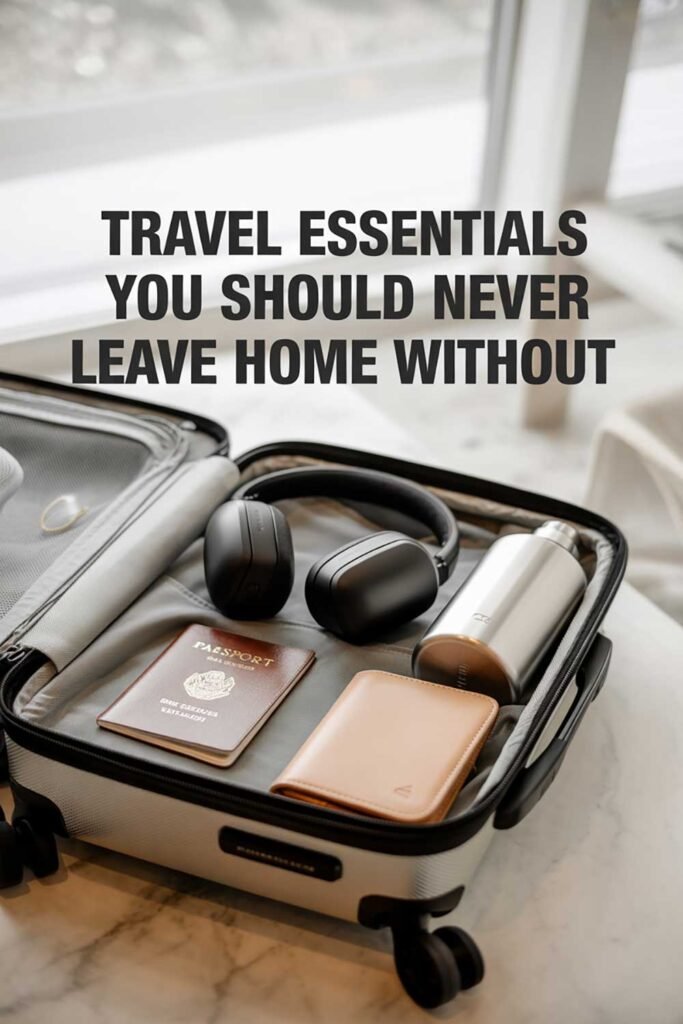
DND FavoritesThe charger is the non-negotiable functional essential of the modern weekend trip. The phone at 20 percent at 6 p.m. on Saturday in the middle of a city where the accommodation address is stored only in the booking app is the specific weekend trip scenario that the packed charger prevents and the forgotten charger produces. The charger in the weekender bag rather than in the outlet where it normally lives requires the specific habit of including it in the weekend packing checklist as an explicit item rather than trusting it to the automatic-habit memory that consistently leaves it in the outlet. One phone charger, one laptop charger if the laptop is coming, and a compact power bank for the day when the phone needs a mid-afternoon top-up and the accommodation outlet is not available: these three items together weigh under three hundred grams, fit in the weekender bag’s interior zip pocket, and provide complete power coverage for the full weekend regardless of outlet availability.
The one thing that makes wherever you sleep feel a little more like home is the weekend bag’s personal comfort item — the single small luxury that costs almost no bag space but produces the specific quality of the first night in an unfamiliar bed that distinguishes the weekend traveler who arrives and is immediately at ease from the weekend traveler who is aware of every unfamiliar element of the accommodation through the first morning. This item is different for every traveler. For some it is the specific pillow case from home that replaces the hotel pillow case because the tactile familiarity of a known fabric produces sleep at a pace that the unfamiliar hotel fabric does not. For others it is a small candle, the specific scent associated with home, lit for the twenty minutes before bed that the hotel room’s generic smell is replaced with the familiar. For others it is the travel sleep mask that is used at home and produces the specific darkness associated with sleep regardless of the hotel room’s curtain performance. Whatever the specific item, it is small, it is personal, and its presence in the weekender bag converts the first night at an unfamiliar destination from an awareness-of-the-unfamiliar experience into the beginning of the relaxed weekend the trip was planned to provide.
The combination of the charger and the personal comfort item represents the practical and the psychological infrastructure of the weekend bag: the charger ensures the phone works and the trip functions at the practical level, and the comfort item ensures the traveler functions at the personal level. Neither is a luxury in the weekend bag. Both are essential, and both weigh and take space that is negligible relative to their contribution to the weekend trip’s quality from the first evening through the last morning.
Pack the charger in a small cable organizer pouch that also contains the earbuds and any other cables needed for the weekend, stored as a unit in the weekender bag’s interior zip rather than loose throughout the bag. The weekend bag excavation to find the charger that is somewhere among the clothes is the specific twenty-second inconvenience that is entirely preventable with a consistent cable-and-accessories pouch that is always in the same interior zip location. The pouch weighs thirty grams, takes the space of a deck of cards, and converts the charger from an item that needs to be found to an item that is always in the same place.
The complete smart weekender system assembles the five elements in this article into a twenty-minute packing session that produces a bag the overhead bin accepts and baggage claim never sees. The system is not a rigid list. It is a set of standards — combination count, shoe count, pouch size, charger plus comfort item — applied to whatever specific clothing, shoes, toiletries, and personal items the specific weekend and the specific traveler require.
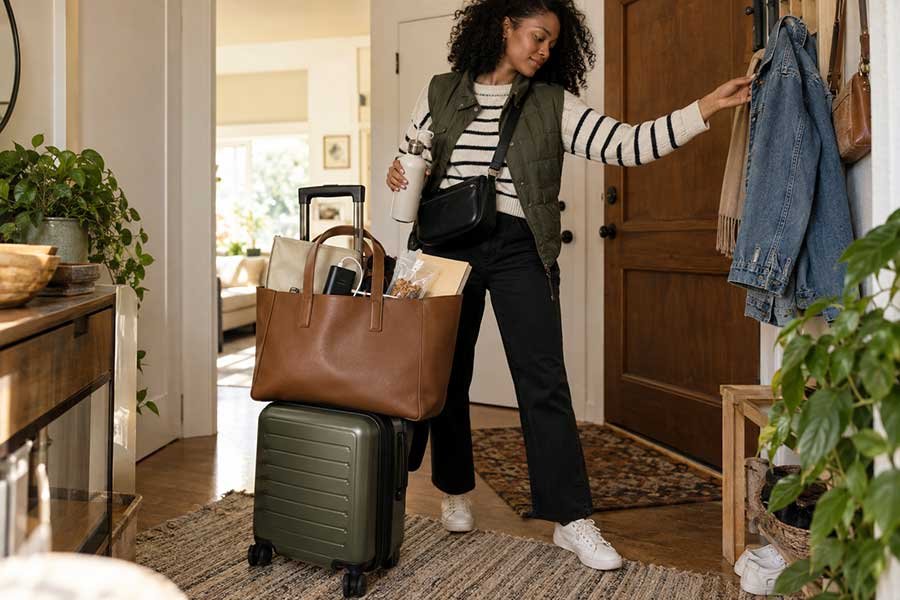
The weekender bag itself: a soft-sided duffel or structured tote of approximately twenty to thirty liters, sized to fit in the overhead bin or under the seat of any standard commercial aircraft and any car’s back seat without occupying significant space. The bag that determines what goes in it rather than the bag that expands to accommodate whatever was packed. The soft-sided duffel that cannot be closed until the contents fit is the external constraint that enforces the weekend packing standard when the internal constraint of deciding what is genuinely necessary occasionally fails under the optimistic pre-trip sense that more might be needed.
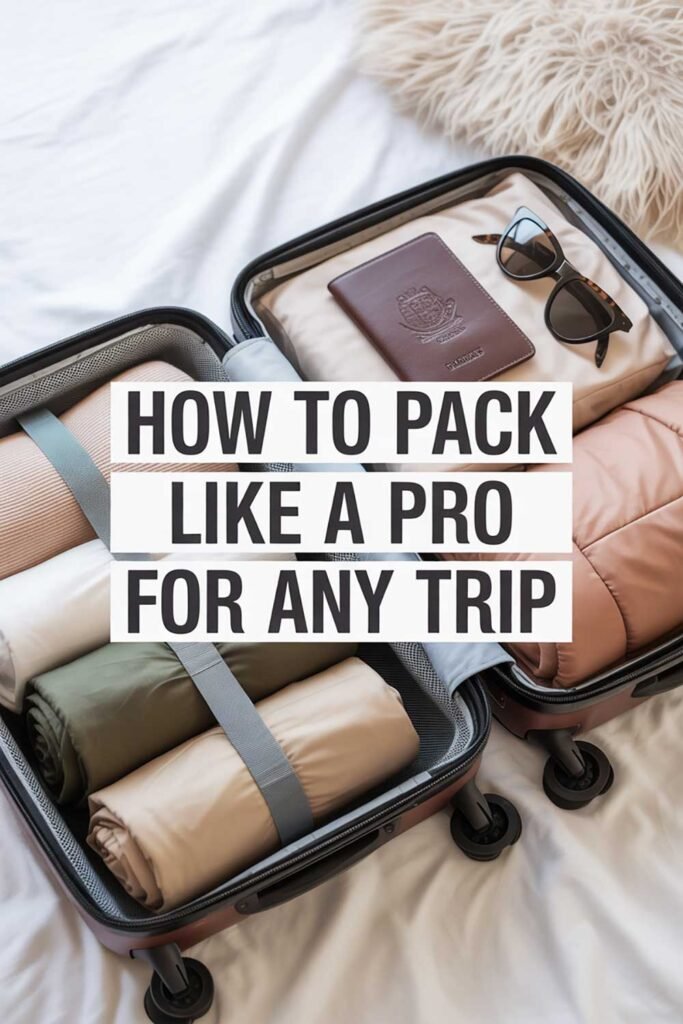
The packing order: clothing first, in the rolling or flat-fold arrangement that maximizes the bag’s available space for the clothing category. Shoes tucked into the ends of the bag or in a shoe bag against the bag’s side panel. The slim toiletry pouch on top of the clothing, accessible without unpacking anything. The cable organizer pouch with charger and earbuds in the interior zip pocket. The comfort item in the bag’s most accessible interior section. The bag closes. The combined weight is under seven kilograms. The packing session from the moment of opening the bag to the moment of closing it is under twenty minutes when the three clothing pieces are confirmed coordinating and the slim pouch is already assembled from the previous weekend trip.
The twenty-minute packing standard is not aspirational for a traveler who has used the system two or three times. It is the natural packing time of a traveler who is not deciding which of seventeen tops to bring because there are three confirmed-coordinating tops in the collection, not deciding whether the third pair of shoes will fit because there is one pair already in the bag, and not assembling the toiletry pouch from the full bathroom cabinet because the permanently packed slim pouch is in the drawer ready to go. The system is not speed. The system is the absence of the decisions that take time and produce the overpacked bag simultaneously.
Apply the twenty-minute standard as a test of the system rather than as a target to achieve under pressure. If the weekend packing session is consistently taking longer than twenty minutes, the specific source of the excess time is the diagnostic information: too many clothing decisions means the coordination is not pre-established; too much time on toiletries means the slim pouch is not pre-assembled; too much time on shoes means the single-pair standard has not been accepted for this trip’s occasion mix. Each excess time source points to the specific system element that needs attention, which is more useful information than the general sense that the packing is taking too long.
Four Women, Four Rolling Suitcases, and a Two-Night Trip
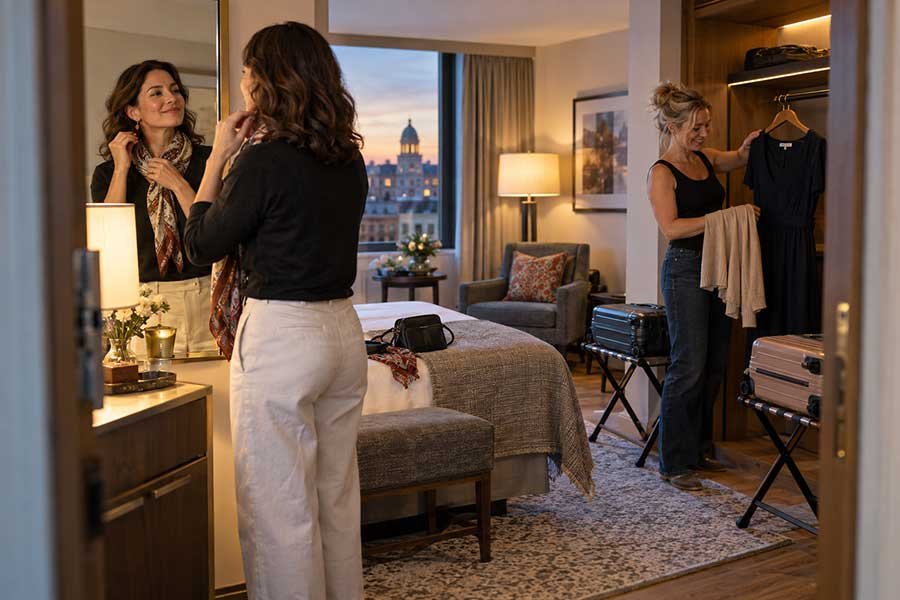
Zara and three friends had been taking girls weekends together for several years when they acknowledged the specific recurring dynamic: every trip began with a group photo at the departure point that included, in the background, a quantity of luggage that suggested a two-week international trip rather than a forty-eight-hour girls weekend. Four women. Four rolling suitcases. One weekend. The group did not discuss this. It was simply what a girls weekend looked like in their iteration of it: maximum outfit options, full beauty routines deployed in travel format, and the specific Saturday afternoon conversation of what everyone was going to wear that night that took twenty minutes to resolve because everyone had brought six options for the one dinner.
Zara started noticing what she wore and did not wear across multiple girls weekends. She noticed that out of the six outfit options packed for each trip, she wore three. She noticed that of the four shoes packed for each trip, she wore one for the majority of the trip and changed into the second for the one dinner that warranted the shoe change. She noticed that the full toiletry bag she packed for each trip contained products she used twice — the first time to unpack them onto the bathroom counter and the second time to return them to the bag. She counted: across her last three girls weekends, she had packed approximately thirty items she did not use.
For the next girls weekend, a two-night stay in a coastal town three hours from home, she packed differently. Three clothing items in coordinating neutrals that she had laid out and confirmed produced six complete combinations. One pair of leather sandals that she wore on the drive and that handled every occasion of the two days. A slim pencil pouch from her desk, borrowed for the weekend and filled with the specific seven personal care items she actually used on previous trips. Her charger in a cable organizer in the bag’s interior zip. Her silk sleep mask, the one item that made the first night at any accommodation genuinely restful for her. The bag weighed four kilos. It fit in the car’s back seat without occupying significant space. The drive to the coastal town was the beginning of the weekend rather than the logistics management of the luggage.
At the house they had rented for the two nights, her three friends were still unpacking from their rolling suitcases when Zara had unpacked completely, hung the three pieces in the closet, and was already out on the deck with a glass of wine watching the water. Her friends noticed. They asked what was in the bag. She explained the system. By the end of the trip, all three had photographed the bag and asked her to send them the list. This article is the list they asked for, and the system Zara built from thirty unused items across three girls weekends and one deck on a coastal evening where she was the only one sitting down while everyone else was still arranging their shoes.
Beyond the five core weekend packing elements, these six additional approaches address the specific weekend packing challenges that most women encounter and that the smart weekend traveler has already resolved.
Choose a weekender bag with a flat base that stands upright rather than a soft duffel that collapses under its own weight. A bag that stands upright on the accommodation’s floor or desk is a bag that is accessible without the archaeological effort of finding the collapsed bottom’s contents. A bag that collapses becomes its own packing problem at the destination: the clothing shifts to the bottom, the toiletry pouch migrates under the shoes, and the charger cable wraps around the sleeve of the one top that needs to be accessible for the morning. The structured base is a thirty-second packing quality-of-life improvement that has no downside except the slightly higher cost of the bag that provides it.
Pack the outfit for the first activity at the top of the bag rather than at the bottom. The weekender bag arrived at the accommodation and the first-activity outfit is at the bottom under the sleep items under the second day’s clothes under the shoes. The arrival is not an unpacking event for a two-night trip if the bag’s top layer is the outfit in immediate demand. Pack chronologically from the top: arrival and first-day items at the top, sleep and second-morning items in the middle, travel home items at the bottom. The bag opens once on arrival and produces the immediately needed item rather than producing the full-bag excavation that begins the trip with an unpack rather than with whatever the first activity was planned to be.
Bring a small reusable shopping tote or mesh bag folded flat in the weekender. The weekend produces discoveries: the farmers market with the jar of local honey, the bookshop with the one book that was genuinely unexpected and needed, the local ceramics that cost twelve dollars and weighed under two hundred grams and was the weekend’s best find. The flat tote stored in the weekender’s interior zip is the container that handles the weekend’s discoveries without requiring them to compete with the clothing for the bag’s available space on the return trip. The tote weighs thirty grams and folds to the size of a phone. The discoveries it accommodates on the return are the weekend’s best stories.
Decide on the evening before the weekend whether the trip is carry-on only or involves checking a bag, and pack accordingly from the start rather than attempting the carry-on and then converting to checked when the bag does not close. A weekend trip that is car-based has no bag size or weight constraint and the weekender bag approach is a choice rather than a requirement. A weekend trip that involves a flight enforces the carry-on constraint and requires the weekender bag approach as the practical standard. The traveler who decides carry-on before packing makes the combination count, one-pair shoe, and slim pouch decisions easily because the carry-on constraint enforces them. The traveler who attempts carry-on and converts to checked partway through the packing session makes no decisions and packs everything that was going to go in the rolling suitcase anyway.
Leave the Sunday outfit at home and wear the Saturday casual outfit home on Sunday. The Sunday return trip does not require a distinct third-day outfit. The Saturday daytime casual outfit that was clean for the morning, worn for the day, and in excellent condition by the evening is the Sunday return trip outfit at no additional packing cost. The third distinct outfit in the weekend bag is better deployed as the second outfit combination of the existing three pieces — the alternative pairing that the combination count confirmed was available — rather than as a separate complete outfit that breaks the coordination system and adds volume for a occasion (the Sunday drive home) that does not require a distinct look.
Bring a portable phone stand or fold a small card to prop the phone for the video call that the weekend away from home consistently produces. The weekend trip FaceTime with the children, the partner, or the friend who could not come is a video call made from a phone propped on a nightstand against a water bottle on Saturday evening, which produces the specific view of the ceiling and one eye that video calls from unsupported phones consistently produce. A pocket-sized foldable phone stand weighs fifteen grams, fits in the cable organizer alongside the charger, and produces the video call quality that the hand-held and the nightstand-propped alternatives do not. It is also the stand that props the phone for the recipe when the group is cooking at the rental house, for the movie when the accommodation has no convenient screen, and for the photography timer when the group photo needs everyone in the frame rather than one friend behind the lens.
Build a weekend-specific version of the master packing checklist that is shorter and more targeted than the full multi-week travel checklist. The full packing checklist applied to a weekend trip includes categories that do not apply — international documents, destination-specific medications, currency exchange, and the extensive electronics setup for a two-week trip — and produces a checklist that is longer to review than the weekend packing session itself. The weekend-specific checklist has four categories: three-piece wardrobe plus accessories, one shoe pair plus socks, slim pouch contents, and practical items (charger, comfort item, flat tote, cable organizer). The weekend checklist review takes three minutes and confirms every item in every category before the bag is closed. The full checklist reviewed for a two-night trip takes ten minutes and includes thirty items that do not apply to the weekend’s actual requirements.
Book the Weekend Destination Worth Taking the Smart Bag To
The smart weekender system earns its full return when the destination is worth every minute spent there rather than at baggage claim. Our travel agents know the weekends worth booking. Let us plan yours.
Book A TripCommon Weekend Packing Mistakes to Avoid
Most weekend overpacking comes from the same consistent patterns. These are the ones that turn a two-night trip into a four-bag group photo.
Packing for every possible version of the weekend rather than the version that will actually happen
The weekend that might include a formal event, a beach morning, a hiking afternoon, and a black-tie dinner is not the weekend that a two-night getaway to a coastal town actually produces. The weekend that actually happens has a casual day, a nice dinner, and a morning departure. The wardrobe for the actual weekend is three coordinating pieces and one pair of shoes. The wardrobe for the possible weekend fills a rolling suitcase. Pack for the itinerary as it is planned and trust the destination’s infrastructure for the rare scenario addition that was not anticipated.
Packing multiple pairs of shoes for a two-night trip
Two nights produces at most two distinct footwear moments: the casual day and the evening. One versatile shoe pair handles both moments in the majority of weekend contexts. The second pair for the one dinner that warranted the shoe change weighs and takes bag space for two days of travel in exchange for one evening’s aesthetic differentiation. Wear the bulkier or heavier shoe on the travel day and leave the second pair in the bag’s footwear pocket or leave it at home. The weekend has not yet been invented that required four shoe changes to navigate successfully.
Packing the full home toiletry routine rather than the weekend essentials
The twelve-step home beauty and personal care routine is the home routine calibrated for a life that includes unlimited bathroom time, full product access, and no competing activity for the time that the routine requires. The weekend routine is the minimum version that keeps the traveler comfortable and presentable for two days. The slim pouch enforces this minimum by its physical size. The full-size hanging organizer has no such enforcement mechanism and consistently produces the home routine in miniature travel format rather than the genuine two-night essential list that a weekend trip requires.
Not confirming that the three clothing pieces actually coordinate before packing them
Three clothing pieces chosen from the closet without a physical coordination test may each be versatile individually and fail to produce the six-combination count the system promises if they do not share a common palette or functional compatibility. The cream blouse does not pair with the red-print midi dress and the rust-orange blazer. The navy midi dress, the cream blouse, and the tan blazer each pair with each other. The combination test, physically holding each piece against every other piece before any item goes in the bag, confirms the coordination that the packing system requires and catches the coordination gap that the mental wardrobe preview consistently misses.
Packing the charger as an afterthought rather than as a confirmed bag item
The charger in the outlet where it normally lives is the charger that is missing from the bag when the bag is zipped. The charger feels too obvious to pack incorrectly because it is the one item everyone knows to pack. It is the one item that is consistently left in the outlet because its obviousness produces the confident assumption that it will be remembered at the right moment, which is the assumption that produces the phone at 20 percent on Saturday evening. The charger is on the weekend checklist. The checklist is checked. The charger is in the bag. The assumption is replaced by confirmation.
Not leaving room in the bag for what the weekend produces
A weekender bag packed to capacity at departure has no room for the farmers market jar, the bookshop find, or the ceramics from the local artisan. The weekend getaway is the most likely of all trips to produce a small discovery worth bringing home because the destination’s character is accessible and the specific things that make the destination worth a weekend are findable at its markets, its shops, and its galleries. Pack to eighty percent of the bag’s comfortable capacity and store the flat tote in the interior zip for the discovery that the remaining twenty percent can accommodate in the bag and the tote can accommodate in overflow.
Love Helping Women Plan Perfect Weekend Getaways?
The weekend trip that is actually worth packing smartly for is the weekend trip that was worth planning. If becoming a home-based travel agent who helps women plan beautiful weekends, girls trips, and every kind of getaway in between sounds like the right next step, see how the TravelPreneur system works. Earn commissions and build a real business from anywhere.
Become An AgentFrequently Asked Questions
These are the questions women ask most often about packing smart for weekend trips. Real answers from real weekend travel experience.
What size weekender bag is right for a two-night trip?
A weekender bag of twenty to thirty liters capacity handles the three-piece wardrobe, one shoe pair, a slim toiletry pouch, the charger and cable organizer, the personal comfort item, and the flat tote with room to spare for most women’s weekend packing at the intentional level this article describes. The specific bag dimensions that fit in the overhead bin on most commercial aircraft are approximately twenty-two by fourteen by nine inches or the equivalent, though carry-on limits vary by airline and fare class and should be confirmed for any trip that involves a flight. For a car-based weekend trip with no airline bag size or weight constraint, the bag size is a comfort and mobility choice rather than a compliance requirement, and the weekender in the twenty-to-thirty-liter range produces a bag that is comfortable to carry, easy to store in any car’s back seat or boot, and light enough to carry from the parking area to the accommodation without the rolling suitcase’s wheels. The bag that the contents determine is not the bag worth having. The bag that the contents must fit into is.
How do you pack for a weekend that has genuinely different occasion types, like a casual day and a formal event?
A weekend with a genuine occasion span from casual daytime to formal evening requires an adjustment to the one-shoe standard but not necessarily to the three-piece wardrobe standard. For a formal event, one elevated piece — the occasion dress that reads as formal — replaces one of the three standard wardrobe pieces and paired with the second shoe (worn on travel day), handles the formal occasion without requiring the casual day wardrobe to extend to a formal register it was not designed for. The total clothing count remains three pieces. The total shoe count is two, with one worn on travel day. The total bag volume for a weekend with a formal event is one occasion dress, one casual top, one versatile bottom, one casual shoe in the bag, one formal shoe on the body during transit, one slim toiletry pouch, and the practical items. The formal occasion expands the shoe count by one and replaces a casual piece with an occasion piece. It does not require a separate formal wardrobe in addition to the casual weekend wardrobe.
What is the one personal comfort item most worth bringing on a weekend trip?
The answer is genuinely personal and differs between travelers, which is why this article defines the category by function rather than by a specific item. The functional test for the weekend comfort item: what single small item from the home environment most reliably affects the quality of the first night’s sleep in an unfamiliar bed? For many women this is a specific pillow case, sleep mask, or pillow spray whose scent or tactile quality is associated with home sleep rather than hotel sleep. For others it is a specific small ritual item: a candle, a specific tea, the book that is currently being read. The item that most reliably activates the psychological transition from travel mode to rest mode in an unfamiliar environment is the item worth the small bag space it occupies. It does not need to be the same item every trip. It needs to be the specific item for the specific traveler that turns wherever they sleep into somewhere they genuinely rested.
How do you handle packing for a girls weekend when everyone in the group packs differently?
The individual packing decisions of each group member are individual decisions that the smart weekend packer applies to her own bag regardless of what the others are packing. The value of the smart weekender system is not that it produces a matching aesthetic among the group but that the individual who uses it arrives at the destination with everything she needs, in a bag that does not require checking, with time and mental bandwidth that the overpacker is using to manage luggage. The group photo at the destination looks the same. The arrival experience is different: the smart packer is on the deck with the wine while the group is still arranging their shoes. The system’s return is personal. Share this article before the next trip and let the system’s demonstration produce the group conversion that abstract argument cannot.
Is it possible to pack a full makeup routine into a slim weekend toiletry pouch?
Yes, with the specific selection of multi-function products that do the most work for the least bag space. The full ten-product makeup routine applied at home in a well-lit bathroom with unlimited time produces a finished result that is genuinely excellent. The weekend trip’s makeup routine applied at the accommodation in a reasonable amount of time with a smaller product selection produces a result that is genuinely very good. The specific products that bridge the gap between the full routine and the weekend minimum most efficiently: a tinted moisturizer with SPF that replaces the foundation and the separate SPF application, a lip and cheek product that does both functions, a mascara, and one eye pencil or liner for the occasions the weekend’s occasion mix includes. These four items in a slim pouch weigh under two hundred grams collectively and produce the finished weekend look that the full routine’s equivalent result produces at four times the weight and three times the pouch volume.
What is the best fabric for weekend trip clothing that looks good across multiple wearings?
The fabrics that perform best across the weekend’s two-to-three wearings of each piece are the fabrics that combine wrinkle recovery, lightweight feel, and the specific quality of looking as intentional on day two as on day one. Fine merino jersey, matte crepe, and ponte knit are the three fabric categories that most consistently meet these requirements for the weekend wardrobe’s tops and bottoms respectively. Fine merino jersey recovers from packing compression quickly and produces a top that looks as fresh at Saturday dinner as it did at Friday arrival. Matte crepe holds its drape and its structure through a day of wear and a night in the bag without the significant wrinkle that structured wovens accumulate. Ponte knit provides the trouser weight and structured appearance without the wrinkle sensitivity that most woven trousers exhibit after a day of sitting and walking. The fabric test before the trip — scrunch the item firmly for thirty seconds and observe whether the creases release in thirty minutes — is the thirty-second test that prevents the Saturday dinner discovery that the planned outfit is irretrievably wrinkled from the bag.
The woman who arrives at the weekend with one bag and a glass of wine on the deck while everyone else is still unpacking is not the lucky traveler. She is the one who packed with intention before she left.
Picture the Friday Arrival
The bag weighs four kilos. It fit in the car’s back seat rather than the boot. At the accommodation, you lift it from the car with one hand. You unpack in three minutes: the three pieces on hangers in the closet, the slim pouch on the bathroom counter, the cable organizer in the nightstand’s outlet. The silk sleep mask is on the pillow. You are on the deck with the wine before your friends have found their second pair of shoes in the rolling suitcase. You packed in twenty minutes. You spent zero time at baggage claim. The weekend started at the driveway. That is the system. That is every weekend from here.
One More Thing Before You Pack the Weekender
Print our free Travel Packing Checklist and use the weekend section as the four-category confirmation that every smart weekender system element is in the bag before it closes. The wardrobe, the shoes, the slim pouch, and the practical items. Three minutes to confirm. The same checklist we recommend before every weekend trip we take together.
Get the Free ChecklistExplore Our Top Picks for a Better Trip
Visit our favorites page for helpful booking ideas and travel essentials that we have found genuinely useful for weekend trips and every kind of getaway. Whether you are planning your next escape or looking for things that make smart packing easier, it is worth a browse.
See Our Top PicksTravel Prints and Printables From Our Shop
Visit Premier Print Works for weekend packing list printables, trip planning journals, weekend getaway planners, and wall art that makes every trip a little more beautiful and a lot more organized from the Friday afternoon the weekender bag is zipped to the Sunday evening the best weekend discovery is on the kitchen counter at home where it belongs.
Visit Premier Print WorksDisclaimer
The information shared in this article is provided by Don and Diana’s Travels for general informational, educational, and inspirational purposes only. It reflects our personal experiences, opinions, and the experiences of travelers we have worked with. It is not professional travel, legal, financial, or medical advice, and it should not be relied on as such.
Airline Baggage Policies
Airline baggage policies, carry-on size and weight limits, and bag fee schedules change frequently and vary by airline, fare class, route, and booking conditions. Always confirm current baggage policies with the specific airline for the specific booking before travel. We are not responsible for any baggage fee, gate check, or baggage-related outcome arising from information in this article.
Affiliate and Partner Links
This article may contain affiliate links, partner links, referral links, and links to products or services that pay us a commission. If you click a link and make a purchase or complete any qualifying action, we may earn a small commission at no extra cost to you. Our recommendations are based on real use and genuine belief in the products and services we share.
Third-Party Websites and Services
We may link to third-party websites, services, and resources for your convenience. We do not control these sites and are not responsible for their content, terms of service, pricing, availability, or any product or service they sell. Your use of any third-party site is entirely at your own risk.
Health, Safety, and Personal Responsibility
Travel involves personal risk. You are solely responsible for your own health, safety, travel insurance, medications, vaccinations, documentation, financial decisions, and choices while planning or taking any trip. We strongly recommend purchasing comprehensive travel insurance for every trip. Don and Diana’s Travels, its owners, employees, contractors, and affiliates accept no liability for any loss, injury, illness, delay, cancellation, damage, theft, or inconvenience arising from your use of the information in this article or from any travel decisions you make.
Composite Stories and Characters
Some stories, examples, and traveler experiences shared on this site are composites drawn from the real experiences of Don, Diana, clients, friends, and travelers we have worked with over the years. Names, identifying details, locations, and circumstances may be combined, changed, or fictionalized to protect privacy. Any resemblance to a specific real person beyond the composite portrayal is unintentional.
No Guarantees
We do not guarantee any specific result, outcome, savings, or experience from using the information, tips, services, or products mentioned in this article. Your results depend on many personal factors including your own choices, effort, circumstances, and external conditions outside of our control.
Copyright and Use
All content in this article is the copyrighted property of Don and Diana’s Travels unless otherwise noted. You may not copy, republish, redistribute, modify, sell, or reuse our content without our prior written permission. You are welcome to share a direct link to this article with proper credit.
By reading and using the information in this article, you acknowledge that you have read, understood, and agree to this disclaimer in full.