Carry-On Travel Essentials for Flights
Your carry-on should have everything you need for the journey without you ever having to stand up and open the overhead bin. The most comfortable traveler on any flight packed their carry-on like their checked bag might never arrive. This article builds the under-seat personal item that makes every flight better from boarding to landing.
Grab Our Travel Packing Checklist
Our free packing checklist includes the flight essentials section with every personal item and under-seat category organized separately from the main checked or carry-on luggage list. Print it before your next flight and pack the flight essentials bag independently from the travel bag, which is the organizational approach that produces the under-seat personal item that actually has everything needed at seat level for the full journey.
Get the Free ChecklistThe flight entertainment system that depends on the airline’s seatback screen is the entertainment system that works until the seatback screen freezes, shows a library six months out of date, or is on the flight that does not have seatback screens at all — which is a meaningful share of domestic and regional flights and an increasing share of newer aircraft configured for connectivity rather than individual screen entertainment. The personal entertainment system loaded on the traveler’s own device before departure plays any content the traveler chose, is always functional independent of the aircraft’s screen condition, and provides the headphone quality and screen brightness preference that the shared aircraft seatback cannot. The key word is loaded: the streaming content that requires internet connectivity to play is not loaded. The downloaded content that plays in airplane mode without any connectivity is loaded.
Download entertainment before every flight on the home or hotel Wi-Fi where speed and reliability support the download. The specific downloads for any flight: one to two episodes of the television series currently being watched, one feature film as the longer-duration backup for the flights where the television series runs out before the descent begins, one or two podcast episodes in the specific format that works best for the flight’s context (a narrative podcast for the window seat with headphones in for four hours, a shorter-form podcast for the connection flight’s forty minutes), and one audiobook chapter or two for the traveler who prefers audio to screen during flight. The entertainment download session takes fifteen minutes the evening before departure or the morning of at home Wi-Fi and produces a device that can fill any flight duration from a one-hour domestic connection to a twelve-hour overnight long-haul without any connectivity dependency.
Noise-canceling headphones are the single most significant comfort upgrade available for any flight longer than two hours and are correctly categorized as an entertainment essential rather than a comfort luxury. The combination of downloaded content and noise-canceling headphones converts the aircraft cabin’s ambient noise environment, which includes engine noise, air conditioning, and the conversations and movement of the surrounding passengers, into a private audio environment where the content sounds as it was intended to sound. The difference between a four-hour flight in noise-canceling headphones with downloaded content and the same flight with earbuds and streaming content that pauses when the in-flight Wi-Fi drops is not subtle.
The e-reader or a physical book rounds out the entertainment kit as the low-power, screen-off alternative that does not require headphones and provides the different cognitive engagement of reading rather than watching during the sections of the flight where screen use produces eye strain or where the aircraft’s movement makes screen content less comfortable than text. An e-reader loaded before departure with two to three books provides hundreds of hours of reading content in a device lighter than a single paperback. A physical book is the backup for the traveler who prefers print and is the entertainment option that requires zero power and zero connectivity regardless of what else fails.
The most comfortable traveler on any flight packed their carry-on like their checked bag might never arrive.
Your carry-on should have everything you need for the journey without you ever having to stand up and open the overhead bin. That is the standard. Pack to it.
Pack a short cable organizer pouch or a small zippered flat case in the personal item specifically for the in-flight cables and accessories: the headphone cable or wireless headphone charging cable, the device charging cable, the airline seat adapter if needed for older aircraft audio jacks, and the power bank with its cable. These items loose in the personal item tangle, hide at the bottom, and are retrieved with the specific under-seat archaeology that undermines the organized personal item at the exact moment the boarding music plays and everyone wants their headphones. In the cable organizer, every item is in a specific slot, the pouch is at the top of the personal item for immediate boarding access, and the in-seat setup takes thirty seconds rather than the two-minute tangled-cable search.
Let Us Book the Trip Worth All This In-Flight Preparation
The best long-haul flight comfort system is wasted on a trip that does not earn the destination at the other end. Tell us where you want to go. We will book the trip worth the journey. You pack the personal item that makes the flight the beginning of the experience rather than the ordeal before it.
Plan Our EscapeThe aircraft seat is the one environment that every traveler occupies for hours without any ability to change its fundamental conditions: the seat is the seat, the temperature is largely outside individual control, the air is the cabin air, and the environment around the seat belongs to other passengers with their own preferences and movement patterns. The comfort kit does not change any of these conditions. It converts the traveler’s relationship to them by adding the specific personal comfort items that the aircraft seat does not provide and that make the hours in that seat an experience of comfortable travel rather than an endurance event.
The neck pillow is the comfort kit item with the most direct relationship to the quality of sleep and rest available on any flight. A pillow that supports the cervical spine in a natural sleeping position prevents the specific wake-up-with-a-stiff-neck outcome that the head-to-the-side unsupported sleep position produces in most aircraft seats. The memory foam neck pillow in a U-shape that wraps the back of the neck rather than resting on the collar bones is the most effective format for sleep support and collapses to half its size in a compression bag for storage in the personal item. A neck pillow purchased and used on the flight is the neck pillow that was slept on, arrives at the destination having served its function, and is on the next trip regardless of how much sleep the flight actually produced because its absence at 3 a.m. on an overnight flight is felt distinctly.
An eye mask and earplugs are the second and third comfort kit items of specific functional importance. The cabin lights that stay on for meal service and then dim but do not go off for the sleeping portion of the flight, and the window that the passenger three rows forward always opens during the dawn approach, are the specific light interruptions that an eye mask addresses completely. Earplugs provide the passive sound blocking for the traveler who is not using noise-canceling headphones during sleep, handling the engine noise and cabin ambient sound at a level that permits sleep of sufficient depth to provide meaningful rest. Both items weigh under twenty grams combined and take less space than a chapstick in the personal item’s side pocket.
A warm layer in the personal item rather than the overhead bin is the comfort item whose absence is most frequently felt and least frequently prepared for. Aircraft cabins are cold. They are deliberately kept at lower temperatures than most building environments for a combination of air circulation and passenger alertness reasons, and the temperature variance between the aircraft’s general cabin temperature and the individual passenger’s comfortable rest temperature is often significant. The light down jacket or the merino wrap that was packed in the overhead bin requires the passenger to stand, open the bin, retrieve the item, and disturb the row to return to the seat in a way that the same item in the personal item’s exterior pocket does not. Pack one warm layer within arm’s reach of the seat, not in the bin.
Include a small personal care refresh pouch in the personal item for long-haul flights over six hours. The refresh pouch contains a travel-size face mist, a small facial moisturizer, a lip balm, a travel-size hand lotion, a toothbrush and a small amount of toothpaste for the pre-landing freshening, and a few individually packaged cleansing face wipes. The aircraft cabin’s recycled low-humidity air dehydrates the skin and mucous membranes during long flights, producing the uncomfortable dry-skin and chapped-lips experience that most long-haul passengers manage with nothing. The refresh pouch applied at the three-hour and six-hour marks produces meaningfully more comfortable skin and a significantly fresher pre-landing feeling than the unmanaged dry cabin air alternative. The entire pouch weighs under two hundred grams and fits in the personal item’s exterior pocket alongside the earplugs and eye mask.
The checked bag that is delayed, misrouted, or lost at an international destination produces one of three outcomes for the traveler who packed a change of clothes in it: arrival at the first accommodation with no clean clothing until the bag arrives, a pharmacy and clothing store shopping trip on the first afternoon of the trip, or a significant wait at the destination airport filing a delayed baggage report before going anywhere. The traveler who packed a change of clothes in the personal item produces a fourth outcome: arrival at the first accommodation with exactly enough clean clothing for the first night and the first morning regardless of what has happened to the checked bag, the complete ability to proceed with the trip’s first evening plans without any detour, and the baseline personal hygiene and presentation capability that allows the first day to be a travel day rather than a lost-luggage management day.
The change of clothes in the personal item for any trip that involves a checked bag: one complete outfit appropriate for the trip’s first planned activity, which for most leisure trips is a casual first evening outfit and for business trips is the first meeting’s professional outfit. One complete change of underwear. The sleep items if the first accommodation is reached near the end of the day, since clean sleepwear on the first night after a long flight is a small comfort with a disproportionate restorative effect. These items fit in a small compression bag or a flat packing cube within the personal item without occupying significant space and provide the complete first-night and first-morning clothing independence from the checked bag that converts a delayed bag from a crisis into an inconvenience.
The change of clothes argument applies to carry-on only travel as well, though differently. The carry-on that is gate-checked on a full flight is the carry-on that follows the same delayed or misrouted path as a checked bag without the traveler having chosen to check it. Gate checking is more common on smaller regional aircraft, on full flights where overhead bin space runs out at the gate, and on flights where the airline enforces strict size compliance at the gate for carry-ons. A personal item that fits under the seat cannot be gate-checked because it is not placed in the overhead bin. The items in the personal item under the seat are with the traveler regardless of what happens to the carry-on in the overhead bin.
Pack the change of clothes in the personal item in a compression flat packing cube that can be transferred directly to the checked bag when it arrives and the personal item’s change-of-clothes slot can be used for something else for the return journey. The compression packing cube keeps the change of clothes organized and contained within the personal item during the flight and provides a clean transfer mechanism to the checked bag at the accommodation without requiring the personal item to be emptied and repacked around the clothing items. For the return journey, the compression cube returns to the personal item with the next trip’s change of clothes or with the souvenir or purchase that needs the personal item’s protected space for the homeward flight.
The In-Flight Essentials We Pack on Every Flight
The noise-canceling headphones that have converted every long-haul flight from an endurance event to a private theater, the memory foam neck pillow that compresses to a water-bottle size for the personal item and has never failed to produce at least two hours of inflight sleep on any overnight flight, and the power bank that has never landed at a destination with a dead phone. Real in-flight essentials picks from real frequent flyers.
DND FavoritesPower management for a flight begins at the gate rather than in the seat. The phone at 100 percent at boarding maintains enough charge for a domestic flight’s duration without any in-seat charging. The phone at 60 percent at boarding may not reach the destination at usable battery level, particularly on flights where the device is running entertainment, navigation references, and background apps simultaneously. Charge every device to 100 percent before every flight at whatever charging opportunity exists before the gate: the airport lounge, the terminal charging station, the restaurant outlet near the gate. The full-battery boarding is the power management decision that makes the power bank a backup rather than the primary power source for the flight.
The power bank in the personal item is the backup for the device that began the flight fully charged and still needs more charge by the end of a long-haul flight, and the primary source for the device that began the flight at less than full charge due to an unavoidable pre-departure drain. A power bank of at least 10,000 mAh provides two full phone charges and a partial tablet or laptop charge without occupying significant personal item space, weighs under 250 grams, and handles every power scenario a domestic or short-haul international flight produces. For long-haul flights of eight or more hours, a 20,000 mAh power bank provides sufficient charge for two phones and a full tablet charge. The cable for the power bank lives in the cable organizer alongside every other in-flight cable, confirming the power management infrastructure is complete at boarding rather than discovered incomplete at altitude.
In-flight snacks in the personal item address the specific gap between the airline’s complimentary snack service and the traveler’s actual hunger across a long flight. The airline’s snack service provides one snack packet and a beverage on a schedule determined by the flight’s service plan. A traveler who is hungry two hours before the service cart reaches their row has no recourse without their own provisions. In-flight snacks: mixed nuts or trail mix in a small container or sealed bag, a protein bar or two, dark chocolate or another calorie-dense treat preferred by the specific traveler, dried fruit, and any snack that satisfies the traveler’s in-seat hunger management without producing odors that affect the surrounding passengers (strong-smelling foods in a pressurized cabin with recycled air are a specific courtesy consideration).
The reusable water bottle filled after security is the hydration system that provides water at seat level throughout the flight without depending on the flight attendant service schedule. Aircraft cabin air has extremely low humidity, typically below 20 percent, which produces dehydration significantly more quickly than the traveler’s normal terrestrial environment. A traveler who is not actively hydrating throughout a long flight typically arrives at the destination mildly dehydrated in ways that amplify jet lag, fatigue, and the skin dryness that the cabin environment produces. A 500 to 750 ml water bottle filled at the terminal water station after security provides the individual hydration management that the flight attendant’s water service, typically one cup per service round, cannot consistently provide at the rate that long-haul dehydration requires.
Bring a small electrolyte powder or tablet to add to the water bottle for flights of six hours or longer. The dehydration that long-haul flights produce is not purely water depletion but electrolyte depletion as well, particularly sodium and potassium, and the water-only hydration that a reusable bottle provides replaces volume without replacing electrolytes. A single electrolyte tablet or half-sachet of electrolyte powder added to the water bottle converts the plain water hydration into electrolyte hydration that addresses the specific depletion profile of long-haul flight physiology. These are available in individually packaged single-serve format, weigh under five grams per serving, and are added to the water bottle after filling at the terminal station. The arrival-at-destination energy and alertness difference between electrolyte-hydrated and water-only-hydrated is consistent and noticeable on flights over six hours.
The personal item under the seat is the bag that is with the traveler from departure gate to arrival destination regardless of what happens to anything in the overhead bin. It is the bag that cannot be gate-checked. It is the bag that stays with the traveler during the connection’s sprint across the terminal when there is no time for overhead bin retrieval. It is the bag that is on the seat or under it during every security interaction, every customs declaration, and every hotel check-in. The items that need to be present at every one of these interactions belong in the personal item, not in the carry-on overhead bin and certainly not in the checked bag.
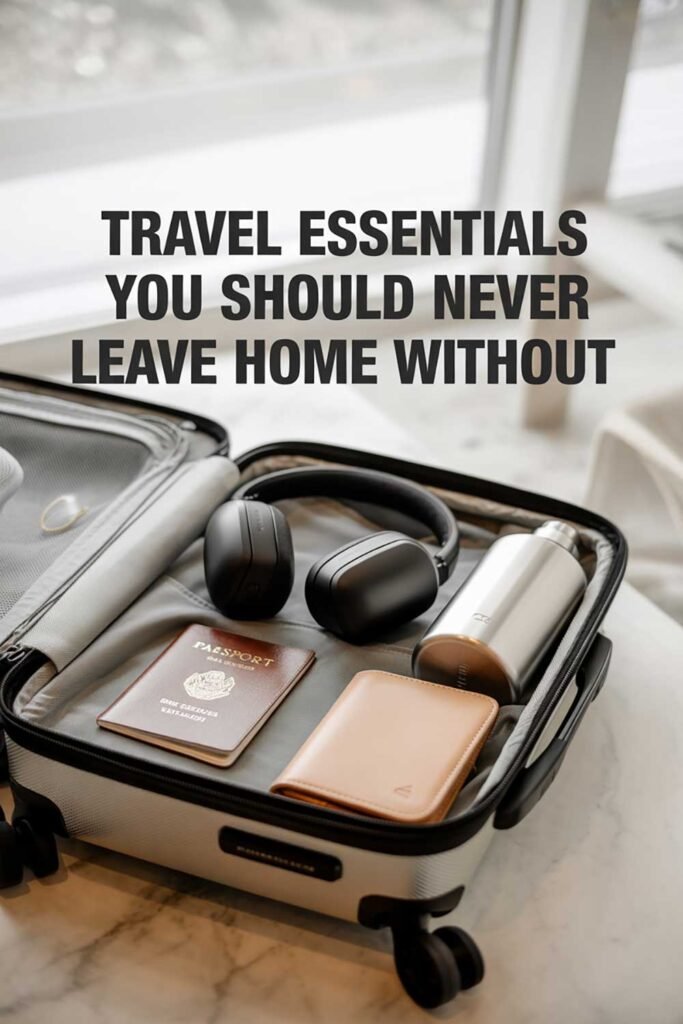
The personal item’s permanent essentials: the travel document wallet with passport, every visa and required entry authorization, travel insurance documentation, and accommodation confirmations. The phone and its charger cable. The power bank. Every card used for the trip in a safe interior pocket. Prescription medications in original labeled packaging with the prescribing documentation for any medication that requires it at customs. The airline boarding pass, whether physical or digital on the phone. The connection information for every leg of the journey. The destination accommodation’s address in a format that can be shown to a taxi driver without internet connectivity. The earplugs and eye mask if the flight involves a scheduled sleep period. These items are in the personal item and they stay in the personal item at every stage of the journey.
The personal item also handles the items that are needed in the first minutes after landing before the overhead bin or the checked bag is accessible: the destination’s local currency for the taxi or transit fare if it was pre-exchanged, the SIM card for the destination if it was purchased before departure and needs to be swapped at the airport, the sunglasses for the bright destination arrival, and the jacket if the destination temperature requires more coverage than the clothing worn on the flight. These items, positioned in the personal item’s most accessible external pocket or in the top of the main compartment for immediate post-landing retrieval, convert the arrival from a multi-bag retrieval sequence into a single-item grab from a known location.
Use the personal item’s organization consistently across every flight rather than varying what goes in it based on the specific trip’s characteristics. The personal item that always contains the document wallet in the interior zip, the phone cable and power bank in the right exterior pocket, the snacks and water bottle in the left exterior pocket, and the comfort kit and entertainment accessories in the main compartment’s top section is a personal item where every item is findable in the dark, at altitude, and under the mild cognitive fog of a long flight’s mid-hours. The personal item that is organized differently on every trip requires a search at every access. The consistently organized personal item requires a retrieval. The difference between a search and a retrieval is exactly the difference between the comfortable in-seat experience and the under-seat archaeology that the personal item was supposed to prevent.
A Hundred Flights Before the System That Should Have Been There From the First One
Vivian had been flying for work every week for three years before she acknowledged the pattern. She was efficient in the airport, Global Entry through immigration, TSA PreCheck through security, priority boarding from the loyalty status she had accumulated from the first year of weekly flights. She was efficient everywhere in the airport except at her seat. At her seat she got up. She got up for the neck pillow at boarding because she had packed it in the overhead bin. She got up for the charger at hour two because it was in the carry-on and the carry-on was in the bin. She got up for the snacks at hour three because she had packed them in the carry-on as an afterthought and they were under her laptop bag under the packing cube. She got up three to four times per flight to access items that were in the overhead bin because she had never considered that the overhead bin and the under-seat bag were different containers serving different functions.
The consolidation happened on a flight where the overhead bin above her row was full and the gate agent gate-checked her carry-on. She had everything in the carry-on including her headphones, her neck pillow, the document wallet with the hotel confirmation she needed for the taxi, her snacks, and her charger. Her personal item under the seat had her laptop and her phone. The flight was four hours. She watched the seatback screen without headphones, neck unsupported, uncharged, hungry for the last hour, and arrived at the destination unable to show the taxi driver the hotel address because the document wallet was in the gate-checked bag. The taxi driver knew the hotel. The bag arrived at the hotel forty minutes after she did. She sat in the hotel room and made a list.
The list organized itself naturally into two categories: the items that belonged in the bag in the overhead bin because they were for the destination and the items that belonged in the bag under the seat because they were for the flight. The neck pillow was for the flight. The charger was for the flight. The headphones were for the flight. The snacks were for the flight. The document wallet was for the journey. The change of clothes was the insurance for the delayed checked bag that she had experienced twice in three years and had managed both times by buying something from the hotel gift shop. All of these were under-seat items. None of them needed to be in the overhead bin to reach the destination, because the destination was not their function. Their function was the four hours between the gate and the destination, which happened entirely below the overhead bin.
Vivian bought a second personal item bag, a structured under-seat backpack with separate compartments, specifically for the in-flight system. She reorganized: the carry-on in the overhead bin held her work materials, her clothing, and everything needed at the destination. The personal item under the seat held everything needed for the flight itself. She flew the same route the following week. She did not get up once between boarding and landing. The neck pillow was under the seat. The headphones were under the seat. The charger and the power bank were under the seat. The document wallet was under the seat. The snacks were under the seat. The hotel confirmation address was in the personal item’s top pocket. She was the most comfortable person in her row for four hours. She is the system in this article.
Beyond the five core essential categories, these six additional in-flight items address the specific comfort, health, and contingency scenarios that frequent flyers have learned to prepare for and that occasional flyers discover are needed at the specific in-flight moment when they cannot be obtained.
Pack a small compression bag or dry bag inside the personal item for the items that need to be compressed or kept dry during the flight: the neck pillow, which compresses to half its size and frees the personal item space for the boarding process, and any item that needs to be protected from the spill scenario that overhead bag retrieval during turbulence occasionally produces. The compression bag is also the correct storage for the dirty clothes from the flight if the traveler changes clothes at the destination and wants to separate the travel clothes from the destination wardrobe before the checked bag arrives.
Pack a compact travel umbrella in the personal item’s exterior pocket for any destination where precipitation is possible on arrival day. The umbrella that is in the checked bag or the carry-on overhead bin is an umbrella that requires bag retrieval before it can be used, and baggage claim or the hotel transfer from the airport is exactly the moment when the arriving traveler most needs a weather layer that does not require bag retrieval. A compact folding umbrella in the personal item exterior pocket is available in five seconds from under the seat and provides immediate weather coverage from the aircraft door to the taxi without any additional bag management.
Include a few over-the-counter health items in a small resealable bag in the personal item: two pain reliever tablets, two antihistamine tablets, two antacid tablets, and two anti-nausea tablets. These four items in two-tablet quantities weigh under ten grams total and address the four most common in-flight and immediate post-flight health discomforts: headache from cabin pressure and dehydration, allergic response to the cabin environment, digestive discomfort from in-flight food or the pressure effects on the digestive system, and nausea from turbulence or motion sensitivity in smaller aircraft. Having these items within arm’s reach under the seat converts a manageable discomfort into an immediately managed one rather than a three-hour endurance until landing and a pharmacy.
Pack a physical pen in the personal item. International arrival declarations, customs forms, and the specific paper forms that airlines and immigration officials still use require a physical pen, and the traveler who does not have one is the traveler who is asking the flight attendant for one, waiting for it to return from whoever has it next, or arriving at the customs declaration counter without having filled out the form. A pen in the personal item’s exterior pocket is the most consistently useful low-stakes travel item a traveler can carry, weighs nothing, and eliminates a minor friction point at every flight that involves any paper interaction.
A reusable face covering in the personal item’s exterior pocket addresses both the health preference of travelers who choose to wear one during flights in enclosed cabin environments and the practical requirement of destinations or transit countries that require face coverings in specific areas. It also doubles as an additional eye-covering layer when the eye mask alone is insufficient for the window seat passenger whose neighbor opens the shade during the descent. Folded flat in the personal item exterior pocket, it takes no meaningful space and is available immediately without bag access.
Pack a small notebook or index card with the trip’s most critical information written by hand: the destination accommodation address, the local emergency numbers, the phone number for the accommodation, the car rental or transfer booking confirmation number, and the connecting flight gate if known. A paper backup for the phone’s digital information is specifically useful for the in-flight moment when the phone battery fails earlier than expected, the phone is in airplane mode and a downloaded reference is not loading correctly, or the turbulence is severe enough that operating a phone screen is impractical. The three-minute task of writing the five most critical pieces of trip information on an index card before departure produces a physical backup that requires no power, no connectivity, and no screen to provide every piece of information the first hour at the destination most frequently requires.
Organize the personal item in a layout that distinguishes the during-flight items from the at-destination items using a consistent internal structure. The during-flight items (headphone cable organizer, snacks, water bottle exterior pocket, comfort kit, charger and power bank) are in the most accessible locations. The at-destination items (change of clothes compression cube, destination cash or SIM, umbrella) are in the least accessed locations. This layout means the personal item serves its in-flight function from a frequently-accessed organization and transitions to its arrival function by providing the at-destination items from their consistently known positions without requiring full bag reorganization on landing. The personal item organized this way is not a flight bag. It is a flight-to-destination system that functions fully in both phases without any reconfiguration between them.
Book the Flight Worth Packing This Carefully For
The in-flight essentials system earns its return on the long-haul flight to the destination that was worth the flight hours, the overnight flight that needs to produce sleep, and the multi-connection day where the personal item is the only bag that is certain to arrive at the destination with the traveler. Our travel agents know the routes, the connections, and the destinations. Let us book yours.
Book A TripCommon Carry-On Flight Preparation Mistakes to Avoid
Most in-flight discomfort is avoidable. These are the most consistent carry-on preparation failures that produce it and what to do before the next boarding.
Packing in-flight items in the overhead bin carry-on rather than the under-seat personal item
The overhead bin is physically inaccessible during boarding before the bin closes, during the taxi and takeoff sequence, during turbulence when the seatbelt sign is on, during the meal service when the cart blocks the aisle, and during any portion of the flight when standing up would disturb sleeping passengers beside or adjacent to the seat. These are not rare intervals. They collectively represent a significant portion of most flight durations. Every in-flight item in the overhead bin is an item inaccessible for a significant portion of the flight when it may be needed. Every in-flight item under the seat is available in thirty seconds at any point in the flight regardless of cabin status.
Depending on the airline’s entertainment system without personal entertainment downloaded
The airline’s seatback screen is available when it is functional and not available when it is not. It shows the airline’s current content library rather than the specific content the traveler chose. It is absent on aircraft configurations that use in-flight Wi-Fi connectivity rather than individual seatback screens. A downloaded personal entertainment library is available on every flight regardless of the aircraft’s screen configuration, the content library’s currency, or the seatback screen’s operational status. The fifteen-minute download session before every flight is the entertainment preparation that eliminates the seatback screen dependency entirely and produces the in-flight entertainment experience the traveler chose rather than the one the aircraft happened to offer.
Not boarding with devices fully charged
The seat power outlet at many airline seats, particularly in economy class on older aircraft, is not available for the full flight duration or may not function at full charging rate. The device that boards at 60 percent with the expectation of reaching 100 percent at the seat outlet may arrive at the destination at 80 percent rather than 100 percent if the outlet is not functional or the charge rate is insufficient for the device’s simultaneous use. The device that boards at 100 percent with a fully charged power bank as the backup arrives at the destination with its power needs covered regardless of seat outlet availability. Charge everything to 100 percent before boarding, at whatever charging opportunity exists at the terminal before the gate.
Not packing a change of clothes in the personal item for checked bag travel
The checked bag delay or loss scenario is not catastrophic when the personal item contains a complete outfit change and the essential overnight items. It is genuinely disruptive when the personal item contains only the electronics and the overhead bin carry-on was gate-checked and contains the clothing. Pack a change of clothes in the personal item for every flight that involves a checked bag, not only for the flights where delayed baggage feels more likely. Delayed baggage does not announce itself in advance. The one trip where it is not packed is reliably not the trip it happens on.
Relying on the flight’s water service for in-flight hydration
The flight attendant’s water service on most flights provides one beverage service with the meal and one additional service on long-haul flights, which amounts to two cups of water across a flight duration that may be eight to twelve hours. Two cups of water across twelve hours in a 15 to 20 percent humidity environment is significantly below the hydration rate that the specific dehydration environment of a long-haul flight requires for comfortable arrival. A 500 to 750 ml water bottle filled at the terminal and refilled at the aircraft galley when needed provides the hydration rate that the flight attendant service cannot, at no cost beyond the thirty seconds of galley interaction needed to request a refill.
Not organizing the personal item consistently across every flight
The personal item organized differently on every flight is a bag where nothing is in a known location and every item requires a search at altitude in a dark cabin at 3 a.m. The personal item organized the same way on every flight is a bag where every item is in its assigned location, retrievable without looking, and accessible without disturbing adjacent passengers. The consistency is not a rigid rule that adds friction to the packing process. It is a habit that eliminates the search entirely and replaces it with the retrieval that the personal item’s entire organizational logic was designed to produce.
Love Helping Travelers Fly Smarter and Travel Better?
The traveler who knows what goes in the personal item and what goes in the overhead bin is the traveler who boards with confidence and arrives ready. Helping travelers get from departure to destination with that experience is the kind of work that builds genuine client loyalty. If becoming a home-based travel agent who helps people travel smarter, book better, and arrive ready sounds like the right next step, see how the TravelPreneur system works.
Become An AgentFrequently Asked Questions
These are the questions travelers ask most often about packing the carry-on for flights. Real answers from real frequent flyer experience across flight durations, seat types, and aircraft configurations.
What is the difference between a carry-on bag and a personal item and how should each be packed?
A carry-on bag is the larger bag that goes in the overhead bin, typically up to 22 by 14 by 9 inches for most US domestic carriers though size limits vary by airline and aircraft. The personal item is the smaller bag that fits under the seat in front, typically a backpack, tote, or small duffel, with a typical limit of around 18 by 14 by 8 inches though this also varies by airline. The functional distinction is accessibility: the overhead bin is physically inaccessible during several portions of the flight, while the under-seat personal item is accessible at any point. The overhead carry-on should contain everything needed at the destination: clothing in packing cubes, toiletries, destination shoes, and any item that does not need to be accessed during the flight. The under-seat personal item should contain everything needed during the flight: entertainment, comfort items, power, snacks, water, documents, and the change of clothes insurance. This packing philosophy means that a gate-checked carry-on is a significant inconvenience but not a flight-ruining event, because everything needed for the journey is already under the seat with the traveler.
What are the rules about liquids in the personal item and carry-on for flights?
The carry-on liquids rule, typically three ounces or 100 milliliters per container with all liquids in a single quart-sized clear resealable bag, applies to both the carry-on and the personal item since both are screened at the security checkpoint. The water bottle must be empty at security and can be filled after the checkpoint. Medically necessary liquids including medications may be permitted in quantities exceeding the standard limit with appropriate documentation, though the specific rules vary by country and screening authority. All other liquid-carrying considerations for the personal item are identical to those for the carry-on: liquids in containers of 100 milliliters or less, all in the clear bag at the top of the personal item for easy removal at the security checkpoint. The clear bag in the personal item follows the same principle as in the carry-on: packed at the top and accessible without removing other items, since it must be removed from the bag and placed in the security tray at every checkpoint.
Are noise-canceling headphones worth the investment for occasional travelers?
The answer depends on flight frequency and flight duration rather than a universal yes or no. For travelers who fly more than four times per year on flights of two hours or longer, noise-canceling headphones produce a consistent and measurable improvement in flight comfort that accumulates into a significant quality-of-life improvement across those flights. The specific benefit is the replacement of the aircraft’s constant engine and cabin ambient noise environment with the sound content the traveler chose, which produces measurably better sleep quality, lower perceived fatigue on arrival, and better entertainment experience than the earbuds-plus-aircraft-noise alternative. For travelers who fly once or twice a year on shorter domestic flights, the price-to-use ratio of premium noise-canceling headphones may favor a high-quality pair of earbuds instead, which provide meaningful noise isolation at a lower price point and produce an adequate in-flight audio experience for occasional travel without the investment that the daily use of a frequent flyer justifies more easily.
What should go in the personal item for an overnight or long-haul flight specifically?
For overnight and long-haul flights the personal item requires the full comfort kit that shorter flights can sometimes forgo: the neck pillow and eye mask for sleep quality, the ear plugs as the passive sleep noise management, and the warm layer for the temperature management that overnight cabin conditions specifically require. The refresh pouch for the pre-landing freshening that converts the overnight flight arrival experience from groggy and dry to presentable and comfortable. The electrolyte tablet or powder for the water bottle to address the deeper dehydration that twelve-plus hour flights produce. The full entertainment library download to cover the complete awake hours before sleep and the awake hours after it with enough content variety to prevent the specific boredom of being fully awake for the final two hours of an overnight flight with nothing left to watch. For flights crossing multiple time zones, the melatonin or sleep aid if used, the eye mask, and the light-blocking wrap or blanket that the aircraft’s blanket service occasionally provides and occasionally does not are the difference between arriving at the destination having genuinely slept and arriving having performed the motion of sleep for five hours without actually achieving it.
Can you bring food through airport security in the personal item?
Solid foods can be brought through airport security in the personal item in most countries without restriction. The liquids rule applies to food items with a liquid or gel consistency: soups, yogurt, jams, peanut butter in quantities over 100 milliliters, and any spreadable or pourable food item. Solid foods including whole fruits, sandwiches, crackers, nuts, protein bars, chocolate, dried fruit, and similar solid snacks pass through security without any volume restriction in most jurisdictions. International travel introduces additional food restrictions based on the destination country’s agricultural import regulations: many countries prohibit or restrict the import of fresh fruits, vegetables, and certain animal products, and failing to declare or properly dispose of these items before the customs inspection can result in significant fines. For domestic travel, solid food in the personal item is unrestricted at security and is the simplest and most cost-effective snack strategy available for any flight.
What do you do when the overhead bin is full and your carry-on has to be gate-checked?
A gate-checked carry-on is retrieved at the jet bridge on arrival at most airports and follows the same delayed, misrouted, or lost path as a checked bag on a small percentage of flights. If the carry-on must be gate-checked, transfer to the personal item any item needed during the flight or in the first hour at the destination before handing the carry-on to the gate agent: documents if they were in the carry-on rather than the personal item, phone charger and power bank if they were in the carry-on, any medication needed during the flight, the change of clothes if it is available, and any entertainment item not already in the personal item. A one-minute transfer at the gate produces the personal item that covers the flight regardless of what happens to the gate-checked carry-on. The traveler whose personal item already contains all in-flight essentials because it was packed that way from the start requires no transfer at all: the carry-on can be gate-checked with no interruption to the in-flight experience because nothing in it was needed for the journey.
The passenger who never reaches overhead during a five-hour flight is not a more relaxed person by nature. They simply put everything they needed for the five hours under the seat before they sat down.
Picture Your Next Boarding
The personal item goes under the seat in front. The carry-on closes the overhead bin above. You sit down. The neck pillow is in the exterior pocket. The headphones are in the cable organizer at the top of the personal item. The snacks are in the left exterior pocket. The water bottle is in the right exterior pocket. The document wallet is in the interior zip. The power bank and charger cable are in the cable organizer. The downloaded content is on the device. The flight is four hours. You do not stand up once. The carry-on in the overhead bin contains everything you need at the destination and nothing you need before it. That is the system. That is every flight from here.
One More Thing Before You Pack the Personal Item
Print our free Travel Packing Checklist before your next flight. Use the flight essentials section to pack the personal item separately from the main travel bag, which is the packing approach that produces the under-seat bag with everything needed for the journey at arm’s reach rather than the under-seat bag with whatever was left over after the main bag was packed. The same checklist we use before every flight we take.
Get the Free ChecklistExplore Our Top Picks for a Better Trip
From the noise-canceling headphones that converted every long-haul flight from an endurance event to a private theater to the memory foam neck pillow that compresses to the size of a water bottle and has produced in-flight sleep on every overnight flight since we started using it, see the in-flight essentials and travel products we actually use and recommend. Real picks from real flights of every duration and every route type.
See Our Top PicksTravel Prints and Printables From Our Shop
Visit Premier Print Works for flight packing checklists, travel day planners, personal item organizer printables, travel journals, and wall art that makes every trip a little more beautiful and a lot more organized from the moment the boarding pass is pulled up to the morning the destination window comes into view at the end of the approach.
Visit Premier Print WorksDisclaimer
The information shared in this article is provided by Don and Diana’s Travels for general informational, educational, and inspirational purposes only. It reflects our personal experiences, opinions, and the experiences of travelers we have worked with. It is not professional travel, legal, financial, or medical advice, and it should not be relied on as such.
Airline and Airport Security Regulations
Airline baggage policies, carry-on and personal item size and weight limits, gate-check policies, liquids rules, security screening requirements, and related aviation regulations change frequently and vary by airline, airport, country, and fare class. Always confirm current regulations with the specific airline and the relevant aviation security authority before every flight. We are not responsible for any security checkpoint outcome, gate-check, baggage fee, or travel disruption arising from information in this article.
Medical and Health Information
The health information in this article about hydration, cabin dehydration, electrolytes, and over-the-counter medication suggestions is general educational information only and not professional medical advice. Consult a healthcare provider before taking any medication or making any health decision related to travel. Carry prescription medications in their original labeled packaging and confirm import regulations for any prescription medication for international travel destinations.
Food and Agricultural Import Regulations
The food items that can be carried through security may not be permitted for import into the destination country. Many countries have strict agricultural import regulations that prohibit or restrict fresh fruits, vegetables, meats, and certain other food items. Always declare food items at customs when required and confirm the destination country’s import regulations for any food carried across international borders. Failure to declare restricted food items can result in significant fines and confiscation at customs.
Affiliate and Partner Links
This article may contain affiliate links, partner links, referral links, and links to products or services that pay us a commission. If you click a link and make a purchase or complete any qualifying action, we may earn a small commission at no extra cost to you. Our recommendations are based on real use and genuine belief in the products and services we share.
Third-Party Websites and Services
We may link to third-party websites, services, and resources for your convenience. We do not control these sites and are not responsible for their content, terms of service, pricing, availability, or any product or service they sell. Your use of any third-party site is entirely at your own risk.
Health, Safety, and Personal Responsibility
Travel involves personal risk. You are solely responsible for your own health, safety, travel insurance, medications, vaccinations, documentation, financial decisions, and choices while planning or taking any trip. We strongly recommend purchasing comprehensive travel insurance for every trip. Don and Diana’s Travels, its owners, employees, contractors, and affiliates accept no liability for any loss, injury, illness, delay, cancellation, damage, theft, or inconvenience arising from your use of the information in this article or from any travel decisions you make.
Composite Stories and Characters
Some stories, examples, and traveler experiences shared on this site are composites drawn from the real experiences of Don, Diana, clients, friends, and travelers we have worked with over the years. Names, identifying details, locations, and circumstances may be combined, changed, or fictionalized to protect privacy. Any resemblance to a specific real person beyond the composite portrayal is unintentional.
No Guarantees
We do not guarantee any specific result, outcome, savings, or experience from using the information, tips, services, or products mentioned in this article. Your results depend on many personal factors including your own choices, effort, circumstances, and external conditions outside of our control.
Copyright and Use
All content in this article is the copyrighted property of Don and Diana’s Travels unless otherwise noted. You may not copy, republish, redistribute, modify, sell, or reuse our content without our prior written permission. You are welcome to share a direct link to this article with proper credit.
By reading and using the information in this article, you acknowledge that you have read, understood, and agree to this disclaimer in full.