Why I Switched to One-Bag Travel and Never Looked Back
I used to be the person with two bags. A rolling carry-on and a personal item stuffed to the zipper line. Sometimes a checked bag when the trip was longer than five days. I’d watch the one-bag travelers glide past me in the airport – single backpack, nothing else, moving like they were walking to the corner store rather than boarding a transatlantic flight – and I’d think: they must be going somewhere close. Or packing inadequately. Or missing things they’ll wish they had.
I couldn’t imagine fitting everything I needed into a single bag. Not because I was an extravagant packer – I’d read the lists, I used packing cubes, I considered myself reasonably efficient. But one bag felt extreme. One bag felt like sacrifice.
Then I tried it. One trip, one bag, as an experiment I expected to abandon by the second morning.
I didn’t abandon it. I haven’t used a second bag in three years.
This isn’t an article about how to pack into one bag. There are excellent guides for that. This is an article about what changes when you do – the cascading effects on your travel experience, your mindset, your stress levels, and your relationship with stuff that nobody told me about because nobody talks about the transformation. They only talk about the technique.
What I Was Before: A Profile of the Two-Bag Traveler
I wasn’t an overpacker by conventional standards. I rolled my clothes. I used packing cubes. I brought reasonable quantities of sensible items. My carry-on was organized. My personal item was functional. By any normal measure, I packed well.
But I packed to capacity. Both bags were full. The carry-on used every cubic inch. The personal item was zipped tight. Together, they weighed thirty-five to forty pounds, which I carried through airports, up stairs, through train stations, and across hotel lobbies with the quiet acceptance of someone who believed this was what travel required.
The weight was normal to me. The dual-bag logistics were normal. The overhead bin competition was normal. The personal item crammed under the seat was normal. I didn’t experience these things as problems because they’d always been present. They were simply what traveling felt like.
The Experiment
The switch wasn’t philosophical. It was practical. A budget airline ticket to a five-day trip with restrictive baggage allowances made the two-bag approach expensive. The second bag fee was $65 each way. The math was simple: either pay $130 for the privilege of my second bag or find a way to travel without it.
I found a way. I packed a 35-liter backpack with five days of clothing, toiletries, a laptop, and the accessories I considered essential. The bag weighed sixteen pounds. It fit under the seat. It cost nothing extra.
The trip was supposed to be about the destination. It turned out to be about the bag.
What Changed Immediately
The Airport Disappeared
I don’t mean it literally disappeared. I mean it stopped being an obstacle course. With one bag on my back and both hands free, the airport became a series of hallways I walked through rather than a gauntlet I navigated.
No overhead bin strategy. No competition for space. No wrestling a roller bag through narrow aisles. No gate-checking anxiety. No waiting at the luggage carousel. No wondering whether my checked bag made the connection.
I walked off the plane, through the terminal, past the baggage claim, and out the door. The airport took fifteen minutes instead of forty-five. Not because I walked faster. Because I skipped every step that the second bag (or the checked bag on longer trips) had always required.
This alone was transformative. The airport had been the most stressful part of travel, and I’d accepted that stress as inherent to the experience. It wasn’t inherent to the experience. It was inherent to my luggage.
My Body Relaxed
Thirty-five to forty pounds distributed across a rolling bag and a shoulder bag creates physical patterns you don’t notice until they stop. The shoulder tilted to hold the personal item strap. The wrist fatigued from dragging the roller. The lower back compensating for the asymmetric load. The general physical tension of managing two objects through crowded spaces.
Sixteen pounds on my back, evenly distributed, created none of these patterns. My shoulders were level. My hands were free. My back was straight. I moved through airports and cities with a physical ease that felt like someone had removed weights I didn’t know I was wearing.
By the end of the first day, I realized my body had been working harder than necessary on every previous trip. Not dramatically harder. Marginally harder. But marginal strain across thousands of steps and multiple hours compounds into fatigue that I’d always attributed to travel itself rather than to what I was carrying through it.
Decisions Simplified
Two bags require ongoing logistical decisions. Which bag holds the item I need? Can I access it without opening the overhead bin? Should I gate-check the roller? Is the personal item under the seat accessible? Where do I put both bags in the taxi, the train, the hotel room?
One bag eliminated every one of these decisions. Everything was in one place. Accessibility was immediate. Storage was singular. The cognitive overhead of managing luggage – small but constant – simply vanished.
What Changed Over Days
Spontaneity Became Default
On day two, I passed a sign for a neighborhood market three metro stops from my hotel. On any previous trip, I would have evaluated: can I carry my bags there? Is there luggage storage? Will I need to return to the hotel first?
With one bag on my back, the evaluation was instant. I was already carrying everything. There was nothing to retrieve, nothing to store, nothing to manage. I walked to the metro, rode three stops, and explored the market for two hours. The decision took three seconds because the bag was already on my back and it changed nothing about my mobility.
This pattern repeated daily. A side street that looked interesting? Walk down it. A café in a neighborhood across town? Go there. A change of plans that requires moving across the city? Already mobile. The bag was with me, weighed sixteen pounds, and imposed zero constraints on spontaneous movement.
I’d never connected luggage to spontaneity before. But the connection is direct. Heavy or multiple bags anchor you to your accommodation because every outing requires deciding whether to bring the bags or return for them later. One light bag means you’re always carrying everything, which means you’re always free to go anywhere.
I Stopped Thinking About Stuff
This was the most surprising change. With two bags, some portion of my mental bandwidth was always allocated to my belongings. Where are my bags? Are they secure? Did I pack the right items for tomorrow? Should I reorganize tonight? Is the important thing in the accessible bag?
With one bag, the mental allocation collapsed to nearly zero. Everything I owned on the trip was in a single container on my back. The container was always with me. There was nothing to track, secure, reorganize, or worry about. The mental space that luggage management had quietly occupied for years was suddenly empty and available for the actual experience of traveling.
I started noticing more. Not because my eyes changed but because my attention was no longer partially committed to luggage logistics. The street noise, the quality of light, the details of buildings, the faces of people – all became more vivid when the background process of stuff management shut down.
I Moved Faster Between Experiences
Transit between destinations – the bus to the airport, the airport to the hotel, the hotel to the next city – had always been the dead time of travel. The hours spent managing bags through transitions, waiting for checked luggage, navigating stations with heavy loads.
One-bag travel compressed transit dramatically. I walked directly from one experience to the next with nothing to check, nothing to retrieve, nothing to manage. A bus station that previously consumed an hour of bag logistics now consumed fifteen minutes of walking on and walking off. An airport that consumed two hours now consumed forty-five minutes because every bag-related step was eliminated.
The time savings across a trip were significant. Over five days, I estimated I recovered four to six hours that would have been spent on luggage logistics. Four to six hours is an extra half-day of travel experience, recovered not by waking earlier or sleeping later but by simply carrying less.
What Changed Over Weeks and Months
My Packing Permanently Simplified
The first one-bag trip required effort and sacrifice. By the third trip, it required neither. The items I’d agonized over leaving behind on trip one were items I’d forgotten I ever carried by trip three.
The reduction had a ratchet effect. Each trip revealed items that went unused, which were removed for the next trip, which revealed more unused items. The bag didn’t just stay at one bag. It got lighter within the one bag. Sixteen pounds became fourteen. Fourteen became twelve. The system refined itself through the feedback loop of actual use versus anticipated need.
The wardrobe I now travel with – four tops, two bottoms, one layer, one rain shell, two pairs of shoes (one worn) – would have felt impossibly sparse three years ago. It now feels precisely right. Not minimal for the sake of minimalism. Right because every item gets used, nothing goes unworn, and the total weight allows a travel experience that heavier packing cannot.
My Relationship With Possessions Shifted
This was unexpected and gradual. Living for weeks at a time with twelve to sixteen pounds of total possessions created an experiential reference point for what I actually need versus what I habitually accumulate.
I didn’t come home and throw everything away. I’m not a minimalist convert selling possessions on social media. But the purchases slowed. The accumulation decelerated. When you’ve proven to yourself that you can live comfortably with almost nothing, the urgency to acquire more things loses its grip. Not through philosophy. Through evidence.
The closet at home looks different to me now. Not wasteful exactly. Just abundant in a way that feels excessive compared to the sufficiency I’ve experienced on the road. Gradually, the closet has begun to reflect the packing list – fewer items, better quality, more versatile.
My Travel Identity Changed
I used to identify as someone who traveled well – organized, prepared, efficient. The identity was built around competent management of stuff. Good packing cubes. Smart luggage choices. Optimal bag organization.
My identity shifted from someone who manages travel stuff well to someone who has eliminated travel stuff as a category requiring management. The competence didn’t change. The object of competence did. Instead of being good at packing, I became good at not needing to pack much. The skill is lighter in every sense.
What I Actually Lost
Honesty requires acknowledging the trade-offs.
Outfit variety. I wear the same four shirts in rotation. I have one pair of pants for most situations and one pair of shorts. I don’t have the perfect outfit for every context. I have adequate outfits for every context. The gap between perfect and adequate turns out to be smaller than I imagined and entirely invisible to everyone except me.
Gear for unlikely scenarios. I don’t carry hiking boots, formal shoes, swimming fins, or backup electronics. If an unexpected activity requires gear I don’t have, I either skip it, adapt with what I have, or buy something inexpensively at the destination. This has happened three times in three years. Each time, the solution cost less than $20.
The comfort of excess. There’s a psychological comfort in having more than you need. The safety net of extra clothing, extra toiletries, extra options. I traded that comfort for physical comfort – lighter shoulders, freer movement, faster transit. The trade was unambiguously positive, but the psychological adjustment was real.
Souvenirs and shopping. One bag constrains what you can bring home. A large souvenir doesn’t fit. Extensive shopping requires shipping rather than carrying. I’ve adapted by buying fewer, smaller, more meaningful objects from my travels, which is arguably an improvement, but the constraint is genuine.
Why I Never Went Back
People ask whether I’ve been tempted to return to two bags. The honest answer is no, and the reason is simple: the benefits of one-bag travel compound while the costs diminish.
Each trip reinforces the system. The packing gets faster. The travel gets smoother. The spontaneity gets more natural. The stress reduction becomes more dramatic by contrast as I watch other travelers wrestle with luggage I no longer carry.
Meanwhile, the costs shrink. The outfit repetition that felt like sacrifice on trip one feels like simplicity on trip ten. The gear limitations that concerned me initially have produced exactly three situations in three years requiring adaptation. The souvenir constraint has improved my purchasing habits.
The benefits grow. The costs shrink. The gap widens in favor of one bag with every trip. Going back would mean voluntarily reintroducing stress, weight, logistics, time loss, and cognitive load that I’ve eliminated. No amount of outfit variety or extra footwear justifies that reintroduction.
Real-Life One-Bag Conversion Experiences
Jennifer switched to one-bag travel after a trip where she carried two bags through a cobblestone city for twenty minutes searching for her hotel. The physical strain and frustration of that search was the catalyst. She hasn’t checked a bag or carried a second one in two years. Her most common observation: “I don’t miss anything I stopped bringing.”
Marcus resisted one-bag travel for business trips, insisting that professional appearance required wardrobe options. He tried it once on a three-day conference with two dress shirts, one blazer, one pair of trousers, and versatile shoes. Nobody noticed his limited wardrobe. He noticed the freedom of walking through the airport without a roller bag for the first time in his professional life.
The Thompson family adapted one-bag principles per person for family travel. Each family member carries one bag. The total family luggage dropped from four bags plus a stroller to four backpacks. Airport transitions that previously consumed an hour now take twenty minutes. The children, ages nine and twelve, manage their own bags independently, which the parents describe as an unexpected parenting benefit.
Sarah’s conversion was gradual. She went from a checked bag plus carry-on, to a carry-on plus personal item, to a carry-on alone, to a 40-liter backpack, to a 28-liter daypack over the course of two years and eight trips. Each reduction felt risky in advance and effortless in practice.
Tom converted at sixty-three after watching a younger traveler board a two-week Mediterranean trip with a single backpack. He assumed age required more gear. His next trip, he tried one bag for a ten-day itinerary. He packed medications, comfortable shoes, and four merino shirts. “I spent a decade believing I needed more because I was older,” he said. “Turns out I needed less because I finally knew what mattered.”
20 Powerful and Uplifting Quotes About One-Bag Travel
- “One bag felt extreme. One bag felt like sacrifice. It turned out to be the opposite of both.”
- “I used to watch one-bag travelers glide past me and think they must be packing inadequately. They were packing accurately.”
- “The airport had been the most stressful part of travel. The stress wasn’t inherent to the experience. It was inherent to my luggage.”
- “Sixteen pounds on my back, evenly distributed, felt like someone had removed weights I didn’t know I was wearing.”
- “Heavy bags anchor you to your accommodation. One light bag means you’re always free to go anywhere.”
- “The mental space that luggage management quietly occupied for years was suddenly empty and available for actual experience.”
- “I recovered four to six hours per trip that would have been spent on luggage logistics. That’s half a day of living.”
- “When you’ve proven you can live comfortably with almost nothing, the urgency to acquire more things loses its grip.”
- “Instead of being good at packing, I became good at not needing to pack much.”
- “The gap between the perfect outfit and the adequate outfit is smaller than I imagined and invisible to everyone except me.”
- “The benefits compound while the costs diminish. The gap widens with every trip.”
- “Going back would mean voluntarily reintroducing stress, weight, and cognitive load I’ve eliminated.”
- “Nobody at the conference noticed my limited wardrobe. I noticed the freedom.”
- “I don’t miss anything I stopped bringing.”
- “Each trip’s reduction felt risky in advance and effortless in practice.”
- “I spent a decade believing I needed more because I was older. I needed less because I finally knew what mattered.”
- “Spontaneity became default. The bag was already on my back and it changed nothing about my mobility.”
- “I started noticing more. Not because my eyes changed but because my attention wasn’t committed to luggage logistics.”
- “The system refined itself through feedback. What went unused got removed. What remained was precisely right.”
- “I didn’t come home and throw everything away. But the purchases slowed. The accumulation decelerated.”
Picture This
Imagine yourself in an airport. Not a specific airport. The universal airport. The one with the long corridors, the moving walkways, the gate numbers climbing as you walk deeper into the terminal.
You’re watching two versions of yourself pass through this space.
Version one is you from three years ago. You’re pulling a carry-on roller with one hand. The personal item is slung over your opposite shoulder, its strap cutting slightly because you packed the laptop and the extra shoes and the toiletry bag and the “just in case” layer that made it heavier than comfortable. The roller bag catches on the carpet seam. You correct. The personal item slides down your shoulder. You hoist. A family with a stroller is ahead of you and the corridor is narrow and you can’t pass because the roller bag needs space you don’t have. You wait. You check the gate number. You’re still twelve gates away. You walk.
At the gate, the overhead bin announcement begins. Your bag is carry-on size but so is everyone else’s, and the airline is offering gate-check for volunteers and if you don’t board in the first groups your bag might not fit. You stand when your zone is called, join the line, shuffle down the jet bridge, turn sideways to navigate the aisle, hoist the bag into the overhead, push it to fit, close the bin, and wedge the personal item under the seat where it occupies the legroom your feet need.
You sit. You’re mildly stressed, mildly uncomfortable, mildly tired from the physical work of getting your luggage and yourself from the terminal entrance to this seat. The flight hasn’t begun and travel has already cost you energy.
This was normal. This was every flight for fifteen years.
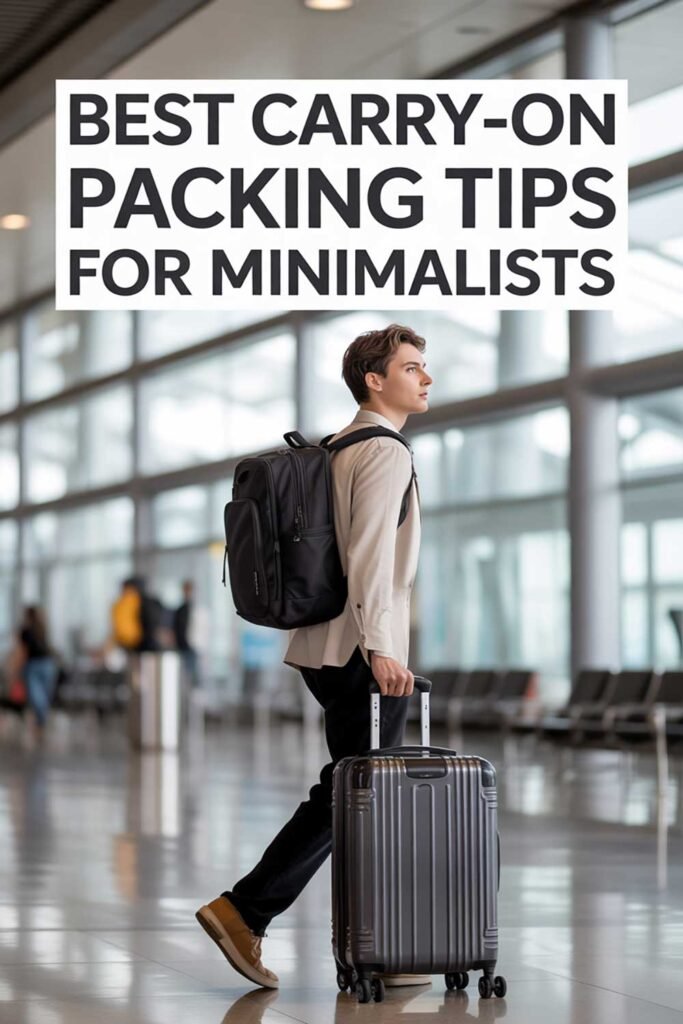
Version two is you now. You’re walking. Just walking. A backpack on both shoulders, evenly weighted, twelve pounds. Your hands are free. One holds coffee. One holds nothing.
The family with the stroller is ahead. You adjust slightly left and walk past. No roller bag requiring corridor width. No shoulder bag sliding. Just a person walking through a hallway.
At the gate, the overhead bin announcement plays. You don’t listen. Your bag fits under the seat with room to spare. You board whenever your zone is called – first or last, it doesn’t matter, because no overhead bin space is required. You walk down the aisle normally, sit down, slide your bag under the seat, and stretch your legs into the space a personal item used to occupy.
You sit. You’re not stressed. You’re not tired from luggage logistics. You’re drinking coffee and reading and the flight hasn’t begun and you feel exactly the same as you felt when you walked into the terminal. Nothing was lost between the entrance and the seat. No energy spent on bags. No tension from weight. No stress from competition for space.
The plane lands. Version one waits for the overhead bin to be accessible, retrieves the bag, shuffles up the aisle, walks to the connection gate or to baggage claim, waits thirty minutes for the checked bag on longer trips, and begins the next transition carrying the same weight through the same logistics.
Version two stands up, puts on the backpack, and walks off the plane. Through the terminal. Past baggage claim. Out the door. Into the city. The transition from airplane seat to city street takes eight minutes. Not because you hurried. Because there was nothing between the seat and the street except hallways.
Now expand the frame. It’s not just the airport. It’s the entire trip.
Version one manages luggage in the taxi, the hotel lobby, the hotel room where the suitcase occupies floor space in an already small room. Version one evaluates every outing against the question of what to bring and what to leave behind. Version one returns to the hotel between activities because the bag needs to be there and the needed item is in the bag.
Version two walks out of the airport and into the trip with everything on their back. Walks into the accommodation. Sets the bag down. Walks out. The bag stays or comes along – either way, it changes nothing about the day. There is no luggage to manage because there is no luggage. There is a bag. It’s on your back or it’s in your room and in neither case does it require thought, effort, or time.
Three years of this. Dozens of trips. The bag has been on trains through countryside, on buses through cities, on ferries between islands, through markets and museums and restaurants and neighborhoods and airports on four continents. It has never been a burden. It has never limited an experience. It has never been the reason I couldn’t do something I wanted to do.
And it has never once made me wish I’d brought a second one.
Share This Article
Curious about one-bag travel but not sure you could actually do it? Share this article with travelers who are one-bag-curious but haven’t made the switch, chronic overpackers who need to see what changes on the other side of reduction, anyone who thinks one bag means sacrifice and might be surprised to hear it means freedom, or experienced one-bag travelers who will recognize every single benefit described! The switch is smaller than you think and the transformation is larger than you imagine. Share it on Facebook, Instagram, Twitter, Pinterest, or send it directly to someone dragging a roller bag through a cobblestone city who deserves to know there’s another way. Your share might be the catalyst that changes how someone travels permanently!
Disclaimer
This article is provided for informational and educational purposes only and is based on personal one-bag travel experience and common observations from travelers who have adopted similar approaches. The information contained in this article is not intended to be guidance for all travelers or all trip types.
Individual packing needs vary based on trip duration, destination, professional requirements, medical needs, and personal circumstances. One-bag travel may not suit all travelers or all travel purposes.
The author and publisher of this article are not responsible for any packing decisions, travel experiences, or purchase decisions. Readers assume all responsibility for their own travel preparation.
Bag size and weight recommendations are general guidelines. Airline baggage policies vary and should be verified before travel.
The benefits described represent common experiences but are not guaranteed outcomes. Individual results depend on packing choices, trip characteristics, and personal adaptation.
One-bag travel involves trade-offs that may not be acceptable to all travelers. Evaluate the approach against your specific needs rather than adopting it prescriptively.
By using the information in this article, you acknowledge that you do so at your own risk and release the author and publisher from any liability related to your packing and travel decisions.