33 Vacation Packing Tips That Help You Pack Less and Enjoy More
Every item you leave behind on vacation is one less thing to carry, drag, worry about, or repack at the end of a long day when all you want to do is get home. Thirty-three vacation packing tips for the traveler who is ready to stop hauling half a wardrobe to every destination and start arriving with exactly what the trip needed — no more, nothing missing.
Grab Our Travel Packing Checklist
Our free packing checklist is built around exactly this philosophy — everything the trip actually needs, organized by category, with the outfit-first structure and the final-edit habit already built in. Use it to pack less on the next vacation and measure the difference it makes in how much of the trip you actually enjoy.
Get the Free ChecklistThe best vacations almost always happen to the people with the lightest bags because they were too busy enjoying the trip to worry about what they brought.
Every item you leave behind on vacation is one less thing to carry, drag, worry about, or repack at the end of a long day when all you want to do is get home.
The Mindset: Pack Less Before You Pack Anything
Lay everything out on the bed — then put half of it back
This is the most powerful packing habit available and it costs nothing but honesty. Before a single item goes into the bag, lay every intended item out flat on the bed and look at the pile. The pile is almost always larger than expected because the mental image of the packing list does not include the visual reality of the items occupying actual space side by side. With the full pile visible, the question becomes honest rather than theoretical: which of these will actually be worn? The items that survive that question pack. The items that rely on the imagined trip, the hypothetical dinner, the weather you are bracing for rather than the weather you will actually have — these go back. The pile that remains after the honest half is returned to the closet is the packing list that reflects the real trip. That is always the right bag to pack.
Pack for the trip you have actually planned, not the one you are imagining
The imagined trip is more adventurous, more formal, more varied in weather, and more eventful than the real one almost every time. The hiking gear for the hike not yet booked, the formal outfit for the event still described as possible, the rain gear for the weather pattern that every local knows happens rarely in that season — these are the items of the imagined trip rather than the planned one. Open the confirmed itinerary alongside the packing list and pack only for what is on the calendar. The items that belong to the imagined trip are the items that come home unused, the weight that was carried the whole journey for occasions that never arrived, and the evidence that the packing list was built from optimistic projection rather than honest planning. Pack the real trip. Leave the imagined one where it lives — in the planning excitement rather than the bag.
Accept fully and genuinely that you will re-wear clothes on vacation — because everyone does
The packer who packs a fresh outfit for every single day of the vacation is packing from a social anxiety that the vacation itself will not validate. Nobody on the trip is tracking daily outfit changes. The couple at the next table who were there yesterday do not remember what anyone was wearing yesterday. The local resident walking the same street again is not cataloguing the tourist’s clothing rotation. Re-wearing jeans for a third day, a jacket for the whole trip, and a shirt twice between washes is standard vacation behavior for every experienced traveler, and accepting this fully rather than theoretically is what allows the bag to lose the three extra outfits that the social anxiety packed. Give yourself the explicit permission to re-wear things. The permission is the most practically useful packing tip on this list because it is the one that removes items before the bag is opened.
Remind yourself that almost every destination has a store if you genuinely forget something
The just-in-case packing that adds significant weight to every vacation bag is almost always covering a gap whose real-world consequence is a five-minute stop at a pharmacy or a convenience store at the destination. Shampoo is available in every country with an overnight accommodation industry. Sunscreen is sold near every beach and warm-weather destination. Toothpaste, basic toiletries, a replacement phone charger, an umbrella for the unexpected rain — these are all available at or near virtually every destination the vacation is heading to, at a cost that is almost always lower than the weight, stress, and space cost of carrying the insurance version from home. This is not an invitation to pack carelessly — medications, essential documents, and genuinely hard-to-replace items always travel. It is permission to stop packing things that the destination’s corner shop already has in stock.
Pack for one week even when the trip is longer — then plan to wash
Trip length is the most commonly cited justification for the heavy vacation bag and the easiest one to dismantle. A two-week trip does not require twice the clothing of a one-week trip — it requires the same clothing plus one load of laundry midway through. Pack approximately a week’s worth of clothing regardless of the trip’s total length and build one laundry stop into the itinerary around day seven: a local laundromat, a hotel laundry service, or a sink wash for the quick-dry items that dry overnight. The weight saved by carrying one week of clothing rather than two is the weight that determines whether the bag is manageable or not. The laundry stop costs an hour and a few dollars. The two-week bag’s extra weight costs every transit, every staircase, and every late checkout repack for the duration of the trip.
Ask of every intended item: would I pack it again on the return journey home?
This is the question that exposes dead weight better than any other packing filter. Imagine standing at the end of the trip, repacking to go home, knowing exactly what was used and what was not. Would this item make the cut a second time? The things that were never touched — the fourth pair of shoes, the backup jacket, the “nice” outfit that stayed folded because the occasion it was packed for never materialized — would not survive that honest repack, and they should not survive this one either. Pack the trip as if you have already taken it once and learned what mattered and what did not. On the next trip, you actually will have. The question costs nothing to ask for every item on the pile. The answer is usually obvious and always honest.
Set a packing list deadline forty-eight hours before departure and stick to it
The packing list that grows without a deadline grows until the departure morning, accumulating items from anxiety rather than necessity as the trip approaches and the mind searches for anything else that might be needed. Setting the list deadline forty-eight hours before departure and treating it as final — new items may be added only if they replace something already on the list, not alongside it — is the habit that keeps the bag from becoming the everything-and-more version of itself that the open-ended list produces. The list frozen at forty-eight hours gives enough time to check that items are available, to make any last-minute purchases that the review surfaces as genuine gaps, and to do the physical packing without pressure. The list open until midnight before departure gives no such time and produces the bag packed from anxiety in addition to intention.
Let Us Build the Trip That Earns a Lighter Bag
The vacation where you pack less and enjoy more starts with a trip planned well enough to know exactly what you need. Tell us where you want to go and we will build the itinerary that gives every packing decision a real answer rather than a hypothetical one.
Plan Our EscapeClothing: Fewer Pieces, More Outfits, Better Vacation
Pack outfits rather than individual pieces so nothing arrives without a match
Packing by category — all the tops together, all the bottoms together — is the method that produces the arrival where five tops and three bottoms do not all pair correctly, and the shoes that work with two outfits but not the third. The result is the extra item that was packed for an outfit that does not exist in the combination that traveled. Packing by outfit assembles each complete look before any of its components go into the bag: the top, the bottom, the shoes, the layer, and any accessory that completes the occasion. Every item confirmed against its full outfit before the decision to pack it is made. Every item without a complete outfit is left behind. The bag packed by outfit contains only the pieces that belong to confirmed, complete combinations. The vacation’s morning routine becomes a selection between ready looks rather than an improvisation between individual pieces.
Build every vacation wardrobe around two or three colors that all mix and match
The capsule color palette is what makes a small number of packed items produce a large number of complete outfits. Two or three colors chosen so that every top works with every bottom — a neutral base like navy, black, or khaki paired with one or two complementary colors that also work together — means that five tops and three bottoms produce fifteen outfit combinations rather than the five to ten that an uncoordinated selection would allow. The bag packed outside a palette contains beautiful individual pieces each with only one or two partners, which is exactly why the bag needs to be so large. The bag packed within a palette contains fewer pieces that all work together, which is why it can be smaller. Choose the palette before the outfit assembly. Every piece selected afterward is selected from within it, and the outfit flexibility that results makes the constraint feel like abundance.
Limit shoes to one pair beyond what you wear on the plane
Shoes are the heaviest, bulkiest, most space-inefficient category in most vacation bags and the single most available source of meaningful weight and volume reduction available to the over-packer. One pair worn on the travel day plus one additional pair in the bag covers virtually every vacation scenario: the travel day shoes double as the daily walking shoes, and the additional pair handles anything the walking shoes do not — a nicer dinner, a different activity type, the beach. The third pair, if it exists in the plan, requires a genuine justification against the weight and space it adds, because the second pair usually already covers the occasion the third was packed for. The honest assessment of how many shoe situations the actual confirmed itinerary contains almost always produces the answer two. Pack accordingly.
Let tops create outfit variety over neutral bottoms that repeat throughout the trip
Bottoms — trousers, jeans, skirts — are heavy, slow to dry, and take up significant bag volume per item. Tops are lighter, smaller, and dry faster, making them the right category for variety. Two pairs of neutral bottoms in colors that work with everything provide the base for the entire trip’s outfit rotation, while tops in the capsule’s accent colors create the day-to-day variation that makes the same two bottoms feel like different outfits when paired differently across the week. The observer at the next table sees the top, not the bottom. The bottom can repeat throughout the trip without notice. The top paired differently each time produces the variety that would otherwise require twice as many bottoms. Pack the neutral bottoms generously. Pack the varied tops in the palette’s accent colors. Let the tops do the work that the extra bottoms would have done at three times the weight.
Make sure every packed piece pairs with at least two other items in the bag
The rule that turns a pile of clothes into a true capsule: before any item goes in the bag, confirm it works with at least two other things being packed. The piece that pairs with only one specific item is the piece that earns its weight once. The piece that works with three tops and two bottoms earns its weight every day of the trip. Running this check across the whole outfit-assembled packing list spots the dead-end items immediately — the top that needs the one specific jacket, the shoes that go with one outfit and nothing else. Remove or replace them with something more flexible. Versatility is what allows a small bag to dress a traveler for a long vacation with room to spare. The check takes thirty seconds per item. The bag it produces is the bag whose contents are all genuinely pulling their weight every day they are carried.
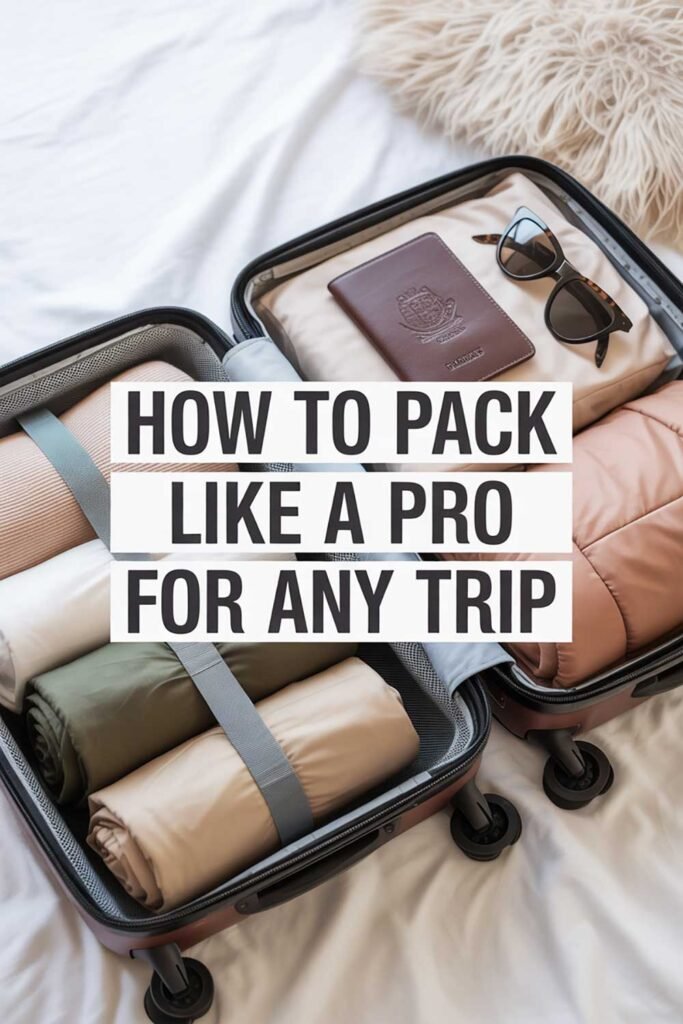
Roll soft clothes instead of folding them to fit more and arrive with fewer wrinkles
Rolling converts a folding habit into a space habit by recovering the volume that flat-folded stacks waste in air gaps between layers and making the corners, curves, and gaps of the bag available to rolled cylinders that flat items cannot reach. A rolled t-shirt occupies roughly one-third of the space of the same shirt folded flat. A bag of rolled soft items holds measurably more clothing than the same bag packed by folding. Rolling also produces distributed, soft wrinkles that resolve quickly on a hanger rather than the sharp, repeated fold lines that packing the same garment flat in the same orientation every trip creates. Roll the soft, casual items. Fold the structured ones that wrinkle differently when rolled. The distinction applied correctly across the whole bag produces a bag that fits more and arrives better.
Pack one versatile layer instead of three single-purpose warm items
The over-packer’s preparation for variable weather involves packing a sweater, a fleece, and a jacket — three separate items for three separate temperature scenarios. The lighter solution is the layering system: one warm, packable mid-layer plus a windproof or water-resistant shell that traps more warmth together than either alone. A thin merino or fleece layer under a light packable jacket handles a remarkable range of conditions because the two work together in a way that three standalone items of similar total weight do not. The layering system also produces more outfit combinations per item than three single-purpose warm pieces because each layer is independently wearable in the right conditions. One system. Two items. More warmth range. Less bag. The math consistently favors the layer over the pile, and the experience of a vacation spent carrying the system rather than the pile confirms it.
What Most People Overpack: The Categories to Cut First
Cut the just-in-case pile down to one or two items with a genuine justification
The just-in-case pile is where the vacation bag’s excess lives — not in the items the traveler knows they need, but in the items assembled around vague scenarios that have not been tested against the real itinerary. Going through the just-in-case items and asking of each one what specifically it would be just in case of, and whether that case is in the confirmed itinerary, is the audit that reduces the pile to the one or two items with a real answer. The rain jacket for a destination with a confirmed rainy season has a real answer. The formal outfit for an event described as “we might go somewhere nice” does not. Keep the just-in-case items whose scenarios have real answers. Return the ones whose answers are “maybe” or “you never know.” The bag that carries only real answers travels lighter than the one carrying every hypothetical.
Never pack a full-size backup of anything already packed in travel-size
The full-size backup — the complete bottle of shampoo alongside the travel bottle, the full-size moisturizer alongside the travel tin, the extra charger alongside the one already in the electronics pouch — is the category of overpacking that feels like preparation and functions as weight. The travel-size bottle filled to trip-length quantity for the duration is calculated specifically not to run out before the trip ends, which means the full-size backup is the weight carried the whole journey against the possibility that the calculation was wrong. Pack the travel-size version accurately filled. Leave the backup at home. The accuracy of the fill is the answer to the backup’s justification. The trip that taught you the fill was not enough is the trip whose calculation is corrected for the next one. The backup is never the answer — the right fill amount is.
Leave the rarely-worn formal option at home unless it is genuinely confirmed on the itinerary
The formal outfit — the dress that is nicer than everything else in the bag, the blazer whose occasion is described as possible rather than confirmed — is the item most frequently packed for a version of the vacation that does not ultimately happen. Most vacations do not produce the formal dinner or the cocktail event that justified packing it. The ones that do can usually be handled by the trip’s most versatile outfit, which was already packed because it was assigned to a real occasion. Remove the formal option unless a specific confirmed booking — a restaurant reservation at the right level, an event with a dress code, an occasion with a known date and time — justifies its presence. The weight and space it occupies across every vacation it traveled to but was not worn is the budget available for the item the next trip actually required.
Pack fewer shoes than you think you need and challenge the number honestly
The shoe assessment that most vacation packers make goes: walking shoes, something for dinner, sandals for the beach or the pool, and possibly one more pair just in case. This produces four pairs when most trips require two and occasionally three. Before confirming any shoe beyond the two covered in tip ten, ask the specific question: which confirmed day of the actual itinerary requires this shoe that the first two pairs cannot cover? If the answer is a specific day with a specific activity, the shoe earns its place. If the answer is general (“I might want options” or “they might come in handy”), the shoe goes back. The vacation’s shoe situation almost never produces the regret of having packed one fewer pair than was available. It regularly produces the regret of having carried four pairs for a trip that used two.
Do not pack what the hotel, the rental, or the destination already provides
Checking the accommodation’s listed amenities before packing takes two minutes and eliminates every item the accommodation will already have in the room: the hairdryer, the shampoo and conditioner, the body wash, the soap, the iron, the towels, and in many cases the basic toiletries that most travelers pack from home on the assumption that nothing will be provided. The accommodation whose listing confirms a hairdryer is the accommodation whose room has one, which means the travel hairdryer packed from home traveled to a destination that already had one. The two-minute amenity check before the toiletry packing session removes every item the room already has and leaves only the items the room does not. The bag whose contents were confirmed against the accommodation rather than assumed against the generic hotel is consistently lighter than the one that assumed and over-packed accordingly.
Leave hair tools behind unless the specific trip genuinely requires them
A travel hair dryer, a flat iron, and a curling tool together represent a meaningful share of the weight and volume that converts a manageable vacation bag into an overweight one. Most hotels provide a hairdryer. Most trips whose activities are primarily outdoor, beach, or active do not require the styling tools that were packed from habit. For the trips where the specific confirmed itinerary — the business conference, the wedding, the formal occasion — genuinely requires the tool and the accommodation genuinely does not provide it, the tool earns its place. For every other trip, leave it. The weight saved is not trivial — a travel hair dryer alone is one of the heaviest small items most travelers pack. The assessment takes thirty seconds: does a specific confirmed occasion require this, and does the accommodation not already have it? Two nos means it stays home.
Cole’s Honest Count and the First Vacation He Came Home From Lighter
Cole had a ritual at the end of every vacation that he had never mentioned to anyone because it felt like the kind of thing you should not admit: he counted the unworn clothes before repacking. Not out loud. Not with any particular ceremony. Just a quiet internal count of the shirts still folded the way they were packed, the trousers that had been at the bottom the whole trip, and the shoes that had traveled to three cities and had never left the bag. The count on his most recent trip before the one that changed everything was nine. Nine items — two full outfits and a pair of shoes — that had traveled the whole vacation, been carried through every transit, repacked at every checkout, and arrived home having contributed nothing to the trip except weight.
He knew why they were there. The two outfits were for the fancier dinners that the trip did not ultimately produce — the restaurants that were nicer than expected had been handled by the outfit he had assigned to “nice dinner” and everything else had been casual. The shoes were for the hiking day that was on the itinerary when he packed and had been replaced by a boat tour when the weather changed the morning it was scheduled. None of it was bad planning. It was the normal consequence of packing for the imagined trip rather than the planned one, and of packing individual items rather than confirmed outfits.
Before the next vacation, he laid everything out on the bed and put almost exactly half of it back. He assembled each outfit flat before anything went in the bag, confirmed every piece against its partners, removed the items that had only one match, and went back through the pile with the confirmed itinerary open beside it rather than the imagined one. He asked of each remaining item whether he would repack it on the return journey knowing what he now knew about how the trip would actually go. He packed two pairs of shoes, wore the bulkier ones on the travel day, and confirmed the hotel had a hairdryer before leaving the travel one at home. The bag weighed less than any bag he had packed for a trip of that length. He came home having worn every item in it. The unworn count at the end was zero. The thirty-three tips in this article are the ones that produced that number and have produced it on every trip since.
The System: Organize the Bag So It Stays That Way
Use packing cubes and assign one per clothing category
Packing cubes are the organizational tool that makes the lighter vacation bag stay organized throughout the trip rather than becoming the pile by day two. One cube per category — tops, bottoms, underwear, layers — means every retrieval goes to the right cube without searching. The cubes compress as they close, reducing the rolled items to the smallest practical volume and making the bag feel like it holds less than it does. The cube system also makes the mid-vacation repack and the departure checkout straightforward: close the cubes in the same order they were packed, confirm each one is complete, put them back in their designated positions. The bag repacks in minutes because the organization was maintained in cubes rather than degraded across the week’s worth of daily access. Use the cubes. Assign the categories. Keep the assignments consistent on every trip.
Always put what you need first on top of the main compartment
The top layer of the bag’s main compartment is accessed first at every accommodation, at the end of every travel day, and at the moments of lowest energy when the specific item needed is the item whose location should require the least effort. Pack the first night’s essentials — the charger, the sleep clothes, the toiletry bag, the medication due that evening — at this layer. Everything else goes below in the order its trip timing suggests. The bag whose top layer answers the first question the accommodation asks is the bag that produces a calm arrival rather than a full unpack just to find three items. Pack in order of use. The layer needed first goes in last. The layer needed last goes in first. The sequence at packing time is the experience at every arrival.
Tuck socks and small items inside shoes to use every inch of space
The interior of each shoe in the bag is volume already committed to the journey — it travels regardless of whether it is occupied. Rolling socks into cylinders and tucking them inside the shoe cavity, alongside any small item that fits — a compact adapter, a folded belt, a small accessories pouch — recovers space that would otherwise be air. In the context of a lighter vacation bag, this consolidates the sock category into the shoe layer rather than requiring a separate space in a cube or pouch. The shoes at the base of the bag with socks inside them have combined two categories into one layer. The corresponding space in the main compartment is available for items that actually need it. Pack the shoes. Fill the shoes. The inch matters when the bag is packed to carry less.
Use compression cubes for bulky soft layers
Compression cubes — those with a secondary zipper that compresses the contents after the initial close — are specifically useful for the items that make lighter packing feel hardest: the fleece, the hoodie, the down jacket, the thermal layer. These are the items that are essential for the destination’s conditions and that would require a significantly larger bag if packed without compression. A compression cube containing a bulky fleece occupies the space of a folded t-shirt stack after the secondary zip closes. The bag that holds the entire trip’s clothing — including the necessary warm layers — in a genuinely manageable size is the bag whose bulk items are in compression cubes and whose regular items are in standard ones. The two systems together extend the lighter bag philosophy to cover trip types that most people assume require heavy luggage.
Fill every gap, corner, and curve deliberately — organized does not mean half-empty
Packing lighter does not mean packing to half the bag’s capacity. It means packing only what the trip requires and using the bag’s full volume for those items efficiently. The gaps between cubes of unequal size, the corners the cube’s rectangular profile cannot reach, and the taper along the bag’s sides are all usable space for the small, flexible items that belong in the bag: a folded scarf in the corner, a flat pouch along the side, a pair of sandals in the taper at the bag’s frame edge. Filling these deliberately — with items that belong in the bag rather than with items added because space exists — produces a bag that uses its full volume for exactly what the trip requires. Lighter does not mean under-packed. It means efficiently packed. The lighter bag that uses every inch for the right items is the bag that goes everywhere without strain.
Leave a deliberate gap for what you bring back from the vacation
Every vacation produces some amount of return cargo — a purchase from the local market, a gift worth bringing home, a bottle of the regional product that was unavailable at the departure city, the few small items that accumulate across a trip’s worth of daily life in a new place. Pack to roughly three-quarters of the bag’s capacity on the outbound journey and treat the remaining quarter as the planned return margin. The gap is not waste — it is intention. The traveler who built it in comes home with the bag closed properly, every purchase inside it, and the organizational structure of the packed bag intact. The one who did not built in the margin comes home with the purchases in a plastic bag from the destination airport because the original bag was already straining before the last day’s souvenir was found. The gap is part of packing lighter. Leave it deliberately.
Weigh the bag at home before leaving — not at the airport where the options are worse
The scale at the check-in counter is the worst place to discover the bag is over the airline’s limit. The options there are a fee, a public repack, or a distribution between the checked bag and a carry-on that was not packed to hold the redistributed items. The scale at home is the right place: the closet is available, the time is unhurried, and the decision about what to return involves nothing more than walking across a room. Step on the bathroom scale while holding the packed bag, subtract personal weight, compare the number to the airline’s limit for the specific journey. If the bag is within limits, leave with confidence. If it is over, the edit happens at home from a position of calm rather than at the airport from a position of time pressure. Weigh it before you leave. The number at home is always the easier one to act on.
Our Curated Collection of Trusted Tools and Official Sources
Everything we use to plan, prepare, and travel with confidence — from official government travel tools to practical planning aids. We have pulled together the resources we trust most so every trip you take is better informed, better prepared, and a lot less stressful from start to finish.
DND ResourcesThe Lasting Habits: Make Packing Less the Permanent Default
Do a final edit and deliberately remove three more items before closing
After the bag is fully packed and the zip is almost closed, open it one final time and remove three items. Not the obvious essentials — three of the borderline items that the packing session talked itself into: the outfit assembled for an occasion the itinerary holds only tentatively, the fourth pair of shoes beyond the honest two, the what-if item whose what-if scenario would be manageable without it. Almost every packed vacation bag contains at least three such items, and the final edit is the deliberate act that removes them while the closet is still available and the trip has not yet started. The items removed in the final edit will not be missed on the vacation. They would have been carried the full journey, used zero times, and confirmed at the last checkout as the ones that came home without a story. Remove them before departure. The final edit is the habit that makes the lighter bag feel genuinely lighter every time.
Build the capsule wardrobe as a permanent system, not a one-trip experiment
The capsule wardrobe — the set of two or three colors that all mix, the outfit combinations that cover every occasion type in the normal travel rotation, the versatile pieces that dress up or down across contexts — is most valuable when it is built once and maintained rather than reassembled from scratch before every trip. The investment is building the initial capsule: choosing the palette, identifying the anchor pieces, confirming the outfit combinations, and assembling the system with the trips ahead in mind rather than only the one being planned. The return on this investment is every subsequent trip whose packing session begins from a known, working system rather than from an open wardrobe and an uncertain starting point. Build the capsule. Keep it consistent. The vacation bag’s weight decreases across trips as the system improves, and the experience of packing from a capsule rather than from uncertainty improves with it.
Photograph the fully packed bag before closing it for the vacation and the return
Two photographs, one minute total: the packed bag before the outbound departure and the packed bag before the return. The outbound photograph is the visual inventory before the bag enters transit — useful for any lost luggage or damage claim that requires describing the contents. The return photograph is the completeness check: the visual confirmation that every item packed for the trip is in the bag before the accommodation is vacated, catching the charger in the outlet and the sunglasses on the bathroom shelf before the door closes rather than after. Both photographs are timestamped automatically and stored in the camera roll where they are retrievable if any question about the bag’s contents requires an answer. Take them. The habit is free, the photographs are small, and the documentation is available at the exact moment it might be needed without any additional effort.
Track what you actually wore and update the packing list after every vacation
The packing list that improves across trips is the one updated after each trip while the memory of what was used and what was not is still accurate. Before unpacking from the return, do a brief review: which items were worn multiple times and should stay on the permanent list, which items came home untouched and should be removed, and which items were genuinely missed and should be added. The list updated from this honest post-trip review is progressively more accurate across every vacation that contributes to it. The traveler who reaches ten trips with an updated list after each one has a packing list that essentially writes itself — the result of ten trips’ worth of honest feedback rather than one trip’s worth of hopeful projection. Update the list every time. The vacation after next will be lighter for it.
Reset and restock the bag within twenty-four hours of returning home
The bag reset within twenty-four hours of the return is the bag ready for the next vacation from the day after this one ends. The laundry goes to the wash. The cubes are emptied and repositioned. The toiletry kit is restocked to the items that ran low. The packing list is updated with the post-trip review’s findings. The bag is closed, organized, and available for the next packing session without the sort-and-search that the bag left open and half-unpacked for a week requires. The reset costs fifteen minutes and removes the rebuild that the neglected return eventually demands. The vacation whose bag is reset the same day it returns starts the next vacation’s preparation with a complete, organized foundation rather than a disassembled one. Close the loop within twenty-four hours. The lighter bag is always ready because the system was always maintained.
Experience packing lighter once and let the experience do the convincing
The final tip is the one that makes all the others permanent: experience the lighter vacation bag once, on a real trip, with a genuine commitment to the system rather than a partial attempt. The experience of moving through airports without strain, checking into every accommodation with a bag that lifts onto the rack rather than being hauled, walking the cobblestone streets without the rolling resistance of a bag packed beyond its comfortable rolling weight, and arriving at the departure hall on the return day with the same organized bag that left home a week earlier — this experience does what the tips alone cannot. It replaces the abstract benefit of packing lighter with the felt reality of what the lighter bag produces at every moment of the trip. Take the lighter bag once. Let the trip be the argument. The thirty-three tips get the bag to the right weight. The experience keeps it there on every trip that follows.
Book the Vacation Worth Packing Lighter For
The best vacations happen to the people with the lightest bags. Our travel agents plan the trips that are worth showing up unencumbered for — the right destination, the right itinerary, and the right pace for the traveler who is too busy enjoying the vacation to worry about what they brought.
Book A TripHalf of it went back before the bag was opened. Every outfit had a match. Shoes were two pairs. The just-in-case pile was honest. The hotel had the hairdryer. The cubes were assigned. The final edit removed three more. The unworn count at the end was zero. That is thirty-three tips. That is the vacation that happened to the person with the lightest bag.
Picture the Vacation You Come Home From Having Worn Everything You Brought
Everything was laid out on the bed and half went back before the bag was touched. The itinerary was open beside the packing list and the items that belonged to the imagined trip rather than the planned one stayed in the closet. Every outfit was assembled flat before any piece was packed. Two shoe pairs, the bulkier ones worn on the travel day. The capsule is two colors and everything mixes. The just-in-case pile came down to two items with real answers. The hotel had the hairdryer — confirmed before the travel one was ever removed from the shelf. The cubes are assigned. The final edit removed three things that would have come home untouched. The bag weighs less than any bag packed for a trip this long. At every transit the bag lifts without effort. At every cobblestone street the bag rolls without resistance. At the last checkout the repacking takes four minutes because everything has a place it is returning to. At home the unworn count is zero. That is thirty-three tips. That is the vacation that happened to the person who was too busy enjoying it to worry about what they brought.
One More Thing Before the Bed Gets Laid Out
Print our free Travel Packing Checklist and use it as the starting foundation — every category organized, the outfit-first structure built in, and the final-edit habit included — so the lighter bag is the one that closes on the first try and comes home with everything worn. The same checklist we use before every vacation we take.
Get the Free ChecklistExplore Our Top Picks for a Better Trip
After years of exploring the globe together, these are the exact tools, platforms, and services we rely on for every single trip — personally tested, traveler approved, all in one place. We don’t recommend anything we wouldn’t use ourselves, and this is the collection of booking platforms and travel tools that have made our adventures smoother, smarter, and more memorable.
See Our Top PicksLove Helping Travelers Arrive at Every Vacation With Exactly What They Need?
Helping a traveler pack the right bag for the right trip — and booking the vacation that justifies packing it carefully — is the kind of practical expertise that makes a home-based travel agent genuinely worth coming back to. If turning your love of travel into a business sounds like the right next move, see how the TravelPreneur system works.
Become An AgentVacation Packing Printables at Premier Print Works
Visit Premier Print Works for packing checklists, capsule wardrobe planners, outfit assignment sheets, and vacation planning printables that make every packing session lighter and every vacation more enjoyable — from the first item laid out on the bed to the final edit that removes the three things that were never going to be worn.
Visit Premier Print WorksDisclaimer
The information shared in this article is provided by Don and Diana’s Travels for general informational, educational, and inspirational purposes only. It reflects our personal experiences, opinions, and the experiences of travelers we have worked with. It is not professional travel, legal, or financial advice.
Airline and Baggage Policies
Airline baggage allowances, weight limits, size restrictions, and related policies vary by carrier and are subject to change without notice. Always confirm current requirements with your specific airline before traveling. We are not responsible for any fees or outcomes arising from reliance on baggage information in this article.
Affiliate and Partner Links
This article may contain affiliate and partner links that pay us a commission at no extra cost to you. Our recommendations are based on real use and genuine belief in the products and services we share.
Composite Stories
Stories on this site combine real experiences from Don, Diana, clients, and travelers we have worked with. Details may be adjusted for privacy and narrative clarity.
No Guarantees
We do not guarantee any specific packing or travel outcome from using the information in this article. Results vary by traveler, destination, and trip type.
Copyright and Use
All content is the copyrighted property of Don and Diana’s Travels. You may not copy or republish our content without prior written permission. You are welcome to share a direct link with proper credit.
By reading this article, you acknowledge that you have read and agree to this disclaimer.