33 Cruise Packing Tips That Make Your Cabin Feel More Organized | Don and Diana’s Travels

33 Cruise Packing Tips That Make Your Cabin Feel More Organized

The cruise cabin is one of the most thoughtfully engineered small spaces in travel — every drawer, hook, and surface positioned to serve the maximum number of functions in the minimum amount of floor space. And yet the majority of cruise travelers arrive, distribute their belongings across every available surface in the first thirty minutes, and spend the rest of the voyage stepping around bags, searching for specific items, and managing a level of cabin disorder that the space was designed to avoid. The engineering was right. The packing and organization habits were not built for it.

These thirty-three tips cover every layer of the cruise organization challenge — from what to pack before boarding to how to set up the cabin on day one, manage it through the voyage, handle port days without losing anything essential, and disembark calmly rather than scrambling to gather what drifted across the cabin over seven or fourteen days. The organized cruise cabin is not a luxury. It is a decision made before and immediately after boarding.

Free Download: Our Travel Packing Checklist

Before the cruise bags close, our free Travel Packing Checklist confirms every item, every document, and every pre-departure step so nothing gets left behind and nothing important gets discovered missing at the terminal. Download it free.

Get the Free Checklist

Before You Pack: The Cruise-Specific Preparation That Changes Everything

Cruise packing has specific requirements that general travel packing advice does not cover — dress codes for formal nights, prohibited items that differ by cruise line, cabin features that vary by ship class, and a port day system whose organization needs to be built before departure rather than improvised at each new destination. The preparation done before opening the wardrobe determines whether the cruise packing session produces the right bag or the common one.

1. Research the dress code for every dining venue and formal night on the specific itinerary

Cruise dress codes range from resort casual across all venues to formal nights requiring black tie on some sailings of some lines. The specific dress code for the specific sailing is published in the cruise line’s documentation and determines how much formal wear to pack, how many elevated outfits are needed, and whether the casual-only approach that works for a beach resort will produce the specific disappointment of arriving underdressed for a dining venue the cruise was partly chosen for. Read the specific sailing’s dress code before selecting a single item of clothing. The formal night outfit that was not packed because the dress code was not checked is the most consistently avoidable cruise wardrobe problem.

2. Check the cruise line’s prohibited items list before packing

Every cruise line maintains a prohibited items list that includes items most travelers would consider standard travel equipment: power strips with surge protectors are prohibited on most lines because the ship’s power system cannot accommodate them; steam irons and clothes steamers are typically prohibited because of fire risk; some lines restrict candles, certain extension cords, and specific appliances. The item confiscated at embarkation is the item paid for and left at the port. Check the specific cruise line’s current prohibited items list before packing. The non-surge-protected power strip is the approved alternative on most lines — confirm the specific line’s requirements before purchasing.

3. Confirm what the cabin provides before packing what it already has

Most cruise cabin categories provide hair dryers, beach towels for pool deck use, basic toiletries, robes, hangers, and in some cases specialty amenities that vary by cabin tier. Checking the specific cabin category’s listed amenities before packing removes every item the cruise line provides and frees the bag for what the ship genuinely does not supply. For the cruiser whose bag is consistently heavy, the cabin amenities check is the simplest and most immediate weight reduction available.

4. Download the cruise line’s app and complete online check-in before departure

Every major cruise line now offers a dedicated app whose functionality includes online check-in, boarding pass generation, daily schedule, dining reservations, excursion booking, and onboard account management. Completing online check-in before departure — including uploading a photo, registering a credit card to the onboard account, and confirming muster station assignment — reduces the embarkation day process from an hour of queuing through multiple check-in stages to a streamlined walk-on experience at many terminals. Download the app before the departure day. Complete everything it allows before arriving at the terminal.

5. Pack a dedicated port day bag that travels in the carry-on

The port day bag — a lightweight, slash-resistant crossbody or a packable backpack that fits under a bus seat or in a small locker — needs to be accessible from the moment of embarkation rather than buried in the checked cruise luggage whose delivery to the cabin can take several hours after boarding. Pack it in the carry-on for the embarkation day so it is available for the first port regardless of when the main luggage arrives. The port day bag that was in the checked luggage and had not been delivered by the first morning at sea produces the first port day improvisation the cruise was not planned for.

6. Weigh and measure every bag before the cruise terminal

Cruise lines do not typically enforce checked bag weight limits at the terminal in the way airlines do, but the luggage handlers who move bags from the terminal to the cabin have physical limits on what they can safely maneuver through the ship’s corridors and stairwells. A bag that cannot be reasonably managed by one person creates difficulty and occasionally results in damaged items during transfer. More practically, the bag that cannot be lifted into the overhead storage in the cabin, does not fit under the lower berth, or occupies the full floor space of the small cabin is the bag whose size creates the organizational problem that no amount of organizational equipment can fully solve. Pack appropriately for the cabin’s specific storage capacity.

Book A Trip

Book the next cruise with a travel agent who knows the right sailing, the right cabin category, and every detail that makes the difference between a cruise that felt right and one that felt like it was missing something. Let us handle it.

Book A Trip

The Cabin Organization Kit: What to Bring That the Ship Does Not Provide

The cruise cabin’s organization potential is constrained by a small number of specific design limitations — one power outlet near the desk, limited hook positions, a bathroom whose counter space is measured in inches, and drawer space calibrated for efficient rather than generous storage. A small selection of low-cost, low-weight organizational items brought from home addresses every one of these limitations and transforms the cabin’s livability across the voyage.

7. Bring magnetic hooks for the cabin walls

The walls of most cruise cabin interiors are magnetic metal panels — a feature specifically designed to accommodate the magnetic hooks that experienced cruisers have brought for decades. A set of four to six strong magnetic hooks attached to the cabin wall on embarkation day provides hanging positions for bags, hats, lanyards, jackets, robes, and any other item that would otherwise occupy the limited hook positions the cabin provides or end up on surfaces where they contribute to the visual and physical disorder that small cabin spaces accumulate quickly. Magnetic hooks weigh almost nothing, cost very little, and are one of the highest-return items per gram in any cruise organization kit.

8. Pack a cruise-approved power strip to solve the single-outlet problem

The standard cruise cabin provides one or two power outlets — almost never enough for the modern traveler’s charging requirements across a multi-week sailing. A non-surge-protected power strip — the specific type approved by most cruise lines — multiplies the cabin’s charging capacity from the first evening without violating the ship’s prohibited items policy. Confirm the specific cruise line’s power strip requirements before purchasing or packing — the surge-protected version is prohibited on most lines, the non-surge-protected version is generally approved, and the distinction matters at embarkation security. One power strip. Confirmed against the specific line’s policy. Packed in the carry-on for day-one accessibility.

9. Bring a hanging toiletry organizer for the bathroom door

The cruise cabin bathroom’s counter space typically accommodates a toothbrush and a small tube of toothpaste comfortably and very little else. A hanging toiletry organizer — the type with multiple clear pockets that hooks over the bathroom door — converts the door into a full organizational surface for every toiletry, medication, and grooming item that the counter cannot hold. Everything visible. Everything accessible. Nothing on the floor or balanced on the counter edge. For cabins shared between two people, the hanging organizer is the difference between a functional bathroom and one whose counter management requires active negotiation throughout the sailing.

10. Use packing cubes to organize the cabin’s limited drawer space

The cruise cabin drawer opened and searched daily — items removed to find the specific item underneath, returned to approximate positions, progressively less organized with each interaction — is the drawer that reaches maximum disorder by day three and requires a full reset before it becomes navigable again. Packing cubes in the drawers maintain category separation automatically: the tops cube is always in the tops drawer, the bottoms cube is always in the bottoms drawer, and every item is findable without removing what is above it. The cruise wardrobe that stays organized through a fourteen-day sailing was organized by a system that did not require daily maintenance to sustain it.

11. Pack a lanyard and attach the cruise card to it immediately at embarkation

The cruise card — the card that opens the cabin door, charges onboard purchases, tracks embarkation and disembarkation at every port, and serves as the on-ship identity document — is the item most commonly searched for, left behind on port days, and accidentally dropped in the water during tender boarding across every sailing on every line. A lanyard worn around the neck or wrist from the moment the card is issued converts the cruise card from a lost-item risk into a confirmed-present item at every checkpoint. Pick up the card at embarkation. Attach it to the lanyard immediately. It does not leave the lanyard until disembarkation.

12. Bring an over-door shoe organizer for the cabin’s small items

The over-door shoe organizer — hung on the cabin’s main door or bathroom door — provides twelve to twenty individual pockets for the small items that otherwise end up distributed across the cabin’s limited surface space: sunscreen, chapstick, sunglasses, headphones, charger cables, medicine, playing cards, pens, the port day cash pouch, the spare lanyard. Everything in a pocket. Everything visible. Everything retrievable without moving anything else. The over-door organizer is the organizational item that experienced cruisers most frequently cite as the single addition that changed the cabin’s daily livability most significantly.

13. Pack a small collapsible bin or basket for the cabin’s desk surface

The desk or vanity surface in a cruise cabin becomes the default landing zone for everything that does not have a designated position — the day’s receipts, the sunglasses, the lip balm, the earrings, the phone charger, the port map picked up from the shore excursion desk. A small collapsible fabric bin placed on the desk surface on day one provides the single designated position for this category of items and prevents the surface drift that turns a clear workspace into a search zone by day two. Empty it at the end of each sea day. Keep it in position throughout the voyage. The clear surface that begins each morning is the one whose bin was emptied the evening before.

“The organized cruise cabin is not the largest one. It is the one where someone brought six things from home that the ship does not provide and unpacked everything in the first hour.”

Plan Our Escape

Let us plan the cruise — the right line, the right itinerary, the right cabin — so every one of these tips has the best possible cabin to work with. Tell us where you want to sail.

Plan Our Escape

Cruise Clothing: Packing the Wardrobe That Covers Everything Without Overpacking

The cruise wardrobe challenge is more complex than the typical vacation wardrobe because it spans multiple distinct contexts in a single trip — pool deck casual, port day practical, smart casual for most evenings, and formal attire for formal nights. Each context requires specific clothing and the temptation to pack separately for each one produces a bag whose size is determined by the number of contexts rather than by the number of days, which is the wrong calculation.

14. Pack one complete formal night outfit per formal night on the itinerary — not one per evening

The number of formal nights varies by itinerary — a seven-night Caribbean sailing typically has one or two, a fourteen-night transatlantic may have four or five. Pack specifically for the confirmed number of formal nights, not for every evening of the sailing. One formal outfit per formal night, confirmed as a complete look on the bed before packing — shoes, accessories, the full ensemble — is the packing decision that keeps the formal wear category from becoming the wardrobe’s largest and heaviest. Re-wearing a formal outfit on non-adjacent formal nights is entirely normal and unnoticed on a ship where the same guests are present throughout.

15. Build all casual and resort wear around two or three base colors

Two or three colors whose every combination works — white, navy, and tan; black, cream, and coral — produce a cruise wardrobe where every top pairs with every bottom, every layer works across every outfit, and every accessory serves the full wardrobe. The coherent palette is especially valuable on a cruise because the limited cabin storage rewards the wardrobe that produces the most outfit combinations from the fewest individual items. The cruise wardrobe built on a coherent palette fits in the cabin’s drawers. The wardrobe without one does not.

16. Plan re-wearing deliberately across sea days and port days

The sea day outfit and the port day outfit are different contexts that the same clothing often serves — casual trousers worn for the sea day morning and again for the less formal port day afternoon, a linen shirt serving the pool deck, the shore excursion, and the evening dinner with different accessories. Plan the re-wearings before packing rather than discovering them at the destination. The wardrobe whose re-wearings are planned produces fewer items packed without sacrificing range. The wardrobe whose re-wearings were not planned arrives at the ship with more items than the cabin’s storage was designed for.

17. Pack one versatile cover-up that works from pool deck to lunch venue

The pool deck to the ship’s casual lunch venue is the most common daily transition on any warm-weather cruise and the one for which the single versatile cover-up earns its space most clearly. A linen shirt dress, a lightweight cotton kaftan, or a quality sarong that works over a swimsuit at the pool bar, as a cover for the buffet, and as a casual afternoon look requires no change of clothing for the full midday range. For the cruiser who spends significant time moving between the pool deck and the ship’s casual venues, this one item replaces the three or four single-purpose pieces that the same transition otherwise produces.

18. Roll casual and resort wear — fold formal items flat in dry cleaning bags

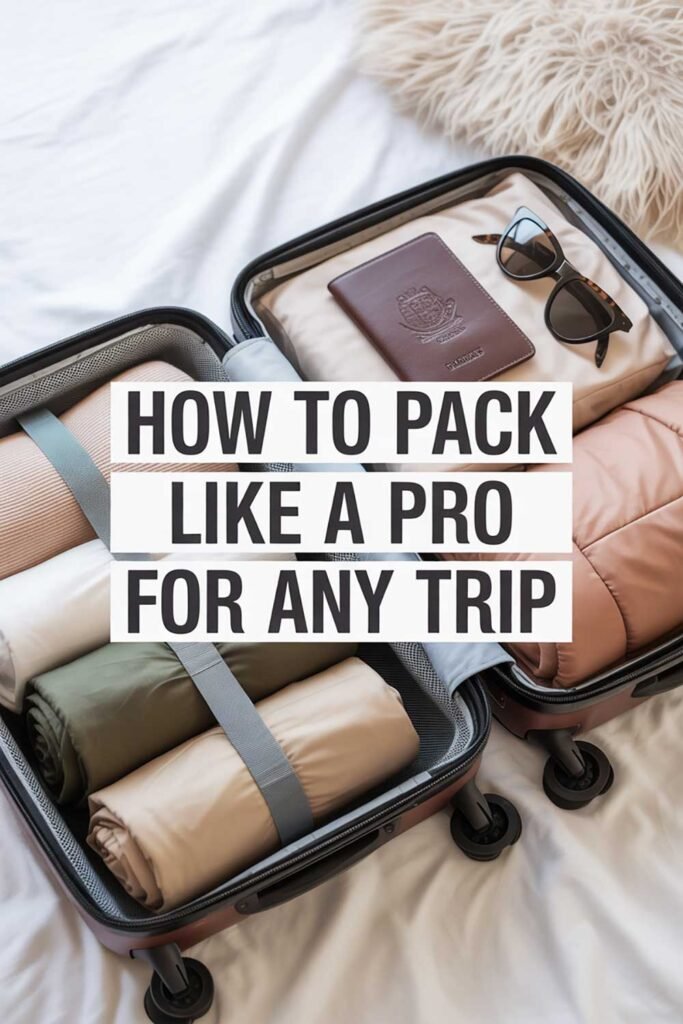
The packing method distinction matters more on a cruise than on most trip types because the formal night outfit that arrives wrinkled may not have access to steaming or pressing at a convenient time before the specific evening that requires it. Roll every casual and resort item — t-shirts, swim cover-ups, casual trousers, knitwear. Fold the formal items carefully along their natural fold lines, place them in dry cleaning bags, and pack them flat at the top of the suitcase where they bear the minimum compression weight from items below. The formal night outfit that arrives in wearable condition from this packing method is the one that did not require the ship’s laundry service to rescue it.

19. Pack shoes for function first — waterproof sandals that cross every context

The cruise shoe collection should cover three specific requirements at minimum: a comfortable walking shoe for port days with significant walking, a waterproof or water-resistant sandal that works from the pool deck to the casual lunch venue to the casual evening, and a formal shoe for formal nights. Three pairs covers every context the typical cruise produces. The waterproof sandal is the highest-function single shoe in the collection because it covers pool deck, casual onboard, casual shore excursion, and beach port in a single pair. Choose it before choosing anything else. Every additional shoe pair requires a confirmed context the existing three cannot cover.

20. Leave a deliberate quarter of the suitcase empty for port purchases

The cruise port market, the local artisan shop at the tender port, the destination rum whose bottle needs space on the return — the cruise is one of the trip types most likely to produce purchases at multiple ports whose combined volume requires return-journey bag capacity. Packing to seventy-five percent of the suitcase’s capacity on the outbound allows every port purchase to come home without a reorganization session at the last port or an overweight surcharge at the embarkation terminal. The deliberate gap is not empty space. It is the return margin that makes every port purchase a comfortable decision rather than a logistical problem.

DND Resources

Our travel resources page has trusted tools and planning guides for every type of trip — including cruise-specific planning resources and destination information for ports around the world.

DND Resources

Port Day Packing: The System That Keeps Every Shore Excursion Running Smoothly

Port days are where cruise organization is most tested — the transition from the controlled cabin environment to a new destination requires a specific set of items assembled correctly, the cruise card managed carefully, and the return to the ship completed on time regardless of what the afternoon produced. These tips cover the port day system from the pre-departure preparation to the return aboard.

21. Use a dedicated port day bag that is slash-resistant and closes securely

The port day bag — a lightweight crossbody with a secure zipper or a packable backpack with anti-theft features — is the bag that goes ashore rather than the full-size travel bag or the ship’s beach bag. It should fit under a seat on a shore excursion bus, carry all port day essentials without excess bulk, and provide enough security to carry a small amount of cash and a copy of the cruise card photo without concern in tourist-density port environments. Choose it before the sailing. Keep it in the carry-on for day-one access. Use it for every port day.

22. Keep a dedicated port day essentials pouch always stocked

A small zippered pouch in the port day bag — reef-safe sunscreen, SPF lip balm, a photocopy of the passport photo page, a small amount of local currency for the specific port, the credit card for port purchases, the ship’s emergency contact number written on paper — that is restocked the evening before every port day is the preparation that means leaving the ship each morning requires picking up the bag rather than assembling it. The pouch whose contents are confirmed the evening before departure day is the pouch that never produces the port-side realization that the sunscreen was left in the cabin.

23. Keep the cruise card on the lanyard for every port departure and return

The cruise card is required for re-boarding the ship at every port — the ship’s security system logs every departure and return and the card is the credential that confirms the passenger is aboard before departure. A cruise card left in the cabin, dropped at the port, or forgotten in the port day bag’s bottom compartment produces the specific situation of being dockside without the credential required to reboard, which requires the ship’s security officer and a process whose urgency depends on how close to departure time the problem is discovered. The card on the lanyard around the neck leaves the ship on the neck and returns on the neck. It does not leave the lanyard at any port.

24. Dress in layers for ports with significant indoor time

The air conditioning in port museums, restaurants, shopping centers, and buses on warm-weather itineraries is frequently set significantly colder than the outdoor temperature — an adjustment whose comfort depends entirely on having a layer available rather than having left it on the ship because the outdoor temperature at departure did not suggest needing it. A lightweight long-sleeved layer or a compact packable jacket in the port day bag adds negligible weight and covers every air-conditioned indoor environment the port day produces. Dress for the outdoor temperature. Pack for the indoor one.

25. Bring a reusable water bottle for every port day

Bottled water at tourist-density port destinations is more expensive than the same product at the ship, less convenient than the ship’s free water stations, and produces plastic waste at every port whose cumulative environmental impact across a fourteen-port sailing is meaningful. A reusable water bottle filled at the ship before departure covers the port day’s hydration requirement through the warm outdoor walking that most port days involve. Refill at restaurants, hotels, and any accessible tap whose safety is confirmed. Return to the ship having used none of the port’s bottled water supply and none of the budget’s money on something the ship provided for free.

26. Wear the port day’s walking shoes on the ship — not packed in the port bag

The walking shoe worn on the ship from the cabin to the gangway is the walking shoe that does not occupy port bag space and does not need to be changed at the gangway. Comfortable walking shoes worn through the ship’s corridors on port morning are an entirely normal sight on any sailing. The tender boarding, the gangway walk, and the first half-hour of the port are more comfortable in the shoe already on the foot than in the sandal worn to the gangway and changed there. Wear the walking shoe from the cabin. Change at the accommodation that evening if the ship’s dress code requires it for dinner.

How Cam Finally Built a Cruise Cabin That Felt Like a Home Rather Than a Storage Problem

Cam had taken four cruises across five years and described every cabin experience with the same specific qualifier: the first two days were a constant minor frustration of not knowing where anything was, and the last two days were a scramble to find and reassemble everything that had drifted across the cabin during the sailing. The middle days were the cruise. The bookends were management.

The change came from a recommendation from a fellow passenger on the fourth sailing who appeared to have a suspiciously well-organized cabin — surfaces clear, no visible bag pile in the corner, everything apparently findable without effort. The answer was six items: magnetic hooks on the wall, a hanging toiletry organizer on the bathroom door, packing cubes in the drawers, a non-surge-protected power strip confirmed against the line’s policy, an over-door shoe organizer on the cabin door, and a lanyard for the cruise card from the moment it was issued.

The fifth sailing began with thirty minutes of cabin setup using all six items. The magnetic hooks held the bags that had previously occupied the floor corner of every previous sailing. The hanging organizer held everything that had previously competed for the bathroom’s two inches of counter space. The packing cubes kept every drawer navigable from day one to day fourteen. The over-door organizer held the sunglasses, the port day cash pouch, and the charger cables that had previously been the first thing searched for each morning. The cruise card never left the lanyard. The first two days were the cruise. The last two days were also the cruise. These thirty-three tips are the complete version of those six items and every organizational habit that the organized cabin requires to maintain itself across the voyage.

Become An Agent

Love helping travelers plan cruises that feel organized, comfortable, and genuinely enjoyable from embarkation to disembarkation? See how to turn that into a home-based travel business.

Become An Agent

The Cabin Habits That Keep the Organization Working Through the Full Voyage

The organizational equipment is the infrastructure. The cabin habits are the maintenance that keeps the infrastructure working from embarkation to disembarkation. A cabin set up correctly on day one but managed without daily habits will drift into disorder by the middle of the sailing. A cabin set up correctly and maintained with a small number of daily habits stays organized throughout the voyage with almost no active effort.

27. Unpack completely on embarkation day — every item in its designated position

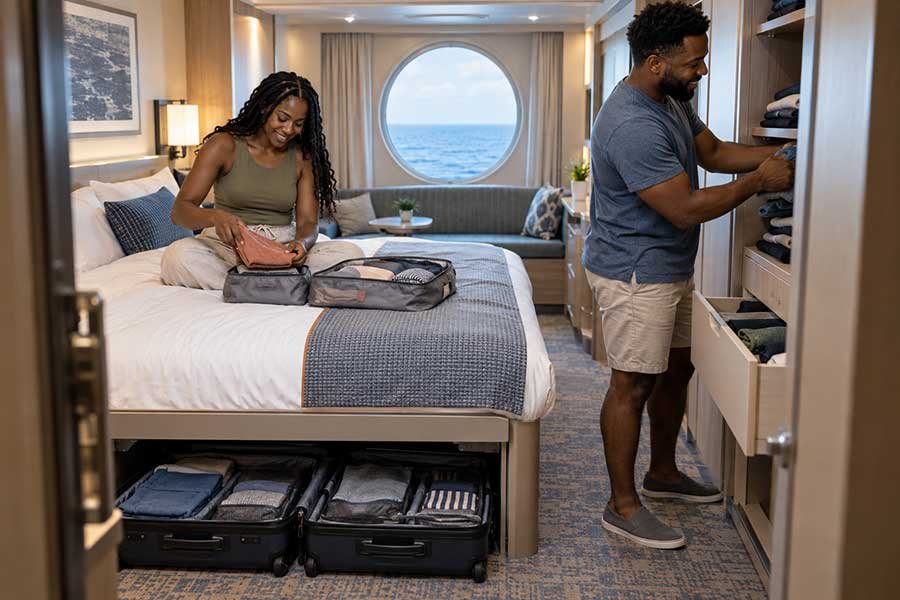
The bag that sits partially unpacked in the cabin corner for the first three days is the bag whose contents are searched through rather than accessed from their positions. Unpack completely on embarkation day while the embarkation energy is available and the positions are still clearly visualized. Every clothing item in its packing cube in the correct drawer. Every toiletry in the hanging organizer. Every small item in its over-door pocket. The cabin bag empty and stored under the lower berth or in the wardrobe. The cabin is then set for the voyage rather than set up progressively across the first several days.

28. Designate one position for the cruise card and never deviate from it

The cruise card not on the lanyard belongs in one specific position in the cabin — the same position every time it is not being worn: the top pocket of the over-door organizer, the specific magnetic hook by the cabin door, the specific drawer whose only contents are the cruise card and the room key. The position chosen at embarkation is the position used for the full voyage. The cruise card that is always in its position is found in two seconds at every departure. The cruise card without a designated position is the most commonly searched-for item in every cabin on every sailing.

29. Use the cabin safe for the passport, backup payment card, and the voyage’s cash

The cabin safe — a small electronic safe in most cabin categories — is the secure storage for the items whose loss or theft would most significantly disrupt the voyage: the passport, the backup card that is not the primary card for onboard charges, and the cash carried across the full sailing. The primary cruise card and the port day card live in the lanyard and the port day pouch. Everything irreplaceable lives in the safe. The safe code set at embarkation and confirmed in the notes document before leaving the cabin the first time is the code available when needed and not requiring a cabin return to look up.

30. Do a quick cabin tidy before leaving for every port day

The five minutes before leaving the cabin for a port day — surfaces cleared, items returned to their positions, the over-door organizer’s top pocket checked for the cruise card — is the preparation that produces a calm return to the cabin at the end of the port day rather than a return to the disorder the departure morning left. The cabin that was tidy at departure is the cabin that is still approximately organized on return, requiring only the port day’s accumulated additions to be placed in their positions. The cabin that was not tidy at departure requires full reorganization before the evening routine can begin.

31. Use the laundry bag from the first evening — never mix clean and worn

The cruise’s extended duration — seven to fourteen days or more — means the clean/worn distinction in the cabin’s storage becomes progressively more important as the sailing continues. A lightweight laundry bag placed in the cabin on embarkation day is the boundary that maintains this distinction automatically: every worn item goes into the laundry bag from the first evening, every clean item stays in its packing cube. The cabin whose laundry bag was used consistently from day one has a clear clean/worn separation at every point in the voyage. The cabin without one requires a smell-test sort at some point in the second week.

32. Begin packing for disembarkation the evening before the final morning

The disembarkation morning on a cruise is one of the most time-pressured of any trip type — passengers must vacate the cabin by a specific time, luggage must be in the corridor by a specific earlier time for ship handling, and the sequence of breakfast, cabin clearing, and disembarkation lineup all compete in a compressed window. The packing done the evening before disembarkation removes every time-pressured packing decision from that morning. The luggage is in the corridor before sleeping. The carry-on is packed with everything needed for the disembarkation day. The morning is for breakfast and departure, not for assembly.

33. Do a thorough cabin sweep before leaving for the final time

Every drawer opened and confirmed empty. The bathroom counter cleared. The safe opened and emptied — the safe that is found locked and inaccessible after departure by the next passenger most commonly contains items whose owner did not do a final sweep. The magnetic hooks removed and packed. The over-door organizer taken down. The charging cables from every outlet. Under the lower berth. The balcony if applicable. The item found by this sweep comes home. The item not found joins the ship’s lost property system whose recovery process from the middle of the ocean is more complex than the three minutes the sweep requires. Do it before the cabin door closes for the last time.

Picture This

The embarkation day began with online check-in already complete and the app already showing the cabin number and muster station assignment. The carry-on held the port day bag, the organizational kit, and everything needed for the first twelve hours before the checked luggage arrived. The cabin setup took thirty-five minutes: magnetic hooks on the wall for the bags and hats, hanging toiletry organizer on the bathroom door, packing cubes in the drawers, approved power strip at the desk outlet, over-door organizer on the cabin door with every small item placed in its pocket, cruise card on the lanyard from the moment it was issued.

By day two, the organizational habits were already automatic — the five-minute morning tidy before every port departure, the cruise card checked on the lanyard at the gangway, the port day pouch stocked the evening before, the laundry bag collecting every worn item from the first evening. By day seven, the cabin looked the same as it had on day two. The surfaces were clear. The drawers opened to organized cubes. The bathroom counter held only what the hanging organizer could not. The safe held the passport and the backup card, both confirmed at every port departure.

The evening before disembarkation, the checked luggage was packed and in the corridor by nine. The carry-on held the disembarkation day essentials. The final morning was breakfast and departure. The cabin sweep found the charging cable in the bathroom outlet and one magnetic hook still on the wall above the desk. Both came home. The cabin door closed on a space that was as organized as it had been when the voyage began. That is thirty-three tips. That is the cruise cabin that felt like a home because someone decided before boarding that it would.


Before the Next Cruise: Grab the Free Packing Checklist

Our free Travel Packing Checklist is the foundation of the cruise packing system these thirty-three tips describe — every category, every pre-departure confirmation, and every final check that makes the embarkation day calm rather than chaotic. Download it free.

Get the Free Checklist

Explore Our Top Picks for a Better Trip

After years of cruise travel and destinations around the world, these are the booking platforms and travel services we personally rely on — tested, trusted, and recommended because they have consistently made every voyage smoother and more memorable.

See Our Top Picks

Travel Printables at Premier Print Works

Visit Premier Print Works for cruise packing checklists, cabin organization guides, port day planners, and travel printables that make every cruise more organized and every cabin more comfortable from embarkation to disembarkation.

Visit Premier Print Works

Disclaimer

The information shared in this article is provided by Don and Diana’s Travels for general informational, educational, and inspirational purposes only. It reflects our personal experiences, opinions, and the experiences of travelers we have worked with. It is not professional travel, legal, or safety advice.

Cruise line policies, prohibited items lists, cabin amenities, dress codes, port procedures, and disembarkation requirements vary significantly by cruise line, ship, sailing, and cabin category and are subject to change without notice. Always confirm current requirements and policies directly with your specific cruise line before sailing. Power strip policies in particular vary by line and are strictly enforced — always verify the specific line’s current requirements before purchasing or packing any electrical equipment. We are not responsible for any items confiscated, fees charged, or outcomes arising from reliance on information in this article.

This article may contain affiliate and partner links that pay us a commission at no extra cost to you. Our recommendations are based on real use and genuine belief in the products and services we share. Stories on this site combine real experiences from Don, Diana, clients, and travelers we have worked with. Details may be adjusted for privacy and narrative clarity. All content is the copyrighted property of Don and Diana’s Travels. You may not copy or republish our content without prior written permission. By reading this article you acknowledge that you have read and agree to this disclaimer.

Scroll to Top