31 Packing Tips for a One-Week Vacation Without Overpacking
One week is the trip length that tricks most travelers into overpacking — it feels long enough to need options for every possible situation and short enough that you end up wearing the same five things anyway. Thirty-one packing tips for the seven-day trip that fits in a carry-on, looks great every day, and never produces the specific regret of dragging an overweight bag through every airport and hotel lobby of the trip.
Grab Our Travel Packing Checklist
Our free packing checklist is built around exactly this — the one-week trip whose seven outfits are all confirmed, the bag is organized by category, and the final edit is built in so the seven-day trip that used to need a checked bag closes in a carry-on with room to spare. Use it before the next one-week trip and count the overweight bag fees you don’t pay.
Get the Free ChecklistEvery extra outfit you pack for a one-week trip is just extra weight you carry through every single day of it for clothes you almost never end up wearing.
One week is the trip length that tricks most travelers into overpacking because it feels long enough to need options for every possible situation and short enough that you end up wearing the same five things anyway.
The One-Week Mindset: Why Seven Days Fools Almost Everyone
Recognize that one week is the most common overpacking trap — and it has a specific cause
Two nights: nobody overpacks. Two weeks: most experienced travelers know they need to manage the weight. One week sits in the specific middle zone that produces the most consistently oversized bags because the trip length activates two contradictory impulses simultaneously: it feels long enough to justify options for every possible scenario, and it is short enough that the week passes before most of those scenarios materialize. The result is a bag packed for the imagined seven days — the rainy afternoon, the spontaneous nice dinner, the activity that did not make the confirmed itinerary — whose actual use is five outfits and a lot of unnecessarily carried weight. Understanding that this is the specific psychology of one-week overpacking is the first step toward not doing it. The one-week trip does not need options. It needs confirmation. Every item in the bag for a seven-day trip should be there because a specific confirmed day requires it — not because seven days felt long enough to justify its presence.
Seven outfits is the maximum — and that includes the travel day outfit worn through the airport
Seven days. Seven outfits. The math is complete before the bag is opened. The travel day outfit — worn through the airport, on the flight, and to the accommodation’s check-in — is one of those seven. It does not arrive in the bag. It arrives on the body, which means it contributes zero to the bag’s weight and volume while covering one of the seven days. This leaves six outfits in the bag for six destination days. The bag built for this count — not for seven in the bag plus the travel day outfit as an additional item — is the bag that closes without sitting on it and arrives under the airline’s weight limit for the vast majority of one-week trips. Seven is the number. Six go in the bag. One is worn. The math produces the trip. The anxiety adds to it. The seven-outfit limit is not a sacrifice — it is the accurate count of the outfits the seven days actually use.
Plan one outfit per day with absolutely no backup maybes — the backup outfits are where the overweight fees live
The backup maybe is the specific item that overpacks every one-week bag: the extra dress in case the first one does not feel right, the second pair of jeans because the first might get dirty, the top that does not have a confirmed outfit but might come together at the destination. The backup maybe is never worn. It is carried for the full seven days through every airport, every staircase, every cobblestone street, and every hotel corridor — doing nothing except contributing to the bag’s weight and the traveler’s physical load. Remove every backup maybe from the packing list before the bag is opened. One outfit per day. Six in the bag. That is the complete, accurate count. The outfit that did not have a confirmed partner at packing time will not have one at the destination either. It will travel unused and come home folded exactly as it was packed. Leave it at home instead.
Build every outfit for the seven days around the same two or three base colors so everything mixes and matches
The capsule palette is what makes seven outfits from fewer than seven top-bottom combinations — and what makes a seven-outfit bag significantly lighter than the seven fully independent combinations that a non-capsule wardrobe requires. Two or three colors chosen so that every top works with every bottom, and every layer works with every outfit, multiply the outfit options from the pieces available rather than fixing them at one per piece. Navy, white, and tan. Black, cream, and olive. Any three colors whose interactions all work produce a situation where five tops and two bottoms make ten distinct combinations rather than five. The palette also means the accessories and shoes work across every outfit rather than being paired to specific combinations. Choose the palette for the trip before selecting any specific piece. Every piece selected from within it earns the seven-outfit count more efficiently than any piece selected outside it.
Accept fully and genuinely that wearing the same clothes multiple times on a one-week trip is normal — for everyone
The social accounting that produces a fresh outfit for every day of the seven-day trip assumes an audience tracking the daily rotation that does not exist. Nobody at the café on Thursday was at the same café on Monday noting which trousers were worn. Nobody on the street on day six was on the street on day two. The hotel’s staff sees many guests in many outfits across many days whose specific repetitions are tracked by nobody. Re-wearing the jeans for days three, five, and seven is normal vacation behavior for every experienced traveler, and explicitly granting permission to do it before the bag is packed removes three pairs of trousers from the bag before it is opened. The experienced light packer’s wardrobe is built around this permission as a foundational assumption. The overpacker’s is built around the anxiety of its absence. Grant the permission. The bag gets lighter immediately.
Remind yourself that one load of laundry at the destination is always easier than dragging an overweight bag through every day of the trip
The specific weight of the overweight bag — the checked bag that exceeded the limit at the check-in desk, or the carry-on that strained the overhead every boarding and deplaning — is carried through every transit of the seven-day trip. Every airport. Every staircase at the accommodation. Every cobblestone street. Every hotel corridor. The laundry session at the trip’s midpoint — a hotel laundry service, a self-service laundromat, a sink wash of the quick-dry items — costs one hour and a few dollars and enables the same seven-day wardrobe in half the bag’s weight. The overpacker who recognizes this comparison and makes it honestly before packing is the overpacker who packs for five days and plans the midpoint laundry. The one who does not makes the comparison retrospectively at the final checkout, when it is too late. Make the comparison before the bag is opened. The laundry is always easier than the weight it prevents.
Let Us Build the Seven-Day Vacation That Makes Every Carry-On Worth It
The one-week trip packed into a carry-on deserves a destination planned as carefully as the bag that carries it. Tell us where you want to go and we will build the seven-day itinerary that gives every outfit a confirmed reason to be there and every day a clear enough purpose that the backup maybes stay in the closet where they belong.
Plan Our EscapeThe Clothing System: What a Seven-Day Wardrobe Actually Needs
Five tops and two bottoms covers the clothing needs of most one-week trips
Five tops and two bottoms is the arithmetic of the one-week wardrobe: five tops worn once each across five days plus the travel day top worn on travel day equals six days of tops, with the seventh covered by the option to wear the travel day top again at the week’s end or add one more top that brings the count to six. Two bottoms re-worn across the week’s days — the jeans worn three times, the trousers worn three times or the skirt worn alternately — provide the wardrobe’s structural foundation. The combination of five tops and two bottoms in a coherent palette produces ten outfit combinations, far more than the seven days requires. The three outfit combinations left unused are the buffer that makes the wardrobe feel flexible without requiring additional garments. Five tops. Two bottoms. The count is complete for most one-week trips before accessories, shoes, or anything else is considered. This is where the bag’s clothing budget begins and ends.
Wear the bulkiest and heaviest items on the travel day so they never enter the bag
Every item worn on the body on travel day is an item that does not occupy bag space or contribute to bag weight — and for the one-week trip where every gram and every cubic centimeter matters, the items worn rather than packed produce the most direct available space recovery. The heaviest shoes, the thickest jacket or layer, and any bulky accessories worn through the airport cost nothing to the bag’s weight or volume while covering the travel day’s outfit requirement. On a one-week trip, wearing the heavy items on travel day frequently makes the difference between a carry-on that closes and one that requires checking — because the aggregate weight and volume of the travel day’s outfit is the last margin between a manageable bag and an overloaded one. Wear the heavy. Pack the light. The seven-day trip that needs no checked bag often achieves that by starting with this one decision.
Choose fabrics that resist wrinkles and dry overnight for the one-week trip specifically
Fabric choice matters for every trip but most for the one-week trip where the laundry plan depends on overnight drying rather than multi-day hang time. Merino wool, jersey knit, quick-dry technical fabrics, and most synthetic blends dry within a few hours of a sink wash and resist the wrinkles that transit compression produces in pure cotton and linen. The same trip in cotton requires either more garments (because the washed cotton takes a day to dry in humid conditions) or more laundry services (because the self-service sink wash does not work with the fabric). Choose the fabrics whose travel behavior supports the seven-outfit, one-laundry-session system. The garment that washes at the sink on Wednesday evening and is dry by Thursday morning enables the five-outfit bag that covers the full week without a second laundry session. The fabric that requires twenty-four hours to dry makes the same system require either more garments or more planning. Choose accordingly.
Pack one layer that covers every temperature variation the seven days are likely to produce
One week of destination weather produces a narrower range of conditions than the anxiety of packing for it suggests. A light packable down jacket, a quality merino pullover, or a windproof layer whose compressed size fits in the bag’s corner covers the cool morning, the air-conditioned interior, the evening chill, and the unexpected weather shift that one-week trips occasionally produce. Three layers for three separate temperature scenarios takes three times the space and weight of one versatile layer that covers all of them. The one layer whose range is widest for the destination’s known conditions is the layer worth spending time finding before the trip. The layering system — a warm mid-layer plus a windproof shell — covers more temperature range together than either individually and more than three single-purpose layers combined. One. Choose the right one. Trust it to handle the week.
Every piece going into the bag must pair with at least two other pieces already confirmed to be in the bag
The single-partner piece takes up space and weight for one outfit. The three-partner piece takes up the same space and weight for three outfits. In the compressed arithmetic of the one-week bag, the single-partner piece is the clearest available evidence of an item that does not belong in the specific bag being packed. Before any piece is placed in the bag, confirm the pairings: this top works with both bottoms. This bottom works with at least three tops. This layer works with every outfit. Any piece that fails this check is the piece that will be worn once and carried for six more days. Remove it. Replace it with something whose partner count is higher or leave the position empty. The bag whose every piece partners with at least two others contains fewer items than the fully packed alternative and produces more distinct outfit combinations from the items it holds. Partner count is the filter. Apply it before the bag closes.
No backup options — if a piece does not have a confirmed outfit role for the specific week, it does not go in
The backup option is the item whose specific outfit role is “maybe” rather than confirmed. The dress in case something nicer comes up. The extra top in case one of the five feels wrong at the destination. The second pair of trousers in case the first pair is not right for the specific occasion. These are all backup maybes — items whose presence in the bag depends on a scenario that has not been confirmed in the itinerary and whose absence from the bag costs nothing if the scenario does not materialize, which it almost never does. Enforce the no-backup rule before the bag is opened: every item must have a specific confirmed day, occasion, or outfit role in the actual itinerary. Items without this confirmation stay in the closet regardless of how comfortable or practical they seem. The one-week bag packed without backup maybes is the bag that fits in the carry-on, comes in under the weight limit, and produces the same enjoyable vacation from its confirmed-purpose contents that the overpacked alternative was supposed to produce from its additional weight.
The Physical System: Organize and Compress the Seven Days Into the Smallest Possible Space
Use packing cubes — one per clothing category — to organize and compress simultaneously
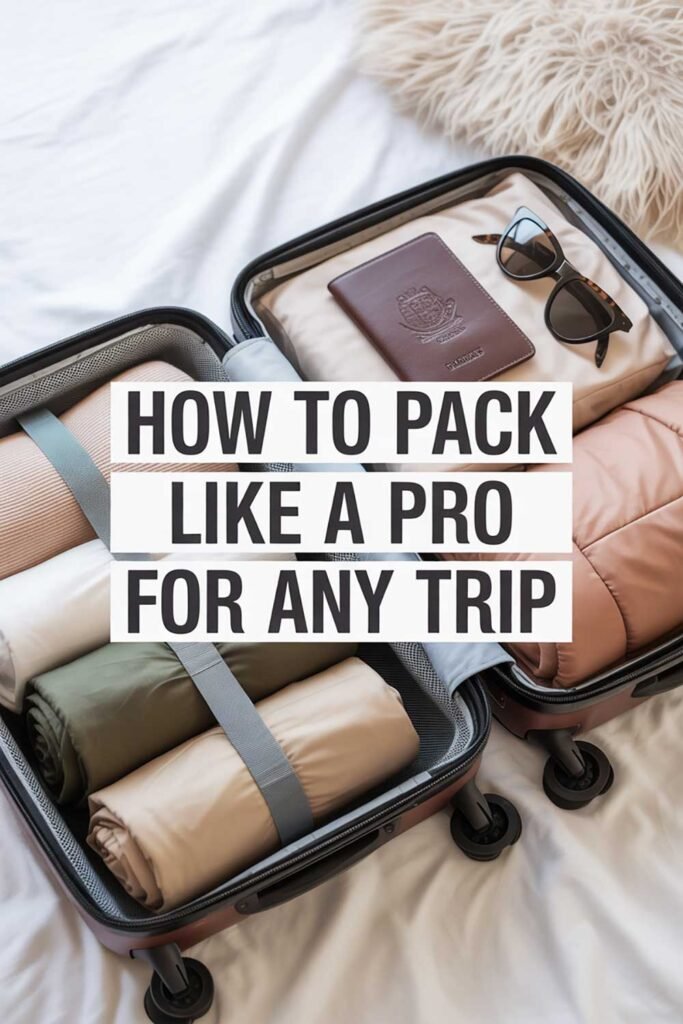
Packing cubes for the one-week trip do two things that matter equally: they organize the bag so every category is instantly findable without searching, and they compress the rolled items inside them to the smallest practical volume. The tops cube compresses five rolled t-shirts to a stack the size of a paperback novel. The bottoms cube compresses two pairs of rolled trousers to a similar footprint. The organized, compressed cubes stack predictably in the bag rather than shifting around loose items that settle into inefficient positions during transit. For the one-week carry-on specifically — where every cubic centimeter either fits the seven-day wardrobe or forces a checked bag — the compression is the margin between success and the overweight fee. Use four cubes: tops, bottoms, underwear, layer. Keep the assignments identical on every trip. The bag that organizes and compresses simultaneously is the bag that closes on the first attempt and arrives in the same organized state it left.
Roll every soft piece into a tight cylinder — the rolling technique that cuts volume by two-thirds
Rolling is not optional for the one-week carry-on. It is the technique that makes the arithmetic work: the t-shirt that takes three times the space flat occupies one-third as a rolled cylinder, and five rolled t-shirts in a packing cube take up the space that two flat-folded ones would require. The correct rolling technique — fold in half lengthwise, roll tightly from the hem toward the collar, tuck the collar flap over the roll to secure it — produces the most compact cylinder for each item and the most efficient arrangement in the cube. Quick-dry fabrics roll more tightly than cotton. Knitwear rolls softly and fills irregular spaces. Jeans fold in half lengthwise and roll tightly into cylinders that pack efficiently against the bag’s frame. Roll everything that is not a structured garment. The space the rolling recovers is the space the carry-on needs to close without being sat on. It is the most accessible and most consistently impactful single technique available to the one-week packer.
Shoes go in first — sole-to-sole in bags along the frame at the base of the carry-on
Shoes go in first because they establish the base layer that everything else is organized around, and they go in sole-to-sole because the paired profile fits more efficiently against the bag’s frame than any other shoe arrangement. A lightweight shoe bag for each pair keeps the sole’s contents isolated from the clothing layers above them. Placed sole-to-sole along the frame at the wheel-end base, the bagged pairs sit against the rigid perimeter where their shape fits naturally and create the foundation for the packing cubes above them. The shoe layer packed first and positioned correctly is the layer that makes the remaining space organized and predictable rather than the layer whose irregular placement creates gaps that are never efficiently filled. Two pairs, two shoe bags, shoe-end base. Everything above them builds on a known foundation. The bag organized this way is organized throughout the seven days, not just at departure.
Pack the heaviest items closest to the wheels for a balanced, manageable carry-on
Weight distribution matters most for the carry-on that is lifted, carried, and rolled through every transit of the one-week trip — more than for the checked bag that spends most of its time on a conveyor or a carousel. Heavy items packed at the top produce a bag that tips and strains every time it is set down, carried, or rolled through an airport terminal. The same items — shoes already along the frame, the toiletry kit, electronics — packed at the wheel end produce a bag that rolls upright, balances naturally, and maneuvers through airports with the ease that the correctly balanced bag provides and the incorrectly balanced one never does regardless of its quality. Pack heavy first at the base near the wheels. Build everything lighter above it. The one-week carry-on handled correctly through seven days of transit rewards the sixty seconds of intentional weight placement with the physical ease that its opposite costs across every day of the trip.
Fill every gap, corner, and curve with socks, chargers, and small items before closing the lid
The one-week carry-on packed with neat cubes and correctly positioned shoes still contains usable space in the corners, the curves at the base frame, the taper along the sides, and the gaps between cubes. These spaces are the bag’s recovered capacity for the small items that belong in the bag but cannot justify a dedicated cube position: socks rolled into the shoe cavities, a charging cable coiled in the corner between cubes, a small accessories pouch tucked in the side taper, a travel adapter in the heel space of the shoe. For the one-week carry-on where every millimeter of space has been paid for in weight allowance and carry-on dimensions, leaving these spaces empty is leaving paid-for capacity unused. Fill every gap deliberately with items that belong in the bag. The carry-on that uses its full three-dimensional volume for the right items is the carry-on that holds the seven-day trip completely and comfortably.
Use the bag’s lid pocket specifically for the items needed first on arrival at every accommodation
The lid pocket is the most accessible space in the bag when it opens and the natural position for the items whose need is most immediate at every arrival: the phone charger for the first evening, the sleep clothes for the arrival night, the toiletry bag for the first morning’s routine, the accommodation booking reference. Pack these items in the lid pocket before the main compartment receives anything — last in, first out. Every arrival at every accommodation across the seven-day trip produces the same accessible experience: the lid opens, the first-needed items are visible, and the evening setup takes three minutes rather than the main-compartment excavation that the unprepared packing produces. The one-week trip involves multiple arrivals and departures if the itinerary includes multiple stops. The lid pocket whose contents are organized for the arrival rather than for whatever was on top when packing happened earns its organization at every single one of them.
Marco’s Last Checked Bag and the One-Week System That Made It Unnecessary
Marco traveled for about seven to ten days at a time, several times a year, and had paid the checked bag fee so consistently that he had stopped thinking of it as a cost and started thinking of it as part of the ticket price. The bags he checked were large. They were organized — he used packing cubes, he rolled, he was not a disorganized packer. The problem was not the method. The problem was the quantity. A seven-day trip produced a bag that weighed fourteen kilograms, and the fourteen kilograms was not an accident: it was the result of seven days feeling long enough to pack for every possible version of itself, which produced a bag for the imagined trip rather than the planned one.
The counted outfits on his last overweight trip, before he changed the system, was eleven. Eleven outfits for seven days. He had counted them at the final checkout when he was repacking and noticed how much of the bag’s weight was clothing he had not worn. The count of unworn items was five — five complete outfits that had traveled the full trip through two cities, three flights, and four hotel lobbies and had contributed nothing to the experience except weight. He did the math on what those five outfits had cost in checked bag fees and overweight charges across the trips they had been traveling on for years. The number was not useful information. What was useful was deciding it would stop.
The next seven-day trip he packed seven outfits — six in the bag, one worn — all built around navy, white, and camel. Every piece paired with at least two others. Five tops, two bottoms, one layer, two pairs of shoes with the heavier ones worn on travel day. The bag fit in the carry-on. The carry-on fit in the overhead. There was no checked bag fee. There was a laundry session on day four that cost twelve dollars and twenty minutes and reset the wardrobe for the second half of the week. The unworn outfit count at checkout was zero for the first time. The bag weighed six kilograms. He has not checked a bag on a one-week trip since. The thirty-one tips in this article are the system that produced that six-kilogram carry-on. The extra five kilograms that used to travel with him stayed home where they belonged.
Toiletries, Shoes, and the Things That Add Weight Fast on a Seven-Day Trip
Two pairs of shoes maximum — wear the heavier pair through the airport on travel day
Shoes are the heaviest category relative to their outfit contribution and the one most reliably over-represented in the one-week bag. Two pairs — one worn on travel day, one in the bag — is the limit that keeps the carry-on manageable. The two pairs chosen for the one-week trip should cover every confirmed occasion on the itinerary without requiring a third: the daily walking shoe that is comfortable enough for a full day and stylish enough for the evening, and the one alternative that handles any occasion the first pair does not. The third pair requires a specific confirmed occasion that the first two cannot cover before its space and weight earn a place in the seven-day carry-on. Most one-week trips do not produce this occasion. The shoes travel for seven days through every transit and hotel corridor. Two pairs. The heavier ones worn. This is the footwear arithmetic that makes the one-week carry-on work.
Travel-size everything in the toiletry bag — filled to the trip-length amount, not the bottle’s capacity
The toiletry bag is the most consistently over-weighted category in the one-week carry-on for two reasons: the bottles are often larger than the trip requires, and the collection of liquids grows with each trip as items are added without items being removed. Fill every reusable travel-size bottle to the amount required for seven days — the daily-use amount multiplied by seven, plus a small margin — rather than to the bottle’s capacity. A shampoo bottle that holds sixty milliliters filled to twenty-five milliliters for a seven-day trip carries zero unnecessary weight. A full sixty-milliliter bottle carries thirty-five milliliters of weight that will be in the bottle at the end of the trip, untouched. Calibrate the fills before every trip. The toiletry bag whose bottles are filled to trip-length amounts rather than to their capacity is lighter than the alternative by a meaningful percentage of the total toiletry kit weight. Multiply this across six or eight bottles and the saving is the margin that keeps the carry-on under the airline’s limit.
Swap shampoo and conditioner for solid bars — they are not liquids and do not take quart bag space
Solid shampoo and conditioner bars are the toiletry swap that recovers the most quart-bag space per switch for the one-week trip. A standard shampoo bottle occupies roughly one-third of the quart bag’s available volume and is subject to the airline’s liquids limit. The solid bar occupies zero quart-bag space, weighs less than the half-full travel bottle it replaces, and performs equivalently for most hair types. The switch adds the solid bar’s weight — typically under fifty grams — and removes the liquid bottle’s volume and weight from the toiletry calculation. For the seven-day trip where the quart bag’s limited volume is one of the genuine constraints on how much the bag can hold, freeing two-thirds of the quart bag with one switch is a meaningful gain. The remaining liquid space goes to the items with no solid alternative. Make the switch before the seven-day trip. The quart bag recovered by the solid bar is the quart bag available for what genuinely needs it.
Check the accommodation’s amenities list and leave behind everything it already provides
The hairdryer, the shampoo and conditioner, the body wash, the soap — most hotels and many vacation rentals provide these items, and packing them from home for a seven-day trip is carrying weight for the accommodation to provide for free. Two minutes of checking the accommodation’s listed amenities before packing begins removes every item the accommodation already stocks. For a one-week carry-on where the toiletry kit is one of the bag’s heaviest single categories, the accommodation items removed from the kit are frequently the difference between the bag that fits and the bag that does not. The hairdryer alone — if the accommodation provides one and the packed one stays home — removes a meaningful share of the toiletry kit’s weight. Check the amenities. Pack only what the accommodation does not have. The lightest toiletry kit is the one that was confirmed against the accommodation’s amenity list before the first bottle was placed in the quart bag.
One accessories pouch with the pieces that work across everything in the bag — not a full collection
The accessories pouch for a one-week trip is a small zip bag containing the pieces that were confirmed to work across the seven-day wardrobe during the outfit-laying process: the two or three jewelry pieces that pair with every look, the belt that works with the dress and the trousers, the scarf that covers three uses across the week. The full accessories collection — the pieces accumulated at home across multiple years of shopping and gifting whose presence in the travel accessories bag is a matter of habit rather than confirmed outfit planning — does not belong in the one-week carry-on. It belongs on the dressing table at home where it lives between domestic occasions and is replaced by the small, specific pouch of pieces that were chosen for this specific week. A small zip bag. The confirmed pieces only. The bag is lighter for the pieces left home. The outfits are not worse for the absence of what was not planned.
Never pack a full-size backup version of anything already packed in a travel size
The full-size backup — the complete bottle of sunscreen alongside the travel-size version, the full-size toothpaste alongside the travel tube, the extra full-size moisturizer alongside the small tin — is the toiletry overpacking that looks like preparation and functions as unnecessary weight carried for the full seven days against the possibility that the travel-size version runs out. The travel-size version filled to the trip-length calculation does not run out before the trip ends — that is what the calculation is for. Pack the travel-size version. Leave the backup at home. The calculation is corrected for the next trip if it turns out to be insufficient — the first-trip discovery of the right fill amount is the calibration whose result improves every subsequent pack. The backup is never the answer. The right calculation is. Make it before the bag is packed. The backup that was left home stays on the bathroom shelf where it is available for the return trip home.
The destination has stores — almost everything genuinely forgotten can be purchased on arrival
The just-in-case toiletry, the backup item, the extra product packed against the possibility of forgetting the primary — these are almost all available at a pharmacy, a supermarket, or a convenience store within walking distance of most accommodation in any destination a one-week trip is likely to visit. The sunscreen in the wrong brand. The specific pain reliever not packed. The moisturizer that ran out faster than calculated. These items are available at the destination at comparable or lower prices than the home pharmacy whose travel-size versions cost more per milliliter than the full-size alternatives available locally. Pack the medications, the essential documents, and the genuinely irreplaceable items. Leave the coverage items for the destination’s pharmacy whose stock is available and cheaper than the space and weight cost of carrying them from home for seven days. The destination has stores. It has had them the whole time. Trust them.
Our Curated Collection of Trusted Tools and Official Sources
Everything we use to plan, prepare, and travel with confidence — from official government travel tools to practical planning aids. We have pulled together the resources we trust most so every trip you take is better informed, better prepared, and a lot less stressful from start to finish.
DND ResourcesThe Final Checks and Habits: Close the Bag Right and Keep the System Ready
Do the final edit after packing and remove three items before the bag closes
The fully packed one-week carry-on almost always has three more items than the seven-day trip requires. Not the obvious overpacking candidates — three items that made it through the outfit-confirmation process on the strength of individual plausibility but that the final honest review identifies as backup maybes dressed as confirmed pieces. The second layer whose function is entirely covered by the first. The fourth top when the fifth outfit confirmation was always the least certain. The accessory whose outfit partner is not in the bag but might have been. Open the packed bag one more time and remove three items without negotiating with the anxiety that packed them. These items will not be missed across seven days. They would have been carried for the full week and confirmed at checkout as the items that came home folded exactly as they were packed. Remove them before the bag closes. The closet is available. The decision is free. The bag is lighter for it through every day of the seven-day trip that follows.
Weigh the bag at home before leaving — on the bathroom scale, before the departure morning
The airline’s carry-on weight limit — seven kilograms on many budget carriers, ten on some full-service ones — is a number that the one-week packer needs to know relative to the packed bag before reaching the airport rather than at the gate where the options for addressing it are expensive, time-pressured, or both. Step on the bathroom scale while holding the packed bag, subtract personal weight, compare the result to the strictest carrier limit on the trip’s itinerary. If the bag is within the limit, board with confidence. If it is not, the closet is available and the decision can be made calmly rather than at a gate agent’s request with other passengers watching. The home weigh-in takes sixty seconds. It produces the number that determines whether the one-week carry-on strategy works. Know the number before the departure morning. Act on it at home if needed. Arrive at the airport with nothing left to discover.
Photograph the packed bag before closing it — the visual record serves two purposes
Two photographs, sixty seconds total: the organized bag before the outbound zip closes and the same bag before the return repack. The outbound photograph is the visual inventory for any lost or damaged bag claim whose contents need to be described. The return photograph — or the honest memory of which items were worn and which came home folded as packed — is the most accurate input available for the master packing list’s post-trip update. The items in the outbound photograph that came home untouched are the items to remove or flag before the next one-week trip. The items missing from the bag that were wished for across seven days are the items to add. The visual record makes this assessment specific rather than general. The one-week system improves only when the feedback is applied. The photograph is the feedback’s starting point. Take it before every departure. Use it after every return.
Pack the outbound bag with the return journey’s weight and volume in mind from the start
The bag packed to absolute capacity on the outbound journey has no answer for the seven days’ worth of purchases, receipts, the souvenir from the market on day four, or the product bought at the destination because it was better and cheaper than its home-city equivalent. The seven-day trip is a purchasing trip as well as a travel trip, and the bag that closed with no margin on the outbound will not close cleanly at all on the return without the specific discomfort of leaving purchases behind or redistributing the bag’s contents in the hotel room before the taxi arrives. Pack to eighty percent of the bag’s capacity on the outbound journey and treat the remaining twenty percent as the return margin whose presence was planned rather than discovered. The carry-on that boards on the outbound with deliberate space returns as a carry-on with the seven days’ finds already inside it and the zip closed cleanly before checkout.
Leave deliberate space for what you buy at the destination — the market find the bag was waiting for
The most consistently reported post-trip purchase experience is the item found at the destination that became the most-worn item in the following year’s wardrobe — the scarf from the city market, the specific product from the local producer, the small piece that carried the trip home in a way no photograph does. Leaving deliberate space in the one-week bag for this item is the pre-departure decision that makes arriving home with it possible without a panicked repack or an unexpected checked bag. The gap is not empty. It is reserved. The one-week trip that arrives home with the market find packed alongside the seven days’ wardrobe is the trip that used the bag fully rather than filling it to capacity with items that were there before the destination produced what it always produces when the space for it was made available. Reserve the space. The market is waiting for someone who brought room for what it has to offer.
Reset the one-week packing system within 24 hours of returning home
The carry-on reset within twenty-four hours of returning from the one-week trip is the carry-on ready for the next one-week trip from the day after this one ends. The laundry comes out and goes to the wash. The cubes are emptied and returned to their designated positions. The toiletry kit is restocked with whatever ran low. The master packing list is updated with the week’s honest feedback — the unworn items removed, the missing items added, the fill amounts recalibrated. The bag is closed in its organized, ready state. This reset takes fifteen minutes and converts the next one-week trip’s packing session from a rebuild of a disbanded system into a ten-minute confirmation of one that is maintained. The one-week packer who resets within twenty-four hours every time is the one whose system gets better across trips because the feedback was applied and the system was ready when it was next needed. Reset within twenty-four hours. The next seven days starts better for it.
Book the One-Week Trip the Carry-On Was Built For
The seven-day trip packed into a carry-on deserves a destination worth arriving without overweight bag fees for. Our travel agents plan the one-week vacations that give every outfit a confirmed reason to be there — and make every arrival the effortless beginning it was supposed to be when the bag was right.
Book A TripSeven outfits. Two colors. Every one confirmed flat on the bed before a single piece went in. The backup maybes stayed in the closet. The laundry on day four cost twelve dollars. The carry-on fit in the overhead. The overweight fee was not paid at this airport or any airport on this trip. The unworn count at checkout was zero. That is thirty-one tips. That is the one-week trip that finally stopped needing a checked bag.
Picture the One-Week Trip Where the Bag Finally Made Sense
Seven outfits. Travel day outfit worn on the body — does not go in the bag. Six outfits in the bag, all built around navy, white, and camel. Every piece pairs with at least two others. Five tops. Two bottoms. One layer. Two pairs of shoes with the heavier ones on through the airport. No backup maybes. Solid shampoo bar outside the quart bag. Toiletry bottles filled to seven-day amounts, not bottle capacity. Accommodation checked — hairdryer confirmed provided. Everything rolled. Shoes sole-to-sole along the frame. Heavy items at the wheels. Every gap filled. Final edit removed three things. Weigh-in at home: six kilograms. The carry-on fits in the overhead without assistance. The overweight fee was not paid. On day four a laundry session reset the wardrobe in twenty minutes. The market on day five produced the scarf that came home in the space left deliberately for it. The unworn count at the final checkout was zero. The return bag closed cleanly. The reset happened the evening of arrival home and took fifteen minutes. The next one-week trip starts from that ready carry-on. That is thirty-one tips. That is the seven-day trip that finally stopped needing the checked bag it never really needed in the first place.
One More Thing Before the One-Week Bag Is Packed
Print our free Travel Packing Checklist and use it to confirm the seven outfits are all in the bag with confirmed outfit partners, the backup maybes are all in the closet, and every pre-departure step that makes a one-week carry-on possible is complete before the departure morning begins. The same checklist we use before every one-week trip we take.
Get the Free ChecklistExplore Our Top Picks for a Better Trip
After years of exploring the globe together, these are the exact tools, platforms, and services we rely on for every single trip — personally tested, traveler approved, all in one place. We don’t recommend anything we wouldn’t use ourselves, and this is the collection of booking platforms and travel tools that have made our adventures smoother, smarter, and more memorable.
See Our Top PicksLove Helping Travelers Pack Smarter and Arrive Without the Overweight Fee?
Helping a traveler build the seven-day system that fits in a carry-on — and booking the one-week trip it is heading to — is the kind of practical expertise that makes a home-based travel agent genuinely worth coming back to. If turning your love of travel into a business sounds like the right next move, see how the TravelPreneur system works.
Become An AgentOne-Week Packing Printables at Premier Print Works
Visit Premier Print Works for one-week packing checklists, seven-outfit planners, capsule wardrobe builders, and travel organization printables that make every seven-day trip a carry-on trip — from the two base colors chosen before the first outfit is confirmed to the final edit that removes the three things the trip was carrying but never needed.
Visit Premier Print WorksDisclaimer
The information shared in this article is provided by Don and Diana’s Travels for general informational, educational, and inspirational purposes only. It reflects our personal experiences, opinions, and the experiences of travelers we have worked with. It is not professional travel, legal, or financial advice.
Airline and Baggage Policies
Airline carry-on size limits, weight allowances, and related policies vary significantly by carrier and are subject to change without notice. Budget carriers in particular may have more restrictive carry-on limits than the examples described in this article. Always confirm current requirements with your specific airline and every carrier on a multi-leg journey before traveling. We are not responsible for any fees or outcomes arising from reliance on baggage information in this article.
Affiliate and Partner Links
This article may contain affiliate and partner links that pay us a commission at no extra cost to you. Our recommendations are based on real use and genuine belief in the products and services we share.
Composite Stories
Stories on this site combine real experiences from Don, Diana, clients, and travelers we have worked with. Details may be adjusted for privacy and narrative clarity.
No Guarantees
We do not guarantee any specific packing or travel outcome from using the information in this article. Results vary by traveler, destination, and trip type.
Copyright and Use
All content is the copyrighted property of Don and Diana’s Travels. You may not copy or republish our content without prior written permission. You are welcome to share a direct link with proper credit.
By reading this article, you acknowledge that you have read and agree to this disclaimer.