30 Travel Essentials Worth Packing Every Time
Every experienced traveler eventually arrives at the same realization: a shorter, more intentional packing list beats a heavy bag full of maybes every single time. The items that earn a permanent spot are the ones that have quietly saved a trip — not the things you might need, but the things you have already needed and were grateful you had. Thirty of them, here.
Grab Our Travel Packing Checklist
Our free packing checklist is built around exactly the kind of intentional, permanent list these thirty essentials describe — everything that earns its place on every trip, organized by category, ready to confirm before every departure so nothing that quietly saves trips gets left on the bathroom shelf.
Get the Free ChecklistThe essentials worth packing every time are not the things you might need — they are the things you have already needed and were grateful you had.
A shorter, more intentional packing list beats a heavy bag full of maybes every single time. The items that earn a permanent spot are the ones that have quietly saved a trip.
Power and Connectivity: Stay Charged in Every Country
Universal travel adapter
The universal travel adapter is the item that earns its place on the first international trip and never comes out of the travel gear again. Outlet standards vary by region — the flat two-prong common in North America, the round two-prong of continental Europe, the angled flat-prong of Australia, the large three-prong of the United Kingdom — and a destination country’s outlet is incompatible with the home country’s plug on arrival just often enough to make carrying a universal adapter on every trip the only rational policy. A quality universal adapter covers the major outlet types worldwide, includes USB ports so phones and small devices charge without occupying the adapter’s outlet entirely, and survives years of travel without significant wear. Buy one good one. Keep it in the travel gear permanently. The moment it saves a trip is the moment it pays for itself across every trip thereafter.
Portable charger
The portable charger is the essential that experienced travelers identify most consistently as the item that has quietly saved a specific moment: the boarding pass kept alive at twelve percent when the gate outlet was occupied, the navigation app that reached the accommodation when the hotel’s outlet was on the other side of the room from the front door, the communication that reached home when the phone would otherwise have gone dark mid-day. A charger with enough capacity to fully charge a smartphone at least once — typically ten thousand milliampere-hours as a practical minimum — covers the day’s demands without requiring a wall outlet between morning and evening. Keep it charged between trips as part of the travel gear restock habit. The trip that needs it is not the trip to leave it out of the bag to save space.
Multi-port USB charging block
The multi-port USB charging block — a single wall block with three or four USB and USB-C ports — replaces the three or four individual chargers that most travelers carry for their various devices and reduces the entire charging setup to one adapter-sized block plus the cables already in the electronics pouch. Modern GaN charging blocks deliver fast-charging speeds to multiple devices simultaneously from a block not much larger than a standard single-port charger, making the weight trade-off favorable on every trip. Paired with the universal adapter, the multi-port block turns one outlet in any country into a full charging station for every device in the bag. One block. One adapter. Every device charged every night without the wall-plug competition that the single-outlet hotel room otherwise produces.
Short charging cable for in-seat use
The standard charging cable at full length is an inconvenience in an airplane seat, a restaurant booth, or any space where a long cable drapes across a surface, connects to something below the tray table, and gets in the way of everything else on the small available space. A short cable — thirty centimeters to one meter — kept in the personal item’s exterior pocket pairs with the seat’s USB port or the portable charger in the bag to charge the phone at the ideal length for close-quarters use. Short cables also travel more compactly than full-length ones, coil tightly without tangles, and make the electronics pouch neater throughout the trip. Carry one short cable in the personal item for in-transit use alongside the full-length cable in the electronics pouch for hotel room and desk use. Both earn their place on every trip.
Compact power strip
The compact power strip transforms the most common hotel room frustration — one accessible outlet near the bed — into a functional charging station for every device in the bag without requiring any negotiation with the room’s layout. A three-outlet strip with a short cord occupies the space of a bar of soap in the travel bag, weighs less than a full water bottle, and provides the equivalent of three wall outlets from the single one the hotel offers near the nightstand. It also means the phone, the earbuds, and the portable charger can all replenish overnight without rotating through a single outlet, and the morning departure begins with everything fully charged rather than one device still waiting its turn. Compact power strips are among the most frequently recommended travel purchases by experienced travelers who discovered them after one too many single-outlet nights.
eSIM or international data plan arranged before departure
Connectivity at a destination is no longer the optional travel enhancement it once was — it is the navigation system, the translation tool, the accommodation address lookup, the emergency contact, and the boarding pass backup that modern travel is built around. Arranging the international data solution before departure rather than at the destination — an eSIM purchased and activated from home, or the home carrier’s international plan enabled in advance — means connectivity from the first moment of arrival rather than from the moment the airport’s paid Wi-Fi is accessed or the destination SIM is purchased. eSIMs in particular are activated from the phone’s settings before the flight and require no physical SIM swap, no local language navigation of a foreign phone shop, and no gap in coverage between landing and finding a store. Arrange it before the flight. Arrive connected.
Let Us Build a Trip the Right Bag Is Already Packed For
The most intentional packing list starts with a trip worth packing that intentionally for. Tell us where you want to go and we will build the destination, the itinerary, and the accommodation that makes every item on the essentials list genuinely earn its place in the bag.
Plan Our EscapeDocuments and Organization: Keep Everything Findable at Every Border
Slim document organizer
The slim document organizer — a flat wallet-style holder with slots for the passport, boarding passes, travel insurance card, foreign currency, and the cards used most frequently while traveling — is the item that kept everything findable at every border, every check-in desk, and every gate agent interaction where the document needed to be produced quickly and correctly. Without it, travel documents distribute themselves across jacket pockets, bag zippers, and tray tables in a pattern that requires a different search at every checkpoint. With it, every document has a place and every checkpoint is a single reach rather than a moment of mild panic. Choose one slim enough to fit in a jacket pocket and use it on every trip. The slim document organizer that travels on every trip is the one whose value is measured in the searches that never happen.
A pen
A pen in the travel bag is the essential that costs the least, takes up the least space, and produces the most disproportionate gratitude at the specific moment it is needed — which is almost always a moment where no one else nearby has one either. International arrival cards, customs declarations, hotel check-in forms, paper boarding passes, restaurant receipts, and the sudden need to write down an address or a confirmation number all arrive on the road with enough frequency that the pen becomes, over multiple trips, one of the items whose absence is noticed most acutely. Keep one in the personal item’s exterior pocket alongside the boarding pass and the document organizer. Replace it when it runs dry and not before. The simplest item on the list with one of the highest per-gram return rates of anything in the bag.
Small luggage padlock
A small TSA-approved combination padlock on the carry-on’s main zipper is the deterrent that addresses the most common form of opportunistic luggage theft — the unattended bag in a public space whose zipper slides open in seconds and closes again before anyone nearby has noticed. It does not prevent a determined thief with the right tools and sufficient time. It does prevent the casual opportunist at the airport seat, the train platform, and the hostel common room whose calculation is based on ease of access rather than persistence. TSA-approved locks can be opened by security staff with a master key during checked-baggage inspections without cutting the lock. Keep one padlock permanently with the travel gear, include the combination in the document backup email sent before every trip, and use it without exception on any bag left unattended in a public space.
Luggage tags with current contact information
The luggage tag is the passive identification system that works while the owner is not watching — at the baggage carousel, at the airline’s lost luggage desk, and in the hands of the airport staff member who found the bag in the overhead bin after the passenger deplaned. A tag with a name, a phone number, and an email address is all the information the airline’s routing system needs to reunite a misplaced bag with its owner, and the absence of a tag is the single most common reason a recovered bag takes longer to return than it needs to. Use a tag with a cover flap over the contact information so the details are visible to airline staff and not to the random person in the baggage claim area. Check and update the contact information before every trip. The tag that has not been updated in three years may have the wrong phone number on the trip it is actually needed.
Packing cubes
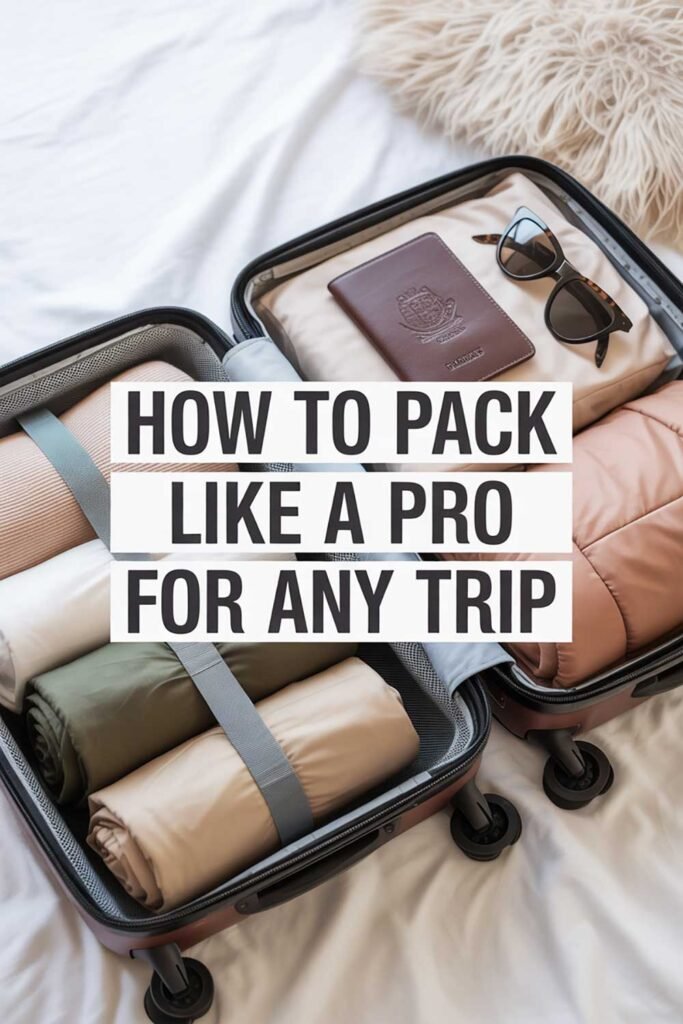
Packing cubes are the organizational essential that experienced travelers almost universally identify as the item that changed how packing works for them permanently — not because they compress or reduce what is packed, but because they transform the bag from a single large space that everything occupies randomly into a structured system where every category has a container and every container has a place. The top of the main compartment is for the cube that opens first at the hotel; the bottom is for the cube that is not needed until later in the trip. Repacking at checkout takes the time it takes to fold each cube rather than the time it takes to locate and reassemble every item from where it settled across three days of daily access. Packing cubes are the organizational infrastructure that makes every other packing habit function as intended.
Dedicated dirty laundry bag
A dedicated bag — a lightweight mesh pouch, a compression cube reserved for worn items, or the hotel’s own laundry bag claimed on the first night — is the essential that maintains the organizational integrity of the packing cube system for the entire trip rather than only until the first outfit comes off. Without it, worn and clean items merge in the main compartment over successive days until the end-of-trip repack requires a full sort before the washing machine can be loaded. With it, the worn items go directly to the designated bag from the first evening, the clean items stay in their cubes throughout the stay, and the return journey’s bag is as organized as the outbound one. One small, lightweight bag. One habit established on the first night. The clean-and-dirty sorting problem eliminated on every trip from that point forward.
Comfort and Sleep: The Items That Make Transit and Rest Actually Work
Sleep mask
The sleep mask is the essential that gets dismissed as a luxury until the first red-eye flight or early-morning hotel room where the curtains do not fully close demonstrates its actual value, after which it becomes the item most often described as the one small purchase that changed long-distance travel. Cabin light during overnight flights, the ambient glow of entertainment systems on standby, the morning light that enters hotel rooms at the hour the destination’s sunrise occurs rather than the hour the traveler’s body is ready to wake — a sleep mask addresses all of these in one motion and adds almost nothing to the bag’s weight. Keep one permanently in the personal item alongside the earplugs. Use it proactively rather than reactively. The restful flight and the undisturbed hotel morning begin with the mask on before the attempt to sleep rather than reached for after the first failed attempt.
Neck pillow
The neck pillow packed in the personal item rather than the overhead bin is the one that is actually used — pulled out before takeoff, in place before the first attempt at sleep, supporting the neck through the hours when the seat’s headrest alone produces the stiffness that the first morning at the destination does not need to begin with. Inflatable neck pillows compress to the size of a fist and add almost nothing to the personal item’s weight or volume, making the cost of carrying one on every long flight essentially zero and the benefit of having it on the flights where it is used genuinely significant. Memory foam versions are more comfortable but larger; the choice between them is a personal decision, but carrying one of them on flights over four hours is not. The neck that lands without stiffness belongs to the traveler who had the pillow ready before the seatbelt sign went off.
Earplugs
A pair of foam earplugs in the personal item’s exterior pocket is the sleep essential that costs almost nothing and occupies almost no space and produces the specific sleep quality difference between the flight where the engine noise was constant background and the one where it was not. Combined with a sleep mask, earplugs convert the economy cabin’s light and noise environment into something genuinely closer to a rest environment than the default — not silence, not darkness, but meaningfully reduced versions of both that make sustained sleep more achievable across a long overnight flight. They are also the hotel essential for the accommodation whose walls are thinner than the review suggested, the room that faces the street whose traffic starts at six, and any shared accommodation context where the neighbor’s schedule differs from the traveler’s. Keep a spare pair in the personal item at all times and replace them when they compress to the point of reduced effectiveness.
Compression socks
Compression socks on a long flight address a real physiological process — the reduced venous blood return from the lower legs that prolonged immobility at altitude produces — with a lightweight, inexpensive, and comfortable intervention that requires only the decision to put them on before sitting down. Experienced long-haul travelers describe the arrival-day difference between compression socks worn throughout the flight and the alternative as one of the clearest and most consistently noticeable comfort improvements they have made to their travel routine. They work best when worn from the start of the travel day rather than applied mid-flight after swelling has begun. Choose a pair that fits correctly — compression at the right gradient for the calf size — and keep them in the travel gear alongside the other flight comfort items. They cost almost nothing, pack flat, and change how the legs feel at the end of every long journey.
Lightweight packable scarf
The packable scarf earns its permanent place in the travel bag through the quiet accumulation of uses that no single-purpose item can match. On the flight, it is the warm layer when the cabin cools and the blanket was not available or not sufficient. At the religious site, it is the shoulder covering that permits entry to the traveler who did not otherwise pack one. In the hotel room, draped over a bedside lamp, it is the warm ambient light that the overhead fluorescent fixture does not provide. On the beach, it is the cover-up that transitions from water to lunch. Folded, it is a seat cushion on a hard bench, a neck support against a bus window, a compression wrap for a sprained ankle on a hiking trail. Pack one in a neutral color that works with the trip’s capsule wardrobe. It earns its weight on most trips and pays for itself entirely on the first trip where it solves a problem no other item could.
Hand cream and lip balm
Hand cream and lip balm are the two items whose absence on a long trip is noticed in a specific and persistent way — the dry hands after repeated sanitizer use and air travel’s low humidity, the cracked lips at the end of a long flight that no amount of water quite addresses on its own. Both items are small enough to live permanently in the personal item’s exterior pocket, cost very little, and are used on almost every travel day in every season and every climate. Lip balm is particularly valuable on overnight flights where cabin dryness is most pronounced. Hand cream is particularly useful after long days of transit, repeated hand washing, and the general skin dehydration that heavy travel days produce. Pack both. Use them proactively rather than waiting for the dryness to become the discomfort that prompts a search for a pharmacy at the destination.
How Nadia Built the List That Never Lets a Trip Down
Nadia did not set out to build a permanent packing list. She set out to pack for individual trips, each one from scratch, each one with approximately the same result: a bag heavier than last time, several items packed optimistically and returned unworn, and one or two things genuinely missed on the road that she swore she would never forget again. The universal travel adapter she needed in Portugal and had not brought. The portable charger that would have saved the boarding pass situation in Amsterdam. The compact first aid kit whose absence became relevant when a blister on a cobblestone walking day turned into a problem she would have addressed in ten seconds with the right supplies. She remembered each gap clearly because the gaps had cost her something — time, money, comfort, or a piece of the trip she would rather have spent differently.
The list grew from the gaps. After Portugal she added the adapter. After Amsterdam she added the portable charger and the short cable. After the blister she added the first aid kit with specific attention to the blister treatment section. After a long-haul overnight flight that left her stiff and tired through the first full day, she added the compression socks and the neck pillow and moved the sleep mask from the carry-on to the personal item where it would actually be used rather than technically present. After a hotel room whose single lamp produced light harsh enough to make reading uncomfortable, she added the lightweight scarf that has since been over a bedside lamp on a dozen different continents.
The list reached thirty items over several years of travel and has not grown meaningfully since, because by that point every item on it had earned its place through a specific experience of being needed and having it, and every item she had ever removed had earned its removal through the specific experience of multiple trips where it was carried and never touched. The list that exists now is not the list of things she might need. It is the list of things she has already needed, assembled across enough trips to know the difference between the two with certainty.
The thirty essentials in this article are that list — not hypothetical travel gear, but the specific items that have quietly saved trips for experienced travelers who have taken enough of them to know exactly what belongs in the bag and what belongs in the cabinet at home. Build the list from this one. Adjust it from your own experience. Keep it short and keep it honest. The bag that leaves with exactly this list is the bag that arrives at every destination with everything that matters and nothing that does not.
Health, Safety, and Preparedness: Handle Problems Before They Become Ones
Compact first aid kit
The compact first aid kit is the essential that earns its place most clearly in the specific moment it is needed — the blister at mile three of a walking day that a bandage and blister treatment addresses in thirty seconds and ignores at the cost of the remaining four miles, the small cut from a coastal rock that antiseptic wipe and adhesive bandage handles cleanly, the headache on a long travel day that the ibuprofen in the kit reaches before it compounds. A compact travel kit — blister treatments, adhesive bandages in multiple sizes, antiseptic wipes, pain reliever, antihistamine, antidiarrheal, and any other items relevant to the traveler’s specific history — fits in a pouch the size of a paperback book and handles the vast majority of minor medical situations that travel produces. It is not a hospital. It is the intervention that keeps a minor issue from becoming a trip-disrupting one, which is the specific problem it needs to solve.
All medications in their original packaging
Every medication a traveler takes regularly or might need on a trip — prescription medications, over-the-counter essentials, vitamins, motion sickness remedies, and anything related to a chronic condition — belongs in the carry-on or personal item in its original packaging, with enough supply for the trip length plus several days of contingency for delays and extended stays. Original packaging carries the prescription label, the dosage information, and the pharmacy documentation that makes international customs and security interactions straightforward rather than complicated. A digital photograph of every prescription and a printed copy of the prescribing physician’s contact information, stored in the document organizer, provides the additional documentation that some international destinations require for controlled substances. Never pack critical medications in checked luggage. The checked bag’s detour is always possible. The medication needed daily has no substitute available at the destination on short notice.
Hand sanitizer
Hand sanitizer in a small bottle in the personal item’s exterior pocket is the item used more frequently on travel days than on most days at home — at the airport, on the aircraft, at the restaurant whose bathroom required a longer walk than anticipated, after the market, before the snack, and at a dozen other moments when hand washing is the right action and a sink is not immediately available. Travel concentrates the specific surfaces — seat buckles, tray tables, shared transport handholds, hotel remote controls, menu books — whose collective microbial load is higher than most daily environments, and hand sanitizer addresses this gap consistently and with almost no cost or weight. A small bottle refilled from a larger one at home before every trip, kept in the same exterior pocket as the lip balm and the pen, is used until empty on most long trips. Pack one on every departure without exception.
Refillable water bottle
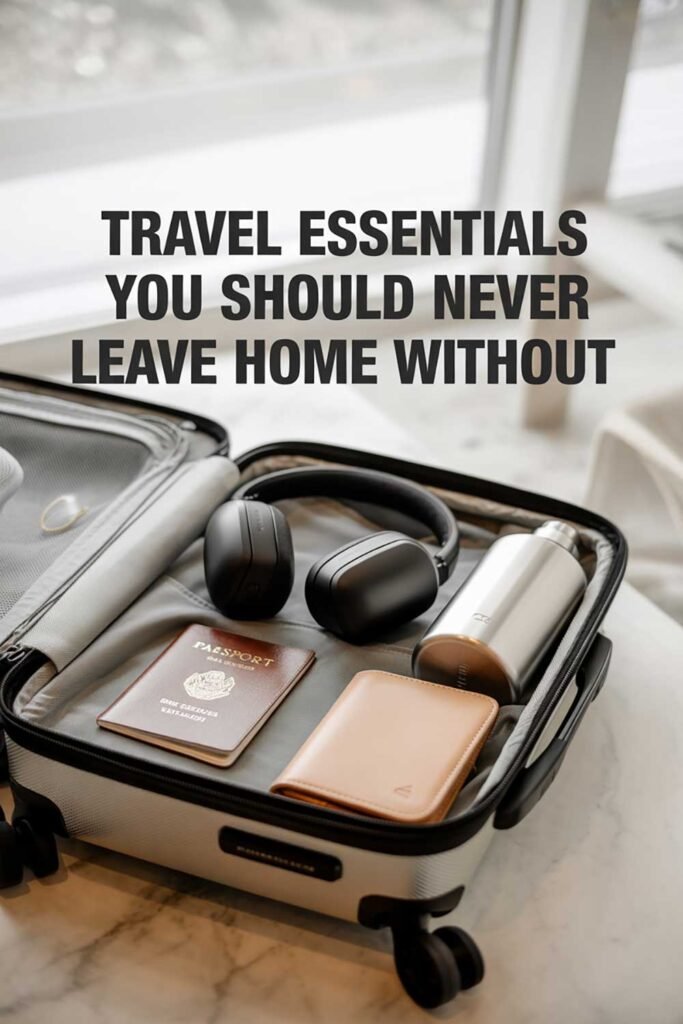
The refillable water bottle is the travel essential that addresses the most common source of travel day discomfort — dehydration — at zero recurring cost after the initial purchase, while simultaneously eliminating the plastic bottle purchase at every airport, train station, and tourist site whose markup is proportional to the captive audience it serves. Fill it at every airside fountain before boarding, at every hotel room tap where the water is drinkable, and at every refill station the destination provides. On long flights it provides hydration on the traveler’s schedule rather than the airline’s service cart schedule. On full travel days it means the specific energy drop and headache that dehydration produces by mid-afternoon is addressed by the habit of carrying water rather than the search for a place to buy it. A good stainless steel or BPA-free bottle travels on every trip and is one of the highest-use items in the bag across the full travel day.
Travel-size sunscreen
Sunscreen in a travel-size container that fits within the TSA’s quart-bag limits is the health essential most commonly packed at full size — creating quart-bag overflow, size confiscation at security, and checked-bag reliance for an item available at a pharmacy near almost every destination. A travel-size tube or stick provides enough coverage for the first two or three days of a trip, with additional supply available at the destination where larger sizes at local prices are the better option for longer stays. Pack one small version for the transit day and the first days of arrival. Buy the larger size locally for the remainder of any extended trip in a sun-exposed destination. The sunscreen that sails through security in the quart bag is the one whose size was decided deliberately rather than by default.
Small flashlight or headlamp
A small flashlight or compact headlamp is the essential that spends most trips in the bag unused and earns its total lifetime value on the handful of occasions where it is the item between functional and genuinely stuck. The accommodation whose power goes out at ten in the evening. The pre-dawn departure when the room is dark and the light switch is across the room from everything that needs to be packed. The cave, the canyon, the rural trail, or the underground attraction that the phone’s flashlight handles adequately and the dedicated light handles significantly better. A small LED flashlight weighs almost nothing and lasts years of travel on a single set of batteries. A compact headlamp frees the hands that the phone torch does not. Either version belongs in the travel bag as the quiet backup that most trips do not use and the ones that do are genuinely grateful for.
Our Curated Collection of Trusted Tools and Official Sources
Everything we use to plan, prepare, and travel with confidence — from official government travel tools to practical planning aids. We have pulled together the resources we trust most so every trip you take is better informed, better prepared, and a lot less stressful from start to finish.
DND ResourcesConvenience and Smart Extras: The Items That Add Up to a Better Trip
Packable tote bag
The packable tote bag folded flat in the luggage’s bottom layer is the item that earns its place on the first day of every trip where the main luggage goes to the accommodation and the day starts before check-in is available. It becomes the day bag for the morning walk, the market run, the airport bookshop purchase that needs somewhere to go, and the souvenir that needs carrying from the shop to the accommodation without a second bag purchase at the destination. It also serves as the overflow bag for the return journey’s extra purchases, the beach bag for the coastal day, and the grocery run for the self-catering accommodation. Most packable totes fold to the size of a wallet and weigh under fifty grams. The traveler who arrives with one already in the bag is the traveler whose first day starts immediately rather than with a search for something to carry things in.
Packable rain jacket or windbreaker
The packable rain jacket is the essential that most travelers who have been caught in unexpected rain — on a walking tour, at an outdoor market, between the accommodation and the restaurant — add to their permanent list immediately after and never remove. A good packable jacket compresses into its own pocket to the size of a softball, weighs a few hundred grams, and provides wind and rain protection that transforms an outdoor day that turned wet from a miserable one into a manageable one. It doubles as a light layer on cold aircraft cabins and at altitude destinations where the temperature drops more than the forecast suggested. It is the garment that earns its weight most on the trips where the weather diverges from the prediction — which is a regular occurrence in most destinations — and costs nothing to carry on the trips where the weather cooperates entirely.
Reusable zip-lock bags in multiple sizes
A small supply of reusable zip-lock bags in two or three sizes is the travel essential that experienced travelers struggle to articulate precisely but reach for with surprising frequency across every trip. The damp swimsuit that needs to travel to the next destination before the accommodation’s clothesline has fully dried it. The snacks decanted from their packaging to save space in the personal item. The small sandy shells that need carrying without distributing their contents through the bag’s main compartment. The leaking toiletry bottle contained before it reaches the electronics. The charging cable and adapter kept together in the personal item without tangling with everything else. None of these is a dramatic problem. Each one is handled in seconds by a bag that weighs almost nothing and takes up almost no space. Pack four or five across two sizes. Use them without thinking about it. The specific use case arrives on every trip without being predictable in advance.
Travel laundry kit
A travel laundry kit — a small container of concentrated detergent or a packet of laundry sheets, a flat universal sink stopper, and an optional meter of travel clothesline with suction-cup ends — is the essential that makes packing for one week work on a trip of any length. The kit weighs under a hundred grams, takes up a corner of the toiletry bag, and converts any hotel sink into a capable laundry facility for the lightweight and quick-dry items that make up most of a light packer’s capsule wardrobe. A shirt washed at nine in the evening and hung overnight is dry by morning in most climates. The choice on any trip longer than a week is between carrying two weeks of clothes and carrying one week of clothes plus this kit, which weighs a fraction of the extra clothing and produces the same result. The kit stays in the travel gear permanently.
Microfiber travel towel
The microfiber travel towel earns its place on any trip involving beaches, hostels, guesthouses, day tours with water activities, or any accommodation category that does not guarantee towel provision. It dries in a fraction of the time a standard towel requires, packs to the size of a folded t-shirt, absorbs more moisture per gram than cotton, and weighs almost nothing in the bag. Even on trips where the accommodation reliably provides towels, the microfiber towel serves as the beach towel that goes where the accommodation’s linens cannot, the poolside layer that does not require returning to the room between swim and lunch, and the hair towel on the accommodation’s towel-rationed floor. In the context of a minimalist packing list it earns its space because it replaces a category of need — the dry towel wherever the trip goes — that a hotel towel alone cannot always cover.
A small notebook
The small notebook is the final essential on the list and the one whose value is most resistant to the argument that the phone already does everything it does. The phone’s notes app requires the phone to be unlocked, the app to be open, and the battery to be above zero — none of which is guaranteed at the moment a confirmation number needs to be written, a restaurant recommendation from the taxi driver needs to be recorded, or the address that the helpful local is spelling out at a pace that the typing keyboard does not match needs to be captured. The notebook requires none of these conditions. It also serves as the travel journal that the notes app version of the same thing never quite becomes, the sketch of the map the stranger drew for directions, and the running list of the trip’s best moments that the photograph cannot fully capture. A small, lightweight notebook and the pen from tip eight. The analog backup that no battery can kill and no software update can corrupt.
Book the Trip Every One of These Essentials Was Made For
The permanent packing list built from thirty trip-tested essentials deserves a destination worth testing it against. Our travel agents book the trips that put every item in the bag to genuine use — the right destination, the right pace, and the right experience for the traveler carrying exactly what they need.
Book A TripThe adapter worked in every outlet. The charger kept the boarding pass alive. The tote became the day bag by nine in the morning. The first aid kit handled the blister at mile three. The sleep mask made the red-eye restful. The document organizer found everything at every border. That is thirty essentials. That is the bag worth packing every time.
Picture the Bag That Has Everything and Nothing Extra
The adapter is in the electronics pouch alongside the multi-port block and the short cable. The portable charger is full and in the personal item. The document organizer is at the top of the carry-on with the passport, the boarding pass, and the pen. The packing cubes are assigned and closed. The dirty laundry bag is ready for the first evening. The sleep mask and earplugs are in the personal item’s exterior pocket where they will actually be used. The compression socks are on. The first aid kit is at the bottom of the bag, quiet and ready. The packable tote is folded flat underneath it. The travel laundry kit is in the toiletry bag. The notebook and pen are together where they can be reached without unpacking everything else. Not a single item in the bag is there because it might be useful. Every item in the bag has already proven itself on a trip where it mattered. That is thirty essentials. That is the intentional list that beats a heavy bag full of maybes every single time.
One More Thing Before the List Is Complete
Print our free Travel Packing Checklist and use it alongside these thirty essentials to confirm every permanent item is in the bag and every pre-departure task is handled before the departure day begins. The same checklist we run before every trip we take, built around exactly the kind of intentional, trip-tested list this article describes.
Get the Free ChecklistExplore Our Top Picks for a Better Trip
After years of exploring the globe together, these are the exact tools, platforms, and services we rely on for every single trip — personally tested, traveler approved, all in one place. We don’t recommend anything we wouldn’t use ourselves, and this is the collection of booking platforms and travel tools that have made our adventures smoother, smarter, and more memorable.
See Our Top PicksLove Helping Travelers Show Up With Exactly the Right Bag?
Helping a traveler arrive prepared — every essential in place, nothing missing that matters — is exactly the kind of detail that makes a home-based travel agent the person clients come back to. If turning your love of travel into a business sounds like the right next journey, see how the TravelPreneur system works.
Become An AgentTravel Essentials Printables at Premier Print Works
Visit Premier Print Works for permanent packing list printables, travel planners, gear checklists, and travel journals that make building and maintaining the intentional packing list a little more beautiful and a lot more consistent — from the first trip that teaches you what belongs in the bag to the hundredth that confirms it.
Visit Premier Print WorksDisclaimer
The information shared in this article is provided by Don and Diana’s Travels for general informational, educational, and inspirational purposes only. It reflects our personal experiences, opinions, and the experiences of travelers we have worked with. It is not professional medical, health, legal, or financial advice.
Medical and Health Information
References to first aid, medications, compression socks, hand sanitizer, sunscreen, and related health items in this article are general educational information only. Individual health needs vary. Always consult a qualified healthcare provider for advice specific to your health circumstances, conditions, and medication requirements before traveling.
Security and Safety Information
References to luggage locks, document security, and personal safety are general educational suggestions. We make no guarantees about the security of any specific product or practice. Travelers are responsible for their own safety and security decisions.
TSA and Travel Regulations
TSA rules, international security regulations, and airline policies regarding carry-on items are subject to change. Always confirm current requirements with the relevant authorities and carriers before traveling.
Affiliate and Partner Links
This article may contain affiliate and partner links that pay us a commission at no extra cost to you. Our recommendations are based on real use and genuine belief in the products and services we share.
Composite Stories
Stories on this site combine real experiences from Don, Diana, clients, and travelers we have worked with. Details may be adjusted for privacy and narrative clarity.
No Guarantees
We do not guarantee any specific travel experience or outcome from using the information in this article. Travel involves inherent uncertainty and personal responsibility.
Copyright and Use
All content is the copyrighted property of Don and Diana’s Travels. You may not copy or republish our content without prior written permission. You are welcome to share a direct link with proper credit.
By reading this article, you acknowledge that you have read and agree to this disclaimer.