30 Genius Suitcase Packing Tips for Organized Travelers
Organized packing is not a personality trait — it is a system, and once you have the right one in place every suitcase you ever pack from that point forward takes half the time and arrives in half the chaos. Thirty genius packing tips for the traveler who is ready to stop opening the suitcase on arrival and regretting exactly how they packed it.
Grab Our Travel Packing Checklist
Our free packing checklist is the master list these thirty tips are built around — every category organized, the outfit-first structure confirmed, the cube assignments included, and the final check built in so every suitcase closes with a real system behind it and arrives the way a packed suitcase is supposed to arrive.
Get the Free ChecklistA suitcase packed with a real system behind it is the difference between arriving somewhere ready to go and spending the first twenty minutes of your trip looking for things you know you packed.
Organized packing is not a personality trait — it is a system, and once you have the right one in place every suitcase you ever pack takes half the time and arrives in half the chaos.
The Foundation: Build the System Before the Suitcase Opens
Start every packing session from a master packing list — not from an open wardrobe and an uncertain memory
The master packing list is the difference between a packing session that is a confirmation of a known system and one that is a reconstruction from memory under time pressure. A packing list built once — every category, every subcategory, the pre-departure tasks alongside the clothing items — and refined after each trip becomes the accurate representation of what the trip genuinely requires rather than what anxiety suggests it might. Pack from the list every time. The list is not checked off as items go in — it is the starting point that determines what goes in before the bag is opened. Items not on the list require a justification to be added. Items on the list that the current trip’s itinerary does not require are removed before packing begins. The master list is the system’s foundation. Without it, every packing session is the first one. With it, every packing session is better than the last because the list was updated after the trip before it.
Lay everything out flat on the bed before a single item goes into the suitcase
The physical act of laying every intended item flat before anything is packed makes the total visible, the duplicates identifiable, and the organizational decisions possible before the suitcase’s constraints make them necessary. The pile on the bed is the honest version of what is intended to pack — and it is almost always larger than expected. The item that looked like a reasonable single addition to the mental packing list looks different as part of the physical pile that already contains three similar options. The over-duplicate, the item that has no outfit partner, and the just-in-case item whose scenario is genuinely hypothetical are all identifiable in the pile before they occupy space in the suitcase. Laying everything out does not add time to the packing session — it replaces the time that would have been spent reorganizing after discovering the suitcase would not close. The pile reviewed before packing produces the suitcase that closes on the first attempt.
Pack complete outfits as confirmed sets — never individual pieces separated from their partners
The suitcase packed by category — all tops together, all bottoms together — is the suitcase whose outfit chemistry is assumed rather than confirmed. The top that needs a specific bottom that is in a different layer. The shoes that work with two of the five tops but not the other three. The layer whose color partners with one outfit and looks wrong with everything else. These gaps are visible when outfits are assembled flat before packing and invisible when items are packed by category. Assembling each complete outfit — top, bottom, layer, shoes, accessories — and confirming the combination before any piece goes in the suitcase removes the gap-creating items before they travel. Every item in the suitcase belongs to a confirmed, complete outfit. Nothing arrives without a partner. The morning routine at the destination is a selection between ready looks rather than an improvisation between individual pieces whose combination was never confirmed to work.
Set a packing completion deadline 48 hours before departure and close the list at that point
The packing list that stays open until departure accumulates anxiety additions with every approaching hour — the item added because the trip is close enough to make its absence feel risky, the backup for the item already packed, the just-in-case layer for the weather scenario that every local description of the season suggests is unlikely. Setting the completion deadline at forty-eight hours before departure and treating it as final — new additions after the deadline may replace something already on the list, not join it — produces the packing list that reflects genuine trip requirements rather than the requirements plus two days of mounting anxiety. The forty-eight-hour gap between packing completion and departure is time for confirming items are available, addressing anything the review surfaces, and doing the physical packing without time pressure. The packing done inside this window is the packing that is calm, deliberate, and consistent with the system.
Choose the right suitcase size for the trip’s actual requirements — not the largest available
The largest available suitcase is the suitcase that fills to its capacity regardless of how long the trip is or what it actually requires, because the space exists and the natural tendency to prepare for every contingency expands to fill whatever container is available. The suitcase sized for the trip’s confirmed clothing and item requirements — measured against the packing list rather than against the available luggage options — is the suitcase whose fullness at departure reflects the trip’s actual needs rather than the bag’s capacity. A carry-on for trips under a week. A medium checked bag for trips of one to two weeks where the carry-on limit is genuinely exceeded. The large checked bag for the extended international trip or the trip with specific gear requirements. The right choice is the smallest size that fits the confirmed packing list. The wrong choice is the one whose extra space becomes the reason the packing list expanded to fill it.
Weigh the suitcase at home on the bathroom scale before leaving for the airport
The bathroom scale weigh-in — step on holding the suitcase, subtract personal weight, compare to the airline’s limit — is the sixty-second habit whose value is entirely in its timing. At home, the closet is available, the time is unhurried, and the response to an over-limit discovery is removing items in two minutes without an audience or a fee. At the check-in counter, the response is a fee, a public repack, or a redistribution into the carry-on that was not packed to receive the redistributed items. The home version of this discovery is a solved problem. The airport version is an expensive or stressful one. Check every carrier’s specific limit for each leg of the journey before packing — the budget carrier’s limit on the connecting leg may be stricter than the outbound full-service carrier’s. Pack within the most restrictive limit on the trip. Weigh at home. Know the number before the departure morning produces one as a surprise.
Let Us Build the Destination That Makes Every Organized Arrival Worth the System Behind It
The suitcase that arrives organized and ready to go deserves a destination worth arriving organized for. Tell us where you want to go and we will plan the trip whose itinerary gives every packed item a confirmed reason to be there and every organized arrival the experience it was prepared for.
Plan Our EscapeThe Physical Packing: Where Everything Goes and Exactly Why
Pack the heaviest items closest to the wheels for a balanced, easy-rolling suitcase
Weight distribution determines how the suitcase handles across every transit the trip produces — the airport floor, the hotel staircase, the cobblestone street, the taxi trunk loading and unloading. Heavy items packed at the top or toward the handle produce a bag that tips away from the handle when rolled and strains the grip across every long terminal walk. Heavy items packed at the wheel end — shoes, the toiletry kit, electronics, and any dense item — sit at the center of gravity and produce a suitcase that rolls naturally upright, stays balanced on the handle, and maneuvers through airports with the physical ease that the imbalanced version never achieves regardless of the bag’s quality. The heaviest items go in first, at the base near the wheels. The lighter items layer in above them. The suitcase that handles well across every transit began with the weight placed correctly before anything else was considered.
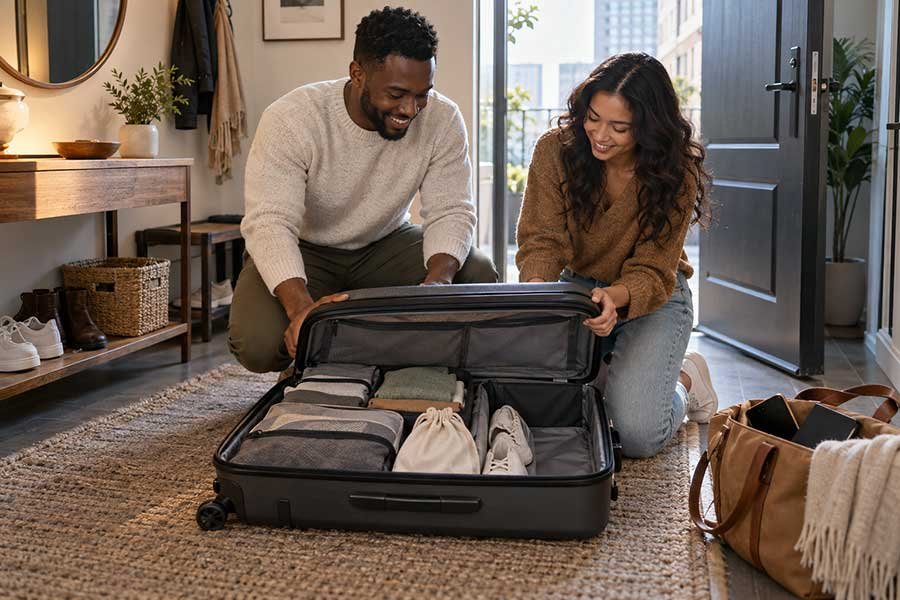
Place shoes sole-to-sole in shoe bags along the suitcase frame at the wheel-end base
Shoes packed loose in the suitcase accomplish two things neither of which is desirable: they distribute whatever the sole has been in contact with across whatever they contact in the same layer, and they occupy space inefficiently because their shape does not conform to the rectangular packing cube structure built above them. A lightweight shoe bag for each pair — a simple fabric pouch — isolates the sole’s contents from the clothing and positions each pair sole-to-sole for the most efficient profile. Placed along the frame at the wheel-end base, the sole-to-sole pairs sit against the rigid perimeter where their shape fits naturally and create a stable, predictable foundation for the packing cubes above them. The shoes in their bags along the frame are the first items in every suitcase packed correctly. Everything else is organized around the foundation they establish.
Tuck socks and small items inside shoes before placing them in the suitcase
Every shoe in the suitcase occupies space regardless of whether its interior is used. Rolling socks into cylinders and tucking them inside the shoe — alongside a compact charger, a folded belt, a small accessories pouch, or any other item whose shape fits the cavity — converts air into storage and consolidates multiple small categories into the shoe layer rather than distributing them across the cubes above it. The practical effect in the organized suitcase is the recovery of cube space that the tucked items would otherwise have claimed, applied consistently to every shoe on every trip. In the context of a checked bag managing weight limits, the weight of the tucked items is already being paid for as part of the shoe’s presence in the bag. Filling the shoe produces no additional weight cost. The space it recovers above the shoe layer is available for the items that genuinely require cube organization.
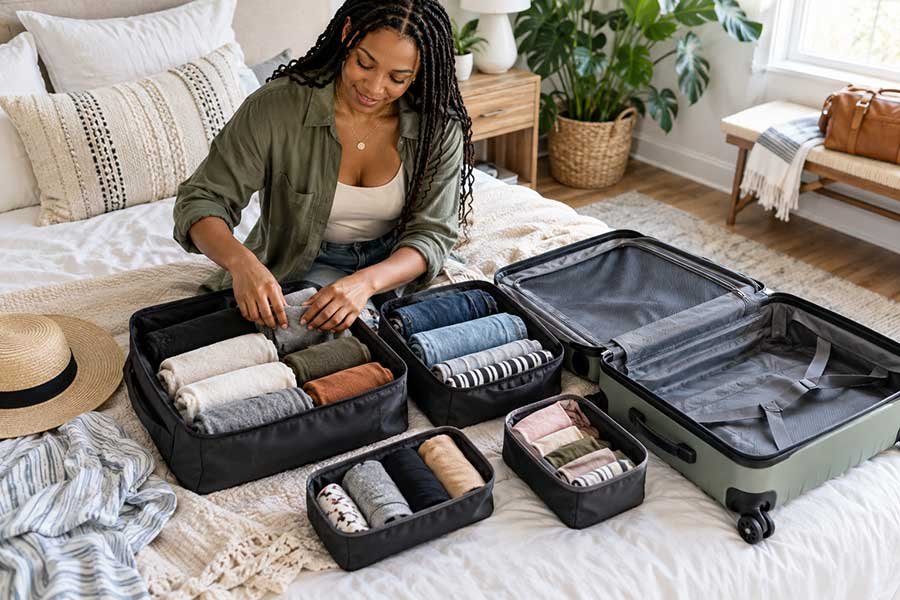
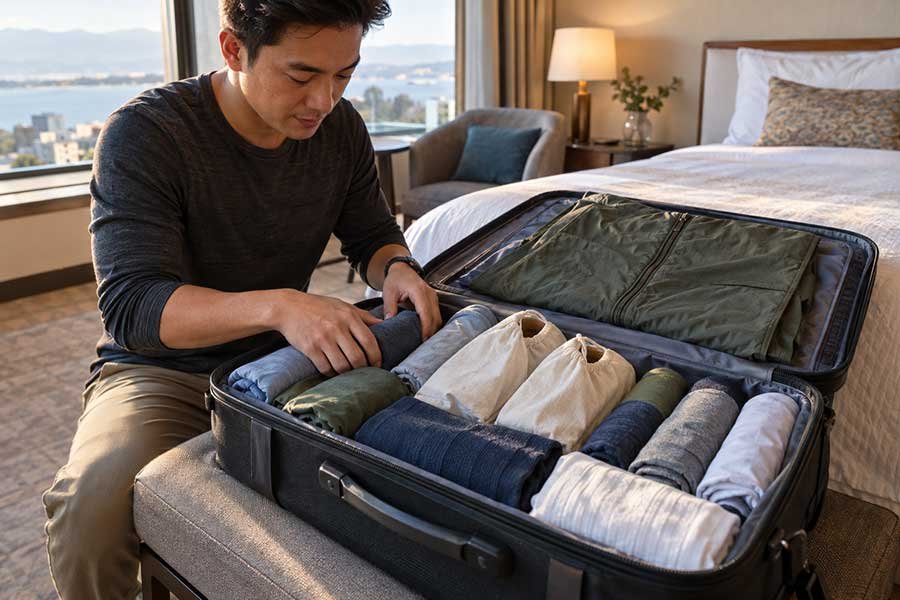
Roll soft casual clothes into cylinders to maximize space and minimize wrinkles
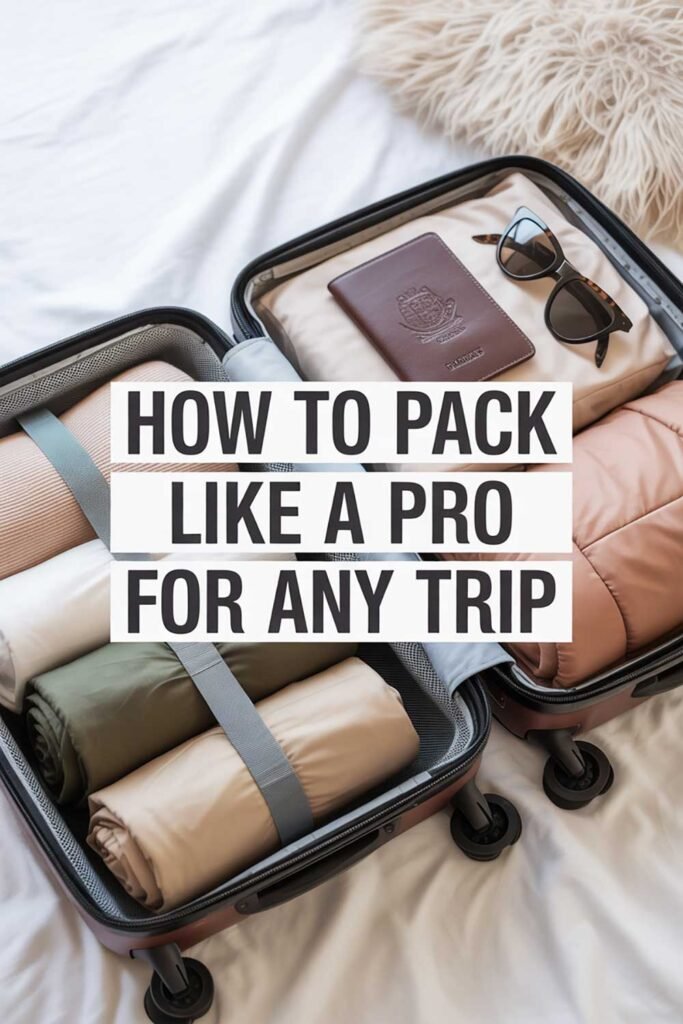
Rolling is the physical packing technique with the most consistent return on applied effort across every trip that uses it correctly. A rolled t-shirt occupies approximately one-third of the space of the same shirt folded flat. A suitcase of rolled soft items holds meaningfully more clothing than the same bag packed by the flat-fold method that most travelers use by default. Rolling also produces softer, more distributed wrinkles — pressure applied evenly across the rolled cylinder rather than at the specific fold line that flat packing reinforces with the bag’s weight across the full transit duration. The wrinkles from rolling resolve in minutes on a hanger. The fold line from flat packing sometimes requires steaming to address on a formal garment. Roll the soft casual items: t-shirts, casual trousers, knitwear, jeans, underwear. Leave the flat-fold method for the structured garments that wrinkle differently when rolled. Applied correctly to the right items, rolling is the single most accessible space recovery technique in the organized suitcase.
Lay structured items that wrinkle if rolled flat in the top layer of the suitcase
Rolling is not the right technique for every garment, and applying it to structured items whose fabric relies on its form produces the wrinkle outcome it is supposed to prevent. Blazers, formal trousers, linen shirts, structured dresses, and tailored items belong flat — folded along their natural fold lines, ideally inside a dry cleaning bag that allows the fabric to shift and redistribute under pressure rather than hold a fixed crease, and placed at the top layer of the suitcase where they are accessed last and pressed by the fewest items during transit. A packing folder with a rigid board creates the consistent, single fold line that freehand folding in a packed suitcase cannot reliably replicate. Flat-packed structured items on top; rolled soft items below. The technique matched to the garment is the technique that produces the arrival where every piece of clothing looks the way it was intended to rather than the way the packing method happened to determine.
Fill every gap, corner, and curve deliberately before closing the lid
The organized suitcase with neat cubes, correctly placed shoes, and properly rolled items still contains usable space in the corners that the cube’s rectangular profile cannot fill, the curves at the base frame, the taper along the sides, and the gaps between cubes of unequal size. These spaces are the suitcase’s recovered capacity — available for the small, flexible items that belong in the bag and cannot justify a dedicated cube: a folded lightweight scarf in the corner, a flat electronics pouch along the side, a pair of sandals in the taper at the frame edge. Fill these spaces with items that belong in the suitcase rather than with items added because the space exists. The organized suitcase uses its full three-dimensional volume for exactly the right items. The space left empty after the cubes are placed is the capacity the trip paid for in weight and carry-on allowance and left unoccupied. Fill the gaps. Every inch in the bag is already being paid for.
The Organizational System: Cubes, Categories, and the Logic That Keeps Everything Findable
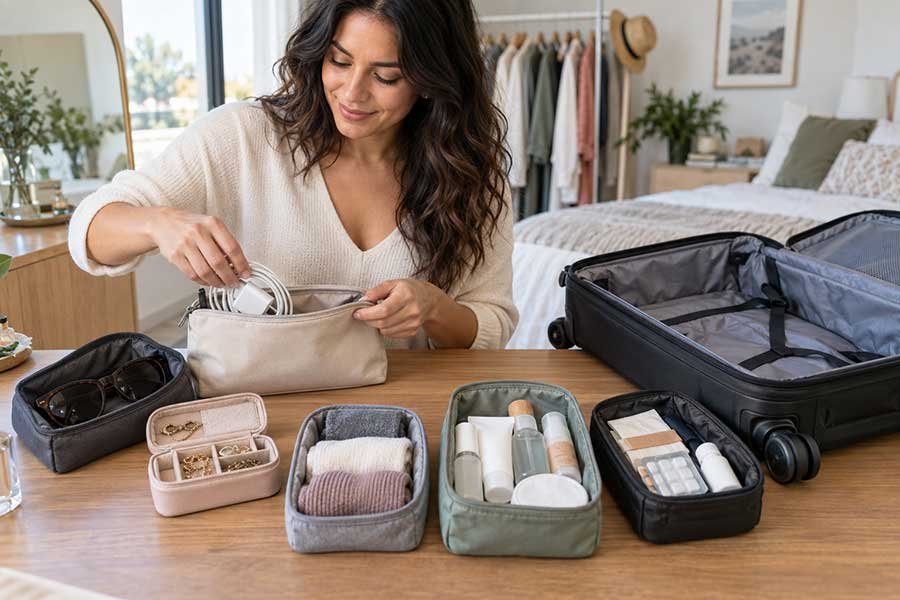
Use packing cubes and assign one dedicated category to each — never mixed
Packing cubes are the organizational infrastructure that converts a suitcase from a single open space where everything competes for position into a system where every category has a container, every container has a location, and every item is findable in the time it takes to open one cube rather than excavate an entire bag. The category assignment is the key: tops in one cube, bottoms in another, underwear in a third, layers in a fourth — consistently, on every trip, regardless of what the specific items are. The cube that is always tops is the cube opened when a top is needed. No search required. No context needed. The organization is built into the system rather than into the specific trip. A packing cube system maintained consistently across trips is the closest available equivalent to having the suitcase know where everything is. Assign the categories once. Keep them permanently. The first trip with the system is the one that takes the longest to establish. Every subsequent trip benefits from the system already existing.
Color-code or label each packing cube so its category is identifiable without opening it
The color-coded cube system produces the suitcase whose organization is visible from above the open lid — the specific color that always holds the tops is immediately identifiable without opening or moving any cube. The label system produces the same result through text rather than color. Either approach converts the suitcase from a contents-unknown container into a navigable system whose sections are identifiable before any searching begins. For solo travelers this eliminates the category search at altitude or at the accommodation’s first evening. For families it eliminates the family bag excavation whose depth increases with the number of people sharing a suitcase. Choose the system — color or label — and apply it consistently. The cube opened is the cube with the right contents because the system said which one to open before it was opened.
Designate one cube for items that do not need to be accessed until the final destination
The organized suitcase has a natural access hierarchy: the lid pocket for the items needed first, the top layer for the items needed on arrival, and the base layers for the items not needed until the destination is reached. Within the cube system, one cube can serve the same function as the base layer — the cube designated for items not needed until the final destination, packed first and positioned at the base. This cube might hold the formal outfit for the confirmed special occasion, the beach items for the resort stay that begins at the end of the trip’s transit days, or the specific items packed for one confirmed occasion rather than daily use. Knowing this cube is not needed until the destination makes the suitcase interaction at every interim point — the connection, the layover accommodation, the journey day — a system with one less cube to manage. The designated non-transit cube simplifies every access that precedes the final destination’s arrival.
Use the suitcase lid pocket for the items needed first on arrival — always
The lid pocket is the most accessible space in the suitcase when it opens — the first layer visible, reachable without moving anything in the main compartment, and perfectly positioned for the items whose need at the destination is most immediate. Pack it deliberately and consistently: the charger for the first evening, the sleep clothes for the arrival night, the toiletry bag for the first morning, the document wallet with the accommodation booking reference. This consistent use means the lid pocket is predictable on every arrival — the items that are there are the items that were needed first, in the same positions they occupied on the last trip. The arrival that requires searching the full suitcase for the charger and the sleep clothes was packed with the lid pocket used as the catch-all for items that did not have another designated position. The arrival whose first needs are answered from the lid pocket in two minutes was packed with intention. Use the lid pocket for the arrival. Use it the same way every time.
Designate a dirty laundry bag and use it from the first evening at every accommodation
The suitcase that becomes a pile by day two is almost always the suitcase without a dedicated dirty laundry container — the one where worn items return to the main compartment rather than a designated space, mixing with clean items and erasing the cube organization the packing system established. A lightweight laundry bag — a mesh pouch, a compression cube designated for worn items, or a simple fabric bag — placed at the base of the suitcase before departure is the container that maintains the clean-dirty boundary from the first evening. Use it immediately and consistently: every worn garment from the first evening goes directly into the laundry bag rather than anywhere else. The suitcase that contains one structure for clean clothing and one for dirty clothing stays organized throughout the stay because the boundary is maintained daily rather than allowed to degrade across the trip and addressed only at checkout when everything is already mixed.
Use compression cubes specifically for bulky soft layers that would otherwise dominate the suitcase
The fleece, the hoodie, the packable down jacket — the soft, insulating items whose air-to-fabric ratio is highest — are the items whose presence in the suitcase is most dramatically changed by compression. A medium fleece in a standard cube occupies a third of the suitcase. The same fleece in a compression cube, with the secondary zipper closing after the initial fill, occupies the space of a folded t-shirt stack. Compression cubes are not general-purpose tools — applying compression to every item reduces the benefit to the items it was designed for. Use compression cubes specifically for the soft, insulating, air-filled garments. Use standard cubes for everything else. The two systems working together in the same suitcase extend the bag’s functional capacity to cover the full trip’s clothing requirements — including the necessary warm layers — without requiring a larger suitcase whose extra space the trip did not actually need.
Jess’s First Suitcase That Opened at the Destination Ready to Go
Jess had a specific and reliable experience every time she unzipped a suitcase at a new accommodation: a moment of immediate mild regret at how it had been packed. Not dramatic regret — the clothes were all there, the trip was going to be fine — but the specific feeling of looking at the suitcase’s contents and knowing that the next several minutes were going to be a reorganization exercise that could have been avoided if the packing had been different. The charger was at the bottom. The sleep clothes were under the second layer of the rolled shirts and the pair of shoes that had been placed sideways rather than sole-to-sole. The toiletry bag was in the main compartment rather than the lid pocket, which was occupied by a receipt from the departure airport and the noise-cancelling headphones she had used on the flight.
She had owned packing cubes for two years before assigning specific categories to them rather than filling each one with whatever fit at the time of packing. The category assignment changed the experience of using them entirely: the specific cube for tops was the cube opened when a top was needed, without any other possibility. The cube system maintained consistently meant the suitcase was navigable rather than searchable — and the distinction, once experienced, made the previous version of packing feel obviously inferior.
The sole-to-sole shoe placement along the frame came from watching someone else pack and noticing how efficiently the shoes fit against the suitcase’s perimeter rather than in the middle where they displaced everything above them. The heaviest items at the wheel end produced a bag she could roll with one finger through the airport rather than the bag that required full-arm management through every corridor. The dirty laundry bag at the base from the first evening meant that checkout repacking took four minutes because everything was either in its cube or in the laundry bag and the distinction was never uncertain.
The system took one trip to establish and produced every trip after it as a different experience. The first arrival under the system was the first time she unzipped a suitcase at the destination and found it organized exactly as packed — the lid pocket with the charger and the sleep clothes, the cubes with their assigned contents, the shoes in their bags at the base with the socks inside them. She was ready to go in five minutes. The thirty tips in this article are the system that produced that five minutes. The previous version produced the reorganization. The system is the difference.
Staying Organized Through the Trip: The Daily Habits That Keep the System Working
Return every item to its designated cube immediately after using it
The micro-habit with the highest daily return for suitcase organization is the one that takes thirty seconds per item: the charger goes back in the electronics pouch, the sunscreen goes back in the toiletry bag, the book goes back in the lid pocket, the spare memory card goes back in the electronics pouch. The item returned to its designated location after every use is the item whose location is known without searching at every subsequent moment it is needed. The item left wherever was convenient after the last use is the item searched for through multiple cubes and pouches when the taxi is arriving in forty-five minutes and the specific item’s location is no longer certain. Return items as a habit rather than as a cleanup. The suitcase whose system is maintained by the habit of returning items is the suitcase that is always organized rather than the one that requires periodic reorganization to return to the organized state the system was supposed to maintain.
Unpack the packing cubes into hotel drawers and the wardrobe for stays of two nights or more
The suitcase used as a drawer — opened and searched through daily, cubes accessed repeatedly, items drifting from their designated positions across the accumulated daily use — is the suitcase whose organization degrades gradually regardless of how well it was packed at departure. For stays of two nights or more, spending ten minutes unpacking the cubes into the room’s drawers and hanging structured items in the wardrobe maintains the organization across the stay without the daily suitcase interaction that degrades it. The daily routine accesses a drawer or a wardrobe rather than a suitcase. The departure repack takes five minutes because everything is in an organized drawer rather than distributed across a bag that has been opened and imperfectly closed daily. The suitcase whose system is maintained by unpacking into the room rather than living out of the bag for the duration is the suitcase that repacks quickly and arrives at the next destination in the same state it arrived in the first one.
Do a thirty-second visual tidy before leaving any hotel room for the day
The thirty-second room check before leaving for the day catches the item placed somewhere unusual the previous evening, confirms the toiletry bag is in its designated spot, notices the charger still in the outlet, and verifies that the suitcase or the drawers are in a state that checkout preparation will not require addressing from a disorganized starting point. This is not a full checkout sweep — it is the daily maintenance pass that prevents the organizational drift that accumulates across multi-night stays when unaddressed. A room maintained by a daily thirty-second tidy stays organized throughout the stay without any single dedicated reorganization session. The departure repack is smooth because the room’s state reflects the daily maintenance rather than the accumulated drift of several days of unchecked disorder. The thirty-second tidy is also the checkout sweep’s advance notice system: the item out of place noticed today is found today rather than at the checkout tomorrow with the taxi waiting.
Keep the toiletry bag in the same designated spot at every accommodation
The toiletry bag that migrates to different surfaces at different accommodations — the bathroom shelf at one hotel, the desk at the next, the bedside table because the bathroom shelf was occupied — is the toiletry bag whose location requires active memory at each new destination and whose checkout sweep must check each different spot it may have occupied. Keeping the toiletry bag in the same designated location at every accommodation — bathroom shelf, bathroom counter, the dedicated hanging position if a hanging bag is used — means the checkout toiletry confirmation is a single location check rather than a tour of the surfaces the bag may have moved to across the stay. The toiletry bag in the same spot is always found without searching and never left behind because the standard location was confirmed clear. A habit established on the first night of the first trip. Maintained automatically at every accommodation after it.
Repack for departure the evening before checkout — not the morning of
The departure morning repack — conducted under the time pressure of the checkout clock, the transport departure, and the next destination’s travel logistics — is the repack whose completeness is inversely proportional to the available time. The evening-before repack happens when the accommodation is quiet, the time pressure is absent, and the attention available for confirmation is not competing with departure logistics. Every item returns to its cube. The laundry bag is confirmed full of worn items and the cubes full of clean ones. The lid pocket is restocked for the next transit. The toiletry bag is packed from the bathroom and confirmed complete. The suitcase closes and the room check reveals what remains outside it. The departure morning is for the final quick check, the checkout, and the transit — not for the repack that could have been done the previous evening from a chair rather than from the floor with one eye on the clock.
Do a thorough, systematic room sweep before every single checkout
The checkout room sweep is the final safety net for every item the packing system maintained across the stay — and it needs to be systematic rather than cursory to do its job. The charger outlet by the bed. The safe. The bathroom’s full surface area, including behind the taps where small items fall. The wardrobe hooks and the shelves above them. The desk drawers. The area around the nightstand. The floor under the bed. The balcony or terrace if the accommodation has one. This sweep takes three minutes conducted systematically and catches the charger, the glasses case, and the book that the quick general impression would have missed. The three minutes are available at every checkout because the evening-before repack has already completed the main task. The sweep uses the three minutes that the morning repack would have consumed if the evening preparation had not already done it. Do the sweep. Every checkout. Three minutes. Every item that is there to be found comes home.
Our Curated Collection of Trusted Tools and Official Sources
Everything we use to plan, prepare, and travel with confidence — from official government travel tools to practical planning aids. We have pulled together the resources we trust most so every trip you take is better informed, better prepared, and a lot less stressful from start to finish.
DND ResourcesThe Final Checks and the Reset: Close Every Suitcase Right and Keep the System Ready
Do a final edit after packing and deliberately remove three items before closing
The fully packed suitcase almost always has three more items than it needs. Not the obvious overpacking candidates — three items that made it through every editing pass on the strength of individual plausibility. The outfit assembled for an occasion the confirmed itinerary holds only tentatively. The pair of shoes whose function is entirely covered by the first pair with one minor difference. The what-if layer whose what-if scenario is a genuine possibility whose probability is low. Open the packed suitcase one more time and remove three items without negotiating with the anxiety that packed them. These items will not be missed. They would have traveled the full trip, arrived back home unworn, and confirmed at final checkout as the items that were correctly identified — but one editing pass too late. Remove them before the suitcase closes. The closet is available. The decision is easy at home. The habit produces the suitcase that closes without sitting on it and arrives without the dead weight the three items would have contributed across every transit.
Tuck chargers, cables, and small electronics into an accessible outer pocket — not the main compartment
The charger and the charging cable are the items most frequently needed at the gate, at the layover airport outlet, and at the accommodation’s first evening — all moments when reaching into the main compartment of the suitcase is inconvenient or not possible. The charger in the suitcase’s outer zippered pocket is the charger plugged in at the gate outlet in ten seconds before boarding, reconnected at the layover without disturbing the main compartment’s organization, and available at the accommodation before the bags are even fully unpacked. The outer pocket designated for these items — chargers, cables, adapters, and any other small electronic accessory — is the pocket that makes the transit and the arrival smoother than the main-compartment version of the same items. Pack them in the outer pocket before the suitcase is closed. Keep them there for every trip. The pocket with a purpose is the pocket that earns its space on every departure.
Photograph the fully packed suitcase before closing it for departure and return
Two photographs whose combined investment is under two minutes: the organized suitcase before the outbound zip closes and the return repack at the final checkout. The outbound photograph documents the contents before transit for any lost luggage claim. The return photograph is the completeness confirmation: the visual check that every item packed for the trip is in the bag before the accommodation door closes, catching the charger left at the outlet and the sunglasses on the bathroom shelf before the departure rather than after. Both photographs are timestamped automatically and stored in the camera roll. Both are retrievable at the exact moment they might be needed without any additional organization. The return photograph compared to the outbound photograph at the final checkout is also the most precise input available for the master packing list update: the items present in both photographs that came home without being used are the items to reconsider before the next trip.
Check every packed bag against the master packing list before anything leaves the house
The final check of every bag against the master packing list before the departure is the quality control step that catches the item on the list that never made it into the bag, the item in the wrong bag, and the item whose presence in the bag was assumed but not confirmed. The check is not a re-examination of every packed item from scratch — it is a confirmation that every item on the list is accounted for somewhere in the bags. The items that are confirmed present provide the departure confidence that the system’s organization was correctly maintained. The items that are not confirmed present are found at home rather than at the destination. The check takes ten minutes for a complete packing system and prevents the specific discoveries that the departure morning finds instead when this step is skipped. Do it before anything moves toward the door. The bags confirmed against the list are the bags that arrive with what the trip requires.
Reset and reload the full suitcase system within 24 hours of arriving home
The suitcase reset within twenty-four hours of every return is the investment that makes every next trip’s packing session a confirmation rather than an assembly. The laundry comes out and goes to the wash immediately. The packing cubes are emptied and returned to their designated positions in the suitcase. The toiletry bag is restocked with whatever ran low during the trip. The dirty laundry bag is emptied. The charger is returned to the outer pocket. The suitcase is closed in its organized, ready state. The reset takes fifteen minutes and converts the next trip’s preparation from a forty-five-minute assembly of a disbanded system into a ten-minute confirmation of a maintained one. The suitcase that is always reset is the suitcase that starts every subsequent packing session from the right place — which is the place where the system exists and needs only confirmation, not construction. Reset within twenty-four hours. The next trip begins from there.
Update the master packing list within 24 hours of returning while the trip’s honest feedback is still specific
The master packing list improves only from the honest feedback of the trips that test it — and that feedback is most specific, most accurate, and most actionable in the twenty-four hours after returning when the memory of what was used, what was wished for, and what came home without being touched is still vivid. Before unpacking becomes the week’s secondary concern, open the master list: add the item that was wished for and not there, remove the item that traveled unused on this trip and the one before it, note the destination-specific adjustment that would improve the list for a similar future trip, revise the cube assignment that turned out to be suboptimal in practice. The list updated from honest post-trip feedback is progressively more accurate and more useful across every trip that contributes to it. The traveler who updates it consistently reaches the packing session where the suitcase closes on the first attempt, under the weight limit, confirmed against the list, exactly as organized as when it left home — because the thirty tips were applied and the system was maintained from the packing session through the return and the reset. That is the system. That is the organized suitcase.
Book the Trip the Organized Suitcase Deserves to Travel To
The suitcase that arrives organized and ready to go deserves a destination planned with the same intention. Our travel agents plan the trips that give every organized arrival the first day it earned — the accommodation confirmed, the itinerary ready, and the suitcase’s system already working from the moment the zip opens at the destination.
Book A TripThe categories were assigned and the cubes were color-coded. The shoes were sole-to-sole along the frame with socks inside them. The heaviest items were at the wheel end. Every soft thing was rolled. The gaps were filled. The lid pocket had the charger and the sleep clothes on top. The final edit removed three things. The suitcase closed on the first attempt. At the destination it opened organized. The first twenty minutes were the trip. That is thirty tips. That is the suitcase packed with a real system behind it.
Picture the Suitcase That Opened at the Destination Ready to Go
The master list was the starting point and every item on it had a confirmed outfit partner. The pile on the bed was edited before the suitcase was opened. The cubes were color-coded and each category was assigned before the first item was rolled. The shoes went in sole-to-sole along the frame, socks tucked inside them, first. The heaviest items followed at the wheel end. Everything soft was rolled; everything structured was flat in the top layer. Every gap and corner was filled with something that belonged there. The dirty laundry bag was at the base. The compression cube held the fleece at a fraction of its unpacked size. The lid pocket held the charger, the sleep clothes, and the accommodation booking reference. The final edit removed three items. The suitcase was weighed at home and confirmed under the limit. It was photographed before the zip closed. It was checked against the list before anything left the house. At the destination it opened in five minutes and produced everything it held in the position it was packed. No regret. No twenty-minute search. No pile by day two. The system worked because it was built before the suitcase opened and maintained until it was reset. That is thirty tips. That is the organized suitcase.
One More Thing Before the Suitcase Opens
Print our free Travel Packing Checklist and use it as the master list foundation for every packing session from here — category assignments included, the outfit-first structure built in, and the final check step that confirms every bag against the list before anything leaves the house. The same checklist we use before every trip we take.
Get the Free ChecklistExplore Our Top Picks for a Better Trip
After years of exploring the globe together, these are the exact tools, platforms, and services we rely on for every single trip — personally tested, traveler approved, all in one place. We don’t recommend anything we wouldn’t use ourselves, and this is the collection of booking platforms and travel tools that have made our adventures smoother, smarter, and more memorable.
See Our Top PicksLove Helping Travelers Arrive at Every Destination Organized and Ready?
Helping a traveler pack the right suitcase for the right trip — and booking the destination it is heading to — is the kind of practical expertise that makes a home-based travel agent genuinely worth coming back to. If turning your love of travel into a business sounds like the right next move, see how the TravelPreneur system works.
Become An AgentSuitcase Packing Printables at Premier Print Works
Visit Premier Print Works for master packing lists, cube category assignment guides, outfit planners, and travel organization printables that make every packing session faster, every suitcase more organized, and every arrival the experience of opening a bag that was packed with a real system behind it — and arrives exactly the way it left home.
Visit Premier Print WorksDisclaimer
The information shared in this article is provided by Don and Diana’s Travels for general informational, educational, and inspirational purposes only. It reflects our personal experiences, opinions, and the experiences of travelers we have worked with. It is not professional travel, legal, or financial advice.
Airline and Baggage Policies
Airline baggage allowances, weight limits, size restrictions, and related policies vary by carrier and are subject to change without notice. Always confirm current requirements with your specific airline before traveling. We are not responsible for any fees or outcomes arising from reliance on baggage information in this article.
Affiliate and Partner Links
This article may contain affiliate and partner links that pay us a commission at no extra cost to you. Our recommendations are based on real use and genuine belief in the products and services we share.
Composite Stories
Stories on this site combine real experiences from Don, Diana, clients, and travelers we have worked with. Details may be adjusted for privacy and narrative clarity.
No Guarantees
We do not guarantee any specific packing or travel experience from using the information in this article. Results vary by traveler, destination, and trip type.
Copyright and Use
All content is the copyrighted property of Don and Diana’s Travels. You may not copy or republish our content without prior written permission. You are welcome to share a direct link with proper credit.
By reading this article, you acknowledge that you have read and agree to this disclaimer.