23 Packing Tips for People Who Want a Lighter Suitcase
The heavy suitcase is almost never the result of packing too many things the trip genuinely needs. It is the result of packing too many things the trip might need — backup outfits for occasions that never materialize, toiletry bottles filled to capacity when trip-length amounts would weigh half as much, shoes that earn one wearing across seven days, and the full-size versions of products that exist in travel size for exactly this purpose. The weight is in the decisions, and better decisions produce a lighter bag without any sacrifice to the trip’s actual requirements.
These twenty-three tips address every category that adds unnecessary weight to a suitcase — clothing selection, toiletries, shoes, the supporting items, and the habits that keep the bag light consistently rather than occasionally. The goal is not the smallest possible bag. It is the right bag: light enough to move freely, organized enough to find everything, and accurate enough that nothing comes home untouched.
Free Download: Our Travel Packing Checklist
The lighter suitcase starts with the right checklist — a permanent, trusted starting point that confirms every item before it earns a place in the bag. Download ours free and use it before the next trip.
Get the Free ChecklistClothing: Where Most of the Weight Lives
Clothing accounts for the majority of suitcase weight for the majority of travelers, and the clothing decisions that produce a heavy bag are almost always made with the wrong question. The question “what might I need?” produces coverage — an outfit for every possible occasion, backup options for every confirmed one, and the specific anxiety items that have never been worn at a destination but feel necessary to have available. The question “what will I actually use?” produces a wardrobe built from the confirmed itinerary rather than the imagined version of the trip, and the bag that results is consistently lighter.
1. Read the confirmed itinerary before opening the wardrobe
The itinerary is the accurate version of the trip. The imagination is the expanded version. A ten-day trip with four casual exploration days, two active days, two beach days, and one elevated dinner requires five distinct outfits — not ten. Reading the itinerary before selecting a single item produces the wardrobe built for the trip that was booked. Opening the wardrobe first produces the wardrobe built for every possible version of that trip, which weighs significantly more than the one that was actually needed.
2. Pack by occasion type, not by day count
One outfit per calendar day is the calculation that produces suitcase weight proportional to trip length rather than trip content. One outfit per distinct occasion type is the calculation that produces the right number of items regardless of how many days the trip spans. The casual outfit worn on days two, four, and six is not a compromise — it is accurate packing for a trip whose casual days genuinely require one outfit, not three. Count the occasions. Pack for those. The days take care of themselves.
3. Build the wardrobe around two or three base colors
Two or three colors whose every combination works — navy, white, and tan; black, cream, and olive — produce a wardrobe where every top pairs with every bottom, every layer works across every outfit, and every accessory complements everything in the bag. The coherent palette multiplies the outfit combinations from the items packed rather than fixing them at one per piece. Ten items in a coordinated palette produce more distinct looks than fifteen items in uncoordinated colors, at two-thirds of the weight.
4. Apply the two-partner rule before any item earns a place in the bag
Every item going in the suitcase must pair with at least two other items already confirmed to be going in the suitcase. One partner earns one wear from the weight of one item. Two partners earn two wears from the same weight. The item with no confirmed second partner is the clearest indicator of an item that does not belong in this specific bag. Run the partner check for every clothing item before the bag closes. The items that fail it are the ones to remove. The items that pass it are doing the work the bag needs them to do.
5. Choose wrinkle-resistant, quick-dry fabrics for the bulk of the travel wardrobe
Merino wool, jersey knit, ponte, and quality travel synthetics pack more compactly, weigh less per useful wear, and maintain their appearance under compression better than the cotton, linen, and structured fabrics that require more care. The same outfit in a travel fabric and in a cotton version occupies a different amount of space and produces a different arrival condition after twelve hours in a compressed bag. Choose the travel-appropriate version where available. The weight recovered is meaningful across a full wardrobe selection.
6. Grant yourself explicit permission to re-wear before the packing session begins
The default assumption in most packing sessions — never consciously stated but consistently applied — is that a fresh outfit per day is the minimum standard. It is not. The jeans re-worn on days two, four, and six represent three fewer items in the bag with zero impact on the trip’s experience. Grant the permission before selecting the first item. It removes the baseline assumption that has been adding unnecessary weight to bags that were packed without it.
7. Do a final edit and remove three items after packing — before the bag closes
The fully packed suitcase almost always has three more items than the trip requires. Items that made it through every editing pass on the strength of individual plausibility but whose honest final review identifies them as backup maybes dressed as confirmed necessities. Open the packed bag one more time. Remove three items without negotiating with the anxiety that packed them. They will travel the full trip untouched and confirm at final checkout that they were correctly identified one editing pass too late. Remove them before the bag closes. The closet is right there.
Book A Trip
Book the next trip with a confirmed itinerary — the lighter packer’s most useful tool. Our travel agents plan the trip so every packing decision has a specific occasion to answer to.
Book A TripShoes and the Supporting Categories That Add Weight Fast
For many travelers, the clothing selection is already reasonably managed and the suitcase weight problem lives in the supporting categories — shoes packed three deep for a five-day trip, a toiletry kit whose bottles are filled to capacity rather than trip-length amounts, and full-size backup products packed alongside travel-size versions of the same thing. These categories have specific, simple solutions whose combined effect on bag weight is often larger than any single clothing decision.
8. Limit shoes to two pairs and wear the heavier pair on travel day
Shoes are the heaviest, least compressible, most space-inefficient category in any suitcase. Two pairs — one worn on travel day, one in the bag — is the number that keeps the bag manageable for most trips. Both should be chosen so that comfort and style coexist: comfortable enough for a full day of walking, styled enough for the evening. Every additional pair requires a specific confirmed occasion that the first two genuinely cannot cover before its weight earns a place in the bag. Most trips do not produce that occasion.
9. Fill toiletry bottles to trip-length amounts — not to the bottle’s capacity
A sixty-milliliter travel bottle filled to capacity for a five-day trip carries forty milliliters of unnecessary weight. Filled to twenty-five milliliters — the accurate daily-use amount for five days — it carries exactly what the trip requires at a fraction of the full bottle’s weight. Apply this calculation to every bottle in the toiletry kit before every departure. The kit whose bottles are all filled accurately is lighter than the alternative by a meaningful total across six or eight bottles — and lighter enough, on many trips, to be the weight difference that matters at the check-in counter.
10. Switch to solid shampoo and conditioner bars
Solid bars are not subject to the quart-bag liquids rule, weigh less than the travel bottles they replace, and last longer per gram of product than liquid equivalents. The switch recovers the quart bag’s limited volume for liquids with no solid alternative and removes the heaviest items in the typical toiletry kit from the liquids weight entirely. Under one hundred grams for both bars combined, versus two filled sixty-milliliter bottles at over one hundred and twenty grams. The weight saving is real and the performance equivalent for most hair types.
11. Check accommodation amenities before packing what they already provide
The hair dryer, the shampoo, the body wash, the iron, the beach towels at the resort — most hotels and many vacation rentals provide these items. Two minutes checking the accommodation’s listed amenities before packing removes every item the destination supplies at no cost. For the traveler whose suitcase is consistently close to the airline’s weight limit, the accommodation items removed from the kit are frequently the margin between a bag within limits and a bag that requires reorganization at the check-in counter or a fee.
12. Never pack a full-size backup of anything already in the bag in travel size
The full-size backup is weight carried for the full trip against the possibility of the travel-size version running out — which almost never happens when the fill amount was calculated correctly for the trip’s length. Pack the travel-size version at the trip-length amount. Leave the full-size backup at home. If the calculation is insufficient, the destination’s pharmacy or supermarket stocks the product. The local pharmacy is always cheaper than the overweight bag fee whose cause was the backup product that traveled unused.
Plan Our Escape
Let us plan the trip that makes every carefully chosen item worth packing — a destination worth arriving at lighter and ready to explore from the first day.
Plan Our EscapeThe Physical Packing Techniques That Recover Space and Weight
Once the right items are selected in the right quantities, the physical packing techniques determine how much space they take and how the bag’s weight is distributed. These tips are the structural decisions that convert a good selection into a well-packed, genuinely light suitcase.
13. Wear the heaviest items on travel day
Every item worn on the body on travel day is an item not contributing to the suitcase’s measured weight. The heaviest shoes, the thickest jacket, and any bulky accessories worn through the airport cost nothing to the bag’s weight while covering the travel day’s outfit requirement. This is the single most consistently effective weight reduction available to any traveler at any trip length. Wear the heavy. Pack the light. The bag that boards within its limit often achieves that margin here alone.
14. Roll every soft item and stand the rolls upright in packing cubes
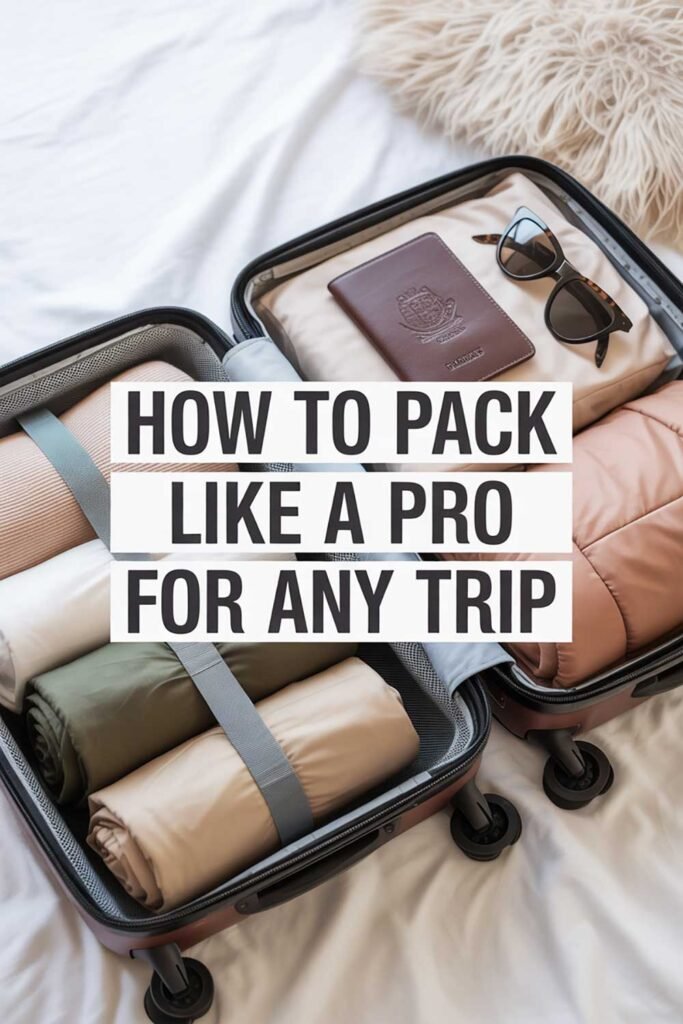
A rolled soft item occupies roughly one-third of the space of the same item folded flat — which means the same wardrobe fits in a smaller, lighter bag when rolled rather than folded. Stood upright in the packing cube, every rolled item is also visible from above and retrievable with one reach without disturbing anything else. Roll every soft item. Stand every roll upright. The bag that closes on the first attempt without compression almost always contains rolled clothing in organized cubes.
15. Use compression cubes for the trip’s bulkiest soft layers
The standard packing cube holds soft clothing efficiently. The compression cube — with a secondary zipper that reduces contents to a fraction of their uncompressed volume — holds the fleece, the down jacket, and the thick hoodie at the footprint of a folded t-shirt stack. One compression cube used specifically for the trip’s bulkiest soft layer recovers more suitcase space than almost any other single addition to the packing system and allows bulky but essential layers to travel without occupying the disproportionate volume their uncompressed size would require.
16. Fill every gap, corner, and curve before closing the bag
The spaces in the suitcase — the corners at the frame, the curves at the base, the gaps between packing cubes — are capacity that exists at no additional weight cost if filled with light items rather than left empty or filled with heavy ones. Rolled socks in shoe cavities, the charging cable coiled in the corner between cubes, the travel adapter in the heel space of the shoe — these placements recover meaningful capacity from the bag’s interior at zero additional weight cost since the items were going in anyway.
17. Weigh the bag at home before every departure
The bathroom scale weigh-in — step on while holding the bag, subtract personal weight, compare to the airline’s limit — is the sixty-second habit whose entire value is in its timing. At home, removing items costs nothing and takes two minutes. At the check-in counter, the same edit costs money and happens publicly under time pressure. Weigh the bag at home. Know the number before the departure morning. The bag weighed at home never produces a surprise at the counter.
How Reed Finally Packed a Bag That Felt Right
Reed had been trying to pack a lighter suitcase for four years. Not casually — actively. The research had been done. The packing cubes had been purchased. The rolling was happening. The bag was still consistently heavier than it needed to be and Reed could not fully identify where the weight was coming from because no single category seemed obviously wrong. The clothes seemed reasonable. The shoes were two pairs. The toiletry kit was in a travel bag. Everything felt justified individually. The bag was still too heavy as a whole.
The diagnosis came from a single exercise: emptying the bag completely after a trip and weighing every category separately on a kitchen scale. The clothing was fine — three point two kilograms for an eight-day trip, entirely appropriate. The shoes were fine — one point one kilograms for two pairs, both worn. The toiletry kit was the problem: two point eight kilograms. Two point eight kilograms for a bag that should have weighed under one. Bottles filled to capacity rather than to trip-length amounts. Three full-size products packed alongside their travel-size equivalents. A hair dryer the hotel had provided on every stay at that specific chain for three consecutive trips.
The fix took fifteen minutes at the bathroom cabinet: every bottle refilled to trip-length amounts, the three full-size backups removed, the hair dryer confirmed on the accommodation’s amenities list and left at home. The toiletry kit went from two point eight kilograms to nine hundred grams. The total bag weight went from eight point four kilograms to six point five. The bag cleared the airline’s seven-kilogram carry-on limit with margin to spare. It was not the clothes. It was never the clothes. These twenty-three tips are the complete version of what the kitchen scale audit revealed. The weight was always in the category nobody thought to weigh.
Become An Agent
Love helping travelers pack smarter, travel lighter, and enjoy more of every trip? See how to turn that passion into a home-based travel business.
Become An AgentThe Habits That Keep the Bag Light Trip After Trip
The lighter suitcase achieved once is a successful edit. The lighter suitcase achieved consistently is a built system. These final tips are the maintenance habits that convert a single successful light pack into the permanent way the bag is packed — improving after every trip rather than resetting to the same heavy starting point.
18. Count the untouched items at every checkout and remove them from the permanent list
The items packed and never opened across a trip are the items whose presence on the packing list is wrong. Count them at every checkout — specifically, by name. Remove them from the permanent packing list before leaving the accommodation. The list updated from the honest feedback of the items sitting untouched at checkout is the list that produces a lighter bag on the next trip without requiring the same editing effort to arrive at the same conclusion a second time.
19. Reset the bag and restock the toiletry kit within twenty-four hours of returning home
The laundry out and to the wash. The cubes emptied and returned to their positions. The toiletry kit restocked to trip-length amounts — not to bottle capacity. The charger back in its outer pocket. The bag closed in its ready state. The reset done on the evening of returning home is the preparation that makes the next trip’s packing session a twenty-minute confirmation rather than a two-hour rebuild from a dismantled system.
20. Leave a deliberate gap for the return journey
Pack to approximately seventy-five percent of the suitcase’s capacity on the outbound journey. The remaining twenty-five percent is the return margin — available for the market purchase, the local product, the destination find that needs room to come home. The suitcase packed to absolute capacity on the outbound has no answer for any of these. The suitcase packed with a deliberate gap arrives home with the find inside it and the zip closed without difficulty or a return-journey overweight fee.
21. Choose a lighter suitcase — the bag’s own weight counts toward the limit
The suitcase itself is part of the total weight checked at the airline counter. A standard hard-shell checked bag weighs four to five kilograms empty. A lightweight equivalent in the same format weighs two to two and a half kilograms. The weight difference — two to three kilograms — is transferred directly to packing allowance without changing a single item in the bag. If the airline’s limit is consistently being approached, the bag’s own weight is worth reviewing before the contents are.
22. Apply the three-times rule to every item before it earns a place in the bag
If an item cannot be worn at least three times during the trip in three distinct contexts, it does not earn its space. A white linen shirt worn casually at breakfast, as a beach cover-up, and with tailored trousers for the one evening occasion earns three wears from one item’s weight. A sequined top worn once for one confirmed occasion earns one wear from the same weight. Apply the rule honestly. The items that pass it are the items that justify their weight across the trip’s duration.
23. Trust that the lighter bag is the better bag — every time
The specific anxiety that produces the heavy suitcase — the “what if I need this” feeling that survives every editing pass and inserts the backup items that travel unused — does not disappear after the first light-pack trip. It is present at the next departure and the one after, suggesting that the lighter bag is insufficient. Trust the system over the anxiety every time. The lighter bag that closes comfortably, boards without a fee, and moves freely through every airport and every destination is not the bag that sacrificed the trip’s requirements. It is the bag that got them exactly right.
Picture This
The itinerary was read before the wardrobe was opened. The confirmed occasions — four casual days, two active, one elevated dinner — produced seven clothing items rather than the fourteen the ten-day trip length would have suggested by day count. Every item confirmed with at least two partners. Re-wearing explicitly permitted. The toiletry bottles filled to trip-length amounts. No full-size backups. The hair dryer confirmed on the accommodation’s amenities list and left at home. The heavy jacket worn to the airport. The final edit removed three items that had been uncertain from the start.
The bathroom scale confirmed five point nine kilograms. The bag closed on the first attempt with room remaining. At the destination, every item in the bag had a reason to be there. The morning routine was a top-down scan and one reach. The carry-on went into the overhead bin without negotiation. The spontaneous afternoon detour happened because the bag was light enough to take along rather than leave at the accommodation. The return market purchase fit easily in the gap that was left for it.
At checkout, the untouched item count was zero for the first time. The list was updated with one note before leaving the room. The bag was reset that evening. The next trip starts from there — lighter than the last one, because the system improved. That is twenty-three tips. That is the lighter suitcase that was right before it closed and stayed right through every day that followed.
Before the Next Trip: Grab the Free Packing Checklist
Our free Travel Packing Checklist is the permanent starting point that makes every packing session faster, lighter, and more accurate than the one before it. Every category, every weight consideration, every final check. Download it and use it before the next trip.
Get the Free ChecklistExplore Our Top Picks for a Better Trip
After years of lighter packing and travel together, these are the booking platforms and travel services we personally rely on — tested, trusted, and recommended because they have consistently made our own trips smoother and more enjoyable.
See Our Top PicksTravel Printables at Premier Print Works
Visit Premier Print Works for packing checklists, outfit planners, weight trackers, and travel organization printables that make every suitcase lighter and every departure more confident than the one before it.
Visit Premier Print WorksDisclaimer
The information shared in this article is provided by Don and Diana’s Travels for general informational, educational, and inspirational purposes only. It reflects our personal experiences, opinions, and the experiences of travelers we have worked with. It is not professional travel, legal, or financial advice.
Airline baggage allowances, weight limits, carry-on restrictions, and overweight fee policies vary by carrier and are subject to change without notice. Always confirm current requirements with your specific airline before traveling. Accommodation amenities vary by property. We are not responsible for any fees or outcomes arising from reliance on packing or baggage information in this article.
This article may contain affiliate and partner links that pay us a commission at no extra cost to you. Our recommendations are based on real use and genuine belief in the products and services we share. Stories on this site combine real experiences from Don, Diana, clients, and travelers we have worked with. Details may be adjusted for privacy and narrative clarity. All content is the copyrighted property of Don and Diana’s Travels. You may not copy or republish our content without prior written permission. By reading this article you acknowledge that you have read and agree to this disclaimer.